

Recycled glass countertops are made by setting crushed, reclaimed glass into a cement or resin binder, then polishing the slab smooth. The result is colourful, speckled and practical, but quality varies a lot between makers. This guide walks through the checks that matter before you order, from binder type and thickness to sealing, edges and installation, so the surface you choose suits your kitchen and the way you cook.
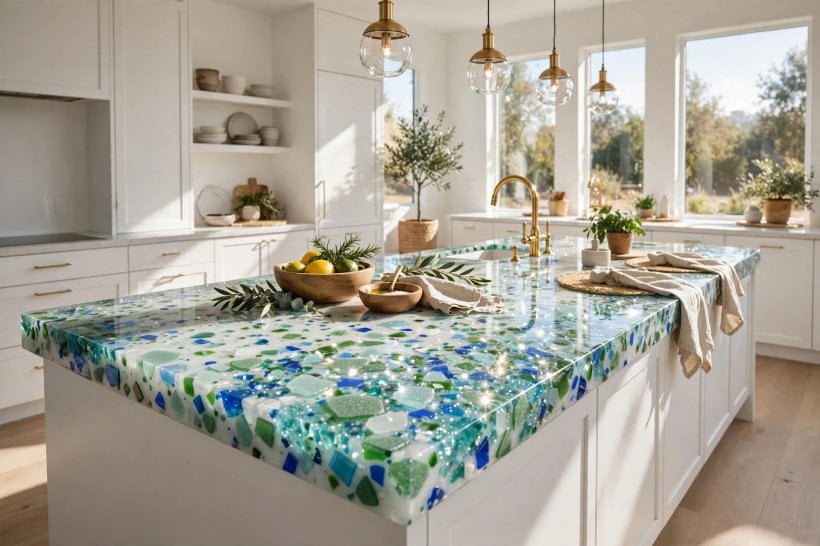
1. Recycled Glass Worktops at a Glance
Start with the quick answers below. They cover the questions buyers ask most often, and the sections that follow expand on each one so you can compare samples and quotations with confidence.
| What is this material made from? | It is made from crushed post-consumer or post-industrial glass, such as bottles and window offcuts, held together in a binder. The binder is usually either cement-based or resin-based, and that choice affects weight, sealing needs and how the surface feels. |
| Is it strong enough for daily cooking? | Yes, for ordinary kitchen use, provided the slab is properly made and supported. It copes well with plates, pans and small appliances, but it is not indestructible, so heavy point impacts and dropped cast iron still deserve care. |
| Does it need sealing? | Cement-bound versions are porous and generally need a food-safe sealer, refreshed from time to time. Resin-bound versions are far less absorbent and may need little or no sealing. Always follow the maker’s own guidance for the slab you buy. |
| Can you put hot pans straight on it? | It is safer not to. Sudden heat can stress the binder and the glass, so use trivets or pan stands as a habit. The same caution applies to most worktop materials, and it costs nothing to build into your routine. |
| Can you chop directly on the surface? | No. Knives can scratch the finish and will blunt quickly on glass and stone-like surfaces. Use a chopping board every time, and wipe spills promptly so pigments and oils do not sit on the surface longer than needed. |
| How much does it tend to cost? | It usually sits in the mid-to-upper range of worktop materials, broadly comparable with engineered stone rather than laminate. Colour, slab thickness, edge work, cut-outs and templating all move the final figure, so compare like-for-like quotations. |
| Is it a good choice for a tiny house? | It can be, because a small run needs less material and the colour can lift a compact kitchen. Check the weight, though, especially in a home on wheels, and confirm the cabinets and floor structure can carry a stone-like slab. |
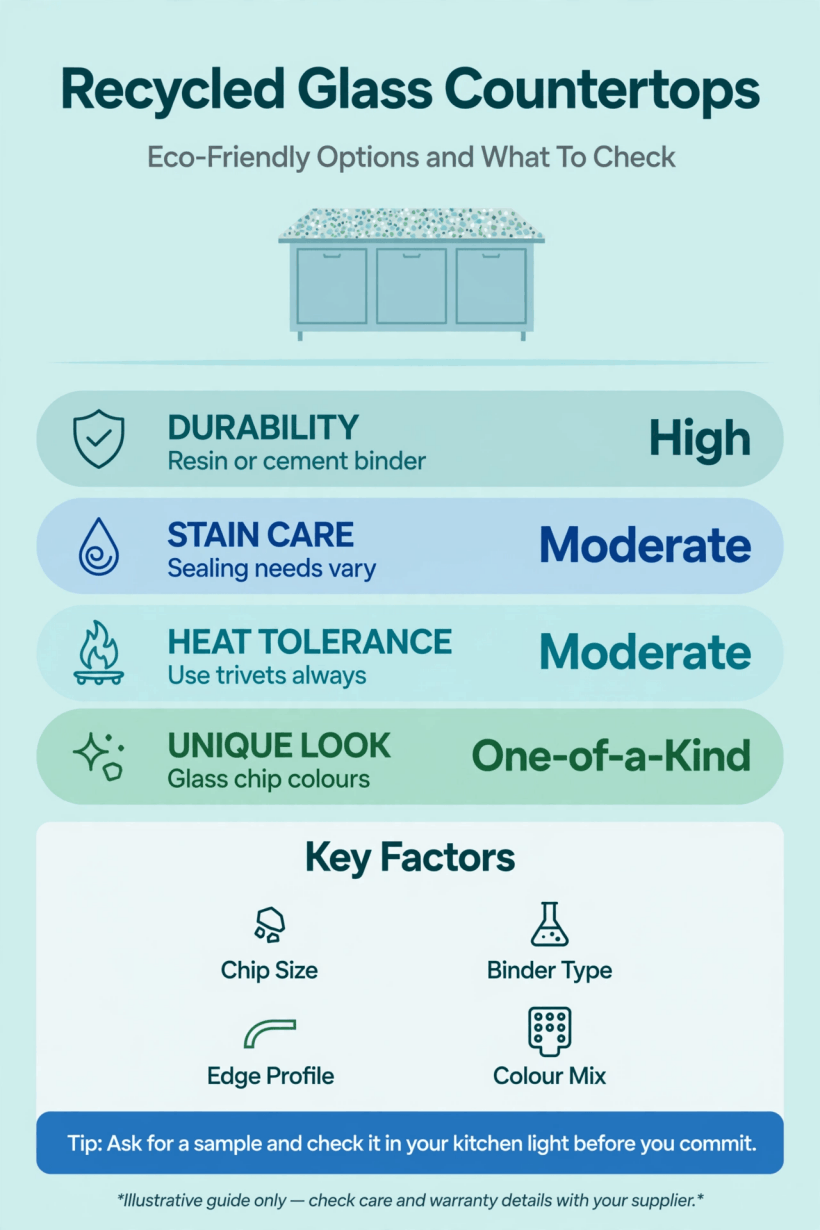
The key buying checks at a glance: binder type, recycled content, thickness, sealing, edges, heat habits and how the slab will be templated and installed.
2. What the Material Actually Is
Every version of this material starts with waste glass. Bottles, jars and flat glass offcuts are crushed into pieces that range from fine sand-like grains to chunky fragments you can pick out with a fingertip. Those pieces are mixed with a binder, poured into a mould, cured, and then ground and polished until the surface is level and smooth. The glass gives the colour and the sparkle; the binder gives the slab its structure and much of its day-to-day behaviour.
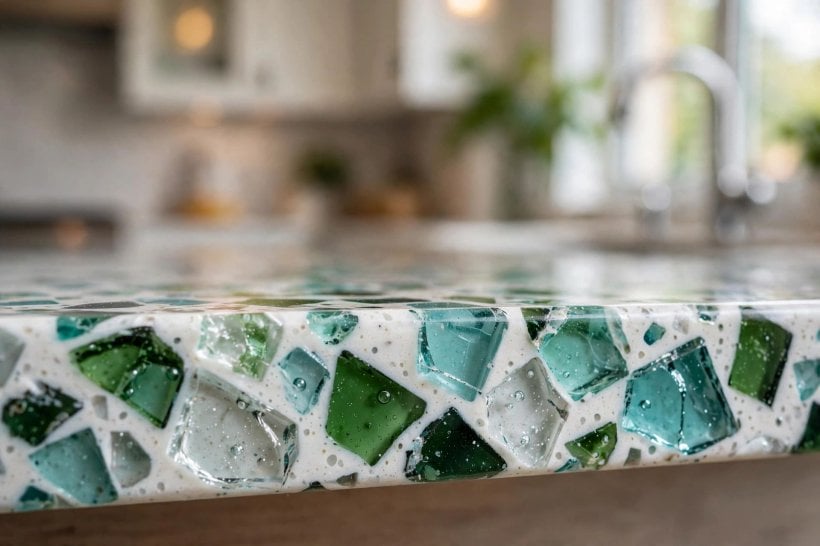
The two binder families behave differently, so ask which one a sample uses before anything else. Cement-bound slabs have a matte, stone-like character and a little natural variation, but they are porous and heavier, and they rely on sealer for stain resistance. Resin-bound slabs are usually smoother and more uniform, resist liquids better, and can feel slightly warmer to the touch. Neither is automatically better; the right choice depends on whether you value a mineral feel or easier upkeep. If you are planning the whole room around the worktop, our guide to tiny house kitchen design can help you balance surface choices with storage and layout.
3. Colour, Pattern and Finish Checks
Colour is the main reason people fall for this material, and also the easiest place to make a mistake. A small sample tile can look lively and bright, while a full slab reads much busier once the pattern repeats across a long run. Ask to see the largest sample you can, or a photograph of a full installed slab in the same colourway, and look at it in daylight and under your kitchen lighting before you commit. Warm bulbs can push blues towards green and make creams look yellow.
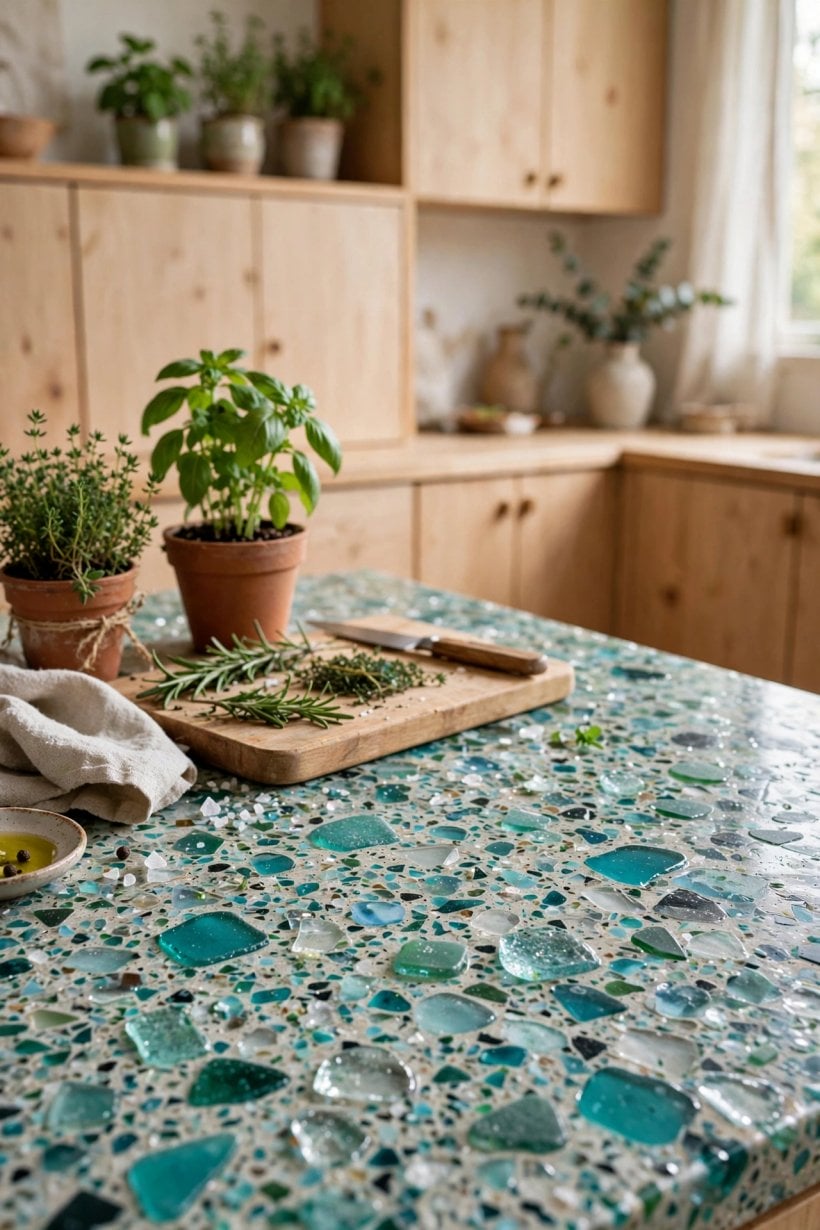
Check the size of the glass pieces as well. Large fragments create a bold, terrazzo-like look that suits plain cabinet fronts, while fine grains read as a gentle speckle from a distance and are calmer in a small room. Then check the finish. A high polish reflects light and shows crumbs and fingerprints more readily; a honed, lower-sheen finish hides everyday marks and feels more relaxed. Run your palm across the sample: it should feel even throughout, with no sharp glass edges standing proud and no pitted patches where the polishing missed. Consistency under your hand is a good sign of careful manufacture.
4. Durability in Daily Use
In normal service these surfaces are workhorses. They shrug off the daily traffic of mugs, plates, mixers and shopping bags, and the polished finish wipes clean without drama. The weaknesses are specific rather than general: a heavy pan dropped on an edge, a point load on an unsupported overhang, or dragging a gritty-based appliance across the surface. Ask the supplier how the slab should be supported, what overhang is sensible without brackets, and whether cut-outs for sinks and hobs are reinforced.
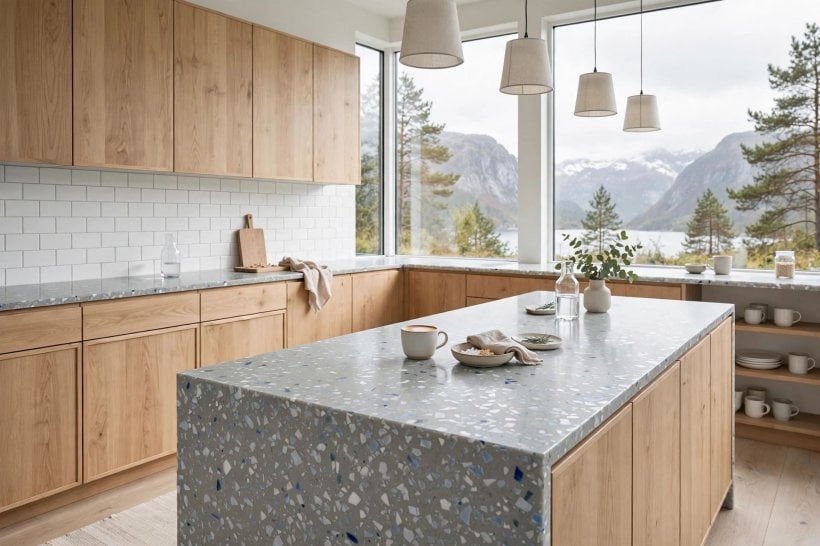
Edges deserve a close look, because edges are where chips start. A slightly eased or rounded profile is far more forgiving than a sharp square arris, especially around the sink where pans and trays swing in and out. If the sample edge feels crisp and fragile, ask what profiles are available and whether the showroom has an aged display you can inspect. A worktop that has served in a display kitchen for a year tells you more about durability than any brochure. For broader layout decisions that affect how hard a small kitchen works, see our ideas for kitchen design in a tiny house.
5. Heat, Stains and Impact: The Honest Limits
No worktop is invincible, and honest limits help you buy well. Heat is the first: a pan straight off the hob carries enough energy to stress binders and, in cement-based slabs, to leave a faint mark. Use trivets without exception. The second limit is staining on porous, cement-bound versions. Red wine, turmeric, beetroot and strong oils can settle into an unsealed or tired surface, so sealers matter and spills should be wiped rather than left to sit while you eat.
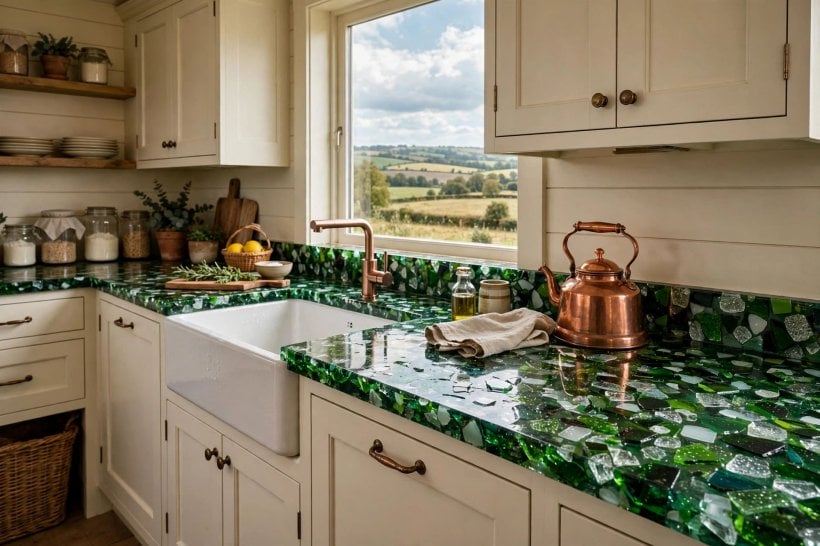
Impact is the third limit. The glass pieces themselves are hard, but the slab can chip if a heavy object strikes a corner or the thin front edge of a sink cut-out. That is another reason to choose a forgiving edge profile and to be sensible about where heavy storage sits. None of these limits makes the material a poor choice; they simply define the habits it asks of you. If your household is hard on surfaces and unlikely to use trivets or boards, a more forgiving material may honestly suit you better, and a good supplier will say so.
6. Sealing and Everyday Care
Ask the sealing question in writing before you order, because it shapes your maintenance routine for years. For cement-bound slabs, find out which type of sealer the maker recommends, how many coats a new installation needs, and how often the treatment should be refreshed in a busy kitchen. For resin-bound slabs, confirm whether sealing is unnecessary or merely optional, and what the maker advises for removing dull patches. Keep the product name and the schedule with your house paperwork so the routine survives a busy year.
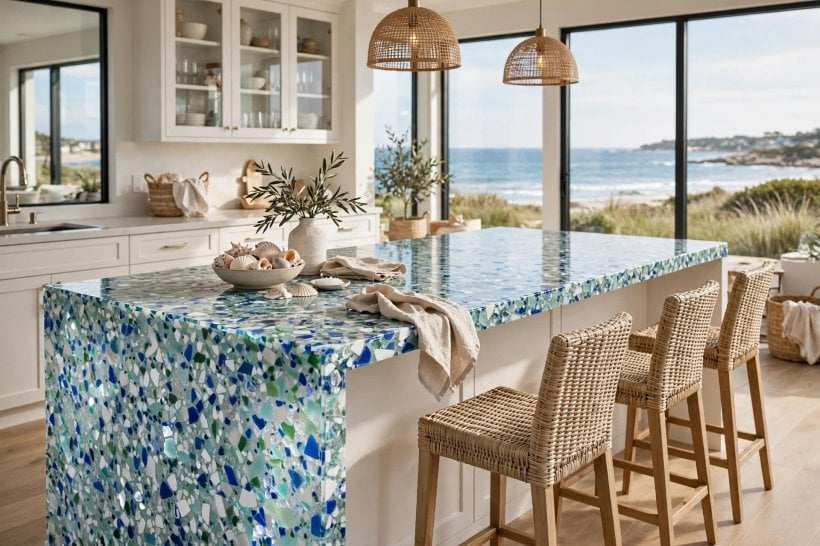
Day-to-day care is simple. Wash with warm water and a mild detergent, use a soft cloth or sponge, and avoid abrasive pads and harsh chemical cleaners that can dull the finish or attack the binder. Wipe up strongly coloured spills promptly, dry the area around the sink tap, and use boards and trivets as a matter of routine. That is the whole regime; there are no exotic products to hunt down. The same gentle approach suits the other surfaces in a small home, as our round-up of bathroom interior design ideas shows for compact wash spaces.
7. Costs, Quotes and What Drives the Price
Expect this material to sit above laminate and basic timber in price and to land broadly alongside engineered stone, with the exact figure driven by choices rather than by the label. Colour is one driver: unusual glass blends and large-fragment mixes often cost more than standard fine-grain colours. Thickness is another, because a chunkier slab uses more material and needs stronger support. Edge profiles, sink and hob cut-outs, drainer grooves, upstands and splashbacks all add labour, and labour is a large part of any installed worktop bill.
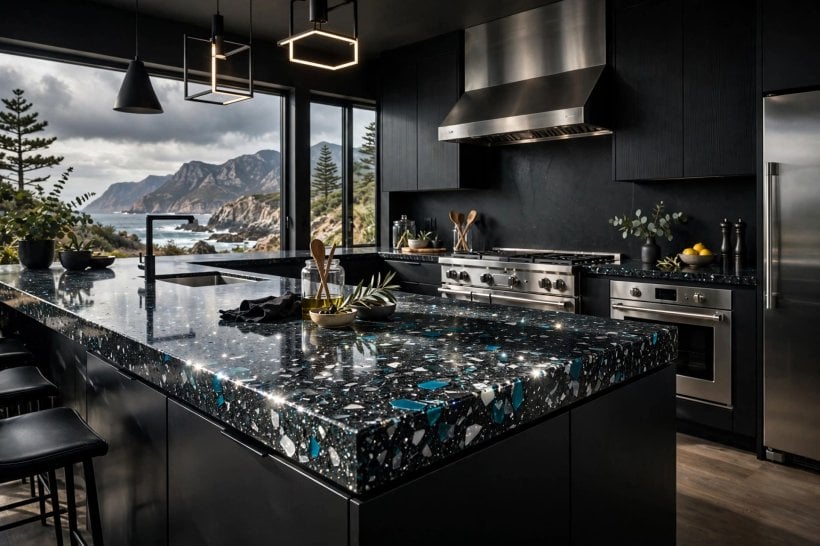
When you compare quotations, insist on the same specification in each: same thickness, same edge, same cut-outs, and templating, delivery and fitting either included in all or excluded from all. Ask what is not included, because disposal of the old worktop, plumbing reconnection and final sealing are common extras that surface late. A clear, itemised quote protects you far better than a low headline figure. If budget is the deciding factor across the whole project, our guide to making a tiny house for less explains where savings are safe and where they store up trouble.
8. Measuring, Templates and Installation Checks
Accurate templating is where good installations are made. Once your base cabinets are fixed and level, the fabricator should visit and make a full-size template that records walls that wander, corners that are not square, and the exact positions of sink and hob. Ask whether templating is included, how long fabrication takes after the template visit, and what access the delivery crew needs. Slabs are heavy and awkward; a tight stair turn or a narrow doorway can change the plan, so raise access early rather than on delivery day.
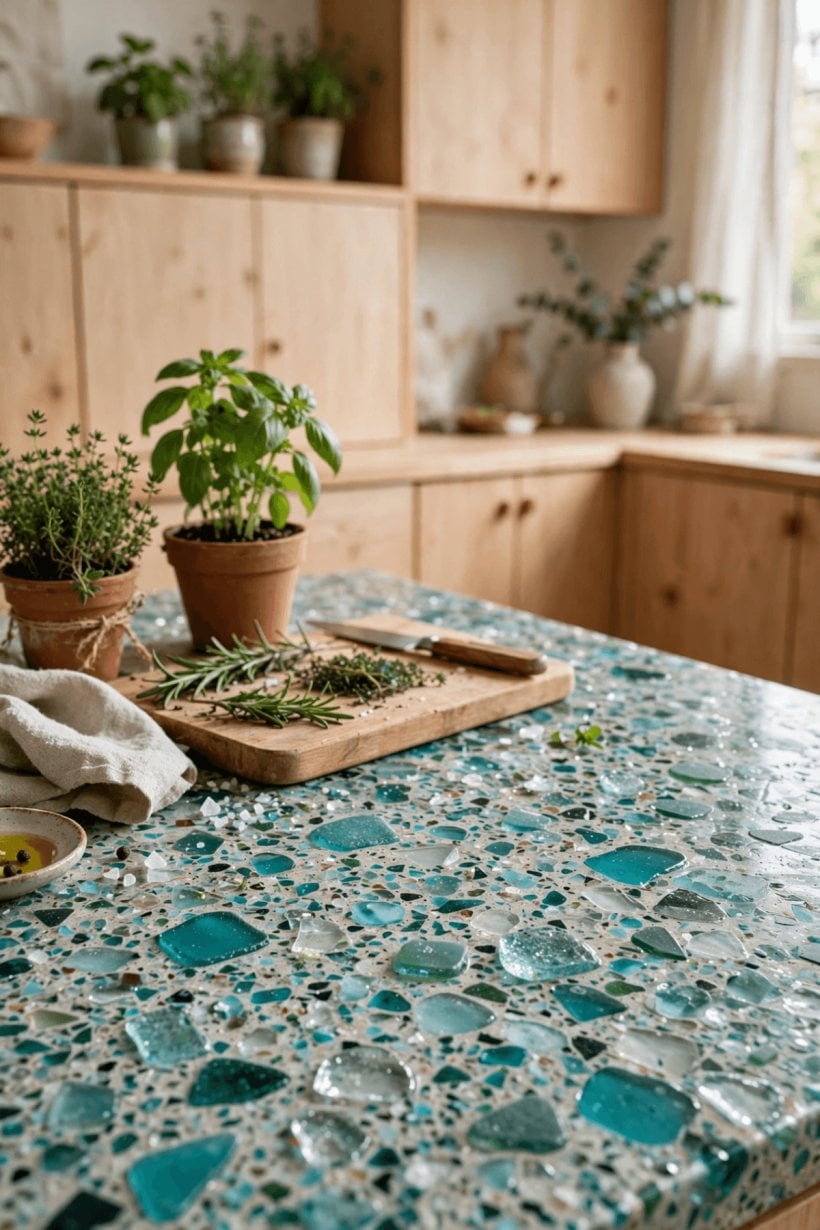
Check the support story as well. Cabinets must be level and firmly fixed, with extra support planned for wide spans, dishwasher gaps and any overhang where people will sit. Ask how joins will be positioned, because a join beside a sink or hob gets the hardest life; a thoughtful fabricator will place joins away from cut-outs and heavy traffic. Finally, confirm who seals the slab if it needs sealing, and when: some makers seal in the workshop, others seal after fitting. Write the answers into your order so there is no confusion later.
9. Suitability for Tiny Houses and Small Kitchens
Small kitchens make this material easy to justify in one way: you simply need less of it. A short run in a bold colour can carry the whole room, and the saving on a long run can be redirected into better fabrication and fitting. The reflective flecks also bounce light around a compact space, which helps a galley layout feel less enclosed. Pair a lively surface with plain fronts and a simple palette elsewhere, an approach that runs through our modern living room ideas for tiny houses as well.
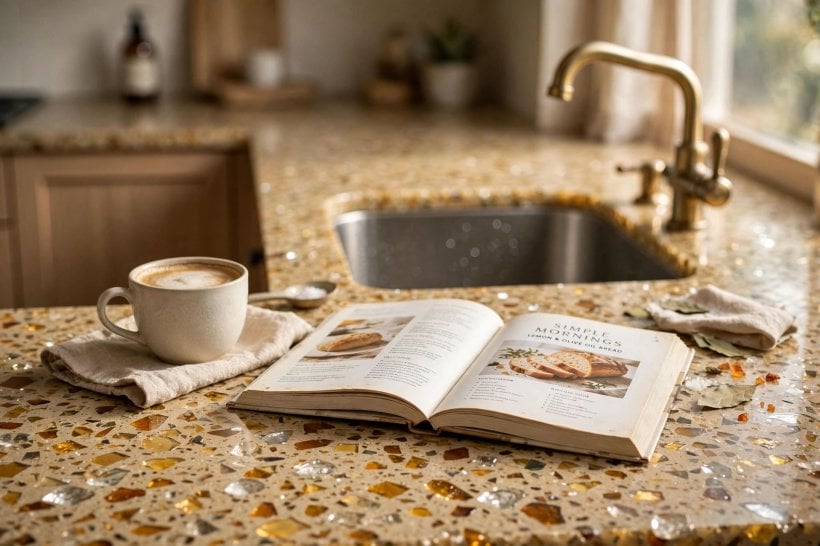
Weight is the check that matters most in a tiny house, and doubly so in one built on a trailer. A stone-like slab is heavy, and that weight concentrates on the cabinets and the floor beneath them. Ask the supplier for the weight per square metre of your chosen thickness, and check it against what your structure can carry, especially if the home travels. Where weight rules the material out, a thinner slab on a rigid substrate, or using the material just for a small island or a bathroom vanity, can give you the look without the load. Our overview of home designing ideas for a tiny house covers more of these material-versus-weight trade-offs.
10. Questions To Ask the Supplier Before You Pay
End the buying process with a short list of direct questions, and keep the answers with your receipt. What is the binder, and what is the recycled content of the glass? What thickness do you recommend for my layout, and what support does it need? Does the slab need sealing, with what, and how often? What edge profiles are available, and can I see an installed example that has been in use for a year or more? What does the quote include for templating, delivery, fitting, cut-outs and disposal, and what would count as an extra?
Ask about repairs, too. Chips happen in real kitchens, so find out whether the maker offers a repair service or a repair kit, and whether a damaged section can be polished back. Ask what the warranty covers and what it excludes, particularly around staining and heat marks, because exclusions tell you how the maker expects the surface to be treated. Finally, ask for the care instructions in writing before the fitting date. A supplier who answers all of this plainly, without pressure, is a supplier you can trust with a surface you will use every single day.
Final Considerations
Buying recycled glass countertops well comes down to a handful of checks: identify the binder, view the colour at full scale, choose a forgiving edge, plan the sealing routine, compare itemised quotes and confirm that your cabinets and floor can carry the weight. Do those things and you get a surface with real character, made from material that would otherwise have gone to waste, that will serve a small kitchen faithfully for years. Take samples home, live with them beside your cabinets for a few days, and let the final choice be the one that still pleases you in ordinary morning light.




0 Comments