

The wall above the toilet is the most wasted wall in the house: a blank stretch of tile within arm’s reach of the one room where storage is always short. Shelving there turns dead air into the bathroom’s hardest-working storage.
These 30 shelving ideas for above the toilet cover floating shelves, ladder and etagere units, cabinets, baskets and built-ins — plus the depth, height and fixing checks that decide whether the result looks designed or dumped.
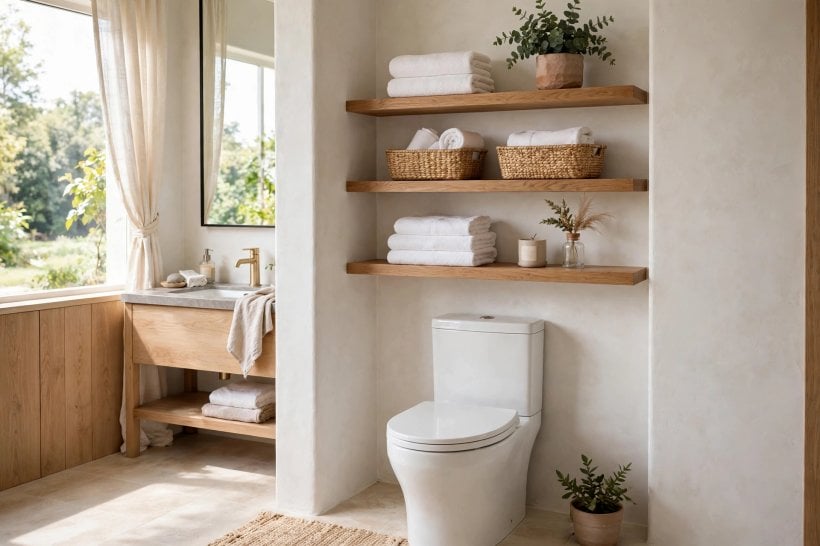
1. Storage Above the Toilet at a Glance
The space above a toilet is a shallow, tall storage zone with its own rules: nothing may crowd the head of someone standing at the basin nearby, nothing may block the cistern’s access for repairs, and everything must survive steam. Within those rules, storage above toilet ideas range from a single floating shelf to full built-in cabinetry — the right choice depends on how much you store, whether you rent, and how confident your fixings are.
| How deep can shelves be? | Roughly the depth of the cistern or a little more — deep enough for towels and baskets, shallow enough to never loom over the user. |
| How high should the lowest shelf sit? | Comfortably above head height for anyone seated or standing at the toilet — measure your tallest user, then add clearance. |
| What must stay accessible? | The cistern lid and any service panel — shelves and cabinets must lift away, open up or sit clear of them. |
| Renting? | Freestanding over-toilet units and tension systems store plenty without a single hole in the wall. |
| Style rule? | Fewer, fuller containers beat many small objects — baskets and jars group the clutter into calm. |
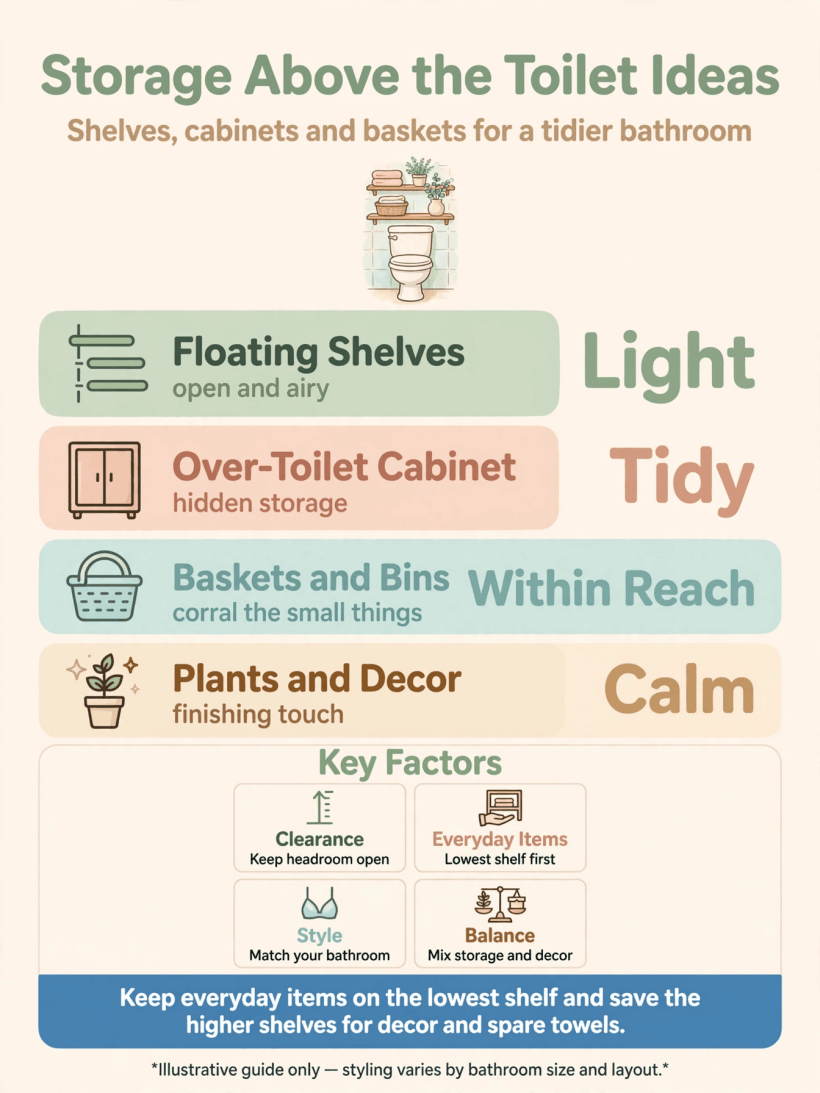
At a glance: shelf depth matched to the cistern, clearance above heads, cistern access kept free, and clutter grouped in containers.
2. Floating Shelves: The Clean Default
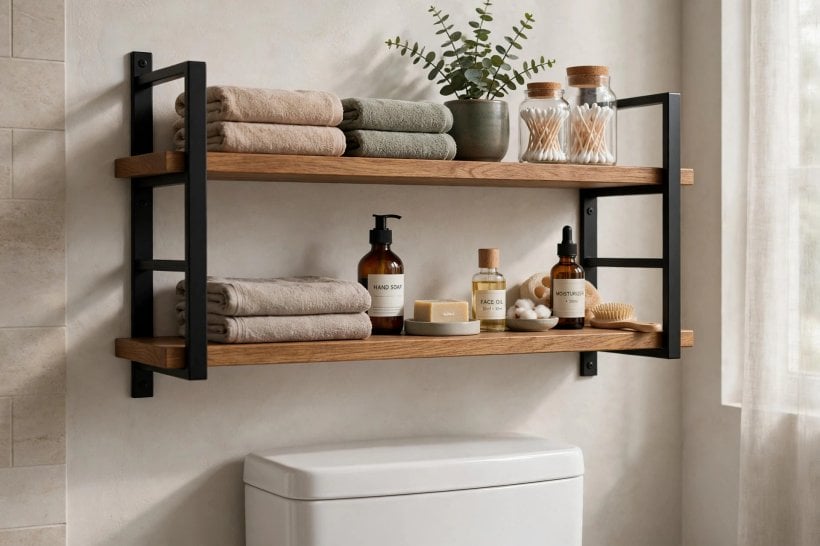
Floating shelves are the most-chosen solution because they fit any width, cost little, and keep the room feeling open. Two or three shelves in a pale timber or white finish, fixed with concealed brackets, hold the daily rotation — towels, a plant, a basket — without visually filling the small room. In the compact bathrooms in our tiny house bathroom designs, floating shelves are the default precisely because they add storage without adding furniture.
1. Fit Two or Three Matching Floating Shelves
Evenly spaced, aligned to the cistern’s centreline, and finished to match the room’s woodwork or vanity.
2. Choose One Long Shelf Instead
A single generous shelf reads calmer than a stack, and suits a guest bathroom where storage needs are light.
3. Add a Rail or Lip to the Shelf Front
A slim upstand stops bottles migrating off the edge when the shelf is brushed in a small room.
4. Keep the Lowest Shelf for Soft Goods Only
Towels and paper on the shelf nearest heads — nothing heavy or glass where it could fall.
3. Ladder Shelves and Over-Toilet Etageres
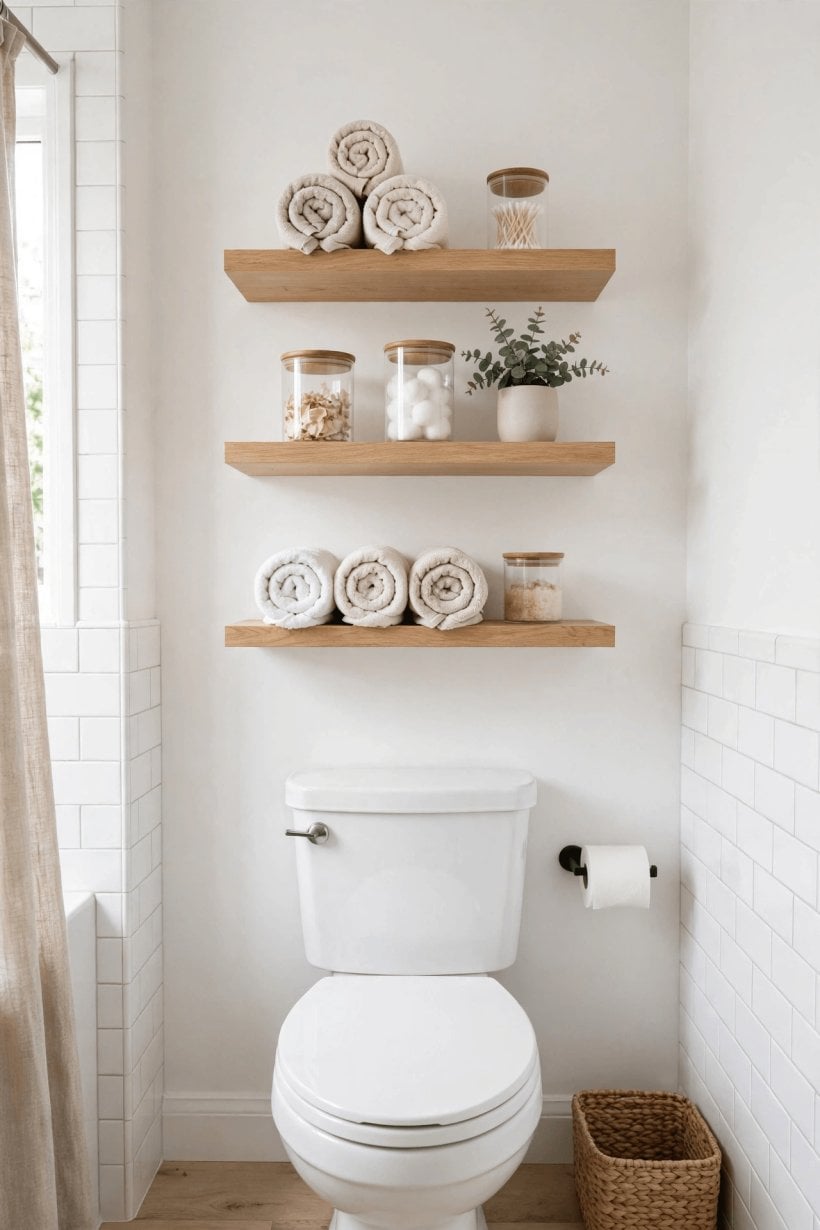
Freestanding units that straddle the cistern — ladder shelves and etagere frames — deliver several shelves with no drilling at all, which makes them the renter’s answer and the fastest weekend upgrade. Their legs stand either side of the toilet, so measure the cistern’s width and the room’s skirting before ordering; the fitted look in our tiny house bathroom layouts comes from exactly this kind of measure-first buying.
Materials split the price range in a useful way. Powder-coated steel frames shrug off steam and wipe clean, bamboo and pale timber warm up a white room, and chrome reads sharp in modern schemes — but check the coating on bargain metal units, because a chipped finish in a steamy room rusts at the chip and stains the wall behind. Feet matter too: adjustable feet forgive an uneven floor, and floor protectors stop the frame marking tiles it stands on for years.
5. Pick a Ladder Shelf for an Airy Look
Rungs widening toward the base hold baskets below and display above, with the least visual weight of any unit.
6. Choose a Framed Etagere for Maximum Shelves
A full frame with three or four tiers is the closest thing to a cupboard without closing the room in.
7. Anchor Tall Units to the Wall Anyway
Freestanding does not mean unsecured — a discreet strap or bracket at the top prevents any chance of tipping.
8. Measure Around the Flush and Fill Valves
Some cisterns sit wider or taller than standard; the unit’s lowest crossbar must clear the lid entirely.
4. Cabinets: Storage Behind Doors
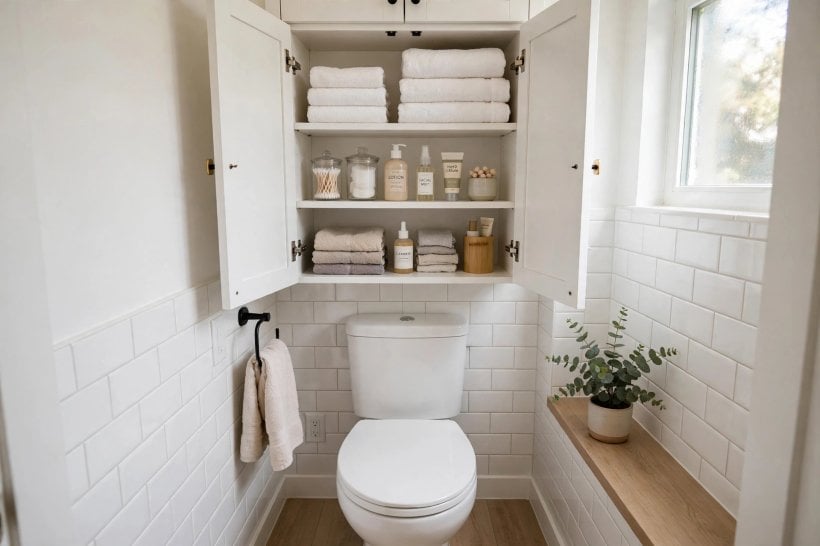
Where the bathroom stores medicines, cleaning products or anything that should not be on open display, a shallow wall cabinet over the toilet hides it all. Doors calm the visual noise of a small room completely — the reason the closed storage in our bathroom interior design ideas so often beats open shelves in family bathrooms.
9. Fit a Shallow Two-Door Wall Cabinet
Sized to the cistern’s width, shallow enough to clear heads, with doors that open without meeting the walls.
10. Choose a Mirrored Cabinet Where the Layout Allows
If the toilet sits beside the basin, a mirrored front can serve both — check sightlines before committing.
11. Add an Open Shelf Beneath the Cabinet
The hybrid that works everywhere: closed storage above, one open shelf below for the daily towel and plant.
12. Keep Cabinet Contents Light and Dry
Steam rises: store sealed and robust items here, and keep anything moisture-sensitive in a drier room.
5. Baskets, Boxes and the Art of Grouping
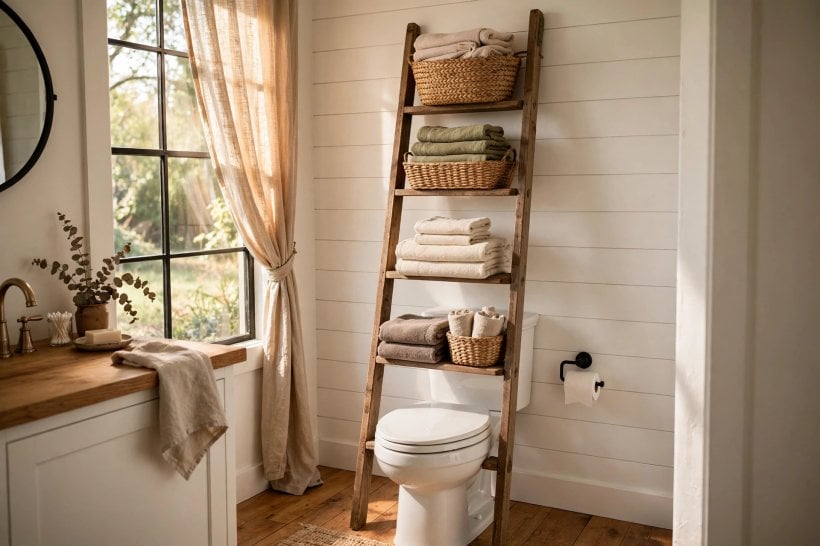
Open shelves succeed or fail on what sits on them. Loose bottles and tubes look like clutter at any budget; the same items grouped in baskets read as a styled shelf. Grouping is also practical — a whole basket lifts down at once for cleaning or for guests.
13. Corral Small Bottles in Woven Baskets
One basket per category — hair, cleaning, spares — in natural fibre that suits the room’s palette.
14. Roll Towels Instead of Folding Them
Rolled towels store tighter, look like a spa shelf, and grab-and-go better than folded stacks on narrow shelves.
15. Decant Into Matching Jars and Bottles
Cotton pads, buds and bath salts in glass or ceramic jars turn necessities into the shelf’s decoration.
16. Keep One Basket as the Guest Supply
Spare paper, a fresh hand towel and basics, ready as a single lift-down kit when visitors stay.
17. Leave One Shelf Mostly Empty
A plant and one object on an otherwise clear shelf is what separates styled storage from a stockroom — restraint is the style, as the calmer examples among our tiny house bathroom interiors show.
6. Built-Ins and Alcove Shelving
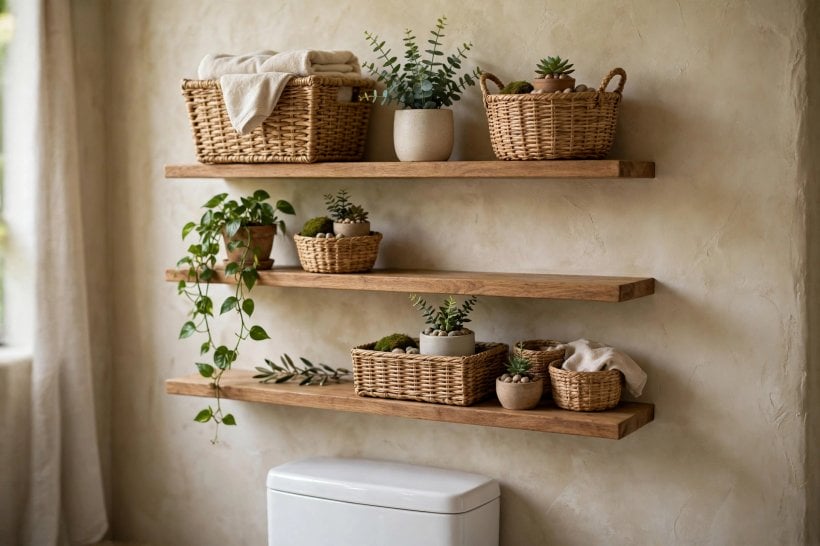
In a renovation, the neatest storage is the wall itself: a recessed niche or built-in shelving around a concealed cistern uses depth that framing already provides, and nothing projects into the room at all. Concealed cisterns with a tiled or panelled front pair naturally with shelved niches on either side — the approach detailed in our waterproof tiny house bathroom guide for wet-room builds.
18. Recess a Niche Above a Concealed Cistern
The shelf sits inside the wall’s depth, finished in the room’s tile, with the cistern’s access panel preserved below it.
19. Build Shelves Into an Existing Alcove
Many bathrooms have a boxed-in corner or chimney breast — shelving its face turns dead structure into the storage wall.
20. Line the Niche With a Contrasting Finish
Timber or a deeper tile inside the recess makes stored items read as display rather than overflow.
7. Small Bathrooms and Tiny Houses
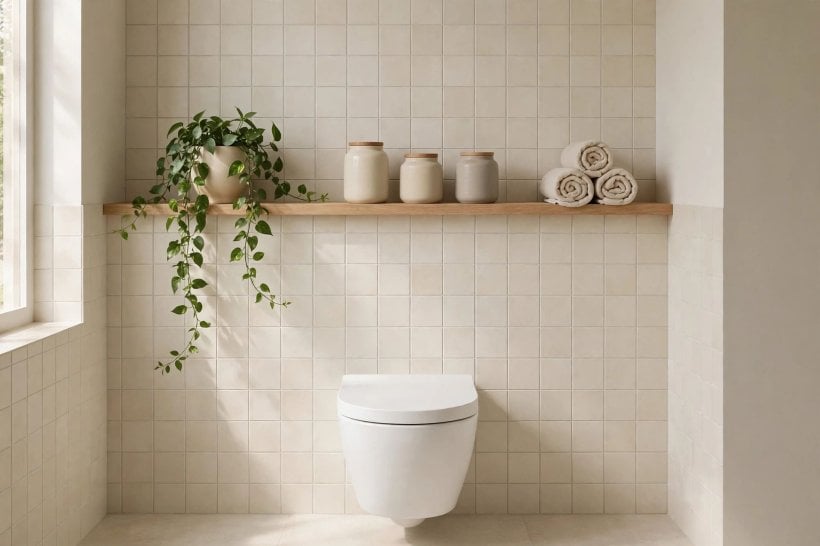
In the smallest bathrooms, above-toilet storage is not an extra — it is often the only storage. The rules tighten: shelves go higher and shallower, every item earns its place, and the wall works from cistern to ceiling. The storage-led layouts in our tiny house plans with hidden storage treat this wall as prime territory for the same reason.
21. Run Shelves to the Ceiling
High shelves hold the rarely used — spare bedding for the sofa bed, bulk paper — freeing lower space for the daily.
22. Use the Corners With an L-Shaped Shelf
Where the toilet sits in a corner, wrapping one shelf around it recovers the dead corner entirely.
23. Choose Slimline Everything
Narrow baskets, small jars, travel sizes: in a tiny bathroom the above-toilet shelf is a curated shelf, not a warehouse.
24. Add a Hook Rail Beneath the Lowest Shelf
The underside of the shelf is free storage too — hand towel, brush and robe hooks live there neatly.
8. Styling the Shelves So They Look Designed
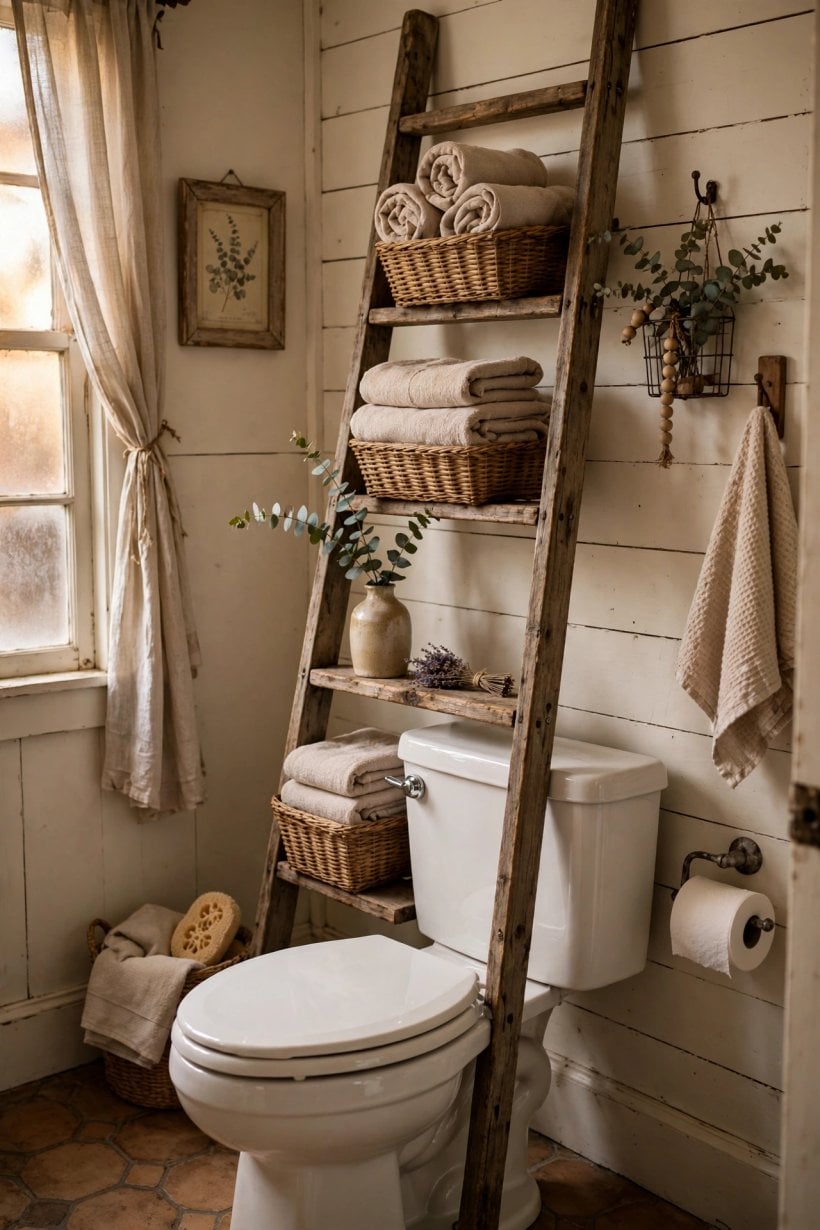
Storage becomes decor with three habits: a limited palette, odd-number groupings, and one living thing. Keep containers within two materials (say, white ceramic and natural weave), arrange objects in threes at varied heights, and finish with a trailing plant — pothos tolerates bathroom steam and low light and softens every shelf it spills from.
25. Work in Threes and Vary the Heights
A jar, a folded towel stack and a plant at three heights compose a shelf the way a photograph is composed.
26. Repeat the Room’s Accent Colour Once
One towel set or basket in the bathroom’s accent colour ties the storage wall to the rest of the room.
27. Add a Small Framed Print Above the Top Shelf
Art above the highest shelf finishes the wall’s composition and signals that the arrangement is deliberate.
9. Installation Checks: Depth, Height, Fixings
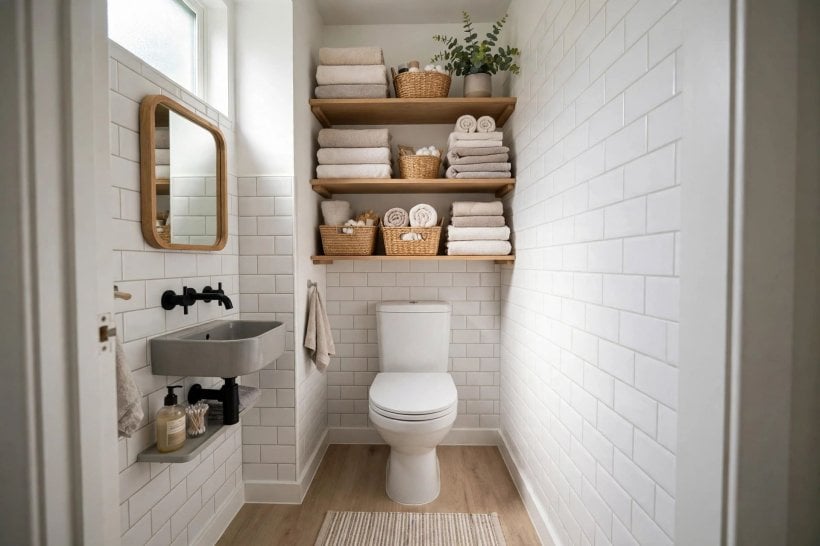
Measure three things before anything is bought. Depth: the shelf should roughly match the cistern’s projection — deep enough for a basket, never so deep it hangs over the seated user. Height: the lowest shelf’s underside must clear the head of the tallest person in the household, seated and standing, with room to spare. And the cistern itself: its lid must still lift, and any access panel must still open, after the shelves go up — a plumber locked out of the cistern by a fixed shelf is an expensive afternoon.
Fixings decide whether the shelf is furniture or a hazard. Bathroom walls are often stud, tile on board, or hollow partitions; use fixings rated for the actual wall construction and the shelf’s loaded weight, and never rely on adhesive pads for anything above a person’s head. Freestanding units get a top anchor for the same reason. The measure-twice discipline from our bathroom design ideas applies double here, because every mistake in this spot hangs over a porcelain fixture.
10. What to Store There — and What Not To
Store high and dry: spare towels, toilet paper, sealed toiletries, cleaning basics in a closed basket, a plant, and the guest kit. These are light, steam-tolerant and grabbed often enough to justify the prime position. Three final habits keep the arrangement working long after installation day.
28. Keep a Step Stool Within Reach
High shelves only earn their keep if they can be reached safely — a small folding step stored beside the vanity turns the top shelf from decoration into storage.
29. Rotate Stock Like a Shop Shelf
New supplies go behind the old, towels rotate from the wash to the back of the stack — first in, first out keeps nothing forgotten at the back of a deep basket.
30. Review the Shelf Every Season
Ten minutes each season — out with the empties, the duplicates and the never-used — stops good storage quietly refilling with clutter, which is the one failure mode of every system in this guide.
Keep elsewhere: medicines that must stay cool and dry and away from children, anything heavy in glass, electrical items anywhere near the steam-and-splash zone, and precious or paper goods that humidity will quietly ruin. Above-toilet shelving is the bathroom’s attic shelf — perfect for the light, the sealed and the spare, wrong for the delicate.
Final Considerations
Above the toilet is the smallest storage project in the house with the largest daily return: match the depth to the cistern, clear every head, keep the cistern reachable, and group what you store. Do those four things and two shelves and three baskets will hold a bathroom’s worth of clutter in a wall space that was previously holding air.
Start simple — one well-fixed shelf, honestly measured, beats a wall of units bought in hope. Add the second shelf, the cabinet or the built-in when the first has proved what the wall can do, and let a month of real use, rather than the showroom, decide what the wall still needs.


0 Comments