

A big garden impresses; a small Japanese garden persuades. Given a few square metres, a stone lantern, gravel and one well-placed maple, the style builds a whole landscape in miniature — and asks in return only restraint, patience and a rake.
These 75 small Japanese garden ideas gather the approach whole: first principles, paths, stone and water, planting structure, bamboo and ground cover, beds and raked gravel, screens and gates, seasonal care and the small-space tricks that make a tiny backyard feel like a journey rather than a view.

1. Small Japanese Garden Ideas at a Glance
Scope first. This collection owns one angle of the garden: the small Japanese-style plot — planted ground, gravel, stepping stones and seasonal care at tiny-backyard scale. Its neighbours keep their own ground: the dry-garden technique in depth is in japanese zen rock garden raking layout; gardens planned around tiny homes in general are in tiny house garden ideas; growing in pots is in container garden ideas; a garden building to sit beside the planting is in modern shed ideas; and the wider traditional style family this garden keeps company with is in cottage interior ideas and traditional home. The enclosed paved courtyard — hard surfaces and pots, a different outdoor room — is treated as its own subject elsewhere on the site; here the ground is planted, gravelled and walked on stone.
One discipline runs through the collection: a Japanese garden is made by subtraction. Every stone, shrub and square of moss must earn its place, because in a small plot there is nowhere for a mistake to hide — and nothing spare to distract from a success.
The tour follows the making itself: principles first, then paths, then stone and water, the planting structure, bamboo and ground cover, beds and raked gravel, screens and gates, the care of the seasons, and finally the tricks that stretch a small space.
| Element | Japanese garden choice | What it brings |
|---|---|---|
| Focal point | One stone lantern or a single maple | Calm focus for the eye |
| Ground | Raked gravel with stone edging | Order that asks little water |
| Path | Stepping stones, gently offset | A slower walk through the plot |
| Planting | Pine, maple, bamboo and moss | Structure in every season |
| Boundary | Bamboo screen or timber fence | Privacy without heaviness |

2. First Principles: Borrowed Scenery in a Small Plot

The opening gallery sets the philosophy: the garden is composed, not planted. These first ideas are the rules of composition that every later section obeys, and they cost nothing but thought.
1. Borrow the view beyond the fence
The oldest trick in the style: frame a neighbour’s tree, a distant roofline or a church spire so it reads as part of your garden. A gap in the planting at the right height borrows a landscape you neither own nor maintain.
2. Compose asymmetrically, always
Mirror symmetry is for parterres. Place the focal stone off-centre, group plants in odd numbers and let paths bend — asymmetry is what makes a composed garden feel like a found landscape instead of a diagram.
3. Allow one focal point only
One lantern, one maple, one great stone — choose a single hero and let everything else be its supporting cast. Two focal points compete; one commands. In a small plot this discipline is the difference between calm and clutter.
4. Hide and reveal along the path
A garden seen all at once is finished in a glance. Bend the route behind a shrub or a screen so the basin, the stone, the seat appear in turn — the plot feels three times its size when it unfolds.
5. Build the palette on green
Foliage first: texture, shape and shades of green carry the garden all year, while flowers appear as brief seasonal accents. A garden that depends on blooms is empty between them; a green garden is merely quieter.
6. Scale down — never just shrink
A small garden is not a big garden reduced; it is a landscape reconsidered at miniature scale, where one stone suggests a mountain. Choose small elements with full intention rather than standard plants crammed into small soil.
7. Treat empty space as a material
The gravel void, the unmown stillness under a pine — emptiness gives the eye rest and the objects meaning. Leave deliberate gaps. A Japanese garden with everything filled in has thrown away its cheapest luxury.
8. Design from the viewpoint
Decide where the garden will most often be seen from — a kitchen window, a single seat, the back door — and compose for that eye first. The famous borrowed view matters only if somebody is standing where it lines up.
9. Lay the bones before the planting
Stones, gravel, path and screens are the permanent structure; plants grow, change and sometimes fail around them. Set the bones first, in their final places, and the garden will hold its design even in winter.
3. Paths: Stepping Stones and Gravel

The pin shows the route in miniature. A path in this style is a pace-setter, not a shortcut, and these ideas lay routes that slow the walker and stage the views.
10. Stepping stones, gently offset
Irregular flat stones set one pace apart, each shifted a little off the line of the last, make the classic walk. The slight offset forces attention downward — which is precisely where a small garden keeps its detail.
11. Gravel underfoot, edged in stone
Where stones end, gravel continues: a raked gravel path with a firm stone edge gives the soft crunch and clean line the style loves, and drains freely after rain in a way hard paving rarely matches.
12. Space the stones to slow the step
Stones placed a touch further apart than a comfortable stride make visitors pause, look up and notice the garden. Slowness is a design feature here; the path is an instrument for playing it.
13. One large standing stone at a threshold
A single broad, flat stone at the gate, the basin or the seat marks arrival. It is the full stop at the end of the path’s sentence, and it anchors the composition wherever it is set.
14. Fill the joints with moss or creepers
Between stepping stones, low moss and creeping plants soften the geometry and knit path to planting. The joints are where a stone path stops looking installed and starts looking grown.
15. Let the path end somewhere
Every route should arrive: at a basin, a lantern, a seat or a gate. A path that wanders to the compost corner and dies teaches the eye that the garden has no story — give it a destination.
16. Curve the route, never corner it
Paths bend in long, lazy curves, screened by planting at the bend. Right angles belong to fences and buildings; the walk through a garden should feel like water finding its way downhill.
17. Rake and sweep the path as ritual
A gravel path is finished anew each time it is raked. Build the habit into the garden’s care and the route stays crisp, weed-free and meditative — maintenance as part of the design, not a chore after it.
4. Stone, Lanterns and Water Basins
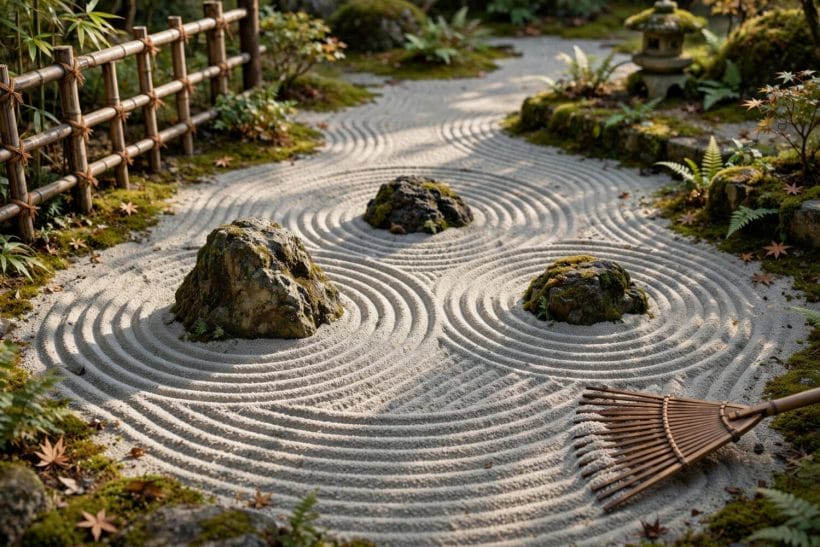
Gallery-2 gathers the garden’s furniture of stone. These objects carry the style’s symbolism — mountain, water, light — and in a small plot each one must be placed like a word in a short poem.
18. One stone lantern, placed with intent
The lantern belongs at a path bend, beside the basin or half-screened by a shrub — never centred like a gnome. A single lantern, weathered and slightly mossed, is the garden’s signature; a pair is a showroom.
19. A water basin for sound and reflection
The low stone basin, filled by a bamboo spout or simply by rain, gives the garden water without a pond: a reflection, a place to rinse hands, a mirror for the maple in autumn.
20. Group rocks in threes
The classic triad — one tall vertical stone, one reclining, one flat — suggests a whole mountain range in a corner. Set them two-thirds buried, as if they had always been there, and the illusion holds.
21. Suggest water with a dry stream
A shallow bed of rounded stones, wandering from a boulder to the basin, reads as a stream that has paused. It gives the garden water’s line and movement in the driest small plot, with no plumbing at all.
22. Let one boulder be the mountain
A single large stone, half-buried at the garden’s highest corner, stands for the sacred mountain of the tradition. Everything smaller arranged around it falls naturally into landscape scale.
23. Edge beds and gravel with stone
Low stones, set shoulder to shoulder or spaced with planting between, give beds and gravel their finished edge. The line between order and wilderness in this style is always drawn in stone.
24. Keep water quiet if it moves
Where a small recirculating feature is wanted, let it trickle rather than splash — from a bamboo spout into the basin, say. In a small garden the sound of water should be discovered, not announced.
25. Choose weathered stone, or wait for it
Bright, freshly cut stone shouts its newness. Reclaimed and weathered pieces settle instantly; new stone earns its place more slowly as moss and lichen colonise it — patience is part of the planting plan.
5. Planting Structure: Pines, Maples and Moss
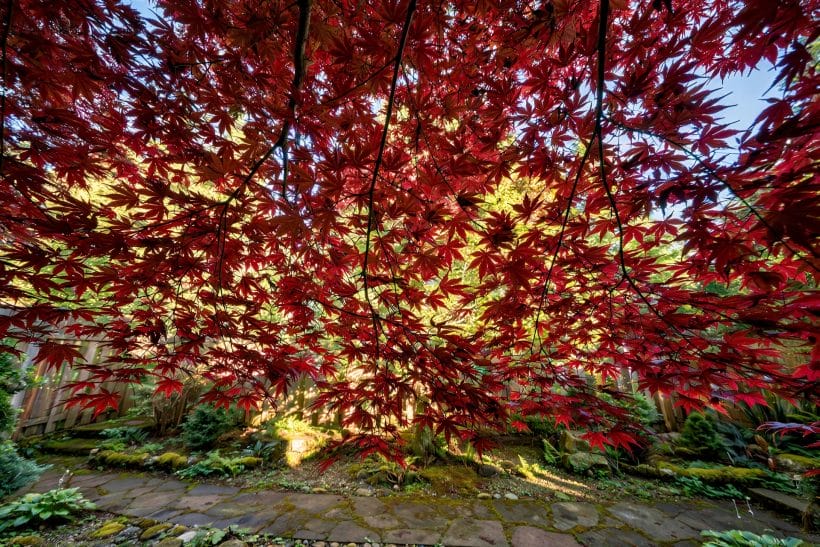
Gallery-3 shows the planting skeleton: one conifer, one maple, evergreen mounds and moss. These ideas build the structure that the seasonal accents then decorate.
26. One pine, pruned to show its shape
The pine is the garden’s elder: keep a single specimen, and prune to reveal the architecture of trunk and branches in open tiers. The pruning is gentle, seasonal and general — remove what crowds, keep what gestures.
27. A Japanese maple as the seasonal star
One maple earns the garden its two great moments: fresh green spring leaves and the autumn fire. Place it where the borrowed-view composition needs height, and let no other plant compete in its seasons.
28. Clip evergreen shrubs into quiet mounds
Rounded, tightly clipped evergreen mounds are the hills of the miniature landscape. They hold the garden’s shape in winter, stay green in every month and ask only an annual trim to keep their composure.
29. Plant in odd numbers and loose drifts
Threes and fives, never pairs and rows: group the same plant in small, irregular drifts as nature scatters them. Even numbers read as planting schemes; odd numbers read as landscapes.
30. Layer the heights like a hillside
Tree above shrub, shrub above ground cover, ground cover spilling to gravel — the layered slope of a hillside, compressed. From the viewpoint the layers should overlap, so no bare soil line interrupts the composition.
31. Let moss be the lawn
In shade, moss makes the green carpet this style prefers: soft, still and needing no mowing. It spreads slowly and rewards patience, and under pines and around stones it is more convincing than any grass.
32. Ferns for the damp, dark corners
Every small garden has a corner nothing wants; ferns want it. Their divided fronds soften stone edges and boundary shadows, and they ask only the moisture and shade that defeat showier plants.
33. Ration the flower colour
An azalea’s brief blaze, a single iris at the basin — flower colour in this style is punctuation, not prose. One seasonal accent at a time keeps each one an event and the garden green-calm between them.
6. Bamboo, Grasses and Ground Cover

Gallery-4 turns to the garden’s soft screen and rustling edge. Bamboo and grasses give privacy, movement and sound; ground covers finish the ground they stand on.
34. Screen with clumping bamboo
For a living screen choose a clumping bamboo, which stays in its allotted ground, over a running kind that travels. The canes give height, movement and the style’s signature rustle in a narrow strip of soil.
35. Grow bamboo in a great pot
In the smallest plots, one large pot of bamboo does the screening of a border with none of the commitment. It can be moved as the composition changes and lifted clear of any boundary dispute.
36. Use grasses for movement
Ornamental grasses are the garden’s weather made visible: they bow, recover and catch low light. A small drift near the seat or the path gives the still composition a living, moving edge.
37. Edge with mondo grass
A dark green ribbon of mondo grass along a path or bed edge is the style’s neat full stop: evergreen, slow and tidy, it draws the line between gravel and planting without a single stone.
38. Carpet the gaps with creeping covers
Between stones and under shrubs, low creeping plants close the soil against weeds and weather. Choose one or two kinds and let them spread into green ground, so the floor of the garden reads as one surface.
39. Dress the basin’s edge with moisture lovers
Plants that like damp roots belong at the basin and the dry stream’s end: sedges and small irises gather there naturally, tying the water feature into the planting instead of leaving it an ornament.
40. Thin the bamboo to see through its base
As canes multiply, remove the oldest and weakest so light reaches the ground beneath and the screen stays a grove rather than a thicket. A bamboo screen you can half-see through feels deeper than a wall.
41. Leave grasses standing through winter
Uncut grasses hold the garden’s structure into the cold months, frost beautifully and shelter the composition when the perennials sleep. Cut them back as new growth stirs and the cycle begins again.
7. Beds, Borders and Raked Gravel

Gallery-5 is the garden’s ground plane at work. Beds in this style are islands in a gravel sea, and these ideas shape, edge and maintain them.
42. Make beds islands in a gravel sea
Rather than wall-to-wall borders, set planting in raised islands surrounded by raked gravel. The gravel is the sea, the beds are land — the composition reads as landscape at once, and paths become shores.
43. Rake patterns with meaning
Straight lines suggest calm water; concentric rings around a stone suggest ripples from it. The patterns are simple, renewed at each raking, and they turn the garden’s maintenance into its most visible art.
44. Raise one island for the hero plants
A gently mounded island bed lifts the pine, the maple or the great stone into prominence and improves its drainage at the same time. Height, in a flat small plot, is emphasis.
45. Retain a slope with stone, not timber
Where the plot slopes, hold the bed with a low wall of rough stone rather than sleepers or boards. Stone retaining disappears into the garden’s own material language and weathers with it.
46. Mulch shrubs with gravel, not bark
Under shrubs and mounds, a gravel mulch keeps the palette continuous from path to bed, suppresses weeds and never blows or rots into the composition. The whole ground plane then speaks one material.
47. Keep every edge crisp
The style’s calm depends on its lines: gravel raked to the stone, stones clear of soil, beds ending where they mean to. A weekly pass with a hand rake and a brush keeps the drawing sharp.
48. Try a checkerboard of stone and moss
In one small formal moment near the house, alternate flat stone squares with squares of moss in the classic chequer. It is the style’s most graphic pattern, best kept to a patch the size of a rug.
49. Refresh gravel as seasonal care
Gravel dulls, scatters and thins with weather and feet. Sieve it, top it up and re-rake it as part of the spring round, and the ground plane — the garden’s largest surface — looks newly made each year.
8. Screens, Fences and Gates
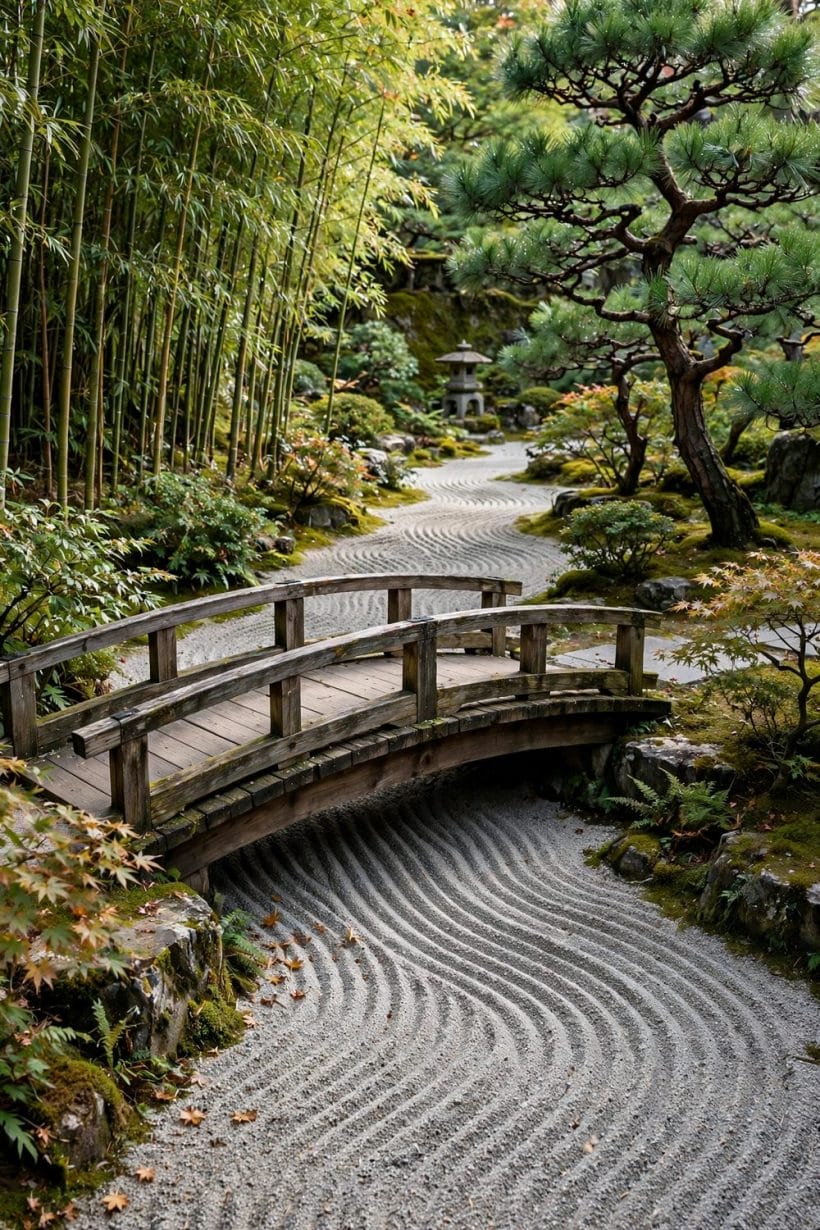
The second pin turns to the boundary. Privacy in this style is achieved by suggestion and layering rather than fortification, and these ideas enclose the garden without closing it in.
50. A bamboo fence against the boundary
Cane and bamboo fencing, tied in the traditional manner, is the style’s boundary of choice: light, textured and clearly a garden’s edge rather than a wall. Set it inside the legal fence if one already stands.
51. Weathered timber, spaced and calm
Vertical timber boards in a silvered, weathered finish make the quiet alternative — the fence as backdrop. Keep the boards plain and close-spaced so the boundary reads as one calm surface behind the planting.
52. A simple gate that signals arrival
A low timber or bamboo gate does not secure anything; it announces a threshold. Passing it, the visitor slows — which, in a garden built on slowness, is the gate’s whole and sufficient job.
53. Hide utilities behind a sleeve fence
The short wing fence — a screen standing off the boundary — exists to hide what the garden cannot digest: bins, meters, the shed’s plain side. It is the style’s honest admission that every paradise has plumbing.
54. Layer planting in front of every fence
No fence should meet the eye bare. A loose layer of shrubs, bamboo or grasses in front of the boundary doubles its depth, hides its foot and makes the plot’s true edge impossible to locate.
55. Screen the ugly sightlines first
Before decorating, list what the garden must not see — the neighbour’s trampoline, the oil tank, the overlooked window — and aim screens at those lines. Privacy is a set of sightlines, solved one by one.
56. Let a small tree partner the gate
One pruned tree beside the entrance, its canopy overhanging the gate, marks the garden’s door with living architecture. The pairing of gate and tree is the composition’s opening sentence.
57. Borrow height without building it
Where taller screening is needed, a tree or a tall bamboo grove inside the boundary gives privacy that reads as landscape, not defence. Height that grows feels generous; height that is built feels suspicious.
9. Seasonal Care Through the Year
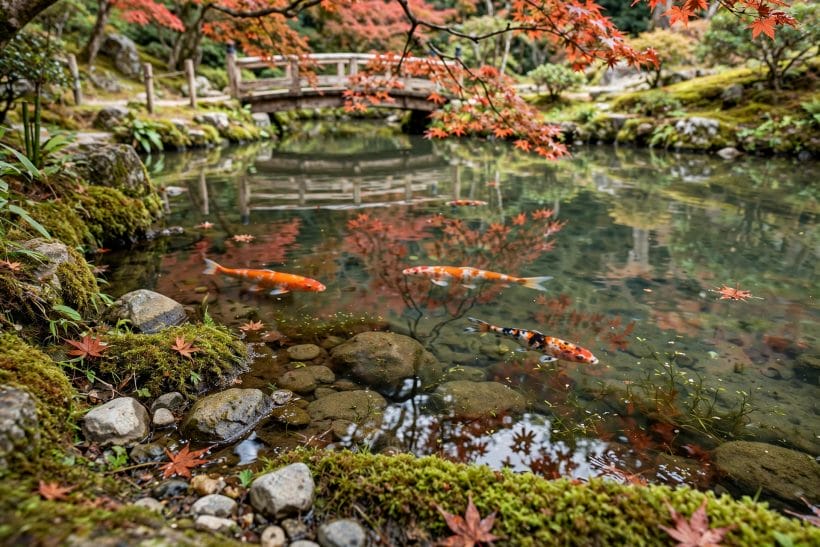
Gallery-6 shows the garden in its autumn round. A Japanese garden is never finished, only kept; these ideas spread the keeping across the year in light, regular touches.
58. Spring: wake the garden gently
As growth stirs, cut back the grasses, check the bamboo’s allotted ground, and pinch back the pine’s new shoots lightly to keep its tiers open. Spring work here is editing, not overhaul.
59. Summer: water the roots, shade the moss
In dry spells, water deeply at the roots of the young and the potted rather than sprinkling everything. Moss and ferns in hot sun appreciate the shade of a nearby shrub — arrange it when you plant.
60. Autumn: enjoy the leaves, then clear them
Fallen maple leaves on gravel are the season’s beauty — for a few days. Then clear them before they mat onto moss and gravel, keeping the colour in the canopy rather than the decay on the ground.
61. Winter: protect pots and branches
In cold snaps, wrap or shelter the great pots, and brush heavy snow from pruned branches before it bends them out of their trained shape. The garden’s winter silhouette is worth the ten minutes.
62. Re-rake gravel after every storm
Wind and rain write on gravel. A short re-raking after rough weather restores the patterns and the calm, and catches early the weeds and seedlings that storms deliver — the garden’s regular reset.
63. Inspect the bamboo’s boundaries yearly
Once a year, walk the bamboo’s edge and confirm it is keeping to its ground; clumping kinds spread slowly, but a yearly look keeps a screen from becoming a dispute with the planting — or the neighbours.
64. Feed lightly, if at all
This is a lean garden by design: rich feeding forces soft growth that ruins trained shapes and clipped mounds. Feed sparingly, in general terms only when a plant plainly asks, and let slowness be the fertiliser.
65. Keep moss clear and breathing
Moss asks little: fallen leaves lifted off, debris brushed away, and a misting in long droughts. In return it stays the garden’s green carpet — tended by removal, like everything else in this style.
66. Edit once a year — remove one thing
The master’s habit: each year, take one thing out — a stone, a shrub, a pot that never earned its place. A garden improved by subtraction stays honest, and the empty space left behind is the improvement.
10. Small-Space Tricks for Tiny Backyards
The collection ends where this style began: in very little room. These closing ideas are the compression techniques that let a tiny backyard hold a whole landscape without crowding a single element.
67. Compose the corner, gravel the rest
In the tiniest plot, build the full composition — stone triad, maple, lantern, moss — in one corner, and let raked gravel and a path fill the remainder. One dense scene plus emptiness reads as a landscape, not a compromise.
68. Design for the window view
A garden mostly seen from indoors should be composed like a picture for that frame: the maple at one third, the lantern low, the gravel leading the eye. Check the composition from the sofa, not the lawn.
69. Paint the boundary dark to deepen the plot
A dark-stained fence recedes; a pale one advances. Where a plot feels shallow, darkening the boundary and lighting the planting against it borrows depth the tape measure says you do not have.
70. One great pot instead of many small ones
A crowd of small pots reads as clutter at exactly the scale this style avoids. Choose one large pot, plant it properly — a bamboo, a maple, a pine in miniature — and let it hold a whole idea.
71. Add sound to mask the street
The basin’s trickle and bamboo’s rustle are not decoration; they are acoustic privacy, covering traffic and neighbours with the garden’s own quiet noise. A small garden that sounds peaceful feels twice as secluded.
72. Light one lantern, not the whole plot
At dusk, a single low light at the lantern or the basin extends the garden into the evening. Floodlighting flattens it; one glow keeps the darkness — and the mystery — that the composition depends on.
73. Place the seat where the composition resolves
Every garden designed from a viewpoint deserves its seat at that viewpoint: one bench or stone, placed where the borrowed view, the maple and the water align. Sit there and the whole design explains itself.
74. Keep it movable if you rent
Stones, pots, gravel laid loose and a screen in sections can all move house with you. A renter’s Japanese garden loses nothing by being portable — the composition is the garden, not the ground it sits on.
75. Start with three things and stop
The final trick is beginning: one stone group, one tree, one gravel field. Live with them a season before adding anything. Most small Japanese gardens fail by addition; the great ones are recognised by what they refused.
Final Considerations
A small Japanese garden is a discipline disguised as a garden: borrow the view, choose one hero, lay stone before planting, and then spend your years editing rather than adding. The ideas above share that order, and it is why a plot the size of a parking space can hold a maple, a mountain and a sea of gravel without a hint of strain.
Begin with the bones — path, stone, screen — while the season allows, plant the structure next, and let the accents arrive as you find them. Kept lightly and raked often, a japanese backyard of this kind does not date, does not demand, and repays every quiet minute spent in it.



0 Comments