

Three stones and a field of raked gravel: almost nothing, yet visitors fall silent in front of it. A dry garden does not decorate a space — it proposes one, turning rock into mountain and gravel into open water. On a small lot, few builds ask for so little material and return so much presence.
Japanese Zen Rock Garden: At a Glance
A Japanese zen rock garden — karesansui, the dry landscape — is meditation given physical form: stone stands in for mountains, raked gravel stands in for the sea, and everything that does not serve the composition is left out. This guide works through the whole craft in build order: the philosophy of abstraction and restraint, the classic triad and larger groupings, the placement rules and honest scaling for small lots, the gravel itself — its size, depth and containment — the three raking patterns and the technique behind them, how to choose rocks with meaning, the near-absence of planting, and finally how to site the garden for daily contemplation. Nothing here needs a large plot; the tradition was always small, and its principles scale down gracefully to the tiniest home’s yard.
| Topic | What It Covers | Key Fact or Figure |
|---|---|---|
| 1. Stillness, Composed | What karesansui is and why it suits tiny lots | Rocks as mountains, gravel as water |
| 2. The Philosophy | Abstraction, asymmetry, odd numbers and ma | Groups of 3, 5 or 7 rocks |
| 3. The Classic Compositions | The triad and groups of five and seven | Vertical, reclining and horizontal roles |
| 4. Placement Rules and Scale | Burial depth, height contrast and one viewpoint | Bury one-third; tallest rock 2–3× the lowest |
| 5. The Gravel Sea | Material, depth, weed barrier and edging | 1/4–3/8 inch gravel, 3–4 inches deep |
| 6. Raking Patterns | Straight lines, waves and the checkered pattern | Hirasen, samon and ichimatsu |
| 7. Raking Technique | The rake, dry gravel and the weekly discipline | A wooden zen rake costs $20–40 |
| 8. Rocks With Meaning | Weathered stone, the four roles and sourcing | Start with 5–7 rocks |
| 9. The Restrained Green | Moss, border planting and the single tree | No plants inside the gravel field |
| 10. The Contemplative Space | Viewpoint, enclosure, seating and daily use | Designed for seated viewing |
The dry garden by the numbers: angular gravel at 1/4–3/8 inch laid 3–4 inches deep, every rock buried one-third, the tallest stone standing 2–3 times the lowest — and the whole field raked weekly.
1. Stillness, Composed
Karesansui translates as “dry landscape,” and the name is the whole method: a garden built without water that nonetheless feels full of it. Rocks carry the part of mountains and islands; the gravel surface, combed into lines and ripples, carries the part of the sea. Nothing in the composition is literal, and that is precisely why it holds the eye — the mind completes what the materials only suggest.
For the owner of a tiny home, the fit is unusually natural. These gardens were always compact by tradition rather than by compromise, and a small plot is no obstacle to the effect. Among all the directions collected in our roundup of tiny house landscaping ideas, the dry garden is the one that asks for the least material — a handful of stones, a contained bed of gravel — and returns a space built for daily looking. What follows treats the philosophy and the practical craft together, because in this tradition the two were never separate.
2. The Philosophy: Less, But Better
Four principles hold a karesansui together. The first is abstraction: the garden is a metaphor, not a model. A rock does not imitate a mountain at small scale; it stands for one, and the gravel stands for water in the same symbolic way. The second is asymmetry: no composition is centred, because a centred arrangement lets the eye settle and stop. Off-centre groupings keep the gaze travelling, which is the quiet engine of the garden’s calm.
The third principle is the odd count — rocks are grouped in threes, fives and sevens, the numbers that read as natural rather than arranged. The fourth is ma, negative space: the empty gravel is not leftover area around the design, it is half the design, and restraint itself is the aesthetic. Knowing what the garden is not helps as much: it is not a collection of pretty stones gathered at random, and it is not a stage set of generic “oriental” props — the tradition deserves better than pastiche. Nor is it low-maintenance by accident; the upkeep is deliberate, and the next sections show why.
3. Layout: The Classic Compositions
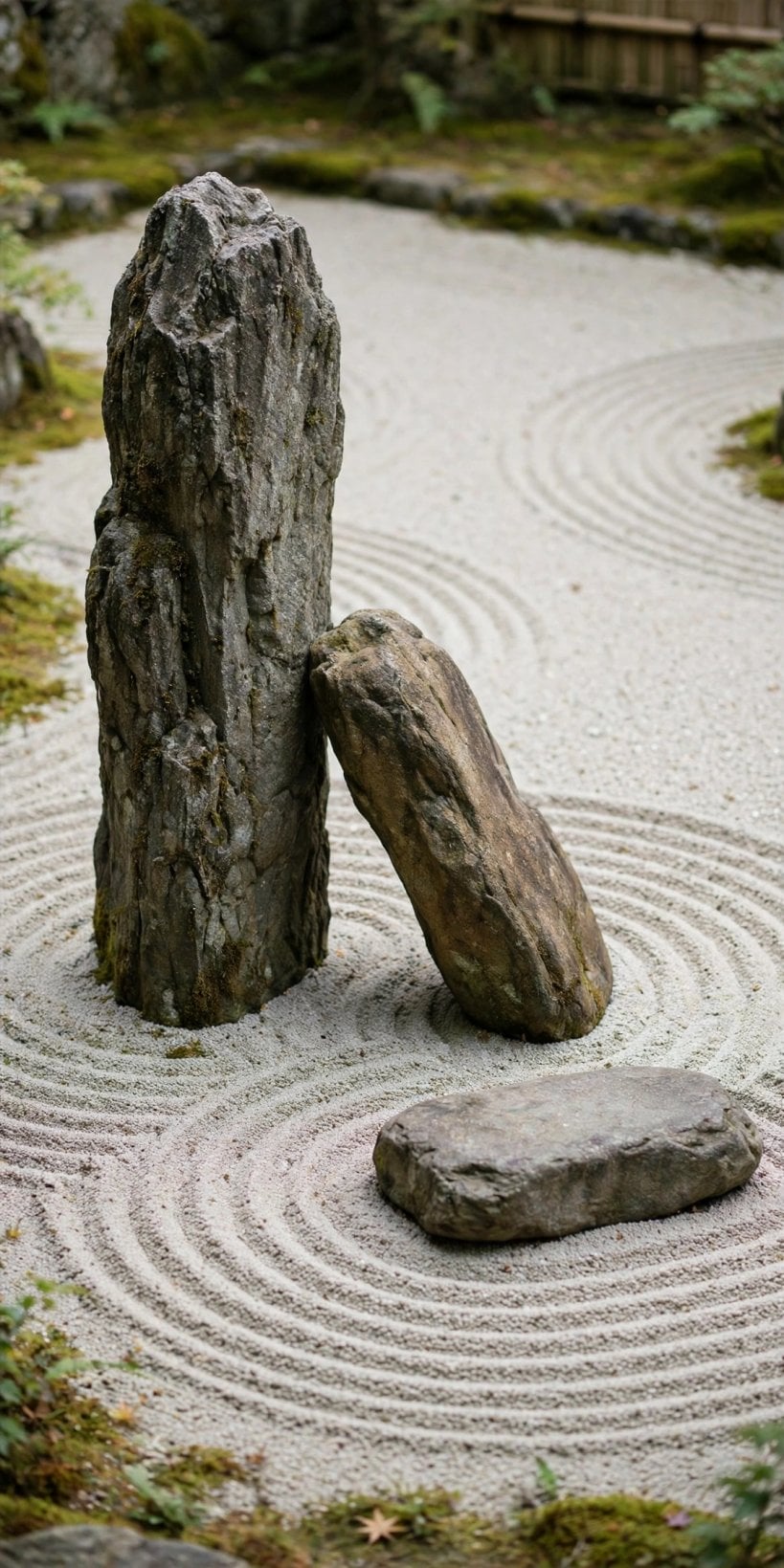
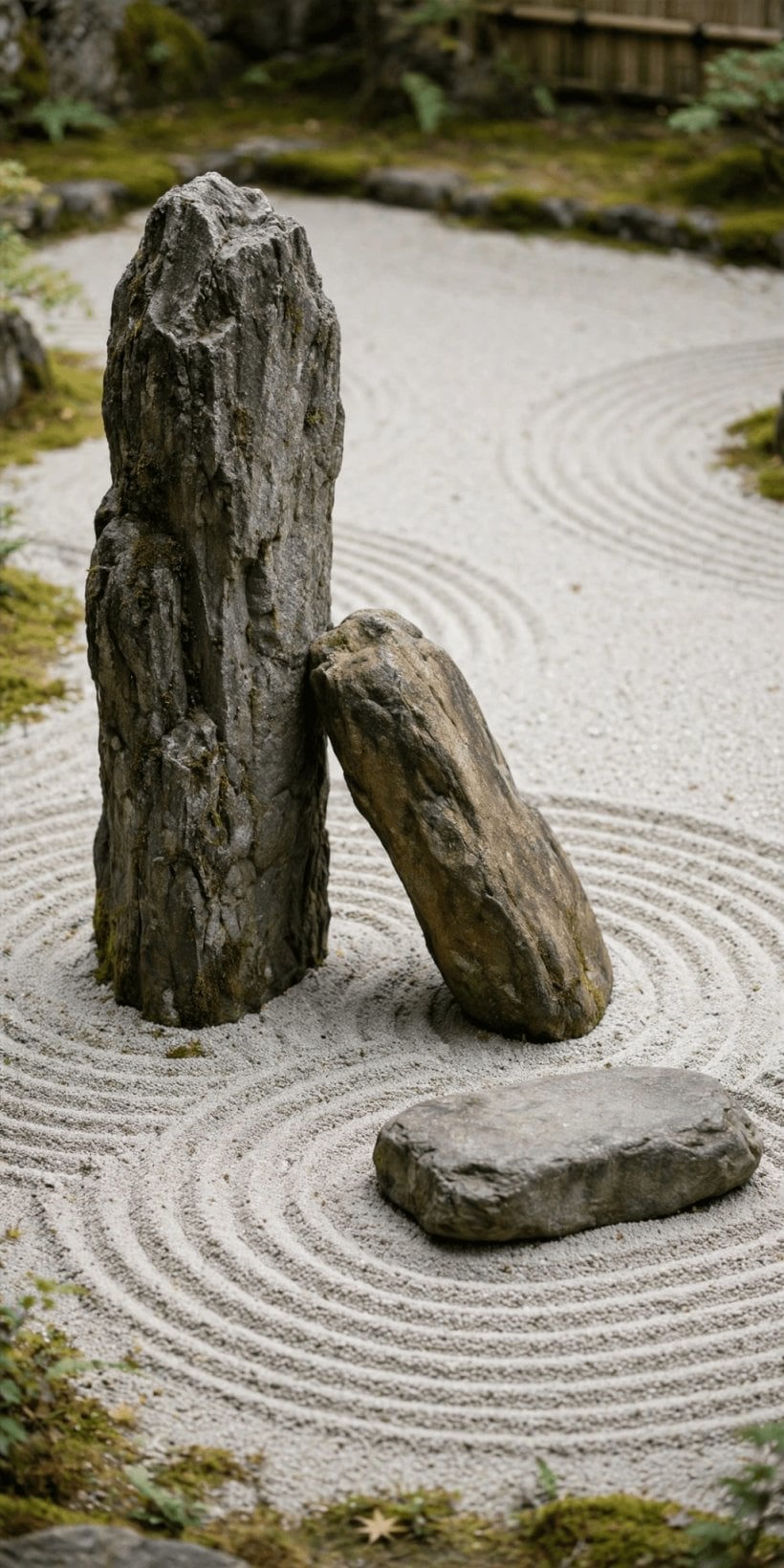
Every composition begins with the triad, the fundamental grouping of three rocks, each with a distinct role. The tall vertical stone stands for heaven; the medium reclining stone, leaning and grounded, stands for the earth; the low horizontal stone stands for humanity. Learn to arrange those three in balance and you have learned the grammar of the entire style — every larger composition is this sentence written longer.
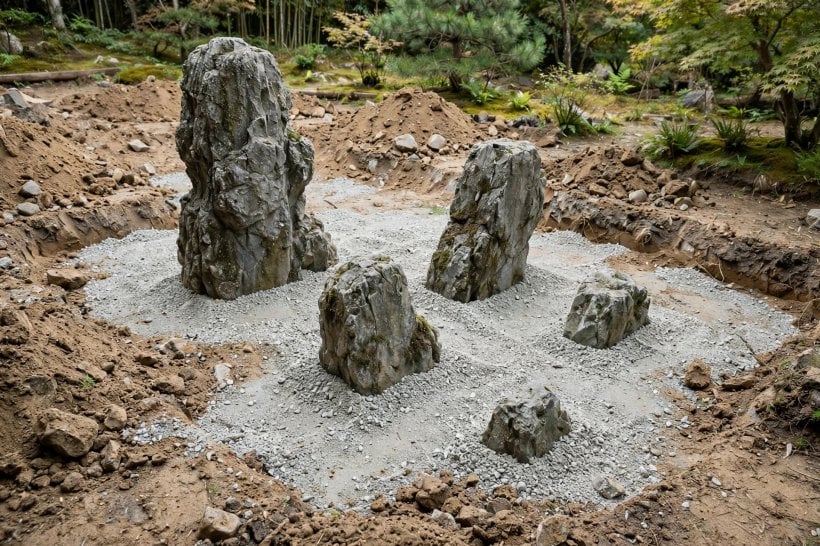
Groups of five and seven extend the same logic. A main group anchors the field, and smaller satellite groups are placed in conversation with it — echoing its character at a reduced scale, never rivalling it. The satellites should feel like a response, not a contest: if two groups compete for attention, the composition fractures and the stillness goes with it. Whether you build a triad or a group of seven, the test is the same — step back and check that one clear hierarchy holds, with a single dominant group and everything else in a supporting role.
4. Placement Rules and Scale
Placement follows a few unforgiving rules. The first is geological: bury one-third of every rock. A stone sitting on top of the gravel looks placed; a stone sunk a third of its height looks emerged, as though it had always been there and the garden was built around it. The second rule bans the commonest beginner’s error — never line rocks up in a row. A straight rank of stones reads as soldiers on parade, the opposite of the naturalistic scatter the style aims for.
Heights should vary dramatically: the vertical rock in a group ought to stand two to three times taller than the lowest stone, or the composition flattens into a hedge of similar bumps. Compositions are also designed for a single primary viewpoint — traditionally the veranda from which the garden is contemplated — so arrange the grouping to read best from where you will actually sit; on a tiny lot, the patio door becomes the veranda. Scale is forgiving: even a 10×15 ft bed is a genuine zen garden. The most famous of all, Ryōan-ji, measures 75×33 ft, and the principles shrink honestly from there. The broader craft of positioning large stones well is covered in our guide to laying out big landscape rocks.
5. The Gravel Sea: Material and Preparation
The gravel is the garden’s water, and its specification matters more than any other material choice. Use crushed granite or limestone at 1/4–3/8 inch — and insist on angular stone. Angular grains lock against each other and hold a raked ridge; rounded pea gravel rolls, slumps and refuses to keep a line, so it cannot carry a pattern at all. Colour runs from white to light gray: white is the traditional brightness, though in strong sun a softer gray reads calmer than a stark, glaring white.
Lay the gravel 3–4 inches deep over a woven geotextile weed barrier. That depth is a balance — deep enough for rake teeth to draw real patterns, shallow enough that the surface stays put. The barrier underneath is not optional: a single weed rising through the gravel sea breaks the meditation entirely, and the wider battle is covered in our guide to eco-friendly weed control for rock gardens. Finally, edge the bed firmly in wood, stone or bamboo. The garden is a contained rectangle, a composition with edges; without edging, gravel migrates outward a little every season and the stillness quite literally leaks away.
6. Raking Patterns: Lines, Waves and Checks
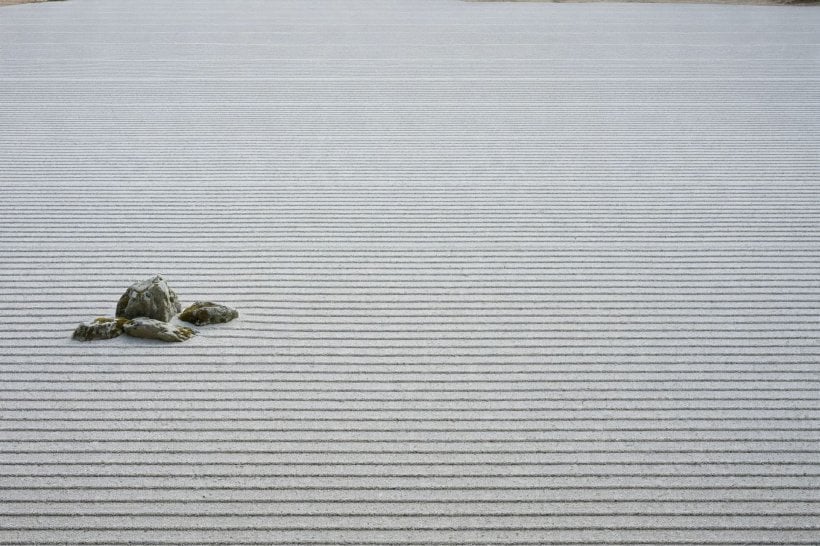
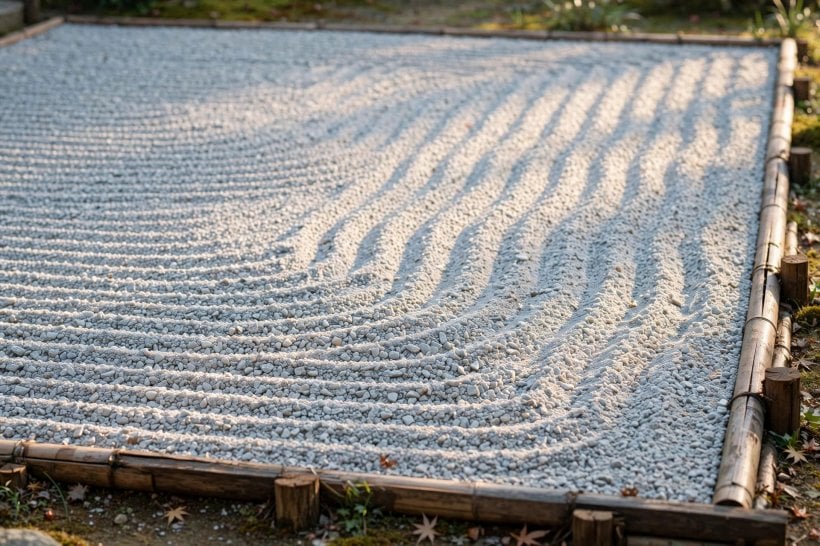
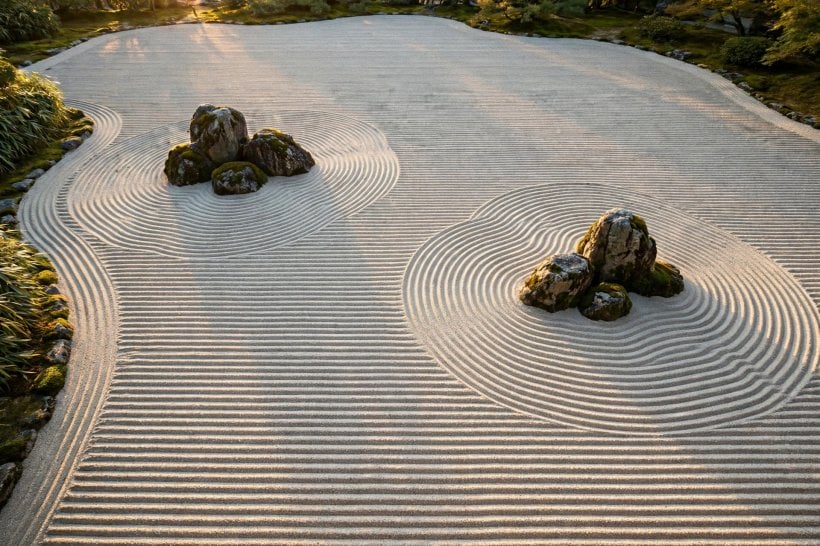
Three classic patterns cover the repertoire. Hirasen is the calm sea: straight parallel lines drawn across the entire field in slow, even strokes, each pass overlapping the last slightly. The lines should be straight enough to satisfy the eye yet still human enough to breathe — machine perfection is not the goal. Samon is the pattern of moving water: concentric arcs raked around each rock group, like ripples spreading from an island. Begin close against the rock and work outward, keeping the arcs smooth and evenly spaced.
Ichimatsu, the checkered pattern, is the formal option: alternating squares raked in opposing directions, so the field reads as a woven checkerboard of light and shadow. It suits larger gardens, where a single direction across the whole field might go monotonous. Most home gardens live on the first two patterns — straight lines for the open sea, waves where the water meets the stones — and the transition between them, handled gently, is where a raked field starts to look like weather and tide rather than decoration.
7. Raking Technique: The Practice
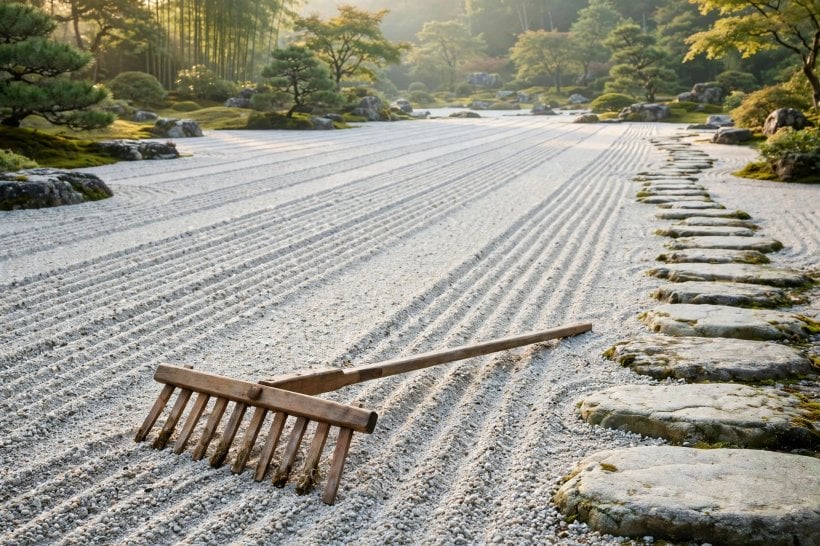
The tool is specific: a wooden zen rake with a narrow head and widely spaced teeth, costing roughly $20–40. A wide garden rake is too coarse for this work — its teeth plough where the zen rake combs. Technique begins with timing: rake only when the gravel is dry, because wet gravel clumps and the lines will not hold. Work from outside the garden, or stand on stepping stones set into the field for the purpose; a single footprint in a finished pattern undoes it, which is the small irony at the heart of maintaining stillness.
Then there is the rhythm. The field is re-raked weekly, and again after every rain or wind that disturbs it. Practise the arcs on a small patch first until the motion is smooth, because hesitation shows in the gravel. Work in a steady direction and finish each pass completely before starting the next; half-drawn lines read as indecision, and in a field this exposed, every indecision is on display. It is tempting to call this upkeep a chore, but the tradition treats it differently: the regular raking is the discipline, and the discipline is the point. The garden is not finished when you build it; it is re-made, briefly, every week, by the person who tends it.
8. Rocks: Selection With Meaning
Choose rocks the way you would choose old furniture: for character earned over time. Weathered, mossy, time-worn stone is the standard — a rock should look ancient, because fresh-quarried stone looks loud in a quiet garden while aged stone whispers. Each rock also takes one of four roles: the vertical, tall and upright, playing the mountain; the reclining, leaning against gravity, playing the earth; the flat, low and horizontal, playing the water’s edge; and the hidden rock — traditionally, one stone is partially buried or merely implied, the unseen element that completes the composition. That last touch is the philosophical signature of the style.
Sourcing is flexible: landscape yards will know what you mean by moss rock or weathered fieldstone, and our guide to sourcing free landscaping rocks covers the found-stone route — a discovered rock with real character beats a bought one. Material choice across rock types is compared in our roundup of landscaping rock types. Start with five to seven rocks in total: fewer is better, you can always add another stone later, and removing one turns out to be much harder emotionally than anyone expects.
9. Planting: The Restrained Green
The planting rule is the garden’s sternest: almost none. In a traditional karesansui there are no plants at all inside the gravel field — the purity of stone and gravel is the whole statement, and a flower blooming in the middle of it shouts in a garden built to whisper. Colour, in particular, has no place inside the field.
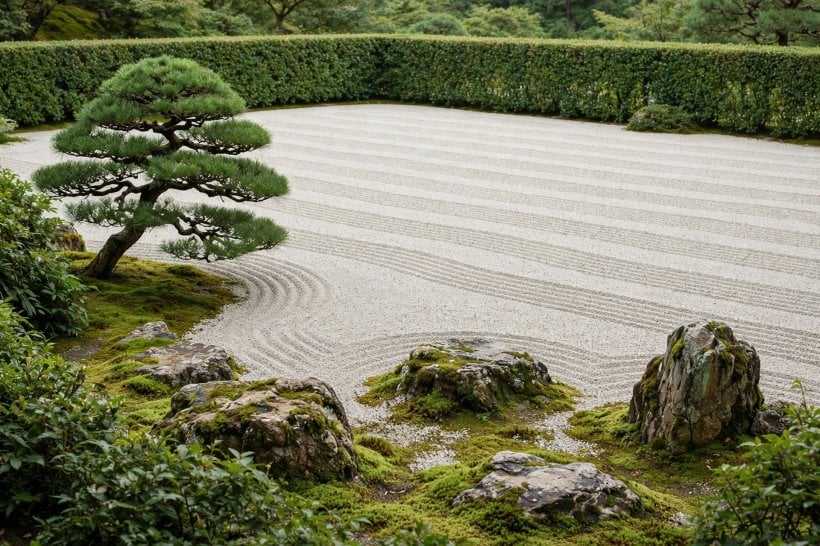
The concessions live at the edges. Moss is the one traditional accent, gathered around the bases of rocks where it softens the junction between stone and gravel; it asks for shade and moisture, and does best on the north side of the rocks — the same shade logic explored in our guide to rock gardens for shade. Beyond the gravel, planting becomes the frame: a clipped hedge, a bamboo screen or a maple standing behind the composition, so the garden is always viewed against green. The modern tiny-lot version adds a single sculptural pine or maple at one corner, pruned in the niwaki style into a living sculpture — one tree, chosen and shaped, that makes the stones make sense.
10. The Contemplative Space: Siting and Use
Site the garden to be looked at, not walked through. The primary viewpoint is a seat — the veranda, patio or deck edge — and the composition should be designed for seated viewing from that one place; stepping stones inside the field exist for maintenance access only. Enclosure matters as much: a simple fence or hedge should bound the space, because the outside world is not meant to intrude on the composition. One bench, or simply the deck edge, serves as the meditation seat facing the garden.
Sound is the one optional layer: a bamboo water feature nearby — the knock of a shishi-odoshi marking time — is traditional, and so is plain silence; choose either deliberately. In daily use the garden earns its keep through small ritual: morning tea taken facing it, ten minutes of looking at the end of the day. That, honestly, is its entire purpose, and it is enough. Nothing about the space needs to change from week to week; what changes is the person sitting in front of it. Owners working out how much presence a small plot can hold will find kindred thinking in our guide to small backyard rockscaping.
Final Considerations
Compose odd-numbered groups of weathered rocks for one seated viewpoint, bury every stone a third deep, spread angular gravel three to four inches over a proper barrier, and rake it — lines across the open field, waves around the stones — every week, as a practice rather than a chore. Plant almost nothing inside the field, frame the whole composition in green, and let restraint do the heavy lifting. A zen garden is not decorated; it is distilled, and its stillness will outlast every trend that passes the fence.




1 Comment