
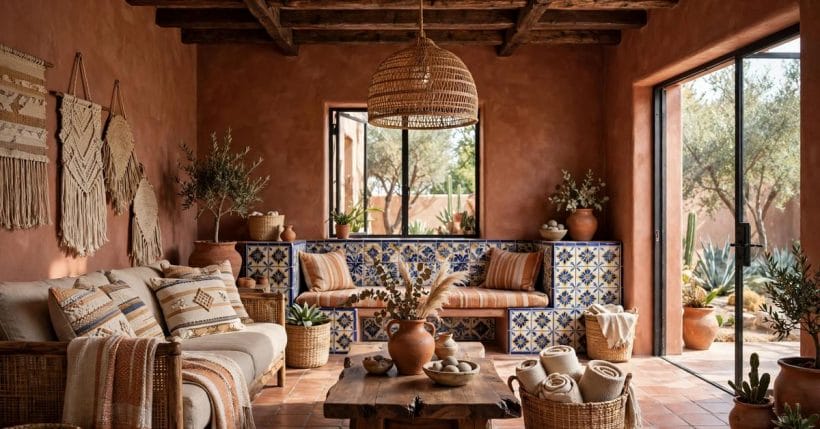
Step into a modern Mexican home and the first thing you notice is not a single object but a feeling: warmth without fuss, colour without noise, and rooms that open to the sky. Mexican design earns that feeling honestly, from plaster, timber, tile and courtyard shade rather than from decoration piled on top.
This guide walks through the elements that make the style work, how they fit together, and how to borrow them without turning a room into a theme set.
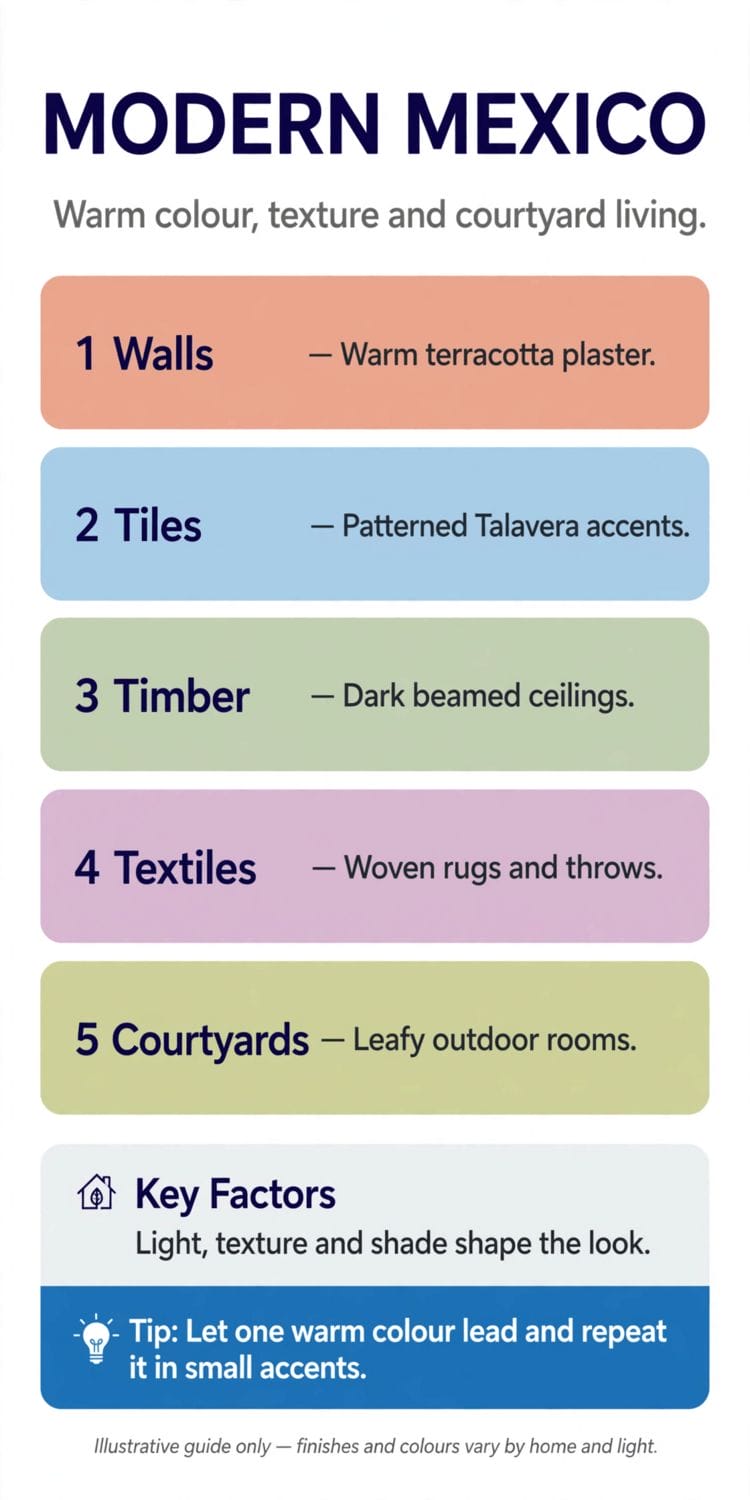
1. The Look at a Glance
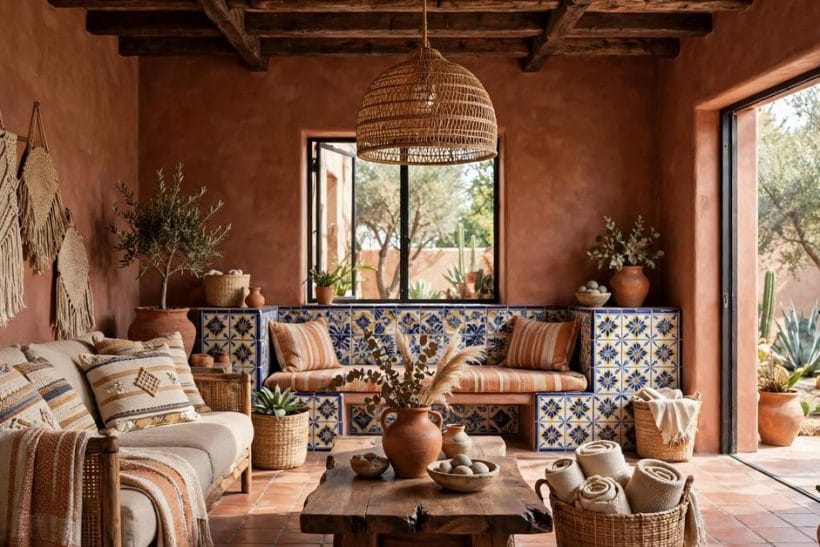
Modern Mexican design is a balance act. It keeps the bones of traditional Mexican homes — thick plaster walls, timber ceilings, tiled floors and a courtyard heart — and edits them for calm, contemporary living. Nothing shouts; everything feels handmade, sun-warmed and easy to live with.
| Element | What it does |
|---|---|
| Warm plaster walls | Softens light and gives rooms their glow |
| Timber beams | Adds rhythm overhead and a crafted feel |
| Tile accents | Brings pattern in small, deliberate doses |
| Courtyard connection | Pulls air, light and plants into the plan |
| Natural textures | Keeps the palette grounded and tactile |
The style sits comfortably beside other warm regional styles. If you like the sun-baked ease of Tuscan style homes, you will recognise the same love of plaster and timber here, handled with a different colour story. And like Italian villa home designs, it treats outdoor rooms as real rooms, not afterthoughts.
2. Warm Plaster Walls
Plaster is the soul of the style. Walls are rarely flat, bright white. They carry a soft, hand-finished texture in warm whites, sand, clay and pale terracotta, and that texture is what makes light behave so beautifully in these rooms — it pools and softens instead of glaring.
When borrowing the look, start with the wall finish rather than the paint colour. A matte, slightly textured finish in a warm neutral will do more for the room than any accent wall. Keep the palette narrow: one warm wall tone carried through the main rooms, with deeper colour reserved for a single feature wall or a tiled niche.
Plaster also forgives. Small imperfections read as character rather than flaws, which is why the style suits older homes and new builds alike. The trick is restraint: texture everywhere, colour in a few considered places.
The finish itself deserves a decision. Traditional limewash gives a soft, chalky depth that changes subtly through the day, while a modern mineral plaster gives a similar texture with a more uniform result. Either can work; what matters is that the finish is matte and slightly varied, never flat and shiny. Floors should follow the same logic — terracotta tile, warm timber or natural stone all sit happily against plaster, while a glossy or cold-grey floor will fight it. When the walls and the floor agree, the room already feels half furnished before a single piece arrives.
3. Timber Beams and Ceilings
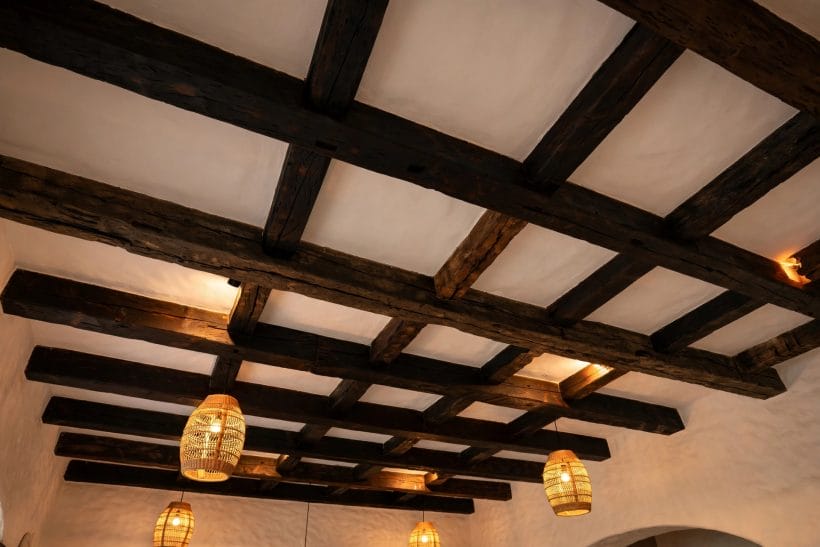
Dark timber beams across a ceiling are the style’s signature overhead move. They break up a plain ceiling, add a sense of craft, and tie the room to the timber used in doors, furniture and shelving.
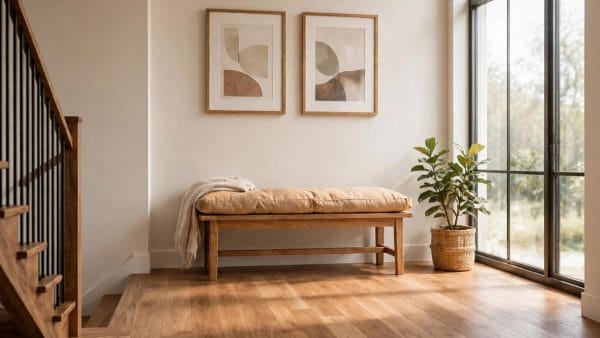
In a modern take, beams are usually left simple — chunky, unadorned, and stained rather than painted. They work best when they have something to relate to below: a timber dining table, a wooden bench, or a shelf run in the same tone. Without that echo, beams can feel stranded.
If your ceiling cannot carry real beams, a shallow timber-clad beam effect gives the rhythm without the weight. Keep the spacing generous and the finish matte; glossy or overly regular beams read as imitation rather than craft.
4. Talavera Tile Accents
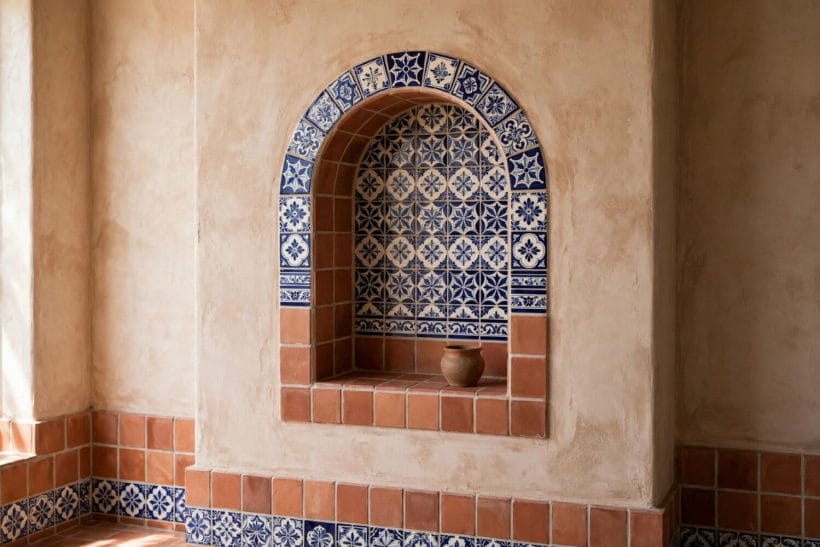
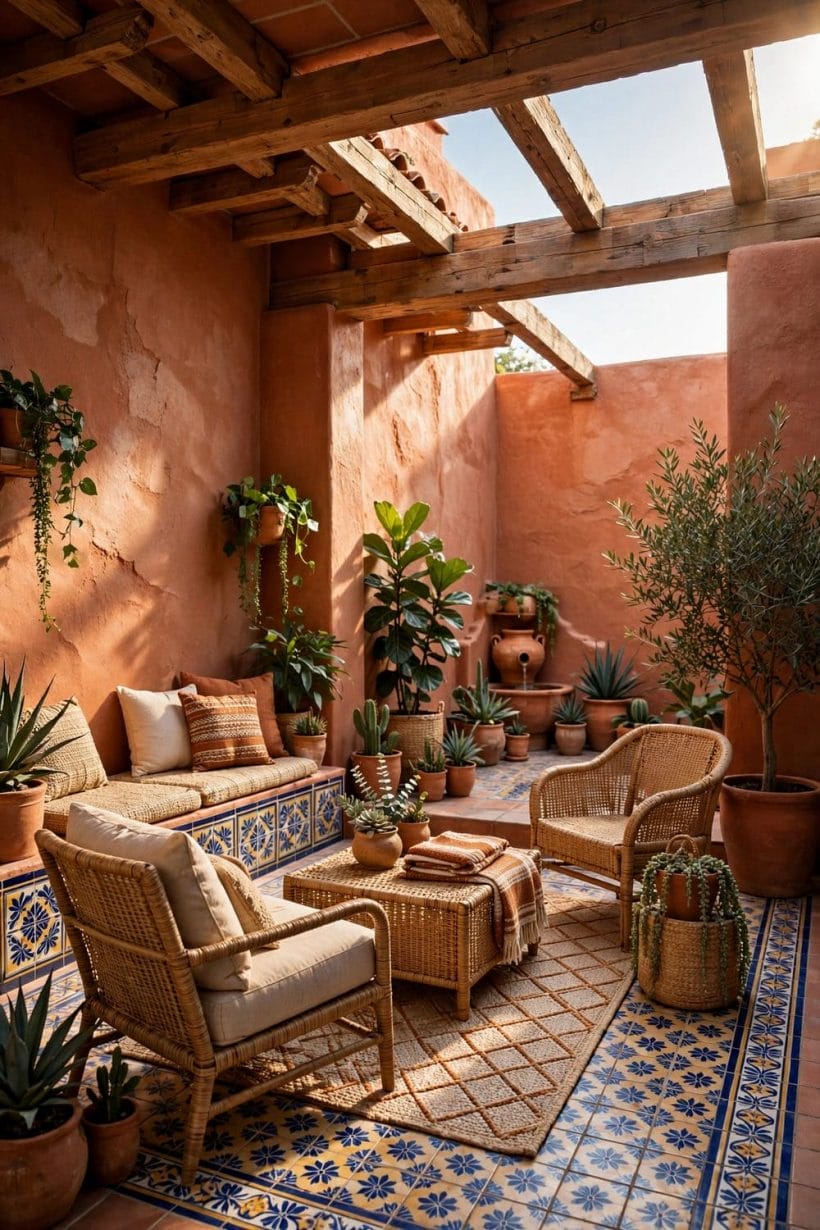
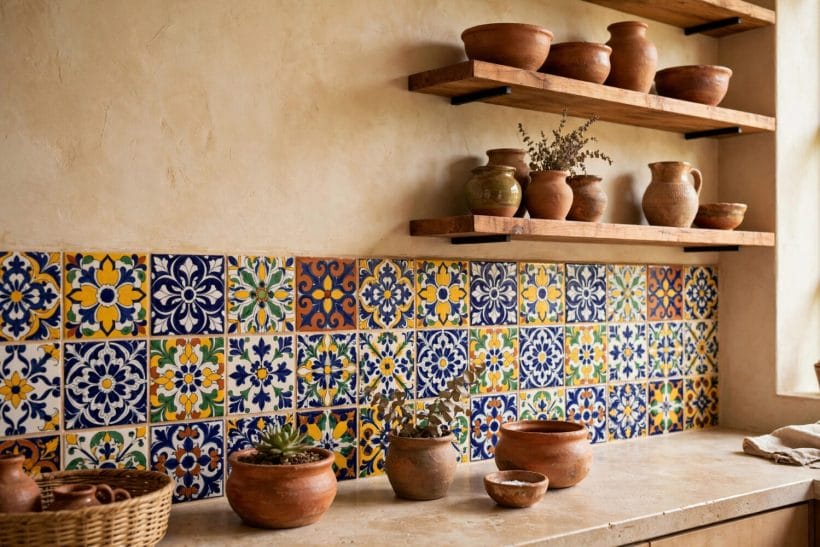
Hand-painted Talavera tile is the style’s jewellery, and like jewellery it works in small doses. A tiled stair riser, a kitchen splashback, a bathroom niche or a courtyard fountain face — each one is a moment of pattern in an otherwise calm room.
The classic mistake is tiling too much. When every surface carries pattern, the eye has nowhere to rest and the room feels busy rather than rich. Choose one or two tile moments per room, keep the rest of the surfaces plain, and let the tile be the thing people notice second, after the room itself.
Colour in tile follows the same warm story: cobalt and deep green alongside terracotta, ochre and cream. Mixed patterns work when they share a palette; clashing palettes do not, however authentic each tile may be on its own.
The kitchen is where tile earns its keep most visibly, and a Talavera splashback is often the first tile moment a household tries. Keep the splashback as the room’s single pattern statement, let the worktops and cabinets stay plain, and the tile will read as a jewel rather than a jumble. For the wider kitchen picture, kitchen ideas gather the layouts and finishes a tiled kitchen sits within, and the same restraint — one pattern, plain partners — runs through them all.
5. Courtyard Living
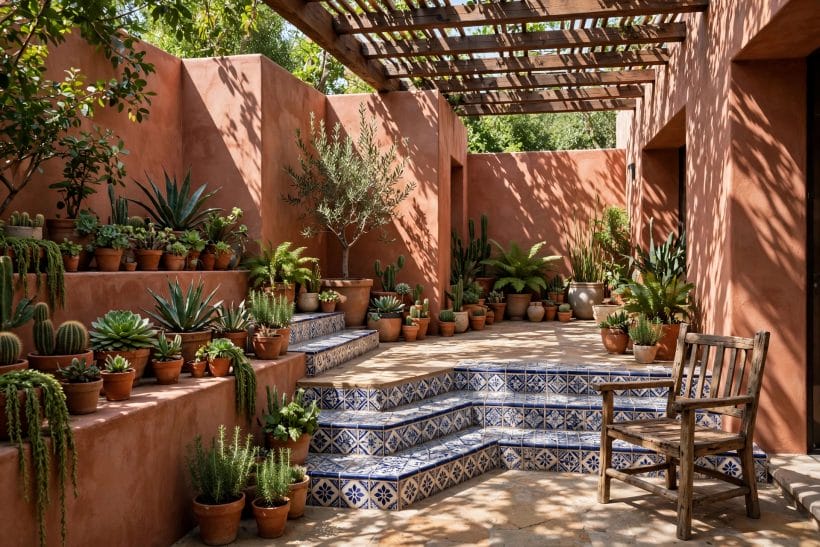
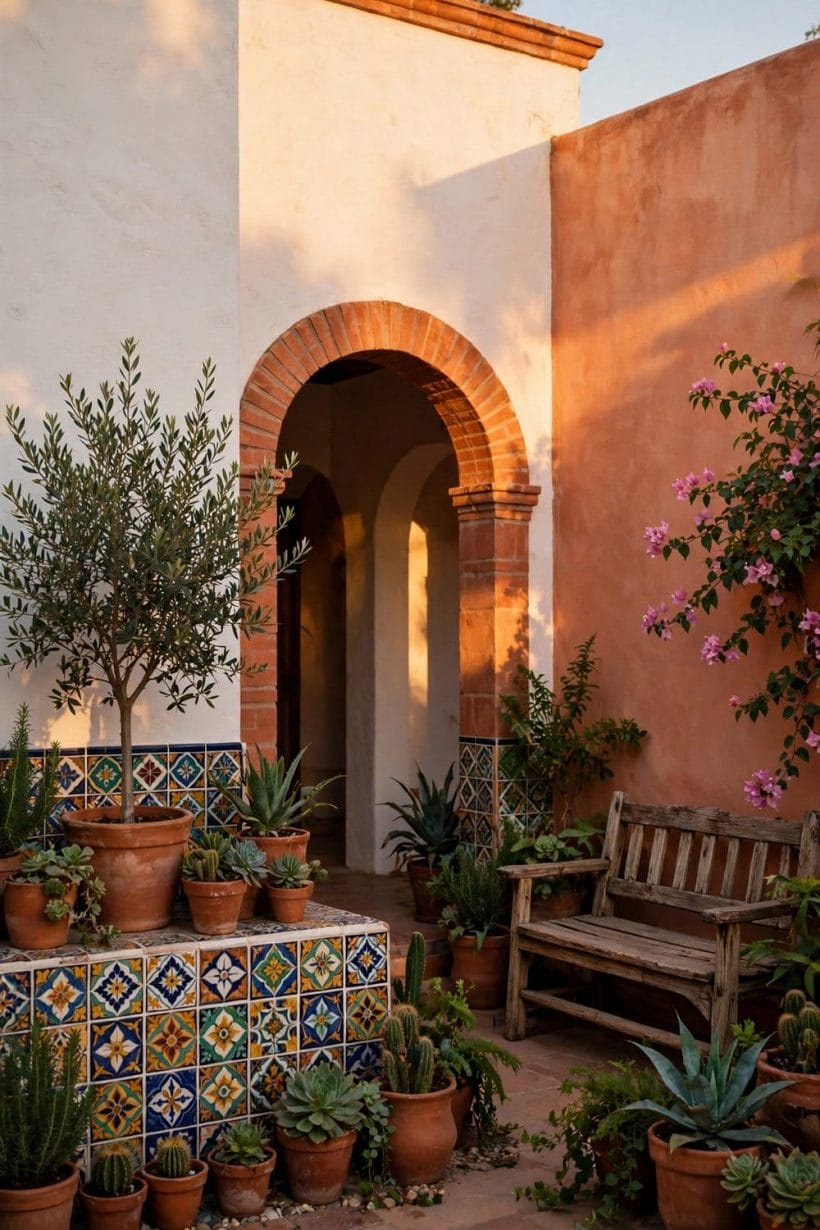
The courtyard is the Mexican home’s outdoor heart — a sheltered, planted space that rooms open onto, giving privacy without shutting out the sky. In modern homes without a true courtyard, the idea survives as a sheltered patio, a walled garden corner, or even a large planted terrace off the main living room.
What matters is the relationship: doors that open wide, a floor material that runs from inside to out, shade overhead, and plants at several heights so the space feels enclosed and green. A courtyard that is only viewed through glass is a picture, not a room; the style wants you to step into it.
Shade is what makes a courtyard usable rather than merely pretty. A timber pergola, a stretched canvas sail, or a vine-covered frame all soften the midday sun while keeping the air moving, and each one changes the character of the space below it. Sound matters too: a small wall fountain or even a shallow clay bowl with moving water gives the courtyard a gentle background note that masks street noise, and it asks for nothing more than a level base and a nearby power point fitted by a professional. Furnish it simply — a bench, two chairs and a table that can stay out in the weather — and the courtyard becomes the room the household drifts toward whenever the weather allows.
For planting and shade ideas in a similar sun-loving spirit, southwestern landscaping ideas share the same drought-wise, gravel-and-plant approach, handled with a desert palette rather than a courtyard one.
6. Colour: Terracotta, Ochre and Deep Green
The palette is earthy and sun-warmed: terracotta, ochre, sand, cream, and deep green from plants and painted timber. Bright colour appears, but as an accent — a painted chair, a row of tiles, a woven throw — never as a whole-room shout.
When choosing colours, test them in your own light. Terracotta that glows in a sunny courtyard can turn muddy in a north-facing room, and a deep green that looks rich on a door can darken a small space. Large sample patches, checked morning and evening, tell the truth that a small swatch cannot.
A useful discipline is the one-colour rule: let one warm colour lead each room, supported by neutrals and one contrasting accent. Two leading colours fight; one leading colour with quiet support feels confident.
7. Timber and Woven Textures
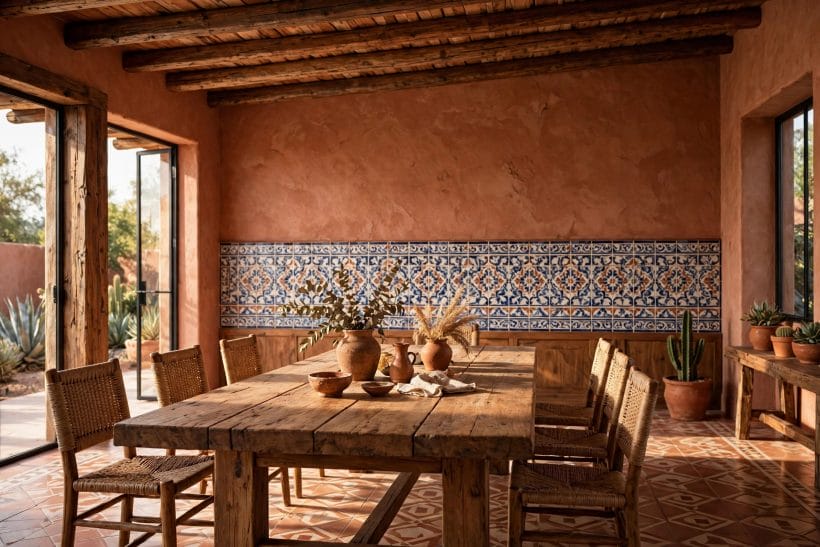
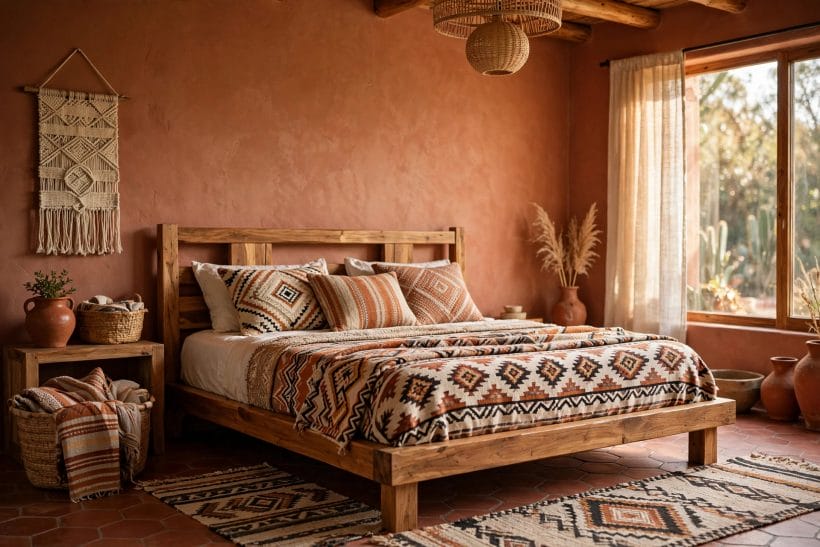
Texture does the heavy lifting in modern Mexican rooms. Rough timber, woven rush and cotton, leather, wrought iron and clay all sit together, and their variety is what keeps a warm palette from feeling flat.
Layer textures at different scales: a chunky timber table against smooth plaster, a woven runner over a plain bench, a clay pot beside a linen curtain. Each pairing gives the eye something to travel between. The style avoids slick, uniform surfaces; even new pieces look better with a hand-finished edge.
Wrought iron earns a special mention. Used sparingly — a light fitting, a stair rail, a mirror frame — it adds a dark, crafted line that sharpens all the softness around it. Used everywhere, it turns heavy. One or two iron moments per room is plenty.
Leather follows the same slow logic. A leather chair or bench in this style is not bought for a pristine first year but for the way it softens, darkens and creases over a decade of use, and that patience is part of the look. Care is simple and general: keep leather out of constant direct sun, wipe it with a barely damp cloth, and condition it when it starts to look dry. Clay and terracotta pots ask for similar honesty — unglazed pots breathe and suit plants, but they also stain and weather, and that weathering is part of their charm rather than a defect to hide.
8. Furniture: Low, Solid, Handmade Feel
Furniture in this style is low, solid and unpretentious. Heavy timber tables, simple benches, leather chairs that improve with age, and storage pieces that look built rather than bought. Nothing is delicate, and nothing demands to be admired from a distance.
Comfort matters as much as looks. Deep seats, soft cushions in natural fabrics, and furniture arranged for conversation rather than display all serve the style’s easy, gathered feeling. A room that looks warm but seats nobody comfortably has missed the point.
When mixing old and new, let the timber tone be the bridge. A new timber piece in a similar stain sits happily beside an older one; a new piece in a clashing finish, however well made, will look like a stranger.
9. Light: Shade, Lanterns and Evening Glow
Light in Mexican design is managed, not maximised. Deep window reveals, shaded patios and pergolas soften harsh sun by day, and warm lanterns, candles and low lamps take over in the evening. The result is a home that feels cool at noon and golden at dusk.
For your own home, think in layers: daylight filtered through shade, a warm overhead light for general use, and low, warm points of light for the evening. Avoid cool, bright overhead light in living spaces; it flattens exactly the warmth the style is built on.
Lanterns and candlelight deserve a practical note too. Open flames belong away from fabrics and draughts, and in homes with children or pets, enclosed lanterns or flameless alternatives give the same glow without the worry.
Window treatments complete the light story. Linen curtains that filter rather than block, wooden shutters that can be angled against the sun, or simple roller blinds in a natural tone all keep the room’s warmth intact. Heavy, dark drapes or stark white vertical blinds both fight the style — one by closing the room down, the other by cooling it. Dimmer controls on the main lights are a small change with an outsized effect: the same room can be bright for cooking and golden for dinner, and that flexibility is what lets a warm palette work morning and night.
10. Bringing It Home Without a Theme-Park Look
The line between inspired and imitation is restraint. Borrow the bones — plaster warmth, timber rhythm, one tile moment, a courtyard habit, an earthy palette — and let your own furniture and life fill the rest. A home that borrows a style’s structure always feels more authentic than one that copies its decorations.
Start with one room and one move: warm the wall tone, add a timber bench, tile a single niche, or open a door to the garden properly. Live with that change before adding the next. Styles settle best when they arrive gradually, and a room built one honest decision at a time never looks like a set.
It is also worth naming what to leave out. Mass-produced souvenir pieces, novelty signage and costume-style decorations are the fastest route to a theme-park look, however well intentioned. The style’s real markers are structural and material — plaster, timber, tile, shade, plants — and a room that gets those right needs no costume pieces at all. If an object only says “Mexico” and does nothing for the room’s warmth, texture or function, it is decoration in search of a reason, and the room is better without it.
It also helps to keep the rest of the house in conversation with the room. A single Mexican-style room in an otherwise unrelated home feels like a holiday display; the same elements echoed lightly through neighbouring rooms — a timber tone here, a terracotta pot there — make it feel like a home with a point of view.
One last practical habit ties the whole style together: repeat, don’t match. The same terracotta tone in a pot, a tile and a cushion; the same timber stain on a bench and a shelf; the same warm white on walls in two adjoining rooms. Repetition with variation is what makes a home feel designed rather than decorated, because the eye reads the echoes even when it cannot name them. Exact matching sets, by contrast, feel bought in one trip. Let each room carry two or three echoes of its neighbours, and the whole house starts to feel like one place rather than a collection of rooms.
Final Considerations
Modern Mexican design rewards patience and restraint. Warm plaster, honest timber, a little pattern, a shaded outdoor room and an earthy palette will carry you most of the way, and the details you add slowly will matter more than any single purchase.
For a softer take on warm colour in a single room, blush pink bedroom styling shows how a warm tone can stay restful, and craftsman living room ideas share the same love of honest timber handled in a different tradition. Borrow the structure, keep the colour warm, and let the rooms do the rest.

0 Comments