

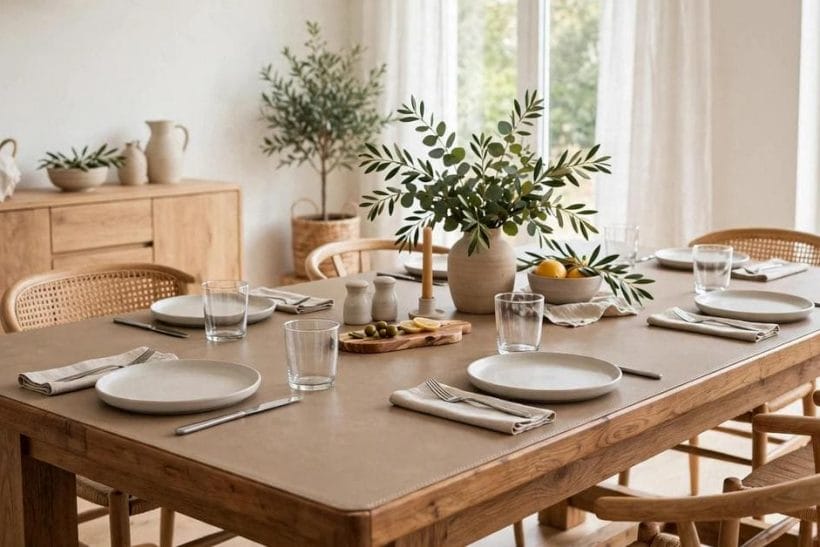
A dining table takes more daily punishment than almost any other piece of furniture in the house. Hot plates land on it, homework spreads across it, glasses sweat on it, and children lean on it with felt-tip pens in hand. A table pad sits quietly between all of that life and the wood beneath — and the difference between a good one and a poor one is the difference between a table that ages gracefully and one that carries every meal as a scar.
This guide walks through what to check before you choose table protection: fit, feel, fabric, care and looks. No brands, no suppliers, no recommendations — just the checks that let you judge any pad on its own merits.
1. What a Table Pad Actually Does
At its simplest, a table pad is a protective layer cut to sit on top of a dining table. It absorbs heat, cushions impact, resists moisture and stops sharp or rough objects from reaching the finish. Some pads cover the whole table; others come in sections that fold or roll away when the table is needed bare. Some are made to stay in place under a tablecloth; others are designed to be seen, with a finished surface that looks presentable on its own.
The job sounds simple, but the details matter. A pad that is too thin will pass heat straight through to the finish. A pad that is too stiff will not sit flat on a table with a shaped or bevelled edge. A pad that traps moisture underneath can do more harm than no pad at all. The checks in this guide exist to catch those failures before you commit, not after the first dinner party.
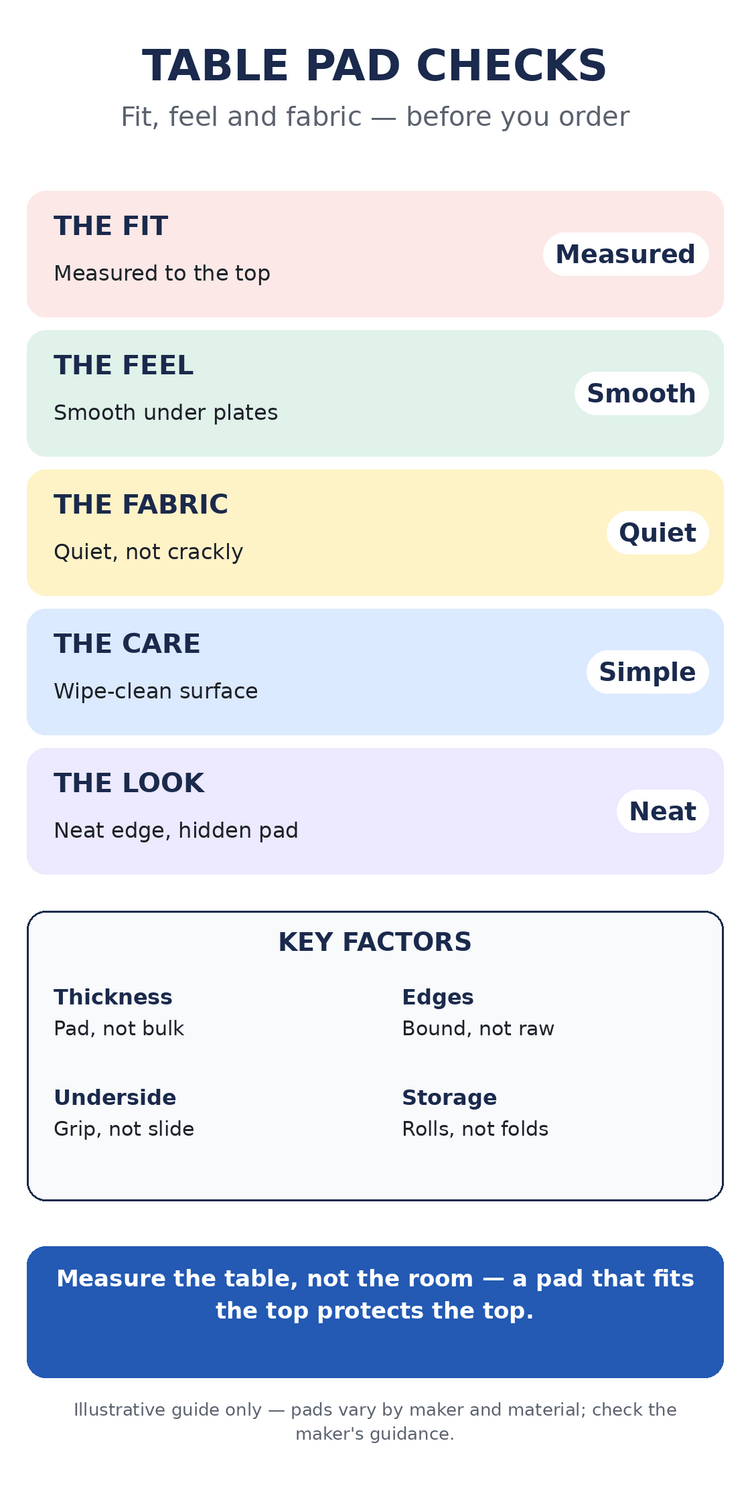
| Check | What good looks like |
|---|---|
| Fit | Measured to the tabletop, edge to edge |
| Feel | Smooth under plates, quiet under cutlery |
| Fabric | Wipe-clean top, grippy underside |
| Care | Simple cleaning, sensible storage |
| Looks | Neat edge that suits the room |
2. Fit First: Measure the Table, Not the Room
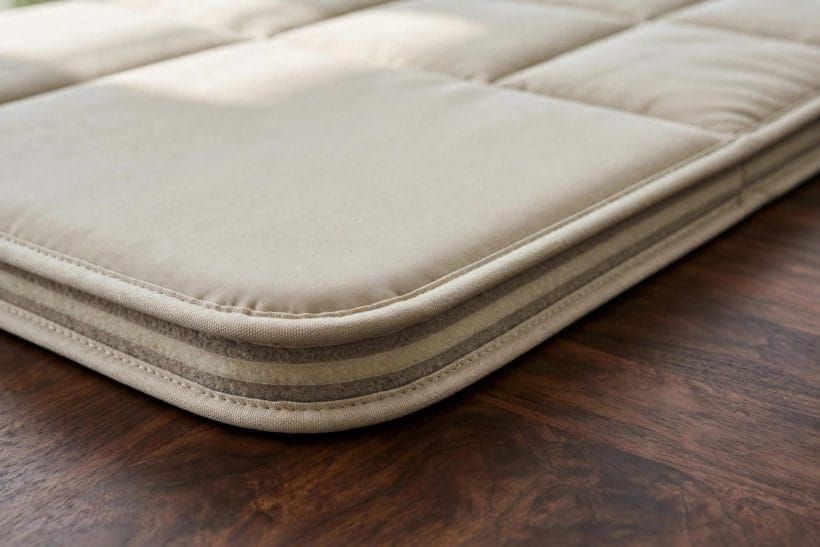
Fit is the first check and the one most often skipped. A pad should match the tabletop it protects — its length, its width, and the shape of its corners and edges. Measure the top itself, not the room around it and not the tablecloth you usually use. If the table has leaves, decide whether the pad must cover the table extended, closed, or both, and measure each configuration you actually use.
Pay attention to edges. A table with a rounded or bevelled edge needs a pad that either follows that edge or stops cleanly short of it; a pad that overhangs a shaped edge will curl, lift and catch. A table with a pedestal base rather than four legs changes nothing about the top measurement, but it changes how you slide a heavy pad into place — check you can position it without dragging it across the finish. Corners deserve the same attention: square corners, rounded corners and clipped corners each need a pad cut to match, or the corners will peel up with use.
Finally, check the pad against the table in daylight, not just under showroom lighting. A pad that looks flush under one light can show a gap under another, and a gap at the edge is where crumbs, spills and heat find their way through.
3. Feel Under the Plate: Thickness, Weight and Quiet

A table pad should feel like part of the table, not like a board laid on top of it. Thickness is a balance: too thin and heat passes through; too thick and plates wobble, glasses feel unsteady and the table looks padded rather than protected. Press the centre of the pad with your palm — it should give slightly and spring back, not dent permanently and not feel like a drum skin.
Weight matters too. A very light pad slides when someone leans on it or pulls a serving dish across it. A very heavy pad is a chore to lift off and store, which means it will stay on the table through seasons when you would rather see the wood. Lift it, fold it or roll it as you would at home, and judge whether the routine is one you will actually keep up.
Quiet is the feel check people forget. Cutlery, plates and glasses should sound muted on a pad, not clattery. Tap a plate on the pad and listen: a good pad deadens the sound; a poor one rings. In a dining room where conversation matters, that difference is felt every meal.
4. The Top Surface: Heat, Spills and Stains
The top surface of a pad does three jobs: it resists heat, it resists moisture, and it cleans easily. Heat is the hardest test. A hot serving dish, a casserole straight from the oven, a mug of tea left to sit — each pushes heat through the pad toward the finish. A pad’s heat resistance should be judged by its construction and its maker’s guidance, not by a single dramatic test. If the maker describes heat limits, read them; if the pad has no stated guidance, treat it as suitable for warm dishes only and keep trivets in play for anything straight from the oven.
Moisture is the quieter enemy. A spilled glass should bead or wipe away, not soak into the pad and sit against the wood. Check the seams and edges especially: a pad whose centre repels water but whose stitched or bound edge wicks it will fail exactly where spills run. Stains follow the same logic. Red wine, coffee, tomato sauce and felt-tip ink are the usual suspects; a surface that wipes clean with a damp cloth after each of those is worth more than a surface that needs special cleaners.
Colour matters here as well. A very pale pad shows every mark; a very dark pad hides marks but also hides crumbs and dust. Choose a tone you will be happy cleaning, not just a tone you like on first sight.
5. The Underside: Grip, Breathability and the Finish Beneath
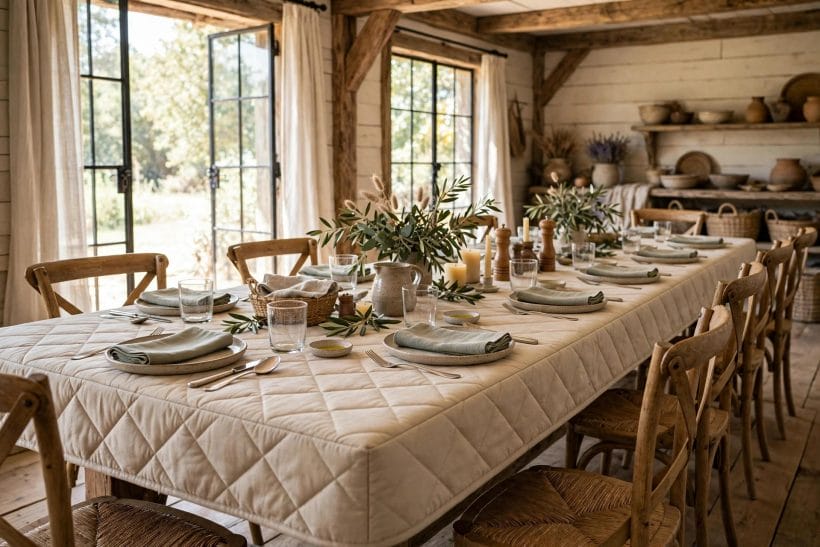
Turn the pad over. The underside decides two things: whether the pad stays put, and whether the finish beneath stays healthy. Grip comes first — the underside should hold the pad in place during a meal without sticking to the finish or leaving residue. Slide the pad on a smooth surface and judge: it should resist a casual push but release cleanly when lifted deliberately.
Breathability comes second and is often missed. A pad left on a table for weeks can trap humidity between pad and wood, especially in damp rooms or over polished finishes. If you plan to leave a pad in place long-term, lift it regularly and check the wood beneath for dullness or clouding. A pad that is lifted, aired and wiped underneath on a routine will protect far longer than one that is never moved.
Watch for colour transfer too. A strongly coloured underside can, over time and with warmth, mark a pale finish. If the pad’s underside is dark or dyed, test it on an inconspicuous corner of the table first and leave it for a few days before committing to full-time use.
6. Edges and Seams: Where Pads Fail First
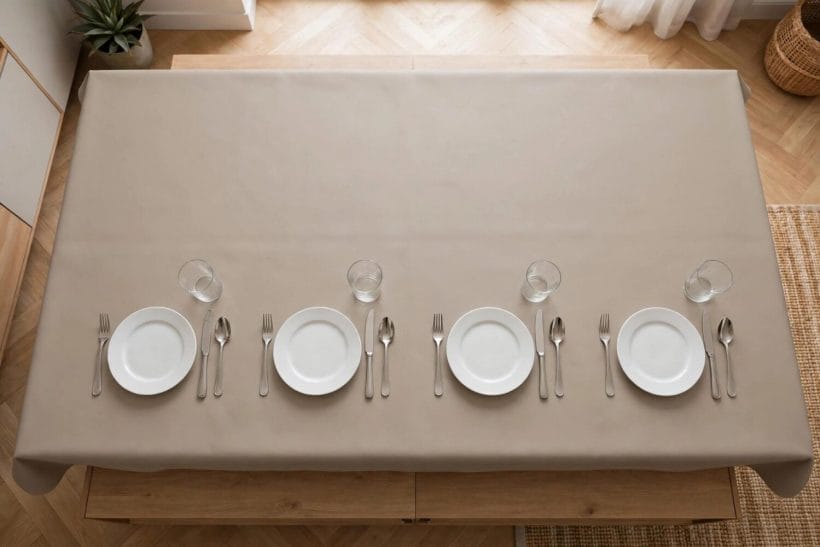
Most table pads do not fail in the middle. They fail at the edges and seams — fraying, lifting, splitting or curling. Run your fingers along every edge and seam before you judge a pad. Binding should feel firm and even, with no loose threads and no gaps where the layers separate. A bound edge generally outlasts a raw cut edge, and a stitched seam generally outlasts a glued one, though construction quality matters more than the method on its own.
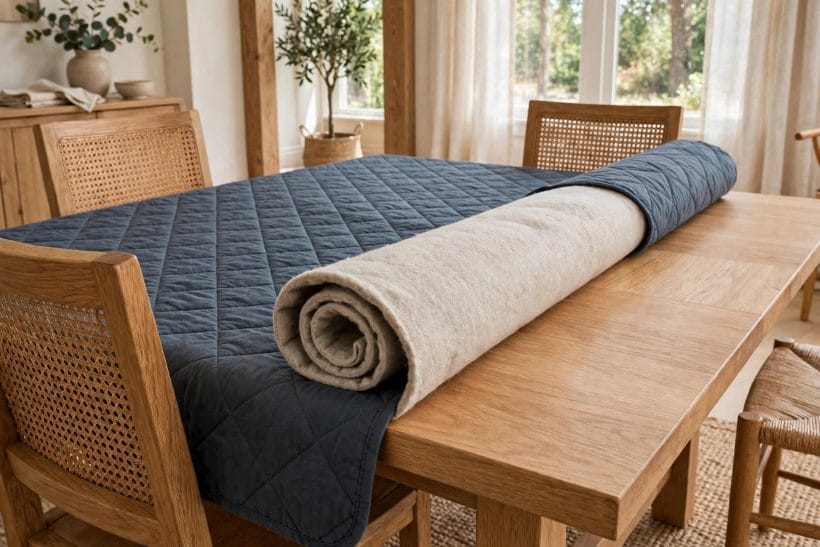
Flex the pad at its folds or joins. Sectional pads fold for storage, and the fold lines are stress points. A fold that already shows whitening or cracking when new will only get worse. Roll-up pads have the same issue at the roll line. If the pad is one piece, check how it bends around the table edge — a stiff pad that cannot follow a rounded edge will lift and catch sleeves and serving dishes.
Also check how the edge looks from a seated position. A thick, raw or mismatched edge is visible from every chair at the table. A neat bound edge in a tone close to the pad’s surface disappears into the setting, which is exactly what table protection should do.
7. Living With It: Cleaning, Storage and Seasons
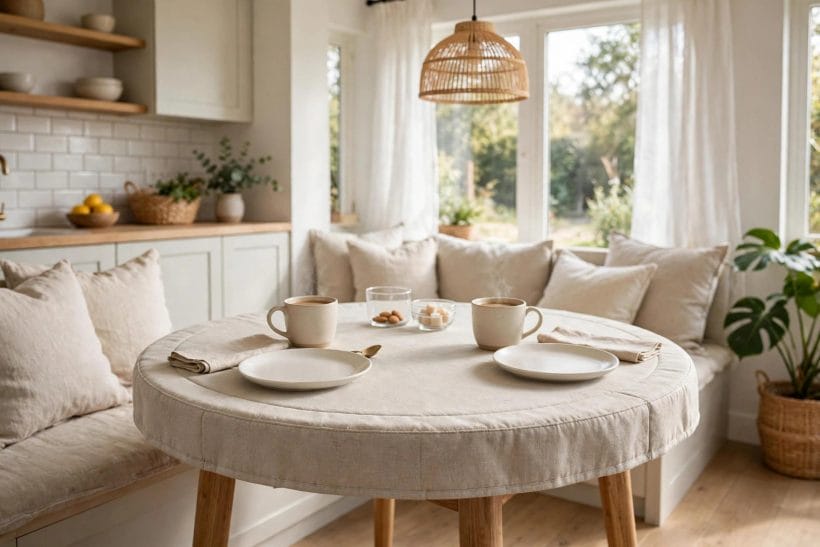
A pad you will not maintain is a pad that will fail. Cleaning should be simple: a damp cloth for daily marks, and whatever deeper clean the maker describes for stubborn stains. If the cleaning routine needs special products, special handling or professional attention, be honest about whether you will keep it up. Pads that go in the wash, where the maker allows it, suit busy households; pads that need hand care suit tables that are used less often.
Storage decides whether the pad survives between uses. A pad that rolls should roll without creasing permanently; a pad that folds should fold along its designed lines; a sectional pad should stack flat without warping. Store it flat or rolled loosely in a dry place, never folded hard against its will and never under heavy objects. Sunlight is an enemy of stored pads as much as of tables — a pad left in a sunny cupboard or against a bright window can fade unevenly and stiffen.
Seasons change the job. In summer, cold drinks sweat and condensation pools; in winter, hot dishes and central heating dry the air. A pad that handles both — moisture on top, dry air underneath — is the one that earns its place year-round. If your table sits near a radiator or a sunny window, check the pad’s surface there first, because heat and light find weaknesses fastest.
8. Looks: When the Pad Is Part of the Room
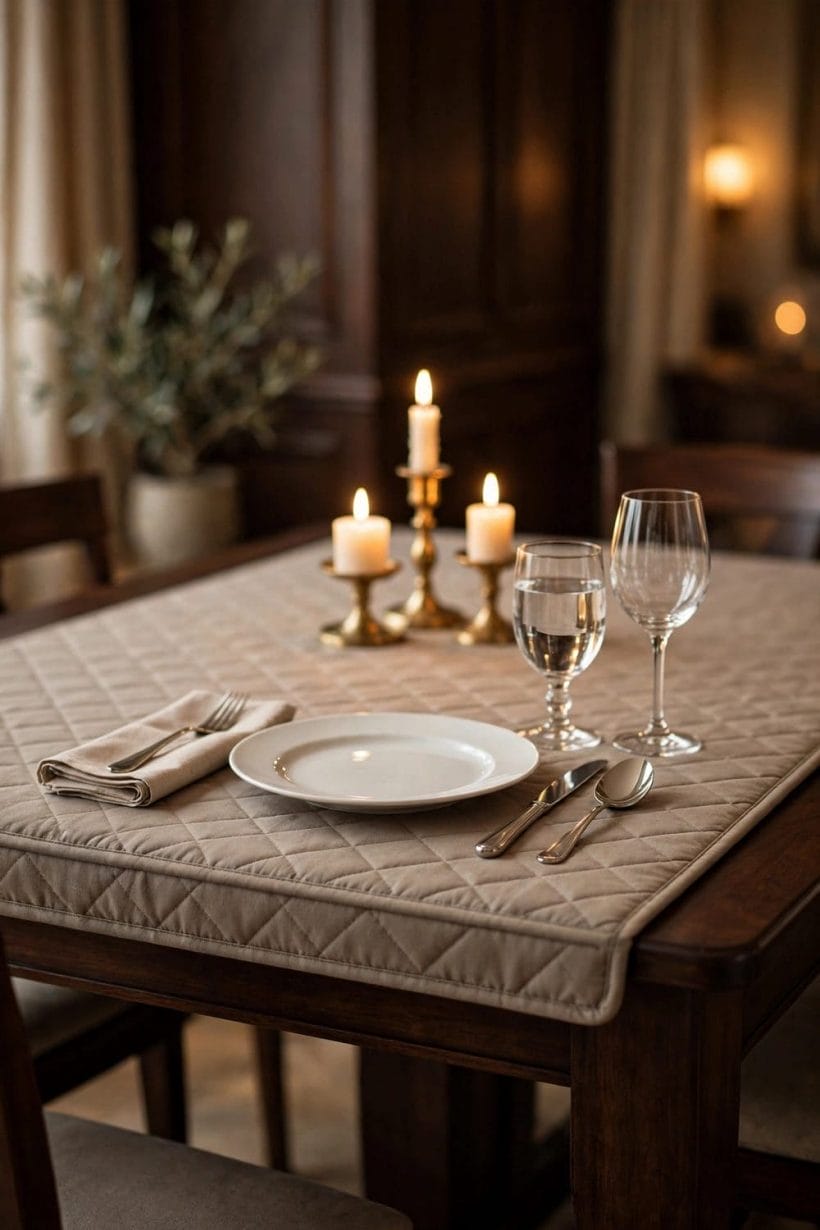
Some pads hide under tablecloths and are never seen. Others are the table’s public face. If yours will be seen, judge it as part of the room: its colour against the wood, its edge against the table’s line, its texture against the chairs and the floor. A pad that matches the room’s palette disappears gracefully; a pad that clashes draws the eye to itself at every meal.
Texture matters as much as colour. A heavily textured pad can fight with patterned placemats or a textured tablecloth, while a smooth pad sits under anything. If you use placemats, test them on the pad: they should stay put without sliding, and their edges should not curl against the pad’s surface. If you use a table runner, check the same — a runner that slips on a smooth pad is a small daily annoyance that adds up.
Consider the occasions too. A pad that looks right for everyday family meals may look wrong for a formal dinner, and the reverse. Sectional pads help here: use the full set for daily life, and lift the sections for occasions when the bare wood should take centre stage. The best-looking pad is often the one you notice least.
9. Special Tables: Leaves, Shapes and Finishes
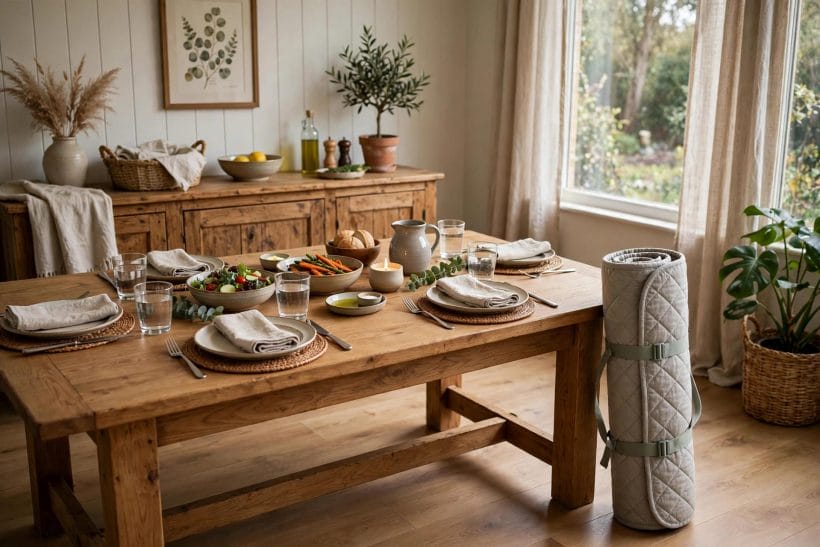
Extending tables need the most thought. A pad must suit the table in each size you use, or you need a plan for which configuration gets protected and which does not. Some households pad the closed table and accept the leaves bare; others pad each section separately. Either approach works if it is decided deliberately rather than discovered mid-meal when a hot dish meets an unprotected leaf.
Round and oval tables need pads cut to their curve, not square pads laid over a round top. The overhang problem is worse on curves: a square corner sticking past a round edge catches everything. Pedestal tables add a different wrinkle — the pad must be positioned without leaning on the pedestal, and a heavy pad can be awkward to centre alone.
Finishes change the rules as well. A hard lacquer tolerates more than a soft wax or oil finish, and a painted table tolerates different risks than a natural wood one. When in doubt, the maker’s guidance for the table’s finish outranks any general advice, and a test patch on an unseen corner outranks both.
10. Buying Without a Recommendation: Your Own Checklist
No guide can recommend a source for you, and this one does not try. What it can do is leave you with a checklist to judge any pad you find, from any maker, in any shop. Walk through it in order: measure the table in every configuration you use; check the fit at edges and corners; press the centre and listen for quiet; test heat and moisture claims against the maker’s guidance; turn the pad over and judge grip and breathability; run your fingers along every edge and seam; confirm the cleaning and storage routine is one you will keep; and judge the looks in your own room’s light.
Ask questions of the maker, not of strangers’ reviews alone: what is the pad made of, what heat and moisture limits does it carry, how should it be cleaned and stored, and what happens to the table’s finish if the pad stays in place for months? A maker who answers those questions plainly is a better sign than any star rating. And keep the receipt and the care guidance together — the pad that is looked after is the pad that protects for years rather than months.
For the wider dining room, the same check-first habit serves everywhere: furniture buying checks for frames and joints, coffee table pictures for low-table styling, and bookcase ideas for the storage that frames a dining space.
Final Considerations
A table pad is a small purchase that guards a large one. Chosen by checks rather than by claims, it lets a dining table live the life it was bought for — daily meals, celebrations, homework, craft projects and all — without carrying every one of those moments as damage. Measure carefully, judge the edges, respect the finish beneath, and the pad will do its quiet job for years.
The dining room around the table matters too: kitchen ideas for the room that feeds it, interior design ideas for the palette it sits in, and tiny house designs for small-space dining that works harder per square foot.




0 Comments