

In a conventional house, an argument ends with a door closing. In three hundred square feet there is no other room, no simmering in separate spaces, no avoiding the conversation until morning. The relationship itself becomes the small space being tested — and the couples who pass the test are not the ones who never fight. They are the ones who built systems for the space.
Tiny House Living for Couples: At a Glance
Couples are the most common tiny house household, which makes tiny house living for couples the movement’s most lived experiment. In 300 square feet there is no storming off to another room and no cooling down in separate wings; proximity is total, and it amplifies whatever a couple brings into it. The thriving couples share no secret except intentionality: they treat communication as part of the floor plan. Territory is designed, alone time is scheduled, fights are given rules, chores are contracted, money is kept transparent, guests are bounded, and the whole arrangement is reviewed on a rhythm. None of this is romance in the greeting-card sense — it is an operating system, and it is learnable. The ten sections below run it in the order a couple meets it: the space rules first, then solitude, conflict, chores, money, guests, intimacy, daily rhythm, the honest failure check, and finally what thriving actually looks like from the inside.
| Topic | What It Covers | Key Fact or Figure |
|---|---|---|
| 1. The Space Rules | Territory in tiny — sovereign space for each partner | Territory disputes are the #1 couple conflict |
| 2. The Alone-Time Protocol | Solitude by agreement instead of by distance | The 20-minute solo walk, daily |
| 3. Fighting Fair at Close Range | Conflict rules built for 300 square feet | Name the feeling within the hour |
| 4. The Chore Contract | Ownership, standards and the nightly reset | The 10-minute nightly reset, together |
| 5. Money | The tiny house financial conversation | Define “big” — $100? $500? — and honor it |
| 6. Guests and Social Life | The third person problem | The 3-day rule for overnight guests |
| 7. Intimacy | The unavoidable topic, addressed directly | Intentional beats hoped-for |
| 8. The Division of the Day | Routines that respect both partners | Negotiated quiet hours for owls and larks |
| 9. When It Is Not Working | The honest check and the responses | Redesign the systems before blaming the match |
| 10. Why Couples Stay | What thriving looks like | “Closer than we have ever been” |
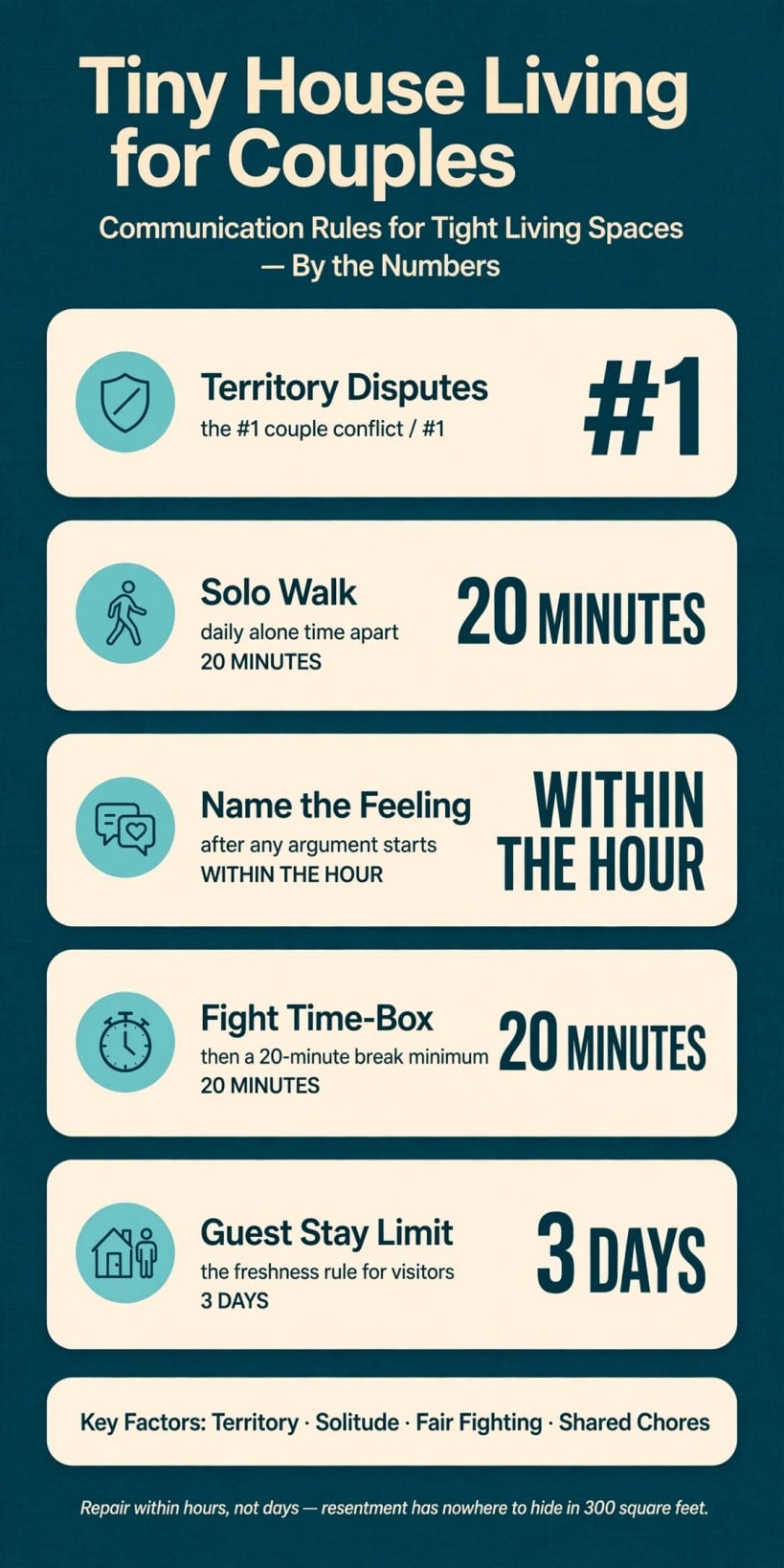
The couple’s operating system by the numbers: territory disputes as the #1 conflict, a 20-minute solo walk, feelings named within the hour, fights time-boxed to 20 minutes, and a 3-day limit on guests.
1. The Space Rules: Territory in Tiny
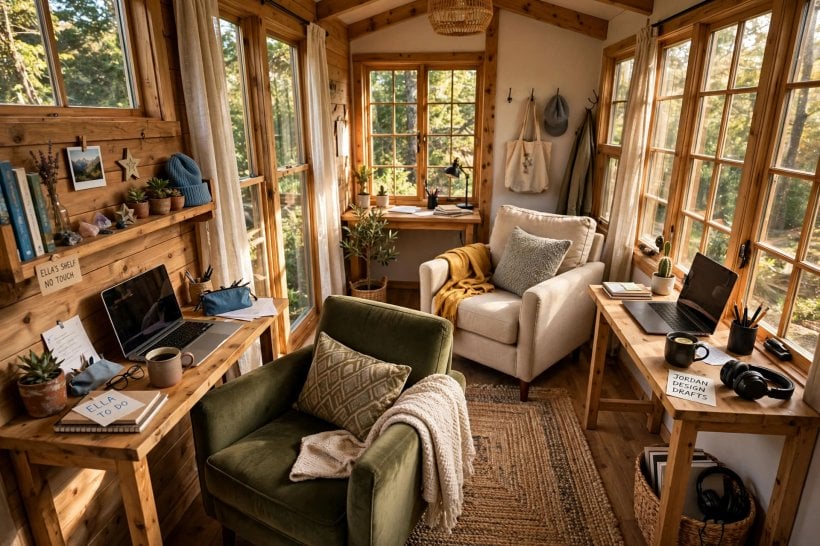
Every partner needs sovereign territory: a chair that is theirs, a shelf nobody reorganizes, a corner for their things. It sounds trivial; it is not — territory disputes are the #1 tiny house couple conflict, disguised as arguments about dishes. The fight about the mug left on the counter is rarely about the mug. It is about whether a person has anywhere in the home that is unquestionably theirs, and in 300 square feet that question gets asked constantly, because every surface is shared by default unless the couple decides otherwise.
Design the house with two of everything that matters: two bedside surfaces, two work spots, two places to sit apart. The layouts that get this right from the first sketch — split sleeping zones, a seat per person, storage divided by owner rather than by category — are collected in our guide to tiny house layouts for couples, and they read differently once you see them as relationship infrastructure rather than floor plans. The principle underneath is simple enough to state plainly: the couple that shares everything shares resentment; the couple with defined territories shares generously, from secure ground. Sovereignty first is what makes the sharing voluntary — and voluntary sharing is the only kind that survives close quarters.
2. The Alone-Time Protocol
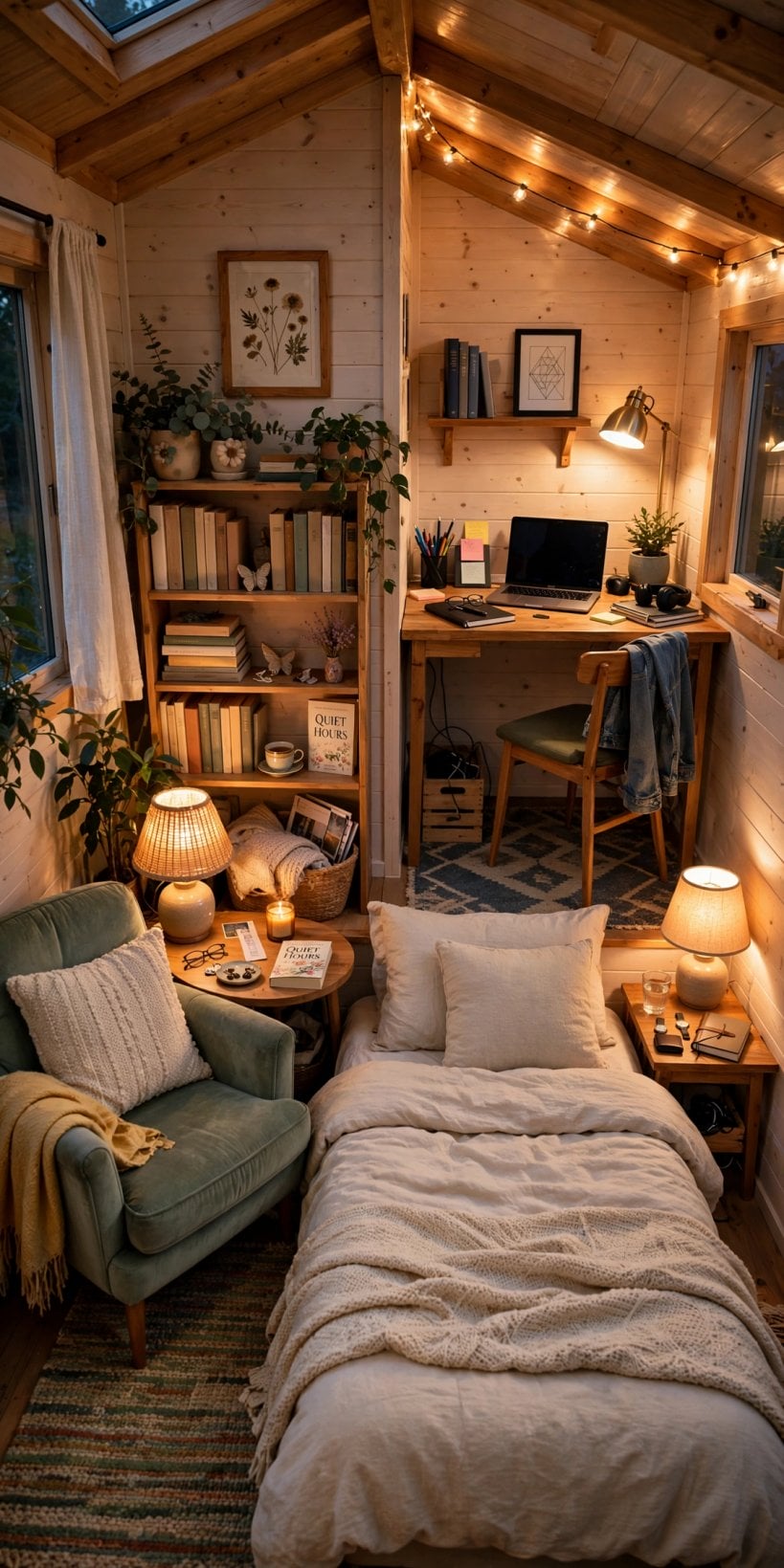
In a conventional house, alone time happens by distance. In a tiny house, it happens by agreement — and the agreement has to be explicit, because the default setting of 300 square feet is togetherness without an off switch. The protocol has four parts. Headphones on means do not disturb: the universal signal, respected absolutely, no exceptions for quick questions. The solo walk is daily and non-negotiable — 20 minutes apart resets more than an hour together. The room rotation gives one partner the house and the other the porch or yard, scheduled rather than fought over. And hobby separation keeps separate interests pursued separately, because the relationship needs outside air.

The physical house can help the protocol hold. Furniture that converts — a table that folds away, a bed that becomes a daytime lounge — lets one small room become two different places across a day, which is the closest a tiny house gets to a door closing; the layouts in our roundup of convertible furniture tiny house plans are full of that trick. But the furniture is the support act. The rule itself is the headliner: couples who schedule apartness stay together; couples who expect constant togetherness burn out.
3. Fighting Fair at Close Range
Conflict in 300 square feet runs under different physics, so it needs its own rules. No silent treatment: impossible to sustain and poisonous at close range — name the feeling within the hour, even if the naming is all you can manage at first. The porch rule: heated arguments move outside, because the walk to the porch cools more than the words heat. Time-box the fight: 20 minutes, then a 20-minute break minimum — flooding shuts down thinking, and small spaces flood fast. No kitchen-sinking: one issue per discussion, because the tiny house punishes the partners who save grievances and unload them in bulk. And repair quickly: the apology within hours, not days — resentment has nowhere to hide in 300 square feet.
None of these rules asks either partner to be less angry. They ask the anger to follow a shape — started honestly, moved somewhere cooler, bounded in time, kept to one subject, and repaired while it is still small. A couple in a big house can afford sloppy conflict; the architecture absorbs it. A couple in a tiny house is the architecture, and the fight has to fit the building it happens in.
4. The Chore Contract
In a tiny house, chores are visible, immediate and constant — and chore imbalance destroys couples faster than any other mundane issue. There is no basement the mess can migrate to and no spare room whose door closes on it; an undone chore sits in the shared eyeline of both partners all day. So the chores get a contract. List every recurring chore — dishes, bathroom, floors, laundry, trash, outdoor, maintenance. Assign primary ownership of each, because “we both do it” reliably means one person does it. Set the standard explicitly: “dishes done before bed” beats “dishes done eventually” every time. And review monthly, rebalancing as life changes.
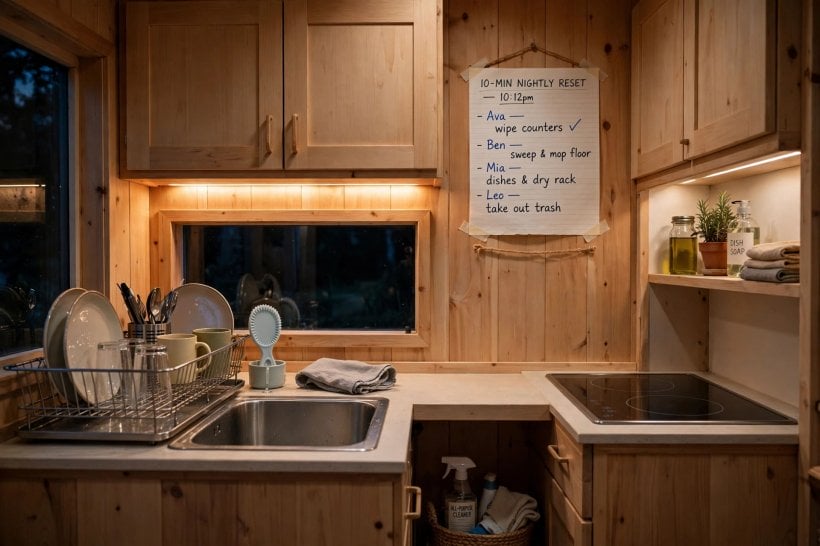
The contract works better when the house itself is on the couple’s side: storage that swallows the daily clutter means fewer visible chores competing for resentment, which is why the systems in our guide to tiny house plans with hidden storage matter to harmony and not just to tidiness. And inside the contract sits one ritual worth naming on its own: the 10-minute nightly reset, done together. It is the relationship ritual disguised as housework — ten minutes of shared effort that leaves both partners waking up to a clean slate, literally.
5. Money: The Tiny House Financial Conversation
Tiny houses simplify money — lower costs, fewer bills — but they concentrate financial decisions: every purchase is visible, and there is no hiding the delivery boxes in a home where both partners can see the whole interior from the door. So the money conversation gets the same explicit treatment as the chores. A shared budget with individual discretionary lines comes first: each partner gets no-questions money, and the amount matters less than the autonomy it protects. Big purchases get discussed — but “big” has to be defined before it is tested, whether the couple’s threshold is $100 or $500, and then honored. And the house fund, a maintenance reserve contributed jointly, treats the house as what it is: the shared project.

How the house itself was paid for shapes this conversation more than most couples expect — a loan payment, a build budget or an outright purchase each leaves a different monthly signature — and the options are compared in our guide to how to finance a tiny house. The deeper principle is the one the small space teaches for free: financial transparency is easier in a tiny house. Make it a feature, not a surveillance system — visibility offered openly builds trust; visibility demanded builds an audit, and nobody thrives in a marriage run like one.
6. Guests and Social Life: The Third Person Problem
A guest in 300 square feet is a third partner in the relationship for the duration of the stay, so guests get rules too. Mutual veto on overnight guests: either partner can say no, with no justification required. Time limits, under the 3-day rule — guests, like fish, have a freshness date, and it comes sooner in tiny houses. The hosting split — who cleans, who cooks, who entertains — agreed before the guest arrives, not negotiated in whispers while they are in the bathroom. And the recovery day: one guest-free day after visitors leave, scheduled rather than stolen.

These rules can sound ungenerous until you have lived the alternative: a guest on the fold-out bed for a week, in the couple’s only room, while both partners perform hospitality on shrinking sleep and no solitude at all. The rules protect the guest too — a visit that ends on day three ends with everyone still fond of each other. Protect the couple’s space fiercely; it is small, and it is precious, and it is the thing every guest is actually visiting.
7. Intimacy: The Unavoidable Topic
Addressed directly, because every couple wonders: thin walls and close quarters require intention, not avoidance. What works starts with scheduling — unromantic on paper, effective in practice, because the planned evening beats the hoped-for moment that the day’s logistics keep eating. The guest protocol runs in reverse: when the couple wants privacy, the signal is clear and respected, the same machinery that protects solitude protecting closeness instead. Sound management is the practical layer — white noise, music, the small technologies of discretion. And honest conversation underlies all of it: needs discussed beat needs assumed.

Couples report that tiny house intimacy is either better — intentional, prioritized — or worse: avoided, awkward. The difference is never the square footage. It is whether the subject is discussed. The tiny house removes the option of drifting into separate routines in separate rooms and letting the question go unasked for months; in 300 square feet, what is not discussed is still present, sitting in the same room. Said out loud, it becomes one more system the couple runs together — and run together is where this house puts everything that matters.
8. The Division of the Day: Routines That Respect Both
Daily rhythm is where the systems meet the clock. Morning people and night owls need negotiated quiet hours: the loft sleeper versus the kitchen early bird is the classic conflict, and white noise plus courtesy solve most of it. Work-from-home boundaries are the modern version — two remote workers in 300 square feet need scheduled call times, headphone discipline, and ideally staggered schedules, because two careers cannot hold meetings in the same room at the same hour. The workstations that make dual remote work survivable are a design problem as much as a communication one, as the setups in our roundup of home office design ideas for tiny houses demonstrate.
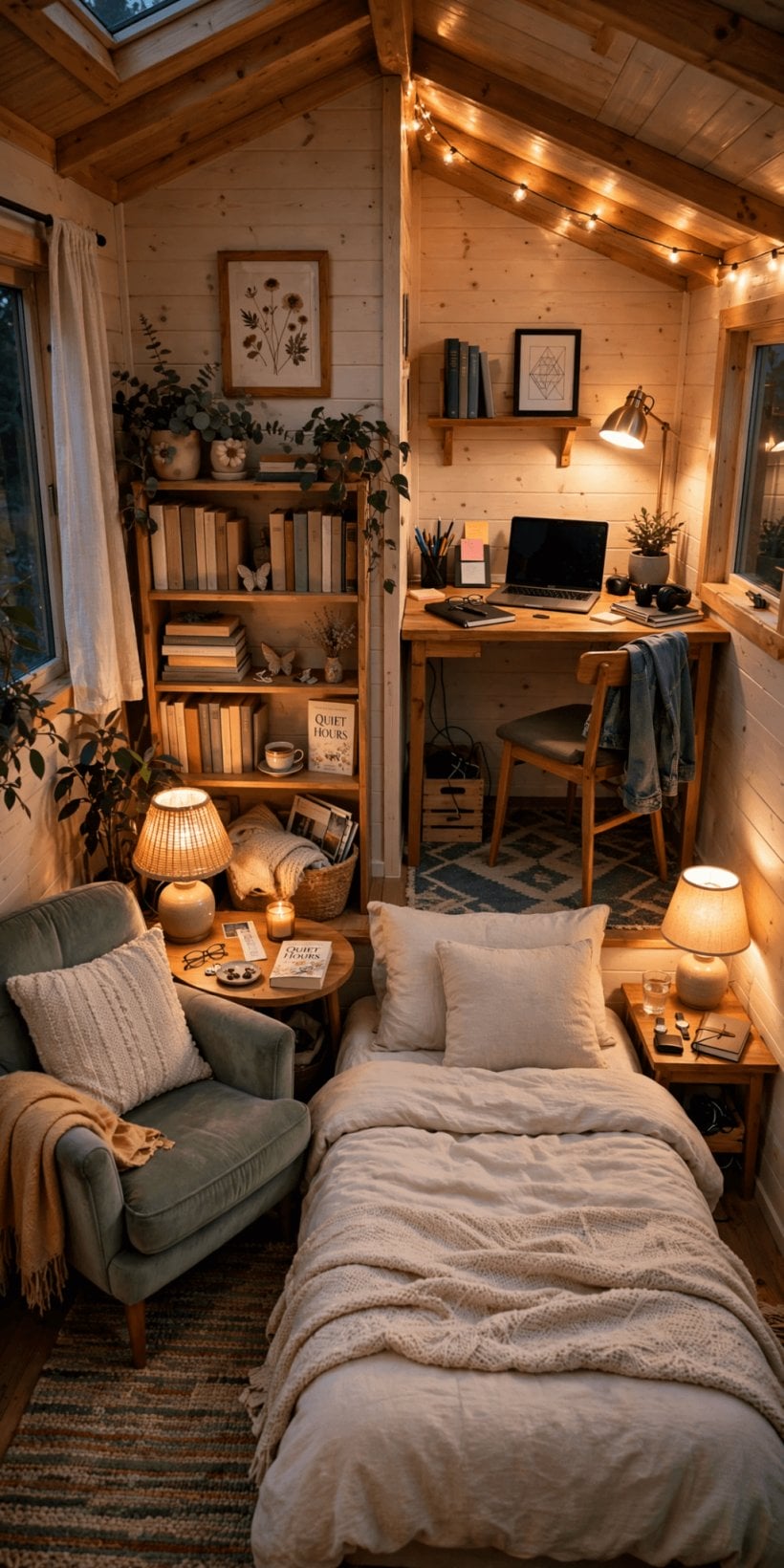
And the evening wind-down closes the day the way the reset closes the chores: a shared ritual — the tea, the porch, the 20 minutes that belong to the couple. Routines are the relationship’s operating system; design them together, and revisit them when work, seasons or health change the inputs. A routine imposed by one partner is a rule. A routine designed by both is a rhythm — and rhythm is what a shared day in one small room runs on.
9. When It Is Not Working: The Honest Check
Sometimes the space is hurting the relationship rather than just testing it, and the warning signs deserve naming. Persistent resentment over territory or chores is a systems failure — redesign, don’t endure. Avoiding home — working late, inventing long errands — means the house itself has become the problem. Fighting about the house instead of in it makes the dwelling a proxy for deeper issues. And the fantasy of separate spaces is data: occasional and normal, constant and vivid is a signal worth respecting.
The responses run in a deliberate order. Redesign the systems first — most issues are design, not compatibility. Try the structured conversation: the weekly 30-minute check-in covering feelings, logistics and appreciation. Consider couples counseling; the tiny house concentrates issues, and a counselor helps unpack them faster. And know that leaving the tiny house is not failing: the house serves the relationship, not the reverse. Couples arriving at tiny living from conventional small homes will recognize most of these failure modes from our guide to how to live in a tiny apartment — the honest check matters at every small scale, and it matters most before resentment becomes the house’s third resident.
10. Why Couples Stay: What Thriving Looks Like
After the rules and the warnings, the question worth ending on is why couples stay — and thrive loudly enough to recommend it. The thriving tiny house couple fights less about stuff, because there is less stuff. They talk more, because proximity forces communication and the skill compounds. They spend intentionally, because the money the small house saves funds the experiences that bond. And they know each other deeply, because 300 square feet is the most honest mirror a relationship can be held up to. The common report, repeated by couple after couple: “we are closer than we have ever been.”
Two disciplines feed that closeness from underneath. The first is the edit: couples who periodically re-curate what the house holds — the method in our guide to the tiny house living declutter transition to 200 square feet — keep the stuff arguments from ever accumulating. The second is remembering that the systems in this guide are not a personality transplant; they are skills, and the wider craft of small living that supports them is laid out in our guide to how to tiny house. The tiny house did not create the closeness. It removed the distance that was hiding the choice — and couples who choose each other daily, in 300 square feet, build something large houses rarely produce: intimacy without escape hatches.
Final Considerations
A tiny house will not fix a broken relationship, but it will reveal a strong one — and make it stronger. The whole system fits into the compact the thriving couples run, and it is worth stating as one list:
- Territory: each partner has sovereign space; it is respected absolutely.
- Alone time: scheduled daily; headphones mean do not disturb.
- Conflict: named within the hour; heated fights go to the porch; repair within hours.
- Chores: explicitly assigned, standards stated, reviewed monthly.
- Money: shared budget, individual discretionary lines, purchase thresholds honored.
- Guests: mutual veto, time limits, recovery day after.
- Check-in: 30 minutes weekly — feelings, logistics, appreciation.
That compact is the whole argument of this guide to tiny house living for couples: designed territory, scheduled solitude, fair fighting, explicit chores, honest money, guarded privacy, and the weekly check-in. The small space is the strictest relationship teacher and the most rewarding one. Learn its lessons together.


0 Comments