
When a conventional house is out of reach, two products do most of the actual rescuing — and they could hardly be more different under the skin. The mobile home, in its modern form the manufactured home, is a factory industry: built indoors on a production line, to a single federal building code, in sizes that run to real family floor plans. The tiny house is a craft product: built one at a time, like a small house, sometimes on a foundation and sometimes on wheels, with no single code or factory behind it. They photograph similarly in listings, they overlap in price at the small end, and they are cross-shopped constantly — while differing in nearly everything that decides an ownership experience over ten years.
This comparison takes the two in the order their differences bite: build standards first, then cost per square foot, financing, placement, and appreciation and land ownership — with space and daily life, resale, and running costs after. Anyone comparing tiny house vs mobile home options is really comparing two ownership shapes as much as two buildings: a factory product with its own code, loans and land economics, versus a small house that behaves like property wherever the law lets it. The verdict at the end follows from those shapes, not from the floor plans.
1. Tiny House vs Mobile Home at a Glance
The table below scores the five headline dimensions head-to-head, plus the two practical ones — space and best use — that shoppers actually argue about at the kitchen table. The sections that follow put the working behind every row.
| Criterion | Tiny house | Mobile (manufactured) home |
|---|---|---|
| Build standard | No single code. On a foundation, built to local residential code like any house; on wheels, vehicle-adjacent with voluntary certification options. Quality is builder-specific. | One federal standard — the HUD code — for every factory-built unit, with in-factory inspection and a certification label on each home. The baseline is consistent nationwide. |
| Cost per square foot | Higher, often much higher: one-off or small-batch labour, custom design, residential materials bought at small scale. | Lower — typically the cheapest enclosed square foot in housing, bought with factory scale, production lines and standardised plans. |
| Financing | A patchwork: RV-style or personal loans for wheeled units, ordinary mortgages only where a foundation build is code-compliant and titled as property. | An established ladder: chattel loans for the home alone, mortgage-style products when home and land are purchased and titled together. |
| Placement | Zoning-dependent everywhere. Wheels complicate legality; a foundation and a dwelling classification regularise it, parcel by parcel. | A mature placement system: manufactured-home communities and parks nationwide, plus wide acceptance on private land subject to local rules. |
| Appreciation and land | Follows the placement. On owned land as a legal dwelling it can share the land’s behaviour; on wheels it behaves like a depreciating vehicle asset. | The structure alone generally depreciates on a vehicle-like curve. Paired with owned land, the land does the appreciating and can carry the package. |
| Space and layout | Compact by definition: the product is smallness, designed around one or two occupants. | Generous by design: multi-bedroom, family-scale layouts are the industry’s standard catalogue. |
| Best for | Minimal footprint, custom quality, and buyers bringing their own land or a legal placement. | Maximum space per dollar inside an established system of codes, loans and communities. |
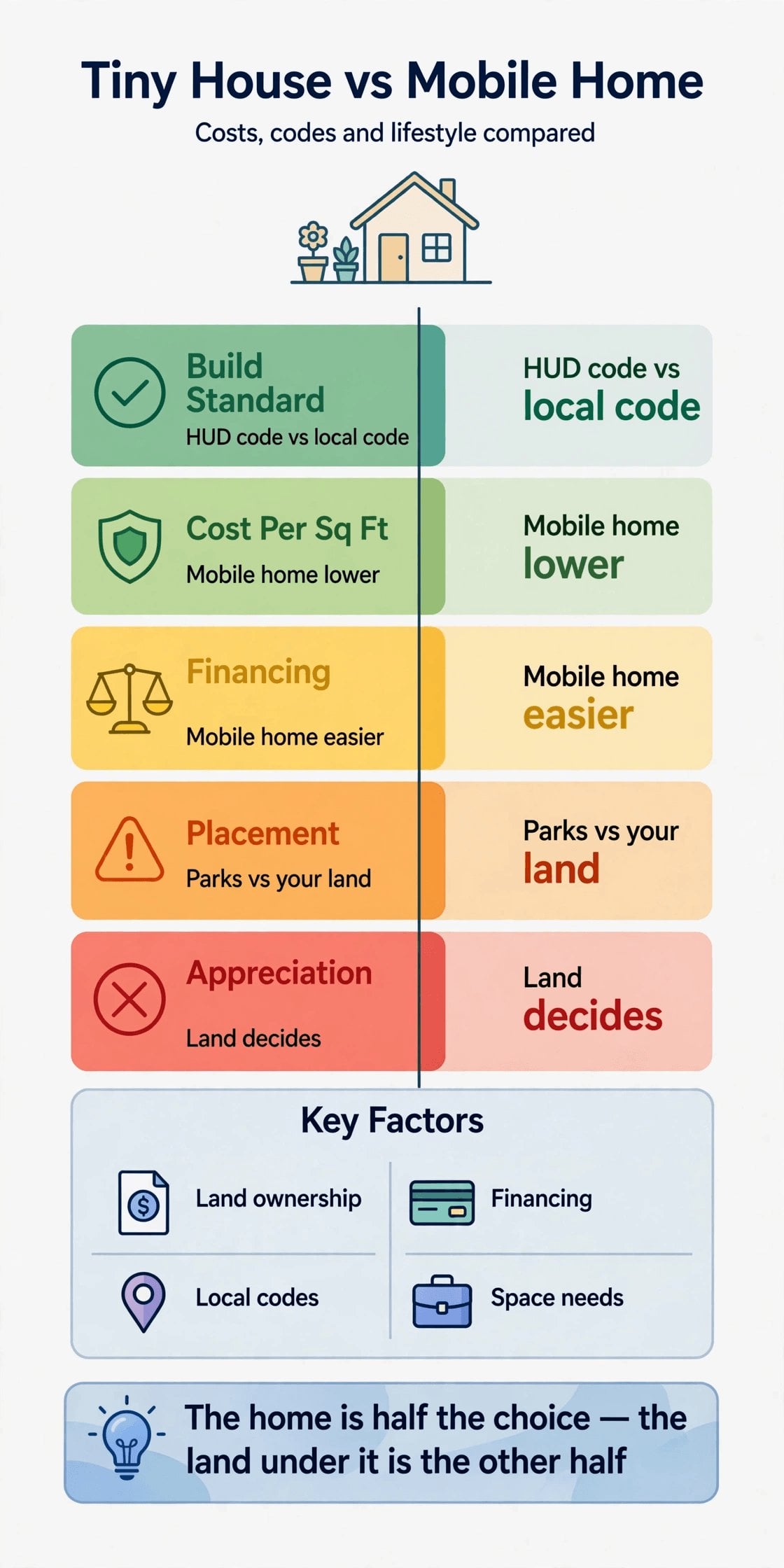
Infographic: the five dimensions in one view — code, cost, loans, placement and land.
2. The Two Contenders: Two Answers to the Same Housing Problem
Vocabulary first, because the manufactured industry renamed itself and the old word stuck. Strictly, “mobile home” describes units built before the federal HUD code took effect in the 1970s; everything factory-built since is a manufactured home, built to that code whether it ever moves again or not — and most are placed once and never do. Surviving pre-code mobile homes still trade at the budget end of the market, and buyers should know which side of that line a cheap listing sits, because code, financing and insurability all change across it. The tiny house has the opposite vocabulary problem: no legal definition at all. It is a size and an intention — a dwelling of a few hundred square feet — delivered either as a tiny house on wheels (THOW) on a trailer chassis, or as a small foundation home assessed like any other house. The used and new stock of both products overlaps in our guide to tiny homes for sale near me, which is a fair place to calibrate what the two markets actually ask side by side.
Why the comparison matters now is simple arithmetic: both products are entry points to ownership for buyers priced out of conventional housing, and both are marketed with the same words — affordable, own your home, escape rent. The escape is real in both cases, but the machinery differs. The manufactured home plugs into an existing national system of factories, lenders, communities and resale channels. The tiny house plugs into the ordinary housing system where it is allowed to, and improvises where it is not. Every dimension below is that difference at work.
3. Build Standards: HUD Code vs Local Residential Code
The manufactured home’s defining feature is not its size or its factory — it is its code. The HUD code is a single federal standard for factory-built housing that pre-empts local building codes for the structure itself: design, structure, fire safety, plumbing, electrical, energy and installation-adjacent requirements are set nationally, production is inspected inside the factory by third-party agencies, and each home carries its certification label and data plate as permanent identity. The practical buyer benefits are uniformity and verifiability. A manufactured home in one state is built to the same rulebook as one in another; a used unit’s standard can be checked from its label rather than taken on trust; and lenders and insurers deal with a product they can classify without investigation.
The tiny house answers to two different rulebooks depending on its feet. On a foundation, it is simply a small house: the local residential code applies in full — structure, egress, energy, services — inspected on site in the ordinary way, and the finished home is a dwelling in law with everything that follows for financing, insurance and resale. On wheels, it leaves the building-code world entirely: no mandatory housing code governs it in most jurisdictions, quality is whatever the builder chose, and voluntary certification schemes exist to fill the gap for buyers who want a standard to point to. The result is a quality distribution with a high ceiling and a low floor — the best tiny houses exceed code houses in craft, and the worst answer to nobody — against the manufactured home’s narrower, guaranteed band.
For buyers, the standard you choose is the verification work you sign up for. With a manufactured home: confirm the label and data plate, match identity paperwork, and know that the code conversation is settled. With a foundation tiny house: the local inspection record is the paper trail to ask for. With a wheeled tiny house: the builder’s documentation, certification if any, and your own inspection carry the whole weight — there is no label to rescue a careless purchase. Neither system is “safer” in the abstract; they distribute diligence differently, and Section 9 returns to what that means at resale.
Pin it: one product carries its code on a label; the other carries it in the builder’s file — know which homework you are buying.
4. Cost per Square Foot: The Factory Advantage and Its Limits
Per square foot, this dimension is the least competitive in the comparison. The manufactured home is built the way cars are built: a production line, standardised plans refined over decades, materials bought by the trainload, labour specialised by station. That machinery produces the cheapest enclosed, serviced, code-inspected square foot in the housing market, and no craft process competes with it. The tiny house is built the way furniture is built: one design, one crew, materials at retail or trade-small scale, and residential detailing priced by the hour. Its cost per square foot lands in site-built territory and often beyond it, because small buildings carry the same kitchens, bathrooms and systems as large ones spread across far fewer feet.
Total cost tells the fairer story, because the products sell different amounts of house. A manufactured home’s low rate buys a large plan — and then asks for its own additions: transport from factory or seller, installation on piers or a foundation system, utility connections, skirting and steps, and (in a community) the lot beneath it on monthly terms. A tiny house’s high rate buys a very small plan, and its additions mirror the container and park-model lessons of this series: site work, hookups, and the placement solution itself. Compare all-in cost for the life you will actually live — a small household may find the tiny total lower despite the punishing rate; a family will find the manufactured total astonishing value for bedrooms no tiny house attempts.
The discipline is to refuse the seduction of both headline numbers: the manufactured sticker that excludes installation and land, and the tiny rate that ignores how few feet it multiplies. Build the full column for each — purchase, delivery, installation or site work, connections, and the first year of placement costs — and the comparison turns honest, which is all this section asks.
5. Financing: Mortgages, Chattel Loans and the Title Question
Financing follows classification, and the manufactured system has spent decades building its ladder. At the first rung, the home alone — typically on rented land or land not part of the loan — is financed with a chattel loan: vehicle-style lending secured by the home as personal property, faster and simpler than a mortgage, priced accordingly. At the second rung, home and land bought together and permanently installed can be titled as real property and financed with mortgage-style products, including the mainstream government-backed channels that serve manufactured housing specifically, with their own property and installation conditions. Age and code status gate the ladder: lenders commonly restrict older and pre-code units, which is one more reason Section 2’s vocabulary matters at purchase.
The tiny house ladder is shorter and must be climbed case by case, as our guide to how to finance a tiny house maps in full. A foundation tiny house, code-inspected and titled as a dwelling, can enter the ordinary mortgage world subject to appraisal and minimum-size realities. A wheeled tiny house finances like the vehicle-adjacent asset it is — RV-style or personal lending, shorter terms, and lenders who vary from enthusiastic to absent. Cash, builder arrangements and staged self-funding fill the remaining gaps in this market.
The title question is the section’s practical core, because it decides which ladder exists: is the home personal property with a vehicle-style title, or real property on a deed? Ask it of any unit before admiring it. The same physical house can sit on either side of that line depending on installation and paperwork, and its loan options, tax treatment and resale mechanics all change across it. Sellers who cannot answer the title question are telling you something about the file you would inherit.
6. Placement: Parks, Communities and Your Own Land
Placement is where the manufactured home’s system advantage is most visible. A national sector of manufactured-home communities exists to receive these homes: serviced lots, installation standards, management, and a tenancy product designed for exactly this structure — the same lot-rent economics examined in our park-model coverage, with the same discipline required: price the lot across years, read the community rules and increase history, and understand the resale-in-place conditions before buying. The comparison of tenancy models in our guide to tiny house communities vs RV parks and the listings reachable through our tiny home communities locator show the landscape both products share at this layer.
On private land the roles partially reverse. A manufactured home is a recognised dwelling class: subject to local zoning, minimum-size, foundation and appearance rules that vary widely, it is placeable on owned land across much of the country, and our guide to where to buy tiny house lots and land covers the parcel-hunting side of that plan. A wheeled tiny house, by contrast, is placeable as a dwelling on private land in only a minority of jurisdictions; its reliable land route is the foundation version, assessed as a small house or accessory dwelling where local rules allow. Buyers whose dream is specifically “my land, my tiny home” should expect the foundation conversation — and buyers whose dream is “a home, in a community, soon” are describing the manufactured product’s home turf.
Either way, the placement rule of this whole series applies unchanged: the legal home for the home is confirmed, in writing, before the home is bought. Communities approve incoming units and owners; zoning offices answer parcel questions free. The sequence costs a week. Its absence has cost buyers in both markets very much more.
7. Appreciation and Land Ownership: The Asset Question
Here the two products’ reputations collide, so take the mechanics slowly. A manufactured home standing alone — on a rented lot, titled as personal property — has historically behaved on a vehicle-like curve: it depreciates, fastest early, because the buyer pool finances it as chattel, the structure ages as a product, and the land beneath it, the appreciating component of ordinary housing, belongs to someone else. That is not a moral judgement on the housing; it is what the asset is. Owners who buy a manufactured home on rented land as shelter economics — lower monthly cost than renting an equivalent — do fine. Owners who buy it expecting house-style appreciation hold the wrong instrument.
Attach land and the picture reorganises. A manufactured home permanently installed on owned land, titled with it as real property, rides the land’s value behaviour, and the package can appreciate as property does — with the structure as a depreciating component inside an appreciating whole, much like any ageing house on good land. The tiny house traces the same fork with its own geometry: on wheels it is the vehicle-curve asset of Section 3’s world; on a foundation on owned land it is a small dwelling whose value follows the parcel and the local market for small legal homes. The legal-community cases in our guide to tiny house villages and legal communities show the shared ingredient in every appreciating small-home story: secure, legal tenure of the ground.
So the asset question is never really “which building appreciates?” — buildings mostly don’t. It is “what land position does this purchase give me, and what does the structure cost me while I hold it?” The manufactured home offers the cheapest route to a land-plus-home package in many markets and the most seductive route to a landless one. The tiny house offers land positions only through the foundation door. Choose the land first and the building second, and both products behave exactly as advertised.
8. Space, Layouts and Daily Life
Daily life is where the manufactured home stops apologising. Its catalogue is family infrastructure: separate bedrooms with doors, a bathroom that fits a tub, storage in every wall, a kitchen a household can cook in nightly, and room for the furniture of ordinary life. For households of three or more, or anyone whose life includes children, elders, large dogs or working from home at an actual desk, the tiny house’s discipline reads less like minimalism and more like deprivation — the honest trade at the centre of this comparison. The manufactured product also lives like the house it is: full-size systems, conventional heating and cooling such as the units in our mini-split installation guide, and skirting and insulation details — see our tiny house skirting options guide, the same physics on a smaller trailer — that reward the standard homeowner maintenance rhythm.
The tiny house’s daily-life counter is quality and intention. Where the manufactured interior is standardised for cost, the tiny interior is designed for a specific life: better materials per foot, built-ins fitted to the owner’s actual possessions, the appliance intelligence of our compact kitchen appliances guide applied with intent, and the psychological dividend many owners report from a space that contains their life exactly. It is a one-or-two-person product and does not pretend otherwise; judged as one, its daily life can be genuinely superior. Judged as a family home, it loses, and no amount of storage ingenuity changes the verdict.
The lifestyle layer cuts both ways as well. Manufactured communities offer neighbours, amenities and a settled social infrastructure; tiny living offers the aesthetic and locational freedom its culture celebrates. Neither is a tiebreaker for everyone — which is precisely why this dimension sits after the five structural ones: codes, costs, loans, placement and land will usually have decided the matter before taste is consulted.
Pin it: the manufactured home wins the floor plan; the tiny house wins the fit — households should count people before they count features.
9. Resale, Moving and the Paperwork Layer
Resale machinery mirrors financing machinery. The manufactured home sells inside its own established market: dealers, community in-place sales, and listing channels that understand the product, with value driven by age, condition, code status — and above all by placement, since an in-place home with an approved transfer sells the site with the structure, while a home sold for removal shrinks its buyer pool to those with land and a moving budget. That moving budget is the category’s hidden tariff: manufactured homes are transportable in the industrial sense, at professional cost, with route, permit and reinstallation work that can rival the value of an older unit, and some communities and lenders restrict moves and incoming ages in ways buyers must check before assuming portability. The inspection routine in our walkthrough on how to inspect a used tiny home before buying is the buyer’s version of the file your own sale will one day face, whichever product you choose.
The tiny house resells as the previous sections predict: foundation homes through the ordinary property market, wheeled homes through the niche one — slower, thinner, more dependent on documentation and certification. Insurance follows the same split, set out in our tiny house insurance guide for wheels vs foundation: the manufactured home’s HUD identity makes it a known product to insurers from the first phone call, while the wheeled tiny house still introduces itself in every conversation.
Paperwork is thus the shared closing skill: titles matched to units, labels and data plates photographed, installation and permit records kept, community approvals in writing. In both markets the documented home sells faster and higher than the identical undocumented one. File-keeping is not administration; it is resale value being manufactured at home.
10. Running Costs and Maintenance Over a Decade
Over ten years, the monthly gap between the products is smaller than the purchase gap. Both are single-storey, modest-volume homes with one of everything: one heating system, one water heater, one set of appliances. The manufactured home’s larger volume costs more to heat and cool in raw terms, though modern HUD-code energy requirements have narrowed what was once a wide efficiency gap — verify the specific unit’s insulation and systems rather than buying the stereotype in either direction. The tiny house’s small volume is cheap to condition, and its custom envelope can be excellent or ordinary depending on the builder of Section 3. Utilities in communities may be metered, included or passed through on either product; read the specific terms. The plumbing and systems logic in our tiny house plumbing layout guide is the shared anatomy both products maintain.
Maintenance divides by manufacture. The manufactured home maintains from catalogues: standard-size components, a national parts trade, community-recommended contractors, and known weak points (roof systems, underbelly and skirting, ageing plumbing materials in older units) that inspectors recite from memory. The tiny house maintains from its builder’s choices: residential-standard parts in the good builds, bespoke everything in the idiosyncratic ones. Neither decade is free; the manufactured decade is more predictable, the tiny decade more variable — one more expression of system versus craft.
Budget honestly for both: an annual maintenance reserve, the mid-life replacements (roof treatment, water heater, heating and cooling service) that arrive on schedule in any small home, and, in communities, lot-rent growth across the decade, which remains the single largest running-cost variable in either product when it applies. The purchase price decides the first year. These lines decide the tenth.
Final Considerations
Pick the manufactured home if your household needs real rooms and a family floor plan, if you want the established machinery — a federal code on a label, lenders with a ladder for you, communities built to receive the home — and if you will handle the land question knowingly: ideally buying land with the home, or renting the lot with your eyes open about what a structure alone does over time. Pick the tiny house if your household is one or two people, if craft, design and a minimal footprint are the point rather than the compromise, and if your route to land is a foundation placement you have confirmed legal before building or buying. The two classic errors are symmetric: a manufactured home bought on a rented lot as an “investment”, and a wheeled tiny house bought with no legal place to park it. Avoid those, match the product to the household size and the land, and both of these much-maligned housing forms do exactly the honourable job they were built for — putting a owned roof over people the conventional market priced out.


0 Comments