

You moved into a tiny house to cut the rent, not the grades. Between classes, work shifts and life in 200 square feet, your GPA is the number that quietly decides your scholarships, your financial aid and your next opportunity — and it is built from just three ingredients: your letter grades, their grade points, and the credit hours behind them.
1. GPA at a Glance
This page’s GPA calculator does the arithmetic instantly, but the method fits on an index card. Every letter grade converts to points on a standard 4.0 scale, each course’s points are weighted by its credit hours, and the totals divide into a semester GPA and, with your prior record added, a cumulative GPA.
| Attribute | Detail |
|---|---|
| The Tool | Free semester and cumulative GPA tool for tiny house students |
| The Scale | The standard scale: A = 4.0 to F = 0.0 |
| The Inputs | Course name, letter grade, credit hours |
| Credit Hours | Typically 3–4 credits; labs 1–2, intensive 5+ |
| The Formula | Total grade points ÷ total credits |
| Semester GPA | The current semester’s courses, weighted and averaged |
| Cumulative GPA | Prior record blended with the new semester |
| The Scholarship Line | Most scholarships require a minimum GPA of 3.0–3.5 |
| The Aid Floor | Satisfactory Academic Progress: usually a 2.0 minimum |
| The Honors Band | Dean’s List and honors typically sit at 3.5–4.0 |
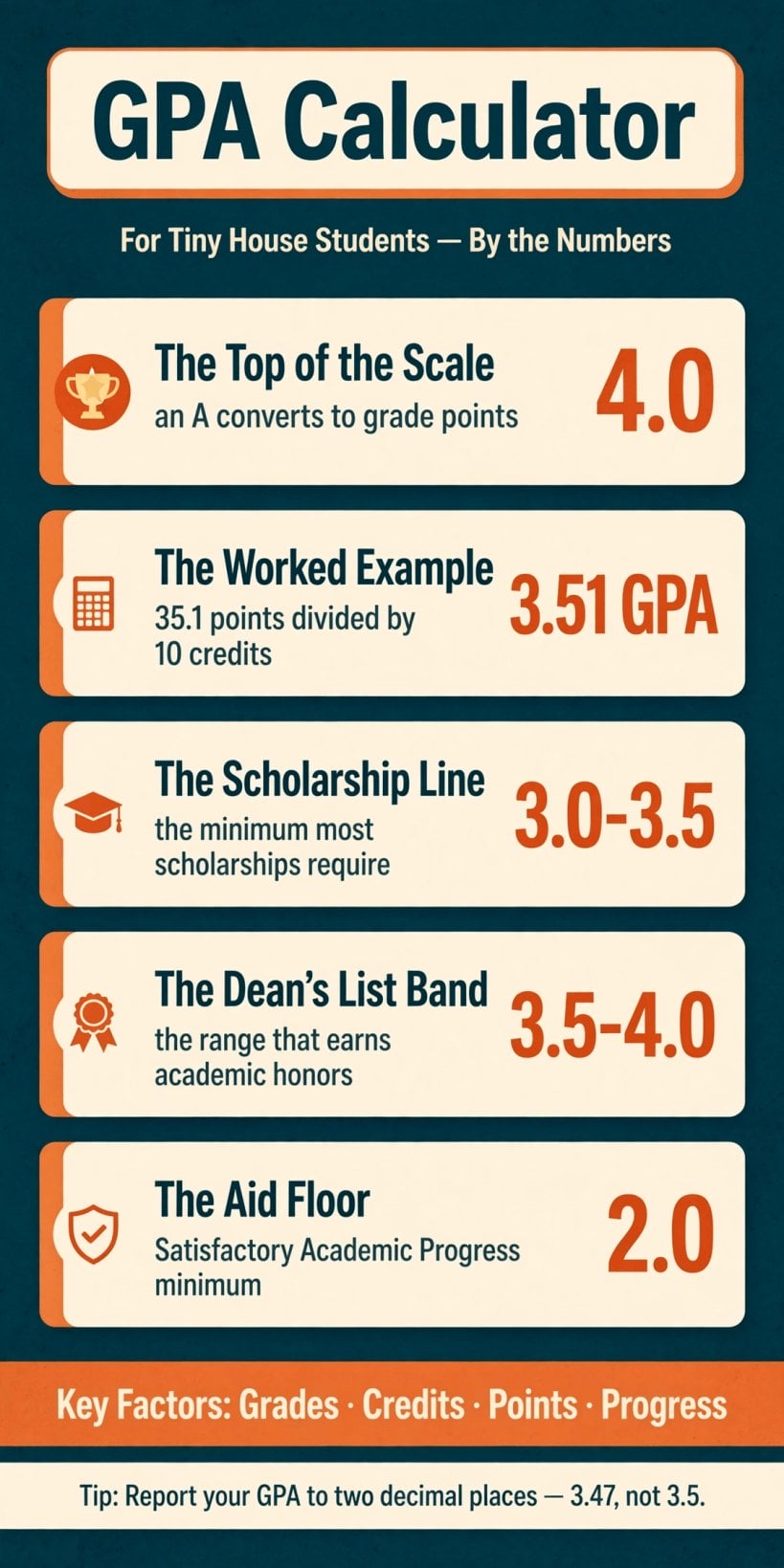
A 4.0 atop the scale, a 3.51 worked example, and the scholarship, honors and aid lines in between.
2. The Grade-Point Scale: What Each Letter Is Worth
Every calculation starts with the same conversion: on the standard scale, an A is worth 4.0 points, an A- 3.7 and a B+ 3.3, stepping down through B (3.0), C (2.0) and D (1.0) to an F at 0.0. Plus and minus grades fill the gaps — B- 2.7, C+ 2.3, D+ 1.3 — so a near-miss still moves your average by the fraction it earned.

3. Credit Weighting: Why Courses Are Not Equal
Credit hours decide how much each grade counts. The formula multiplies each grade’s points by the course’s credits, adds the products, and divides by total credits — so a four-credit B pulls harder than a one-credit lab A. The worked example: an A in a 3-credit course earns 12 points, a B in a 4-credit course 12 points, and an A- in a 3-credit course 11.1 points — 35.1 points over 10 credits, a 3.51 GPA.

4. Semester GPA vs. Cumulative GPA
A semester GPA covers one term — this semester’s courses, weighted and averaged. A cumulative GPA covers your whole degree so far. Blend them by adding two optional numbers — prior cumulative GPA and prior total credits — and the new semester folds in at its proper weight. One strong term lifts a long record slowly; one weak term early, when few credits stand behind it, moves it fast.

5. The Lines That Matter: Scholarships, Aid and Honors
Three thresholds turn a GPA from a statistic into a budget line. Many scholarships require a minimum of 3.0 to 3.5 to keep funding. Federal financial aid runs on Satisfactory Academic Progress, usually a 2.0 minimum. Dean’s List honors typically recognize 3.5 to 4.0, and most graduate programs ask for 3.0 or better. Know your nearest line, and you know what each grade is worth.

6. GPA Goals by Academic Year
The guide below sets a rising target for each year: 3.0 or better as a freshman building study habits; 3.2 as a sophomore; 3.3 as a junior in upper-division courses; 3.5 as a senior finishing with capstones and job applications. The pattern matters more than any single term: an upward trend is what the cumulative figure reveals.
7. The Study Zone: Where the Grades Are Made
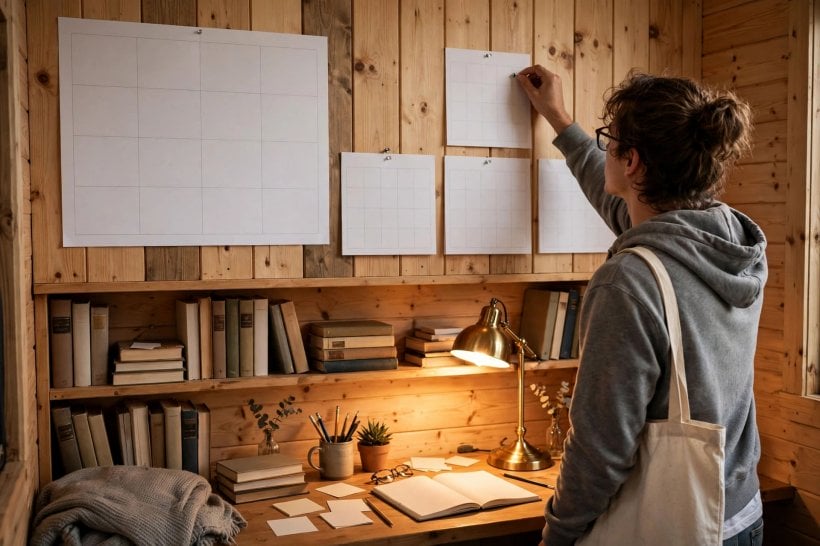
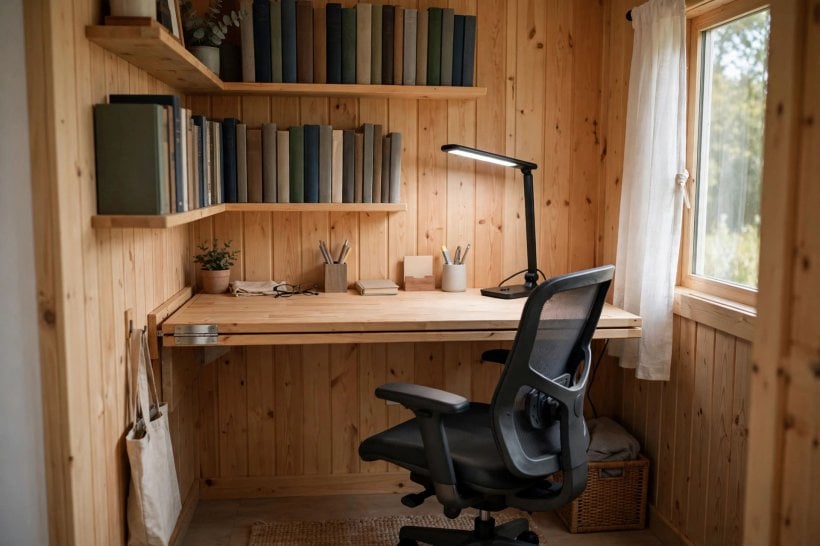
In 100 to 200 square feet, living space and study space are the same space, so divide them deliberately: a fold-down desk that takes up zero space when folded, a proper chair, an LED lamp and wall-mounted shelves make one corner a study zone with a mental trigger: sit there, and it is time to focus. The systems in our tiny house organization strategies and these decluttering ideas keep that corner clear.
8. Raising a GPA That Is Slipping
If the number comes back lower than you need, the levers are practical: many schools replace an F when you retake the course, easier electives can balance a brutal semester, and office hours, study groups and campus tutoring centers exist precisely for this. Supplemental learning helps too — see the online tiny house design and building courses. Fine print: report your GPA to two decimal places, 3.47 rather than 3.5, and a W withdrawal never touches the figure.

9. Your House Is Small; Your Record Does Not Have to Be: The Tiny GPA Calculator
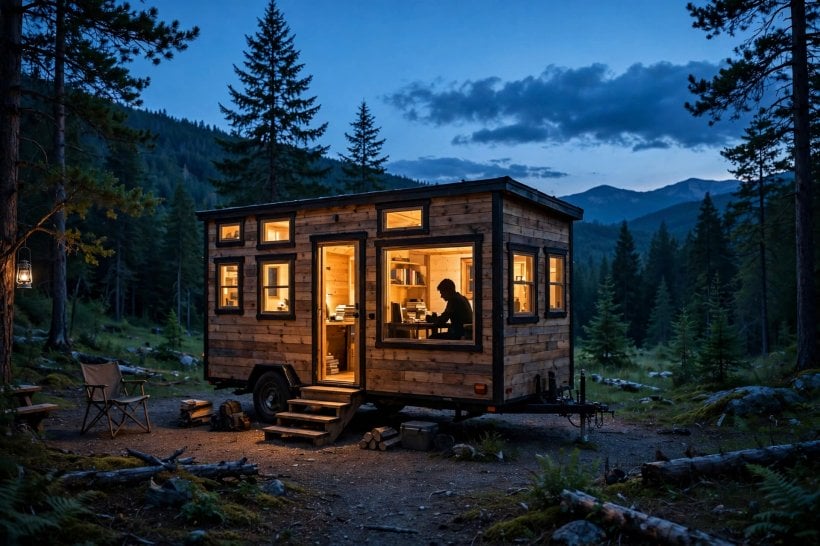
You chose the small house on purpose — the guide below prices that choice at $1,150 to $1,850 saved a month against dorms and apartments, money that never becomes student debt — the heart of the pros and cons of living in a tiny house. The tool protects the other half of the bargain. Enter your courses, check the semester figure, fold it into your cumulative record — and file ‘tiny address, tiny ambitions’ with the other tiny house myths. New to the lifestyle? The 10 must-know tips to kickstart your tiny house adventure are the place to start.
Living in a tiny house while pursuing your college degree? Our free GPA Calculator helps you track your academic progress with ease. Calculate semester GPA, cumulative GPA, and monitor your credits—all while embracing the tiny house student lifestyle.
Whether you’re living off-grid, in a tiny house village, or parked on campus, this tool helps you stay organized and focused on your educational goals. Perfect for students seeking financial freedom through alternative housing while earning their degree.
Tiny House Student GPA Calculator
Track your academic progress while living small.
Current Semester
Cumulative GPA (Optional)
The Tiny House Student Guide
Living in a tiny house off-grid is an amazing way to save money during college, but online courses require stable internet. If you are parked remotely, invest in Starlink or a dedicated 5G hotspot with an external antenna.
Studying in bed or on the couch reduces productivity. Designate a specific “Study Zone” in your tiny house. A fold-down desk attached to the wall takes up zero space when not in use, but provides a mental trigger that it’s time to focus.
Tiny house living and college success go hand-in-hand.
If you're a college student living in a tiny house, you're already making smart financial decisions. Why pay $800-1,200/month for a dorm room or apartment when you can own your home for a fraction of the cost? But living small doesn't mean sacrificing academic excellence.
Our Tiny House Student GPA Calculator is designed specifically for students like you who are:
- 📚 Balancing academics with alternative living
- 💰 Saving money by avoiding traditional housing costs
- 🏡 Living in tiny houses, RVs, or converted vans near campus
- 🎓 Tracking their GPA to maintain scholarships and academic standing
- 🌱 Pursuing sustainable lifestyles while earning a degree
Read also: 50 Tiny House Kitchen Ideas to Make Your Space Feel Bigger
This free tool helps you calculate both semester GPA and cumulative GPA instantly, so you can focus on what matters: your education and your tiny house journey.
How to Use the GPA Calculator
Step 1: Add Your Courses
Click the "Add Course" button to create rows for each class you're taking this semester. You can add as many courses as needed.
For each course, enter:
- Course Name: e.g., “Sustainable Architecture 101” or “Tiny House Design”
- Grade: Select from A (4.0) to F (0.0) using standard GPA scale
- Credits: Typically 3-4 credits per course
Step 2: Select Your Grades
Choose the letter grade you received (or expect to receive) for each course:
Standard GPA Scale:
- A = 4.0
- A- = 3.7
- B+ = 3.3
- B = 3.0
- B- = 2.7
- C+ = 2.3
- C = 2.0
- C- = 1.7
- D+ = 1.3
- D = 1.0
- F = 0.0
Step 3: Enter Credit Hours
Most college courses are worth 3-4 credit hours. Lab courses might be 1-2 credits, while intensive courses could be 5+ credits.
Step 4: Calculate Your GPA
Click the "Calculate GPA" button to instantly see:
- ✅ Semester GPA: Your GPA for current courses
- ✅ Total Credits: How many credits you’re earning this semester
- ✅ Cumulative GPA: Your overall GPA (if you enter prior data)
Step 5: Track Cumulative GPA (Optional)
To calculate your overall college GPA:
- Enter your Prior Cumulative GPA
- Enter your Prior Total Credits
- The calculator automatically computes your new cumulative GPA
Read also: 50 Curated Modern Tiny House Designs You’ll Love
Why Tiny House Students Need a GPA Calculator
1. Scholarship Requirements
Many scholarships require maintaining a minimum GPA (typically 3.0-3.5). Track your progress to ensure you don't lose funding.
2. Financial Aid Eligibility
Federal financial aid requires "Satisfactory Academic Progress" (SAP), usually a 2.0 GPA minimum. Stay on top of your grades to maintain aid.
3. Graduate School Applications
Planning to pursue a master's or PhD? Most graduate programs require a 3.0+ GPA. Monitor your progress early.
4. Dean’s List & Academic Honors
Achieve recognition by maintaining high GPAs (typically 3.5-4.0 for Dean's List).
5. Career Opportunities
Many employers ask for GPA on applications, especially for entry-level positions. A strong GPA (3.5+) can set you apart.
The Tiny House Student Advantage
Living in a tiny house while attending college offers unique benefits:
Financial Freedom
Traditional Housing Costs:
- Dorm room: $800-1,500/month
- Apartment: $600-1,200/month
- Food plans: $300-500/month
- Total: $1,700-3,200/month
Tiny House Living Costs:
- Tiny house payment: $300-500/month (if financed)
- Parking/land: $0-400/month (campus, RV park, or private land)
- Utilities: $50-150/month (minimal)
- Food: $200-300/month (full kitchen)
- Total: $550-1,350/month
Potential Savings: 1,150-1,850/month or 13,800-22,200/year!
Reduced Student Debt
By living in a tiny house, students can:
- Graduate with 50-70% less debt
- Own their home outright by graduation
- Avoid the “rent trap” that drains finances
- Build equity instead of paying landlords
Better Study Environment
Tiny houses offer advantages over dorms:
- ✅ Quiet space: No noisy roommates
- ✅ Personal kitchen: Healthy eating on a budget
- ✅ Customized workspace: Design your perfect study nook
- ✅ Better sleep: Control temperature, light, and noise
- ✅ Mental health: Your own sanctuary reduces stress
Sustainability & Values
Many tiny house students choose this lifestyle because it aligns with their values:
- 🌍 Smaller carbon footprint
- ♻️ Minimalist, intentional living
- 🌱 Connection to nature (especially off-grid setups)
- 💚 Environmental responsibility
Where Can College Students Park Tiny Houses?
Read: The Pros and Cons of Living in a Tiny House
On-Campus Options
Some progressive universities now allow:
- Designated tiny house parking areas
- RV lots that accept tiny houses on wheels
- Student housing alternatives programs
Universities with Tiny House Programs:
- University of Texas (Austin) – Village Farm nearby
- Appalachian State University (NC) – Tiny house research
- Portland State University (OR) – Alternative housing support
- University of California campuses – ADU-friendly policies
Read also: 37 Monster House Designs That Are Seriously Spooky
Off-Campus Solutions
1. RV Parks & Campgrounds
- Monthly rates: $400-700
- Full hookups (water, electric, sewer)
- Near many college towns
- Flexible lease terms
2. Private Land Rental
- Craigslist, Facebook Marketplace
- Farmers and homeowners with extra land
- Rates: $200-500/month
- Often includes utilities
3. Tiny House Communities
- Purpose-built villages near colleges
- Community of like-minded students
- Shared amenities and study spaces
- Examples: Village Farm (Austin), Acony Bell (NC)
4. Family Property
- Park on parents’ or relatives’ land
- Minimal to no cost
- Commute to campus
5. Backyard ADUs
- Rent someone’s backyard
- New ADU laws make this easier
- Urban locations near campus
Study Tips for Tiny House Students
Create a Dedicated Study Zone
Even in 100-200 square feet, designate a specific area for studying:
- Fold-down desk: Mounts to wall, saves space
- Good lighting: LED desk lamp with adjustable brightness
- Ergonomic seating: Invest in a quality chair
- Storage: Wall-mounted shelves for textbooks
Manage Internet Connectivity
Online courses and research require reliable internet:
Options for Off-Grid Students:
- Starlink: $120/month, works anywhere
- 5G Hotspot: $50-100/month with external antenna
- Campus WiFi: Park close enough to access
- Coffee Shop Routine: Study at cafes with free WiFi
- Library Access: Use campus library for intensive work
Time Management in Small Spaces
Living and studying in the same space requires discipline:
- ✅ Set boundaries: “Desk time” vs. “relaxation time”
- ✅ Use timers: Pomodoro technique (25 min work, 5 min break)
- ✅ Go outside: Take study materials to parks or campus
- ✅ Establish routines: Wake/sleep schedules maintain focus
Minimize Distractions
- Keep your tiny house clean and organized
- Use noise-canceling headphones
- Turn off phone notifications during study sessions
- Create a “study mode” ritual (music, lighting, etc.)
Financial Aid & Tiny House Living
FAFSA Considerations
When filing your FAFSA (Free Application for Federal Student Aid):
- Housing Status: You may qualify as “independent” if you own your home
- Asset Reporting: Tiny houses under $10,000 may not need reporting
- Cost of Attendance: Lower living costs can affect aid calculations
Tip: Consult your school's financial aid office about how tiny house ownership affects your aid package.
Scholarships for Alternative Living
Some organizations offer scholarships for students pursuing sustainable lifestyles:
- Tiny House Expedition Scholarship
- Sustainable Living Foundation Grants
- Alternative Housing Research Awards
Maintaining Academic Success While Living Tiny
GPA Goals by Academic Level
Freshman Year (3.0+ Goal)
- Establish good study habits
- Adjust to college rigor
- Build foundation for future courses
Sophomore Year (3.2+ Goal)
- Declare major
- Increase course difficulty
- Maintain upward GPA trend
Junior Year (3.3+ Goal)
- Upper-division courses
- Internship opportunities
- Graduate school prep
Senior Year (3.5+ Goal)
- Capstone projects
- Job applications
- Strong finish for transcripts
How to Raise Your GPA
If your GPA needs improvement:
- Retake Failed Courses: Many schools replace F grades
- Take Easy Electives: Balance hard courses with GPA boosters
- Attend Office Hours: Build relationships with professors
- Form Study Groups: Collaborate with classmates
- Use Campus Resources: Tutoring centers, writing labs
- Manage Your Time: Living tiny = fewer distractions
Read: 44 Lavish Tiny Houses Revolutionizing Compact Living
Common Questions About GPA Calculation
What is a good GPA?
- 4.0: Perfect (A average)
- 3.5-3.9: Excellent (Dean’s List)
- 3.0-3.4: Good (Most scholarships/grad schools)
- 2.5-2.9: Average (Satisfactory progress)
- 2.0-2.4: Below average (Academic probation risk)
- Below 2.0: Poor (Risk of dismissal)
How is GPA calculated?
Formula: (Total Grade Points) ÷ (Total Credits)
Example:
- Course 1: A (4.0) × 3 credits = 12 points
- Course 2: B (3.0) × 4 credits = 12 points
- Course 3: A- (3.7) × 3 credits = 11.1 points
- Total: 35.1 points ÷ 10 credits = 3.51 GPA
Does a W (Withdrawal) affect GPA?
No, withdrawals don't impact GPA but do affect:
- Financial aid (completion rate requirements)
- Time to graduation
- Transcript appearance
Can I round my GPA?
Generally, no. Report GPA to two decimal places (e.g., 3.47, not 3.5).
Resources for Tiny House Students
Finding Parking Near Colleges
- Campendium: RV park reviews
- iOverlander: Free camping spots
- Craigslist: Private land rentals
- Facebook Groups: “Tiny House [Your City]”
- University Housing Offices: Ask about alternatives
Academic Success Tools
- RateMyProfessors: Choose the best instructors
- Quizlet: Study flashcards
- Grammarly: Writing assistance
- Khan Academy: Free tutoring
- Coursera: Supplemental learning
Tiny House Student Communities
- Reddit: r/TinyHouses, r/college
- Facebook: Tiny House Students group
- Instagram: #TinyHouseStudent
- YouTube: Tiny house student vlogs
Read: 10 Must-Know Tips to Kickstart Your Tiny House Adventure
Conclusion
Living in a tiny house while pursuing your college degree is one of the smartest financial decisions you can make. By eliminating expensive housing costs, you can focus on what truly matters: your education, your future, and your freedom.
Use our Tiny House Student GPA Calculator to stay on top of your academic progress. Track your semester GPA, monitor your cumulative GPA, and ensure you're meeting your goals—all while enjoying the benefits of tiny house living.
Your tiny house is more than just a home—it's an investment in your education and your future.



0 Comments