

Most of us guess at our environmental footprint, and most of us guess wrong — the biggest impacts hide in dinner, heating and the daily drive. This sustainable living quiz turns vague green guilt into a number: seven parts, five domains, one honest score in global hectares — and the ranked moves that shrink it fastest.
1. Sustainable Living Quiz at a Glance
The ecological footprint is the land and sea area needed to support a lifestyle — everything you eat, heat, drive and buy, converted into one unit: the global hectare. This assessment scores five domains — food, housing, transport, goods and services — and reads the total against two reference points: the average American footprint of ~8 gha and the sustainable share of ~1.6 gha per person. The gap between your score and that share is the mission; the domain scores tell you where the gap actually lives.
| Attribute | Detail |
|---|---|
| The Unit | Global hectares (gha) — the land and sea area a lifestyle requires |
| The Average American | ~8 gha |
| The Sustainable Share | ~1.6 gha per person |
| The Food Domain | ~25% of the average footprint — the diet lever |
| The Housing Domain | ~20% of the average footprint — the shelter lever |
| The Transport Domain | ~20% of the average footprint — the mobility lever |
| The Goods Domain | ~20% of the average footprint — the stuff lever |
| The Services Domain | ~15% of the average footprint — the shared infrastructure |
| The Score Bands | Mostly highs 6–8 gha · Mixed 3–5 gha · Mostly lows under 2.5 gha |
| The Method | Score each domain honestly, attack the biggest lever first, re-measure yearly |
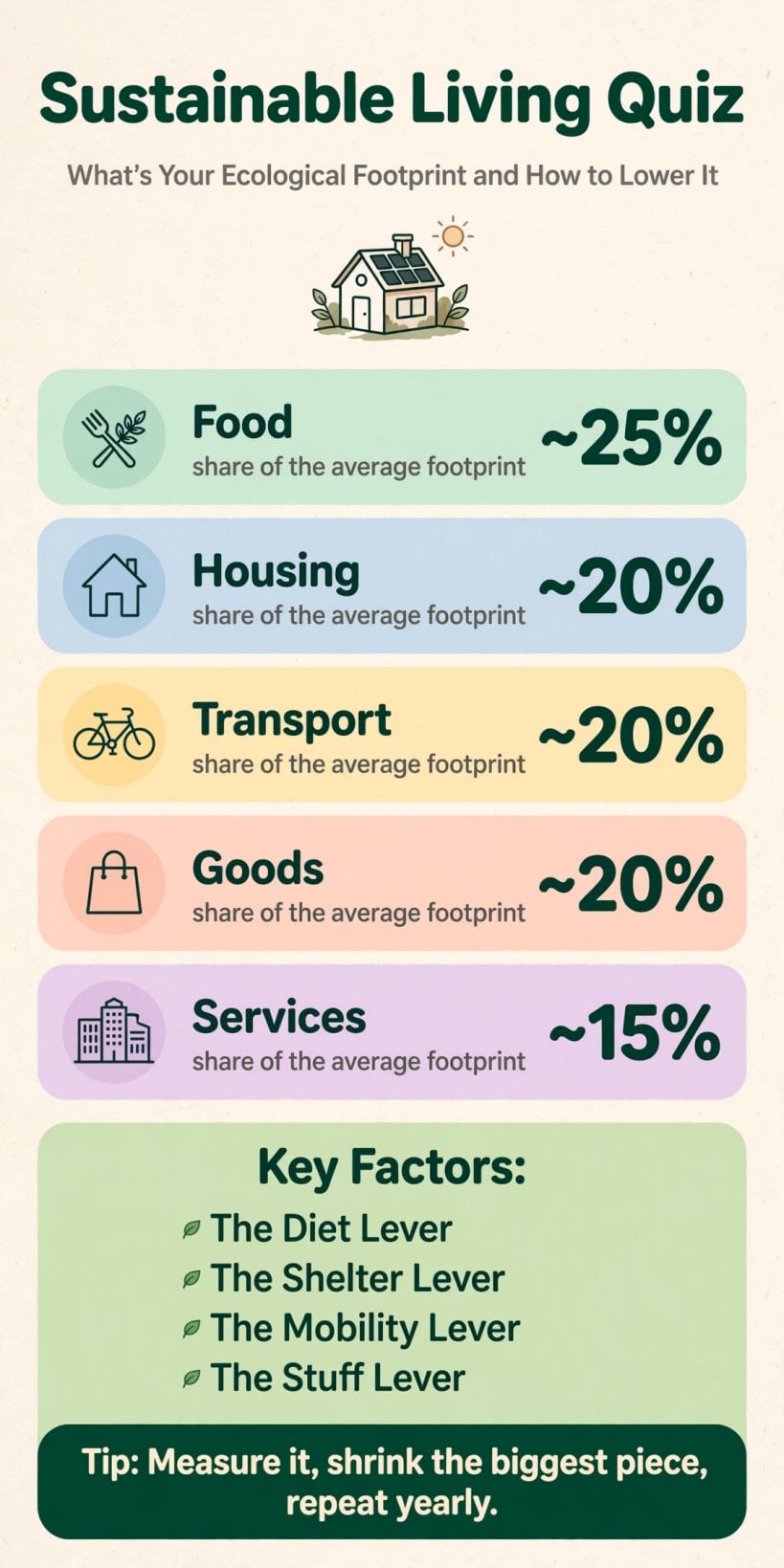
Five domains, two reference numbers: ~25% food, ~20% each for housing, transport and goods, ~15% services — measured against ~8 gha average and the ~1.6 gha sustainable share.
Read the table as a map, not a verdict. Four of the five domains sit within reach of personal decisions — what you eat, how much space you heat, how you move, what you buy — and each carries a named lever in the sections that follow. The fifth, services, is shared infrastructure that no individual controls, which is why an honest score is a starting line rather than a shame number. Answer each domain’s questions as you actually live, not as you aspire to live: the arithmetic only helps if it is true.
2. How the Footprint Works: Five Domains, One Number
A footprint assessment works because it separates a lifestyle into the systems that actually consume land and sea area. Food is the largest single domain at ~25% of the average footprint, because every meal carries the land that grew it, the feed behind the animal products and the energy of the supply chain that delivered it. Housing follows at ~20%: a home is not a one-time purchase but a continuous draw — construction embodied in its materials, then heating, cooling and electricity for every year it stands.
Transport matches housing at ~20%, driven by car dependence: the vehicle, the fuel and the road network behind the daily miles. Goods account for another ~20% — the consumption domain, where every manufactured object carries embodied carbon from extraction, production and shipping. Services close the account at ~15%: the shared infrastructure of a society — roads, schools, hospitals, public administration — divided across everyone who uses it, and the hardest domain for any individual to change directly. Together the five domains explain why two people with the same income can carry very different footprints: the total is set less by how much you spend than by how your food, shelter, mobility and buying are structured.
Taking the assessment honestly means scoring the ordinary week, not the best one. Answer each domain for the life you actually lead — the usual meals, the usual commute, the usual thermostat setting — because the number’s only value is as a baseline you can measure change against. Read it the same way each year: the same five domains, the same unit, the same two reference points of ~8 gha and ~1.6 gha. A footprint that is re-measured on a consistent method becomes a trend line, and a trend line is what turns a one-off score into evidence about which of your changes actually worked.
3. Food: The Diet Questions
The food questions start with meat frequency, because it is the steepest gradient in the domain. The scale runs daily → weekly → rarely, and each step down cuts the food footprint by roughly 20%. Within meat itself, the species matters: the beef-to-chicken swap alone halves meat emissions, so a household that keeps meat but changes its source has already moved its food score before touching anything else. Score where your ordinary week honestly sits — not the holiday week, not the aspirational one.

The second question is sourcing. Local and seasonal food — the farmers market, the garden — shortens the chain between field and plate: fewer food miles, less packaging, and produce picked at ripeness rather than shipped green. The third question is waste, and it is the domain’s biggest free win: the average household wastes nearly a third of its food — the 30% problem — which means a third of the land, water and energy behind the shopping is spent growing food nobody eats. Meal planning attacks the inflow, buying what the week will actually use; the scraps that remain go to compost rather than landfill, following the same cycle as the composting guide to turning organic waste into soil. Score yourself on the full arc: the daily beef eater sits at the high end; the plant-forward, local, low-waste eater at the low end — and the diet remains the single biggest personal lever in the whole assessment.
4. Housing: The Shelter Questions
Housing begins with size, measured as square feet per person — because a footprint follows the floorplan. The original comparison is stark: 400 sq ft heated in a small home against 2,500 sq ft in a conventional one. Every heated square foot is volume that a heating system must hold at temperature all winter, so the shelter score starts with how much space your household actually conditions. If you are unsure what small-space living really involves dimensionally, the breakdown of how much square footage a tiny house has puts real numbers on the small end of the scale.
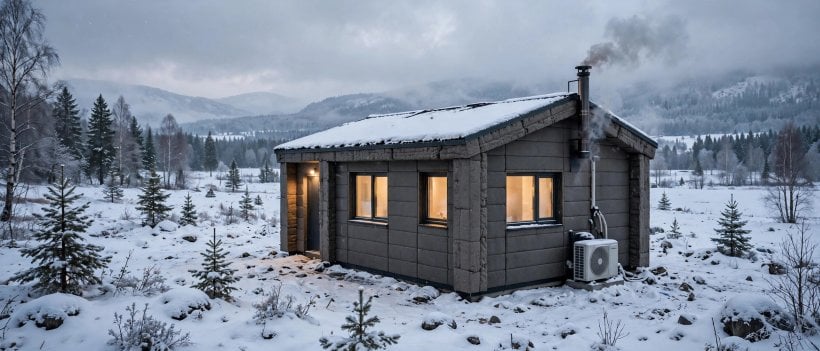
The second question is the energy source — the origin of the electrons. A home drawing on a coal-heavy grid carries a different footprint from the same home under rooftop solar, and the heating system multiplies the difference: a heat pump moves heat rather than burning fuel for it, while a furnace converts fuel directly. For a sense of the baseline a small home draws before any of these choices, see how much energy a tiny house uses. The third question is the climate lever inside the home: the thermostat setting, the insulation that decides how hard the system works to hold it, and the wood stove’s renewability where wood heat is used. Score the arc honestly: a large grid-powered home scores high; a small, solar-powered, efficient space scores low.
5. Transport: The Mobility Questions
Transport opens with the odometer. The average driver logs 12,000+ miles a year, and those miles are the transport core of the footprint — every one of them burns energy, whether it comes from a fuel tank or a battery charged from the grid. The first question is simply volume: how many miles does your ordinary year actually contain, commuting included? A shorter annual total beats an efficient vehicle driven constantly, because the domain counts miles first and machinery second.

The second question is the vehicle itself — its efficiency class. The original states the gap plainly: the truck versus the e-bike is a 25× energy gap per trip, which is why micro-mobility changes the domain so dramatically when it replaces car trips rather than adding to them. The comparison of sustainable micro-mobility across e-bikes, cargo bikes and velomobiles works through which machine fits which trip. The third question is flying, the multiplier: one long-haul flight can exceed a full year of driving in footprint terms, so a single annual long-haul trip can outweigh a careful year of local choices — the honest accounting the rail alternative answers where it exists. Score the arc: the solo car commuter with annual flights scores high; the bike or velomobile rider who flies rarely scores low.
6. Goods: The Consumption Questions
The goods questions begin with the buying rate — the inflow. Every new object arrives carrying embodied carbon: the materials extracted, the factory energy, the shipping. Fast fashion and short-lived gadgets sit at the heavy end of the inflow because they are bought often and discarded young; the buy-it-for-life alternative reverses the arithmetic, paying the manufacturing cost once and spreading it across decades of use. The first question is therefore not what you buy but how often the stream of new things enters the house.

That embodied cost is worth unpacking, because it is invisible at the checkout. The extraction stage takes the raw materials out of the ground or the forest; the production stage shapes them with factory energy; the shipping stage moves the finished object — and then its packaging — across whatever distance separates the factory from your door. A cheap object replaced every year pays all three stages annually, while a durable one pays them once. This is why the goods domain rewards boring virtues: weight, repairable construction, standard parts and materials that age rather than fail.
The second question is the secondhand share — the thrift percentage. Every used purchase skips the manufacturing stage entirely: the embodied carbon was spent by the first owner, and the object simply continues its service life. The third question is repairability, the fix habit: the repaired item versus the replaced one, and the tools and skills that decide which of those two outcomes a broken object gets. A household that can mend clothing, re-glue furniture and replace a part instead of a product holds its goods domain down structurally. Score the arc: constant new consumption scores high; minimal, durable, secondhand buying scores low.
7. Services: The Shared Domain You Don’t Control
Services are the footprint of living in a society at all: the roads graded and lit, the schools and hospitals heated, the water treated, the public administration run — ~15% of the average footprint, divided across everyone. Unlike the other four domains, there is no question in this section that changes your score much, because the infrastructure exists whether or not you use a given piece of it. That is precisely why the domain belongs in an honest assessment: it sets the floor beneath every individual score.

Understanding the services domain protects the whole exercise from two errors. The first is despair: if ~15% of the average footprint is locked into shared systems, then perfection was never available, and a score above the sustainable share is partly a property of the society around you, not only of your choices. The second error is excuse-making: the four controllable domains still total roughly 85% of the average footprint, so the levers in your hands are the large majority of the number. Score services as it stands — everyone carries it — and let it calibrate your expectations for the total rather than excuse the domains you do control. Where an individual does touch this domain, the contact is indirect: shared systems shrink per person when they are well used and well shared — full buses, busy libraries, connected neighbourhoods spread the same infrastructure across more lives. Your score will not move much on this line, and it is not meant to; the domain’s role in the assessment is honesty about the floor.
8. Your Results: Reading the Score
Add the domains and read the total against the three bands. Mostly highs place you with the average Westerner at 6–8 gha — the 4–5 Earths lifestyle, meaning humanity would need four to five planets if everyone lived this way. Treat that band as the starting point, not the shame: it describes the default settings of an ordinary modern life, the water most people are swimming in before they measure anything.

A mixed pattern lands at 3–5 gha — the transition band: the conscious score, where some domains have been redesigned and others still run on defaults, and the momentum matters more than the position. Mostly lows score under 2.5 gha — the footprint leader’s territory, approaching the sustainable share of ~1.6 gha and standing as proof the low bands are reachable inside a real life. And the honest footnote to every band: perfection is not the goal. The system constrains choices — the services domain alone guarantees that — so the direction of travel matters more than the number on any single reading.
9. The Highest-Leverage Moves: Shrink It
The original ranks the reductions by impact, and the order is the strategy. First, ditch the second car for micro-mobility — the transport lever, removing an entire vehicle’s miles and embodied cost from the household. Second, shift the diet plant-ward — the food lever, riding the steepest gradient in the largest domain. Third, power the home with renewables — the energy lever; the sizing question behind it is worked through in how much solar power a tiny house needs, and the principle scales to any roof.
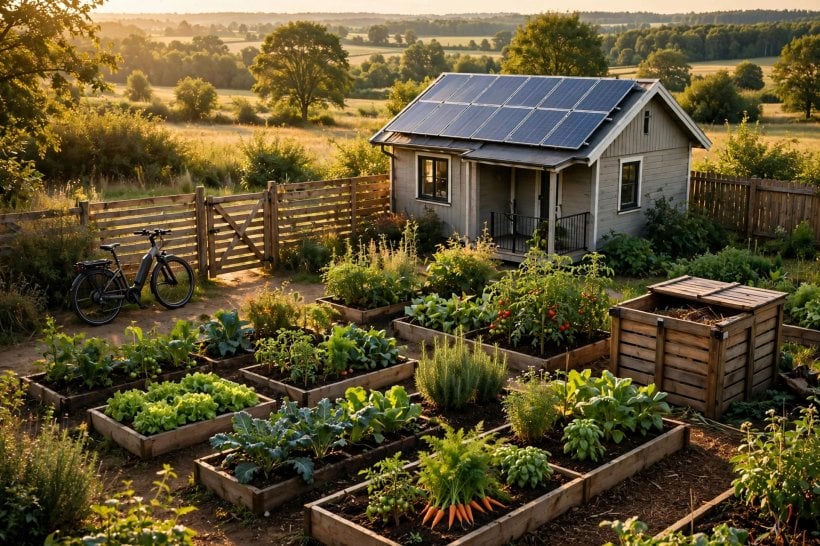
Fourth, shrink the heated space — the housing lever, cutting the volume every winter bill is calculated on. Fifth, stop food waste — the free lever, the one reduction that costs nothing and pays back at the checkout. Sixth, buy durable and secondhand — the goods lever, slowing the inflow to the pace of actual need. Work the list from the top in your own largest domain first; a ranked list only helps if it is applied in order of impact rather than order of convenience.
10. The Compound Effect: Redesign, Don’t White-Knuckle
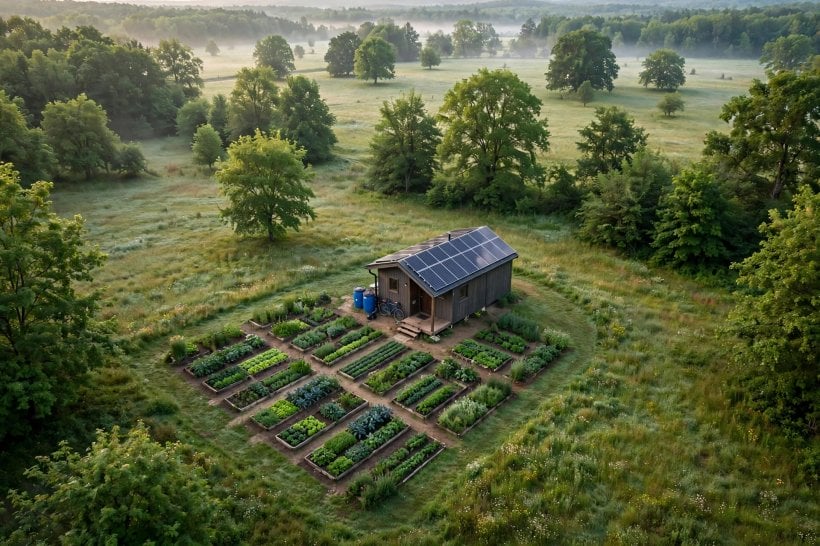
The deepest lesson of the assessment is architectural. The tiny off-grid homestead pulls three of the ranked moves simultaneously — micro-mobility by location and scale, renewables by design, a shrunken heated space by floorplan — which is why its footprint collapses by architecture rather than by willpower. A lifestyle built so the low-footprint choice is the default choice does not depend on daily discipline; the structure makes the decisions in advance. The systems behind that structure are unglamorous and learnable: the tiny house utilities guide to power, water and off-grid sewage covers the connections, and the comparison of off-grid power stations for tiny houses covers the storage that keeps a small system honest through the night.
Whatever scale you redesign at — one domain or the whole homestead — close the loop the way the method prescribes: score the five domains honestly, attack the biggest lever first, then re-measure on a yearly cycle. Each pass shows which redesign actually moved the number and which was decoration, and the yearly rhythm turns a one-off score into a trajectory. The footprint, tracked that way, stops being a judgment and becomes what it was designed to be: a map.
Final Considerations
Score the five domains honestly — the number is the starting line. Attack the biggest lever first, usually transport or diet, where the 80/20 of personal impact lives. Redesign rather than white-knuckle: the small solar home, the e-bike and the planned kitchen shrink a footprint by structure, not effort. Measure it, shrink the biggest piece, repeat yearly — direction over perfection, every time.




2 Comments