

North Carolina runs from high Appalachian ridges down to a quiet Atlantic shoreline, and a tiny home that thrives at one end of the state can struggle at the other.
This guide to tiny house builders north carolina is a checking routine: the county questions to settle first, the credentials to verify, and the terrain calls that shape a sound build.
1. Choosing a North Carolina Builder at a Glance
Most buyers here compare three kinds of builder, and this guide’s infographic uses that same grouping. It also names four factors that shape nearly every project in the state: county rules, the mountains-versus-coast divide, delivery, and certification. Decide which builder type matches how you want to live and how much of the work you want to take on yourself, then judge every candidate against those same four factors.
| Builder type | Best for | What the infographic highlights |
|---|---|---|
| Custom design-build firms | Buyers who want one team throughout | Full service, one team from plans to keys, with the widest freedom over layout, size and finishes. |
| Mountain and community specialists | Sloped lots and tiny-home villages | Local experts in steep ground, graded foundations and community placements in the high country. |
| Shell and DIY-finish builders | The lowest starting cost | A weather-tight shell you finish inside, keeping the first invoice down in exchange for your own labour. |
The homework underneath is shared by all three. Confirm what your county allows on your parcel, verify the builder’s licensing and registration, ask how the home is certified and inspected, read the construction specification rather than the brochure, agree the delivery plan in writing, and study the warranty before any deposit changes hands. The rest of this guide works through those checks in order.
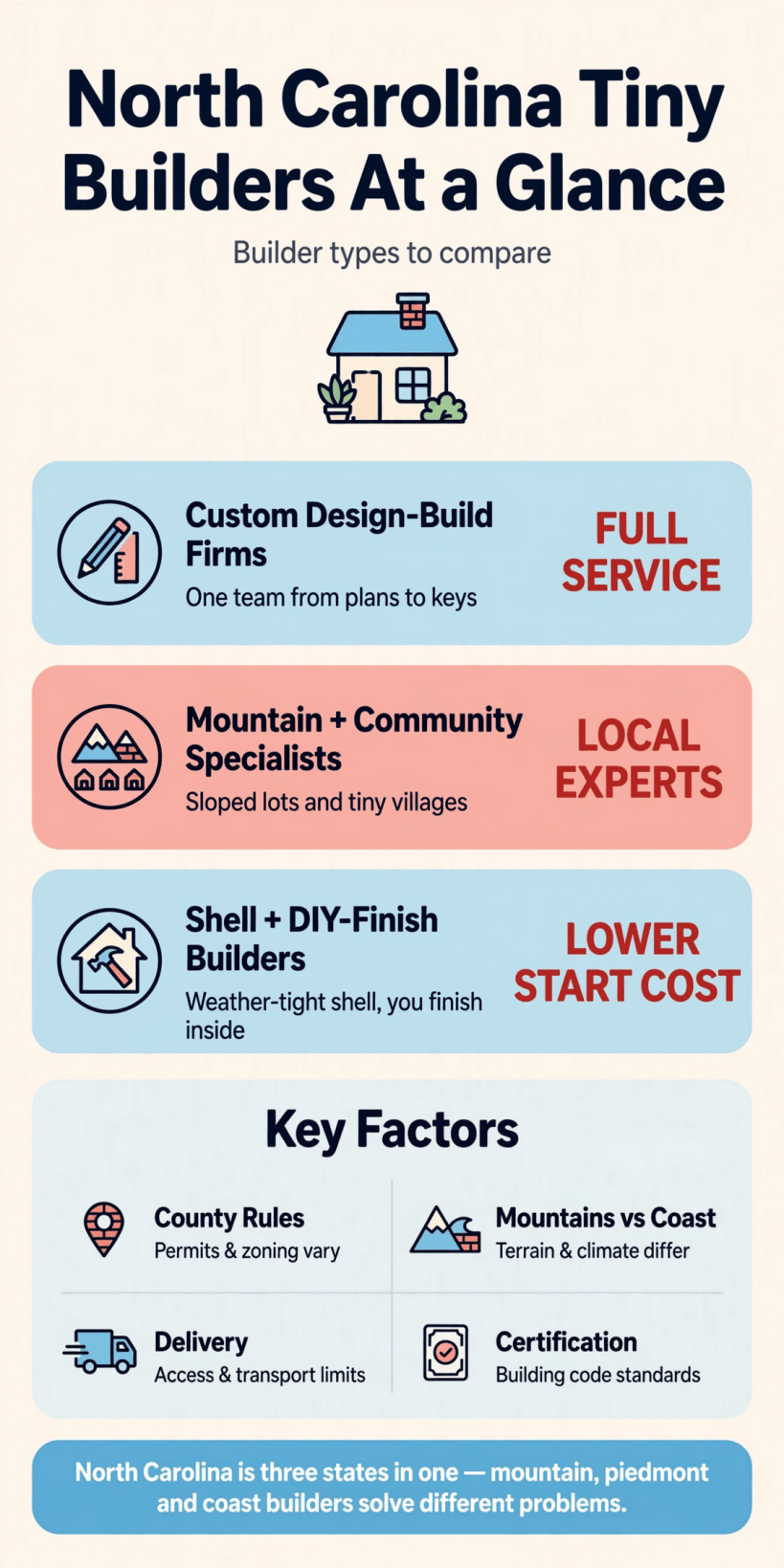
North Carolina at a glance: three builder types to compare, and the four factors — county rules, mountains versus coast, delivery and certification — to test every candidate against.
2. Start With County Rules, Not Floor Plans
North Carolina has one hundred counties, and land-use answers are given locally, so the rules governing a tiny home — minimum dwelling size, setbacks, foundation expectations, and whether a home on wheels is treated as a dwelling at all — depend on exactly where your land sits. Mountain counties, fast-growing piedmont suburbs and coastal jurisdictions each answer differently, and some handle small homes case by case rather than by written rule. The county answer is therefore the foundation every later decision stands on, and it costs nothing but a phone call to obtain.
Get that answer in writing before you fall for a floor plan: which category your home falls into, which permits and inspections apply, and whether septic approval, a floodplain overlay or a homeowners’ association changes the picture. Our overview of how to get a tiny house built, from first sketch to finished home maps the normal sequence, and our explainer on how building codes treat unconventional small homes shows why the label matters later. Then ask each builder what they have already placed in your county: local fluency — knowing which office, which forms and which inspector — is one of the most reliable quality signals you will encounter.
3. Verify Licensing, Registration and Certification
Start with the business itself. Ask for the builder’s licensing and registration details, confirm they are current, and check that the legal name on those documents is the name that will appear on your contract. Ask what insurance the operation carries, and expect paperwork to be produced promptly and without drama. Careful builders treat verification requests as a compliment, because only serious buyers bother to make them, and hesitation at this stage is information in itself.
Certification is the second half of the check, and it matters because it shapes how the home is titled, taxed, financed and insured. Ask which standard the home is built and inspected to, who performs inspections during construction, and what documentation you will hold at handover — especially for work that disappears behind wall panels, such as framing, wiring and plumbing. Ask for stage photographs as a standing arrangement rather than a favour. The same documents-first discipline anchors our coverage across the state line in the Virginia tiny house builders guide, where county paperwork plays the same central role.
4. Mountains vs Coast: Match the Build to the Terrain
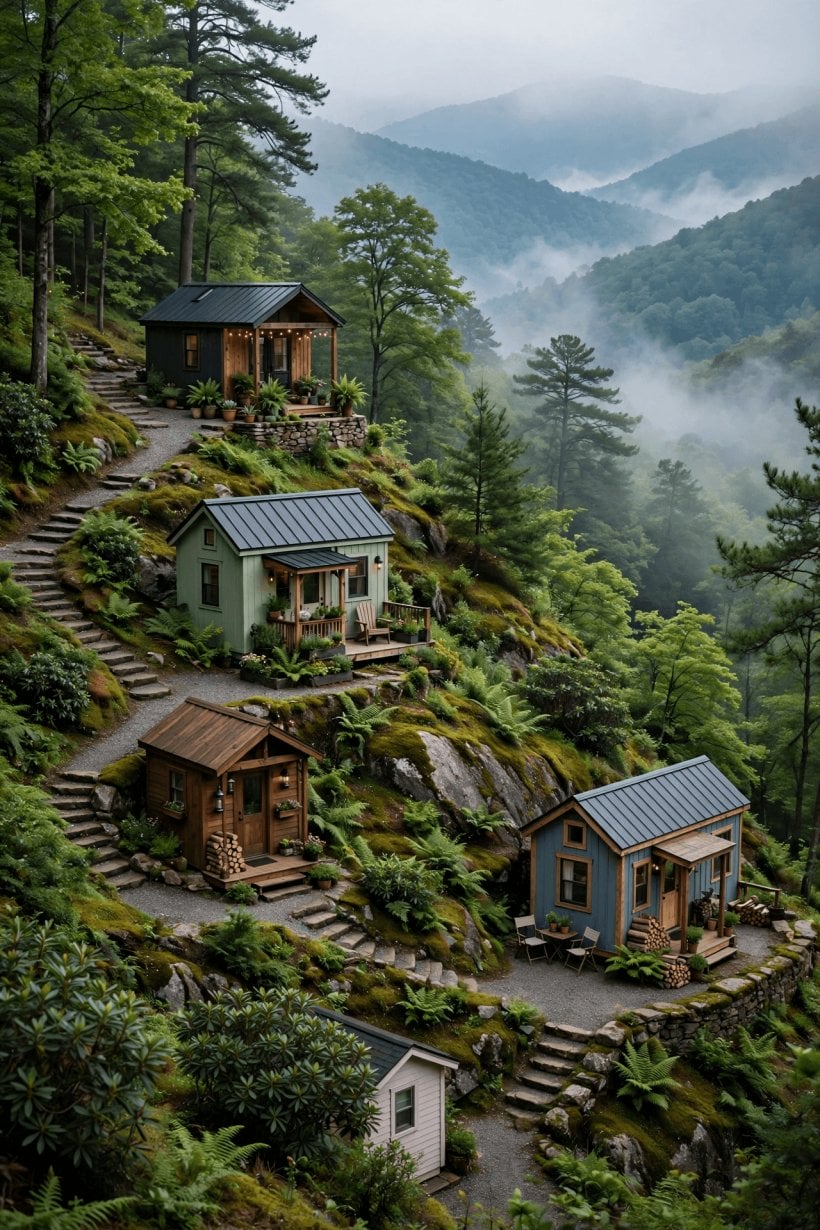
The infographic’s warning deserves plain words: North Carolina is three states in one — mountain, piedmont and coast — and builders solve different problems in each. In the west, the questions are elevation, slope and winter: how the home is founded on graded ground, what snow and wind the roof is rated for, and how pipes are protected on cold ridge nights. On the coast, the questions flip to humidity, salt air, storm winds and flood levels, where fixings, cladding and ventilation decide how gracefully a home ages.
Ask every builder which terrain their standard specification was designed for, and what changes — in writing — when the same model is placed in your region instead. Pipes and undersides deserve attention in both climates: our guide to tiny house skirting options that protect pipes and improve insulation covers the main approaches. A reference buyer living in the same terrain, in the same model, through a full year of its weather, is worth more than any brochure claim; ask for that phone number specifically.
5. Questions to Ask Every Builder
Ask identical questions of every shortlisted builder, write the answers down, and compare them in one sitting. Sameness is the discipline that turns sales talk into evidence you can weigh.
- How many tiny homes have you completed in North Carolina, and may I see one?
- Can I speak with two recent buyers, including one in my terrain?
- What is included in this quoted scope, and what is excluded?
- May I see your licensing, registration and insurance documents today?
- How is the home certified and inspected, and what paperwork do I receive?
- What changes in the specification for mountain, piedmont or coastal placement?
- What payment stages do you propose, and what completes each stage?
- What timeline is realistic from deposit to delivery, and what causes delays?
Score the manner of the answers alongside their content. Straight replies, documents offered unprompted and references produced early are the working habits of organised builders. Anything vague at this stage will be vaguer once a build slot, a deposit and a deadline are involved, so treat evasiveness as an answer all by itself.
6. Delivery Radius Across a Long State
North Carolina is a long state, and delivery deserves its own discussion. Ask how far the builder delivers within the state, how transport is charged, and what the last stretch to your parcel looks like: switchback mountain roads in the west, gated community lanes in the piedmont, and bridges, causeways and soft ground near the coast. Share photographs, gate widths, slopes and turning space early, so the route is planned on paper rather than improvised on the day with a home on a trailer.
Fix responsibilities for delivery day in the contract — transport, positioning, levelling, anchoring where required, and who connects water, sewer or septic and power. Ask what preparation is yours, from a level pad to cleared access, and what the fallback is if weather closes in on the booked date. Buyers weighing a wider search will find the counterpart planning in the South Carolina tiny house builders guide, where coastal delivery raises many of the same questions. A delivery that is scheduled, costed and assigned in advance is a delivery that usually passes quietly.
7. Warranty, Service Distance and References
Read the warranty for its process, not just its promises. What does it cover — structure, roof, workmanship, installed systems — for how long, and how does a claim actually reach someone who can act on it? Then ask the geography question honestly: if the workshop sits hours from your lot, who attends a fault, are local contractors used, and what response times are realistic? Get the mechanism into the contract documents rather than leaving it resting on goodwill.
References are the cheapest due diligence you will ever buy. Ask recent owners what went wrong and how the builder responded; responsiveness under pressure is the trait you are really purchasing for the next decade. Seek out at least one owner whose home has passed a full year in your terrain, through mountain winter or coastal storm season alike. While you complete the ownership picture, our guide to how to insure a tiny house once it is delivered covers the cover and classification questions that travel with builder paperwork at handover.
8. Understand What Drives the Cost
Headline prices mislead because the specifications beneath them differ. The steady drivers are size and layout complexity; whether the plan is stock or bespoke; the foundation and terrain work your parcel demands; heating, cooling and any off-grid equipment; finish level; and the build route itself, with a shell shifting interior cost from the invoice onto your weekends. Certification and inspection arrangements can also move the total where extra documentation is involved.
The site budget is the second half of the story: foundations or pads, drainage, delivery distance, placement equipment and utility runs regularly exceed the gap between two builders’ workshop prices, so compare whole-project numbers rather than workshop numbers. If borrowing plays a part, read our playbook on how to get a loan for a tiny house and our guide to tiny house mortgages and how lenders classify these homes before signing, since a home’s certification category influences which lenders will engage at all. Builders who itemise calmly are easier to trust — and far easier to hold to account — than builders who defend one round number.
9. Red Flags That Should Slow You Down
Certain patterns justify ending a candidacy on the spot: no licensing or insurance evidence, most of the price demanded before work begins, certification answers that change between conversations, or a refusal to let you view a completed home and speak with its owner. Add pressure selling, a terrain specification described only in adjectives, and delivery promises made without a single question about your land. Each one quietly transfers risk from the builder to you, where it does not belong.
Also beware the quote that undercuts the whole field with no visible explanation. In a state where slope work, storm specification and long delivery distances are real costs, a suspiciously cheap build usually means something has been left out — a thinner specification, excluded delivery, unfinished interior work. Ask what is missing before you admire the number. Walking away costs an afternoon; discovering the omission after the home is sited costs a great deal more.
10. Compare Final Quotes Like for Like
Close the process with a single comparison sheet. Line the surviving quotes up on scope, terrain specification, heating and cooling, certification paperwork, delivery and siting responsibilities, warranty process and payment stages — and chase down every gap before treating any total as real. The builder who survives that spreadsheet with documents intact is almost always the right choice, whatever the photographs suggested at the start.
One more check is worth doing before the contract is signed: read the whole agreement aloud, slowly, with the comparison sheet beside it. Anything promised in conversation but missing on paper — a foundation allowance, a delivery date, a warranty response time — shows up instantly when the words have to be spoken. Ask for each missing item to be added as a written amendment agreed by both sides. Builders who work transparently do this without resistance; builders who resist amendments are telling you how disputes will go later.
Readers whose search crosses state lines can apply the identical test with our guides to tiny house builders in Virginia, tiny house builders in South Carolina and tiny house builders in Ohio. Keep one project file from the first call — county answers, licence copies, specification, stage photographs, warranty — because in five years that file will be the memory of the purchase. Choose the builder who helps you build it without being asked twice.
Final Considerations
North Carolina rewards buyers who sequence decisions properly: county answer first, credentials second, terrain specification third, and only then the enjoyable business of layouts and finishes. Pick the builder whose paperwork verifies, whose specification suits your mountains, piedmont or shoreline, whose delivery plan fits your roads, and whose past buyers confirm the aftercare. Do that, and the home that arrives will be the home the contract described — settled in its landscape, not just handsome in the brochure.


0 Comments