

Virginia contains multitudes: Blue Ridge slopes, flat coastal land, historic towns and fast-growing suburbs, each with its own county office and its own view of small homes.
This guide to tiny house builders in virginia is a due-diligence routine: the county questions to settle first, the credentials to verify, and the site and delivery details that decide whether a project runs smoothly.
1. Choosing a Virginia Builder at a Glance
Virginia buyers generally sort builders into three camps, and this guide’s infographic uses the same split. It also flags four factors that shape most projects here: county rules, slopes, delivery and certification. Decide which camp fits your land and your appetite for involvement, then measure every candidate against those four factors before comparing finishes or prices.
| Builder type | Best for | What the infographic highlights |
|---|---|---|
| Custom design-build firms | Buyers wanting a fully tailored home | Plans drawn around you, with the widest finish choice — balanced against larger budgets and longer lead times. |
| Mountain cabin and ADU specialists | Sloped lots and backyard dwellings | Experience with foundations on gradients and with accessory dwelling projects behind an existing house. |
| Shell and DIY-finish builders | Hands-on buyers managing costs | A weather-tight shell you complete inside yourself, swapping your own labour for a smaller build invoice. |
Every route leads back to the same homework. Confirm your county’s position for the exact parcel, verify licensing and registration, ask how the home will be certified and inspected, plan honestly for slope and access, agree the delivery method, and read the warranty before any deposit is paid. The rest of this guide takes those checks one at a time, in the order that causes the fewest surprises.
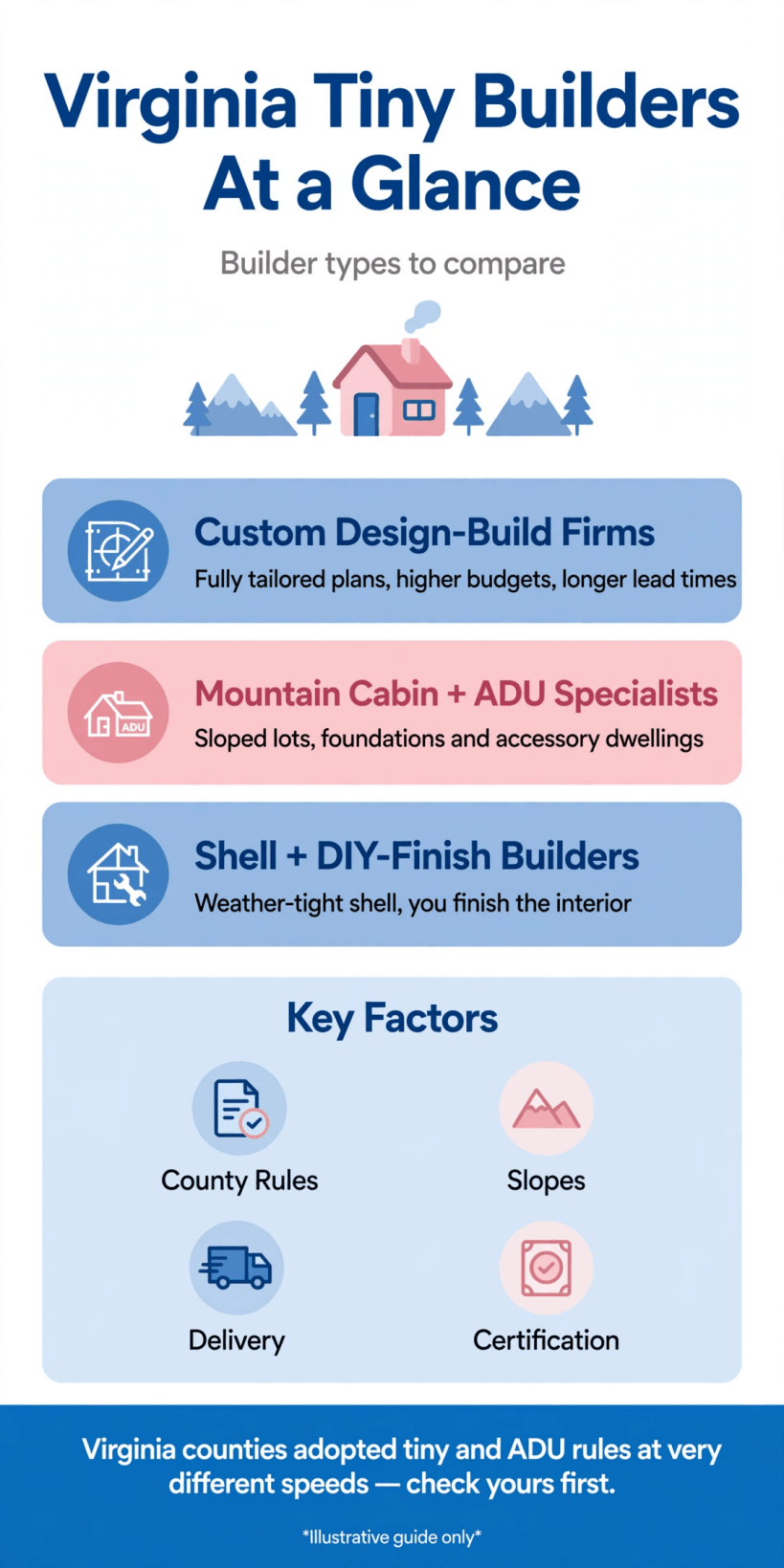
Virginia at a glance: three builder types to compare, plus the four factors — county rules, slopes, delivery and certification — to test each one against.
2. Start With County Rules and ADU Routes
Virginia counties adopted tiny home and accessory dwelling rules at very different speeds, so the answer you get depends heavily on the county — and sometimes the town — your land sits in. One county may treat a small foundation home as a standard dwelling, the next may route you through an accessory dwelling permit with size caps and owner-occupancy conditions, and a home on wheels may be classified differently again. Assume nothing until your own county has answered for your own parcel.
Put the questions in writing: what category does the home fall into, what permits and inspections apply, are there minimum or maximum sizes, and do setbacks, septic approvals or historic-district overlays change the picture? Our overview of how to get a tiny house built, from first sketch to finished home sets out the usual order of operations, and our explainer on how building codes treat unconventional small homes shows why the classification decision echoes through finance and insurance later. A builder who has worked in your county recently will talk about its process in specifics; a builder who waves the topic away is telling you something important.
3. Verify Licensing, Registration and Certification
Credentials come before design meetings. Virginia licenses contractors through the state, so ask for the builder’s license and registration details, confirm they are current and correctly classified for residential work, and check that the legal entity on the license is the entity named in your contract. Ask for evidence of insurance in the same conversation. Professional operations expect these requests and produce documents promptly; hesitation is data.
Then pin down certification. Ask which standard the finished home is built and inspected to, who performs inspections during the build, and what documentation you receive at handover — particularly for the stages you will never see again once walls close, such as framing, wiring and plumbing. Agree that stage photographs will be shared as the build progresses. The same documents-first approach anchors our coverage further south, including the Mississippi tiny house builders guide, where county and moisture paperwork carry similar weight. Verify first, and the creative conversation that follows rests on solid ground.
4. Sloped Lots, Foundations and Mountain Sites
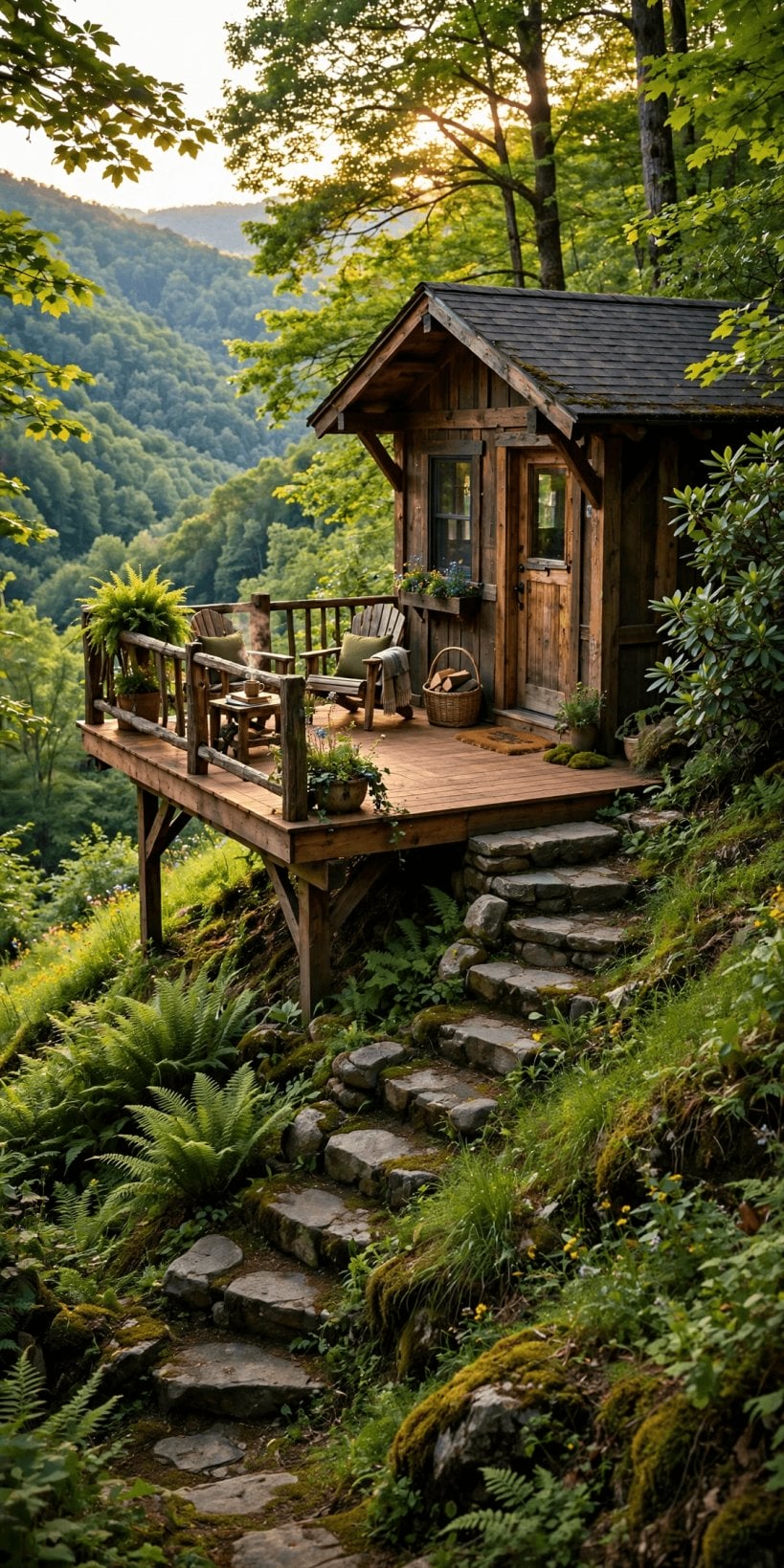
Much of western Virginia is not flat, and slope quietly drives design, cost and delivery decisions. A hillside parcel may suit a foundation build or a cabin-style home stepped into the gradient, while a home on wheels needs a properly prepared, level pad that drains away from the structure. Ask each builder to assess your actual lot — from photographs, a survey or a site visit — rather than quoting from a standard assumption.
Discuss drainage with the same seriousness as the structure itself: where does water run in a storm, what does the access drive do in winter, and how will the foundation or pad handle freeze and thaw? If you are still choosing land, our framework for where to buy land for eco-living, using a location scoring system helps weigh slope, access and services before you buy. Whatever is agreed — foundation type, retaining work, drainage runs — belongs in the written specification and site-work scope, because slope surprises are among the most expensive kind.
5. Questions to Ask Every Builder
Consistent questions, asked of everyone, turn sales conversations into comparable evidence. Put these to each shortlisted builder and keep the answers in one document.
- How many tiny homes or small cabins have you completed in Virginia?
- Can I visit a finished home and speak with two recent buyers?
- What is included in the quoted scope, and what will I still need to arrange?
- Who handles permits, inspections and certification, and what do I receive at handover?
- How do you approach sloped or difficult-access sites like mine?
- What payment stages do you propose, and what completes each stage?
- How are design changes priced and approved after signing?
- What is a realistic timeline from deposit to delivery, including lead times?
Judge the manner as well as the matter. Straight answers, documents produced without chasing, and references offered early are the habits of a builder whose projects tend to stay organised. If simple questions meet fog at this stage, expect thicker fog when money and deadlines are involved.
6. Delivery Into the Mountains and Valleys
Delivery in Virginia can mean a straightforward interstate run or a careful climb up a winding mountain road with tight switchbacks, low branches and weight-limited bridges. Ask each builder how far within the state they deliver, how transport is priced, and what route information they need from you. Photographs of the final approach, gate widths and turning areas prevent most delivery-day improvisation.
Agree the full siting plan in the contract: who transports, who positions and levels the home, who anchors or connects it to its foundation, and who hooks up water, sewer or septic and electricity. Ask what happens if weather or a soft access drive forces a postponement, and what preparation — a finished pad, cleared trees, a gravelled track — is yours to complete first. Buyers weighing states side by side will find the northern counterpart in our guide to tiny house builders in Pennsylvania. The principle travels well: delivery should be a scheduled operation, not an adventure.
7. Four Seasons: Snow, Humidity and Heating
Virginia gives a small home four real seasons to survive. Mountain winters bring snow loads and freezing pipes; Tidewater summers bring humidity that hunts for weak ventilation. Ask how the roof is rated for your elevation, what insulation and air-sealing the specification includes, and how plumbing is routed and protected against freezes. Ask, too, how fresh air and moisture extraction are handled in summer, because a tight small home without planned ventilation grows stale and damp quickly.
Heating and cooling choices deserve specifics rather than adjectives: what system is included, what is an upgrade, and what running arrangement the builder assumes. If advanced insulation interests you, our explainer on vacuum insulated panels in tiny houses covers one of the newer options honestly. As ever, the rule is simple — if a comfort feature matters to you, it must appear in the written specification, priced and named, before you sign.
8. Warranty, Service and References
A warranty is only as good as the process behind it. Ask what is covered — structure, roof, workmanship and installed systems — for how long, and exactly how a claim is raised and resolved. Clarify the geography of aftercare: if the workshop is three hours from your lot, who physically attends a fault, does the builder use local partners, and what response times are realistic? Put the answers in the contract pack.
References are where warranty promises get tested. Ask recent buyers — ideally including one mountain build and one who has lived through a winter — what went wrong and how the builder behaved when it did. Follow-through matters more than faultlessness. While you assemble the ownership picture, our guide to how to insure a tiny house once it is delivered covers the cover and classification questions that pair naturally with builder paperwork at handover.
9. Understand What Drives the Cost
Compare drivers, not headline numbers. Size and design complexity lead: bespoke plans, complex rooflines and high-end finishes raise labour quickly, while a stock shell you finish yourself moves cost off the invoice and onto your weekends. Site work is the quiet heavyweight in Virginia — foundations on slopes, retaining and drainage work, long utility runs and difficult delivery routes routinely separate two quotes more than the homes themselves do.
Specification choices add their share: insulation level, window quality, heating and cooling systems and off-grid equipment all move the total, as does the certification route where it changes inspection and documentation work. If finance is part of the plan, read our playbook on how to get a loan for a tiny house and our overview of tiny house mortgages and how lenders classify these homes before committing, since lenders care how the home is categorised. Builders who itemise patiently are giving you the means to compare; protect that transparency by demanding it from everyone.
10. Red Flags and the Final Like-for-Like Test
Certain behaviour should end a candidacy: no license or insurance evidence, most of the price demanded before work begins, certification answers that shift between conversations, or a refusal to let you see a completed home and call its owner. Add pressure selling, delivery promises made without a single question about your lot, and quotes so far below the field that the missing scope is obvious once you look. None of these require debate — they require a different builder.
For the final test, line the surviving quotes up against one scope: design and finish
One discipline ties the whole process together: never let an important answer stay verbal. County guidance, license numbers, inspection arrangements, slope and drainage decisions, delivery responsibilities and warranty promises all belong on paper, in a single project file you start on day one and keep adding to. Whenever a conversation produces a commitment, follow it with a short email summarising what was agreed and ask the builder to confirm it. Serious builders do this themselves; the rest learn quickly that you expect it.
That file becomes more valuable over time, not less. It answers the insurer who asks how the home was certified, the warranty question that surfaces in the second year, the contractor who needs to know what sits inside a wall before opening it, and the future buyer who will pay more for a small home with a documented history than for an identical one with a shrug. Choosing a builder is, in the end, choosing whose paperwork you will trust for years — so let the quality of the documents guide the decision as firmly as the quality of the show home.
level, insulation and systems, foundation and site duties, certification paperwork, delivery and siting responsibilities, warranty terms and payment stages. Cross-check the method against our guides to tiny house builders in South Carolina, tiny house builders in Ohio and tiny house builders in Illinois if your search crosses state lines. Keep one project file — county answers, documents, photographs, warranty — from the first call onwards. The builder who helps you build that file is, more often than not, the builder who builds the home properly too.
Final Considerations
Virginia rewards buyers who sequence the work correctly: county answer first, credentials second, site and delivery honesty third, and only then the enjoyable arguments about layouts and finishes. Choose the builder whose license checks out, whose slope and delivery plans fit your real parcel, and whose past buyers confirm the aftercare. Do that, and the home that settles onto your lot will match the one described in the contract — in every season the Commonwealth can offer.


0 Comments