
Full-time living on wheels starts with a fork in the road, and both directions look tempting. On one side stands the tiny house on wheels: a genuine small house, framed, insulated and finished like a house, that happens to sit on a trailer. On the other stands the RV: a vehicle designed from the factory floor for travel, with every system engineered around movement. They are cross-shopped constantly because they promise the same things — lower costs, fewer possessions, a life aimed outward — but they are opposite machines. One is a residence that tolerates relocation. The other is a vehicle that tolerates residence. Full-time life exposes that difference in every season.
This comparison works through the two options dimension by dimension, in the order full-timers feel them: upfront cost, comfort and insulation, mobility, running costs, maintenance, resale, and parking and placement. It finishes with a verdict, because the honest answer is not that one is better — it is that each is better at a different life. Anyone weighing tiny house vs rv full time living is really deciding what their home should optimise for, the road or the residence, and every dimension below is that one choice wearing a different hat.
1. Tiny House vs RV Full Time Living at a Glance
The table below scores the seven dimensions head-to-head. Read it as a pattern rather than a scorecard: the tiny house wins wherever the test is residential, the RV wins wherever the test is vehicular, and the sections that follow show the working behind each row.
| Criterion | Tiny house on wheels | RV (motorhome or trailer) |
|---|---|---|
| Upfront cost | Custom-build territory: price driven by builder, materials and finish, with a serious tow vehicle as an extra if you will ever move it yourself. | The widest spread in housing: used trailers at the budget end, large motorhomes at house prices. A motorhome includes its vehicle; a trailer still needs a tow vehicle. |
| Comfort and insulation | Residential insulation, real walls and house systems. Four-season capable when built and sited for it — the stronger winter product. | Lightweight construction and thin wall assemblies. Four-season use is possible in winterised models with skirting and effort, but it is a workaround, not the design brief. |
| Mobility | Moves are events: heavy, tall, planned, sometimes permitted, usually seasonal at most frequent. | Moves are the point: drive or tow away in an hour, with the whole campground network laid out for you. |
| Running costs | Low when parked long-term: modest site costs, small energy demand, utility or off-grid supply at household logic. | Two budgets in one: stationary months can be cheap; travelling months add fuel and nightly site fees that behave like rent. |
| Maintenance | House rhythms and house trades: roof, seals, standard systems, parts from any builders’ merchant. | House plus vehicle: chassis, running gear and (in a motorhome) an engine and drivetrain, plus RV-specific systems and parts. |
| Resale | A thinner, slower market. Documented, certified, well-kept builds defend their value; undocumented self-builds are hard to price and harder to finance for the next buyer. | A deep, liquid market with predictable depreciation. Easy to sell at almost any point — at a price that falls steadily from the day you buy. |
| Parking and placement | The hard dimension: legal long-term placement is scarce, local and must be solved before purchase. | An entire economy exists to receive you — with stay limits, park rules and seasonal pricing as the terms of admission. |
| Best for | Settle-first lives: one base per season or year, work and routines anchored, movement occasional. | Move-first lives: the journey is the lifestyle, bases are temporary, and staying legal is built into the product. |
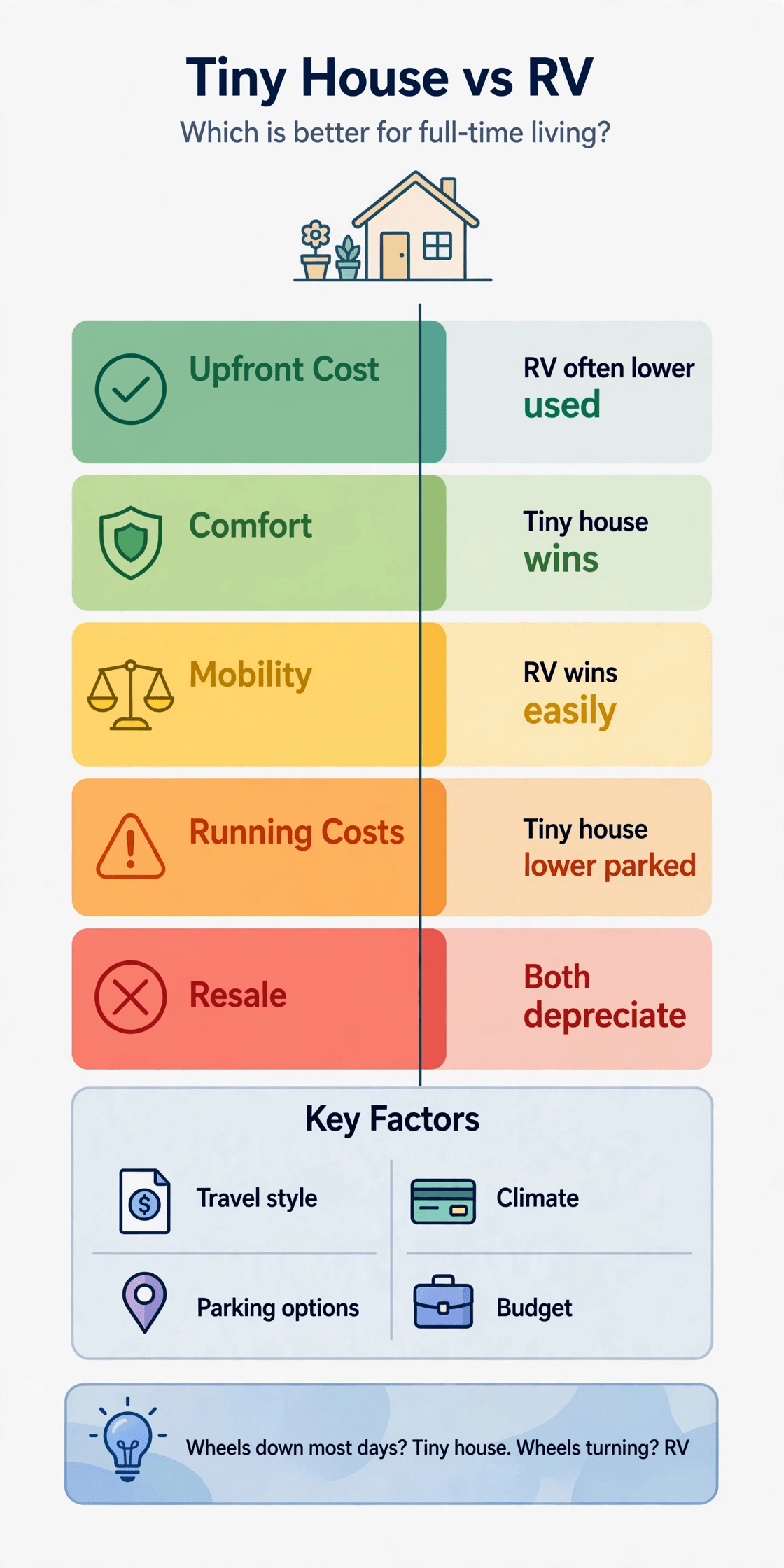
Infographic: the seven dimensions in one view — residential strengths against vehicular ones.
2. The Two Contenders: A House That Can Move vs a Vehicle You Live In
Definitions first, because every later dimension is downstream of them. A tiny house on wheels is a small dwelling built on a trailer chassis, usually by a specialist builder or a skilled self-builder, using residential materials and methods: framed walls with real insulation depth, house windows, house plumbing and electrical systems, and interiors fitted like a small home because that is what it is. An RV — motorhome, travel trailer, fifth wheel or camper — is a manufactured vehicle built to the RV industry’s own standards and certification regime, set out in our explainer on what RVIA certification is and why it matters. That certification is not paperwork trivia: it is why insurers, lenders, parks and buyers all know what an RV is, while a tiny house must explain itself in every one of those conversations.
Construction philosophy follows definition. The RV is engineered to a weight budget, because every pound costs fuel, payload and handling: thin composite walls, lightweight fittings, systems sized for trips — water carried in tanks, waste held in tanks, heating and cooling designed for occupancy measured in weeks. The tiny house is engineered to a comfort budget: weight is a constraint handled by the trailer’s rating rather than a daily driving concern, so walls get depth, windows get size, and systems are sized for occupancy measured in years. Stand inside each in January and you are standing inside those two philosophies.
Size, the dimension shoppers compare first, is the one that matters least. Both products offer similar floor areas at similar lengths. The differences that decide full-time success are the ones in the table: how the walls behave in winter, what a move actually involves, where each is allowed to stop, and what each is worth when the adventure ends. Buyers who choose on floor plans get surprised by physics, logistics and paperwork. The sections below take those in order.
3. Upfront Cost: The Sticker Is Only the First Number
The tiny house’s upfront cost is a builder’s cost. A professionally built unit prices like the small custom house it is: design, trailer, framing, the insulation system, residential systems and finish quality drive the total, and the spread between a basic shell and a high-finish build is wide. Used tiny houses exist at lower figures, with condition and documentation doing the pricing. Two additions catch buyers out. The first is movement: a tiny house heavy enough to live in needs a genuinely capable tow vehicle or a hired professional move, and if the truck is not already in your life it belongs in the purchase maths. The second is arrival: site preparation, utility connections or off-grid systems, and skirting and set-up at the placement are real money spent before the first night.
The RV’s upfront cost is a vehicle’s cost, spread across the widest range in this comparison. Used travel trailers open the door at the lowest figures in full-time wheeled living; new motorhomes close it at prices rivalling houses. A motorhome bundles the vehicle into the price — convenient, and worth remembering when comparing against a tiny house plus truck, which is the honest like-for-like. A travel trailer unbundles it, which is cheaper if a suitable tow vehicle is already owned and a nasty surprise if not. The RV’s other upfront truth is depreciation: vehicles lose value fastest early, so the used RV a few years old is this comparison’s budget champion, bought after someone else paid for the steepest part of the curve.
Financing draws the same line. RVs sit inside mature vehicle-lending products; tiny houses sit in the patchwork mapped by our guide to how to finance a tiny house, where classification and certification decide which lenders will talk. For cash buyers the dimension simplifies to one rule: compare the all-in first-year figure — purchase, tow or drive-away readiness, placement or first-season site costs, insurance — never the two stickers. On that honest basis the options are closer than the adverts suggest, and the winner depends entirely on whether a tow vehicle and a placement are already in your life.
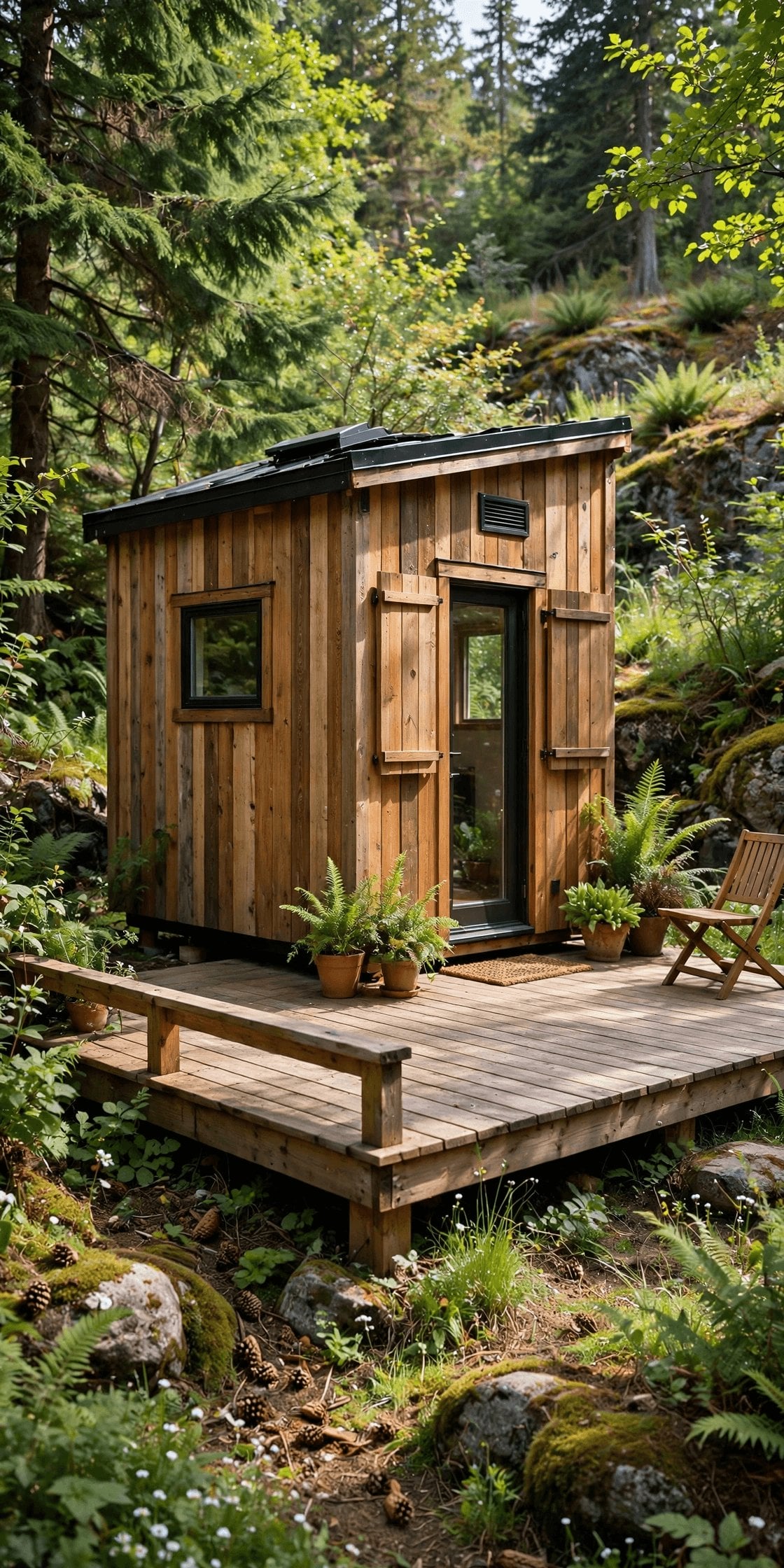
Pin it: compare the all-in first year, not the sticker — the tow vehicle and the first winter both send invoices.
4. Comfort and Insulation: Winter Nights Tell the Truth
Comfort is where the tiny house collects its rent for all that weight. Residential wall assemblies with proper insulation depth, a real thermal envelope and house-grade windows produce the thing full-timers actually crave in month three: a home that holds a steady temperature, stays quiet in wind and rain, and does not sweat condensation onto every surface on a cold morning. The methods are the familiar ones from our guide to how to insulate a tiny house with spray foam, rockwool or sheep’s wool, applied without a weight accountant vetoing every inch. Heating and cooling are residential too — a mini-split behaves in a tiny house exactly as it does in a small flat, because the building physics are the same.
The RV’s comfort story is a story of design intent. It was built for the trip, and its walls, single-glazed or lightweight windows and compact systems deliver a perfectly pleasant three-season life. Winter asks more than the design brief promised: thin assemblies lose heat quickly, tanks and lines need protection from freezing, condensation management becomes a daily chore, and the standard fixes — skirting, insulated hose runs, dehumidifying, higher heating fuel use — are the well-known winterising repertoire rather than a secret. Four-season-rated models narrow the gap genuinely, with better insulation and protected tanks, and buyers set on year-round RV life in cold country should treat that rating as the entry ticket rather than an upgrade. Our notes on tiny house living in cold climates — humidity, drafts, frozen pipes — apply to both products, but the RV starts further from the answers.
Daily comfort divides the same way. The tiny house offers residential fixtures, a kitchen you can actually cook in, a bathroom that feels like a bathroom, and storage designed around possessions rather than payload. The RV counters with slide-outs that transform a parked interior, and layouts refined over decades of production — at the price of moving walls, mechanisms and seals that a stationary house never maintains. Neither is a compromise-free win. But across a full year of nights, the house built for residence wins the residence test, and it is not particularly close.
5. Mobility: Moving House vs Driving Home
Mobility is the RV’s home turf, and the margin is enormous. An RV move is a driving task: stow, unplug, hitch or start the engine, and go — an hour of routine that full-time RVers perform weekly without ceremony. The destination infrastructure is equally native: fuel stations that fit you, campgrounds laid out for your connections, dump stations where you need them. A motorhome adds the towed-car question; a trailer adds hitching and towing skill; both are solved problems with a century of practice behind them.
A tiny house move is a logistics project. The same weight and height that bought the comfort of Section 4 now demand a heavy-duty tow vehicle, route planning for clearances and, in some jurisdictions, permits or escort requirements for oversize loads. Our guide to towing a tiny house: trucks, hitch weights and road regulations and the cost breakdown in our tiny house moving guide on transport costs show why most owners hire professionals and move on a seasonal rhythm — a few times a year at most, and often once, ever. Treating a tiny house as a weekly traveller is buying the wrong product, and the market’s regret stories begin exactly there.
The deciding question is therefore embarrassingly simple: how often will you honestly move? Lifestyle writing glamorises perpetual motion, but most full-timers of both kinds settle into rhythms — a season here, a month there. If your honest rhythm is measured in weeks or months per stop, the tiny house’s mobility penalty is paid rarely and its comfort dividend nightly. If your rhythm is measured in days, the RV’s comfort compromises are the price of a life that is genuinely about the road. Answer with your calendar, not your daydreams.
6. Running Costs: The Monthly Reality
Parked, the two options converge more than either community admits. A stationary tiny house on a rented site or owned land runs on household logic: a modest space to heat and cool, small appliance loads, water and waste as plumbed services or managed systems. A stationary RV on a monthly site rate runs similarly, with the campground’s pricing replacing the landlord’s. Energy strategy tilts running costs for both — the sizing logic in our guide to solar panel kits and battery banks for tiny homes applies to any small wheeled roof, and the fuel-choice arithmetic in propane vs electric in tiny houses describes the heating and cooking trade-offs both products share.
Travelling splits them again. A moving RV buys its freedom in fuel and nightly fees: a touring month with frequent stops can cost more in site fees alone than a stationary month costs in total, which is why experienced RVers mix paid sites with monthly rates and legitimate free or low-cost stops, and why the lifestyle’s true cost is a driving-style statistic, not a product statistic. A moving tiny house spends its travel money in rare, large lumps — the professional move — and nothing at all between times.
The practical method is two budgets, not one. Price a stationary month and a travelling month for each option, using your own region’s site fees and your own driving appetite, and weight them by the rhythm you admitted to in Section 5. Most households discover the stationary budgets are twins and the travelling budgets are strangers — and that the choice was never really about money per month, but about which months they intend to have.
7. Maintenance: House Systems vs Vehicle Systems
A tiny house maintains like a house, which is its quiet superpower. Its systems are residential and standard: the plumbing logic of our tiny house plumbing layout guide, heating and cooling from the same catalogue as our mini-split installation guide, parts available from any trade counter, and any competent local tradesperson already fluent in everything inside it. The maintenance calendar is the homeowner’s calendar — roof and seals inspected seasonally, systems serviced on household intervals — with two wheeled additions: the trailer’s tyres, brakes and bearings age whether or not it moves, and they must be kept move-ready if a future relocation is to remain possible.
An RV maintains like a house and a vehicle simultaneously, because it is both. The roof and seams of a structure that flexes down highways need a vigilance houses never ask for; water ingress is the category’s great destroyer and its prevention is a standing chore. Systems are RV-specific — tank-based water and waste, 12-volt electrics alongside mains, compact appliances — serviced by RV technicians, with parts through RV channels. A motorhome adds a full vehicle: engine, drivetrain, and the service schedule of the truck underneath the house. None of this is unmanageable; all of it is more, and it prices into ownership as money, time or both.
The DIY divide mirrors the parts divide. Handy tiny-house owners can self-maintain almost everything with ordinary tools and skills. Handy RV owners can self-maintain a great deal too, but will meet proprietary fittings, vehicle systems and warranty conditions that push them toward specialists. Buyers should score their own appetite honestly: maintenance tolerance is a lifestyle feature, and choosing the product whose chores you will actually do is worth more than any specification.
8. Resale: What Each Is Worth in Five Years
The RV resale story is the vehicle story: predictable depreciation, steepest in the early years, flattening with age, inside the deepest and most liquid used market in this comparison. That combination is genuinely double-edged. You will lose money on a known curve — and you can exit in a weekend, at almost any age of unit, to a national pool of buyers, through dealers who will take it today at a wholesale figure. For a lifestyle experiment with an uncertain end date, that liquidity is a feature no tiny house offers.
The tiny house resale story is a property story in miniature. The market is thinner and regional, buyers are fewer, and their lenders are fussier — which makes documentation the value: certified or professionally documented builds, with systems and weights on paper, defend their prices; undocumented self-builds sell slowly and at discounts that reflect the buyer’s risk. The inspection logic in our walkthrough on how to inspect a used tiny home before buying is what your future buyer will apply to you, so building and keeping the file that survives it is resale work done in advance. Placement can add a second value layer: a tiny house sold with a legal site arrangement, like a house with land, is a different asset from the same house needing removal. The used market itself is browsable through our guide to tiny homes for sale near me, and its prices are the honest preview of your exit.
Match the exit to the experiment. If the plan is a year of trying the life, the RV’s liquid exit caps your downside. If the plan is a decade of living small, the tiny house’s slower, document-driven market rewards the owner who bought quality and kept records. Either way, buy the unit the next buyer will want: in RVs, the popular floor plan in clean condition; in tiny houses, the certified, documented, sensibly finished build.
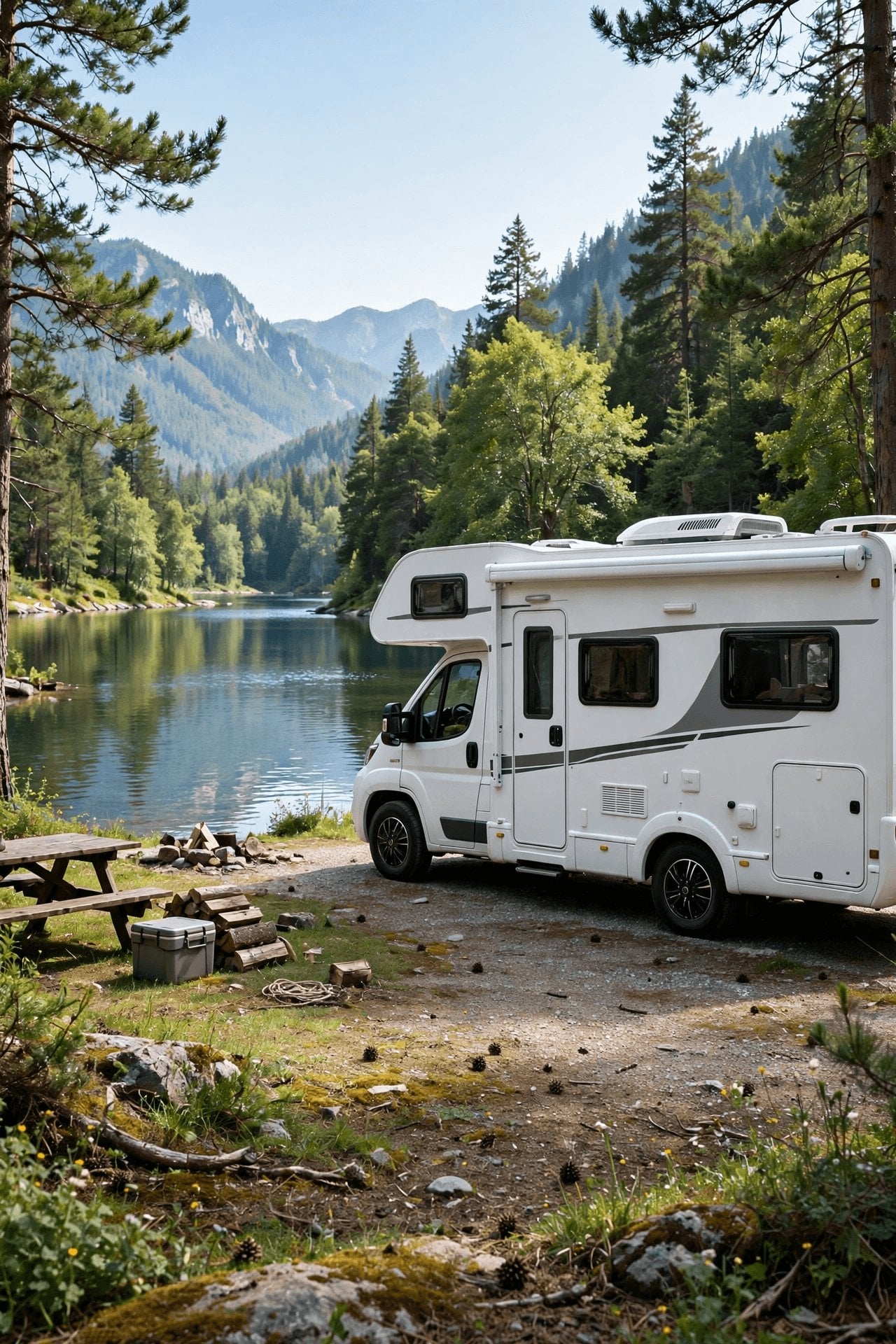
Pin it: the RV sells in a weekend at a discount; the tiny house sells in a season at a defended price — plan your exit for the one you buy.
9. Parking and Placement: Where Each Is Allowed to Sleep
Placement is the tiny house’s examination question, and it must be revised before purchase. A tiny house on wheels occupies a legal grey zone in most jurisdictions: it is not a house to the building code, not quite a vehicle to the road code, and its right to be lived in somewhere depends on local zoning, on whether the district allows accessory dwellings or tiny-house placements, and on the specific site — owned land, a tiny-house community, or a park that accepts them. The tenancy models are compared in our guide to tiny house communities vs RV parks, and legal communities can be located through our tiny home communities locator. The governing rule: the placement is solved, in writing, before the house is bought — because a finished tiny house with nowhere legal to sit is the category’s one true nightmare.
The RV parks inside an economy built for it. Campgrounds and RV parks accept you as their entire business model — with terms: stay limits that vary by park and season, pricing that swings with demand, and rules on unit age, condition and occupancy that full-timers must read as the tenancy conditions they are. Beyond parks, the RV’s vehicle status opens doors the tiny house cannot use: overnight provisions, public-land stays where regulations allow them, and the simple legality of being a vehicle in vehicle places. The RV’s placement problem is not legality but economics and availability — in popular regions and seasons, the good sites are a booking competition.
The shared truth underneath both stories is that neither product abolishes the land question; they rent two different answers to it. The tiny house rents scarcity — few legal placements, each precious. The RV rents infrastructure — many placements, each temporary. Choose the answer whose terms you can live inside for years, and verify it for your actual region, because placement law is the most local fact in this entire comparison.
10. The Hidden Dimensions: Insurance, Paperwork and Daily Friction
Three quieter dimensions decide more full-time outcomes than any specification sheet. Insurance first: the RV insures as the certified vehicle it is, through mature products every broker understands. The tiny house insures through the classification puzzle set out in our tiny house insurance guide for wheels vs foundation — possible, increasingly normal, but a conversation rather than a checkbox, and one to have before purchase, since some placements and lenders require the policy you have not yet confirmed exists. Registration, titling and driver-licensing requirements follow the same split: routine for the vehicle, variable for the house on a trailer, and local in both cases — check yours rather than borrowing a forum’s.
Paperwork has a domestic twin: the address. Full-time wheeled life of either kind runs into domicile, mail, voting, banking and medical-admin questions that houses answer automatically. Both communities have worked solutions — domicile services, mail forwarding, friendly-base addresses — and the RV world’s longer history makes its solutions more packaged. Budget the administration as a real task of the first season, whichever you choose; it is identical work wearing two sets of forms.
Daily friction finishes the list: laundry logistics, guest nights, workspace on a rainy week, a dog, a hobby with equipment, the flu in 200 square feet. The tiny house absorbs friction like a small home — better storage, better bathroom, a door that closes. The RV absorbs it like a travel product — you can always drive to the laundromat town, the guest’s hotel town, the better-weather town. Year two of full-time life is decided by these frictions far more than by floor plans, so trial before you buy if you possibly can: rent each for a fortnight in the season you fear most, and let the friction vote.
Final Considerations
The verdict, plainly. Pick the RV if movement is the point of the exercise: if you intend to change bases monthly or more, want the campground infrastructure and legal simplicity of a certified vehicle, accept vehicle depreciation and vehicle maintenance as the subscription price of freedom, and can live three-season-plus-winterised rather than four-season residential. Pick the tiny house if residence is the point: if you will stay seasons or years per base, want the winter comfort, fixtures and aging curve of a real house, will do maintenance with house trades and house parts, and — the non-negotiable condition — you have solved a legal placement in writing before you buy. The classic mistakes are mirror images: a tiny house bought by someone whose life needs to move, slowly becoming an expensive prisoner of its own weight; an RV bought by someone who parks it for five winters, paying vehicle compromises for a stationary life. The products are both good. Buy the one whose good matches your calendar.


0 Comments