

Seattle — the Emerald City, where the tiny house market meets Pacific Northwest prices. Demand is high, land is scarce, and the premium is real — but so is the payoff for a buyer who does the homework. This guide walks the whole road: prices, builders, listings, checks, financing, neighborhoods, parking, the rain factor, and the day the keys finally change hands.
Tiny Houses in Seattle for Sale: At a Glance
This guide covers tiny houses in Seattle for sale from the first listing search to the first night in: the market and its prices, the builders and their shops, the checks that protect you, the financing and the insurance, the neighborhoods and the parking question, the rain and the PNW style, the commandments and the mistakes, the used market and the negotiation — and the payoff at the end of it all.
| Topic | What It Covers | Key Fact or Figure |
|---|---|---|
| The Market and the Prices | Demand, supply and the Seattle premium | New builds $80,000–$150,000 |
| The Builders and the Listings | Local and regional builders; where listings live | Watch the listings daily |
| The Checks Before Buying | Certification, title and third-party inspection | RVIA certification, verified |
| Financing and Insurance | RV loans, personal loans, credit unions, policies | Shop and compare the terms |
| Neighborhoods and Parking | City, suburbs, zoning and the backyard question | The jurisdiction decides |
| The Rain and the PNW Style | Moisture, ventilation, cedar and big windows | 150 days of drizzle a year |
| The Commandments and the Mistakes | The rules of buying and the errors that cost | 10 commandments of Seattle tiny buying |
| Visiting, Ordering and Delivery | Shop tours, custom timelines, staged deposits | Custom builds take 3–6 months |
| The Used Market and Negotiating | Depreciation, auctions, comps and leverage | Used homes run $40,000–$90,000 |
| The Payoff | The keys, the first night, Emerald City life | Research, inspect, buy |
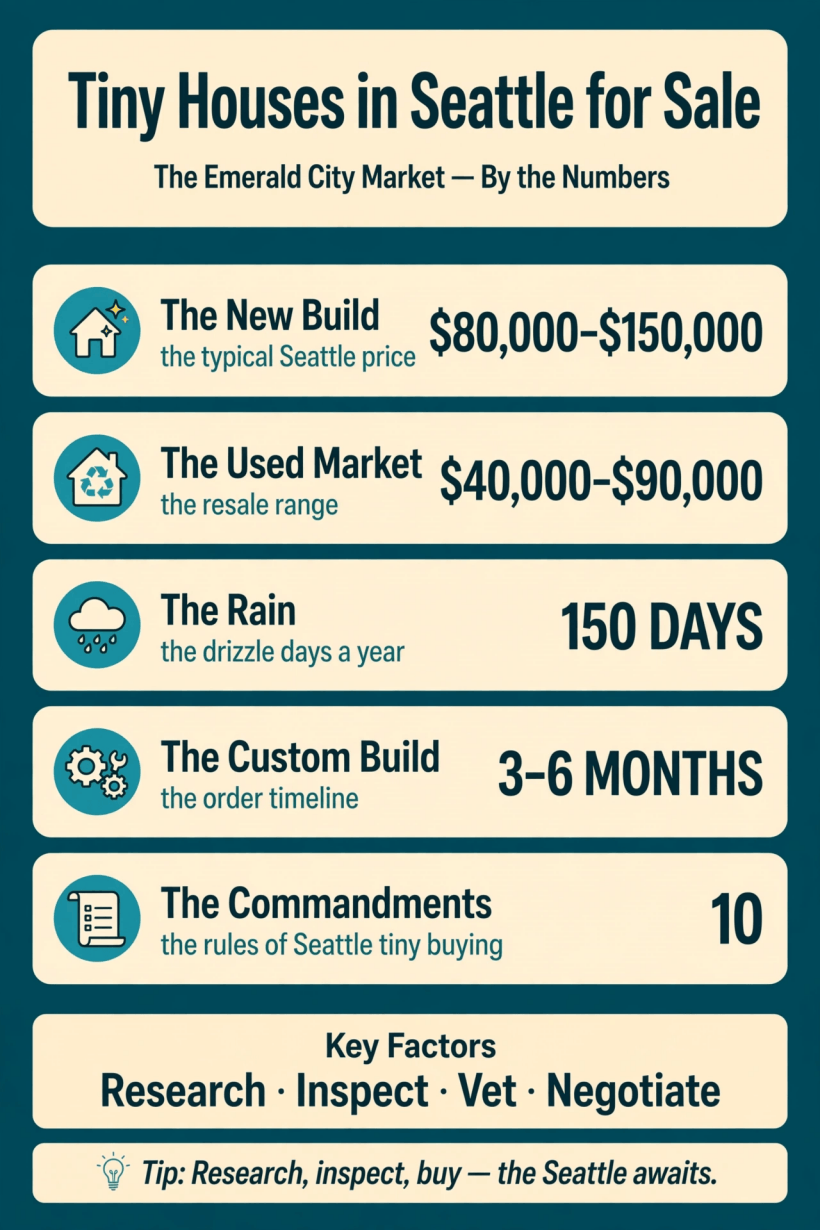
The Seattle market at a glance: what a new build costs, what the used market asks, how the rain shapes the design — and the ten rules that govern every purchase.
1. The Seattle Tiny Market and the Prices
Start with the market itself, because Seattle sets the terms of everything that follows. The demand is high — driven by the tech economy and everyone it draws to the Emerald City — while the supply is still growing, builder by builder. Put those two together and you get the market’s standing rule: the Seattle premium. Homes here command prices that would raise eyebrows in cheaper regions, and the buyer who accepts that early shops with clear eyes.
The prices follow from the market. A new build typically runs $80,000–$150,000 — the typical Seattle range, the real cost of a fresh, warrantied tiny in this city. The used market runs $40,000–$90,000, a wide band that rewards condition, build quality and patience. So how much do tiny houses cost in Seattle? Exactly that — and the Seattle premium is real, because the market commands the prices. Buyers who want a benchmark for how different another city’s numbers can look can compare our tiny houses for sale in Memphis TN buyer’s guide, where the same kind of home trades on a very different scale. Budget for Seattle prices honestly, and the rest of the purchase becomes a series of solvable problems.
2. The Builders and Where to Find Listings
Every Seattle purchase begins with a builder or a listing, and usually both. On the builder side, you have two families to research. The local builders are the researched and the toured — the shops you can drive to, walk through and judge in person. The regional builders are the delivered and the sited — builders from further afield who deliver into the Seattle area and set the home on your spot. Either way, the rule is the same: the builder is the vetted and the chosen. A builder you have not researched is a risk you chose, and the builder decision echoes through the price, the timeline and the quality of the finished home.

On the listings side, the search runs on two rails. Online, the marketplaces are the searched — the platforms where new and used homes appear and disappear. Direct, the builders themselves hold inventory, sometimes the freshest stock on the market. The rule for listings is discipline: the listings are the watched, the daily. Good Seattle homes do not sit waiting for a weekly browser; they move. So where can you buy a tiny house in Seattle? The local builders, the online marketplaces and the used listings — and the bought home is the researched one: the builder toured, the used home inspected.
3. What to Check Before Buying
Before money moves, three checks protect you, and none of them is optional. The certification: the RVIA — the verified; a certified build carries a standard behind it, and in a market this expensive, the standard matters. The title: the clear — the confirmed; a tiny house with a murky title is not a bargain, it is a future legal problem with a roof. The inspection: the third-party — the essential; your own eyes are a buyer’s eyes, hopeful by nature, while a third-party inspector is paid to be suspicious. The rule compresses all three: the checked is the bought — the safe. Skip a check and you have not saved money; you have bought the risk the check would have priced.
What should you inspect on a used tiny house? The trailer (the rust), the roof (the leaks), the systems (the working), the title (the clear) — seen with third-party eyes. Our step-by-step used tiny home inspection checklist walks that examination in full. And how do you avoid scams when buying used? The in-person inspection, the title verification, the escrow payment. The scammed buyer is the rushed buyer: the patient buyer stays safe. A seller who will not meet, will not show title, or will not use escrow is telling you everything you need to know — walk away.
4. Financing and Insurance in Seattle
Most Seattle buyers do not pay cash, so the financing deserves the same shopping energy as the home itself. The RV loan is the common route — the compared: because many tiny houses on wheels are titled and treated like RVs, RV loans are the standard instrument, and terms vary enough that comparison pays. The personal loan is the alternative — the weighed: simpler for some buyers, costlier for others. Credit unions belong in the mix as well. Can you finance a tiny house in Seattle? Yes — the RV loans, the personal loans, the credit unions. The financed home is the shopped home: the terms compared, the fine print read, never accepted from the first desk you sit at. Buyers weighing the whole cost picture can go deeper with our guides to super-affordable tiny homes and the true cost of tiny houses, prefab vs DIY.

Insurance closes the money side of the purchase. The RV policy is the common cover — the compared, again, because quotes differ. The specialty route is the tiny-specific policy — the shopped, written for exactly this kind of home. Either way, the rule is absolute: the insured is the protected — the always. A home that rolls, parks under trees and lives through 150 days of drizzle does not go uninsured in any sensible plan. Arrange the policy before the home moves, not after the first storm.
5. Neighborhoods, Parking and the Backyard Question
A tiny house needs somewhere legal to be, and in Seattle that question splits by jurisdiction. Inside the city, the picture is the pricey and the zoned — land costs city money and the rules are city rules. In the suburbs, the picture is friendlier — the researched: more space, more variation, and jurisdictions that may treat a tiny house very differently. The rule never changes: the jurisdiction decides — the always. Not the seller, not the builder, not the listing — the jurisdiction where the wheels stop. Buyers drawn to the community side of tiny living can compare how placement works in our tiny house community Fort Collins CO guide.

Then comes the parking question, which the original guide states as a rule in its own right: the parking is the solved — the first. Solve it before the purchase, not after. The land itself is scarce and pricey in Seattle; a lease is the negotiated and the flexible answer for many buyers, and a good lease, in writing, is worth as much as a good floor plan. And the backyard question — can you put a tiny house in your Seattle backyard? Check the current ADU and DADU rules, because Seattle has been evolving them. The backyard tiny is possible; the current code decides. Is Seattle a good place for tiny house living? The culture is welcoming but the land is pricey, and the suburbs and surrounding areas offer the best options: the jurisdiction and the budget decide.
6. The Rain Factor and the PNW Tiny Style
Seattle’s weather is not a footnote to the purchase; it is a design brief. The rain factor starts with the number: 150 days of drizzle a year — the designed. A Seattle tiny is designed for that drizzle the way a desert tiny is designed for heat. The moisture is the managed and the ventilated: water will try to get in and stay in, and the homes that thrive here are built to breathe it out again. The rule deserves memorizing: the Seattle tiny breathes — the dry. When you inspect any Seattle home, you are really inspecting its answer to the rain: the roof, the seals, the ventilation, the places where damp announces itself first.

The style grows out of the same climate. The cedar is the natural and the local — the region’s own wood, at home in the region’s own weather. The big windows answer the gray: when the light is scarce for months, the windows are how the tiny borrows it back. The truth of the section: the PNW style is the place — the designed. It is not decoration applied afterward; it is what a tiny house looks like when it is designed for evergreen light and wet winters. Buy the style knowingly: a home that looks right in Seattle usually works right in Seattle, because the look and the logic grew from the same rain.
7. The 10 Commandments and the Mistakes to Avoid
The original guide distills the whole purchase into ten commandments, and they deserve their full list. Research the market. Budget the real. Vet the builder. Inspect the used. Verify the title. Shop the financing. Solve the parking. Check the zoning. Negotiate the fair. Buy the confident. Read them again slowly, because every section of this guide hangs on one of those ten lines: the market research of the first section, the vetting of the second, the title and inspection of the third, the financing of the fourth, the parking and zoning of the fifth. Ten short orders — and the buyer who keeps all ten rarely tells a horror story.
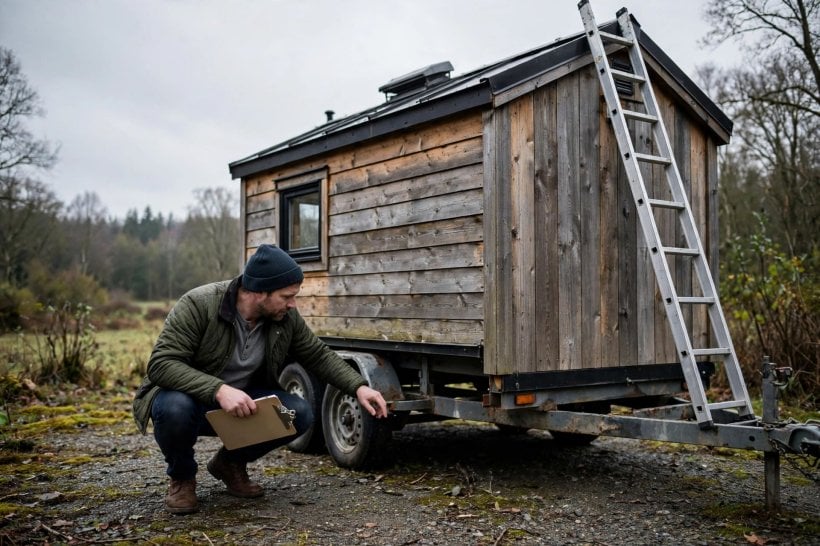
The mistakes are the commandments read backwards. The unseen — bought without being inspected, the classic error in a fast market. The no-title — murky paperwork waved through because the home looked perfect. The overpaid — the researched buyer negotiates; the unresearched buyer simply pays. The rule writes itself: the researched avoids — the regretted. Every mistake on this list is a commandment skipped: the inspection skipped, the title skipped, the comps skipped. Keep the ten rules, and the mistakes stay what they should be — a list of things that happened to other buyers.
8. Visiting the Builder, Ordering Custom and Delivery
Timing first, because the original guide answers the question plainly: what is the best time to buy a tiny house in Seattle? The fall and winter — the slower market, the motivated sellers. The timed purchase is the saved purchase: patience pays. Then the process. Visiting the builder means the shop — the toured, the observed — and the builds in progress — the judged. A builder’s half-finished homes tell you more than a finished showpiece: look at the framing, the fits, the care taken where no buyer was expected to look. The rule: the visited is the trusted — the chosen.

Ordering custom turns the visit into a contract. The design is yours — the specified, drawn and agreed before a board is cut. The timeline is the 3–6 months — the waited, and worth scheduling your life around honestly rather than hopefully. The deposit is the staged — the protected, released in steps as the build proves itself. The rule: the custom is the patient — the rewarded. And when the home is finished, delivery and setup close the process: the route, planned and permitted; the site, leveled and ready. The rule for the day mirrors the rule for the whole purchase: the delivery is the planned — the smooth.
9. The Used Market, Auctions and Negotiating the Price
The used market deserves its deep dive, because at $40,000–$90,000 it is where many Seattle buyers actually land. The depreciation is the gentle — the tiny: well-built tiny houses hold their value better than buyers expect, which cuts both ways — less bargain basement, more lasting worth. The gems are the well-built — the found: the careful first owner’s home, maintained through the rainy seasons and sold for life’s reasons, not the house’s faults. The truth of the used market: it rewards — the patient. Set the watch, keep the inspection discipline, and let the right home surface. The rarer channels reward the same temperament. Auctions and estate sales are the rare — the deals, the watched — and the quick: the decisive, the ready. The rule: the auction is the prepared — the won. Arrive with a ceiling and the title questions ready, or do not arrive at all. Buyers who decide the used route is not for them can price the alternative in our guide to how to make a tiny house for cheap.

Negotiating is where research turns into money. The comps are the researched — the armed: know what comparable homes actually sold for before you name a number. The flaws are the noted — the leveraged: every honest defect found in inspection is a fair argument, made calmly. The rule keeps both sides honest: the negotiated is the fair — the both. And should you buy new or used in Seattle at all? The new — the warrantied, the custom — against the used — the cheaper, the available. The choice is the weighed: the budget and the patience decide.
10. The Seattle Buying Payoff and Life After the Keys
End where the purchase ends: the payoff. The owned — the Emerald City, the tiny. The researched — the confident, the bought. The lived — the PNW, the daily. The truth of it: the payoff is the keys — the tiny. Everything before this section was process; this section is what the process buys. The final signature — the signed papers, the widest smile — is not the end of the story but its beginning. Buyers still deciding where the tiny life should happen can read how the land equation changes in our tiny houses for sale in Colorado with land buyer’s guide before they commit to the Emerald City.
The first night: the moved-in — the Seattle rain outside, the cozy earned. The truth: the first night is the sweetest — the owned. Then the rituals assemble themselves. The coffee ritual: the brewed in the tiny kitchen, the view of the Sound. The mountains: the Cascades as backdrop and weekend escape. The ferry ride: the Sound crossed, the tiny left as home. Pike Place: the market, the flowers, the Saturday; the tiny kitchen stocked fresh. The rain song: the patter on the metal roof, the inside warm and dry. The homecoming: the arrived, finally — the exhaled home. The Sound at dusk, the tiny’s windows lit. And the deepest change of all: the buyer becomes the neighbor — the welcomed, the waved-at. The evergreen state stays green, and the forever is the chosen — the Emerald City forever.
Final Considerations
Seattle’s tiny house market rewards the researched buyer — the prices known, the builders vetted, the listings watched. For anyone weighing tiny houses in Seattle for sale, the sequence in this guide is the whole discipline: research the market, check the home, solve the parking, keep the ten commandments, and let the payoff come to a prepared buyer. Buy smart, inspect well, live tiny in the Emerald City. Note: prices and availability change — verify all current information directly. This is not financial advice; consult a qualified professional for financing decisions.

1 Comment