

Colorado has quietly become America’s tiny-house frontier: more than 300 days of sun a year, rural mountain land still priced within reach, and the densest concentration of tiny builders in the country. Whether you want a house on wheels, a foundation-built small home, or a home-and-land package, this guide walks through the prices, the listings, the builders and the legal groundwork before you spend a dollar.
Tiny Houses for Sale in Colorado With Land: At a Glance
Shoppers looking at tiny houses for sale in Colorado with land are really shopping three markets at once: the house itself, the land under it, and the rules that decide whether the two can legally meet. This guide prices all three. It opens with the current Colorado price bands for new and used homes, then samples real listings from Cedaredge to Denver, introduces the builders who anchor the market, and maps where land is cheapest — the Western Slope and the San Luis Valley. From there it covers the county-by-county zoning reality, the financing routes that actually work for tiny homes, and what high-altitude winters demand from a build. It closes with the regional markets, a step-by-step buying process with an inspection checklist, and a total-cost worksheet so your budget survives contact with raw land.
| Topic | What It Covers | Key Fact or Figure |
|---|---|---|
| 1. The Colorado Market and Prices | What new, used and foundation tiny homes cost | New THOW: $25,000–$90,000 |
| 2. Real Listings | Actual homes and packages on the market | Cedaredge package: $350,000 on 2.45 acres |
| 3. Colorado Builders | The makers worth touring before you buy | Simple Tiny Homes: $39,900–$69,900 |
| 4. Where to Buy Land | The cheapest regions and the raw-land maths | Rural acreage: $15,000–$40,000 |
| 5. Zoning Reality | County rules, RVIA certification and permits | No statewide code — county by county |
| 6. Financing | RV loans, FHA/USDA and the lender check | RV loans: 6–10% over 15 years |
| 7. Mountain-Building Reality | Insulation, snow, solar, water and off-grid life | R-30+ walls, R-40+ roofs |
| 8. Metro, Mountain Towns and Communities | Denver deals, the view tax and WeeCasa | Denver Pacifica 24′: $65,000 |
| 9. How to Buy | The process, inspection checklist and negotiating | New custom builds: 3–6 months |
| 10. Total Cost Worksheet | The all-in budget and the final checklist | Rural all-in total: $75,000–$150,000 |
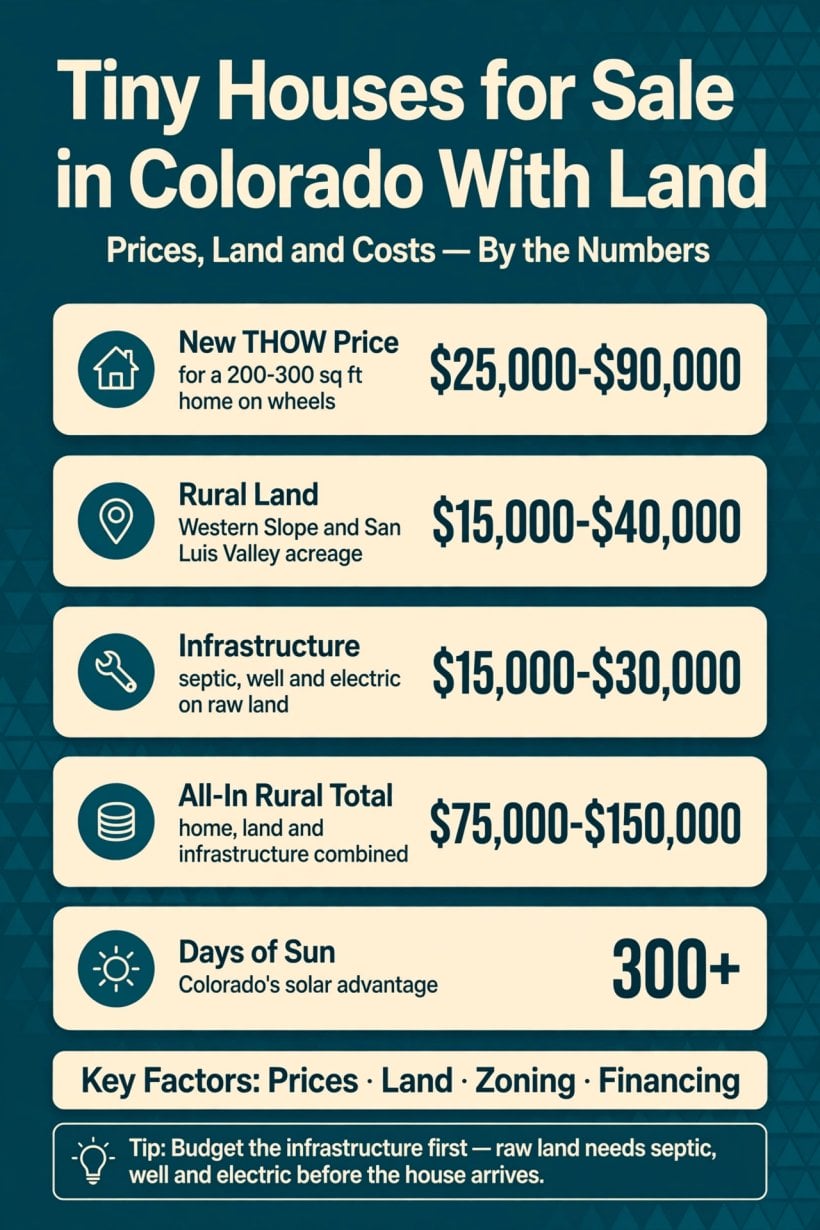
The Colorado market by the numbers: new tiny houses on wheels at $25,000–$90,000, rural land at $15,000–$40,000, $15,000–$30,000 of infrastructure on raw acreage, an all-in rural total of $75,000–$150,000 — and 300+ days of sun working in your favour.
1. The Colorado Market: What Tiny Houses Cost
Start with the house itself. A new tiny house on wheels in Colorado runs $25,000–$90,000, with most builds falling in the 200–300 sq ft range. Buyers who want a permanent small home instead should look at foundation tiny houses at $60,000–$120,000 — more money, but a fixed structure that lenders and counties treat more like conventional housing. On the used market, a second-hand THOW typically runs $40,000–$72,000, and the marketplace deals reward buyers who are ready to move quickly.
Land changes the maths completely, which is why this guide treats the two purchases together. Bare rural acreage can still be found at $15,000–$40,000, while a tiny house sold together with mountain land jumps to $350,000–$400,000 — the premium for acreage with a view. For a wider sense of how these bands compare nationally, our breakdown of how much tiny houses cost puts Colorado’s numbers in context. The short version: Colorado pairs mid-range house prices with some of the cheapest usable land in the West.
Why does this one state support such a deep market? The original guide’s answer is a stack of advantages rather than a single cause: the densest builder market in the country, 300+ days of sun, rural land still priced from $15,000, and a culture — outdoorsy, independent — that matches tiny-house values naturally. Each factor alone exists somewhere else; Colorado is where they arrive together, and the prices above are what that combination costs.

2. Real Listings: What’s Actually Available
Listings show what the price bands buy in practice. At the package end, a Cedaredge listing pairs an 8×28 custom tiny home with 2.45 wooded acres at $350,000, while a Collbran property offers a tiny home on roughly 37 acres at $400,000 — in both cases the land, not the house, carries most of the price. These are the mountain-acreage premiums from the previous section made concrete.
House-only listings sit far lower. A 2022 30′ THOW in Golden with 350 sq ft was listed at $72,000; a 2020 Pacifica 24′ in the Denver area at $65,000; and a 2017 32′ THOW placed in a tiny-home community in Woodland Park at $55,000. Builder-direct listings widen the entry point further — Simple Tiny Homes in Cañon City advertises 22–30′ models from $39,900 to $69,900. If you are still deciding where homes like these are sold at all, our guide to where to buy a tiny house on wheels maps the main channels. Prices and availability change, so verify every listing directly before planning around it.
3. Colorado Builders Worth Touring
Colorado’s real advantage is builder density — no other state packs so many tiny builders into one market, and that competition works in the buyer’s favour. Trailer Made is the custom name to know, the builder behind the Cedaredge tiny in the listings above, known for one-off builds rather than catalogue models. Simple Tiny Homes in Cañon City anchors the affordable end, with the 22–30′ range priced at roughly $40,000–$70,000. ESCAPE represents the national end of the market — the certified standard, built to a recognised specification that helps with financing and resale.
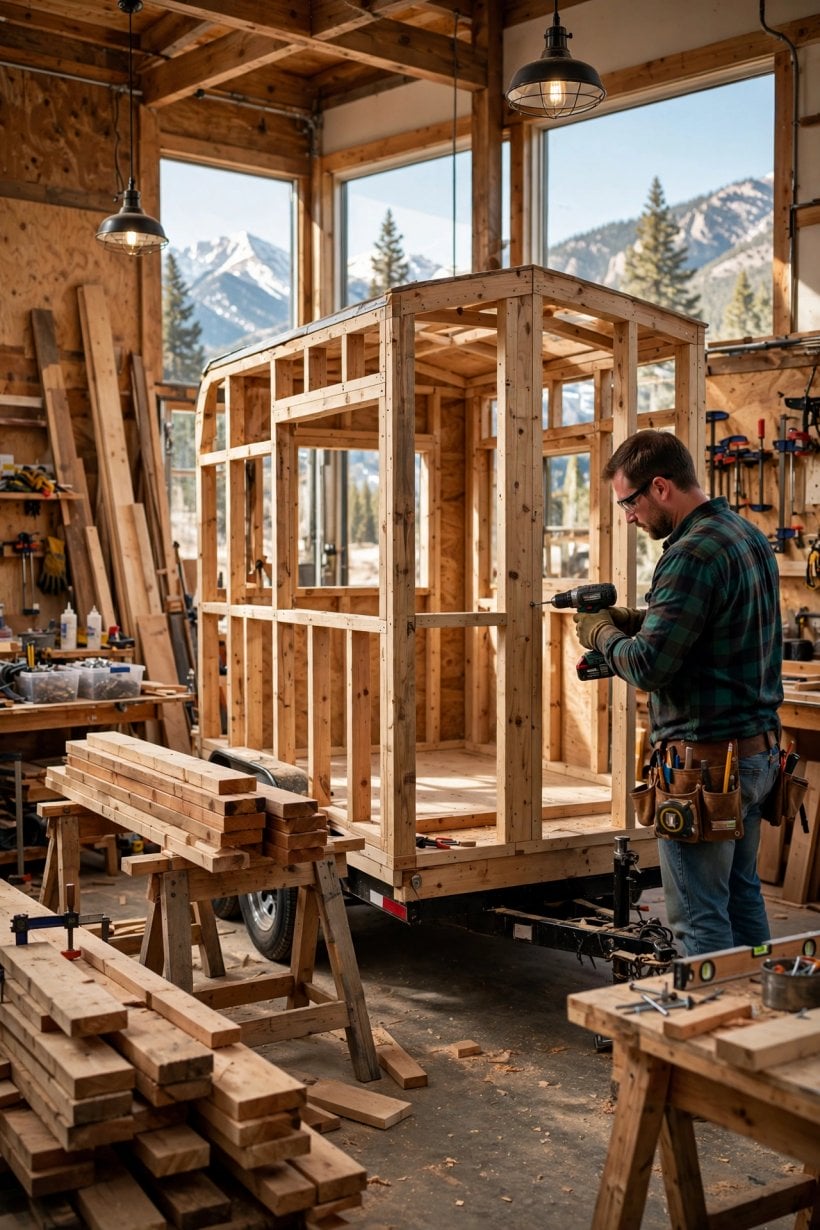
Beyond the named makers sit dozens of small local builders, and that depth is the point. The original advice bears repeating: tour the shops. Walk the factory floors, sit inside finished homes, compare wall build-ups and trailer quality in person. A state’s worth of builders within driving distance is a negotiating asset and a quality check at the same time — use it before you sign anything.
4. Where to Buy Land
Two regions dominate the affordable-land conversation. The Western Slope offers the lowest costs in the state, with rural acreage at the $15,000–$40,000 level. The San Luis Valley is the other budget stronghold — affordable land with, in the original guide’s words, the fewest restrictions in Colorado. The mountains are the opposite play: beautiful, scarce and priced accordingly, which is how home-and-land packages reach $350,000 and beyond.
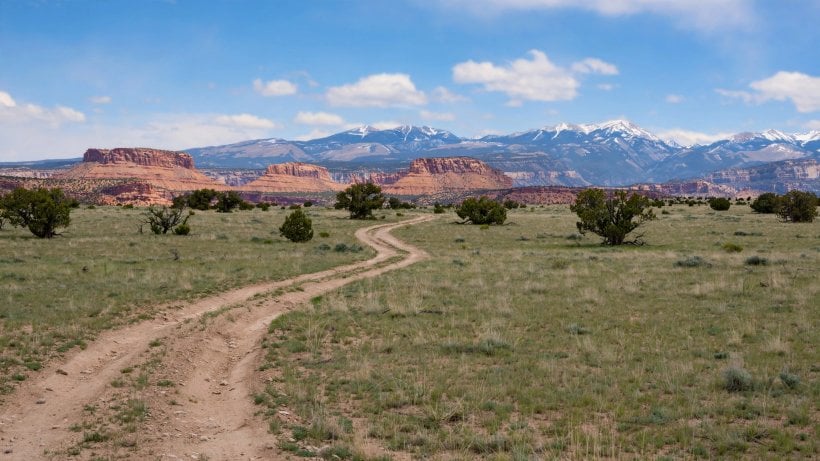
Whatever the region, raw land is not finished land. Budget $15,000–$30,000 on top of the purchase price for septic, well and electric — that is the raw-land maths, and skipping it is how budgets break. Buyers comparing the package route against buying land separately should read our guide to a tiny house for sale with land, which weighs the bundled deals against the DIY assembly. Search the Western Slope and the valley first, confirm the infrastructure costs for each parcel, and only then compare parcels on price.
5. Zoning Reality: County by County
Here is the legal fact that shapes every Colorado purchase: there is no statewide tiny-house code. Legality is decided county by county, so local research is not a step in the process — it is the process. The direction of travel is encouraging: Colorado counties are progressively adopting ADU and THOW-friendly rules, and the momentum is real, but adoption on paper in one county says nothing about the county next door.

Certification is the other half of the question. A tiny house on wheels may be titled as an RV — where RVIA certification helps, both with the county and with lenders — or accepted through a conditional-use route, depending on the county. WeeCasa in Lyons stands as the established example of the permitted path: a community that did the regulatory work so residents don’t have to improvise it. Before any offer, confirm your exact plan with the local building department, and read our overview of where you can live in a tiny home for the broader placement picture. The county call takes minutes and settles the single biggest risk in the whole purchase — make it before the offer, never after.
6. Financing a Tiny House and Land
Financing follows the house type. For an RVIA-certified tiny house on wheels, the working route is an RV loan — typically 6–10% over 15 years, with lenders such as LightStream and Alliant named in the market. Foundation models open the conventional door: FHA and USDA routes become possible because the home is a fixed structure. And a large share of Colorado tiny purchases are simply cash — the simplest route of all, common at the used-market price points.
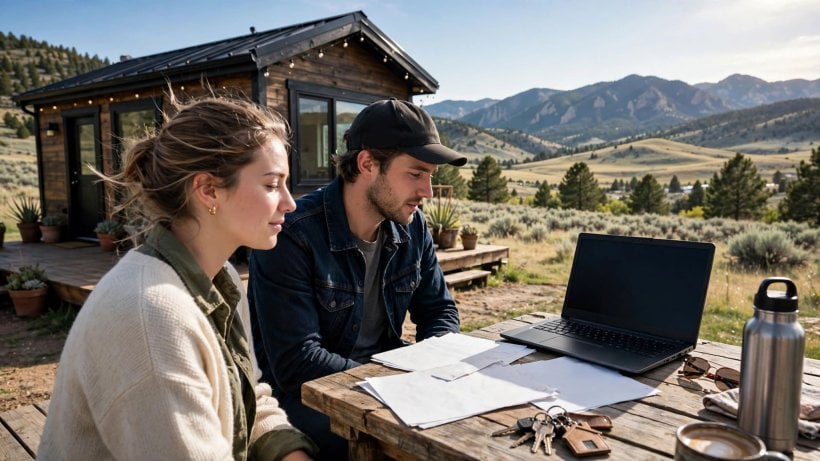
One step is non-negotiable whatever route you take: verify your lender’s tiny policy before you commit. Lenders differ sharply on tiny homes — on whether they will lend at all, on certification requirements, and on whether the land can be financed alongside the house. A five-minute call before the offer beats a collapsed deal after it. Treat financing as a research task alongside zoning, not an errand for the end of the process.
7. Mountain-Building Reality
Colorado altitude rewrites the building spec. Insulation is the headline: R-30+ walls and R-40+ roofs are the high-altitude winter standard, because a tiny house has little thermal mass and loses heat fast when the temperature drops. Snow is the second design driver — roof loads at altitude are an engineering question, not a guess, and the roof structure has to be specified for them.
The compensation is the sun: 300+ days of it, which makes Colorado a solar advantage state and off-grid living genuinely practical. In the San Luis Valley especially, affordable remote land pairs with that sun — though water becomes the planning problem instead, with wells to drill or water to haul, and winter battery maths to respect. Buyers dreaming of the fully self-sufficient version should read our guide to how to live off grid in a tiny house before committing to a remote parcel.
For owners, the first year is the proving ground: the first season spent learning the systems, the land gradually improved toward a homestead, and the first full winter as the honest test of that R-30 specification. The original guide’s rhythm is worth picturing — morning coffee with a mountain view, midday trails as the backyard, evenings under the alpine glow. That lifestyle is the return on all this engineering discipline.
8. Denver Metro, Mountain Towns and the Community Option
The Denver metro market runs on Front Range logic: the listings are there — the $65,000 Pacifica 24′ is the example — and the builder shops are close enough to tour in a weekend, but the land carries a metro premium. The original guide’s play is worth naming: buy the THOW in the metro market, then place it on rural land — arbitrage between where houses are plentiful and where land is cheap. The mountain towns invert the equation. There the $350,000-plus packages are a view tax: you are buying the ski access, the trails and the alpine setting, with valley towns as the value alternative nearby.
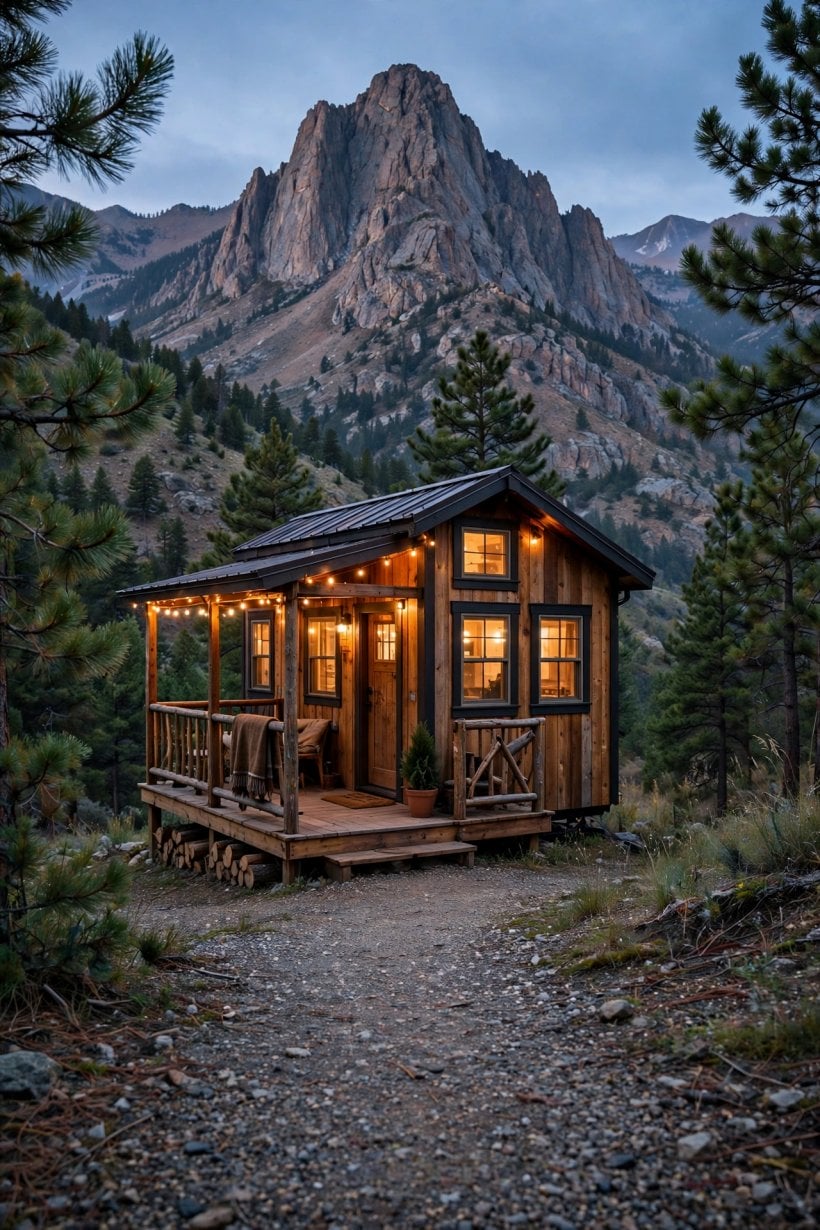
Between owning land and renting a lot sits the community option. WeeCasa in Lyons is the established flagship — shared infrastructure, permits already in place, and the easier on-ramp that comes with both. The trade is community rules: shared living has a rulebook, and buyers should visit in person and read it before deciding. Community models differ by state, too — our roundup of tiny house communities in Florida shows the village end of the spectrum, while the state-by-state comparison in our guide to tiny houses for sale in Texas underlines the original verdict: Colorado wins on builder density and solar, which is why this market keeps its frontier status.
9. How to Buy: The Process, Inspection and Negotiation
The process runs in a fixed order. Define the purchase first — THOW or foundation, your own land or a community. Budget the honest total: home, land and infrastructure together. Research zoning with the county call before anything is signed. Tour the builders — Colorado’s density is the advantage, so use it. Then inspect, finance and place: verify the lender’s tiny policy, and budget the $15,000–$30,000 of land preparation before the house arrives. Our step-by-step guide to how to buy a tiny house expands each stage.
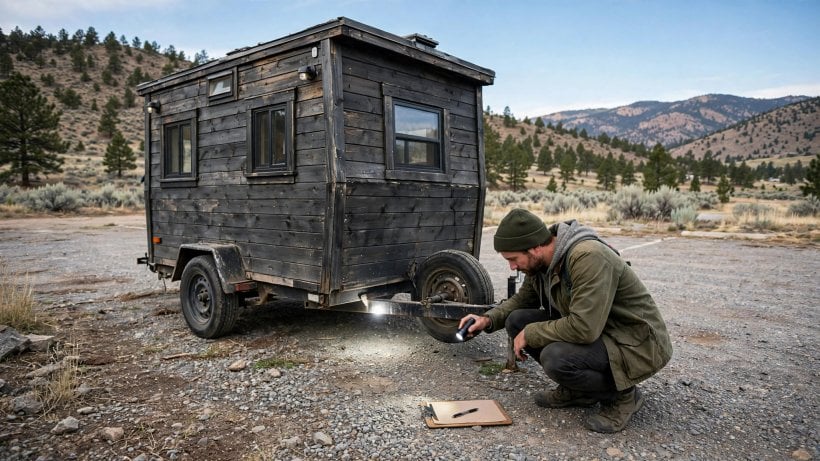
Buying used deserves its own discipline. Inspect like a house: the trailer and frame as the foundation, water intrusion and mould as the dealbreakers, the electrical and plumbing systems properly tested, the title checked through the VIN and registration, and the actual weight confirmed as towable. Then negotiate with what you have — marketplace comps, the leverage of anything the inspection found, and the season itself, since winter is the buyer’s market. Bundle home plus delivery where you can, and keep the walk-away as your discipline. Timelines, finally: a used purchase takes weeks, a new custom build 3–6 months, and land plus infrastructure adds another 2–4 months — the patient buyer gets the better deal.
10. The Total Cost Worksheet and Final Checklist
Assemble the honest budget in one place. The home: $40,000–$90,000 new, or $40,000–$72,000 used. The land: $15,000–$40,000 rural, or $350,000 and up in the mountains. Infrastructure on raw land: $15,000–$30,000 for septic, well and electric. Delivery: $2,000–$8,000 for the transport. Insurance: an annual figure to be quoted, not guessed. Added up, the rural route totals $75,000–$150,000 all-in — the honest maths that separates a plan from a wish.
Run the final checklist against that worksheet before you commit. Zoning: confirmed with the county — the non-negotiable. Budget: the all-in worksheet, honestly totalled. Builder: toured and vetted in person. Inspection: thorough, if the home is used. Financing: the lender’s tiny policy verified. Infrastructure: the $15,000–$30,000 budgeted, not discovered later. With every box checked, the Colorado tiny is yours — and the first year, from the first settling season to the first R-30 winter test, becomes the reward rather than the surprise.
The outlook supports buying with patience rather than panic. The original guide’s bet for 2030: progressive zoning adoption keeps making placement easier, the builder market keeps growing more competitive, and affordability keeps driving demand — Colorado’s tiny lead extends. A market moving that way rewards the ready buyer: checklist complete, financing verified, and the discipline to wait for the right parcel at the right price.
Final Considerations
Colorado’s tiny market is the deepest in America — the builders, the listings, the land and the sun all in one state. Whether the right purchase among the tiny houses for sale in Colorado with land is the $65,000 Denver THOW or the $350,000 Cedaredge mountain package, the pattern is the same: research the zoning, tour the builders, budget the infrastructure, and inspect like it matters. Do those four things and Colorado rewards the prepared buyer. One last note from the original guide: prices and availability change — verify listings and zoning directly before you act.


2 Comments