
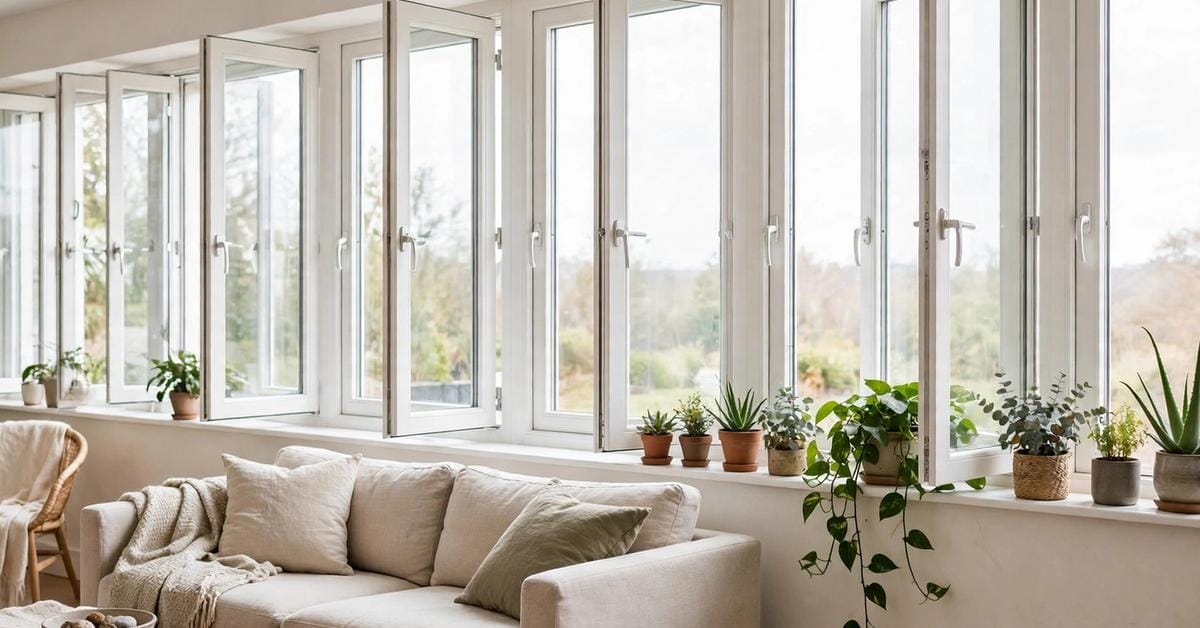
A window that will not close properly, a frame that lets in a draught on a cold evening, or glass that has misted between the panes can turn a simple room into a daily irritation. When replacement finally moves from a vague idea to a real plan, the first question most homeowners ask is about the cost to install a window, and the honest answer is that no single figure can cover every home. Two windows that look alike from the street can involve very different amounts of work once the old frame comes out and the opening is seen properly.
This guide explains the drivers behind a window installation quote in general terms only. It gives no prices, no ranges and no calculator, because any figure printed here would be wrong for most readers: homes differ, areas differ, and the scope of the job differs even more. What follows is a way to read quotes with confidence, to understand why one quote sits above another, and to ask the right questions before work begins. Window installation is professional work throughout this guide, and nothing here is a guide to fitting a window yourself. Local quotes, in writing, are the only figures that matter for your home.
| Item | What it is |
|---|---|
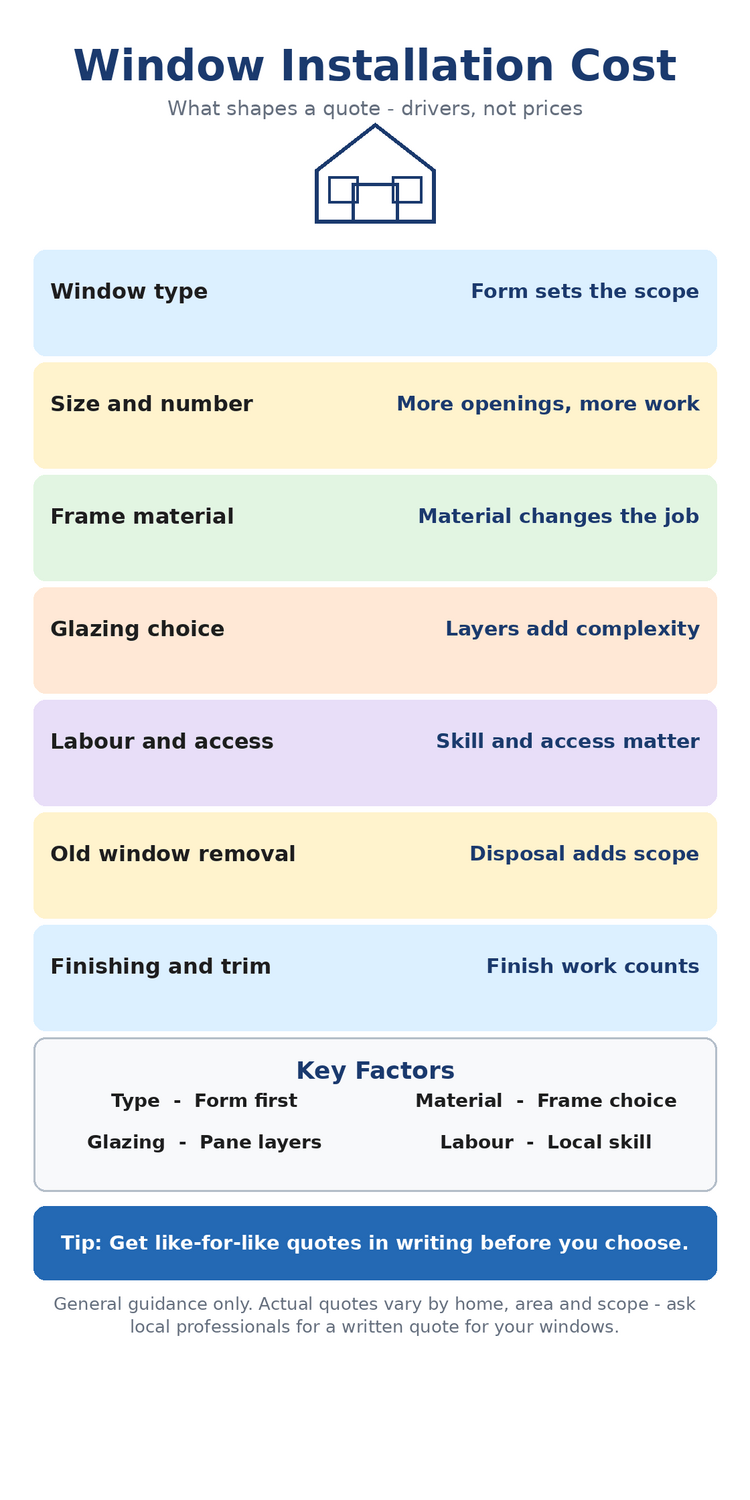
| Window Type: How Form Sets the Scope | The form of the window is the first driver of scope, because form decides how the window opens, how many moving parts it has, and how it sits in the wall. |
| Size and Number: Why Openings Add Up | Size matters in a straightforward way: a larger opening means a larger unit, more glass, a heavier frame and more sealing around the edges. |
| Frame Material: What the Frame Brings to the Quote | Frame material shapes a quote through the work it involves, not through any single quality claim. |
| Glazing: Panes, Coatings and Comfort in General Terms | Glazing is the part of the window most people notice least and think about most, because it affects light, sound and comfort in the room. |
| Labour and Access: The Professional Side of the Quote | Labour is often the least visible part of a window quote and the hardest to compare, because it covers skill, time and care rather than a product you can hold. |
| Removal and Disposal: The Old Window in the Quote | Every replacement begins with a removal, and removal is work in its own right. |
| Finishing, Trim and Making Good | Finishing is where a window job either blends into the house or stands out for the wrong reasons, and it is often where quotes differ most. |
| Rooms and Placement: Where the Window Sits | Where a window sits changes what it must do, and therefore what its quote must cover. |
1. Start With the Job, Not the Window Alone
The most useful way to think about a window quote is to think of it as a job, not as a product on a shelf. The window itself is only one part of what you are paying for. Around it sit the survey of the opening, the preparation of the wall, the fitting itself, the sealing and finishing, and the clearing away afterwards. A quote that looks simple on one line may hide several of those stages, while a fuller quote spells them out. That difference in detail, more than any single item, is often what separates one quote from another.
Begin, then, by describing the whole job to each installer in the same words. Say whether the window is a straight replacement in an existing opening or whether the opening itself will change. Say which rooms are involved, whether access is easy, and whether the old windows stay or go. When every installer prices the same job, their quotes can be compared fairly. When each one prices a slightly different job, comparison becomes guesswork, and the lowest figure may simply be the narrowest scope.
It also helps to decide early what matters most to you in the finished result. Some homeowners care most about daylight, others about quiet, others about easy cleaning or a frame that suits an older house. Those priorities shape the type, the glazing and the finish, and therefore the scope of the work. A clear brief does not make a quote cheaper, but it does make it more accurate, because the installer is pricing the window you actually want rather than a generic one.
2. Window Type: How Form Sets the Scope
The form of the window is the first driver of scope, because form decides how the window opens, how many moving parts it has, and how it sits in the wall. A fixed pane that never opens is a simpler unit than a window with sashes, hinges and handles that must all work smoothly for years. A window that slides, tilts or folds adds mechanism, and mechanism adds fitting care and adjustment time. None of this makes one form better than another; it simply means that form and scope move together.
Bay and bow forms deserve their own thought, because they change the shape of the room as well as the wall. A projecting bay involves several linked units, a roof or head above them, and a seat or sill below, so the job touches more surfaces than a flat window in a flat wall. The linked guide to bay windows shows how that projecting form changes a room, and it is a useful read before you ask for a bay quote, since the form itself explains much of the extra scope involved.
Special shapes carry the same lesson in a smaller way. A round, arched or very tall window may need a frame made to measure for that opening, and made-to-measure work takes longer to survey, make and fit than a standard-sized unit. If your home has an unusual opening, expect the quote to reflect the measuring and making time, not just the glass and frame. Ask the installer to explain how the shape affects the fitting, so you understand what the scope covers.
3. Size and Number: Why Openings Add Up
Size matters in a straightforward way: a larger opening means a larger unit, more glass, a heavier frame and more sealing around the edges. It also means more care in handling, because a large pane is harder to move into place and to set level than a small one. None of this is surprising, but it is easy to overlook when comparing rooms, since a generous living-room window and a small bathroom window are very different jobs even when they sit in the same house.
Number matters just as much, and sometimes more. Replacing every window in a house is a programme of work, not a single job repeated, because the installer must plan the order, protect each room in turn, and keep the house weather-tight at the end of each day. Doing windows in phases can suit a household better, and it can also change how a quote is structured, since each phase carries its own preparation and finishing. Ask how the work is sequenced, and what the house will look like between phases.
It is worth counting openings honestly before you seek quotes, including small ones that are easy to forget, such as a landing window or a high window over a stair. A quote built on a full count will be more reliable than one built on a rough guess, and it avoids the awkward moment when an extra window appears halfway through the job. A careful count also helps you decide whether to include every opening now or to leave some for a later phase.
4. Frame Material: What the Frame Brings to the Quote
Frame material shapes a quote through the work it involves, not through any single quality claim. Different materials are made differently, finished differently and maintained differently, and those differences show up in how the frame is handled, jointed and sealed. A material that needs painting or regular finishing brings that finishing work into the job, while a material with a factory finish brings a different kind of care in handling, since marks made during fitting cannot simply be painted over.
Colour and finish also play a part. A plain finish is a simpler job than a dual finish, where the inside and outside of the frame carry different colours, or a wood-grain effect that must line up neatly across joints. Period homes add another layer, because a frame that must suit existing joinery, stonework or brickwork needs closer matching and more careful making good around the edges. None of these choices is right or wrong; each one simply adds its own kind of work to the quote.
When you compare materials, compare the whole life of the frame, not just the day of fitting. Ask how the finish is maintained, how handles and hinges are reached for adjustment, and what happens if a seal or a sash needs attention later. A frame that is easy to look after may suit a busy household better than one that needs regular care, even if the fitting scope looks similar on paper. The quote should reflect the frame you will live with, not only the frame that arrives on the day.

5. Glazing: Panes, Coatings and Comfort in General Terms
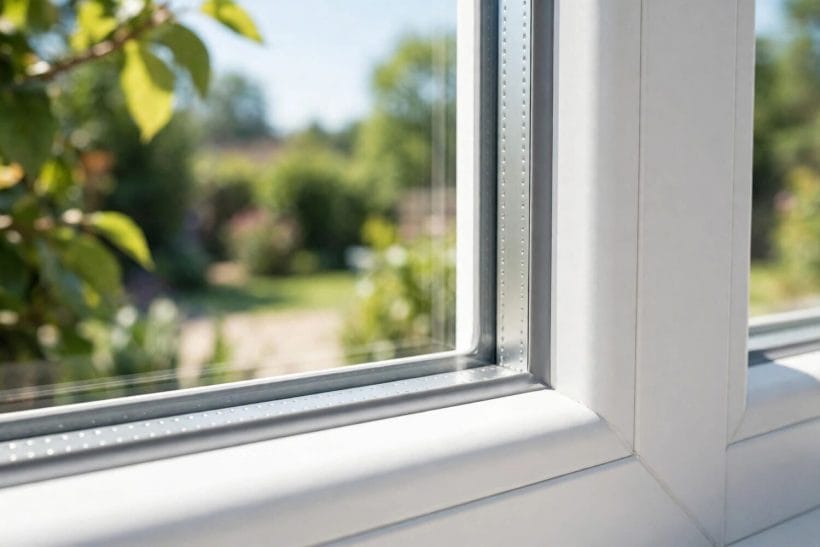
Glazing is the part of the window most people notice least and think about most, because it affects light, sound and comfort in the room. The number of panes is the simplest driver: more panes mean a heavier, more complex unit, with more sealing and more care in fitting. Additional layers, coatings or gas fills between panes add further making and handling steps. The right choice depends on the room, the direction it faces, and what bothers you most about the existing window, whether that is draughts, noise or glare.
It helps to talk about glazing in terms of what you want the room to feel like, rather than in technical shorthand. A bedroom facing a busy road raises different questions from a sunny south-facing kitchen, and a north-facing study raises different questions again. An installer who understands the room can explain, in plain language, what each glazing option does and what it does not do, and where a simpler option would serve just as well. Be wary of any explanation that promises a single answer for every room in the house.
Glass size and thickness also feed into the work. A very large pane needs more hands and more care to move and set, and a thick or laminated pane is heavier still. Safety glass in certain positions, such as low windows or windows beside doors, is a separate consideration that your installer should raise without being asked, since it concerns how the glass behaves if it breaks. Ask where safety glass applies in your home, and make sure the quote covers it where it is needed.
6. Labour and Access: The Professional Side of the Quote
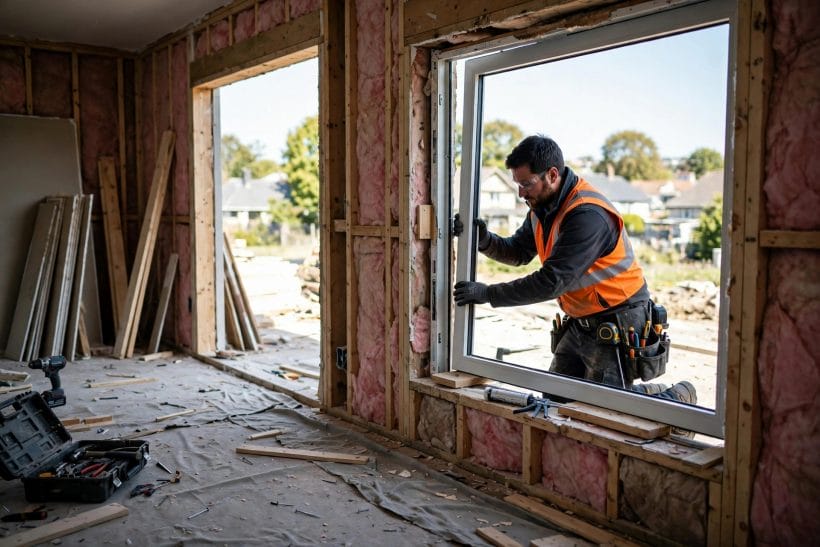
Labour is often the least visible part of a window quote and the hardest to compare, because it covers skill, time and care rather than a product you can hold. A good fitting depends on measuring accurately, setting the frame level and square, sealing it properly against weather, and adjusting the sashes so they open and close smoothly. Each of those steps takes time, and rushing any of them shows up later as a draught, a sticking sash or a damp patch. The labour in a quote is, in large part, the time to do those steps properly.
Access changes labour more than most homeowners expect. A ground-floor window reached from a garden path is a different job from a window two floors up, reached over a conservatory roof or a narrow side passage. Upper floors may need scaffolding or safe access equipment, and that equipment brings its own planning, hire and safety work into the quote. Similarly, a home with limited parking, a long carry from the road, or rooms that must stay in use during the work will need more planning time, and that planning is real work even though it leaves no visible trace.
Local conditions matter here too. Installers in different areas work under different demands, travel and overheads, which is one reason why quotes for the same window can differ from one town to another. That variation is normal, and it is why this guide keeps returning to local quotes rather than general figures. Ask each installer what access arrangements their quote includes, and whether scaffolding or other equipment is covered or charged separately, so you are not comparing a quote that includes access with one that leaves it out.
7. Removal and Disposal: The Old Window in the Quote
Every replacement begins with a removal, and removal is work in its own right. An old frame may be painted shut, fixed into brick or stone, or surrounded by plaster and trim that must be protected. Taking it out cleanly, without damaging the wall around it, takes care and time, and the condition of the opening is often only fully clear once the old frame is out. A quote should say what happens if the opening needs repair once it is exposed, and whether that repair sits inside the quoted scope or is agreed separately.
Disposal follows removal, and it deserves a direct question. Old frames, glass and packaging must leave the site properly, and different materials are handled in different ways. Some installers include removal and disposal in their quote, while others price it as a separate line, so two quotes can look far apart when one includes disposal and the other does not. Ask plainly whether disposal is included, what it covers, and what the house will look like at the end of each working day.
Older homes can add a further layer to removal, since the wall around the window may be uneven, the lintel above it may need attention, or the surrounding plaster may be fragile. A careful installer will allow time to deal with what is found, and will explain the possibilities before work starts rather than presenting them as a surprise midway through. That conversation is part of a good quote, and it protects both sides when the opening turns out to be less straightforward than it looked from the outside.
8. Finishing, Trim and Making Good
Finishing is where a window job either blends into the house or stands out for the wrong reasons, and it is often where quotes differ most. Inside, the work may include new trim, sill boards, plaster repair and painting around the frame. Outside, it may include sealing, pointing, render repair or new cills. Each of those tasks is small on its own, but together they decide whether the finished window looks as if it has always belonged there.
Ask each installer to spell out exactly which finishing tasks their quote covers, room by room. Does it include internal trim and painting, or does it stop at the frame? Does it include external sealing and making good, or is that left for another trade? A quote that stops at the frame is not necessarily a poor quote, but it is a narrower one, and the remaining work still has to be done and paid for by someone. Comparing finishing line by line is one of the most reliable ways to compare quotes fairly.
Small details belong in the same conversation. Handles, locks, trickle vents and opening restrictors all affect how the window works day to day, and they should be named in the quote rather than left to assumption. If you want a particular handle style, a lockable handle, or a vent that can be closed, say so before the quote is written, since hardware fitted afterwards is rarely as neat as hardware planned from the start. The same applies to window dressings: ask whether blinds or curtains need to come down, and who refits them.
9. Rooms and Placement: Where the Window Sits
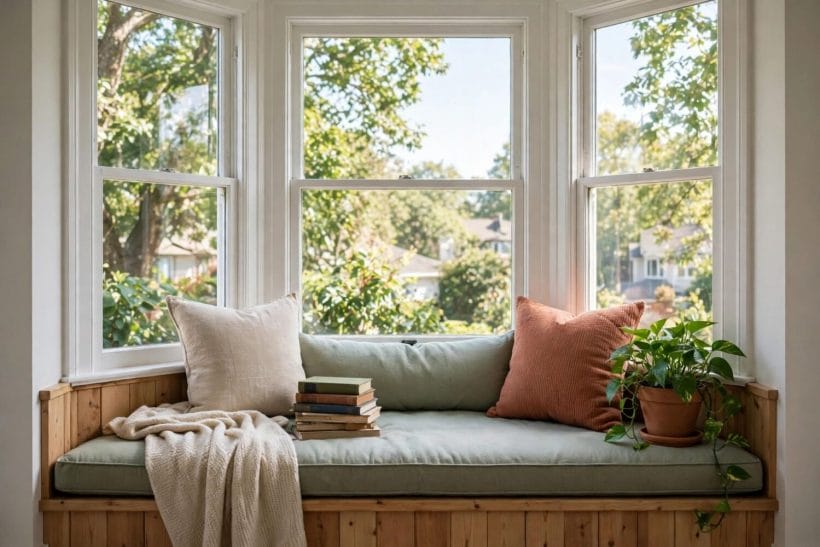
Where a window sits changes what it must do, and therefore what its quote must cover. A bathroom window, for example, lives in a damp room and needs glazing and ventilation that suit that setting, while also giving privacy without shutting out daylight. The linked guide to a window in a shower room shows how placement and moisture shape the choices in that one room, and the same thinking applies, in gentler form, to every wet or steamy space in the house.
Small rooms raise a different set of questions. In a compact bathroom or a tiny bedroom, the window may be the main source of daylight, and its size, opening style and position matter more than they would in a large room. The tiny bathroom ideas guide is a useful companion here, since it shows how light and layout work together in small spaces. A window quote for a small room should reflect the care needed to fit and finish neatly in a tight space, where there is little room to hide an uneven edge.
Light across the whole home is the wider picture. Windows decide how daylight moves through rooms, how a hallway feels, and whether a dark corner can be lifted without changing the structure. The tiny house interiors guide looks at that room-by-room picture in small homes, where every window carries more weight than it would in a larger house. When you plan window work, think room by room first and house-wide second, since the drivers that matter in one room may barely matter in the next.
Whole-house projects add a planning layer on top of room-by-room choices. If window work sits inside a larger build or renovation, the order of trades, the protection of finished surfaces and the timing of deliveries all affect the window quote. The building a tiny house checklist is a reminder of how many stages a small build holds, and window fitting is one stage among many. Tell your window installer where the work sits in the wider programme, so the quote reflects the real sequence rather than an isolated job.
10. Reading Quotes Like for Like
A useful quote reads like a small inventory of the job. It names the window form, the size and number of units, the frame material and finish, the glazing, the hardware, the labour and access arrangements, the removal and disposal, and the finishing work. When a quote reads that way, you can compare it line by line with another, and you can see exactly where two quotes differ. When a quote is a single line with a single figure, comparison is guesswork, and the cheapest line may simply be the one that leaves the most out.
Before you choose, ask each installer the same short set of questions. What exactly is included, and what is not? How is access arranged for upper floors? What happens if the opening needs repair once the old frame is out? How long will the work take, and what state will each room be left in at the end of each day? What guarantees cover the frame, the glazing and the fitting, and who do you call if a sash sticks or a seal fails later? The answers matter more than any general guidance, because they describe your job, not a typical one.
It is also worth checking what a quote assumes about your home. Does it assume standard openings, easy access and sound walls, or has the installer surveyed the actual openings? A quote written after a proper survey is worth more than one written from photographs alone, because the survey is where uneven walls, unusual shapes and awkward access are found. If two quotes differ sharply, the survey is often the reason: one installer has priced what they found, while the other has priced what they assumed.
For a final sense of how form affects scope, compare a flat window quote with a projecting one. The box bay window guide shows a form that touches more wall, roof and sill than a flat unit, and that extra contact is extra scope. The same logic applies in reverse: a simpler form, a standard size and easy access will usually present a simpler scope, and a quote that reflects that is a quote you can trust.
Final Considerations
Window work rewards patience at the quoting stage and care at the fitting stage. Take time to describe the whole job in the same words to each installer, to compare finishing and disposal line by line, and to ask what happens when an opening surprises everyone once the old frame is out. Those conversations cost nothing, and they prevent most of the misunderstandings that turn a straightforward job into a difficult one.
If you take one idea from this guide, let it be this: the drivers, not the headline figure, tell you what a window job involves. Form, size, material, glazing, labour, access, removal and finishing each add their own scope, and a quote that names them is a quote you can judge. For the figures themselves, there is no substitute for local professionals quoting your home, your openings and your choices. That is the proper end point for any question about the cost to install a window: a written, like-for-like quote for the work you actually want, from installers who have seen the openings they will fit. Before you sign, the window buying checks guide is a useful last read, since it gathers the checks worth making while the decision is still open.



0 Comments