
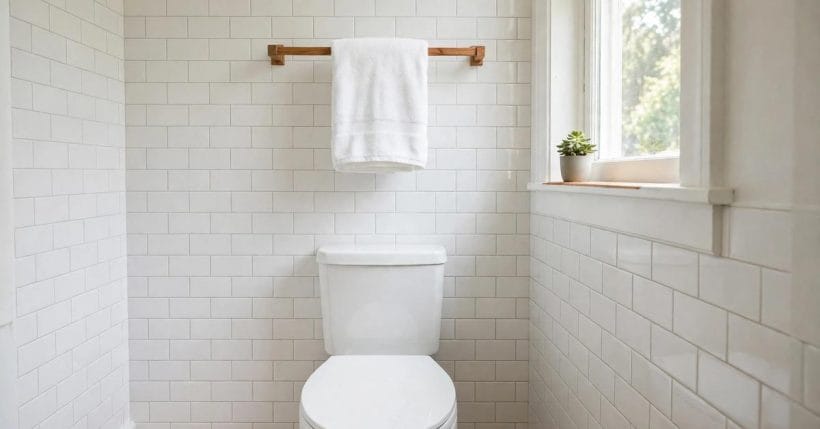
It is a question that comes up in almost every small bathroom: the wall above the toilet is empty, the towel needs a home, and a bar fitted there seems like the obvious answer. In general, yes, it is fine to hang bath towels over a toilet, provided the arrangement suits the room, the towel can dry properly, and the fitting itself is sound. There is no single rule that forbids the spot, and no single rule that makes it right for every bathroom either. What matters is how the spot behaves in daily use, not how tidy it looks on the day it is fitted.
This guide answers the towel bar over toilet question honestly, in practical terms. It looks at why the spot is popular, what can go wrong, how drying and hygiene play into the choice, and which alternatives work when the wall above the toilet is not the best place after all. The aim is to help you judge your own bathroom, rather than to hand down a verdict that ignores its shape, its airflow, and the people who use it.
Small bathrooms reward careful placement more than large ones do, because every wall, hook, and rail has to earn its place. A towel that lives over the toilet can free up the rest of the room, but only if it is easy to reach, easy to keep dry, and not in the way of anything else. If any of those conditions fails, a different spot will serve you better, and this guide covers those too.
1. The Short Answer: Yes, With a Few Practical Checks
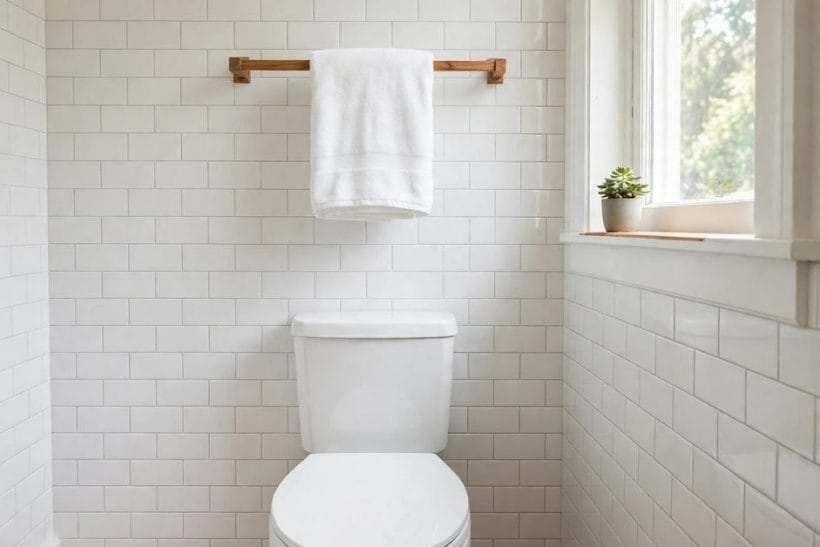
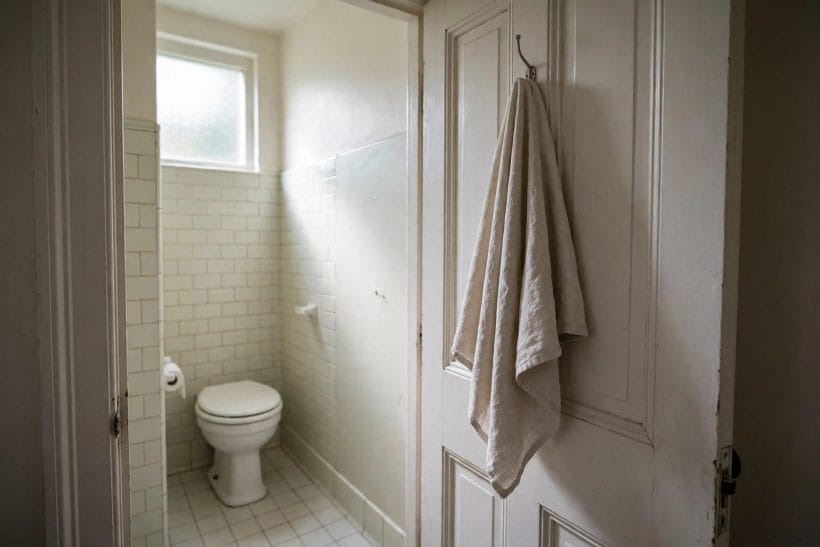
Yes, hanging a bath towel over a toilet is generally acceptable. The wall above the tank is often the only stretch of free wall in a compact bathroom, and using it for a towel bar is a sensible way to make that wall work harder. Many bathrooms are arranged exactly this way, and the arrangement causes no trouble when the towel hangs clear of the tank, dries between uses, and can be reached without stretching or leaning awkwardly.
The checks that matter are simple ones. The towel should not rest on the tank lid or drape so low that it touches the seat or the floor. It should not block access to the flush or to any panel that may need attention later. And it should hang in air that moves, rather than in a still, steamy corner where it stays damp for hours. If those points are covered, the spot is a perfectly reasonable home for a towel.
It is also worth thinking about who uses the bathroom. A towel hung high over a toilet may be fine for an adult and awkward for a child or for someone with limited reach. A towel that is easy for one person to grab may be a stretch for another. The best placement is the one that works for everyone who actually uses the room, day after day, not just for the person who fitted the bar.
2. Why the Spot Above the Toilet Is So Popular
The popularity of the towel bar over the toilet comes down to space. In a small bathroom, the wall above the tank is often unused, while the walls beside the basin and the shower are already spoken for. Putting a bar there turns dead wall into storage without taking any floor space, which is a real advantage in a room where floor space is already tight. For tiny bathroom ideas, that kind of double duty is often the difference between a room that feels workable and one that feels crowded.
The spot is also close to where a towel is needed. After a shower, the towel is within a step or two, and it can be returned to the same place without crossing the room with wet hands. That convenience matters more than it sounds, because a towel that is awkward to put back tends to end up on the floor, on a door handle, or draped over whatever is nearest. A bar over the toilet gives the towel an obvious home, and obvious homes get used.
There is a visual benefit too. A neatly folded towel over the toilet can make a plain wall look finished, adding a soft layer of colour and texture to a room that is otherwise mostly tile and porcelain. In a rented home or a room that cannot be remodelled, a towel bar is one of the simplest ways to make the space feel cared for, without any larger change.
3. What to Weigh Before You Hang a Towel There
Before fitting anything, look at the wall itself. The wall above a toilet may hide pipework, a cistern, or a service panel, and fixings need a sound surface to hold into. If the wall is tiled, hollow, or uneven, the fitting may not hold well, and a bar that pulls loose under the weight of a wet towel is worse than no bar at all. Where the wall or the fixings are in any doubt, it is wise to ask a qualified professional to advise, rather than to guess.
Next, consider the height and the drop of the towel. A bath towel is long, and a bar fitted too low will let the towel brush the tank lid, while a bar fitted too high may be hard to reach. Hold the towel up against the wall before you commit, and check where its lower edge falls. The towel should hang freely, with air around it, and without touching anything below it. That simple check prevents most of the everyday annoyances of the arrangement.
Think too about splashing. The area around a toilet is, by its nature, a place where water can reach surfaces, and a towel that hangs very close to the bowl or directly in the line of a flush may pick up spray over time. A bar fitted squarely above the tank, rather than forward of it, keeps the towel further from that zone. If the toilet sits in a very tight alcove with little clearance, that distance may be hard to achieve, and another spot may be kinder to the towel.
4. Drying: The Detail That Decides Whether It Works
Drying is the real test of any towel spot, and the wall over the toilet is no exception. A towel that dries well between uses stays fresh, feels pleasant, and lasts longer. A towel that stays damp, folded tightly against a wall or bunched on a bar, can develop a musty smell and a limp feel that no amount of folding will fix. Airflow is what makes the difference, more than the choice of bar or hook.
A towel dries best when it hangs in a single layer, spread out rather than folded double, with air able to reach both sides. A bar that lets the towel hang flat against the wall will dry more slowly than one that holds it slightly away from the surface. Hooks and rings, which gather the towel into a bunch, tend to dry more slowly still, though they are convenient for a hand towel that is used briefly and changed often. For a bath towel that is used daily, a bar usually dries better than a hook.
The room itself matters as much as the fitting. A bathroom with a window that opens, or with ventilation that moves air after a shower, will dry towels far more readily than a still, enclosed room. If your bathroom stays steamy long after use, any towel spot will struggle, and the wall over the toilet will be no worse than most, provided the towel is not pressed against a cold tiled wall. If drying is a persistent problem, improving airflow in the room will help every towel spot at once, and it is worth doing before blaming the placement.
5. Hygiene in General Terms
Hygiene is the concern most people raise about towels over a toilet, and it deserves a calm, general answer rather than alarm. In everyday terms, the issue is straightforward: a towel is something you dry yourself with, so it makes sense to keep it as clean and dry as you reasonably can, and to keep it away from obvious sources of spray and dirt. That is a matter of placement and habit, not a reason to rule out a whole wall.
The most practical habits are unglamorous ones. Keep the towel hanging clear of the bowl and the tank, rather than draped over either. Close the lid before flushing, as a matter of routine, since that keeps spray contained in general. Wash bath towels regularly, and swap a towel that has stayed damp or developed a smell rather than leaving it in place. These habits protect any towel, wherever it hangs, and they cost nothing.
It is also worth keeping everyday towels and spare towels apart. The towel you use daily will be handled, washed, and replaced often, so its placement is mainly about drying and reach. Spare towels, which may sit untouched for days, are better kept somewhere dry and covered, such as a shelf or a cabinet, rather than hanging in the open above the toilet. Separating the two roles keeps the daily towel convenient and the spares fresh, which is a better arrangement than asking one spot to do both jobs.
6. Reaching the Towel Without a Stretch
A towel spot that is hard to reach will not be used happily for long. Reaching over a toilet to lift a towel from a high bar can mean leaning across the bowl, which is awkward at the best of times and worse with wet feet on a tiled floor. Before settling on the spot, stand where you would stand after a shower and mime the movement. If you have to stretch, twist, or lean, the bar is too high, too far back, or simply in the wrong place for you.
Households vary, and a height that suits one person may not suit another. Where children use the bathroom, a lower hook beside the toilet may be far more practical than a high bar above it, even if the bar looks tidier. Where someone has limited mobility, a towel within easy arm’s reach, without any need to lean, matters more than any question of appearance. The right height is the one that the people who use the room can reach comfortably, every time.
Also consider what happens when the towel is wet. A wet bath towel is heavier than a dry one, and lifting it down from a high bar with wet hands can be clumsy. A bar at a comfortable height, with the towel hanging in a way that lets you take it down in a single movement, will be used more willingly than a spot that demands a careful manoeuvre. Convenience, in this case, is not laziness; it is what keeps the towel off the floor.
7. Bars, Hooks, Rings and Ladders Compared
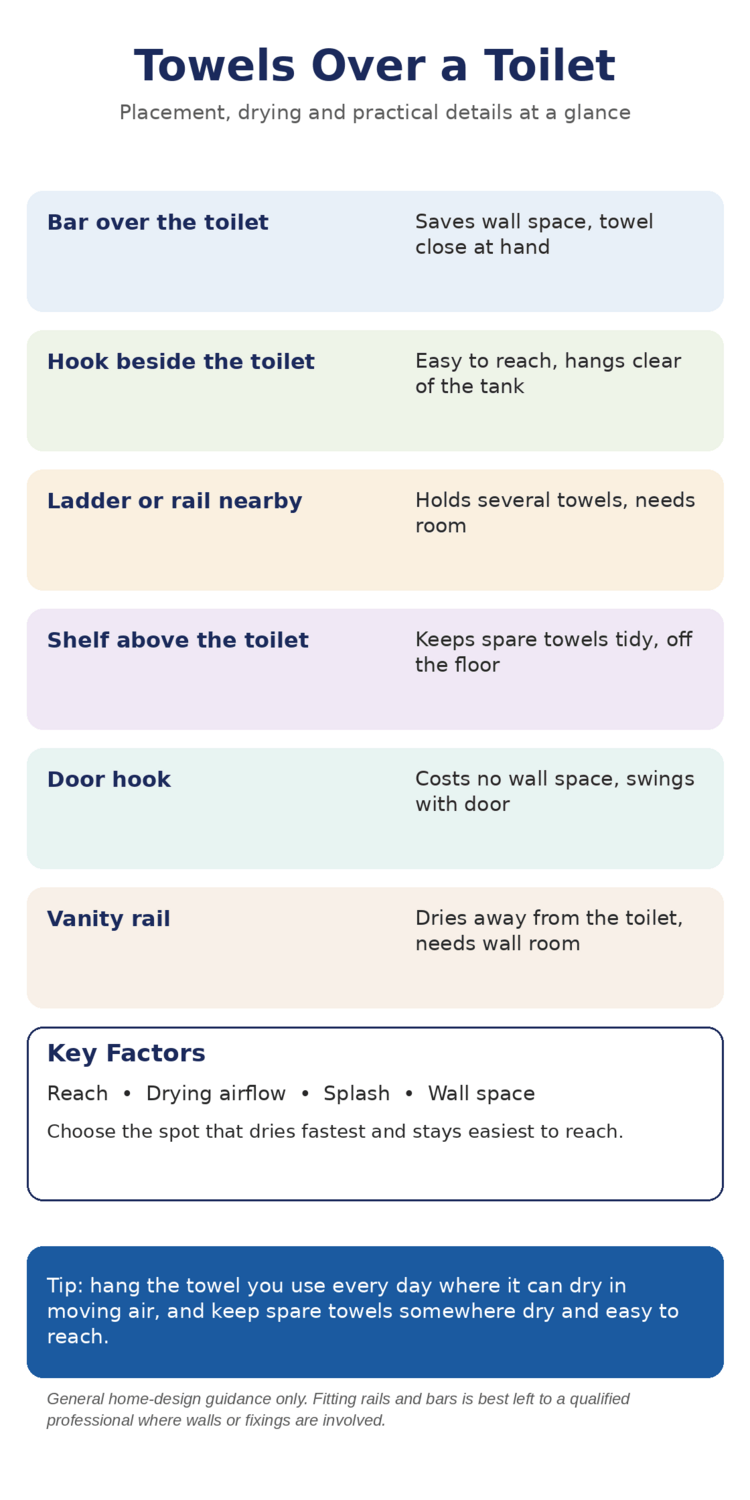
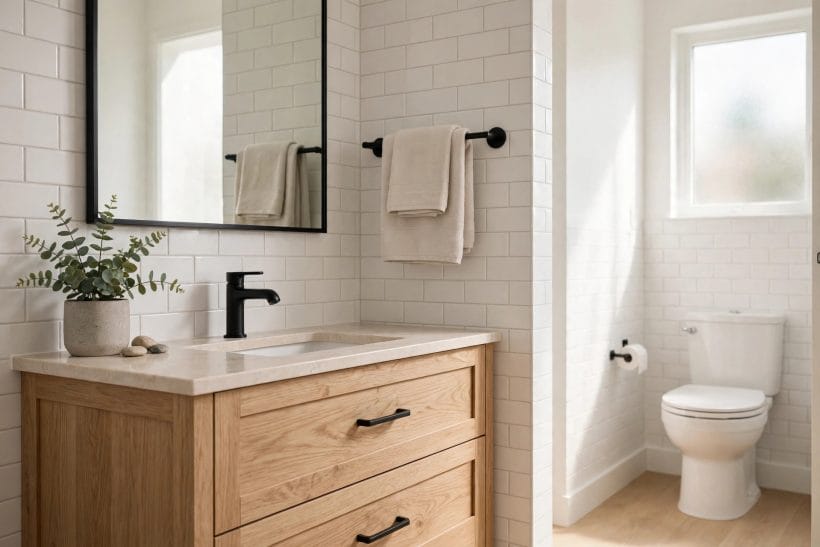
A bar is the classic choice for the wall over a toilet, and it suits a bath towel well, because it lets the towel hang spread out and dry. A single bar holds one towel comfortably; a double bar holds two, though the inner towel will dry more slowly, pressed closer to the wall. Bars come in many lengths and finishes, and the finish is worth choosing with the rest of the bathroom in mind, so the fitting looks intentional rather than improvised. For bathroom faucet finishes, the same thinking applies: matching finishes across fittings gives a room a settled look.
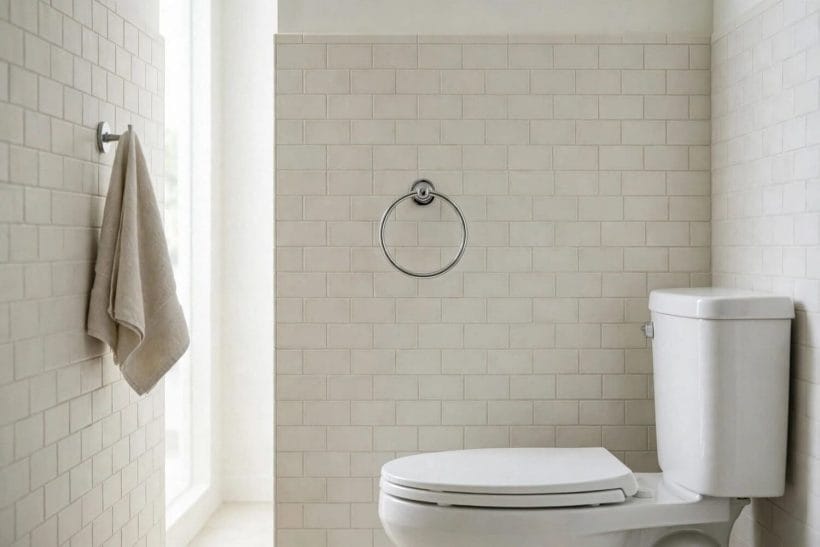
A hook is simpler and cheaper to fit, and it suits a hand towel or a towel that is changed often. Its drawback is drying, since a towel gathered on a hook dries slowly, and a bath towel on a hook can look untidy. A ring sits between the two: it holds a towel in a loop, which looks neat and keeps a hand towel handy, but it is less suited to a large bath towel, which can overwhelm it. Rings work best beside a basin, where a hand towel belongs, rather than over a toilet.
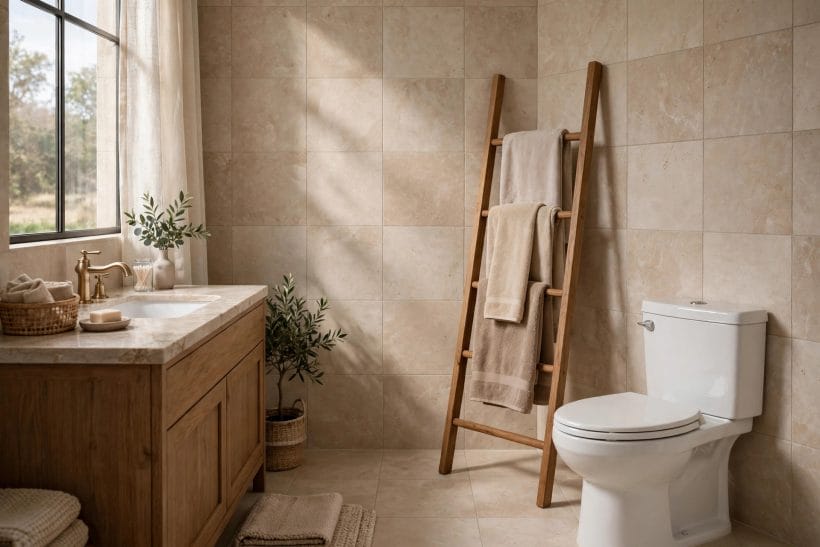
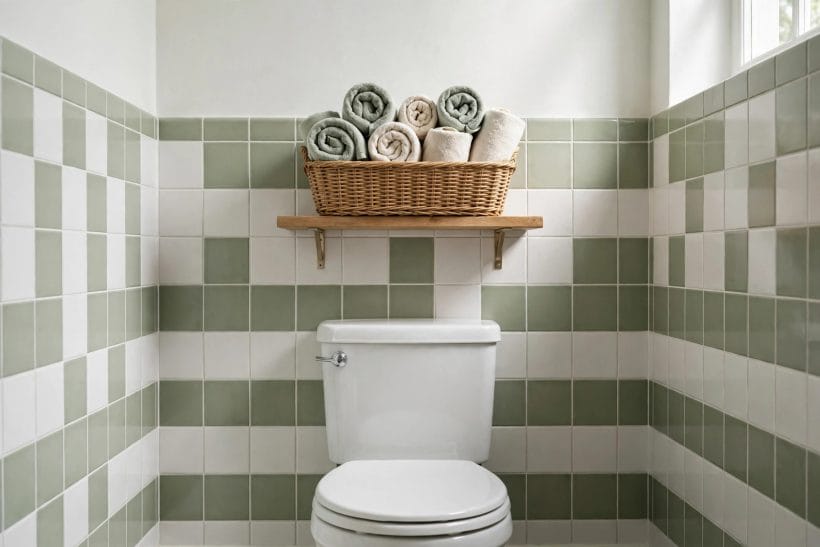
A ladder rail, leaning or fixed, is a good answer when several towels need a home and wall space is short. It holds towels in layers, looks relaxed and informal, and can be moved if the arrangement does not work. Its drawback is floor space, which is exactly what small bathrooms lack, so it suits a slightly larger room better than a very tight one. Shelves above the toilet, meanwhile, suit spare towels rolled or folded, rather than the towel in daily use, and they keep spares tidy without any need for a bar at all.
8. Alternatives When the Spot Over the Toilet Does Not Suit You
If the wall over the toilet fails any of the checks above, there are plenty of alternatives, and none of them is a compromise. A hook or rail on the wall beside the toilet, rather than above it, keeps the towel close at hand while moving it clear of the tank and the splash zone. A rail on the wall opposite the toilet, if such a wall exists, gives the towel room to dry in open air. A towel on the back of the door costs no wall space at all, though it swings with the door and can be knocked.
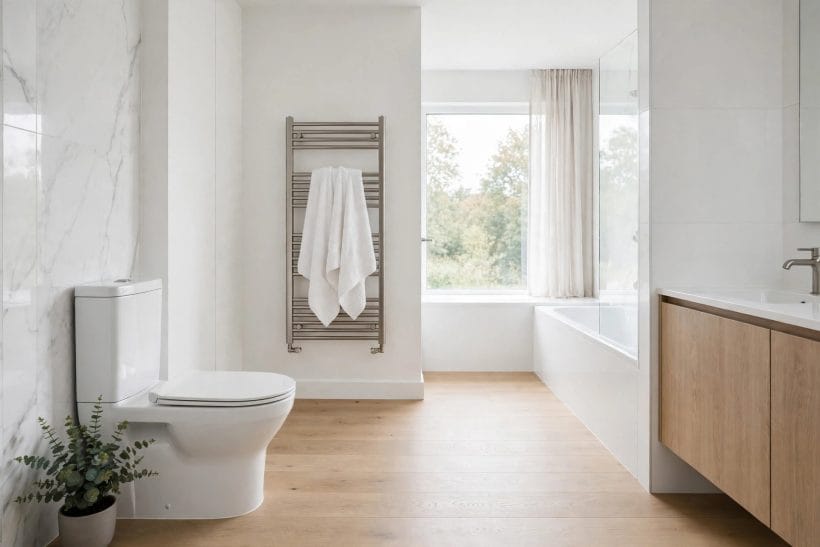
For rooms planned from scratch, tiny house bathroom layouts often show how much difference a small change of plan makes: a towel rail placed on the wall beside the vanity, or a heated rail on a free wall, can solve the towel question without touching the wall over the toilet. A heated rail, where one is already fitted or can be fitted by a qualified professional, is especially good for drying, since warmth as well as airflow helps a towel dry between uses. Where fitting work involves wiring or plumbing, it should be left to a qualified professional throughout.
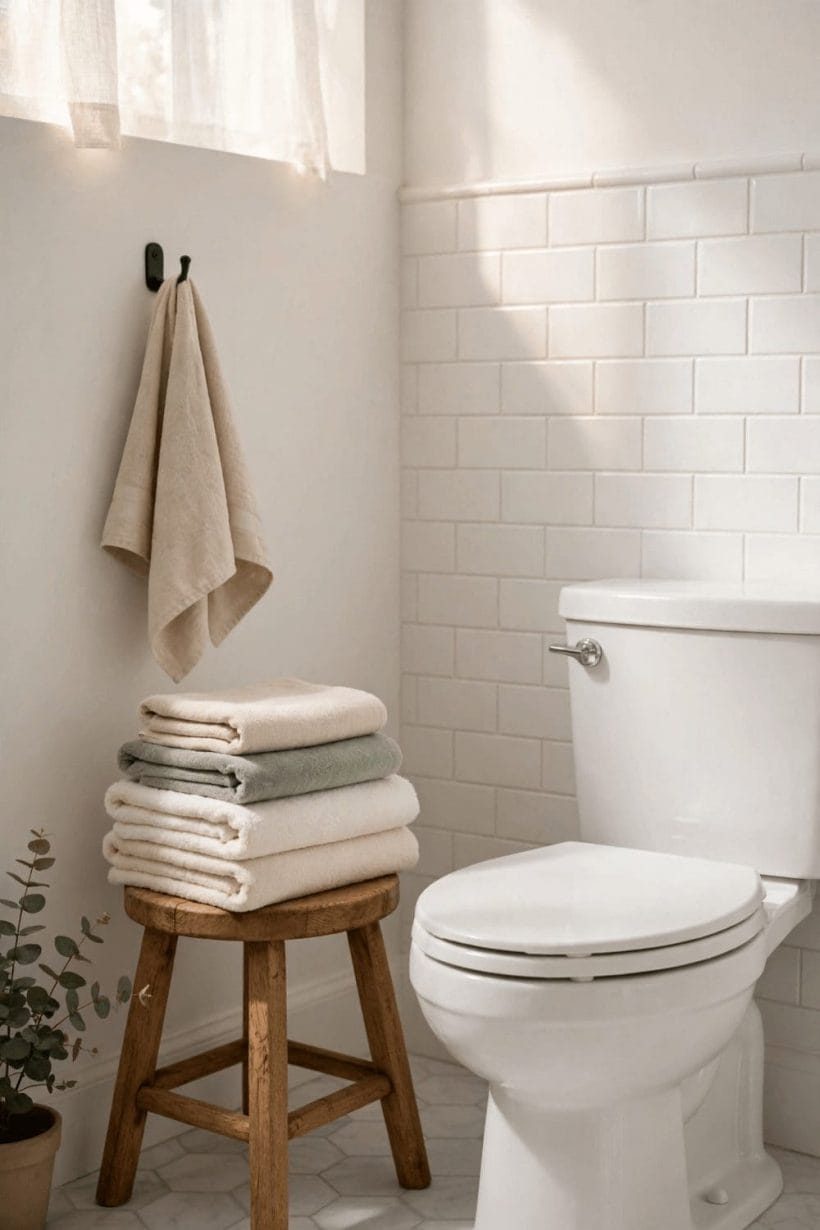
Storage furniture offers another route. A small stool or basket beside the toilet can hold folded towels neatly, and a cabinet or shelf can hold spares out of sight. These options suit people who prefer a bathroom that looks uncluttered, since the towels are not on display at all. They also suit households where towels are changed often, since a stack of fresh towels is always ready. The best alternative is the one that fits the room you have, not the room in a photograph.
9. Making the Arrangement Look Tidy
Whatever spot you choose, a few habits keep it looking tidy. Fold or drape the towel evenly over the bar, rather than bunching it at one end, so it hangs straight and dries evenly. Keep one towel on the bar, rather than layering several, since layers dry slowly and look untidy. Match the bar or hook to the other fittings in the room where you can, so the arrangement looks like part of the bathroom rather than an afterthought.
Colour helps too. A towel in a colour that sits well with the tiles and the walls will make the whole room feel calmer, while a jumble of clashing towels can make even a tidy bathroom feel busy. That does not mean every towel must match; it means choosing with the room in mind, rather than at random. In tiny house designs, where every detail is visible, this kind of quiet coordination is part of what makes a small space feel considered.
Finally, keep the wall itself clean. A bar over a toilet sits above a surface that needs regular cleaning, and dust and splashes will reach the wall over time. Wiping the bar and the wall as part of the normal cleaning routine keeps the arrangement fresh and prevents any build-up that would make the spot feel neglected. A tidy towel on a clean wall is a small pleasure, and it costs only a moment of attention.
10. Fitting and Safety: What to Leave to a Professional
Fitting a towel bar sounds simple, and for a straightforward wall it often is, but there are cases where professional help is the wiser choice. If the wall may hide pipes, cables, or a cistern, if the surface is tiled and could crack, or if the fitting must hold a heavy wet towel on a hollow wall, a qualified professional can advise on fixings and placement. The same applies to any heated rail, which involves electrical work, and to any change that touches plumbing. When choosing fittings, how to choose the right bathroom sink carries the same principle: where water and fixings meet, professional advice protects the room.
Check the fitting itself from time to time, whatever its type. A bar that has worked loose, a hook that wobbles, or a rail that sags under weight should be tightened or replaced before it fails. A towel bar that comes away from the wall can damage tiles and, worse, cause a fall if someone grabs it for support. Never rely on a towel bar as a grab rail; if support is needed in the bathroom, a proper grab rail fitted by a professional is the safe answer.
For interior design ideas more broadly, the lesson is the same: the details that look simplest often depend on sound fixing and sensible placement. A towel bar over a toilet is a small thing, but it is used every day, and it deserves the same care as any other fitting. Done well, it is unobtrusive, useful, and easy to live with; done carelessly, it is a daily annoyance.
Final Considerations
So, is it fine to hang bath towels over a toilet? That is the towel bar over toilet question in short, and in general the answer is yes, with the practical checks this guide has set out. The spot saves space, keeps the towel close at hand, and can look tidy, provided the towel hangs clear of the tank, dries in moving air, and can be reached without a stretch. Where any of those conditions fails, the honest answer changes, and a hook beside the toilet, a rail on a free wall, or a shelf for spares will serve you better.
The question is worth asking because it shows a bathroom being thought about as a working room, not just a decorated one. A towel is used every day, and where it lives affects how the room feels and functions. Tiny house interiors make this point on a larger scale: in a small space, every placement decision matters, and the best decisions are the ones tested against daily life rather than appearance alone.
Start with your own bathroom. Hold the towel where you are thinking of hanging it, check the drop, the reach, and the airflow, and ask whether the arrangement will still work on a busy morning. If it will, fit the bar with care, or have it fitted professionally where the wall demands it, and enjoy a tidy, practical bathroom. If it will not, choose one of the alternatives, and give the towel a home that suits it better. Either way, the towel will have a proper place, and the bathroom will be better for it.


0 Comments