

The trailer is the foundation of a tiny house on wheels, and it is the one component you should never improvise. The right answer to “what trailer should I use for a tiny house?” is: a trailer built or rated for the finished weight of your house, the right length for your plan, and designed to have a house permanently mounted on it. Everything else — adapting a light utility trailer, guessing the weight, buying on price alone — stores up the failures that end tiny house projects.
This guide explains the trailer types, how weight and axles actually work in general terms, deck height and length, the special options, and how to buy new or used safely. It deliberately gives no load figures for your build: ratings belong to the specific trailer and the finished house, and must come from the trailer’s plate and a weighbridge, not from a web page.
1. The Trailer Types at a Glance
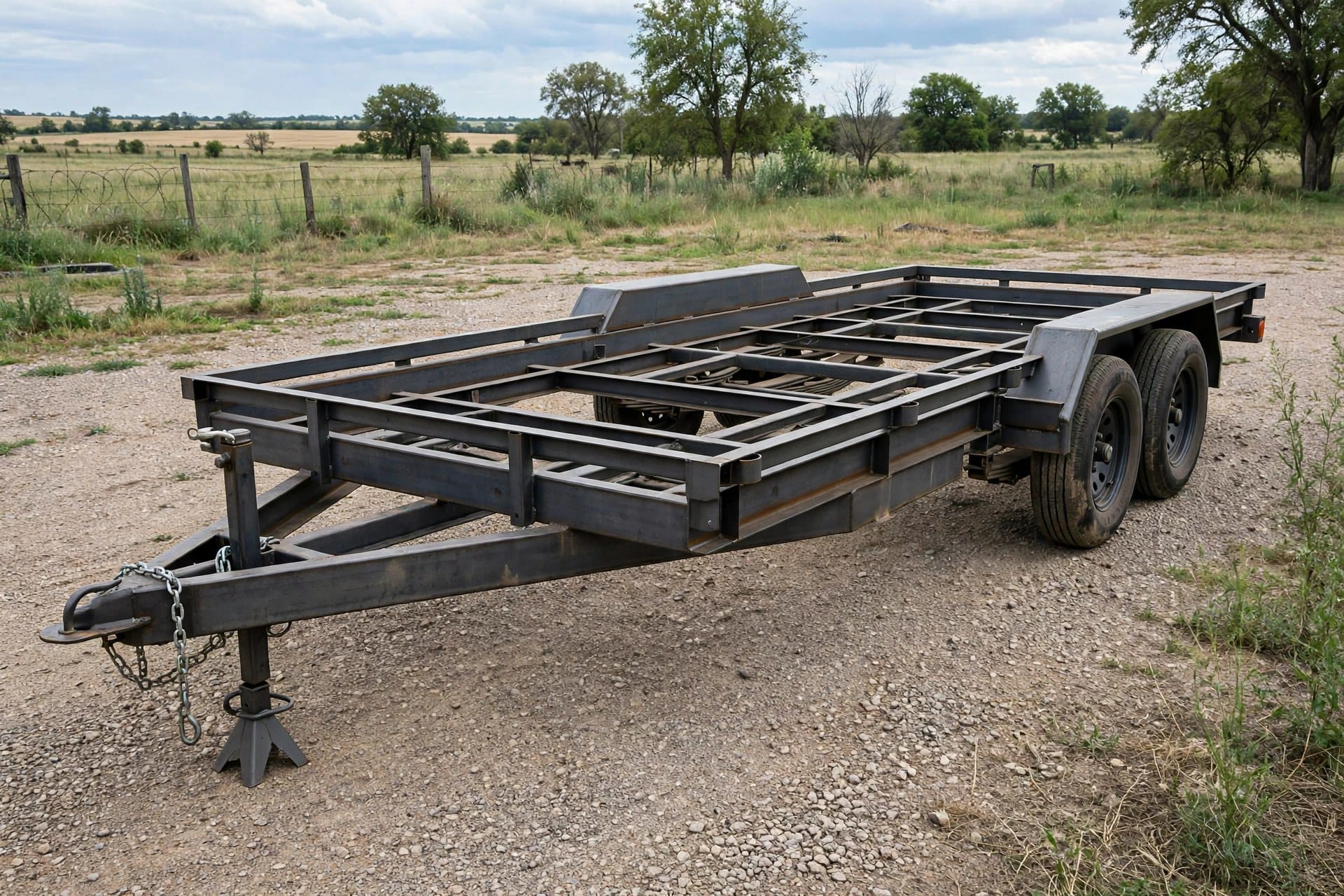
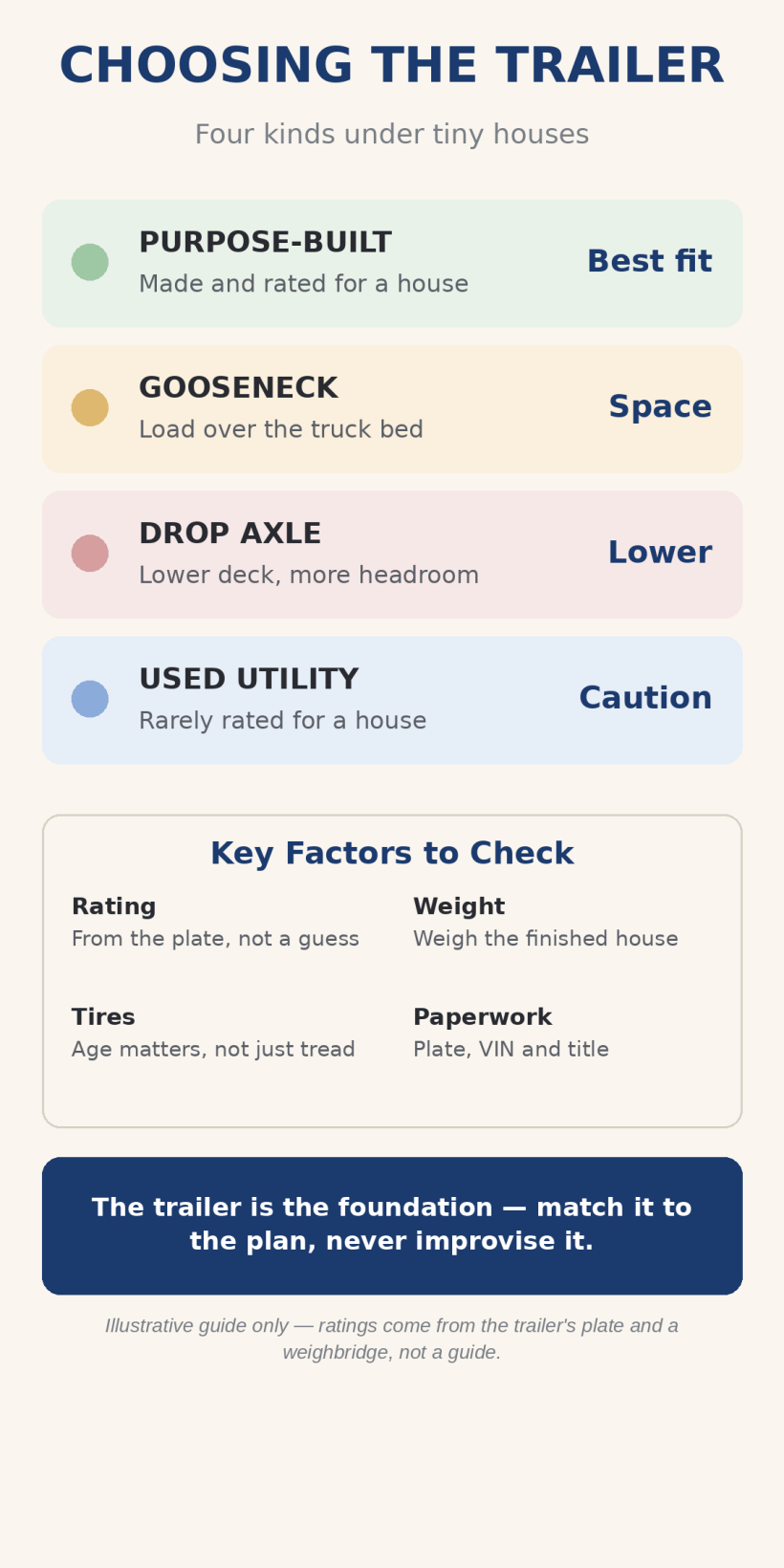
Four kinds of trailer appear under tiny houses. The purpose-built tiny house trailer is made for exactly this job: a steel frame engineered for a house’s weight, with attachment points for the floor and walls. The gooseneck variant carries part of the house over the tow vehicle’s bed, suiting longer, heavier builds. Drop-axle and low-deck variants sit the deck lower, buying interior headroom under road height limits. And the used utility or car trailer is the option to treat with suspicion: it was built for occasional loads, not for carrying a house’s full weight every day of its life.
Your plan decides between them, together with the finished weight. A small, light house for occasional moves and a large house that will live on its trailer permanently are different briefs — which is also why the size conversation in our guide to the biggest tiny house you can build starts with the trailer and the road, not with the floor plan.
2. Purpose-Built Tiny House Trailers: The Default Answer
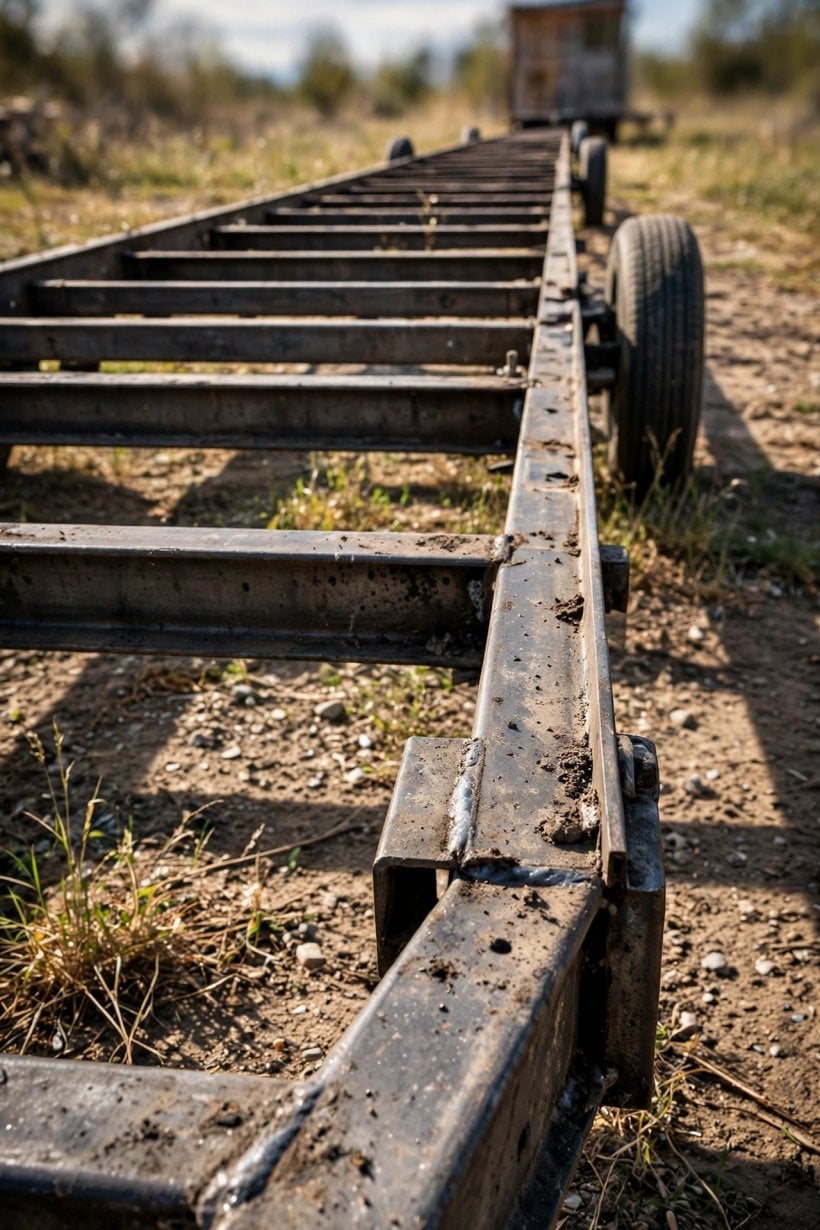
For most builders, the purpose-built trailer is simply the correct starting point. It is engineered around a house rather than adapted to one: the frame’s strength is where the walls will bear, the axles are positioned for a house’s weight distribution, and details like a steel flange or threaded rods for bolting the structure down, a metal flashing layer against road moisture, and levelling jacks at the corners are part of the design rather than later additions.
Builders of tiny houses generally design around these trailers, and plans are drawn to suit them — one more reason the trailer decision comes before the build, as our step-by-step how to build a tiny house sets out. A purpose-built trailer also documents itself: it carries a manufacturer’s plate with its ratings and a vehicle identification number, which matters for titling, insuring, and one day selling the home.
When the trailer arrives, inspect it like the foundation it is: frame members straight and fully welded, the plate present with its ratings recorded in your build file, the deck flat, the jacks working, the coupler and safety chains sound, and the lights and brakes functioning behind a tow vehicle. Photograph the plate and the bare frame before the floor goes on — once the house is mounted, the trailer disappears from view, and your records become the only easy way to answer questions about it ever again.
3. Weight: The Number That Decides Everything
Every trailer carries a maximum total weight rating — the trailer plus everything on it — set by its manufacturer. Your finished house, with its materials, systems, water, and belongings, must sit within that rating with margin to spare, because homes gain weight as they are built and lived in. A trailer that is adequate on the day of the frame is often inadequate under the finished house with full tanks and a library aboard.
Work with the real numbers for your build: the trailer’s plated rating, the builder’s or plan’s weight estimate tracked as materials go in, and a weighbridge ticket for the finished house before its first real journey. Tongue weight — the share of the load pressing down on the hitch — matters to towing behaviour as much as the total; it is set by where the axles sit relative to the load, which is another decision a purpose-built trailer has already made correctly. If any of these numbers is a guess, the trailer choice is a guess too.
Weighing is easier than people expect. Public weighbridges and truck scales weigh vehicles and trailers routinely, and weighing the finished house — and, if you can, the house again with full tanks and your belongings aboard — turns the most important safety figure in the whole build from an opinion into a fact. Keep the ticket with the trailer’s documents; it is evidence for insurers, buyers, and your own towing decisions for the life of the home.
4. Axles, Wheels, and Tires
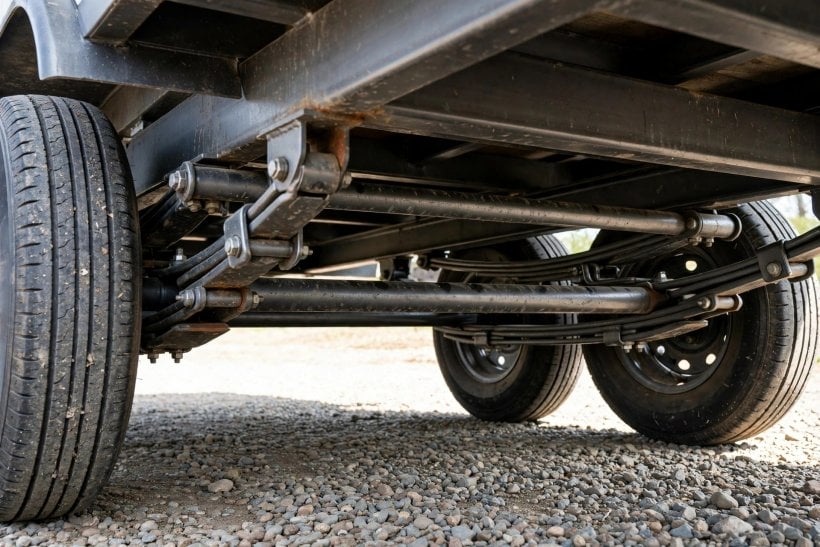
Axles carry the house, so their combined rating must cover the total with margin — heavier houses run tandem axles for exactly this reason. What matters for your build is not a universal rule but the match: axle ratings, wheel ratings, and tire load ratings all at or above what your finished weight asks of them, confirmed from the plates and sidewalls of the actual components.
Tires deserve their own discipline. Trailer tires age out as well as wear out, and a house that sits for years can be riding on tires that look fine and are not. Check age and condition before every move, keep pressures at the plated values, and remember that a tiny house asks its tires to work at high load continuously — unlike a utility trailer’s occasional trip. Bearings, brakes, and lights join the same pre-move check; a house is a heavy, tall load and deserves a hauler’s inspection routine, not a glance.
5. Length, Width, and Deck Height
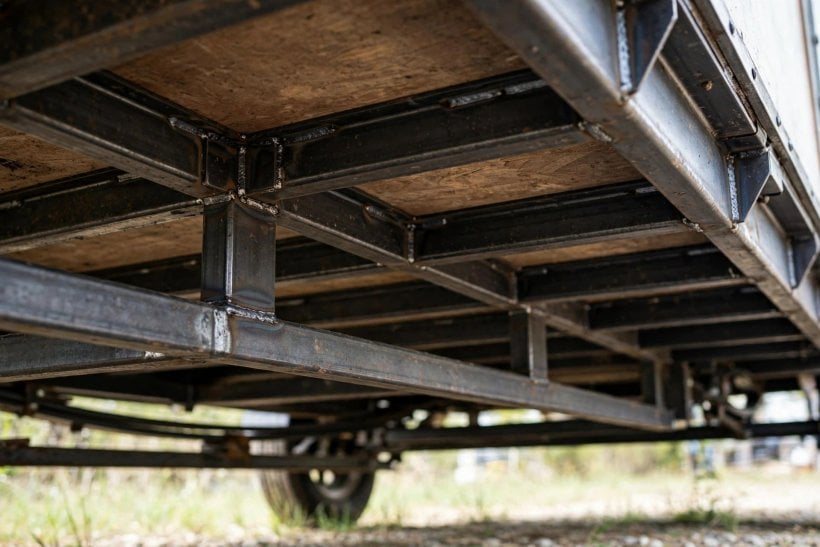
Length follows the floor plan: the trailer should match the house you are actually building, because extending a house beyond its trailer or balancing overhangs is poor structure. Width is effectively settled by the road — houses are built to travel within legal road widths without special arrangements, and the plan’s width should already respect that. Our tiny house floor plans guide shows how designs are shaped by the trailer beneath them.
Deck height is the subtle variable. A higher deck gives ground clearance and room for tanks and insulation below the floor; a lower deck — the point of drop-axle designs — buys headroom inside under the overall height the road allows, which is where loft clearance comes from. Neither is free: low decks drag on steep driveways and rough ground. Choose for the roads and sites your house will actually meet.
One related layout deserves naming: the deck-over design, where the floor sits above the wheels rather than between them. It gives a flat, unobstructed floor at the price of height and a higher centre of gravity, while the between-the-wheels layout keeps the house lower with wheel boxes shaping the interior. Your plan will already assume one or the other — which is the last reason the trailer follows the plan and never leads it.
6. Gooseneck and Specialty Options
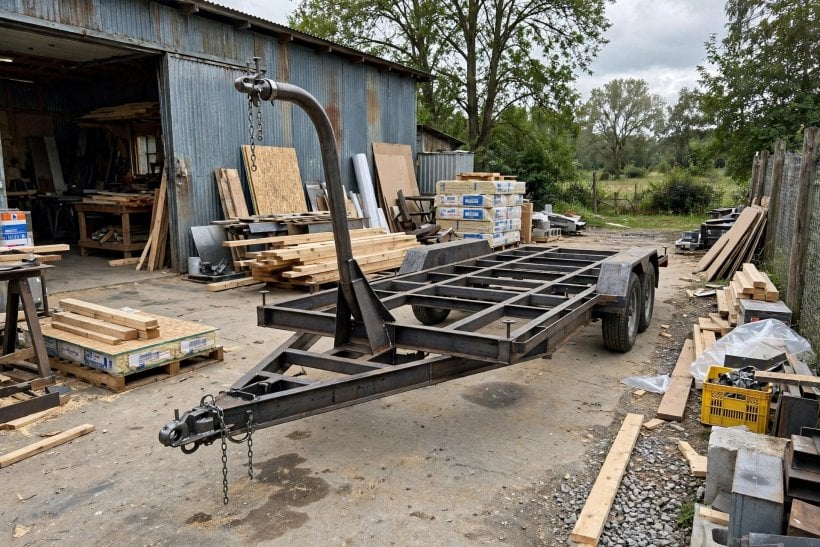
A gooseneck trailer moves the hitch into the tow vehicle’s bed and carries part of the house above it. The gains are real for the right build: space over the hitch that becomes living or sleeping area, and towing behaviour many drivers find steadier with heavy loads. The costs are real too: you need a suitable vehicle fitted for it, the trailer is a more specialised purchase, and the space over the bed is only usable while the design exploits it well.
Other specialties solve narrower problems: detachable or removable tongues where a parked house must sit without a hitch jutting out, extra-heavy frames for masonry finishes or large water storage, and trailers built to a plan’s exact specification. Buy specialty when your build demonstrably needs it — each is a solution in search of the problem it was designed for.
Think about the parked life as well as the moving one. The trailer does not stop working when the journey ends: its jacks and frame carry the house through every storm and season on site, and its tongue, coupler, and running gear wait — sometimes for years — for the next move. A trailer chosen well for towing but stored carelessly, standing in mud on ageing tires, lets the whole home down slowly. Park it level, drained, and protected, whatever type you choose.
7. Buying New or Used, and the Paperwork
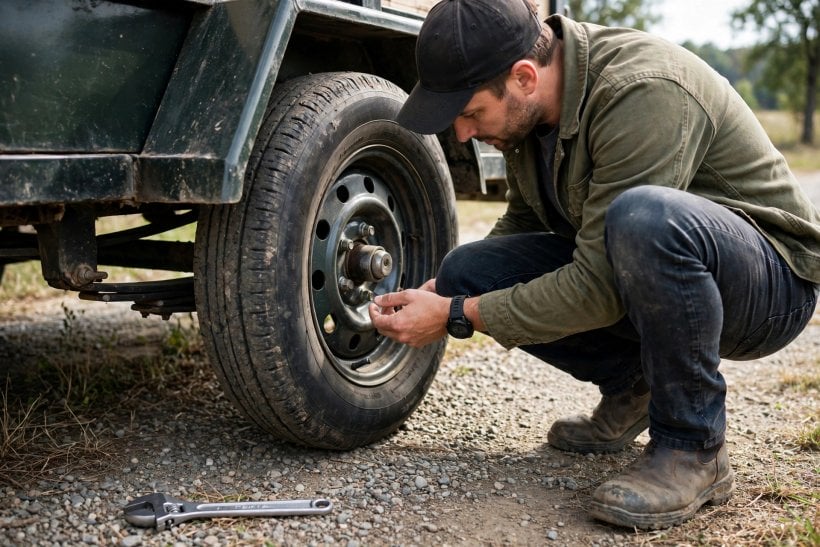
A new purpose-built trailer buys you known ratings, a warranty, and clean documentation at the highest price. A used trailer can be sound value — trailers are simple machines — provided you verify rather than hope: the identification plate present and legible, the title or registration documents matching it, the frame straight and free of structural rust, the axles, brakes, bearings, and lights working, and no sign the trailer has been overloaded in a previous life.
Rust deserves a slow look, especially underneath and inside the frame members, because a house will hide the top of the trailer from inspection for years once it is mounted. Our companion guide to how to buy a tiny house covers the same verify-first discipline for complete homes. If a used trailer’s history or ratings cannot be established, it is not a saving; it is an unknown carrying your house.
8. Hitching, Towing, and Moving the House
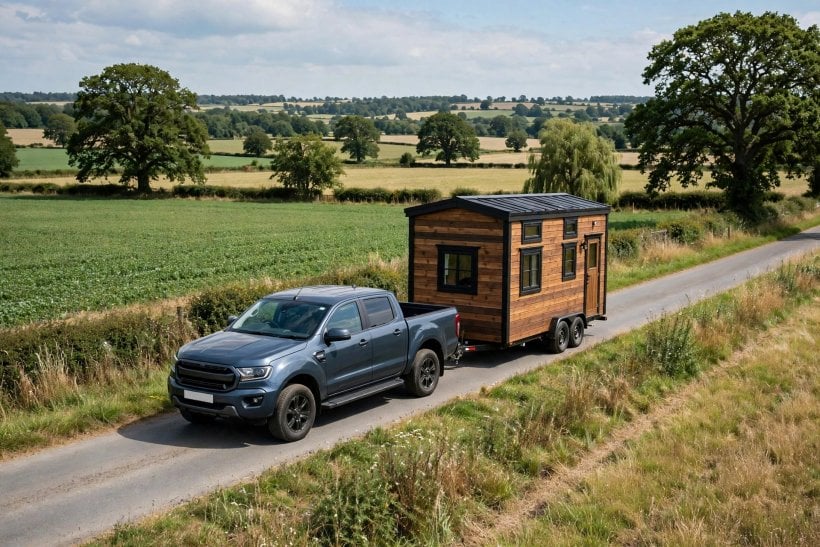
Towing a tiny house is heavy haulage, not a big version of towing a boat. The tow vehicle must be rated for the actual total weight with the right hitch class and a properly set-up brake controller, and the driver needs the slow, wide, unhurried technique a tall, heavy load demands. Many owners move their house rarely and hire professional haulers for those moves — a rational choice that converts an equipment problem into a service.
Insurance and legality travel with the move: the house and trailer should be covered in transit, and any permits or escorts a large load requires on your route arranged in advance. Our guide to tiny house insurance for wheels versus foundation covers the in-transit side, and our comparison of tiny house versus RV full-time living explains why moving a house differs from moving an RV built to tour.
Plan the route like a hauler would: the low bridge, the tight village turn, the soft shoulder after rain, and the destination’s gate are found on paper first or found the hard way. Drive the route in an ordinary car beforehand if it is new to you, noting clearances and turnarounds, and time the move for quiet roads and good weather. A tiny house move done well is a boring story — that is the standard to aim for.
9. Matching the Trailer to the Plan — and Mistakes to Avoid
The trailer, the plan, and the builder form a triangle: plans are drawn for a trailer size and weight class, builders know which trailers their designs suit, and the trailer must be ordered to the plan — never the other way round. If you are building yourself, settle the trailer while the plans are still paper, as our guide to whether you can build your own tiny house recommends; changing trailers after framing begins is expensive in every currency.
The mistakes to avoid are consistent: adapting a trailer rated for less than the finished house, trusting a weight estimate instead of a weighbridge, buying length for a plan you later change, ignoring tire age on a trailer that has stood, skipping the title and plate checks on a used purchase, and treating the hitch end as an afterthought. Every one of them is cheap to avoid at the start and expensive later — the trailer is the worst place in the whole build to learn by error.
10. Frequently Asked Questions
What hitch do I need for a tiny house trailer?
A hitch rated, as a complete system — vehicle, hitch, and coupling — for the actual total weight of house and trailer, with trailer brakes controlled from the cab. Whether that means a heavy bumper-pull setup or a gooseneck depends on your trailer choice in sections 1 and 6. Have the combination confirmed by the trailer maker or a towing specialist against real weights, not estimates.
Can I move my tiny house trailer myself?
If your vehicle is rated for the load, the trailer is road-checked, the paperwork and insurance are in order, and you have the experience a tall, heavy load deserves — yes. If any of those is missing, a professional hauler is the safer and often cheaper answer when the full picture is priced. Many owners tow their first move with a pro and learn from watching.
How long do tiny house trailers last?
A quality steel trailer, kept dry under a house, maintained at its bearings, brakes, and tires, and protected from rust, serves for decades — trailers usually outlast the finishes of the house above them. What ends trailer lives early is overloading, corrosion left alone, and accident damage, which is why the checks in sections 4 and 7 matter more than the year on the plate.
Where do I buy a tiny house trailer?
From the trailer makers who build purpose-built tiny house trailers, from tiny house builders who supply the trailer their designs are drawn for, and — carefully, with the section 7 checks — from the used market. Buying through your builder or plan provider has one quiet advantage: the match between trailer and design has already been made by someone who answers for it.
Final Considerations
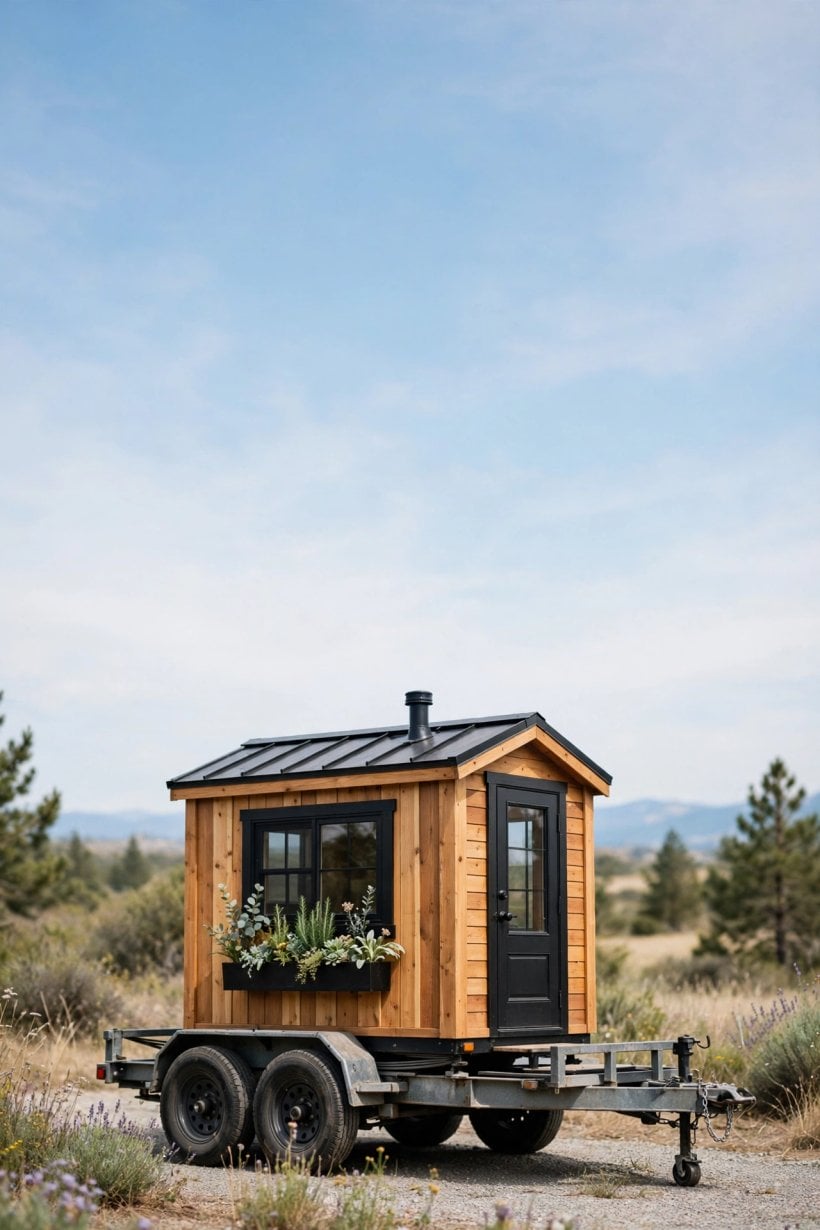
What trailer should you use for a tiny house? A purpose-built trailer, matched to your plan, rated for your finished house’s real weight with margin, on axles and tires that share that rating, with paperwork that proves all of it. Choose it before you build, weigh what you finish, maintain the running gear, and the foundation of your movable home will quietly do its job for as long as the house above it stands. Ratings and road rules vary by place and change over time, so confirm the specifics for your trailer and route with the manufacturer and local authorities. This guide is general information, not engineering advice.



4 Comments