

White cabinets with a white backsplash is the kitchen combination that looks effortless in photographs and is quietly full of decisions in person — which white, which tile, which grout, which metal — because when colour steps back, every other choice steps forward.
This collection builds the pairing in the order the room is actually decided: the cabinet layout first, then the tile, the grout and finish, the worktop and metals, the colour placed around the white, the light above it, and the daily disciplines that keep it honest.
1. White Cabinets and White Backsplash Ideas at a Glance
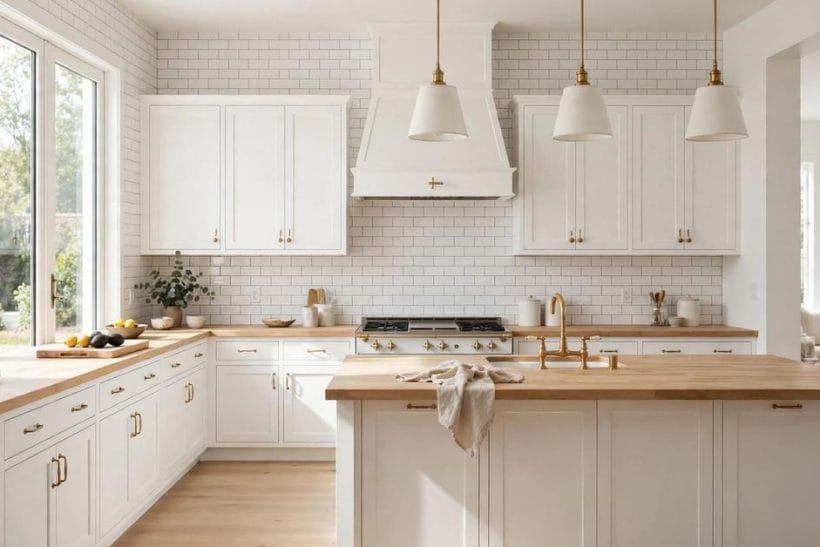
White cabinets and a tile backsplash are the pale-field pairing of this collection’s kitchen ideas pillar: white cabinetry carrying the room’s storage, a tiled backsplash carrying its one invited pattern, and every other element — worktop, metal, island, floor — chosen against that calm ground. It owns the white-on-white topic in the plan, splitting from coloured-cabinet and coloured-tile kitchens by restraint alone.
| Question | Short answer |
|---|---|
| Why pair white cabinets with a white backsplash? | Brightness, calm and longevity: the pale field makes small kitchens feel larger, carries any accent colour, and outlasts fashion because it never was fashion. |
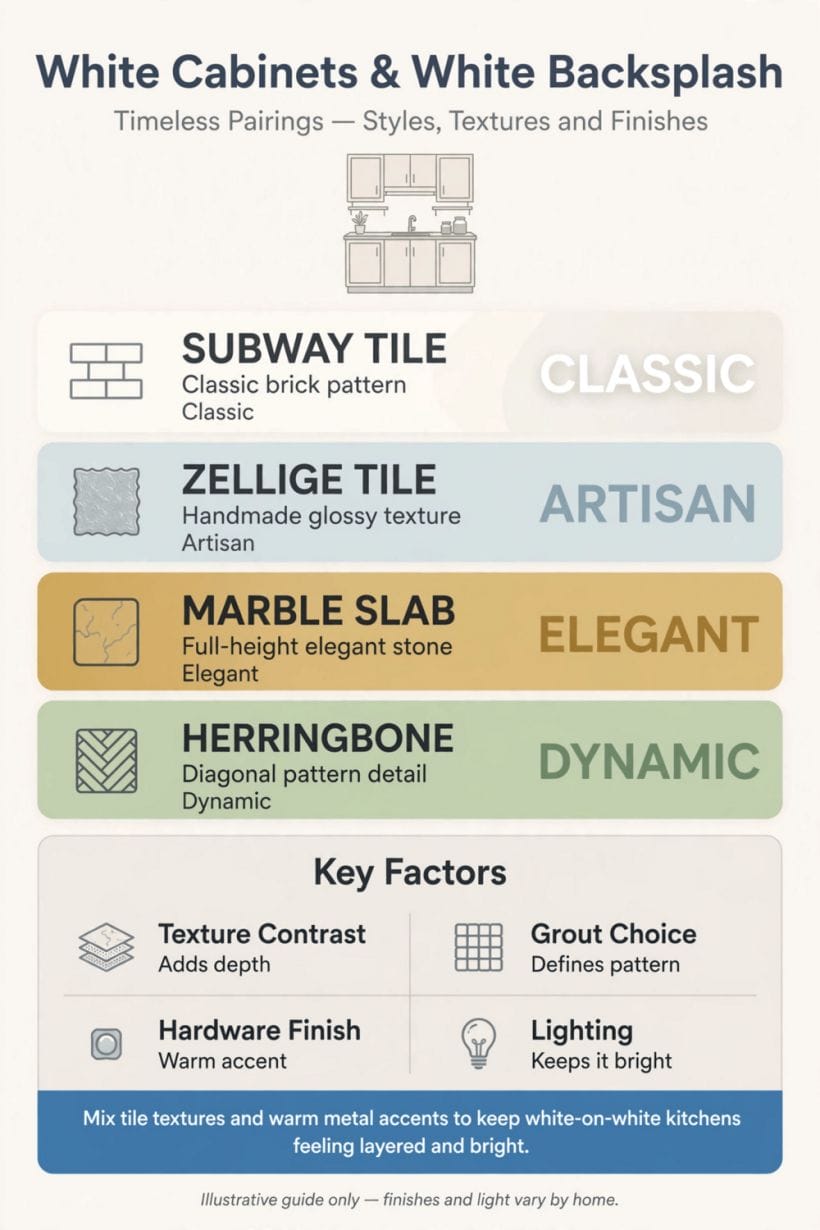
| Which tile suits it best? | The plain metro tile is the native — brick bond for classic, stacked for modern — with handmade-look tiles for warmth and large formats for calm. |
| What grout colour should I choose? | Soft grey or greige for most kitchens: it defines the tile’s pattern kindly and forgives cooking. White grout is purer and higher-maintenance. |
| How do I stop it looking clinical? | Warmth in the layers around it: a timber or dark worktop, brass or black metals, warm bulbs, a coloured island or objects that can leave. |
| Do the two whites need to match? | They need to agree, not match: one warm white and one true white, tested together in the room’s own light with a cabinet door carried to the tile shop. |
| What does it cost to keep? | Thirty seconds of wiping a night and a touch-up pot in a drawer — the pairing’s care is light because it is daily. |
2. Layouts: White Cabinets as the Kitchen’s Frame
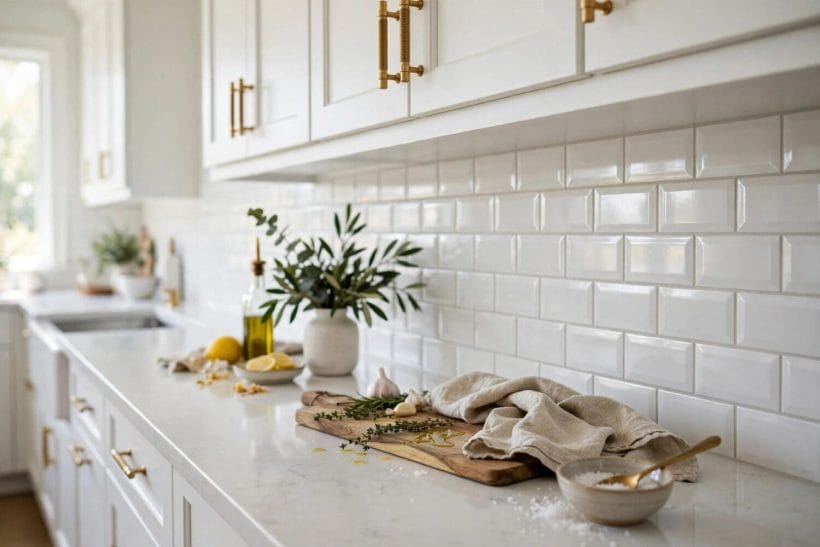
White cabinets are the kitchen’s equivalent of a white shirt: everything else in the room is judged against them, and they forgive almost any companion. The layout decisions come first, because a white kitchen’s brightness is planned in its runs and sightlines long before a tile is chosen.
1. Run white cabinets along the light
White cabinetry earns its keep where it catches daylight: the run under the window, the wall the morning sun reaches.
2. Keep the classic triangle honest in white
The kitchen ideas pillar in this collection plans every layout around the cooker–sink–fridge triangle; in a white kitchen the same discipline applies, with the bonus that pale fronts make a compact triangle feel airy rather than cramped.
3. Take wall cabinets to the ceiling or leave a honest gap
White cabinets stopped short of the ceiling leave a dust shelf that reads as an apology.
4. Mix one run of open shelves into the white
A short run of open timber or white shelves among closed cabinets breaks the clinical stretch, displays the everyday crockery, and gives the backsplash tile a place to be seen rather than hidden behind doors.
5. Give the island a different duty, not a different colour — at first
In an all-white scheme the island can stay white and earn its distinction from a different worktop and the stools beneath it.
6. Plan the small kitchen on the same principles
The tiny kitchen ideas in this collection use white fronts for exactly this room’s reasons: light returns, visual quiet, and a backsplash that can carry pattern without shrinking the space. Small is where the pairing proves itself.
7. Hide the appliances or show them proudly — not both
White kitchens split into two honest camps: fully integrated appliances behind white doors, or proudly shown machines in steel or colour. The muddle — half hidden, half not — reads as indecision at the room’s brightest.
8. Keep handles in the layout conversation
Handles are the kitchen’s punctuation, planned with the runs rather than chosen at the till. In a white kitchen they carry unusual weight: the same doors read farmhouse, modern or classic purely on the strength of their ironmongery.
9. Leave one wall free of cabinets where the room allows
A window wall or a bare stretch with the backsplash running along it gives the eye a rest from cabinetry and lets the tile work as the room’s picture. White kitchens breathe through the walls they did not fill.
10. Plan the eating corner as part of the white scheme
A small table or a banquette at the kitchen’s end belongs to the same family: the built-in banquette seating in this collection, painted to match the cabinets, turns the eating corner into built-in furniture rather than a guest in the room.
11. Light the layout before choosing the tile
Walk the plan at the day’s hours and mark where shadows fall on the worktops. The backsplash lives in those shadows; knowing them first is what separates a bright white kitchen from a merely pale one.
3. The Backsplash Tiles: Shape, Size and Pattern
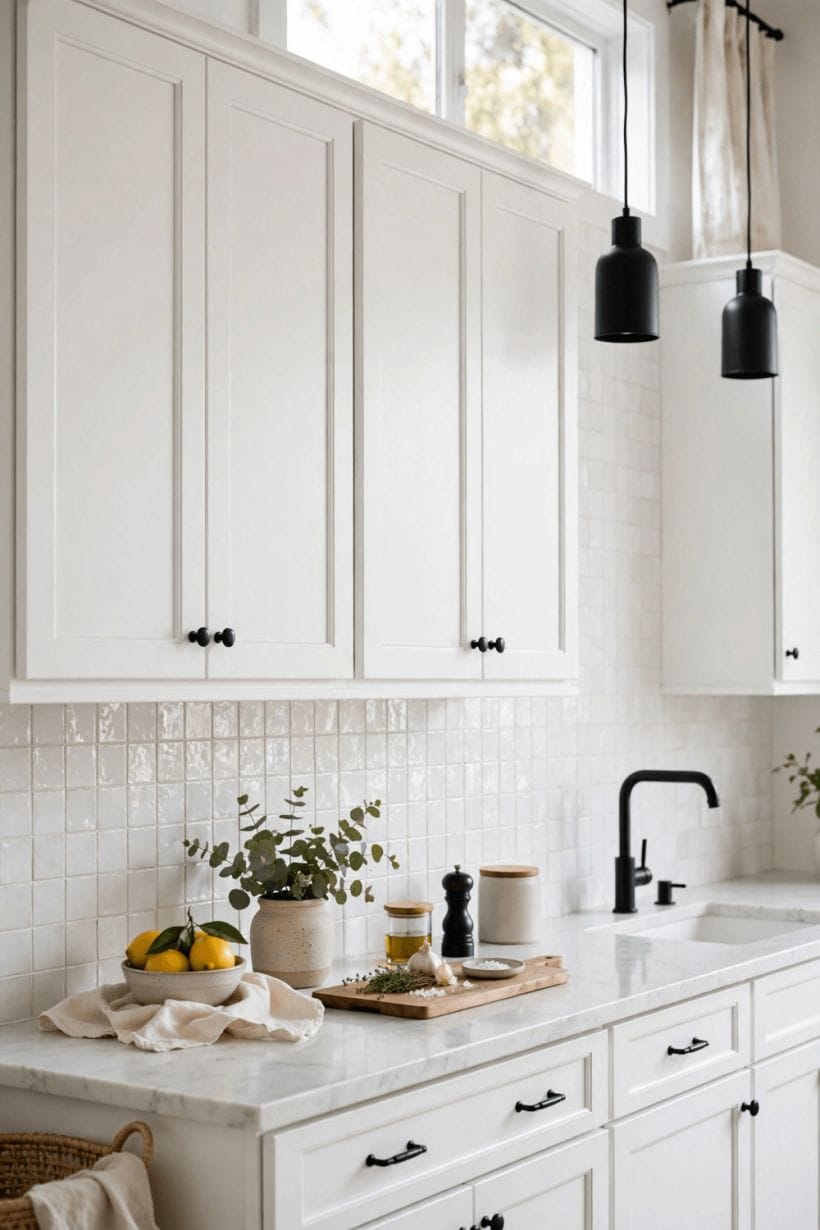
With white cabinets fixed, the backsplash is the kitchen’s one invited pattern — the surface at eye level, behind every task, seen more hours than any other in the house. Its shape, scale and laying pattern decide whether the white kitchen reads classic, modern or farmhouse.
12. Start with the metro tile, the pairing’s native
The plain rectangular metro tile behind white cabinets is the combination’s mother tongue: cheap in origin, endless in variation.
13. Scale the tile to the room’s proportions
Small tiles multiply grout lines and busyness; large-format tiles calm a big kitchen and can overwhelm a small one.
14. Try the elongated formats for a quieter modern line
Long, slim tiles laid horizontally stretch a kitchen visually and sit calmly behind white fronts. Their restraint suits the pairing’s modern mood, where the interest is proportion rather than pattern.
15. Use a handmade-look tile for warmth
Tiles with uneven edges and a glossy, varied glaze catch light in ripples and stop a white kitchen feeling sterile. Against flat white cabinets, their gentle irregularity is often the room’s only needed ornament.
16. Save pattern for one honest place
If a patterned tile calls — encaustic-look, a soft geometric — give it one territory: behind the cooker, or the whole of one short run. Pattern everywhere behind white cabinets turns the room’s background into its foreground.
17. Carry the tile to the ceiling on the cooker wall
Running the backsplash full-height behind the cooker makes a chimney of tile that anchors the room and shrugs off splashes where they actually fly. It is the single most effective upgrade in the pairing’s repertoire.
18. Or run a low upstand and painted wall above
The budget-honest alternative: a short tiled upstand at the worktop, washable paint above. It suits kitchens where the splash zone is small, and the painted band can carry a colour the tiles politely declined.
19. Match the tile’s white to the cabinets’ white
Whites differ: a blue-white tile against warm-white cabinets makes the cabinets look cream and the tiles look cold. Carry a cabinet door to the tile shop and marry the two whites under the same light before ordering either.
20. Let a coloured tile be the room’s one decision
A backsplash in deep green, ink blue or soft sage behind white cabinets is the pairing’s boldest standard move — the cabinets keep the room bright while the tile supplies its character. One colour, whole-heartedly, beats three cautiously.
21. Consider the slab splashback where tiles feel busy
A single slab of stone, quartz or glass behind the cooker removes grout lines from the greasiest zone and gives the white kitchen a calm, expensive plane.
22. Keep the tile’s edge finished honestly
Where the backsplash ends mid-wall, its edge shows: a tile trim, a metal strip or a clean return to the wall’s end.
4. Grout, Finish and the White-on-White Question
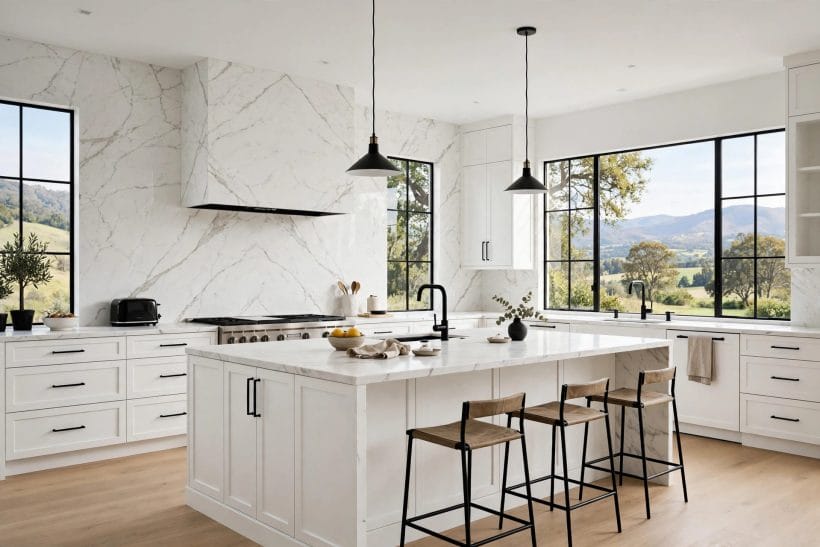
The connoisseur’s part of the pairing: whether a white backsplash behind white cabinets should vanish or define itself, and the two levers that decide it — grout colour and tile finish. Get these right and the combination looks inevitable; get them wrong and it looks like a rental.
23. Choose grout as the pairing’s quiet decision
White grout makes tile and cabinets one pale field — calm, bright, and quick to show cooking’s evidence.
24. Match grout to the tile’s shadow, not its face
The experienced trick: grout the colour of the tile’s own shadow — usually a soft warm grey — so the pattern reads as texture rather than as a grid drawn on the wall.
25. Decide gloss against matt by the light
Glossy tiles bounce daylight around a dim kitchen and wipe clean with a cloth; matt tiles sit quieter and show water marks less.
26. Mix finishes within one colour for depth
The same white tile in gloss on the wall and matt on the cabinet fronts — or the reverse — gives a white-on-white kitchen its dimension.
27. Use texture where colour is refused
A bevelled edge, a rippled surface, a tile laid in relief: texture is how an all-white backsplash earns interest without a single coloured tile. In the pairing’s purest form, the whole design is light moving across white.
28. Seal the grout where cooking is serious
Behind a working cooker, grout sealer is the difference between a backsplash that cleans and one that absorbs. It is an afternoon’s work at fitting time and a permanent mercy thereafter.
29. Avoid brilliant white on both surfaces
Blue-bright whites on cabinets and tile together turn clinical under daylight and grey under lamps. One warm white and one true white — in either order — keeps the pairing on the domestic side of the laboratory.
30. Let the window light arbitrate
Judge grout and finish samples on the actual wall, at breakfast and at dusk, before committing.
31. Run the same tile into a small cloakroom or utility for family likeness
Where the kitchen’s pairing succeeds, its offcuts and its logic serve the house’s smaller wet rooms kindly. One tile bought in quantity, used with restraint in two rooms, is economy that reads as design.
32. Accept that white grout is a commitment, priced in minutes
Households that fry daily and scrub rarely should let the grout go grey without a pang of conscience. The pairing survives every grout colour; what it does not survive is a backsplash its owners have come to resent.
33. Photograph the finished wall before styling it
A plain photograph of tile, grout and cabinets — no props, no fruit bowl — tells the truth about the pairing while there is still time to adjust a shelf or a light.
5. Worktops and Metals That Complete the Pairing
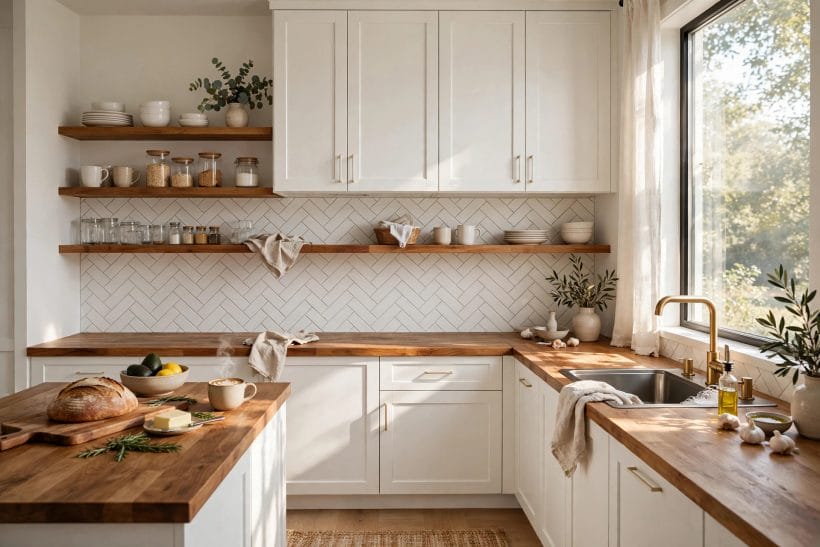
White cabinets and a white backsplash form the room’s pale field; the worktop is the line drawn across it, and the metals are the jewellery. These two choices decide whether the kitchen lands as farmhouse, modern, classic or coastal — the pairing itself is neutral ground.
34. Lay a timber worktop for the farmhouse answer
Warm wood across white cabinets is the pairing’s oldest friend: it stops the white at exactly hand height, forgives crumbs visually, and asks only for oil and honesty in return.
35. Choose pale stone or quartz for the calm modern line
A light stone-look worktop with a whisper of veining keeps the kitchen all-of-a-piece — white on white with a stone horizon. It suits the slab splashback and the handleless door, and it wipes clean without ceremony.
36. Go dark on the worktop for definition
Slate, black granite-look or deep stained timber draws the line the white pairing needs and hides the day’s evidence between cleans. The contrast is the classic white kitchen’s engine: pale above and below, one dark stroke between.
37. Match the metals across taps, handles and lights
One metal, repeated: brushed nickel for cool kitchens, brass for warm ones, black for the graphic modern scheme, chrome where tradition insists. The pairing’s neutrality makes mismatched metals unusually visible — they become the room’s accidental pattern.
38. Let brass warm the whitest schemes
Where an all-white kitchen risks feeling cold, unlacquered brass on handles and tap warms it like sunlight and ages into the room. It is the metal that flatters white cabinets most reliably across every style of the pairing.
39. Keep the sink’s finish in the family
A white ceramic sink disappears into the scheme for the seamless look; a steel sink joins the appliances’ team; a dark composite sink echoes a dark worktop.
40. Use the worktop’s edge as a design line
A thick, square edge reads modern and substantial; a rounded or ogee edge turns the same white kitchen traditional.
41. Carry one worktop material throughout
Two worktops in one small white kitchen — timber at the island, stone at the run — can work in large rooms and merely fuss in small ones.
42. Plan sockets and switches as part of the metal story
White sockets vanish on a white backsplash; metal or black ones join the taps and handles. Decide it as design, not as the electrician’s default, because a row of sockets is a row of anything else on that wall.
43. Set the floor to anchor the pale scheme
The floor is the white kitchen’s ground and its warmth supply: mid-tone timber, terracotta or stone-look tile beneath white cabinets keeps the room from floating.
44. Test the whole sandwich before ordering
Cabinet door, tile, grout, worktop and handle in one stack, in the room’s own light: the pairing is a sandwich of five decisions and should be tasted as one.
6. Colour Around the White: Walls, Floors and Islands
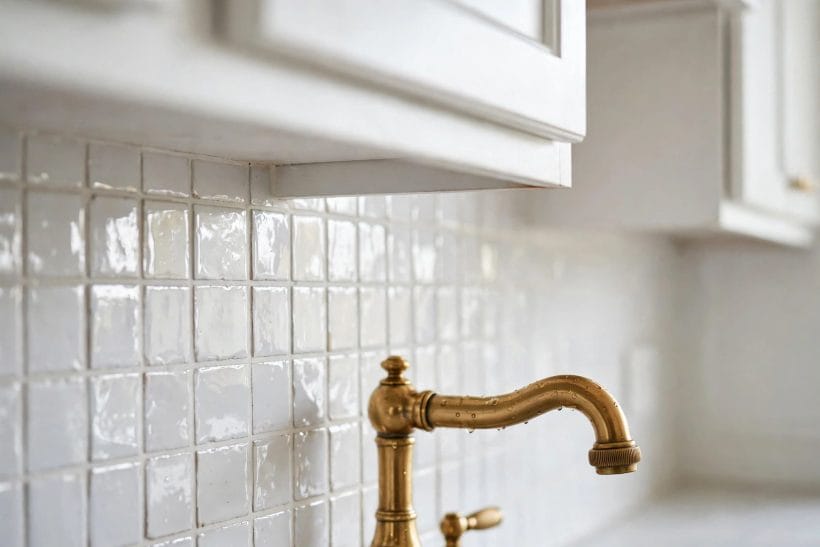
A white kitchen is not a colourless one — it is a kitchen whose colour has been moved to the edges: the island, the walls, the floor, the stools and the shelf of green things. Placing that colour deliberately is what separates the designed white kitchen from the merely unfinished one.
45. Paint the island and keep the runs white
The island in deep blue, green, charcoal or warm grey is the pairing’s favourite colour move: the working walls stay bright and timeless, the island carries the fashion and can be repainted in a weekend when taste moves on.
46. Answer the island with the stools and shelves
One echo is enough: stools in the island’s colour family, a shelf object, a blind. The colour then reads as the room’s decision rather than its accident, and the white field stays the majority it should be.
47. Take the walls a warm pale that flatters white
Wall colour beside white cabinets should be a whisper warmer than the cabinets themselves — a warm off-white, the palest greige — so the cabinets read crisp against it rather than disappearing into an identical field.
48. Or give one wall a real colour and keep the rest pale
The wall without cabinets — the eating wall, the door wall — can carry the room’s deep colour while the tiled walls stay white. The kitchen gains a mood without losing a lumen of its working brightness.
49. Connect the eating corner with colour and cloth
The breakfast nook ideas in this collection sit a small eating corner in the kitchen’s light; cushions and a blind in the island’s colour tie it to the scheme, and the white cabinets keep even a north-facing nook feeling morning-bright.
50. Choose the floor as the room’s warmth or its cool
Timber and terracotta floors warm the white pairing toward the farmhouse; pale stone and concrete-look floors cool it toward the modern. The cabinets and tiles support either — the floor casts the deciding vote.
51. Bring colour in through things that can leave
Kettles, boards, bowls, a runner, herbs on the sill: the white kitchen’s colour can be entirely removable, refreshed seasonally and never regretted at resale. It is the scheme for households whose taste changes faster than their kitchens.
52. Use black as the drawing line, sparingly
Black handles, a black tap, black-framed pendants: the graphic accents that make white schemes look designed rather than defaulted. A little draws the room; a lot turns it into a chessboard.
53. Let the view be a colour
Where the kitchen window frames a green garden, the white pairing’s restraint hands the room’s colour to the view.
54. Carry the scheme into the tiny house kitchen design without shrinking it
Small and tiny kitchens borrow this pairing whole: white fronts, one tile, one metal, colour only in the island or the objects. The discipline that makes a family kitchen calm makes a tiny one feel possible.
55. Repaint before you renovate
The white pairing’s secret economy: when the room tires, the island, the walls and the textiles can all change colour for the price of paint and a weekend, and the cabinets and tiles — the expensive bones — stay.
7. Light Over White Surfaces
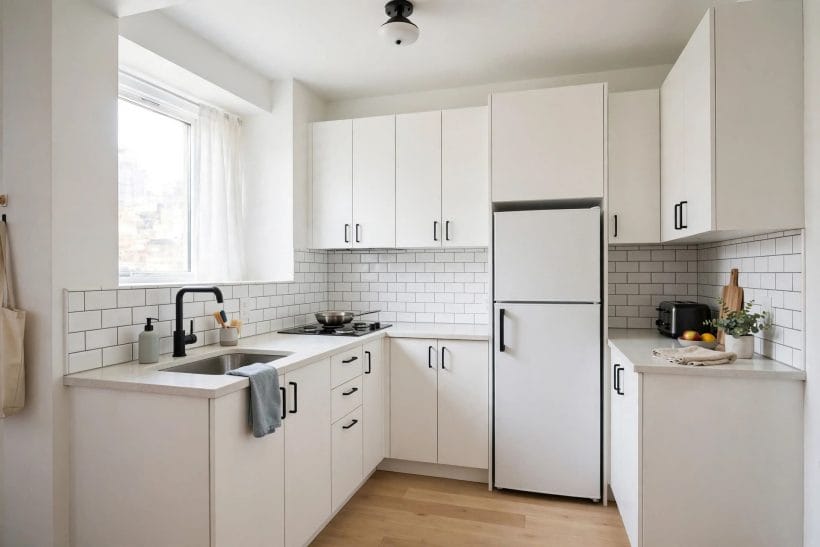
White kitchens live or die by their light: the surfaces return whatever they are given, doubling daylight’s kindness and lamplight’s colour alike. The lighting plan is short — bright task light, warm ambient light, and no bulb anywhere that turns white to grey or blue.
56. Put task light under the wall cabinets
Under-cabinet strips light the worktop and the backsplash together — the exact surfaces this pairing is about.
57. Choose bulb warmth as a scheme decision
Warm-white bulbs keep white cabinets creamy and food appetising; cool bulbs turn the same kitchen clinical. In a white room the bulb’s colour temperature is a design material, chosen with the same care as the grout.
58. Hang pendants over the island as the room’s jewellery
Two or three pendants above the island supply the scheme’s vertical interest and its evening pool of light.
59. Wash the backsplash with its own light where it matters
The run behind the cooker deserves the under-cabinet light continued without a gap: it is the most-worked and most-looked-at stretch of tile in the house, and the pairing’s showpiece deserves its spotlight.
60. Use daylight honestly: dress the window plainly
A white kitchen’s window wants a simple blind or none — the light is the decoration. Heavy curtains over the sink window steal the brightness the whole scheme was bought for.
61. Add a low evening layer
A lamp on the worktop’s far end, the island pendants dimmed, the under-cabinet lights off: the white kitchen at evening should glow rather than glare. Dimmers on every circuit make the transformation a habit instead of a project.
62. Keep glass and gloss working for the light
Gloss tiles, glass cabinet inserts and pale worktops bounce the available light deeper into the room. In a dark kitchen, choosing the pairing in gloss finishes is not a style preference but a lighting plan.
63. Mind shadows in the corners
White schemes show their corners: a dark corner in a white kitchen reads as a mistake rather than a mood.
64. Light inside the deep drawers and larders if budget allows
The white kitchen’s promise is that everything is findable; interior lights in the deepest storage keep the promise at the back of the larder. It is a small luxury that serves the scheme’s whole argument.
65. Check the finished room at night before signing off
Stand in the kitchen at full dark with every light on, then with the evening layer only.
8. Styling, Care and Keeping White Honest
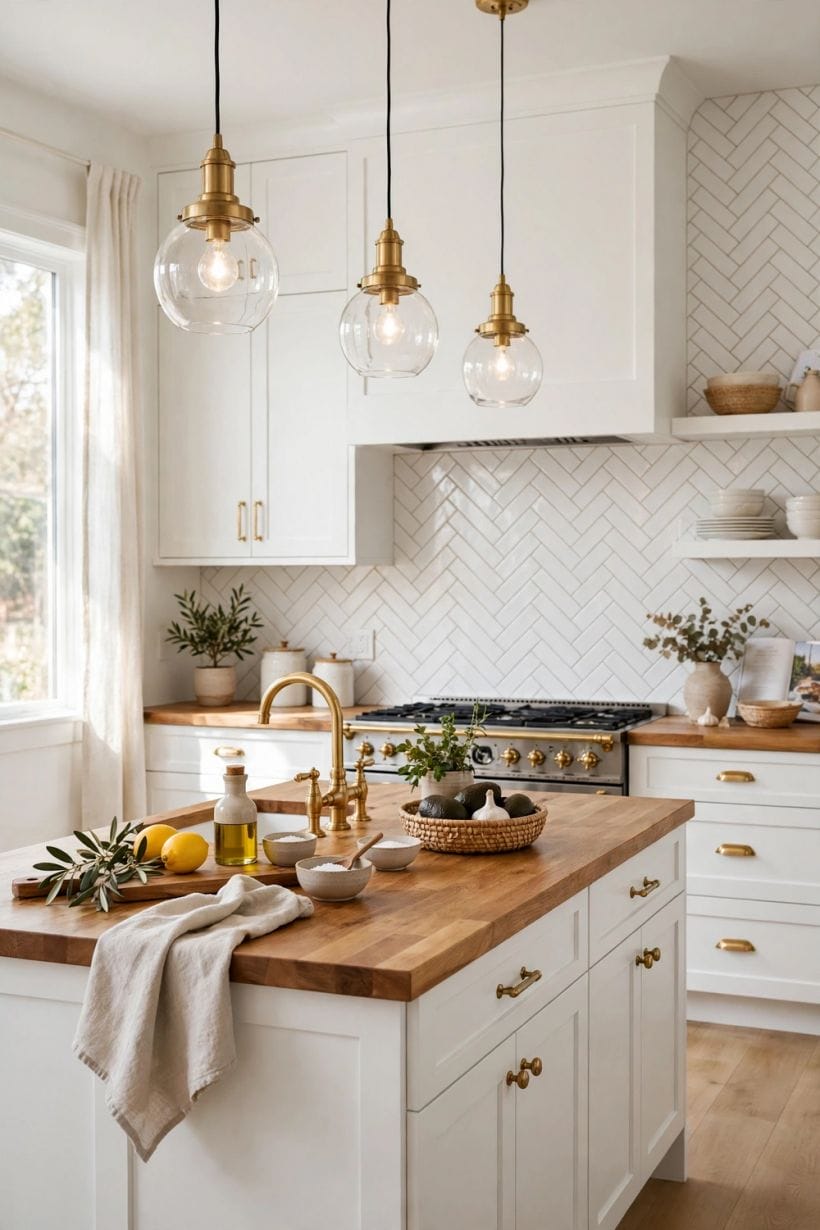
The white pairing’s final discipline is housekeeping raised to design: a white kitchen shows its life, so its life must be arranged. The styling is spare, the care is little-and-often, and the reward is a room that looks like the photographs on an ordinary Wednesday.
66. Style the worktop in working groups
Boards together, oils by the cooker, the kettle’s corner, fruit in one bowl: grouped and gapped, the worktop’s necessities read as composition. Scattered evenly, the same objects read as clutter — the arrangement is the whole difference.
67. Keep the sink zone ruthlessly simple
A brush, a cloth folded, one bottle if any: the sink is where white kitchens confess.
68. Wipe the splash zone nightly, briefly
Thirty seconds with a cloth after cooking keeps the backsplash’s grout its chosen colour for years. The pairing’s care is famously light precisely because it is daily; left monthly, it becomes the deep clean of legend.
69. Touch up cabinet paint before chips multiply
Painted white fronts chip at the handles and the dishwasher’s edge. A touch-up pot kept in the kitchen drawer, used the week a chip appears, keeps the cabinets reading as one surface rather than as a history of knocks.
70. Rotate the shelf objects with the seasons
The open shelf and the worktop’s bowl carry the kitchen’s calendar: citrus in winter, herbs in spring, tomatoes in summer. Against white’s constancy, the small seasonal changes do the decorating work of a whole restyle.
71. Choose textiles that wash and bleach
Tea towels, aprons and seat cushions in a white kitchen should be fabrics that tolerate a hot wash without fading into grey. Their brightness is part of the scheme, and their laundry is part of its honest running cost.
72. Keep one plant always alive in the room
Herbs on the sill or a single green plant on the shelf: against white tile and white cabinets, living green is the colour the scheme is quietly built around. Let it die and the room notices before the household does.
73. Store the cleaning kit as neatly as the cooking kit
The cloths, sprays and brushes of a white kitchen’s upkeep live under the sink in one container, handles up. A scheme this honest about cleanliness keeps its own tools tidy on principle.
74. Accept the patina at the handles
In time the most-touched fronts warm very slightly where hands fall, and lacquered brass darkens to match.
75. Let the finished kitchen be judged at breakfast
The pairing’s true test is a weekday morning: light on the tile, everything findable, nothing shouting. From the home design ideas hub, the same discipline — few materials, honestly kept — is this collection’s advice for every room in the house.
9. Checks and Mistakes: Before the First Purchase or the First Fitting
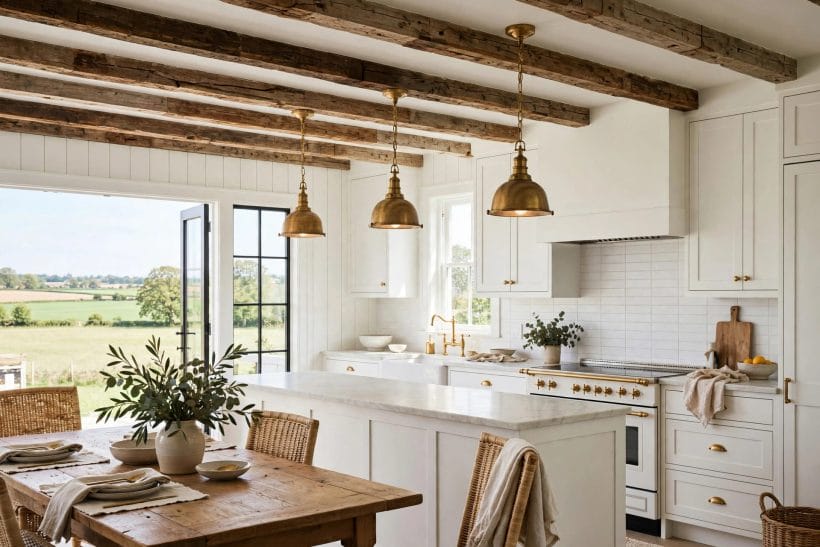
Walk the sandwich of samples once more before ordering — door, tile, grout, worktop, handle — in the room’s morning and evening light. The pairing fails in the gap between samples chosen separately and a room lived in jointly.
Check the fitting details in writing: grout sealed behind the cooker, tile edges finished at every open end, worktop sealed where it meets the tile. A white kitchen shows its shortcuts at eye level, exactly where the backsplash lives.
Resist the late extra colour — the patterned floor tile, the coloured wall unit proposed mid-build. The pairing’s power is its restraint; one more decision can cost it the calm that justified it.
10. Costs and Pulling It Together
Costs in the white pairing follow the bones: cabinets and their fitting first, then the worktop, the tiling and its labour, with grout, metals and lighting the small spends that steer the whole result. The pairing’s economy is that its most fashionable layer — the colour — costs a tin of island paint.
Finish with the light: under-cabinet strips and warm bulbs transform the finished room more per pound than any other late purchase, and they are the layer the evenings will judge.
Final Considerations
White cabinets and a white backsplash are not the absence of a decision; they are the decision to let light, layout and daily order do the decorating — and to keep colour in the household’s hands, in the island, the objects and the view.
Build the pairing in this order and keep it with thirty honest seconds a day, and the kitchen will look like its first morning for as long as the household cares to ask it to.

0 Comments