
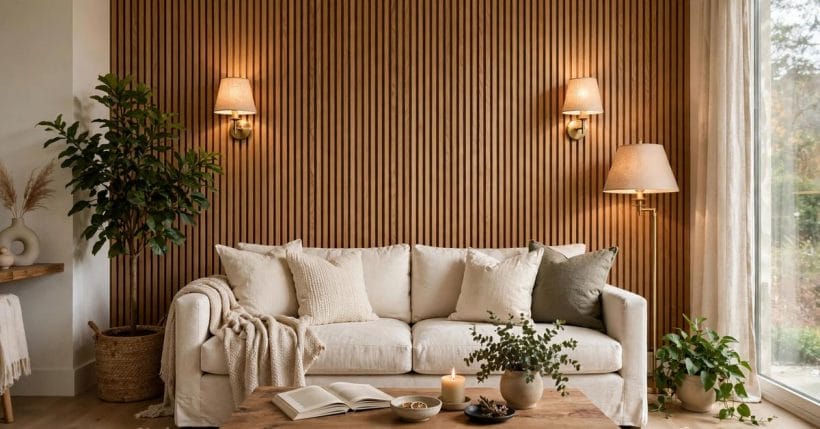
A wood wall changes a living room the way a fireplace does — suddenly the room has a warm side, a direction, a place the eye wants to rest. Timber does what paint promises: it makes the room feel built, not decorated.
These seventy-five ideas take the wood wall seriously: which wall, which timber, which pattern — slats, reclaimed boards, pale oak, dark walnut and shiplap — and how sofas, colour and layered light complete the room around it.
Related Guide: How to Build a Tiny House Out of Pallets: An Honest Guide
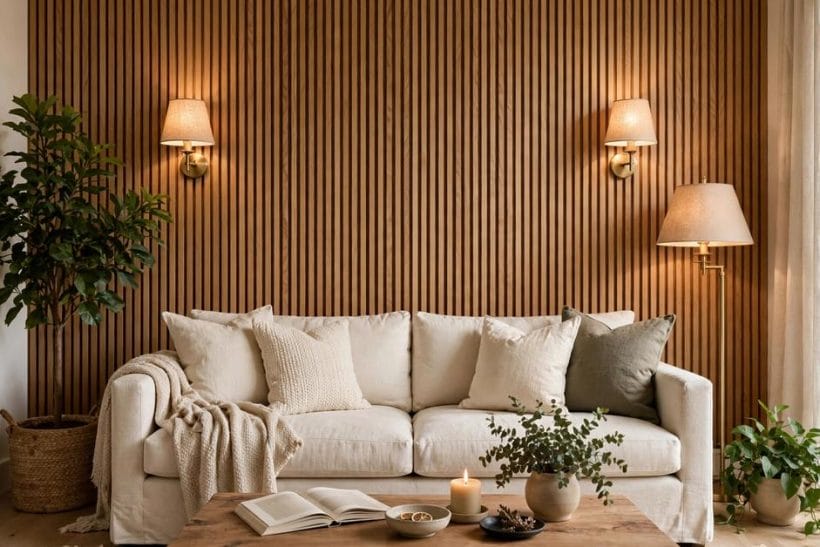
1. Wood Wall Living Room at a Glance
The central entity is the wood-clad living room wall: a principal wall finished in real timber — slats, boards, panels or veneer — that acts as the room’s warm anchor, with seating, colour and lighting arranged in answer to it. The room-wide survey belongs to the living room ideas pillar; this post is the set’s timber chapter, distinct from its siblings — the brick wall living room works the masonry lane, and the media wall living room is built around the screen, while here the wood itself is the feature and everything else is supporting cast.
| Question | Short answer |
|---|---|
| Which wall should get the wood? | Usually the sofa or fireplace wall — the one the room already faces; the first section weighs the candidates |
| Real timber or wood-effect panels? | Both have honest uses — real boards age and repair; good panels win on speed and budget; the choosing section separates them |
| Will a wood wall darken the room? | Only if the tone is deep and the lighting lazy — pale oak brightens, and layered light keeps even walnut glowing |
| Does it suit small living rooms? | Yes — one clad wall adds depth that paint cannot, and depth reads as space when the furniture stays light |
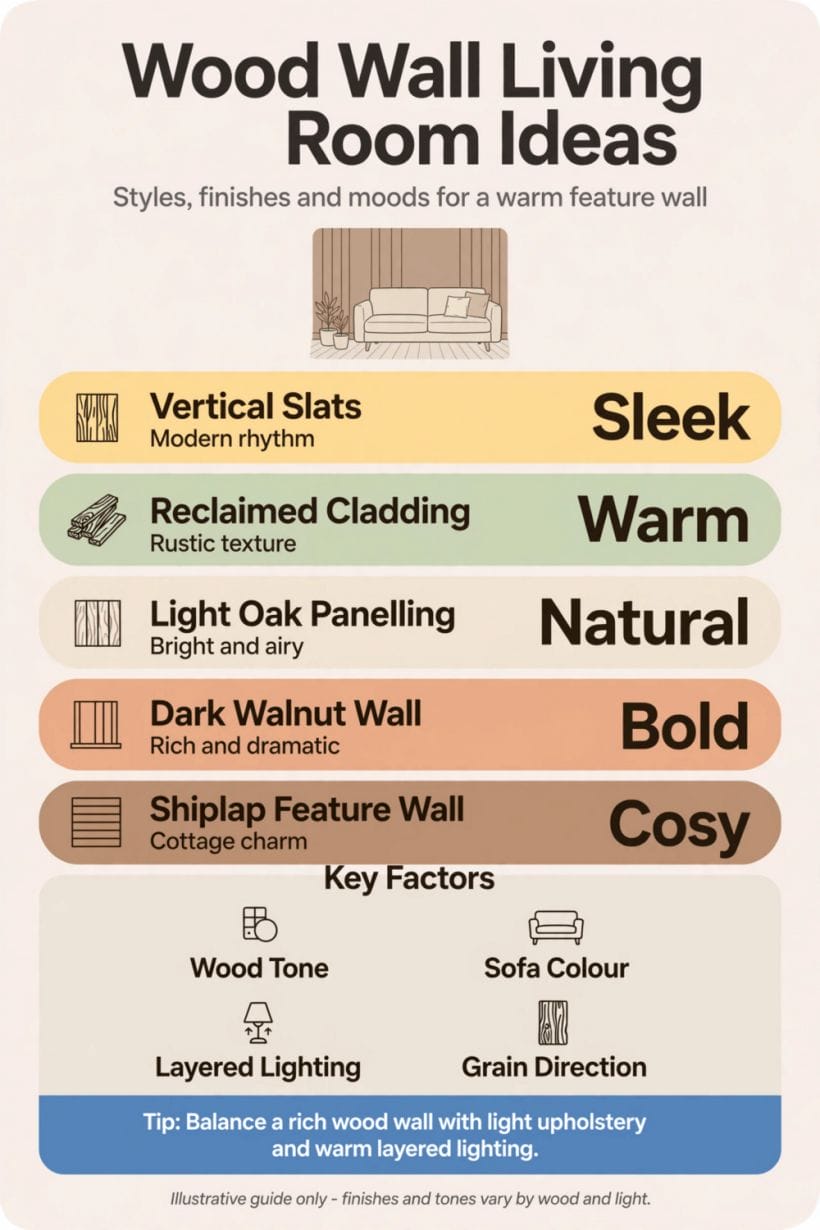
2. Which Wall? The Feature-Wall Decision
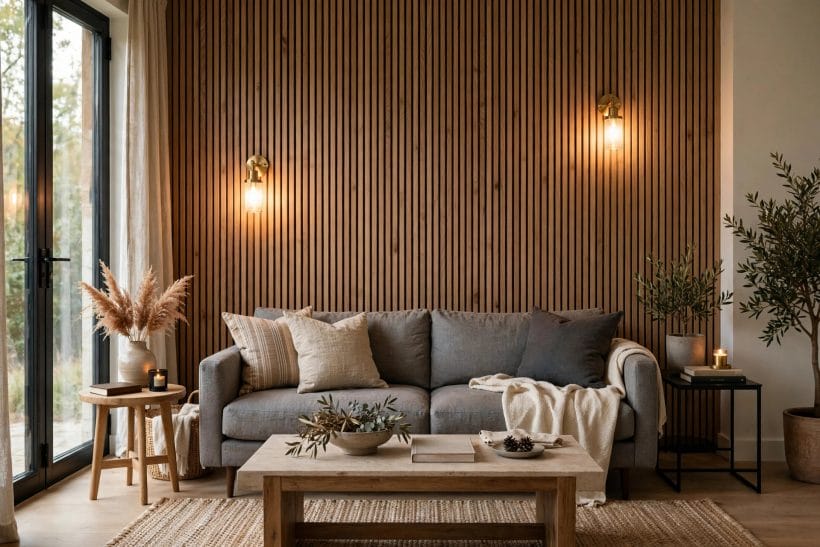
One wall, chosen well, is the whole strategy — wood everywhere is a sauna, wood nowhere is a missed chance. These nine starting points pick the wall before a single board is bought.
1. The sofa wall
The wall the seating backs onto is the classic choice: timber behind the sofa gives the room’s main arrangement a warm backdrop, and you enjoy it every time you face the room from the door.
2. The fireplace wall
Wood around the fireplace doubles the hearth’s warmth — boards or slats cladding the chimney breast read as one crafted whole. Keep clearances and heat rules with the fire’s maker guidance, always.
3. The television wall
Timber behind the screen softens the black rectangle’s glare and gives the tech a crafted home. It neighbours the media-wall post’s territory — there the joinery serves the screen; here the screen is a guest on the wood.
4. The window wall, declined
The wall full of windows is usually the wrong candidate — little surface, constant weathering at the glass line, and the view should win. Exceptions exist in garden rooms; the rule stands for most.
5. The long wall in a narrow room
Cladding the long wall of a narrow room in horizontal boards stretches it further; vertical slats on the short wall pull the ends in. Direction is a tool — the pattern section uses it deliberately.
6. The partial wall: half-height timber
Boards to dado height with painted plaster above give small rooms the warmth without the full commitment. The ledge the cladding makes is a shelf the room will use daily.
7. The alcove treatment
Cladding inside alcoves and the chimney-breast recesses frames them in timber — depth you can see into. Alcove wood suits shelves, the reading chair and the bar cart alike.
8. Two facing panels, not two walls
A panel of cladding at each end of a long wall — behind the sofa, behind the sideboard — rhymes the room without enclosing it. Repetition in miniature is how timber flirts without proposing.
9. The rental answer: freestanding screens
Where walls cannot be touched, a run of slatted timber screens or a great leaning panel gives the wood wall’s effect with no fixings. It leaves when you do, and the deposit survives.
3. Vertical Slats and Modern Rhythm
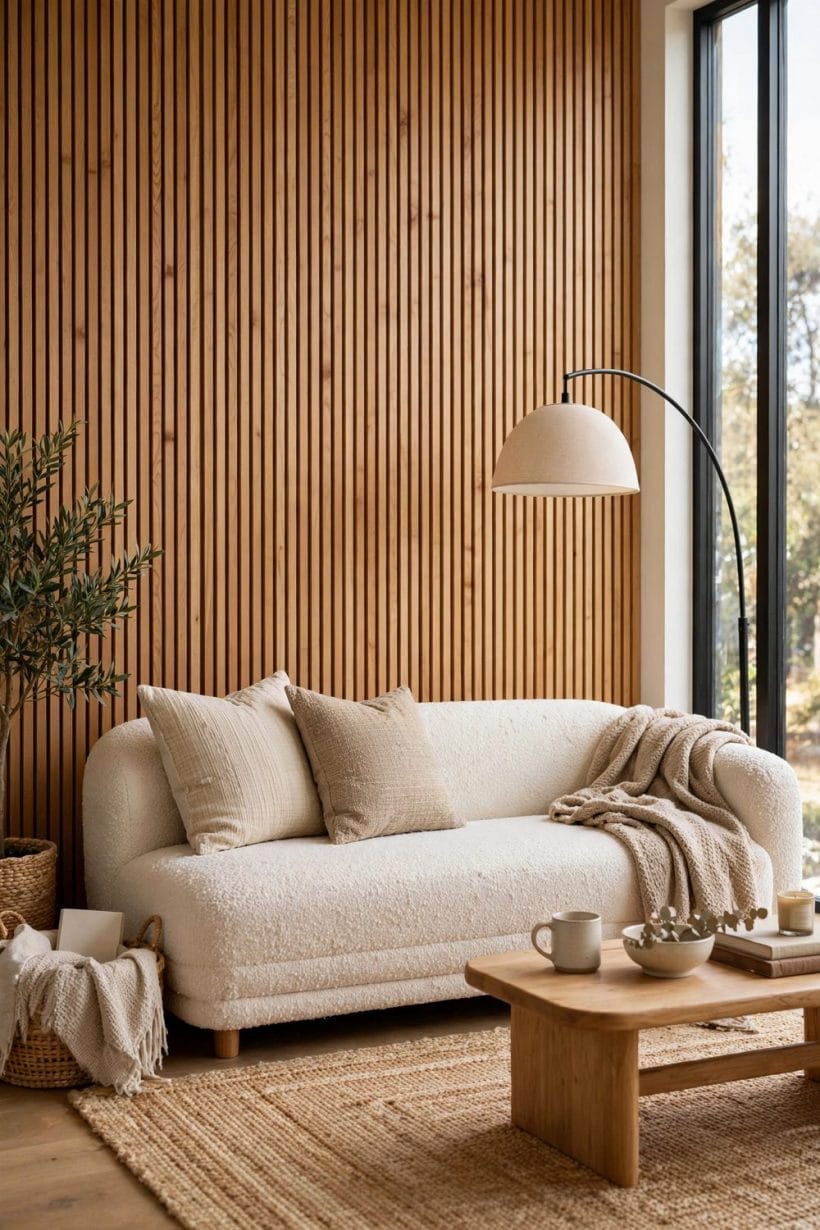
The slatted wall is the modern face of timber cladding — slim battens, shadow gaps, a rhythm you can hear with your eyes. Nine ideas work the slat wall from specification to styling.
10. Classic vertical slats
Even battens with even gaps, floor to ceiling — the slat wall in its purest form. The shadow lines do the decorating; furniture in front should be plainer than the wall behind it.
11. Slats on a dark backing
Battens fixed over a black or deep-brown backing deepen the shadow gaps into stripes of night. The wall reads richer and the individual slats stand forward like keys on a piano.
12. Wide slats, calmer rhythm
Wider battens with narrower gaps slow the wall’s pulse — the choice for bedrooms-adjacent living rooms and anyone who finds fine slats busy. Rhythm is a volume control; set it for the room’s temperament.
13. Slats that turn the corner
Carrying the battens around one corner unwraps the wall into the room — the cladding stops being a picture and becomes architecture. Corners are where slat work proves its craftsmanship.
14. The slatted room divider
A slat screen standing free divides open-plan space while leaking light and sight through its gaps — the wood wall’s most flexible form, and the renter’s friend from the first section grown up.
15. Acoustic slat panels
Slats on a felt backing tame echo in hard-floored rooms — the wall that hushes. In open-plan homes where the television and the toddler compete, acoustic cladding is function wearing beauty’s clothes.
16. Oak slats, the bright modern
Pale oak battens are the slat wall’s daylight register — Scandinavian in feel, kind to small rooms. Oak slats over a pale backing nearly disappear into brightness; over dark, they sing.
17. Walnut slats, the evening register
Walnut battens give the same rhythm a duskier key — the wall for rooms used at night, lamps low, colours deep. Walnut asks for warm metal and cream upholstery as its partners.
18. Painted slats
Slats painted — sage, ink, cream — keep the rhythm and surrender the grain. It is the budget route to the pattern and the brave route to colour; the texture survives the paint, which is the point.
The slat wall’s one vanity is precision: battens magnify every irregularity in the wall behind them, so the preparation — true battens, packed level, gaps gauged with spacers rather than hope — is the craft the finished wall is silently boasting about. A slat wall done in a weekend shows it for a decade; done in two weekends, it shows nothing but the rhythm.
4. Reclaimed Cladding and Rustic Texture
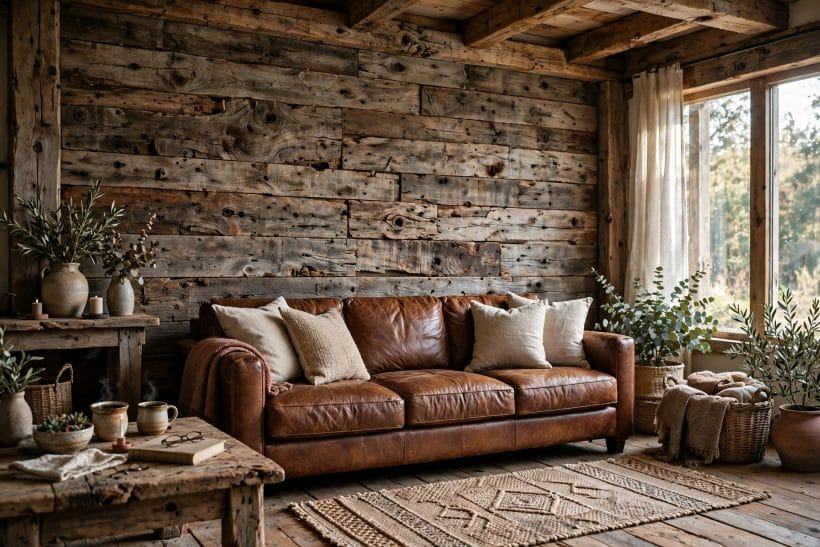
Reclaimed timber arrives with its history written in nail holes and saw marks. These nine ideas bring old wood onto the wall without turning the room into a barn cosplay.
19. Reclaimed boards, full wall
Mixed reclaimed planks across a whole wall are the boldest texture in this post — every board a different decade. Keep the furniture modern and plain so the wall tells one story at a time.
Reclaimed timber also asks a practical kindness: boards that spent a century in a barn arrive thirsty, dusty and occasionally inhabited by history you did not order. Clean them, let them dry in the room, and treat any suspect timber before it comes indoors — the salvage yard’s advice here is worth taking literally. Prepared properly, old boards are the most stable cladding of all: they have already moved everywhere they were ever going to move.
20. Barn wood behind the sofa
Grey-weathered barn boards behind pale seating give the room its frontier register. Weathered grey wood is the rustic lane’s neutral — it hosts any upholstery colour you bring.
21. Pallet wood, done properly
Yes, pallets — sanded, cleaned, graded and laid in courses like proper cladding. The material is humble; the craft decides whether the wall reads resourceful or rough.
22. Old floorboards on the wall
Salvaged floorboards bring long lengths and honest wear — the boards that held a century of feet now hold the room’s eye. Their tongue-and-groove makes fitting them straightforward.
23. Mixed-width rustic courses
Varying board widths across the wall break the grid and double the handmade feel. Mixed widths suit cottages and casual rooms; formal rooms should keep their courses even.
24. Whitewashed reclaimed wood
A whitewash over weathered boards keeps every scar and softens every colour — rustic texture in the pale register. Whitewash is the beach-house door into the wood-wall family.
25. The timber beam as wall jewel
One massive reclaimed beam — as mantel, as shelf, as the lintel of the whole composition — can carry a wall that is otherwise plain boards. A single ancient piece outranks a wall of merely old ones.
26. Sourcing honestly
Reclaimed means salvaged, with a story you can ask about — architectural salvage yards and demolition merchants are the honest sources. New wood distressed to fake it is a costume; buy the real past or buy new and let it age.
27. Sealing without shining
Old boards need sealing against dust and splinters, but gloss kills them. Matt sealers and wax keep the surface touchable and the colour true — the finish should be felt, not seen.
5. Light Oak and Pale Panelling
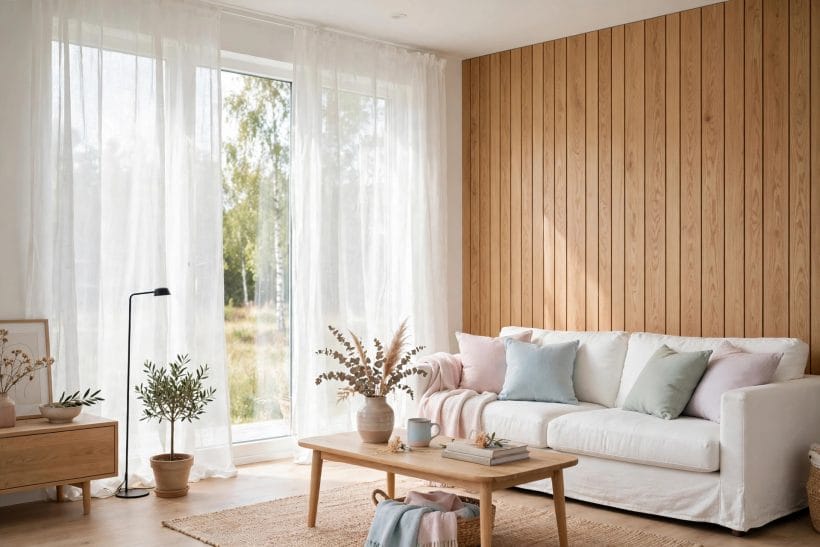
The pale end of the timber family is where wood walls answer their dark reputation. Nine ideas in oak, ash, pine and whitewash — the daylight register, cousin in spirit to the yellow living room‘s sunlit lane.
28. Pale oak panels
Large oak panels with fine joints give the modern pale wall — warm, quiet, architectural. Panels read calmer than boards and suit rooms where the furniture wants the attention.
29. Ash and other near-blonde timbers
Ash, maple and birch run paler than oak with subtler grain — the wall becomes a glow rather than a pattern. Blonde timbers are the small room’s best timber friends.
30. Limed and cerused finishes
Liming wax rubbed into oak’s grain whitens the figure of the wood while keeping its warmth — the pale finish with the most craft in it. It suits traditional rooms going lighter.
31. White-painted panelling
Square or shaker panelling painted warm white is wood’s most formal pale dress — texture through shadow alone. It is the wall that lets every other colour in the room speak first.
32. Tongue-and-groove, painted cream
Beadboard and tongue-and-groove in cream bring the cottage wall indoors — humble, washable, endlessly liveable. Vertical boards lift ceilings; horizontal ones lengthen walls.
33. Pale wood, full height
A whole wall in blonde timber from floor to ceiling turns the room into a light box with grain. Pale full-height cladding is how Scandinavian rooms spend wood without spending light.
34. The pale wainscot
Low pale panelling with plaster above is the shyest wood wall in the post — a skirting grown tall. It protects the wall the furniture abuses and leaves the upper room to art and shelves.
35. Pine, embraced not hidden
New pine’s honey tone, knots and all, is the budget timber with nothing to apologise for. Wax it, keep the rest of the room cream and linen, and pine reads cottage-honest.
36. Pale wood with black accents
Black frames, a black floor lamp, the television’s dark glass — small black notes give pale timber its definition. Without them the blonde room can drift; with them it snaps into focus.
Pale timber carries one more advantage the dark end cannot match: it forgives the rest of the room. Patterned sofas, inherited rugs, the children’s artwork in frames — a blonde wood wall hosts them all like a gallery painted in daylight. Where walnut demands curation, pale oak permits life, and most living rooms are lived in harder than they are curated.
6. Dark Walnut and the Dramatic Wall
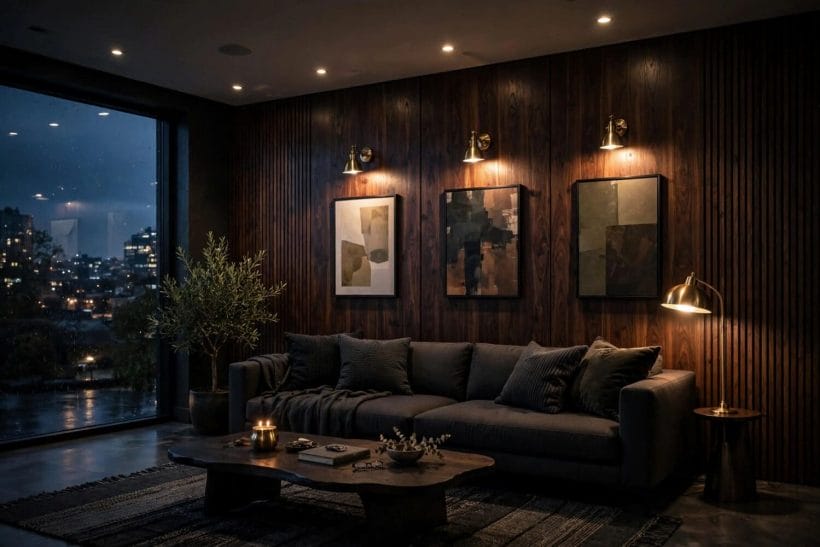
Now the other pole: deep timber used as deliberate drama. Nine ideas in walnut, stained oak and charred finishes — the evening register of the family.
37. The walnut feature wall
Full-height walnut veneer or boards behind the seating is the wood wall’s grand statement — grain like poured chocolate, lit like a painting. Everything else in the room gets quieter and better.
38. Book-matched walnut panels
Panels cut and mirrored so the grain blooms symmetrically — joinery as artwork. Book-matching is where cladding becomes cabinet-making, and the wall becomes the room’s heirloom.
39. Dark stained oak
Oak stained near-black keeps its grain under the drama — the textured dark wall. Stained oak suits modern rooms that want walnut’s depth with oak’s backbone.
40. Charred timber finishes
Charred and brushed boards — the burnt finish borrowed from Japanese craft — give black its most textured form. A charred wall is a fireplace’s natural partner and a brave room’s crown.
41. Dark wood, low rooms, warm light
Deep timber in a low room works when the light is low and warm too — lamps at seating height, never a bright ceiling glare. The den feeling is the reward; gloom is only failed lighting.
42. The dark media backdrop
A walnut wall swallows the television’s edges and ends the black-rectangle problem for good. Screens retire into dark wood like pictures into shadow — the room wins its evenings back.
43. Dark wood with cream upholstery
The essential pairing: pale sofas against deep timber, the contrast the whole wall exists to make. Add brass and candlelight and the room is dressed for every evening it will ever host.
44. Dark wood with colour
Emerald, rust, ochre — saturated colours hold their own against walnut where pastels drown. The dark wall is the confident room’s licence to use strong colour on the soft things.
45. One dark panel in a pale room
A single width of walnut panelling — behind the reading chair, framing the fireplace — samples the drama at tasting size. It is how cautious rooms learn they wanted more.
Dark timber is also the honest choice for rooms whose lives happen after dark — the film room, the drinks room, the winter room. Daylight-led rooms borrow their beauty from the sun and repay it by evening; walnut lends its own, at a steady rate, in every hour the household actually sits down. Choose the wall in the register your evenings live in.
7. Shiplap and Cottage Charm
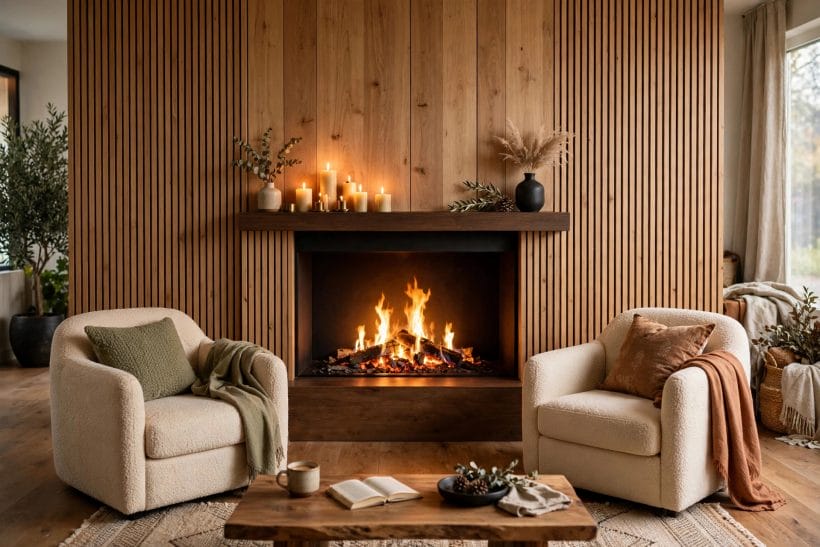
Shiplap and its board cousins bring the farmhouse register — horizontal lines, honest joints, paint or bare pine. Nine ideas work the cottage lane, which shares its spirit with the tropical interiors‘ love of natural texture, though the palette here stays temperate.
46. Classic horizontal shiplap
Overlapping boards with their shadow gap, run horizontally — the farmhouse wall in its best-known form. Horizontal lines settle a room; the eye reads rest along them.
47. Vertical shiplap for height
Turn the boards upright and the same material lifts the ceiling instead. Vertical shiplap suits small rooms and low cottages where every visual inch of height is wages.
48. Shiplap painted, not white
Sage, stone, ink blue — painted shiplap in a colour is the cottage wall grown sophisticated. The shadow gaps keep the craft visible while the colour joins the room’s palette.
49. Bare pine shiplap
Unpainted pine boards, waxed and left to honey with age — shiplap in its working clothes. Bare boards suit rooms with strong textiles to play against the timber’s plainness.
50. The shiplap fireplace surround
Boards cladding the chimney breast and wrapping the hearth give the fire a timber frame. Follow the stove maker’s clearances to the letter — charm never outranks the safety distances.
51. Chevron and herringbone boards
Boards laid in zigzag cost more cutting time and return pattern no straight course can match. One chevron wall is a room’s worth of decoration by itself — furnish the rest plainly.
52. Board-and-batten
Wide boards with narrow battens over the joints — the barn wall’s tailored cousin. Board-and-batten reads more formal than shiplap and takes deep paint colours beautifully.
53. The half-shiplap room
Shiplap to picture-rail height on all four walls with plaster above unifies a room that cannot agree on a feature wall. The timber becomes the room’s dado — architecture, not accent.
54. Ceiling boards as the fifth wall
When the walls must stay plain, board the ceiling — the wood wall idea turned upward. A timber ceiling over a pale room with a beamed or boarded finish is the cottage’s oldest luxury, and the ceiling designs for the living room take that surface further.
8. Sofas Against Wood: Colour and Placement
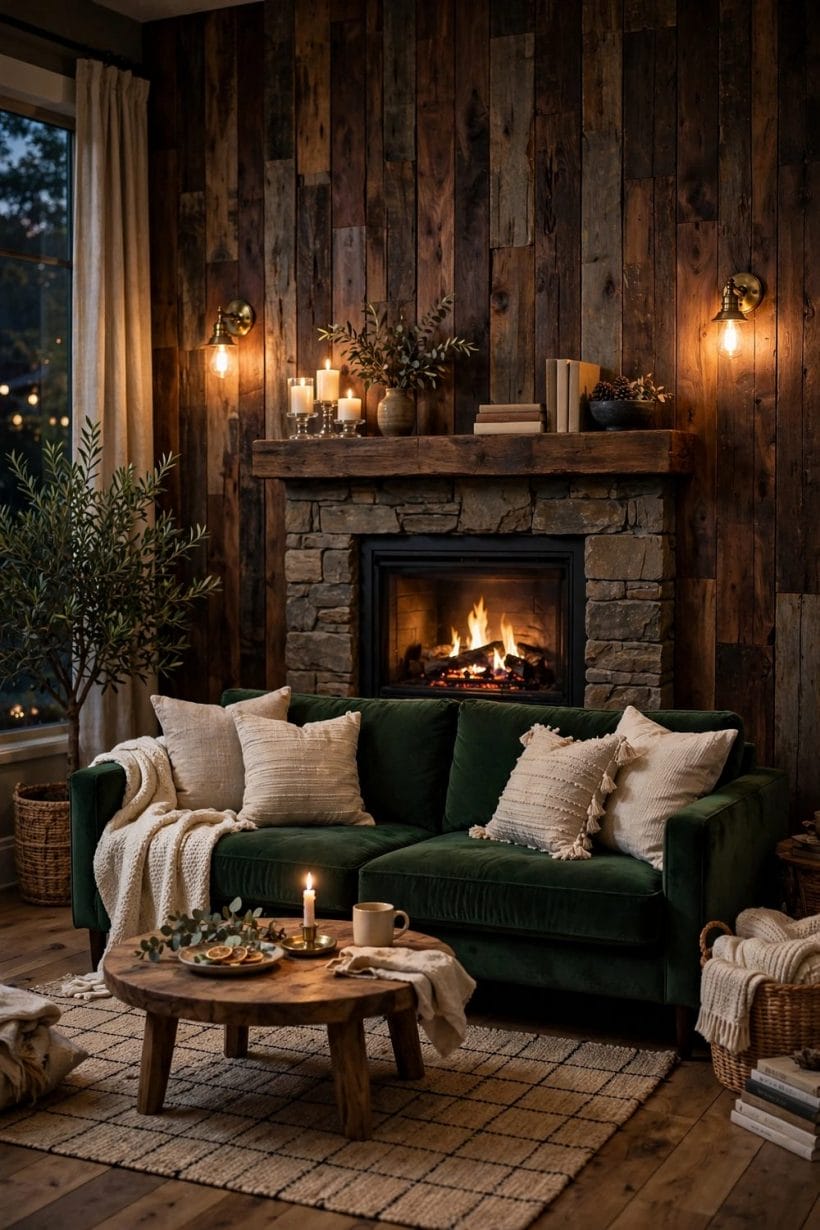
The wall earns its keep in the seating arranged against it. Eight ideas place and dress the furniture the timber frames.
55. The cream sofa against dark wood
The composition this post keeps returning to: pale upholstery, deep wall, warm metal between. If you copy one picture from these seventy-five ideas, copy this one — it works in every size of room.
56. Leather against timber
A tan leather sofa in front of a wood wall doubles the material warmth — hide against grain. Leather suits reclaimed and walnut walls best, and ages alongside both.
57. The sofa floated off the wall
Pull the sofa a hand’s breadth forward and the wood wall breathes behind it; a slim console in the gap takes lamps and books. Floating seating also lets the cladding run uninterrupted — the crafted look.
58. Colour sofas against pale wood
Pale oak and whitewash walls are the licence for a coloured sofa — rust, forest, indigo. The blonde timber behaves like a neutral gallery, and the sofa becomes the room’s painting.
59. Cushions that quote the grain
Cushions in the wall’s own tones — caramel on oak, espresso on walnut — stitch furniture to architecture. One cushion quoting the wood is subtle; a family of them is a theme.
60. Art hung on the wood
Pictures hang beautifully on timber — the grain is a mat no framer can sell you. Group small frames in the wood’s calm stretches and let busy grain stand bare.
61. Shelves let into the cladding
Shelves routed between slats or fixed across boards put books inside the wall’s rhythm. Timber holding timber: the wall becomes the bookcase, and the room gains storage without furniture.
62. The reading corner against the boards
One chair, one lamp, the wall at your back — a reading corner against timber feels sheltered in a way plaster cannot imitate. It is the smallest complete wood-wall room there is.
The principle under all eight ideas is that furniture should converse with the wall, not compete with it. Strong grain wants quiet upholstery; quiet panelling invites pattern and colour. Rooms fail when wall and sofa both shout — and succeed, almost automatically, when one of them agrees to be the audience.
9. Layered Lighting on Timber
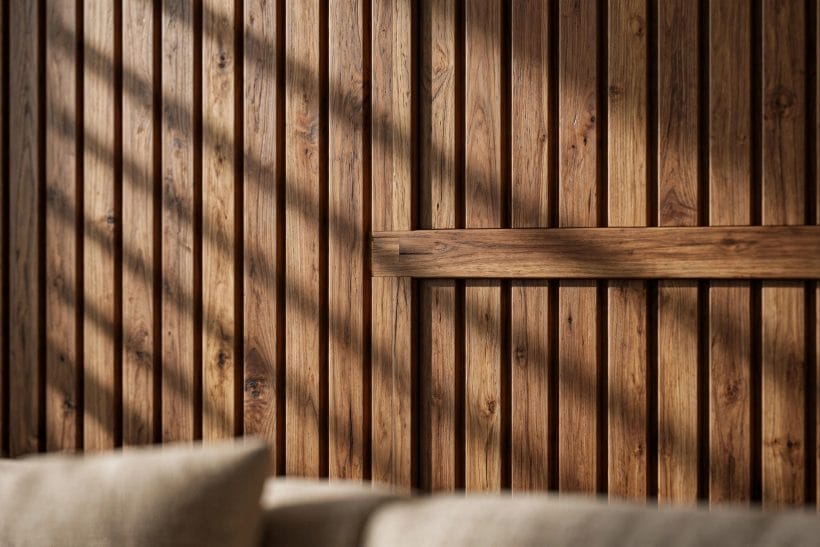
Timber is a light surface before it is a wall finish — grain only exists where light rakes it. Eight ideas light the wall in the layers this series always ends with.
63. Grazing light down the grain
A light source close to the wall — a picture light, a wall washer — drags shadows out of every groove and makes flat boards read deep. Grazing is the wood wall’s portrait lighting.
64. Sconces mounted on the cladding
Brass or black sconces fixed to the timber itself turn the wall into the room’s lamp stand. Symmetry either side of a fireplace or screen gives the clad wall its ceremonial face.
65. Lamps in front, glow behind
Table lamps on consoles set before the wall throw their glow upward across the grain — the timber becomes the lampshade of the whole room. The oldest trick in the post and still the best.
66. LED strips in the shadow gaps
A hidden strip in a slat gap or behind a floating panel edges the wall in light — modern, precise, dramatic. Keep the colour warm; cold strips make timber look like a shop display.
67. Firelight as a layer
Where a real fire exists, it is a lighting layer no fitting replaces — flames animate grain the way wind animates grass. Arrange one seat where the firelight rakes the wall; it is the room’s best chair.
68. Daylight management for timber
Sun bleaches wood unevenly — sheers at the window spread strong light so the wall ages as one piece. Checking how your wall’s aspect fades is part of choosing its timber.
69. Warm bulbs against wood, always
Cool light greys walnut and sickens oak. Every bulb washing a wood wall should be warm — the same rule the brown bedroom lives by, inherited by its living-room cousin.
70. Dimming the whole composition
Dimmers let the wall change register with the evening — bright and grained by day, low and glowing by night. A wood wall on a dimmer is really two walls, and both are worth having.
10. Fitting, Care and Choosing Well
The last five ideas are the practical judgement — material choices, honest fitting and the care that keeps timber beautiful.
71. Solid boards, veneer and panels: the honest differences
Solid timber moves, repairs and ages best and costs most; veneer on board gives premium species at sane cost; printed panels imitate from a distance. All three are legitimate — match the material to the budget and say its name plainly.
72. Acclimatise timber before fitting
Boards stored in the room before fixing settle to its moisture and stop surprising you with gaps. Rushing green or warehouse-dry timber onto a wall is how beautiful cladding becomes a complaint.
73. Battens, levels and the first board
Every clad wall hangs on its framework: battens level, fixings sound, the first board true. A wall forgives many things; a crooked first course is not among them.
74. Care: dust, wax and the sun check
Timber walls ask for dusting, the occasional feed of wax or oil where the finish allows, and an annual look at sun-fade. Care is minutes a year — the lowest-maintenance feature wall in the house.
75. Choose the wall you face
When every argument ties, clad the wall you look at most from where you sit most. The wood wall is a view; build it where the household’s eyes already live, and it will never stop paying rent.
Costs here are timber’s own ladder — printed panels at the foot, veneered boards in the middle, solid and reclaimed at the top, with fitting time a real cost in every single case. Spend on the wall you face daily; a wood wall’s value is measured in evenings, and it pays them back generously for decades.
Final Considerations
Live with the plan a week before ordering: chalk the wall’s outline, sit in your chair at lamp-time, and look at it properly, morning and evening alike. Wood walls are the least reversible idea in this series — a week’s patience is the cheapest board you will buy.
A wood wall living room is seventy-five small agreements between timber and light: one wall chosen well, a species in the register your room lives in, seating placed to quote the grain, and light layered to rake it. Make those agreements and the room gains what no paint can give it — a warm side, a built feeling, and a wall worth facing.


0 Comments