

A black roof changes the conversation a house has with its street. It is the boldest single colour decision on the building — a dark, graphic crown that makes every wall colour beneath it look either brilliant or bewildered, with very little in between.
These 75 black roof house color schemes settle the question family by family: the wall colours, trims and materials that let a dark roof lead — from crisp white farmhouses to deep navy cottages brooding beautifully under slate-dark shingles.

1. Black Roof House Color Schemes at a Glance
Scope first. This collection owns one pairing only: wall colour under a black or near-black roof. Its neighbours keep their own ground: the whole exterior composition is led by exterior home ideas; mixed materials are composed in mixed siding exterior ideas; the pale-wall family is toured in white exterior home ideas; Nordic restraint is in scandinavian exterior home ideas; the contemporary line is in modern exterior home ideas; and the small-scale version is in tiny house exterior ideas. Here, the roof is black and everything answers to it.
One discipline runs through the collection: contrast is a budget, and the black roof spends most of it. Schemes succeed by deciding where the remaining contrast lives — in the wall, in the trim, or in the door — rather than spending it everywhere at once. Materials and upkeep are stated generally throughout, because products, climates and roofs themselves differ on every street.
The tour runs the colour wheel the way the infographic stacks it: whites and greys first, then the greens, the warm masonry families, the dark-on-dark drama and the deep blues — closing with trim, light and the upkeep that keeps a strong scheme strong.
| Wall family | Effect under a black roof | Best suited to |
|---|---|---|
| Crisp white | Maximum contrast, graphic and clean | Farmhouse and classic forms |
| Sage and olive greens | Soft, planted, cottage-calm | Gardens and wooded plots |
| Brick and warm wood | Rich, earthy, traditional | Brick and timber houses |
| Charcoal | Dark-on-dark modern drama | Contemporary architecture |
| Deep navy | Moody colour with white trim relief | Coastal and cottage forms |

2. Crisp White and Soft Grey

The opening gallery shows the pairing that built the black roof’s reputation: white walls under a dark crown, the contrast so clean it reads as a drawing. This section works the white-and-grey family thoroughly, because it is the scheme most black roofs will wear — and the one with the most ways to go subtly wrong.
1. Pure white for the full graphic contrast
The boldest and easiest scheme: white walls, black roof, and the house becomes a study in two tones. It flatters classic and farmhouse forms especially, where the architecture’s lines deserve the emphasis the contrast gives them.
2. Warm white to soften the edge
A white with a hint of warmth keeps the contrast but loses the glare. On older houses and in harsh sun, warm white under a black roof reads as mellow rather than stark — the same scheme with its tie loosened.
3. White walls with black trim echoing the roof
Carrying the roof’s black down into window frames, shutters and the front door ties the scheme into one deliberate chord. The house reads as designed in two colours, on purpose, from roof to doorstep.
4. Soft grey for the calmer cousin
Pale grey walls under a black roof trade the white scheme’s punch for composure. It is the choice for large houses and formal streets, where full contrast might shout and grey simply states.
5. Grey in two tones: walls and gable
Splitting the grey family — a lighter body, a deeper gable or upper storey — gives a big house the modelling its size needs under one black roof. The tones stay in one family, so the composition stays calm.
6. White with natural wood accents
A wood door, porch posts or a gable detail warms the black-and-white scheme without breaking it. The timber note is the difference between a house that looks printed and one that looks lived in.
7. The black-and-white farmhouse formula
White board siding, black roof, black shutters, a plain gable — the modern farmhouse runs on this exact recipe because proportion and contrast do all the work. It remains the safest strong scheme in the collection.
8. Grey stone with white trim under black
Where the walls are grey stone, the black roof settles in as the stone’s darkest note and white trim draws the edges. The scheme is quiet, permanent and almost impossible to get wrong on a masonry house.
9. Keeping white clean-looking by design
White under a black roof shows the weather: splash-back at the base, drips under sills. A masonry plinth, sound gutters and planting held off the walls are the unglamorous details that keep the scheme’s famous crispness.
3. Sage Green and Soft Botanical Tones

The pin softens the tour: a sage-green cottage under its black roof, flowers doing the foreground. Green is the black roof’s most natural partner after white — the roof reads as deep shadow, the walls as foliage — and this section gathers the soft botanical family.
10. Sage green, the cottage default
Sage under a black roof is the cottage scheme perfected: the wall colour borrows from the garden, the roof from the shade beneath the trees, and the house sits in its plot like it grew there.
11. Pale eucalyptus and silvery greens
The greyed, silvery end of green suits coastal and bright-sun plots, where the colour holds its cool under strong light. With white trim it is the black roof’s most restful daytime scheme.
12. Green walls with a black door, not a coloured one
Resist the accent door here: the sage family looks best when the roof and door share the dark note and the walls keep the soft one. Two voices, clearly assigned — that is the whole composition.
13. Cream trim instead of white on green
Stark white trim can glare against sage; a creamy off-white keeps the edges defined but gentle. The pairing suits older houses and planted streets where everything is a little softened already.
14. Green on green: the garden swallows the house
In a wooded plot, sage walls and a black roof let the house nearly vanish into its setting — which some owners count as the highest achievement a colour scheme can reach.
15. A deeper green for the shaded plot
North-facing and tree-shadowed houses can carry a richer green than sunlit ones, since the light will mute it for free. Judge the colour on the wall in its real shade, never on the sunny chart.
16. Sage with natural stone at the base
A stone plinth under sage walls grounds the softness and gives the black roof’s drama a masonry anchor. The three materials — stone, painted green, dark roof — compose the cottage elevation in full.
17. Flower colours as the scheme’s fourth note
Against sage and black, planting becomes part of the palette: white and pale blooms read as trim, deep reds as accents. Plant the borders as deliberately as you painted the walls.
4. Warm Brick and Terracotta

Gallery-2 glows: red brick under a black roof, autumn doing the lighting. Brick is the warm family’s heavyweight — a material with its own colour, texture and history — and this section shows how a dark roof crowns it without a fight.
18. Classic red brick, black roof, white trim
The traditional full stop: brick’s warmth, the roof’s depth and white trim drawing every edge. It is the scheme of a million handsome streets because each element flatters the other two without effort.
19. Letting the brick be the colour
With brick walls, the scheme is half-decided — the roof and trim must answer the brick, not the catalogue. Black suits brick’s darker flecks and gives the wall’s reds their richest contrast.
20. Terracotta and clay tones for sun-belt houses
Where walls are rendered in clay and terracotta tones, a black roof supplies the shade note the palette lacks. The scheme reads Mediterranean and grounded, especially with deep-set windows and timber doors.
21. Painted brick in a warm off-white
Painting brick is a one-way door, but painted warm-white brick under a black roof keeps the texture and loses the busyness — a farmhouse-classic scheme for houses whose brick was never their best feature.
22. Brick with black trim for a moodier read
Swapping white trim for black on a brick house deepens everything: moodier, more urban, more deliberate. The brick warms what could otherwise be a severe scheme into something rich.
23. Mortar colour as a hidden scheme member
Pale mortar makes brick read lighter and busier; dark mortar makes it deeper and calmer. When repointing or building, the mortar choice quietly sets which black-roof scheme the house is actually wearing.
24. A brick gable over painted walls
Mixed elevations — brick on the gable or ground floor, painted boards above or beside — let the warm family lead without wall-to-wall masonry. The black roof unifies the mixture from above.
25. Autumn’s warning: judge brick in all seasons
Brick beside green summer planting and brick beside bare winter branches are two different schemes. The black roof is the constant; choose the trim with the year’s whole wardrobe in mind.
5. Natural Wood and Warm Timber Tones

Gallery-3 goes into the trees: a natural timber cabin whose black roof reads as one more shadow in the forest. Wood walls bring their own warmth and grain to the pairing, and this section composes the schemes where timber, not paint, is the wall colour.
26. Natural cedar weathering under a dark roof
Cedar left to weather travels from honey to silver while the black roof stays constant above it. The combination — warm-becoming-cool walls, permanently dark crown — is the mountain and forest house’s native scheme.
27. Stained dark timber with the black roof
A deep stain pulls timber toward the roof’s own territory, and the house becomes a study in browns and blacks. It suits contemporary cabins and forest retreats that want atmosphere over cheerfulness.
28. Wood gables over masonry walls
Timber reserved for the gable — above stone or rendered walls — gives a house the warm note at its peak, right under the roof that anchors it. The eye reads the layers bottom to top: stone, wood, darkness.
29. Black roof, wood walls, stone base: the full chord
The three natural materials in vertical order compose the vernacular mountain elevation. Each is a different darkness and texture, and the roof’s black is simply the chord’s top note.
30. Keeping timber’s colour with a finish
Owners who love cedar’s first-year honey need a maintained finish to keep it — stated plainly, because the choice between weathering and upkeep is a colour decision too, and the black roof flatters both outcomes.
31. Wood-toned garage and outbuildings
Repeating the house’s timber note in the garage door or garden building ties the plot together under their various dark roofs. The scheme becomes a property palette, not a single facade decision.
32. Pale wood for the Scandinavian read
Pale, almost bleached timber under a black roof reverses the cabin’s usual warmth into something cooler and more Nordic. With black window frames it is the timber family’s most contemporary expression.
33. Timber and glass: the roof as the dark frame
Where the walls are half glass, the black roof and the timber frame divide the architecture between them. The scheme’s success is about proportion — enough wood to warm the glass, enough roof to crown it.
6. Charcoal and Dark-on-Dark Drama
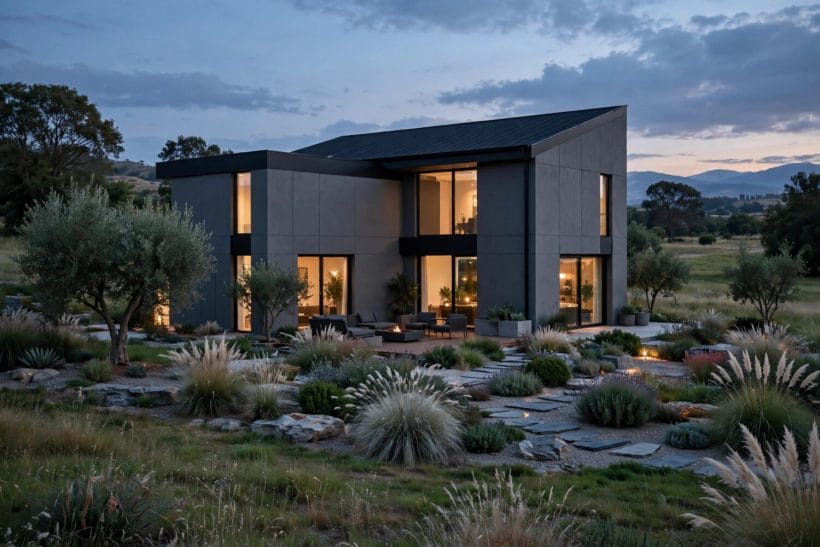
Gallery-4 turns the lights down: a charcoal house under a black mono-pitch, windows glowing. Dark-on-dark is the black roof’s most dramatic family — the roof stops being a contrast and becomes a continuation — and this section shows how the drama is staged without gloom.
34. Charcoal walls, black roof: the monolith
One step of tone between wall and roof turns the house into a single dark object in the landscape. It is the contemporary architect’s favourite for a reason: form, not colour, does all the talking.
35. The tone gap that makes dark-on-dark work
Keep a visible step between the wall’s charcoal and the roof’s black — in value, texture or sheen — or the elevation muddles into one flat mass at dusk. The drama lives in that slender difference.
36. Glass as the third material
Dark houses need their glass to perform: big panes reflecting sky by day and glowing by night supply the contrast the palette withholds. In dark schemes the windows are the trim.
37. Warm interior light as part of the scheme
A charcoal house at dusk, windows lit amber, is one of the great sights in residential design. Plan the interior lighting as part of the exterior composition — at night, it is the facade.
38. Pale landscaping against dark walls
Silver foliage, pale gravel and light stone blaze against charcoal walls in a way they never do against white. The garden becomes the scheme’s contrast department, and it changes with the seasons for free.
39. Dark-on-dark for the retiring plot
In a wooded or landscaped setting, a dark house withdraws — the anti-statement that lets the land lead. Owners of beautiful plots choose charcoal the way gallery owners choose grey walls.
40. One light element: door, numbers or a chimney
A single pale note — a natural wood door, a white chimney breast — gives the dark scheme its punctuation. One is elegance; two is a debate; three is a different scheme entirely.
41. Sheen as a colour: matte versus satin
In near-monochrome schemes, finish carries the variation colour would: matte walls, a satin roof edge, brushed metal details. The eye reads the sheen changes as design, because at this palette they are.
7. Cream, Stucco and Stone Neutrals
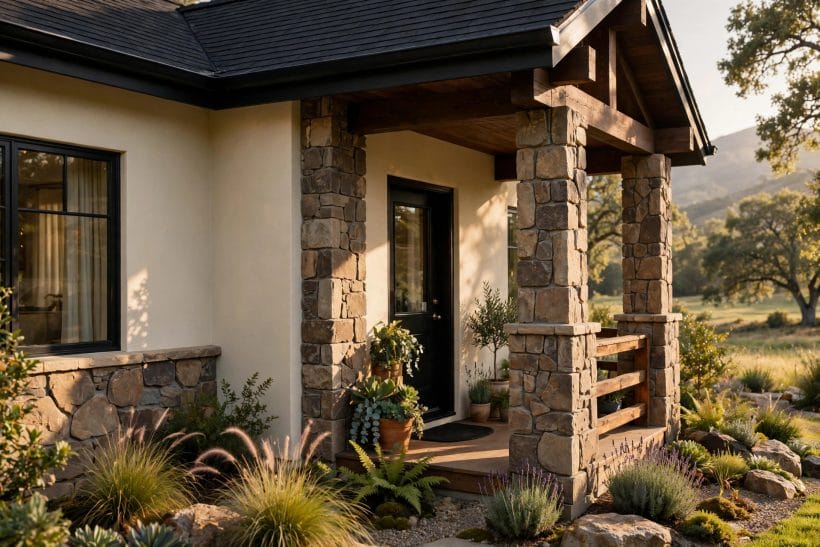
Gallery-5 comes in close at the porch: cream stucco, stone pillars, the black roof’s edge above. This is the warm neutral family — softer than the white schemes, richer than the greys — and it is where texture starts doing the work that colour does elsewhere.
42. Cream stucco under a black roof
Cream is white with the sun left in it. Under a black roof it reads warm, established and forgiving of texture — the scheme of Mediterranean and Spanish-influenced houses and of any render that deserves a softer light.
43. Limewash and its gentle unevenness
A limewashed wall’s cloudy variation suits a black roof precisely because the roof is so flat and definite: the scheme balances one perfectly even element against one perfectly imperfect one.
44. Stone walls with a limewash or pale mortar
Pale-pointed stonework under a dark roof composes the cottage scheme at its most permanent. The stone does colour, texture and history at once; the roof simply crowns it.
45. Greige: the neutral that minds both sides
Between grey and beige sits the neutral that flatters black roofs in any light and argues with no planting. Greige is the diplomat’s choice — and diplomats’ houses rarely need repainting for fashion’s sake.
46. Cream walls with black shutters and door
The French-provincial chord: warm cream, black accents, dark roof. It suits symmetrical houses and formal gardens, and it has been quietly correct for about two centuries.
47. Texture-forward: roughcast and render patterns
Where walls carry a strong render texture, the black roof’s graphic flatness is the perfect foil. Keep the colour pale and simple and let shadow-play across the texture provide the variation.
48. Stone and stucco mixed on one house
Stone at the base and entrance, stucco above — as in the gallery — divides a large elevation into human-scale parts, unified by the single dark roof passing over both.
49. Warm neutrals with a timber door
The warm family’s front door is wood more often than paint: a natural or stained door in a cream elevation under a black roof completes a scheme in which nothing is cold and nothing shouts.
8. Deep Navy and Moody Blues

The second pin goes coastal and moody: a deep navy house with white trim under storm-grey skies and its black roof. Blue is the black roof’s most characterful partner — close enough in value to be daring, different enough to be a scheme — and this section sails it.
50. Deep navy with crisp white trim
The coastal classic: navy walls need white trim the way a harbour needs its lighthouse paint. The black roof sits above both like the deepest note of the sea itself, and the scheme never dates.
51. Navy and black: the daring near-match
Wearing navy under black asks the two darks to hold their difference — and in daylight they do, the wall reading blue against the roof’s true black. It is a connoisseur’s scheme, best on simple house forms.
52. Softer slate blue for gentler houses
Slate and dusty blues give smaller or older houses the family’s mood without its full drama. Under a black roof they read as the colour of shade on water — quiet, and quietly distinctive.
53. Blue-grey as the bridge family
Where navy feels too committed, blue-grey splits the difference with the grey family of section 2 while keeping a hint of the sea. It is the scheme for streets where the neighbours are all in beige.
54. A red door against navy and black
The navy’s traditional accent is a deep red door — the one warm note, placed exactly where welcome lives. Against blue walls and a black roof it has the confidence of a ensign, and it earns it.
55. Coastal light changes blue hourly
Blue walls are weather vanes: grey at dawn, bright at noon, near-black at dusk against the still-dark roof. Owners who love a house that performs through the day choose blue; those who want constancy choose grey.
56. White porch and railings as the relief
On navy houses the porch earns its paint: white rails and posts give the elevation its breathing room and the entrance its ceremony. The black roof, navy walls and white porch compose the full coastal chord.
57. Navy on the garden side only
A two-face strategy — navy to the garden, something calmer to the street — lets owners keep the drama where they live with it. The black roof, indifferent, crowns whichever personality is showing.
9. Olive, Moss and Earthy Greens
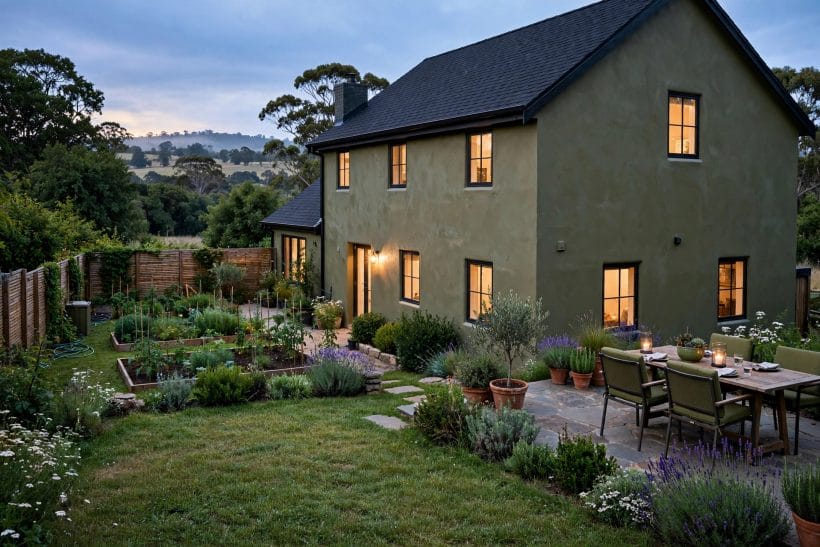
Gallery-6 deepens the green story: an olive house at dusk, garden lush around it, windows warm. Where section 3’s greens were pale and cottage-soft, this family is earthier and moodier — the black roof’s partner for houses that want to belong to their landscape entirely.
58. Olive green, the landscape colour
Olive sits between green and brown exactly where gardens live. Under a black roof it gives a house the camouflage of a hedgerow with the finish of a painted wall — the introvert’s scheme, beautifully done.
59. Moss and forest greens for wooded plots
Deeper greens take the sage idea into the trees: walls the colour of the shadow side of leaves, the roof the colour of the deepest shade. In a wooded plot the house becomes a clearing’s edge rather than an interruption.
60. Earthy green with stone and timber
Olive walls above a stone base, a timber door alongside — the earthy family stacks its materials like a landscape section: rock, wood, leaf, and the black roof as the dark canopy line above all of it.
61. Cream trim to keep olive from gloom
Deep greens drink light; a creamy trim returns it at the edges, drawing windows and the door out of the shade. The pairing is what separates the moody olive scheme from the merely murky one.
62. Green walls, black everything else
Roof, frames, shutters and door in black against olive walls make the green the scheme’s only colour — a decision so clear it reads as luxury. This is the earthy family’s most designed expression.
63. The dusk test: earthy greens after dark
Judge olive and moss in the evening before committing: these colours live for the dusk hour, when they hold their depth against the black roof while paler schemes have already gone grey. Gallery-6 is the evidence.
64. Olive with a pale roofline neighbour
Terraces and close-set houses borrow their neighbours’ palettes; an olive house between pale ones gains definition from the contrast on both sides, its black roof reading as the street’s one deliberate dark note.
65. Planting in the same family, one step lighter
Borders planted a shade lighter than the walls — grasses, pale-green foliage — make the house appear to rise out of its own planting. The scheme extends past the paint line into the garden itself.
66. Weathering gracefully: the matte advantage
Earthy colours in matte finishes age kindly under a black roof, taking on the patina of the landscape rather than fighting it. For owners who repaint rarely, this family forgives the most.
10. Trim, Light and Upkeep: Making the Pairing Last
No image closes the tour, because this section is about time: the trim decisions that finish a scheme and the light and upkeep that will judge it for decades. A black roof is a long commitment — these last nine ideas make sure the marriage underneath it is a happy one.
67. Trim is the scheme’s handwriting
Fascias, sills, corner boards and the porch — the trim is where a colour scheme signs its name. Under a black roof the trim decision is binary in effect: repeat the dark note for a tailored look, or contrast it pale for a drawn one. Either is right; a muddle between them is not.
68. The front door is the scheme’s solo
Every family in this collection assigns the door its role — matching the roof, warming the palette, or flying the one accent colour. Choose the role deliberately: the door is the single element every visitor reads at arm’s length, and it testifies about the whole scheme.
69. Gutters and downpipes: continue the roof
Guttering in the roof’s own black lets the dark line flow unbroken from ridge to ground; pale gutters stripe the elevation at its most visible joint. It is a small specification with an outsized effect on how finished a black-roof house looks.
70. Test colours on the wall, at scale, in real light
Paint a generous test patch on the actual wall and live with it through a full day’s light — the infographic’s own advice, and the trade’s oldest rule. Colours beside a black roof shift dramatically between dawn, noon glare and dusk, and the patch is the only honest preview.
71. North light cools, south light warms
A wall in permanent shade makes every colour cooler and darker; a sun-baked wall bleaches it lighter and warmer. The same sage is two schemes on two faces of one house — sample each principal elevation, not just the convenient one.
72. Heat and the dark roof, stated plainly
Dark roofs absorb more sun than pale ones; how much that matters to the rooms below depends on the roof’s build-up, ventilation and insulation, which vary by house and climate. It is a question for the roofer’s specification, not the colour chart — ask it before the roof, not after.
73. The roof finish changes the colour
Matte shingles, satin metal and gloss tile in the same black are three different crowns — the infographic’s final key factor. A high-sheen roof reads lighter and harder; a matte one deeper and softer. The wall colour must be chosen against the actual finish, not the name.
74. Upkeep: dark shows dust, pale shows grime
Black roofs display pale dust and pollen; white walls display everything else. Neither is a reason against a scheme — but gutters that can be cleaned, walls that can be washed down and planting held off the facade are the maintenance decisions that keep strong schemes looking deliberate.
75. Revisit the scheme when the roof is renewed
A roof lasts for decades, and its renewal is the one moment the whole composition is back on the table. Keep the scheme’s records — colours, finishes, the reasoning — with the house papers, and the next pairing decision starts from knowledge rather than archaeology.
Final Considerations
A black roof is the strongest opening move an exterior can make, and this collection’s seventy-five pairings reduce to one principle: let the roof lead, and assign every other element — wall, trim, door, planting — a clear supporting role. Contrast spent once reads as design; contrast spent everywhere reads as noise.
Choose the family that suits the house’s form and the plot’s light, test it on the wall at scale, and finish the details — gutters, door, plinth — as part of the scheme rather than after it. The dark crown will do the rest, every day, in every season’s light.



0 Comments