

A ceramic tile floor changes a living room’s whole temperament: cool underfoot, patterned like a carpet that never fades, and tough enough to outlive the furniture three times over. It is the floor that Mediterranean houses never apologise for.
This post is about tile on living-room floors only — patterns, formats, wood-look planks and terracotta, the grout and rugs that finish it, and the installation checks that decide whether it delights or disappoints — seventy-five ideas for the hardest-working surface in the house.
1. Ceramic Tile Living Room Floors at a Glance
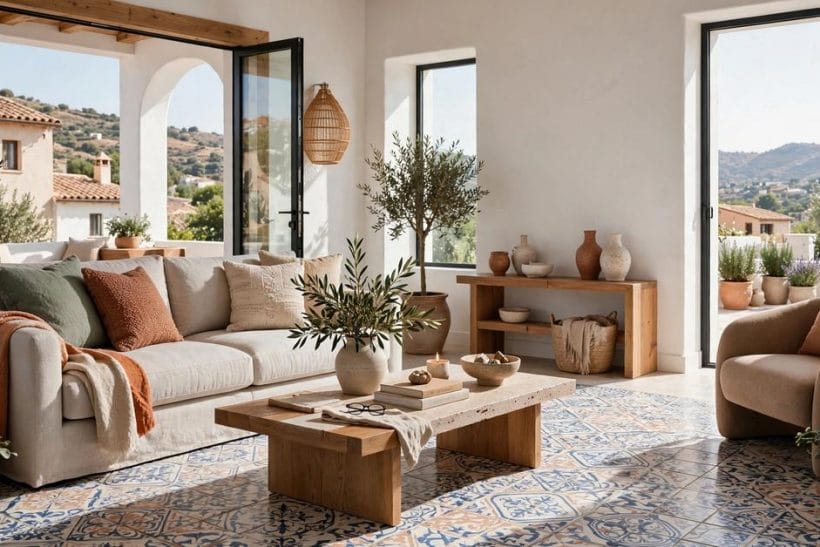
Ceramic tile in a living room means one thing in this post: the floor. The keyword for the row is tile flooring ideas, and the floor is where the discipline stays — patterns underfoot, formats underfoot, finishes judged by feet and furniture rather than by splashbacks. The feature image shows the tradition at full strength, a patterned tile floor carrying an entire Mediterranean living room. Wall tile is a different craft with its own survey in bathroom wall tiles design, and the bathroom floor version lives in ceramic tile bathroom; the wood-effect branch of the family is introduced here and completed in wood-look tile bathroom ideas. What remains — the living-room floor in all its ceramic variety — is quite enough for one post, and it belongs in the wider living room ideas pillar’s family of single-subject surveys.
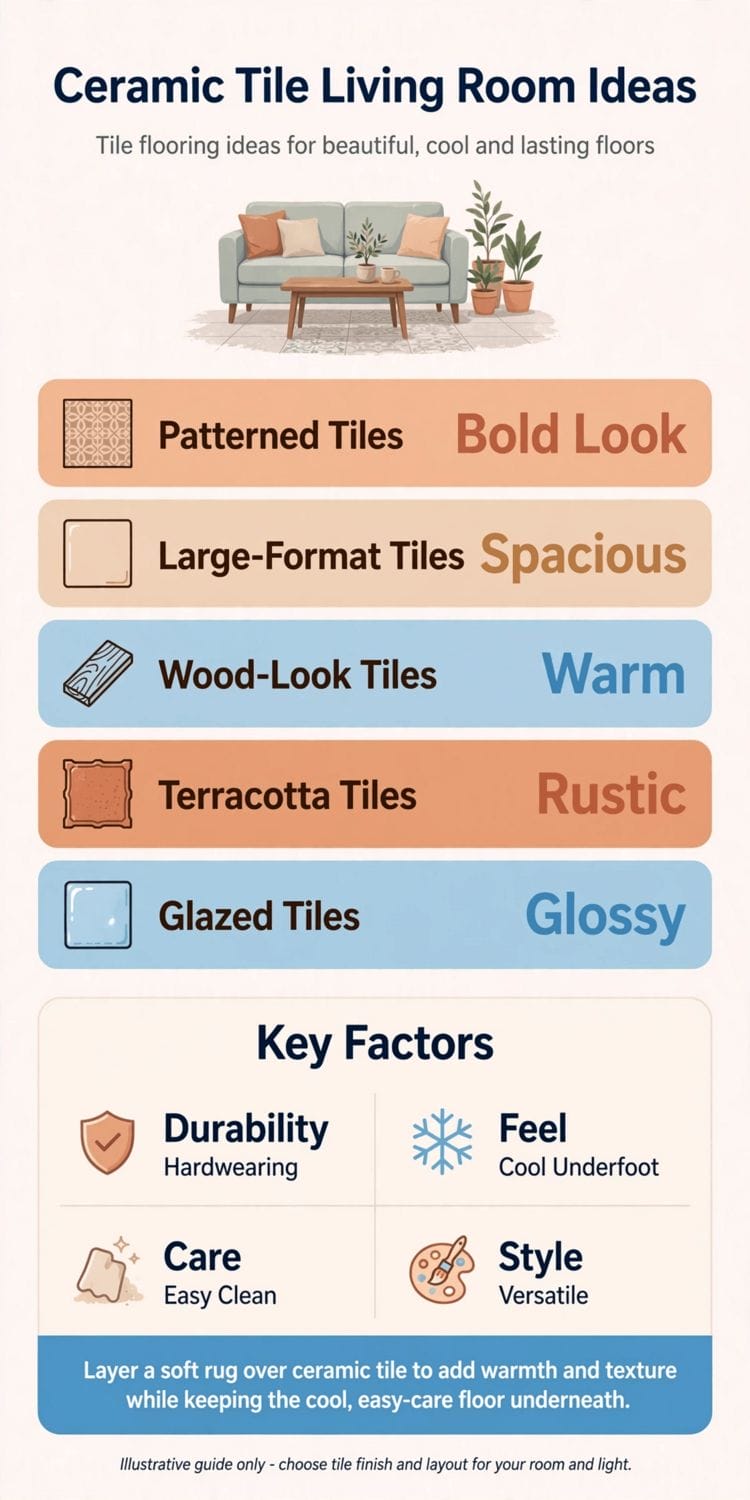
The honest case for the floor is practical before it is beautiful. Tile is cool in hot climates, indifferent to muddy dogs and spilled wine, friendly to rugs, and repairable tile by tile. Its costs and efforts sit in the installation — a flat, sound subfloor and a skilled tiler — rather than in exotic materials, and this post states those drivers generally, with no invented figures. Choose tile for the floor’s whole life, not for a season, and it will repay the decision daily.
| Question | Short answer |
|---|---|
| What does this post cover? | Ceramic tile on living-room floors only — wall tile and bathroom tile have their own posts in this plan |
| Why choose tile for a living room? | Coolness underfoot, pattern that never wears off, easy cleaning and a lifespan measured in decades |
| What decides success? | A flat, properly prepared subfloor and skilled laying — the tile itself is the easy part of the budget |
| How is a hard floor made comfortable? | Rugs in the seating zones, warm textiles and, in cold climates, heating beneath the tile planned from the start |
2. Patterned and Encaustic-Look Tiles
1. The full-pattern floor
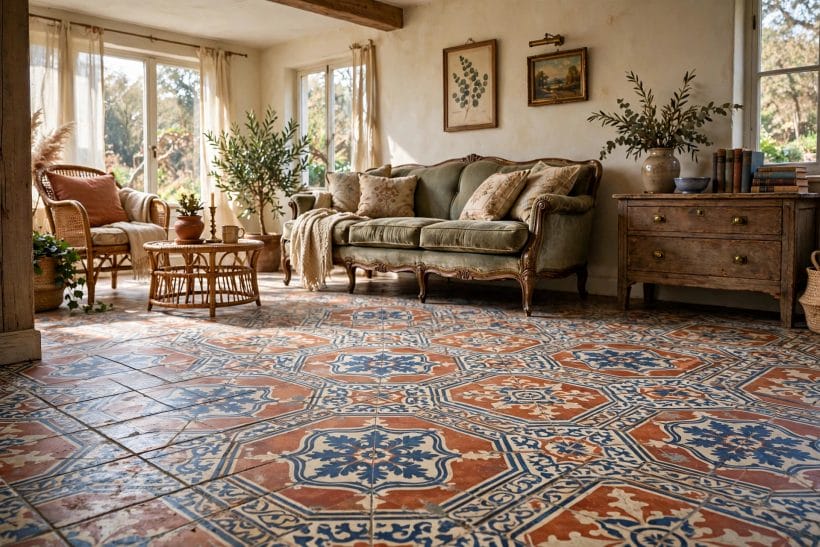
The first gallery image lays pattern wall to wall — terracotta, navy and cream in a repeating geometry — and the room above it stays plain. That is the governing bargain of the patterned floor: it is the room’s rug, artwork and colour scheme in one permanent layer.
2. Pattern as the room’s palette
Pull the sofa, cushions and curtains from the floor’s colours, as the gallery does with its sage sofa and warm wood. A patterned floor chosen first makes every later decision easier, because the palette is quite literally set in stone beneath the furniture.
3. Borders that frame the field
A plain border tile around a patterned field works like a picture frame, calming the pattern’s edge and giving furniture a quiet margin to stand on. Older Mediterranean floors do this instinctively; modern ones rediscover it room by room.
4. A patterned zone, not a patterned room
Where wall-to-wall pattern feels like too much, lay the pattern as a central field — a tile rug under the coffee table — with plain tile around it. The effect is nine-tenths of the drama at a fraction of the commitment and cost.
5. Pattern scale against room size
Small motifs busily repeat in small rooms; grand motifs need floor to unfold in. Match the repeat to the room’s dimensions as you would a rug’s pattern, and mock the layout up dry — tiles unrolled across the floor — before any adhesive appears.
6. Encaustic-look porcelain and ceramic
Modern printed tiles reproduce the old cement-tile patterns with a glazed surface that needs no sealing ritual. State the difference honestly when buying — look and maintenance are the questions — and choose with the household’s appetite for upkeep in mind.
7. Monochrome pattern for quiet rooms
Pattern need not mean colour: a two-tone design in charcoal and cream, or blue and white, gives the geometry without the festival. It suits rooms whose furniture is colourful, and it photographs as calmly as it lives.
8. Mixing pattern with plain furniture
The gallery’s rule again, because it is the one that fails most often: when the floor performs, the furniture whispers. Plain upholstery, plain curtains, wood with visible grain — the pattern has already said everything a pattern can say.
3. Choosing the Tile: Format, Finish and Feel
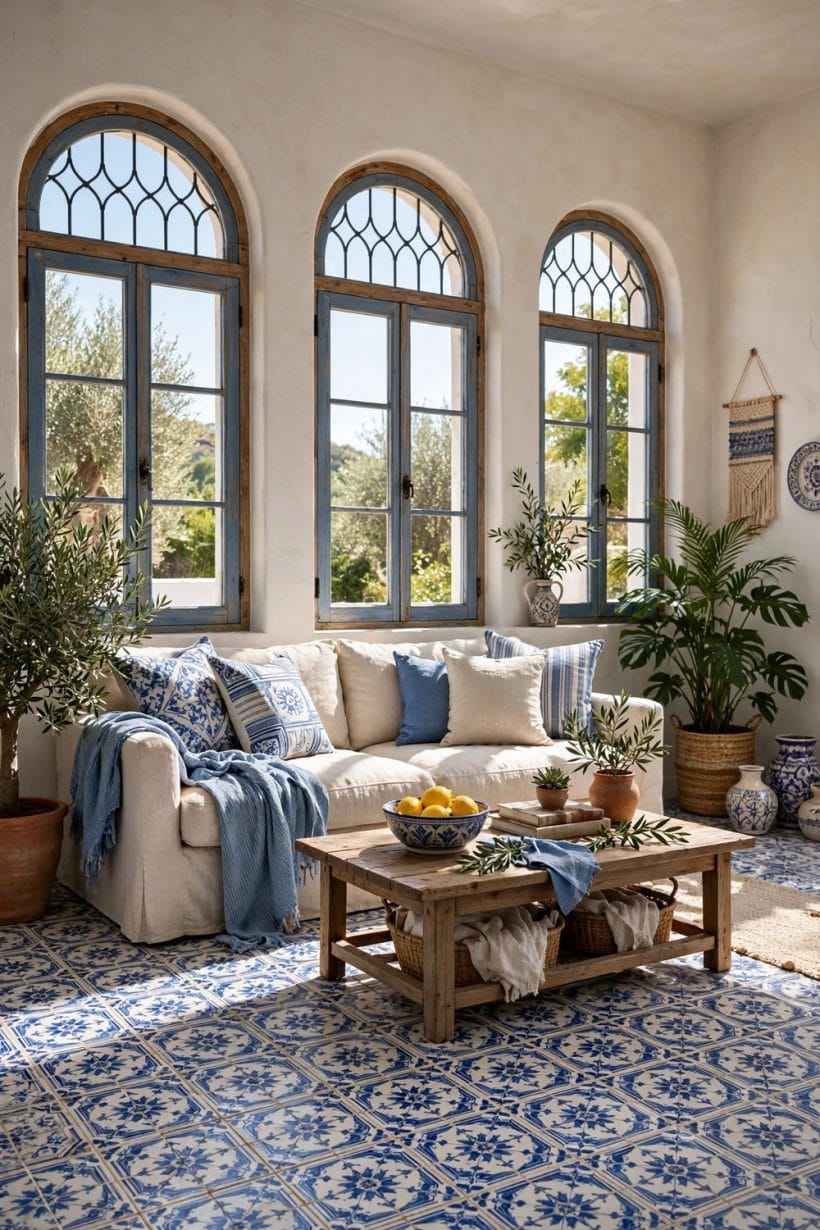
9. Ceramic versus porcelain, stated plainly
Porcelain is the denser, harder-fired branch of the ceramic family and the usual choice for floors; softer ceramics suit gentler duty. Ask which you are being sold, because the words are used loosely and the difference lives in wear and water behaviour.
10. Slip, judged by bare feet
A living-room floor is walked on in socks and bare feet, so the finish’s grip matters more than its shine. Matt and lightly textured surfaces are the safe default; polished gloss is beautiful and treacherous, and section four shows where it can still be used wisely.
11. Finish against the light
Gloss bounces light and shows every crumb; matt hides the week and drinks the light. Rooms with big windows flatter gloss and punish it in the same hour — see the tiles in the room’s actual daylight before deciding, as with paint.
12. Tile size and the grout grid
Large tiles mean fewer grout lines and a calmer floor; small tiles mean more lines and more pattern. The grid is part of the design either way, so choose the grout’s colour as deliberately as the tile’s — section nine returns to it with the close-up evidence.
13. Thickness and thresholds
A tiled floor sits higher than the carpet or boards it replaces, and doors, thresholds and adjoining rooms feel the difference. Plan the build-up height with the tiler before ordering, so the finished floor meets its neighbours gracefully.
14. Underfloor heating, decided first
Tile over heating is the floor’s luxury form — the cold objection answered permanently. The decision must come before the subfloor is prepared, because retrofitting means lifting the floor; with new work, the tiler and electrician plan it together from day one.
15. Sound and the hard floor
Tile reflects sound where carpet absorbs it, so tiled living rooms can ring. Rugs, upholstered furniture, curtains and bookshelves — the room’s soft population — restore the acoustics, which is another reason section seven’s rugs are structural, not decorative.
16. Samples at floor scale
Judge tiles on the floor, in a group, at the room’s light — never from a single tile in the hand in a showroom. A box’s worth laid dry for a weekend tells the truth about pattern, colour and grout together, and suppliers expect the request.
4. Large-Format and Gloss Finishes
17. The seamless pale floor
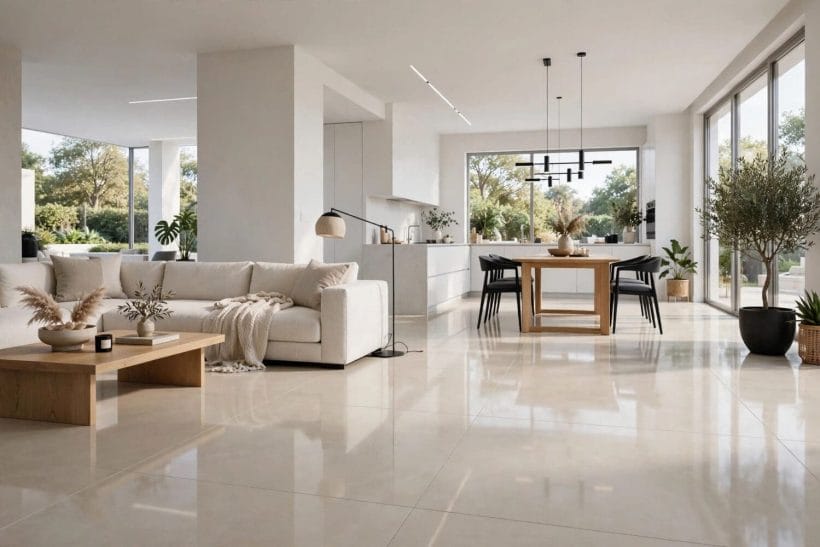
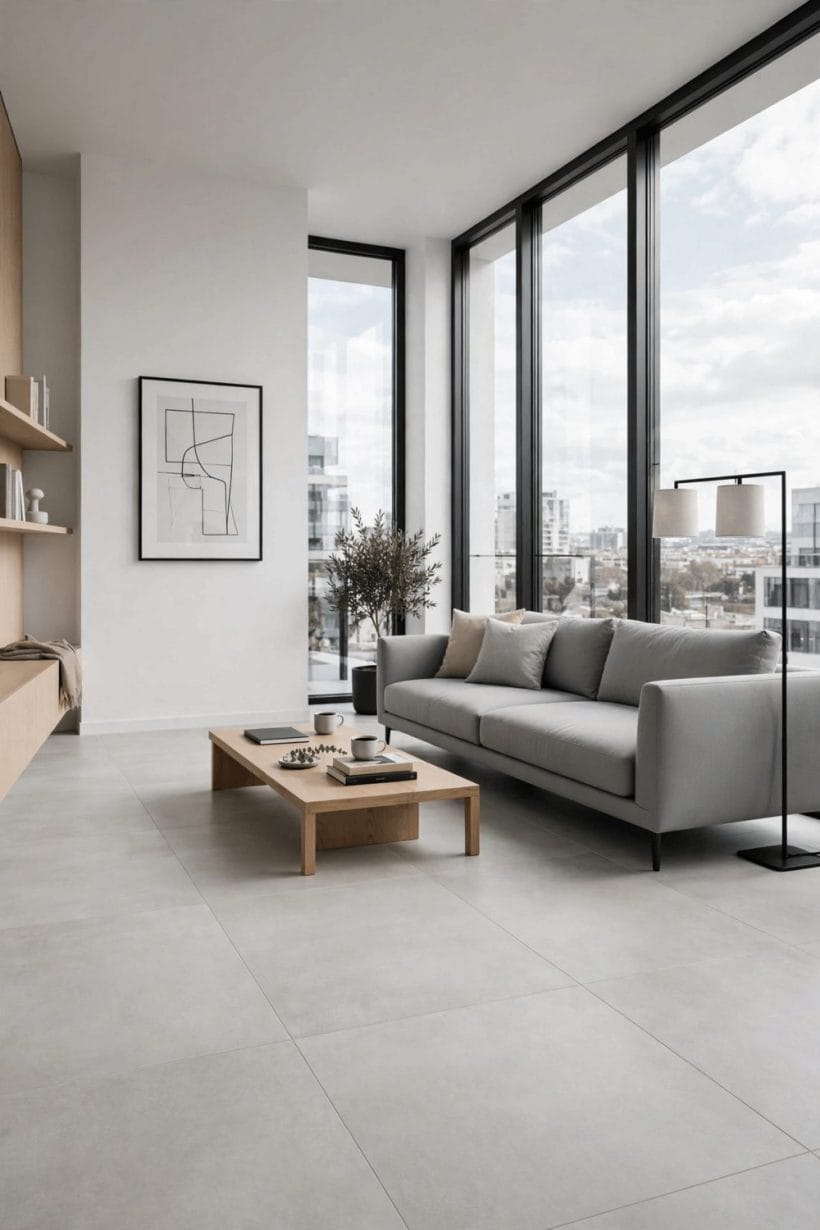
The second gallery’s open-plan room runs big, pale, glossy tiles from sofa to kitchen without a break, and the space reads twice its size. Large format is the modern register of the tile floor: minimal lines, maximum light.
18. Fewer lines, calmer rooms
Every grout line is a small interruption; large tiles reduce them to a faint grid. For rooms already busy with furniture and life, that calm underfoot is the point — the floor stops competing and starts conducting.
19. Gloss in low-traffic elegance
Polished finishes belong where shoes are few and mops are welcome — the grown-up sitting room rather than the dog’s highway. Placed knowingly, as in the gallery, gloss gives a chandelier’s worth of reflected light for free.
20. Large tiles demand flat floors
The bigger the tile, the less it forgives a wavy subfloor: edges catch light and toes. Preparation is the real cost of the large format, and a tiler who talks about levelling before talking about tiles is telling you the truth.
21. Rectified edges and tight joints
Precision-cut tiles allow hairline joints and the near-seamless look of the gallery. The tolerance leaves nowhere to hide, so the laying is specialist work — budget the skill, because the format’s whole effect depends on it.
22. Stone-look large format
Printed stone effects give marble’s sweep without stone’s sealing and staining anxieties. In a living room the difference is mostly in the maintenance conversation; in the photograph there is none, which is precisely the technology’s point.
23. Running the format through doorways
Continuity is the large floor’s gift: tile flowing from living room to hall without a threshold strip makes a small house read as one calm space. Plan the grid from the largest room and let the others inherit it.
24. Dark large-format floors
Charcoal and deep-toned big tiles ground a pale room dramatically and show dust like a conscience. They belong in rooms with the light to carry them and households honest about their sweeping habits — the floor will report both.
5. Wood-Look Tiles
25. Planks that are not planks
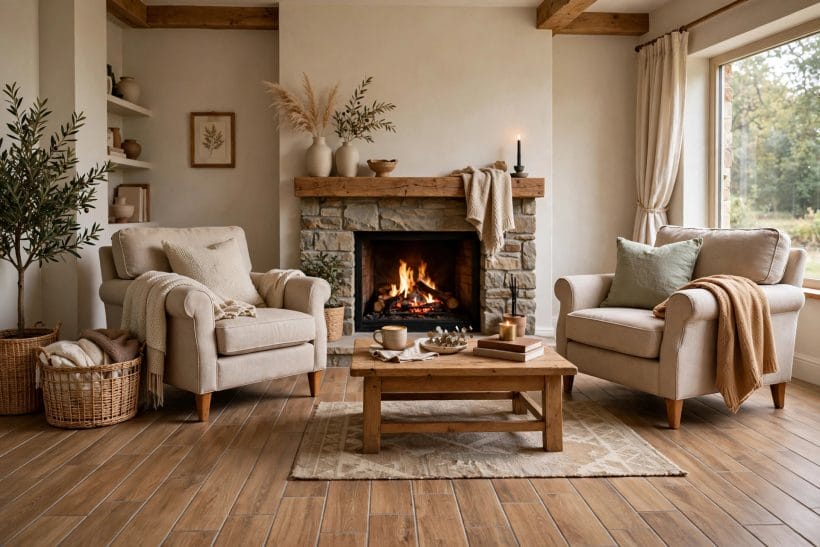
The third gallery’s floor wears the dress of wood — long planks, grain, warm tone — with ceramic’s constitution. Around the stone fireplace it passes at a glance, which is the test wood-look tile sets itself: believable first, practical always.
26. Where wood-look wins
Homes with dogs, underfloor heating, sunny rooms that fade real timber, and kitchens that flow from living rooms are wood-look’s natural constituency. The material removes wood’s anxieties while keeping its warmth of appearance — the compromise is honest and popular.
27. Grout colour makes or breaks it
The illusion lives in the joints: grout matched close to the plank tone reads as shadow gaps between boards, while pale grout draws a grid that betrays everything. This single choice decides whether visitors kneel to check, so spend the decision time here.
28. Laying patterns borrowed from timber
Staggered planks, herringbone and chevron all translate to tile, with herringbone the current favourite for living rooms. The tiler’s labour rises with the pattern’s complexity — the honest cost driver, stated before the quote, not after.
29. Repeat and variation
Cheap wood-look repeats the same printed board until the eye catches it; good ranges carry many faces and shuffle them. Ask how many distinct prints the range holds, and lay a full box dry to judge the repetition with your own eyes.
30. The bathroom branch of the family
Wood-look in wet rooms is where the idea began for many households, and wood-look tile bathroom ideas works that room in full. The living-room version follows the same rules at a larger, drier scale, with pattern choices the bathroom never has room for.
31. Wood-look with real wood furniture
Real timber furniture on printed timber floors can jar if the tones pretend to match. Contrast instead — pale planks under dark furniture, or the reverse — and each material compliments the other without an impersonation contest.
32. Radiators, fires and heat
Around the gallery’s fireplace the tile’s indifference to heat and sparks is the practical crown: no scorch marks, no warping, no rug anxiety. For rooms with stoves and open fires, that indifference alone settles many flooring arguments.
6. Terracotta and Warm Earth Tiles
33. Terracotta, the original
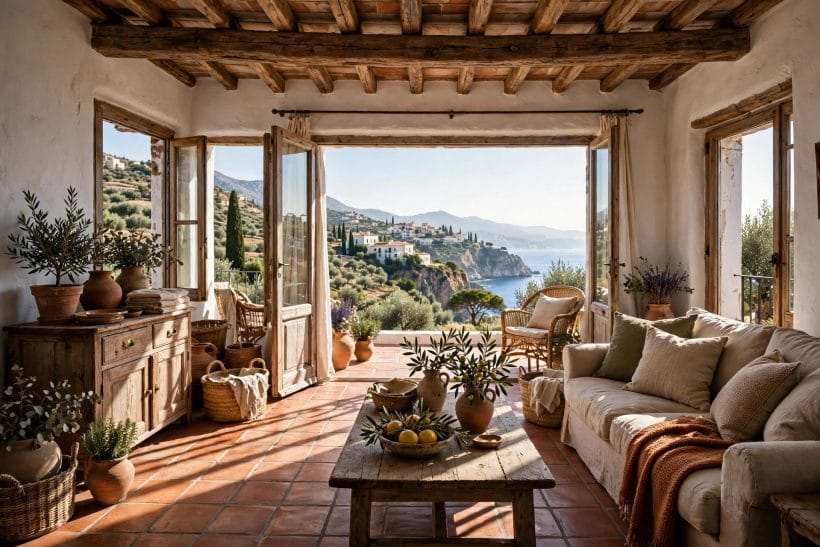
Before pattern and gloss, there was baked earth: the fourth gallery’s terracotta floor, uneven, warm-toned, cool underfoot, running from the beamed room to the terrace without changing its step. It is the tile floor’s ancestral form and still its most atmospheric.
34. Colour that varies tile to tile
Terracotta’s charm is its variation — no two tiles the same blush of clay. Buy from one batch, mix boxes as you lay, and embrace the patchwork; householders who want uniformity should choose a printed tile and be happier.
35. Sealing and care, stated honestly
Unglazed earth tiles drink spills until sealed, and the sealing is a recurring chore, not a one-time event. Makers state their products’ needs; this post’s rule is simply to choose terracotta with the chore accepted, because the look repays those who accept it.
36. Terracotta with white and wood
The gallery’s company — white plaster, dark beams, worn wood, linen — is terracotta’s eternal supporting cast. The floor supplies all the colour the room needs, and everything above it can afford to be quiet, natural and old.
37. Square, hexagon and brick shapes
Earth tiles come in the old shapes: big squares, hexagons, and brick-like rectangles laid in herringbone or basket patterns. Shape is the pattern here — the colour stays clay — and the effect is rustic without a single printed motif.
38. Cool floors in hot climates
Terracotta and its ceramic cousins are air-conditioning by architecture: massive, cool, and pleasant to bare feet through a hot afternoon. In warm regions this is not nostalgia but engineering, and the living room is where the benefit is lived in.
39. Aging gracefully
Earth tiles wear into their setting — edges soften, traffic polishes paths, the floor records the household. Rooms that must look new forever should choose glazed tile; rooms that prefer character will find terracotta ages like leather, not like plastic.
40. Threshold to the terrace
Running the same tile from living room to terrace, as the gallery does, dissolves the wall between them. Check the exterior tiles are rated for outdoor duty and frost where winters bite — the supplier’s stated ratings decide, in writing.
41. Warm tiles, warm textiles
Terracotta’s warmth is visual; underfoot in winter it is as cool as any tile. The rugs of the next section, plus slippers accepted as house uniform, complete the comfort — the honest pairing of a beautiful floor with a practical household.
7. Rugs and Softening a Hard Floor
42. The seating rug
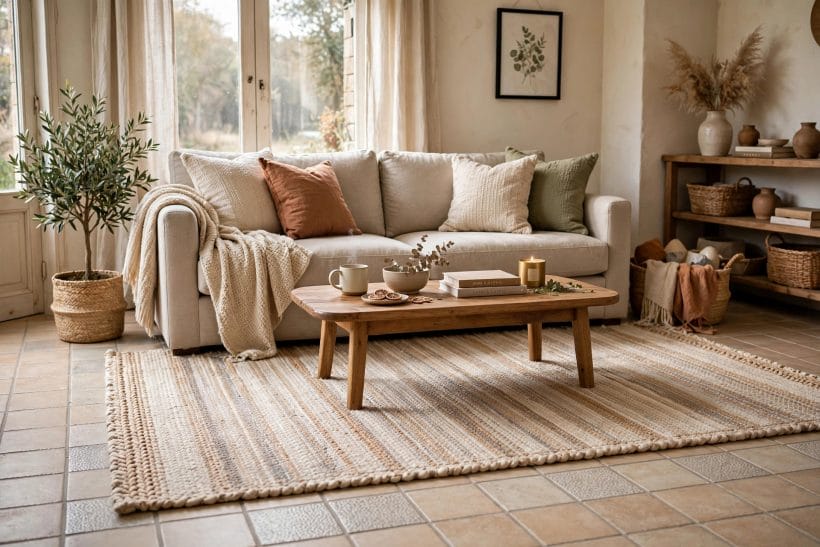
The fifth gallery image sets the template: a large woven rug under sofa, table and feet, tile showing at the room’s edges. The rug is the comfort layer, the acoustic layer and the colour layer, and the tile is its permanent frame.
43. Sizing the rug to the furniture
Front legs of sofas and chairs on the rug, always; a rug floating small in a tiled room reads as a mistake the floor’s grid makes obvious. On tile, measure twice — the grid will measure your rug in public, daily.
44. Flat weaves over pile
Low, flat textiles sit calmly on tile and let chair legs behave; deep pile on a hard floor can feel precarious and shows the tile’s level honestly. Jute, wool flat-weave and woven cotton are the working choices here.
45. Gripping the rug
On a smooth floor a rug travels unless it is held — an underlay mat beneath is not optional equipment. It also adds the cushion bare feet want. Choose the underlay for hard floors specifically, and check it cannot mark the tile’s glaze.
46. Layering smaller rugs
A small patterned rug over a large plain one gives the patterned-floor effect reversibly — the compromise for households who love section two’s drama but not its permanence. The tile beneath stays neutral, and the pattern can leave with the rug.
47. Rugs by the fire and the door
Smaller mats earn their place at the hearth and the garden door, catching the ash and the mud the tile itself shrugs off. Washable ones, in the room’s palette, keep the floor’s low-maintenance promise intact.
48. The room the rugs make
In the family room version of this floor — compare the arrangements in modern family room ideas — rugs zone the play, the seating and the screen areas on one continuous tile field. Tile gives the durable whole; textiles give the rooms within the room.
49. Bare tile, kept proudly
Not every tiled room needs covering: in hot climates and formal rooms the bare floor is the luxury, cool and patterned and complete. Keep furniture feet padded, let the floor be seen, and save the rugs for winter if they come at all.
8. Layout Patterns and Borders
50. The straight grid
Tiles laid square to the walls are the honest default, and in patterned or rustic tiles the grid disappears into the material. It is also the fastest, cheapest laying pattern — the savings can fund better tile, which is a trade worth making openly.
51. The diagonal
Turning the grid forty-five degrees makes small rooms feel wider and ordinary tiles feel designed. It costs more cuts and more waste, and it argues with strongly rectangular rooms — a layout to dry-lay and judge before committing.
52. Herringbone and chevron
Borrowed from parquet, these zigzags give plank tiles their elegance and square tiles a surprise. The labour is the price, and the result in a living room — movement underfoot, direction toward the light — justifies it in the right house.
53. Checkerboard
Black and white, or clay and cream, in alternating squares: the oldest patterned layout, at home in hall-like living rooms and kitchens that flow into them. Keep the squares large for calm, small for energy, and the furniture plain above it.
54. Borders and carpet-fields
Section two’s framed field returns as a layout technique for plain tiles too: a border of contrasting tile defines the seating field like architecture. It is how large plain floors gain ceremony without a single patterned tile in the room.
55. Mixing two tiles
A plain field tile with a patterned one at the hearth, the doorway or the room’s centre medallion gives history’s floors their rhythm. The rule is proportion — pattern as the exception that the plain field sets off, never a fifty-fifty contest.
56. Following the room’s axes
Lay the grid to the room’s true lines — the fireplace wall, the long window — not to a wonky wall the eye forgives. Tilers set out from the room’s focal point and let the cuts fall at the edges; insist on seeing the set-out before the adhesive.
57. Transitions to other floors
Where tile meets boards or carpet, a threshold strip, a brass bar or a tile border manages the meeting. Plan the meeting line to fall under a door or a furniture edge where possible, and the two floors read as chapters, not collisions.
9. Grout, Edges and Detailing
58. Grout as a design line
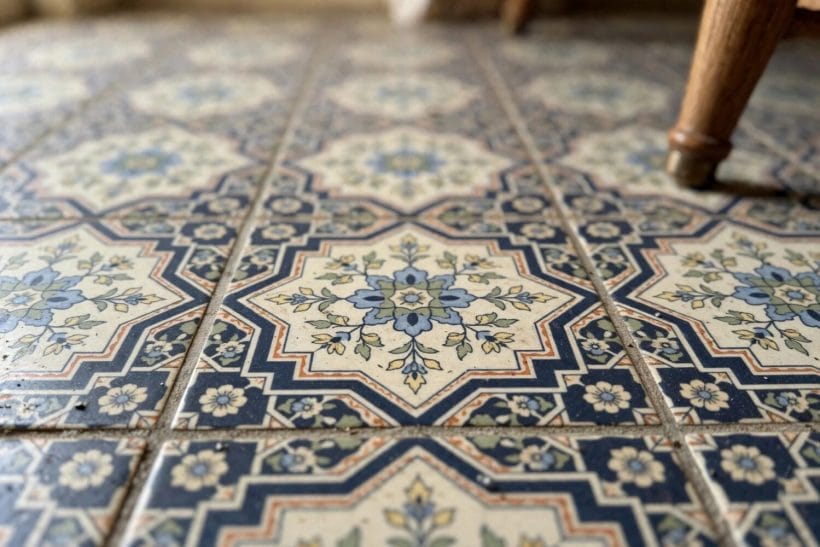
The sixth gallery’s close-up shows the truth of every tile floor: the grout is half the pattern. Its colour decides whether the floor reads as single tiles, a calm grid, or a woven whole — choose it with samples grouted, not guessed from a chart.
59. Matching versus contrasting grout
Matched grout makes the floor recede into one surface; contrasted grout celebrates the grid. Patterned tiles usually want matching or neutral grout so the motifs lead, while plain tiles can take a contrasted line as their decoration.
60. Joint width and the tile’s edge
Handmade-look tiles need wider joints to absorb their unevenness; precision tiles allow hairlines. The tiler matches joint to tile — and a mismatch here, tight joints on rustic tiles, is the commonest cause of a floor that never looks settled.
61. Keeping grout clean
Floor grout greys with traffic where wall grout merely ages. Sealing products and honest cleaning routines exist for it; choose mid-tone grout in busy rooms and the floor forgives the household instead of reporting it. Perfectionists should choose large tiles and few lines.
62. Skirting and edge trims
A tiled skirting or a timber one painted to the walls — either finishes the floor’s edge neatly. The tile version is the Mediterranean habit and shrugs off mop water; the timber version warms modern floors. Decide before laying, because the set-out depends on it.
63. The hearth detail
Where the floor meets a fireplace, tile’s heat-tolerance lets it run straight to the hearth as its apron. A contrasting tile border at the hearth is an old, handsome device that also marks the fire’s safe margin visually.
64. Repairs, imagined in advance
Keep spare tiles from the original batch — a box in the loft is the floor’s insurance. A cracked tile can be cut out and replaced invisibly only if its twin exists; dye lots change, and the time to secure the match is the week of laying.
65. Movement joints, respected
Large floors need discreet movement joints, often at doorways and room divisions, so the field can breathe without cracking. They are engineering, not blemishes; a tiler who plans them openly is protecting the floor you are paying for.
66. The last inspection
Before furniture returns, walk the floor barefoot and by lamplight: lippage, hollow spots and grout misses announce themselves to feet and raking light better than to any checklist. A reputable tiler expects this walk and joins it.
10. Installation, Care and Costs
67. The subfloor decides
Every authority in this trade repeats it: tile floors fail from below. Flatness, soundness and dryness of the subfloor — checked and, if needed, corrected by levelling or boarding — are where successful installations are actually made.
68. Choosing the tiler
Tile living rooms are large, visible fields; choose the tiler on previous floors you can walk on, not on photographs alone. The questions that matter are about preparation, set-out and movement joints — ask all three, and listen for specifics rather than assurances.
69. What the money buys
The budget divides into tiles, preparation, adhesive and grout, the tiler’s labour, and finishing details. In most living-room projects the preparation and labour outweigh the tile itself — which is why this post names drivers rather than figures, and why cheap tile well laid beats fine tile badly laid.
70. Comparing flooring honestly
Set tile against its rivals with the same honesty: the vinyl family has its own checks in premium vinyl plank checks, and wood’s warm case is made in light wood floor living room ideas. Tile wins on life, coolness and pattern; it loses on softness and sound. Choose by the household’s real life.
71. Daily and weekly care
A broom or vacuum, a damp mop, and attention to grit at the door: that is the whole regime for glazed tile. Grit is the enemy — it abrades glazes grain by grain — so door mats and felt pads under furniture are maintenance, not fussiness.
72. Stains and spills
Glazed ceramic shrugs off the living room’s accidents; grout is the vulnerable line, which is why section nine’s sealing and mid-tone choices matter. Unglazed and terracotta floors follow their makers’ stated care, accepted at purchase like any honest material.
73. Furniture on tile
Pads under every leg, lifts rather than drags when moving pieces, and care with castors protect both glaze and grout. A sofa dragged weekly will write its route across any floor; on tile the writing is permanent, so the habit is worth forming at delivery.
74. The floor’s lifespan
A well-laid ceramic floor is measured in decades and usually outlasts the kitchen above it twice over. That lifespan is the cost argument’s core: divide the honest quote by the honest years, and tile is rarely the expensive floor in the room.
75. The final judgement
Choose the tile floor if the room wants coolness, pattern and permanence, and if the household will fund preparation as gladly as pattern. Get those two consents — the material’s and the family’s — and the floor will be walked on with pleasure by people not yet born into the house.
Final Considerations
A ceramic tile living-room floor is a long decision made well once: pattern or plain, gloss or matt, earth or print — but always laid on preparation that respects the material. Get the subfloor, the set-out and the grout right, and the tile itself can be as bold as the Mediterranean feature room or as calm as the white open-plan gallery; both stand on the same discipline.
Then furnish above it with the confidence the galleries show — plain sofas where the floor performs, rugs where comfort asks, wood and linen everywhere. The floor will hold the room’s colour, cool its summers and outlast its fashions, which is all a floor has ever been asked to do, done unusually well.

0 Comments