
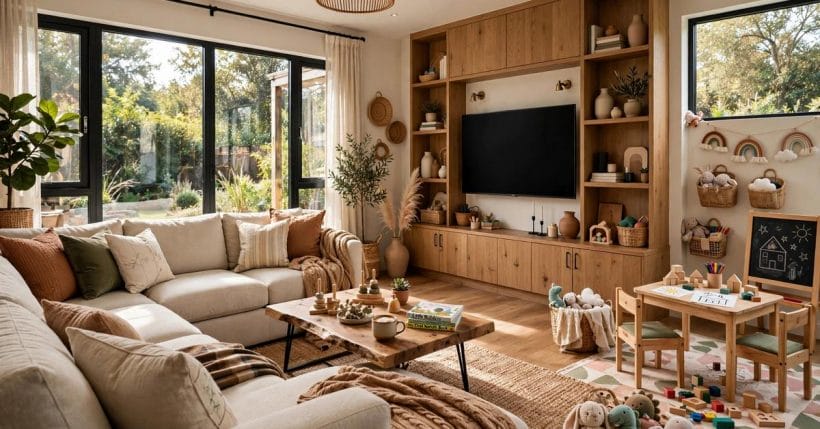
A modern family room has the hardest job description in the house: cinema on Friday, homework desk on Monday, pillow fort by Saturday morning — and it has to look calm while all of that happens. The modern part is not the styling. It is the discipline of giving every activity a zone, every object a home, and every surface a finish that survives real life.
These seventy-five modern family room ideas work through the room in the order it gets used: layout and zones first, then seating, the media wall, play space, storage, colour, light, floors and the finishing layer. The room as a whole belongs to the living room ideas pillar; the classic, all-ages survey lives in our family room ideas post. This post is the modern chapter — clean lines, flexible zones and materials chosen for the way a household actually lives now.
Related Guide: 10 Farmhouse Family Room Ideas: Layouts, Colours, Costs and Practical Details
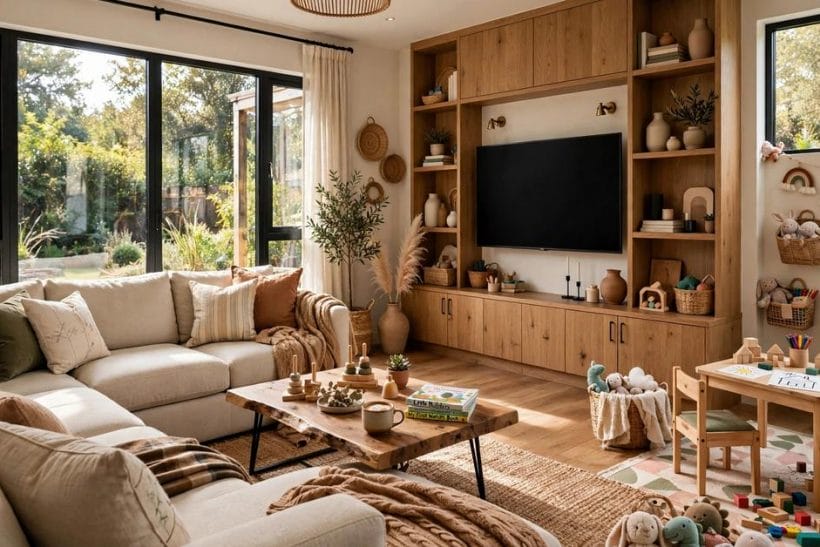
1. Modern Family Rooms at a Glance
A family room fails in predictable ways: the TV faces the window glare, toys migrate across every surface, and the sofa seats three in a room built for six people arguing over it. The modern answer is zoning — deciding what happens where, then letting furniture, rugs and light draw the boundaries instead of walls. The ideas below keep returning to that one move, and to finishes that can be wiped, washed or forgiven.
| Question | Short answer |
|---|---|
| What makes a family room “modern” rather than just new? | Zoned layout, clean-lined furniture, hidden storage and layered light — the look follows the way the room is used |
| How do you keep it tidy with children in it? | Closed storage at child height, a basket for every activity, and a two-minute reset the room is designed to allow |
| Where does the money go? | The sofa first, then storage joinery, then lighting; decor is the cheapest layer and the last one to buy |
| Can a small room be a family room? | Yes — zones shrink, they do not disappear; a play corner, a reading chair and a shared screen still make the room work |
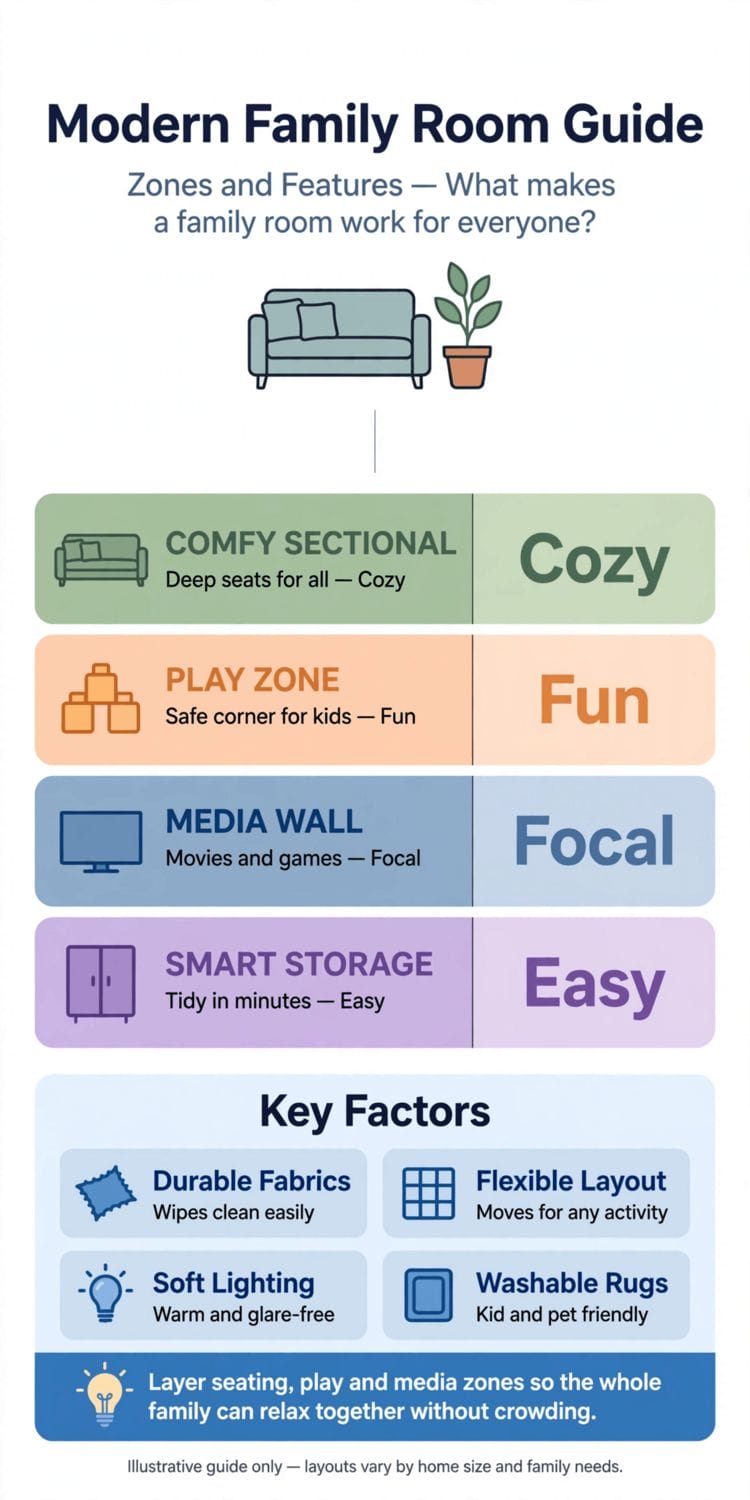
2. Layouts and Zones: The Room Divided Without Walls
Start with the activities, not the furniture. List what the room must hold — watching, playing, reading, games, homework, the occasional nap — and give each one a territory. Zones drawn with rugs and furniture backs can be rearranged as children grow; zones drawn with walls cannot.
1. The three-zone ground plan
Media at one end, play at the other, and a quiet corner between them: the classic family-room triangle. Each zone gets its own rug and its own light, and the walkway between them stays clear so the room never becomes an obstacle course.
2. The rug as a room divider
A large rug under the seating group declares the conversation zone more clearly than any partition. Leave a hand’s width of floor visible around it and the zone reads intentional rather than stranded.
3. Back-to-back zoning
Place the sofa back against the play area and the room splits itself. Adults face the screen or the fire; children play behind the sofa within earshot but out of the sightline — together and separate at once.
4. The window reading corner
One good chair, a small table and the best daylight in the room: the reading corner is the zone every family room needs and most forget. It gives the room a quiet pole to balance the screen’s loud one.
5. A homework ledge along the wall
A shallow desk run beneath a window or along a spare wall takes laptops, drawing and homework out of the seating zone. Add a task light and a drawer per child and the ledge earns its floor space daily.
6. The open middle
Resist filling the centre. An open middle is floor space for trains, yoga, dance practice and the Christmas tree — the family room’s flexibility lives in the square metres you leave empty.
7. Traffic lanes kept honest
Door-to-door routes should cross the room’s edges, never its heart. If a walkway must pass the seating, let it pass behind the sofa — a room people cut through cannot settle.
8. Zones that change by the hour
A folding screen, a rolling cart, curtains on a ceiling track: movable boundaries let the play zone shrink for film night and the desk zone vanish for a party. Modern family rooms flex; they do not fix.
9. The grown-up end
Keep one end of the room deliberately adult — the good lamp, the unshared shelf, the chair nobody bounces on. A family room that is only for children stops being used by the whole family.
3. Sofas and Seating: Built for the Whole Household
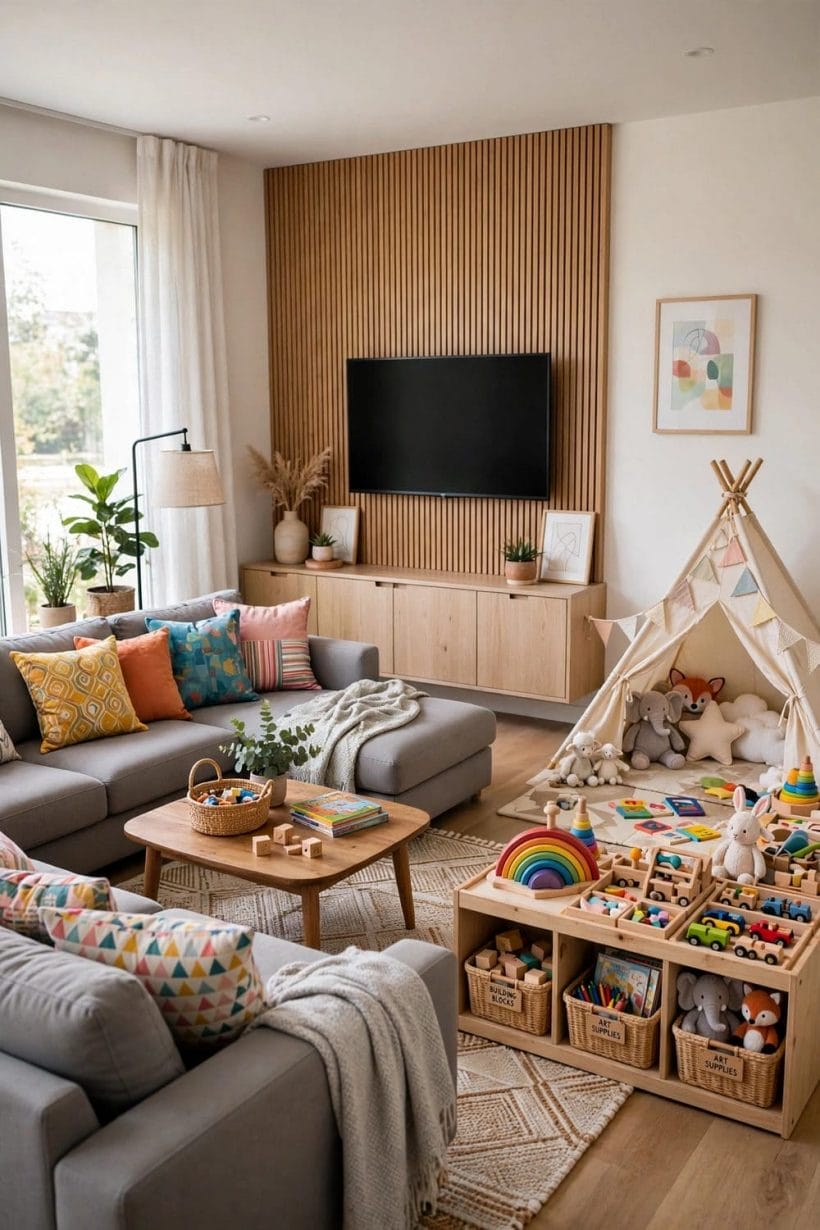
Seating is where the budget belongs. A family sofa is sat on hard, slept on occasionally, and used as a climbing frame daily; buy the frame and fabric for that job description, and let the cushions carry the style. Where the room centres on a hearth instead of a screen, our living room with a standard fireplace post works that warmer arrangement through in full.
10. The deep sectional
A corner sectional seats the whole household in one piece and ends the argument about who gets the good seat — everyone does. Choose a layout that hugs a wall so the middle of the room stays open.
11. Washable covers, always
Removable, machine-washable covers are the single most family-friendly specification in the room. Spills become laundry, not upholstery bills, and the sofa can change colour with a spare set.
12. Performance fabrics in plain language
Tightly woven, stain-resistant fabrics earn their name in a family room. Test with the household’s real threats — juice, felt pen, dog — on a swatch before committing the whole sofa to them.
13. A chaise end for the sprawl factor
One chaise section turns sitting into lounging and gives film night a first-class seat. It also works as a daybed for ill children and overnight grandparents at a push.
14. Two swivel chairs instead of a second sofa
Swivels turn to the screen, the conversation or the play zone as the hour demands. They keep the seating count high without walling the room in upholstery.
15. Floor cushions and a pouffe pool
Children sit on the floor by choice; make it a designed choice. A stack of firm floor cushions and a couple of pouffes give young sitters their own furniture that tidies away in seconds.
16. The window seat with storage inside
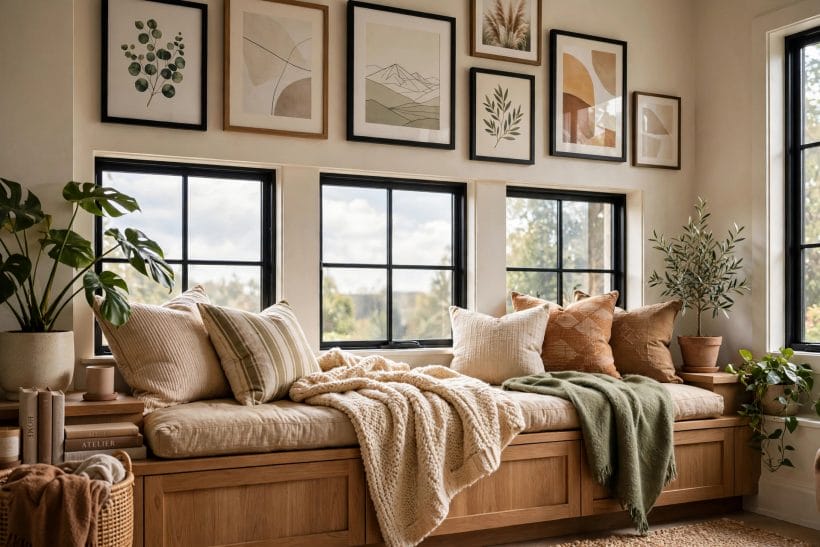
A built-in window seat adds seating, a reading perch and a toy chest in one footprint. Put the lid on soft-close hinges and it serves the room from toddlerhood to the teenage years.
17. A bench instead of a coffee-table crowd
A long bench along the sofa’s back or under the window seats extra friends, holds trays at parties, and parks against the wall when the floor needs clearing.
18. Armchairs that survive being forts
Light enough to move, sturdy enough to hold a blanket roof: the fort-building chair is a family-room institution. Avoid anything so precious it cannot join the game.
4. The Media Wall and TV Setup
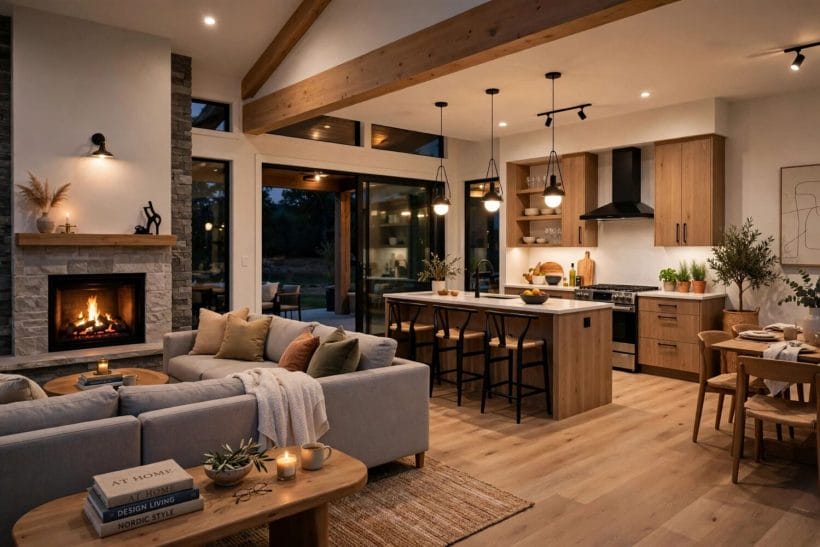
The screen is the room’s second hearth, and it deserves the same planning. Our media wall living room post designs the full built-in wall; here the screen is planned as one zone among several, sized to the seating and stripped of cable clutter.
19. Screen size matched to the sofa distance
The screen should fill the view comfortably from the main seats — no bigger, no smaller. Measure the seating distance first and let it choose the size, not the showroom wall.
20. A low cabinet that swallows the boxes
Consoles, routers and chargers live behind doors in a low, deep cabinet. Ventilation at the back and a cable channel inside keep the technology invisible and the dusting simple.
21. Cables planned, not apologised for
Every cable gets a route: trunking inside the wall where allowed, a raceway behind the cabinet, or a lidded channel along the skirting. A family room’s calm is mostly the absence of visible wires.
22. Bias light behind the screen
A soft light strip behind the screen eases eye strain on film nights and makes the picture look richer. It costs little, hides well, and children think it is magic.
23. Speakers that disappear
A soundbar under the screen or speakers built into the joinery give film sound without a thicket of stands and wires at toddler height. Fewer objects on the floor, fewer accidents.
24. The screen that becomes art
When the television is off it dominates the wall in black. A frame-style screen showing art, or a roller blind and projector for true cinema nights, keeps the room’s daytime face calm.
25. Gaming gear given a drawer
Controllers, headsets and chargers multiply. One drawer with a charging strip inside — ventilated and cable-managed — keeps the gaming layer present but invisible between sessions.
26. Seating aimed at the screen and each other
The classic tension: film wants rows, conversation wants a circle. Angle the swivel chairs and choose a curved or L-shaped layout so both arrangements are a swivel away.
27. Blackout where the screen lives
Daytime sport and Saturday films fight window glare. Lined curtains or a blackout blind on the screen’s wall — layered over sheers for ordinary hours — solve it without darkening the whole room.
5. Play Corners and Kids’ Zones
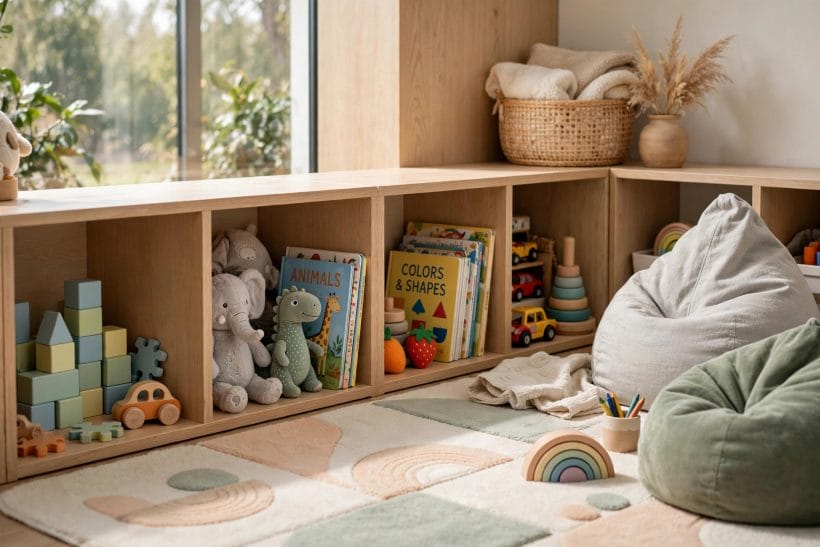
Children will play in the family room; the only choice is whether the room plans for it. A defined play zone with storage at child height keeps the toys territorial — and teaches tidying as part of the game.
28. The play corner with a boundary
A round rug, a low shelf and a corner of the room: the play zone needs an edge children can see. Toys that cross the boundary get tidied; toys inside it are home.
29. Low open shelves, labelled by picture
Open shelves at child height with picture labels let young children fetch and return their own things. Independence at tidying time is worth more than any toy in the room.
30. A table that takes punishment
One small, sturdy table for drawing, building and play dough — ideally wipeable, definitely not precious. When it is outgrown it becomes a side table; nothing in this room is single-use.
31. The reading nook at child scale
A cushion pile, a low book rack with covers facing out, and warm light: a reading nook sized for small people gets used daily and builds the habit the room exists to support.
32. Dress-up and toy rotation boxes
Keep a third of the toys in lidded boxes in the storage zone and rotate them. Rotated toys feel new again, and the play corner never drowns in its own inventory.
33. A display ledge for finished creations
Models and drawings need a home that is not the dining table. One picture ledge at child height, cleared weekly by its owners, keeps masterpieces honoured and surfaces free.
34. Soft edges where the play happens
Round the corners in the play zone — literally. Choose rounded tables, soft ottomans and padded edges where toddlers cruise; the modern look survives, the bruises do not happen.
35. Play that packs into the ottoman
A storage ottoman holding the board games or the train set turns the play zone’s biggest kit into furniture. When the lid closes, the room is adult again in under a minute.
36. A wall the children may write on
One framed chalkboard or whiteboard panel in the play zone gives drawing a legitimate wall. It protects every other wall in the house by existing.
6. Storage That Hides the Clutter
Modern family rooms look calm because their storage is closed, full-height and boringly generous. Plan the storage wall before the sofa: the amount a household owns is fixed, so the only variable is whether it shows.
37. The full-height storage wall
Flat-fronted cabinets from floor to ceiling on one wall swallow games, blankets, craft kits and the vacuum’s attachments. Handleless fronts keep the wall reading as architecture, not furniture.
38. A basket for every activity
Knitting, controllers, chargers, the dog’s toys: one labelled basket each, all living on the same shelves. Tidying becomes sorting into baskets — a job even a tired adult can finish.
39. Closed below, open above
Keep display shelving above shoulder height and closed cabinets below it. The eye-level layer stays calm and curated; the working layer hides behind doors where it belongs.
40. The blanket ladder or basket by the sofa
Throws multiply in family rooms. One large basket or a leaning ladder by the sofa gives them a single home, so film-night blankets do not colonise every seat by morning.
41. A charging drawer for the household’s devices
Phones, tablets and handheld consoles charge in one ventilated drawer with a single cable entry. The room’s surfaces stay clear and bedtime routines get easier to police.
42. Under-sofa and under-seat storage
Low trays under the sofa hold the jigsaw in progress and the train layout between sessions. Dead space under furniture is the cheapest storage in the room.
43. The reset ritual the room is built for
Design storage so the whole room resets in two minutes: everything has a container, every container a shelf, every shelf behind a door or in a zone. If tidying takes longer, the storage — not the family — is wrong.
44. Book storage that grows with the readers
Picture books face out at low level now; the same shelves take chapter books upright later. Plan one bookcase bay per reader and the library grows without colonising the room.
45. One honest junk drawer
Batteries, tape, the mystery cable: every household has them. Give the junk one drawer with dividers instead of letting it spread, and the rest of the storage stays honourable.
7. Colours and Palettes That Stay Calm
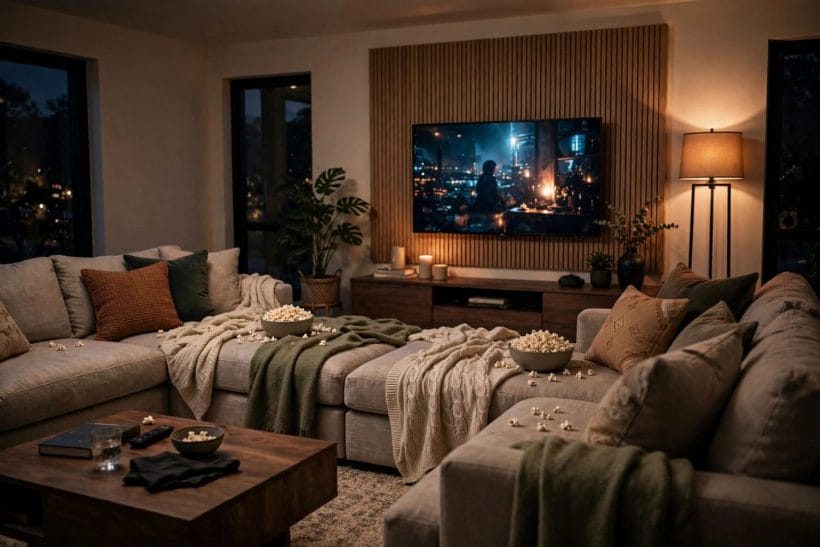
Family rooms are visually noisy by occupation — toys, books, screens, people. The palette should be the quiet part: a warm neutral ground, natural materials in the middle, and colour arriving through things that are easy to change.
46. Warm white walls, washable paint
A warm white reflects the room’s daylight kindly and forgives patch repairs. Choose a scrubbable finish at family height; the wall will be leaned on, kicked and drawn near.
47. One deep accent, kept in one place
A single deep colour — on the media wall, the storage wall or the reading corner — gives the room its character. Everywhere at once it becomes noise; in one place it becomes the signature.
48. Colour carried by textiles
Cushions, throws and the play rug carry the bright colours, because they are the cheapest layer to replace when tastes grow up. The room’s bones stay neutral; its clothes change.
49. A brick wall as the warm accent
Exposed or applied brick brings the warmth and texture a family room’s palette often lacks; our brick wall living room post works that single material through a whole room. Here it suits one wall, behind the seating or the screen.
50. Timber tones as the middle layer
Natural wood in floors, shelves and tables warms the neutral palette without adding colour noise. Keep the tones in one family — all warm or all pale — and the room coheres.
51. Black used as punctuation
Screen, frames, lamp stems, cabinet handles: small black notes give a pale family room its definition. A line of black at picture-rail height ties the zones together.
52. The play zone allowed its own colours
Let the children’s corner be cheerful — a coloured rug, bright cushions, their art on the wall. Zoning the palette as well as the floor keeps joy contained and the adult zones calm.
53. Patterns rationed to one per zone
One patterned rug, one patterned cushion set, plain everything else. Pattern is seasoning in a busy room; more than one per zone and the eye has nowhere to rest.
8. Lighting in Layers
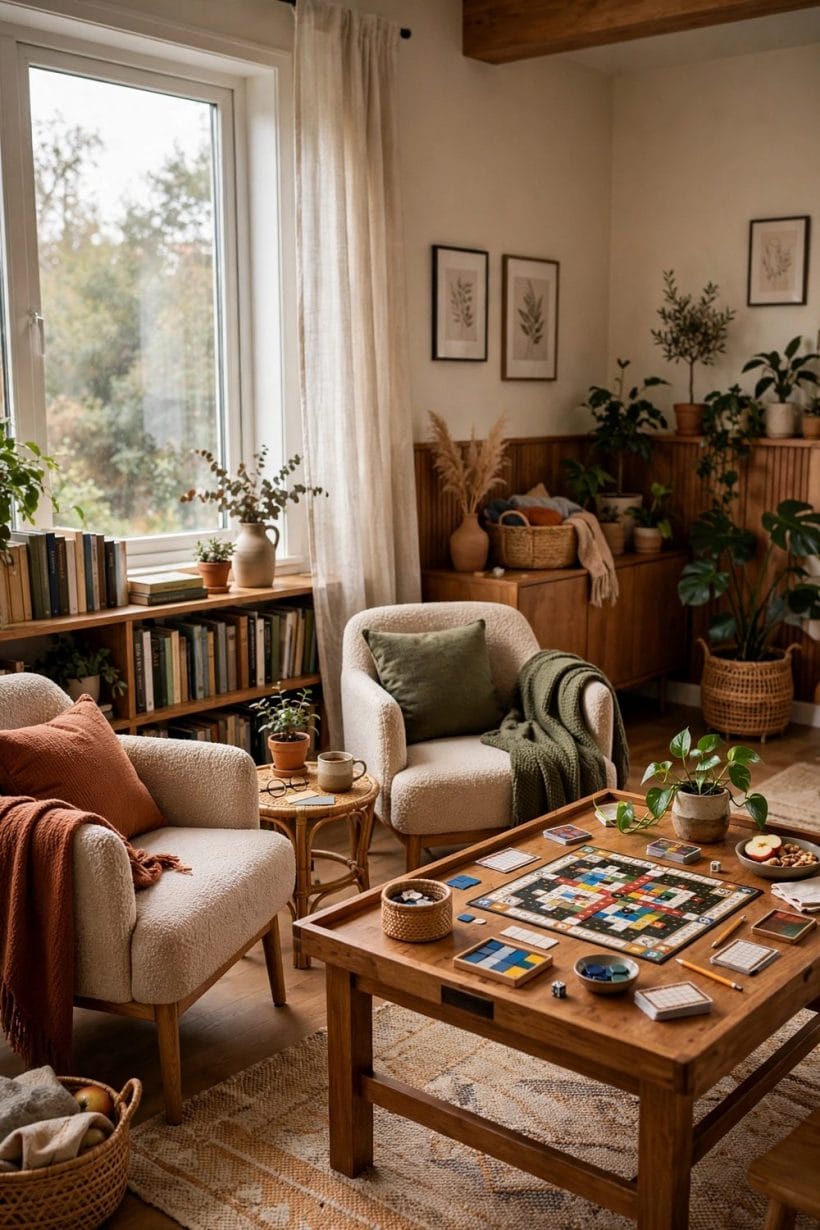
One ceiling light is why family rooms feel like waiting rooms. Layer instead: daylight managed by curtains, ambient light from above, task light where people read and play, and a low warm layer for film nights.
54. Dimming as a default
Every light in the room on a dimmer turns one room into several: bright for play and tidying, low for films, warm for evenings. It is the cheapest transformation in this whole post.
55. Task light at every seat that reads
A floor lamp by the reading chair, a table lamp by the sofa’s end, a clip light at the homework ledge. Reading light belongs at shoulder height, aimed at the page — not overhead.
56. A pendant or two over the play table
Low pendants define the play and craft zone and put light exactly where small hands work. Choose enclosed, robust shades — this is the room where things get thrown.
57. Picture lights over the family gallery
A rail of family photos and children’s art, lit properly, turns the room’s most personal wall into its best feature — and makes the art rotation feel like an exhibition opening.
58. Night lighting for small wanderers
Low-level warm lights along the route to the door — skirting LEDs or a shaded lamp left dim — guide midnight water-seekers without waking the room’s sleepers on the sofa.
59. Sheers under curtains for daytime
Sheers soften daylight for play and homework; the lined pair closes for films and winter evenings. Two layers on one track give the room its full range of moods.
60. Lampshades that forgive
Fabric shades dent and scorch; in the family room choose metal, wood or woven shades that survive knocks. Save the silk shade for a room with a door.
61. One statement light, kept simple
A single generous pendant or an arc lamp gives the modern room its gesture. Keep it sculptural but plain — the room already has plenty to look at.
9. Floors, Rugs and Soft Finishes
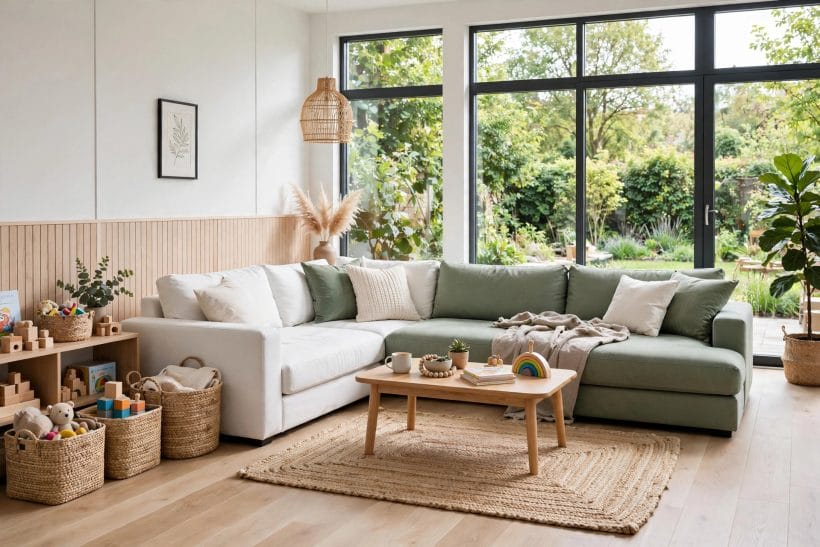
The floor is the family room’s biggest piece of furniture — sat on, played on, spilt on daily. Choose the hard layer for durability, then zone and soften it with rugs that can go in the wash.
62. Hard flooring as the honest base
Timber, laminate or quality vinyl takes the room’s traffic without complaint and cleans in minutes. In a family room, the floor’s job is to be forgiven, and hard floors forgive everything.
63. Washable rugs in every zone
Machine-washable rugs under the seating and the play corner handle the juice, paint and pet incidents as laundry. Buy the underlay with grip — a sliding rug is a hazard with good intentions.
64. A play mat that reads as a rug
Foam play surfaces no longer have to shout. Rug-look mats give babies and toddlers a padded zone that still belongs to the room’s palette — and wipe clean in seconds.
65. Cushions as spare architecture
Oversized floor cushions build forts, spare beds, reading nests and extra cinema seating. In a hard-wearing fabric with washable covers they are the room’s most flexible purchase.
66. Curtains pooled slightly, hems washable
Curtains that just touch the floor soften the room’s lines; keep the fabric washable and the hem off the mop’s path. In the play zone, blinds may simply be the wiser soft finish.
67. Upholstery layered, not matched
A sofa, chairs and cushions in one fabric looks like a showroom. Layer textures instead — a plain sofa, a woven chair, knitted throws — in one colour family for a room that feels gathered, not bought.
68. The nap-worthy throw at every seat
Family rooms run on naps. A folded throw at the end of each main seat, washed on rotation, keeps the room ready for the ill, the tired and the Sunday-afternoon film.
10. Finishing Touches and Everyday Tech
The last layer is the household’s daily machinery — photographs, plants, remotes, speakers — given proper places so the room reads finished rather than merely furnished.
Everyday tech deserves the same zoning discipline as the furniture. The remote lives in one bowl on one table, the streaming sticks and consoles sleep in the media cabinet, and the family’s tablets charge in the drawer planned back in §6 rather than colonising the sofa arms. A room can be full of technology and still feel analogue-calm, provided every device has an address and returns to it. That, more than any single purchase, is what separates the modern family room from the merely new one: nothing in it is homeless, so nothing in it nags.
Our rustic living room ideas show how different the same bones can feel in a warmer hand; the modern family room keeps its finishes plainer and lets the family’s life supply the decoration.
69. A family gallery wall that can grow
Start with a grid of matching frames and leave gaps in the plan for new arrivals. A gallery designed to grow absorbs school photos and holiday prints without ever looking finished-by-accident.
70. Plants placed for the room’s traffic
Greenery on shelves, wall planters and the storage wall’s top — high, stable and out of the play zone’s flight paths. Choose robust, non-toxic varieties where small children and pets share the room.
71. A sound plan, not just speakers
Soft finishes — rug, curtains, upholstery — are the room’s acoustics. A family room that echoes makes films harsh and tempers short; add soft layers until conversation sounds warm.
72. The house-rules board
A small framed board by the door — film-night rota, tidying jobs, the week’s plans — gives the room its gentle administration. Whimsical in a child’s hand, practical in everyone’s.
73. Books where people actually sit
Current reading lives by the seats that read it: a basket by the sofa, a ledge at the reading chair. Books stored across the room are books that quietly stop being read.
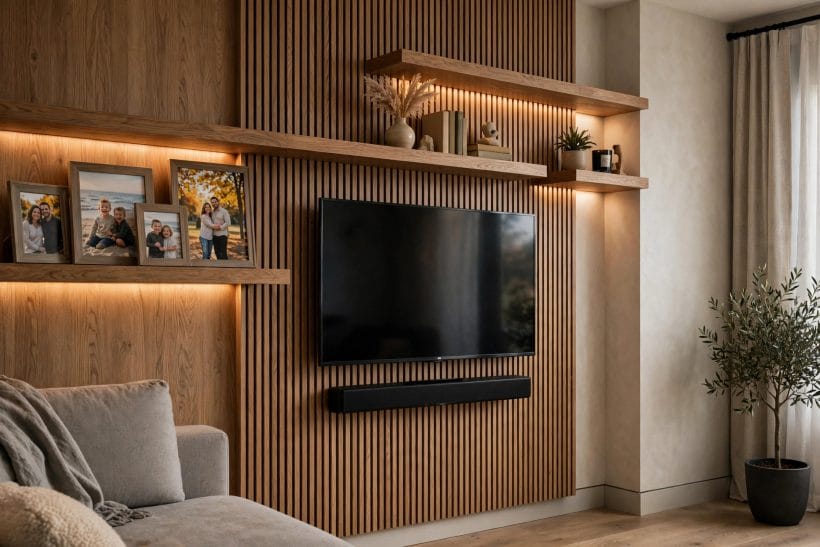
74. A timber-clad wall for warmth
Wood panelling or slats on one wall adds the texture modern rooms can lack; our wood wall living room post explores the treatment in depth. In the family room it suits the media wall or the reading end best.
75. Seasonal rotation, lightly done
A cushion cover swap, a different throw, the play corner re-dressed for a festival: the family room renews itself in an hour when its colour lives in textiles. Build the bones once; dress them often.
Final Considerations
A modern family room is not a style purchase; it is a set of decisions about how a household spends its hours together. Zone the room by activity, spend on the sofa and the storage, keep colour in the washable layers, and light it for every hour from homework to film night. Split the territory cleanly with its siblings — the living room ideas pillar for the room in general, the family room ideas survey for the classic all-ages version — and this post stays what it should be: the modern, function-first chapter of the family’s hardest-working room.



0 Comments