

Four seats, all built for lounging, all constantly confused with one another — in shop listings, in auction catalogues, and in the heads of everyone who has ever tried to buy one. The chaise, the divan, the daybed and the settee are not synonyms; each names a different answer to the question of how a person means to rest.
This glossary defines each term by its shape, its history and its job, then sets the four side by side with the checks that tell them apart in a showroom or a listing. It is deliberately light — a reference to keep, not a thesis to read — because the difference between a chaise and a settee is something you should be able to settle in a sentence.
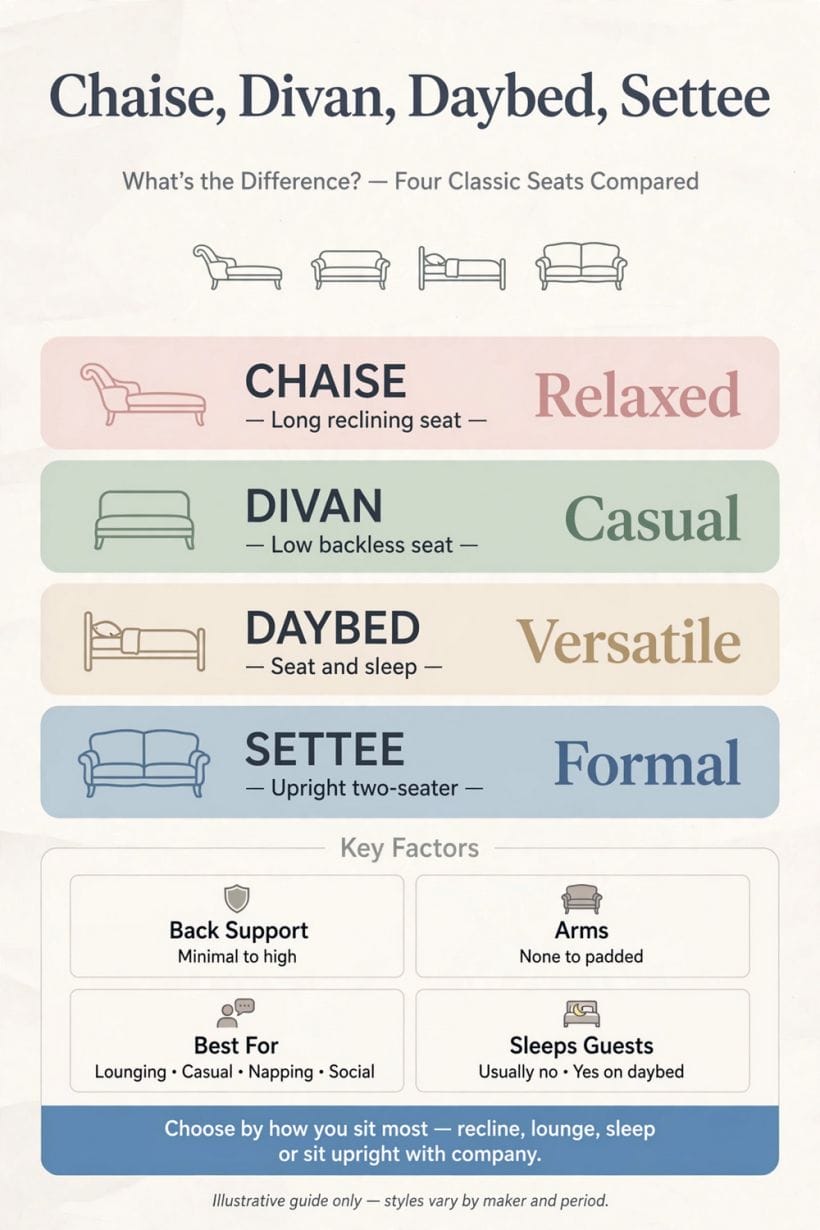
1. The Four Terms at a Glance
Scope first. This article owns definitions: four furniture terms, their distinguishing features, and the buying checks that follow from them. The furniture itself is bought with the help of furniture buying guide, judged for construction in furniture quality check guide and weighed by report in furniture reviews guide. Here, the only question is what the words mean — because a listing that calls a settee a daybed will sell you the wrong seat with total confidence.
| Term | In one line |
|---|---|
| Chaise | A long upholstered seat for reclining, with a back rising at one end |
| Divan | A low, backless or low-backed seat placed against a wall and softened with cushions |
| Daybed | A real bed that serves as deep seating by day — mattress first, sofa second |
| Settee | A small upholstered sofa for two, with arms and a back — a sofa in miniature |
2. The Chaise: Built for Reclining
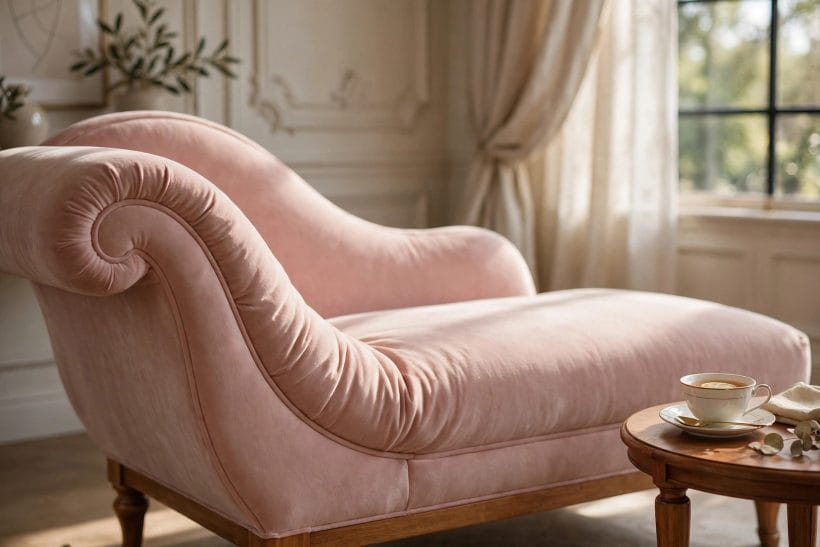
Gallery-1’s seat — long, upholstered, its back sweeping up at one end — is the chaise in its classic form: a chair extended until the legs can join the sitting. Everything about it serves one posture.
1. What a chaise is
A chaise is an elongated upholstered seat designed for one person reclining: sit at the raised end, stretch along the length. The back supports the sitter’s back and shoulders; the seat extends to carry the legs fully. If the seat is only long enough for raised feet on a stool, it is a chair and ottoman, not a chaise.
2. The name, and its longer form
The full name is chaise longue — French for “long chair” — and the shortened chaise is the trade’s everyday word for the same piece. Listings mangle it memorably, but the object is constant: length, upholstery, a back at one end, one reclining person.
3. Where a chaise belongs
Wherever one person reads, rests or watches the room from a slight remove: the bedroom corner, the living room’s bay, the foot of a bed. The chaise is furniture for a solitary pleasure, and it asks for a side table and a lamp as its court.
3. The Divan: The Wall’s Seat

The pin is the warning before the definition: a chaise by tall windows, complete with its own high back, needing nothing from the wall behind it. The divan is the opposite arrangement — a seat defined by what it leans on rather than what it contains.
4. What a divan is
A divan is a low seat, typically without a back or arms of its own, placed along a wall and made comfortable with cushions and bolsters arrayed against that wall. Its comfort is borrowed from its setting: a divan standing free in the middle of a room is only half furnished.
5. A travelling word
The word came west with the furniture it named — the raised, cushioned seating of Ottoman rooms, where the council chamber and its long bench shared a name. The European divan kept the form: low, deep, social, and built along the room’s edge rather than at its centre.
6. Where a divan belongs
In rooms that entertain along their edges — sitting rooms, studios, wide halls — and anywhere a low sightline must be kept: under windows, beneath art. Its modern descendants include the backless day-sofa and, in bed form, the divan base — a shared name the glossary flags rather than settles, and a listing word to read with care.
4. The Daybed: A Bed Wearing Daylight
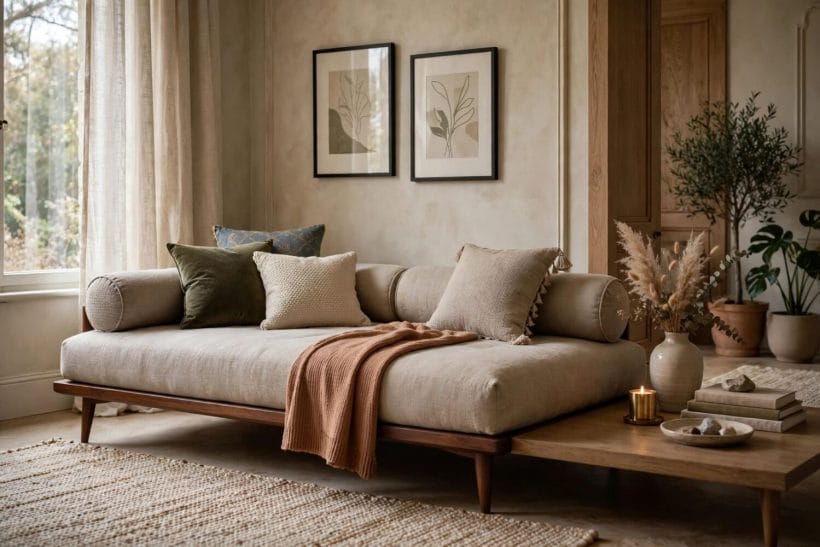
Gallery-2’s piece gives the daybed away at a glance: a proper mattress-depth cushion on a low wooden base, bolsters stood along its back to lend it a sofa’s manners by day. Of the four terms, only this one is a bed.
7. What a daybed is
A daybed is a single bed — full mattress, bed-sized — framed on three sides so that by day, dressed with cushions along its long back, it serves as deep seating, and by night it sleeps one in earnest. The mattress is the definition: no mattress, no daybed.
8. Daybed or sofa bed?
The sofa bed hides a folded mechanism inside a sofa; the daybed hides nothing — the bed is the seat, unfolded and undisguised. Daybeds sleep better and sit deeper; sofa beds sit better and sleep worse. The choice is a confession about which duty matters more.
9. Where a daybed belongs
The spare room, the study, the teenager’s den, the small flat: anywhere a room must be two rooms. Of the four seats in this glossary it is the working piece — the others are pleasures, this one is a solution.
5. The Settee: The Sofa in Miniature

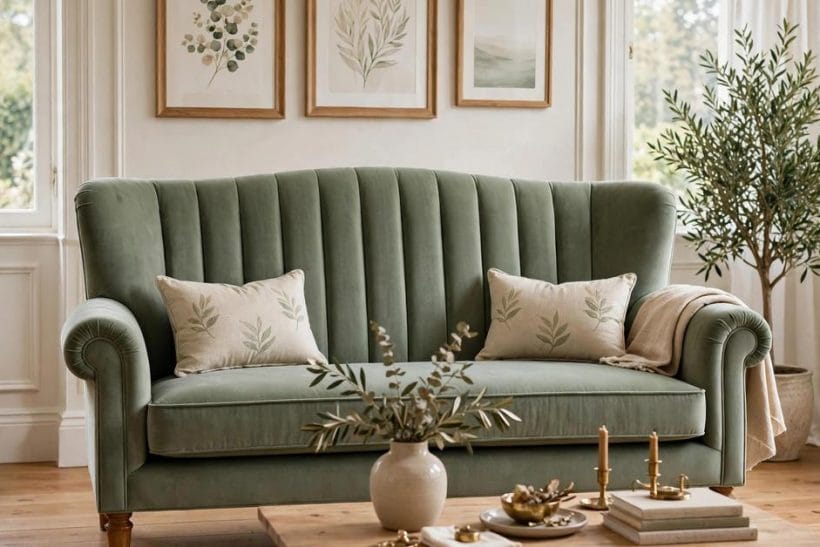
Gallery-3 stands here as the settee’s closest look-alike, the better to banish the confusion: a three-sided wooden daybed, deep enough to sleep on. The settee itself — the feature image’s sage channel-backed two-seater — is something else entirely: the most conventional piece in this glossary, a sofa written small, with no sleeping in its contract.
10. What a settee is
A settee is a small upholstered seat for two, with a back and arms, usually on exposed legs — in essence a compact sofa. Historically it is the older word, the joiner’s term for the long upholstered seats of centuries before “sofa” took the language; antiques are settees, showrooms sell sofas, and they are the same idea at different scales.
11. Settee, sofa or loveseat?
Size and register separate them. The loveseat is the American word for the two-seat sofa; the settee is the same territory spoken by the antiques trade and by makers of period-style pieces — often slimmer, higher-legged and more formal. If a listing says settee, expect a piece with manners.
12. Where a settee belongs
The hall, the small sitting room, the bedroom’s foot, the bay window: wherever conversation for two is wanted at a scale a sofa would swamp. In the traditional living room it is the period-correct seat; in a modern one, it is the tailored exception.
6. Side by Side: The Checks That Separate Them
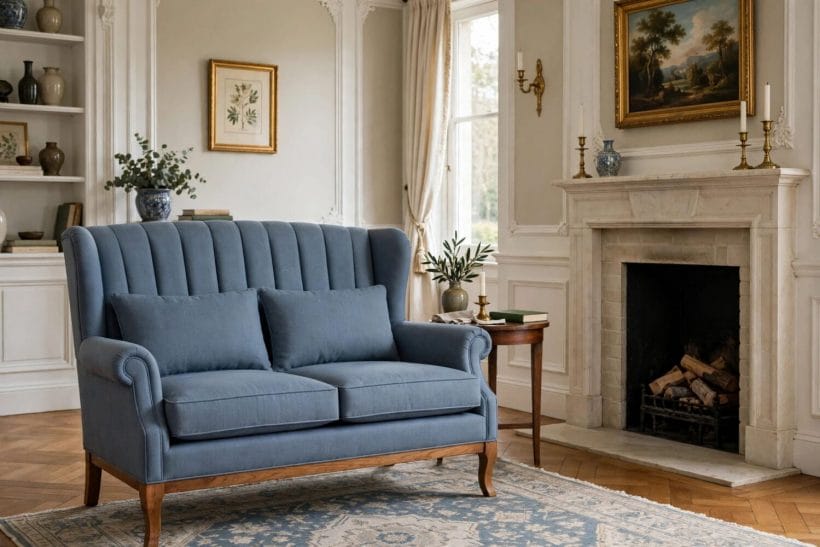
Gallery-4’s blue settee — channel-backed, two-seated, set before the fire — is the worked example. Five checks, applied in order, will name it — and any seat in any listing.
13. Has it a back of its own?
The divan has none — it borrows the wall’s. The chaise has a back at one end only. The settee has a full back. The daybed has a frame that acts as one. The back alone separates three of the four.
14. How many arms?
Settees: two arms, usually. Chaises: none, or one sweeping side. Divans: none. Daybeds: ends rather than arms — the three-sided frame. Arms are the settee’s signature and the chaise’s most common absence.
15. Does it sleep someone?
Only the daybed, properly. A chaise can nap a person; a divan can host a determined guest; neither pretends to be a bed. If the piece must sleep someone weekly, the glossary’s answer is always the daybed.
16. What is the seat made of?
A mattress means a daybed, whatever the listing calls it. Upholstered seat cushions on a frame mean settee or chaise. A platform with loose cushions and bolsters means divan. Follow the seat and the terms fall into place.
17. Length against depth
Relationally: the chaise is long for one; the daybed is bed-long and seat-deep; the settee is short and upright; the divan is as long as the wall allows and as deep as its cushions are many. The proportions in a photograph, read against a door or a person, tell the term before the caption does.
7. Buying Checks for All Four
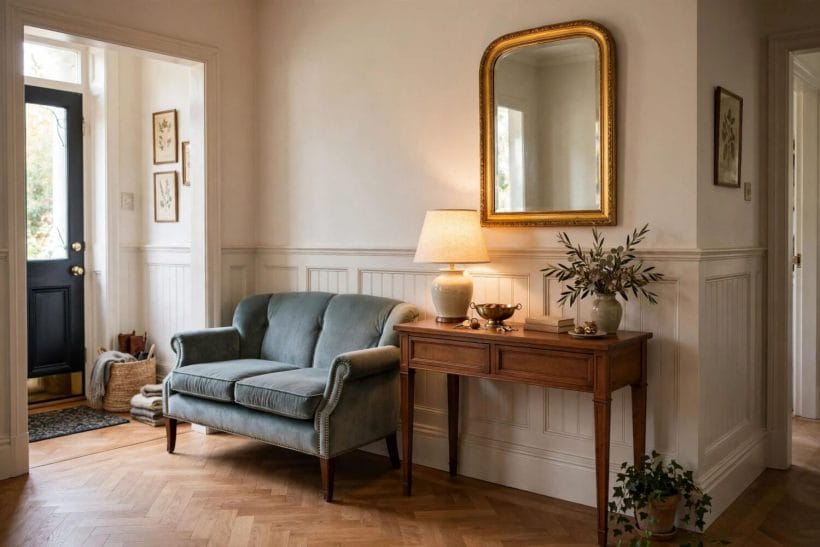
Gallery-5’s hall settee — small, upright, exactly right for its job — is the reward for choosing by fit rather than by label. These checks, and the only research that settles comfort (sitting in the thing), serve all four terms.
18. Name the job first
Reading alone, hosting guests, sleeping weekly, seating two in a hall — the job names the term before the shopping starts. Most buying errors in this family are vocabulary errors: the right piece bought under the wrong expectation of it.
19. Sit, and lie, before you buy
Recline in the chaise, sprawl on the divan’s cushions, sit deep in the daybed, sit upright in the settee: each is judged in its own posture. A minute in the showroom is worth an evening of regret’s tuition.
20. Cushions and bolsters are the divan’s frame
For a divan, the loose cushions are not accessories but structure — their number, fill and firmness are the piece. Price and judge them accordingly, and count replacements into any antique’s true cost.
21. Fabric for the duty
A daybed that sleeps needs bed-worthy, washable dressing; a settee in a hall needs a fabric that forgives bags and coats. The terms are shapes; the fabrics make them practical — a point the room guides, from modern living room ideas to bedroom ideas, repeat in every register.
8. The Terms in the Wild

The second pin’s daybed — framed in wood, heaped with cushions, working as the room’s sofa — is where the words are used loosest. Three habits of the wild are worth knowing.
22. Why shops mix the words
Listings are written for search, not precision: a backless bench becomes a “divan daybed”, a two-seat sofa a “settee chaise”. The seller is not lying so much as casting a net. The buyer’s defence is this glossary’s checks — the object is what it is, whatever it is called.
23. Antique and auction usage
The antiques trade uses the older words precisely: a Georgian settee, a Regency chaise, a campaign daybed are descriptions a valuer will stand behind. In that register the term is part of the attribution, and learning it is learning the furniture’s history.
24. Reading a listing accurately
Translate every listing into the checks of section 6 — back, arms, mattress, proportions — and the word in the headline becomes decoration. The photograph and the measurements, read properly, always confess the term.
9. One Room, Four Answers

Gallery-6’s corner — a daybed dressed for the night in a room that receives guests — closes the glossary where definitions end: in rooms. Three placements, one for each temperament of rest.
25. The reading corner: a chaise
For the solitary reader the chaise is the answer furniture perfected centuries ago: legs up, back supported, the book at the right distance from the lamp. No other seat in the glossary is so single-minded.
26. The guest-room answer: a daybed
For the room that must double, the daybed — with the divan as its cushion-backed understudy where a bed is truly never needed. The glossary’s most practical entry is also its best host.
27. The small formal seat: a settee
For two people talking in a small room, the settee — upright, armed, mannerly — keeps the conversation seated properly. It is the oldest answer here, and in the right room still the most elegant.
10. Choosing by the Job
The glossary reduces, in the end, to a single habit: choose by the job, name by the shape. Recline alone — chaise. Line a wall with cushions — divan. Sleep a guest in a room that works by day — daybed. Seat two with formality at small scale — settee. The words have survived centuries because the four jobs are different, and a house furnished with the differences in mind rests better in every one of them.
Final Considerations
Back or none, arms or none, mattress or cushions, one reclining body or two upright sitters — four checks, and the chaise, divan, daybed and settee will never blur again. Keep the definitions by shape and the listings can call them anything they like; you will know what is actually for sale, and what it is actually for.




0 Comments