

A clearance sale is the best and the riskiest way to buy bedding. The best, because end-of-line colours, discontinued weaves and overstocks sell for a fraction of their ordinary shelf life; the riskiest, because sale stock is where seconds, odd sizes and final-sale terms live, and a sheet set cannot be judged from a folded stack the way it will be judged at two in the morning.
This guide is the checking discipline that separates the two: what to verify about fabric, size, fill and terms before paying, how to inspect what arrives, and how to wash, store and rotate sale bedding so the bargain survives its first year. Everything is stated generally — sale terms are set by each seller, and the seller’s own stated terms are always the ones that govern.

1. Buying Bedding in a Clearance Sale at a Glance
Scope first. This guide owns one job: the checks for buying bedding well when the price is reduced and the terms are tighter than usual. The bedroom as a room is the territory of bedroom ideas; the general method of buying household goods sight-unseen is the furniture buying guide; and small-room bedding is covered in the published tiny bedroom ideas. Here, everything is the bedding itself and the terms it is sold under.
One discipline runs through every section: in a clearance sale, the checks move earlier. What an ordinary purchase lets you fix afterwards — the wrong size, the scratchy weave, the colour that fights the room — a final-sale purchase may not let you fix at all. So the order of this guide is the order of the work: terms first, fabric and size next, inspection the moment anything arrives.
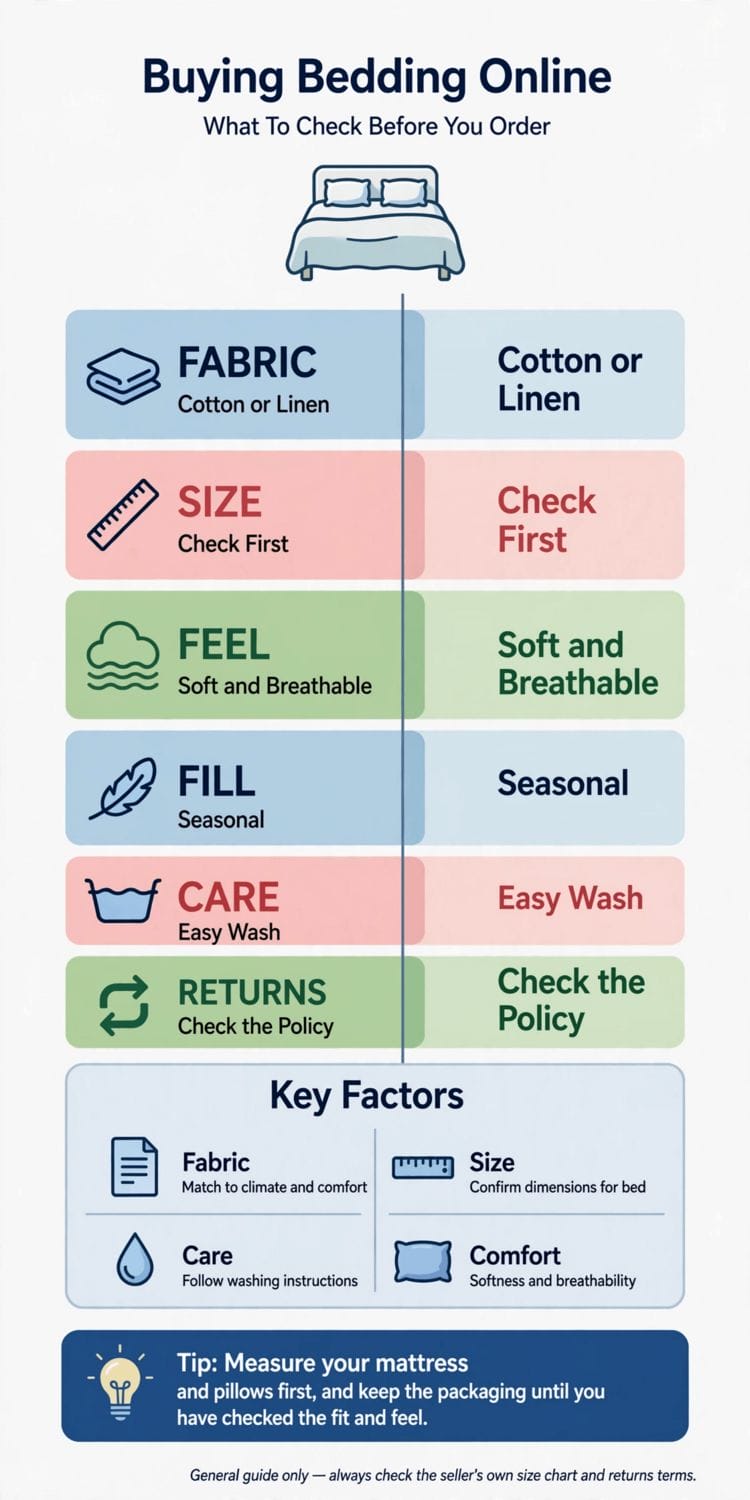
| Check | What good looks like |
|---|---|
| Terms | The returns and final-sale conditions read before paying, not after |
| Fabric | Cotton, linen or a stated blend — named on the label, not implied |
| Size | Your mattress measured first; the seller’s own size chart matched to it |
| Feel | Soft and breathable for the fabric claimed — the hand test where possible |
| Fill | Warmth suited to the season the bedding will actually serve |
| Care | Easy wash on the care label — nothing bought that you cannot launder |
2. Fabric First: What the Label Must Tell You

Gallery-1’s woven landscape — knits, linens and cottons in their natural textures — is the first check made visible. Fabric is the bedding; everything else is finishing, and in sale stock the label matters more than the fold.
1. The fibre must be named
Cotton, linen, or a blend with its proportions stated — the label should say, plainly. Bedding described only by softness words, with no fibre named, is bedding whose maker prefers you not to know, and sale prices do not improve it.
2. Weave words in plain terms
Percale is a plain, crisp weave that feels cool; sateen is woven for a smoother, slightly warmer hand; flannel is brushed for warmth. None is better — they are different, and a clearance rail is where the difference is cheapest to learn by reading rather than by sleeping.
3. Thread-count claims, treated calmly
High numbers on bedding labels are a marketing dialect as much as a measurement. Judge by the named fibre, the weave and the feel in the hand where the sale allows it — a modest count in honest cotton out-sleeps an extravagant claim in a blend.
4. Seconds and irregulars, in general terms
Sale stock sometimes includes seconds — pieces with small faults, sold as such. The general check is that the fault is declared and cosmetic: a weave slub or a shade variation is a bargain; a fault in a seam is a future tear at a reduced price.
3. Size: Measure Before Anything Else

Gallery-3 is the guide’s most repeated photograph in spirit: a tape against a mattress corner. More sale bedding disappoints by fit than by any other cause, and fit is the one fault entirely preventable before paying.
5. Measure the mattress — depth included
Length and width are the beginning; depth is where fitted sheets fail. Measure the mattress with any topper in place, and keep the three numbers written down — sale shopping from memory is how the wrong size comes home.
6. Size names are not universal
The same size word can cover different dimensions between makers and between countries. The authority is the seller’s own size chart for that product, matched against your tape — never the word alone, and never another brand’s chart.
7. Duvets, covers and inserts are three sizes
A duvet cover is bought for the insert it must hold, and both are bought for the bed. In a sale, matched sets separate easily — check that the cover on the rail and the insert at home belong to the same size family before either is paid for.
8. Pillowcases follow the pillows
Standard, square and bolster cases are not interchangeable, and pillow wardrobes are mixed in most houses. Count your pillows by size before the sale, not after the cases arrive.
9. Deep pockets and elastic, stated generally
Fitted sheets declare their pocket depth and whether the elastic runs all round or only at the corners. Mattresses have grown deeper over the years; the declaration on the packet, checked against your measurement, is the whole of this check.
4. Buying Without the Hand Test

Gallery-4 — a laptop of colour swatches beside folded linen on a bench — is the modern sale rail. Where bedding is bought from a listing rather than a shelf, the checks change instruments: description, photograph and terms do the work the hand would have done, in the same spirit as the sight-unseen method of the online flooring guide.
10. Read the whole description, including what is not in it
A “set” is defined by its contents list, and the contents list is where pillowcases quietly become singular. Read for fibre, sizes, piece count and care — and treat a missing item on that list as information, not as an oversight.
11. Photographs show colour; screens approximate it
Every screen warms or cools a colour, and sale colours are often discontinued precisely because they are particular. Where the seller offers a swatch or a second photograph in daylight, use it; where not, buy colours that forgive approximation — naturals, whites, and tones already in the room.
12. Repeated complaints are the review that matters
Read reviews for patterns, not averages: one report of shrinking is an anecdote, the same report repeated is the product describing itself. In sale stock especially, the repeated complaint about fit or pilling is the check the hand cannot make.
13. Keep the listing until the parcel is checked
Save the description and terms as they stood when you paid. If what arrives disagrees with them, the disagreement is provable only from the buyer’s own copy — a small archive that costs a screenshot.
5. Sets, Colours and Completeness
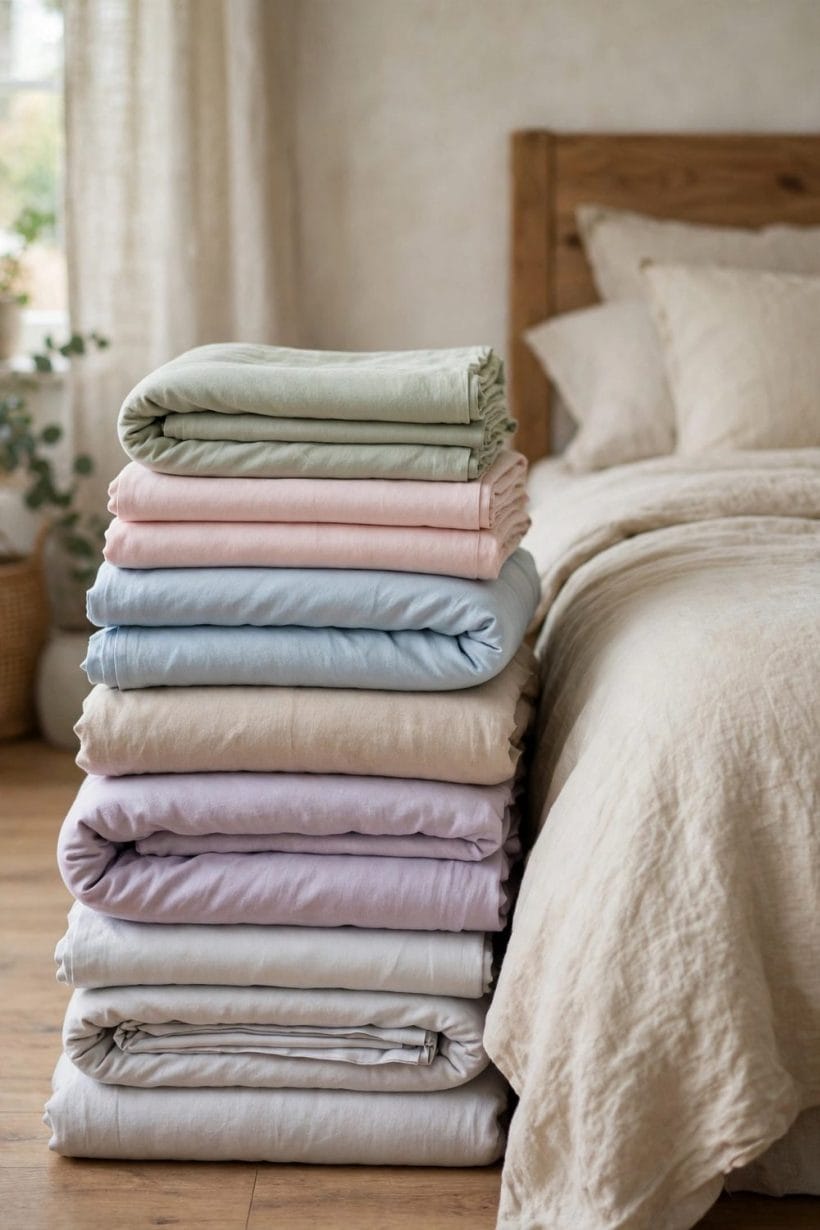
The pin’s stack — folded bedding in sage, blush, blue, cream and lilac beside a dressed bed — is the sale rail’s temptation and its trap in one image: beautiful pieces, bought one colour at a time, that must still make beds.
14. Count a set by its pieces, not its name
Sheet sets and bedding sets vary in what they include between makers. The arithmetic is done on the rail: sheet, cases, cover — against the bed’s actual need, at the set’s actual price.
15. Dye lots and the matching question
Two pieces of “the same” colour bought months apart may not match; two bought together from one lot usually do. In clearance stock, where the lot will not come again, buy the matching pieces in the same visit or design the mismatch deliberately — a contrast intended reads better than a match attempted.
16. Orphan pieces, priced as orphans
A single pillowcase, an unmatched flat sheet, a cover without its insert: all are useful to the house that needs exactly that piece, and worthless to the house that doesn’t. Sale prices on orphans are fair only when the need already exists.
17. Plain colours outlast prints in a mixed wardrobe
Whites, naturals and single colours combine with everything the linen cupboard already holds; a bold print combines with itself. Clearance buying rewards the combinable, because the wardrobe it joins is fixed.
6. Inspect on Arrival: Seams, Faults and Matching

Gallery-2 is the cautionary photograph: a pillowcase seam split, its fill escaping. Faults like it are exactly what prompt inspection exists to find — while the terms for returning a genuinely faulty piece can still be used, and before the bedding has been washed into acceptance.
18. Open everything promptly
Whatever the seller’s window for reporting faults, it runs from delivery, not from first use. Unpack, unfold and look at every piece within days — the linen cupboard can wait; the inspection cannot.
19. Seams, hems and fastenings
Run the seams with your fingers, check hems lie flat, and work every button, tie and zip. A seam’s weakness announces itself to a gentle pull now or to the washing machine later, and now is cheaper.
20. Marks, smells and storage history
Sale stock may have waited in storage: look for marks, tide-lines and the stale smell that one wash may or may not cure. Declared storage marks at a declared price are a bargain; undeclared ones are a conversation with the seller, held promptly and politely.
21. Pairs and sets must match each other
Lay the pieces of a set together in daylight. Two pillowcases of slightly different dye, a sheet and cases a tone apart — the time to see it is on the table, with the paperwork still to hand.
7. Wash and Care Checks

Gallery-5’s line of white bedding in a field is the care section’s whole argument: bedding is the most-washed textile in the house, and its care label is a term of the purchase as real as the price. The room where the washing happens has its own survey in the laundry room ideas pillar.
22. The care label is read before paying
“Easy wash” is the standard to buy to: bedding that asks for specialist cleaning will cost its bargain back in care. The label’s demands — temperature, drying, ironing — are checked against the laundry you actually run.
23. Wash before first use, by the label
New bedding carries its making on its surface; a first wash by the care label settles the hand, the fit and the colour before the bedding is judged. It is also the moment any shrinking declares itself, inside the window where it can still be reported.
24. Colourfastness on a corner first
Deep sale colours earn a small test: a damp white cloth pressed to a hidden corner. Colour that travels in the test will travel in the wash, and knowing before the first full load saves the whites it would have met.
25. Drying and storage are part of care
Some fabrics want the line, some the machine, all want to be stored dry and aired. The check is simple: buy only what your laundry and your cupboard can keep as the label asks.
8. Fill, Warmth and the Hand Test

The second pin is the hand test itself: palms pressing into a duvet, reading its loft. Fill is the one quality no description conveys, which is why clearance bedding with fill is bought, where possible, where it can be touched.
26. Fill type and seasonal warmth
Down, feather, wool and synthetic fills each carry warmth differently, and warmth ratings are stated by each maker in their own terms. The general check is seasonal honesty: buy the warmth for the months the bedding will serve, and let the maker’s own rating — not a shelf label — describe it.
27. Loft and recovery in the hand
Press, and watch the fill come back. Even distribution, no cold lumps, no rustle of broken quills through the casing: thirty seconds of handling reports what a season of sleeping would, and a sale is not a reason to skip the report.
9. Stocking Up Sensibly: Spares, Rotation and Storage

Gallery-6’s linen cupboard — folded sets stacked by colour, every shelf accounted for — is where clearance buying either proves itself or becomes storage. The working rule is rotation: a bed needs its set in use, its spare in the wash cycle, and at most one further set against guests and accidents, on the scale the published tiny house bedroom ideas keep by necessity.
Beyond that point, each additional set is not savings but stock — money folded on a shelf, in colours that must still match rooms years from now. The disciplined sale buyer shops the cupboard first, writes the gaps down (sizes, colours, the guest bed’s lack), and lets the list, not the rail, decide. Bedding bought that way is a wardrobe; bought the other way, it is a warehouse with a duvet problem.
10. Final-Sale and Returns Terms: Read First, Honoured Always
The last section returns to the first check, because it governs all the others. Sale terms are stated by each seller, they differ between sellers, and they bind the purchase from the moment of paying — which is why they are read before it. “Final sale” stated plainly means the piece is yours as it stands, change-of-mind returns aside; a stated returns window means what it says, for as long as it says. Neither is a trick — both are terms, and the buyer’s protection is in having read them while the decision was still free.
Two distinctions are worth carrying into any sale. A genuinely faulty piece is a different matter from a change of mind, and sellers’ stated terms commonly treat them differently — which is why section 6’s prompt inspection matters, and why receipts, packaging and the saved listing are kept until the bedding has been opened, checked and washed once. A bargain, finally, is arithmetic, not atmosphere: the price against the piece’s real usefulness to your beds, your sizes and your cupboard. Bedding that passes every check in this guide at a clearance price is among the best buys a house can make; bedding that fails the checks is expensive at any price, and the rail will still be there — with better stock on it — next season.
Final Considerations
Buy clearance bedding the way this guide is ordered: terms before fabric, measurements before money, inspection before washing, and the cupboard’s gaps before the rail’s temptations. Named fibres, honest sizes, seams that hold, colours that combine and care you can actually give — bedding that passes those checks will out-sleep its price for years. For the rooms it dresses and the wardrobes it joins, the bedroom and small-bedroom posts linked in sections 1 and 9 carry the story onward.




0 Comments