

Somewhere tonight, a household is about to order a whole floor from a website — seduced by a photograph, a price per box and a range no local shop could stock. It can be the smartest way to buy flooring there is. It can also go wrong in ways a showroom never allowed, which is why the question shoppers ask each other — has anyone actually ordered flooring this way, and did it work — deserves a proper answer.
This guide is that answer, written as a method rather than a verdict on any one retailer: what to check before ordering flooring online, in the order to check it. Samples, specifications, batches, measuring, delivery, returns and the true total cost — seven checks that turn a warehouse catalogue into a floor you can stand on, in every sense.
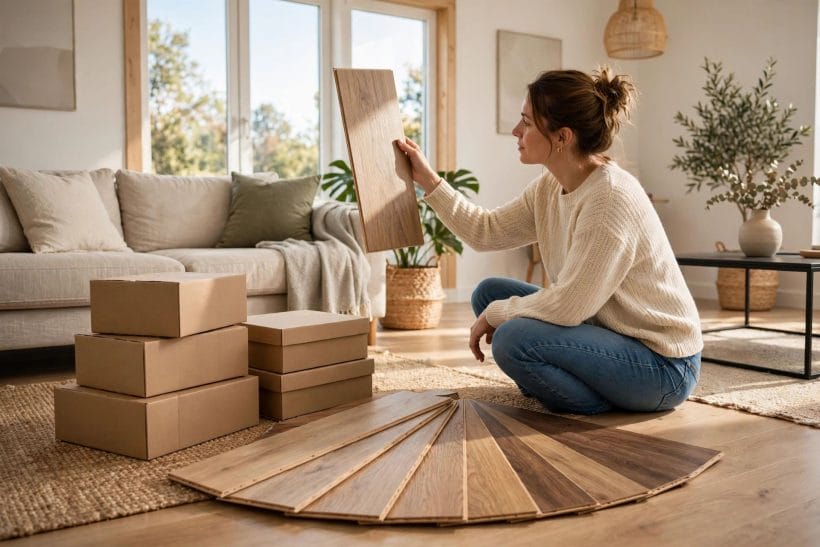
1. Buying Flooring Online at a Glance
Buying flooring online means choosing a floor covering from a warehouse retailer’s catalogue — engineered and solid timber, laminate, vinyl and tile sold by the box and delivered as freight — and taking personal responsibility for the checks a showroom traditionally performed. Its attributes are the product (construction, surface, stated specification), the evidence (samples in the room’s own light), the batch (one run, one order, spares kept), the quantity (honest measuring plus a cutting allowance) and the transaction (delivery terms, checking before signing, returns of unopened boxes). The rooms those floors serve are designed across this site’s home design ideas collections; this page owns the purchase itself.
| Question | Short answer |
|---|---|
| Is it safe to buy flooring online? | Yes, with the showroom’s checks done at home: samples first, one batch, delivery inspected before signing. |
| What is the biggest risk? | Batch variation between separate orders — order the whole floor once, and keep same-batch spares. |
| How much extra should I order? | The cutting allowance your fitter or seller advises for the room’s shape; exact-area ordering is the classic false economy. |
| Is online flooring really cheaper? | Compare the delivered, fitted total — product, delivery, underlay, trims, fitting — never the box price alone. |
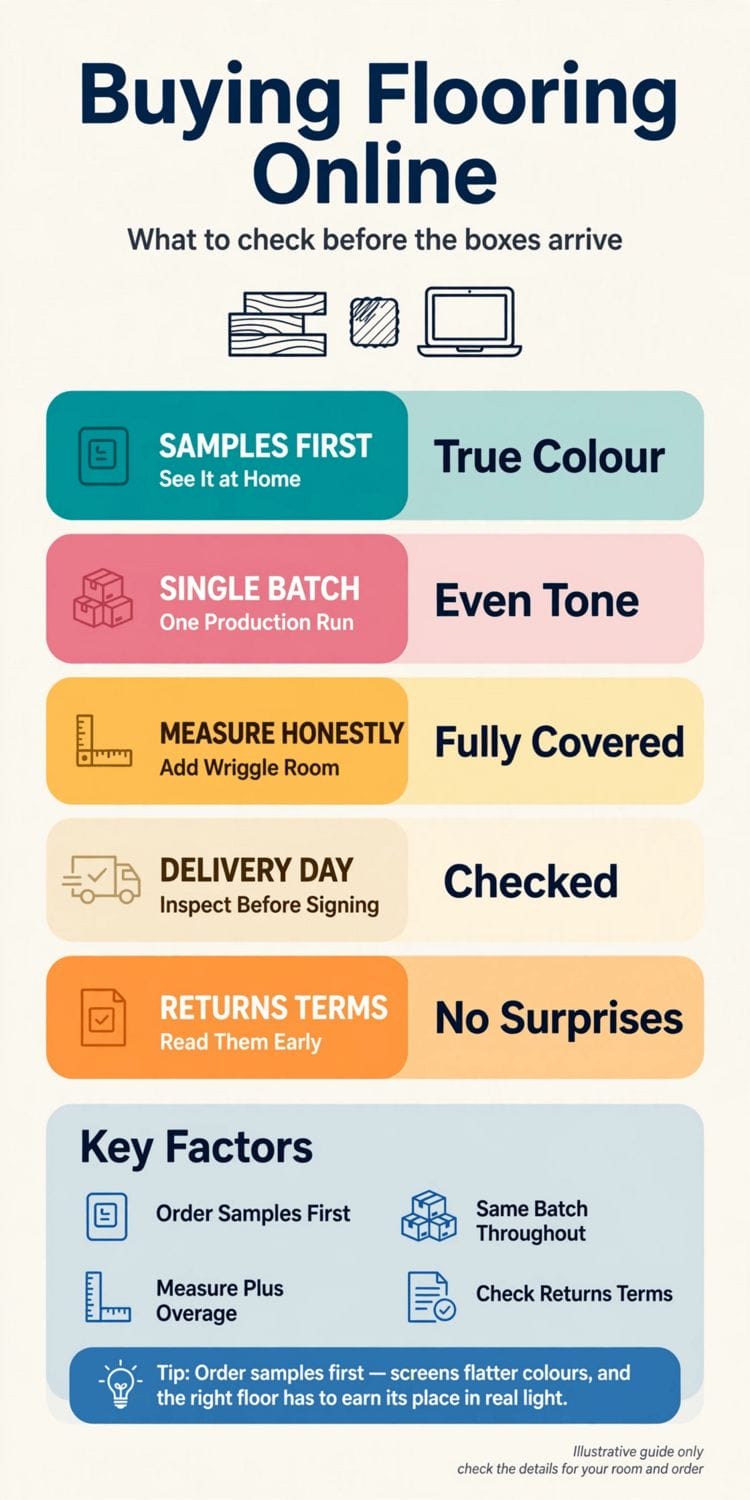
2. Why Flooring Went Online: What the Model Changes and What It Does Not
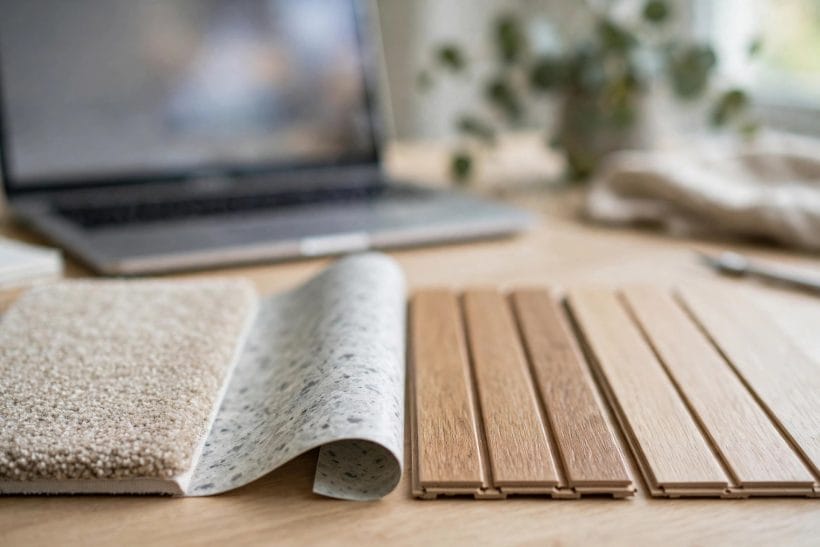
Flooring followed books and electronics onto the internet for a simple reason: a floor is heavy, bulky and chosen from a catalogue, and a warehouse with a website can hold a range no high-street showroom can match. Large online retailers — BuildDirect is one of the names shoppers meet early, built on exactly this warehouse model — list hundreds of boards, tiles and planks that a local shop could never stock, and the lorry replaces the shop floor.
What the model genuinely changes is choice and comparison. Ranges can be compared side by side at midnight, prices for the same construction sit a click apart, and the delivery arrives at the door rather than in the back of a borrowed car. For rural households and for anyone whose local shops stock three shades of beige, that change is not a convenience but a rescue.
What it does not change is everything physical about a floor. The room still has to be measured honestly, the boards still have to acclimatise, the subfloor still has to be sound, and someone still has to fit the thing well. Online buying moves the showroom’s work — advising, checking, reassuring — onto the buyer. This guide is about doing that work properly.
It also changes who carries the risk at each step, and it is worth seeing the exchange clearly. The showroom’s price quietly included advice, a van, a fitter’s relationship and a door to knock on when a board arrived split. The online price strips those out and hands them to you as tasks. Households who enjoy the tasks — and they are genuinely satisfying, in a surveying, clipboard way — keep the saving honestly. Households who would rather not do them are not foolish for paying a local firm; they are buying the service back.
3. Samples First: The Small Box That Decides
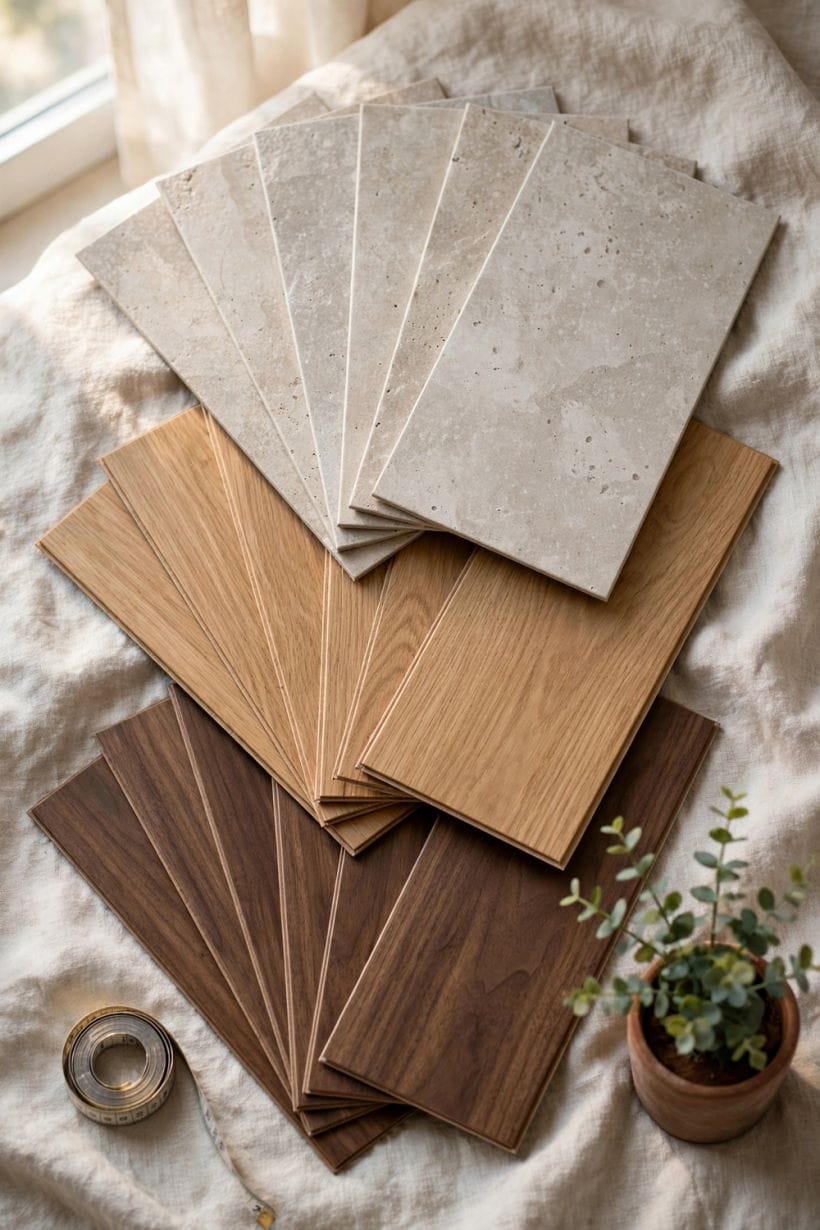
Every honest online flooring purchase begins with samples, and every regretted one begins without them. A screen shows a colour the manufacturer chose under lighting you do not own; a sample shows the actual board, in your room, beside your furniture, in your daylight. Order samples of every serious finalist — and of the one you are about to dismiss, because samples have a long history of reversing decisions.
Live with them properly. Lay the samples where the floor will go and look at them in the morning, at noon and by lamplight, because flooring, like paint, is a light decision disguised as a colour decision. Walk on them in socks and shoes. Put the kettle-side sample near the sink and the door-side sample at the door, where the wear and the weather will actually happen.
Test them with the room’s real life, gently: a drip of water left and wiped, a dragged chair foot, a set of keys dropped from pocket height. You are not trying to destroy the sample; you are learning how the surface behaves before forty boxes of it arrive. Then — and only then — let the full order follow the sample that survived your house.
Order the samples generously while you are at it: two of the favourite, so one can live at the door and one by the window while you decide. Samples are the cheapest line in the whole project, and the only one whose job is to stop you spending the rest of the money wrongly. A household that baulks at the price of samples is about to pay for the lesson at full scale, in a floor it has to look at every day.
4. Reading a Product Page Like a Flooring Specialist
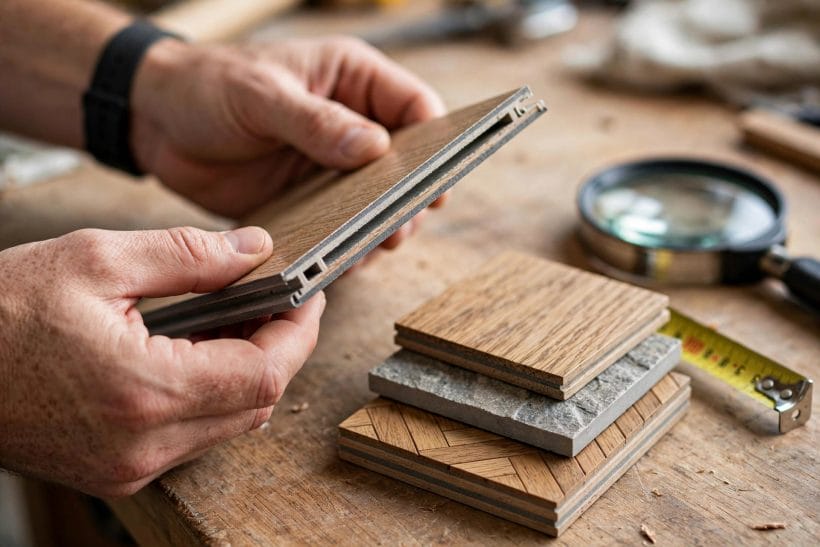
A flooring product page is a specification wearing a photograph, and the specification is the part to read. Begin with the construction: solid timber, engineered board, laminate, vinyl or tile each behave differently under feet, water and time, and the construction — not the photograph of a lifestyle kitchen — decides which rooms the product can honestly serve.
Read the surface next. Finishes range from oils that soak in to lacquers and wear layers that sit on top, and each has its own maintenance story and its own way of ageing. The page will state the board’s dimensions, its fitting system and its intended rooms; treat those statements as the manufacturer’s evidence, and be suspicious of any listing that will not state them at all.
Read the reviews for patterns, never for anecdotes. One furious review is a story; thirty reviews mentioning the same clicking joint, the same colour shift or the same delivery damage are data. And keep the whole page — save or print the specification at order time, because the page you bought from is the description your delivery will be checked against.
Finally, match the product to the room’s actual life rather than its photograph. A board specified for dry living spaces does not become suitable for a wet bathroom because its picture is beautiful, and a delicate finish in a hallway used by dogs and bicycles will record every day of it. The specification’s stated rooms and duties are the manufacturer’s honest sentence in a page of adjectives; buy by that sentence.
5. Batch and Dye-Lot Consistency: The Risk Nobody Photographs
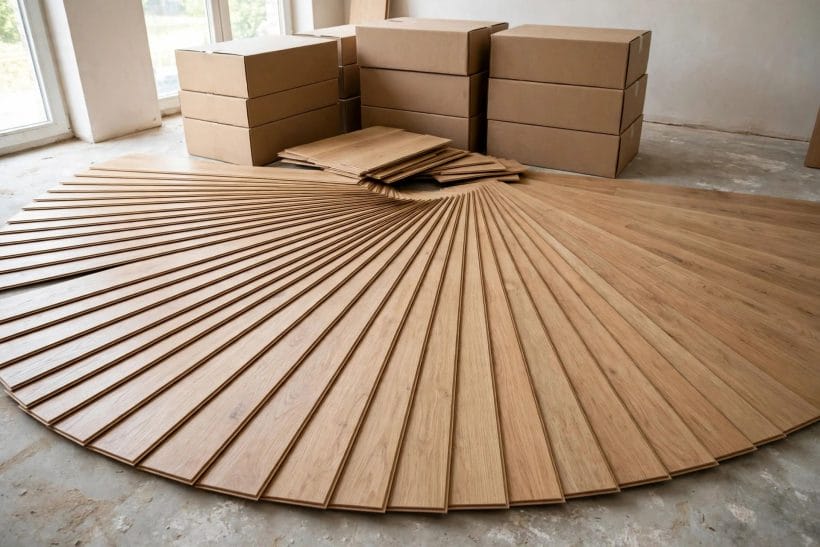
Flooring is made in runs, and runs vary. Timber varies by tree, dyed and printed surfaces vary by batch, and even stone-look tiles shift gently between firings. Within one batch the variation is blended by design; between batches it can stand at the doorway like a change of mind. This is the online buyer’s least photographed risk and the one most worth planning against.
The defence is simple and absolute: order the whole floor — every room it covers, every box — in one order, from one batch, at one time. Note the batch or dye-lot reference on the delivery paperwork when it arrives, and check the boxes agree with each other before the fitter opens the first one. A floor ordered in two instalments is a floor with a visible seam in its history.
Then keep the insurance: a small reserve of boards from the same batch, stored flat and dry, against the day a pipe leaks or a hearth accident writes off three boards in the middle of the room. In ten years’ time those spare boards will be the most valuable timber in the house, precisely because their batch no longer exists.
6. Measuring the Room and Ordering the Overage
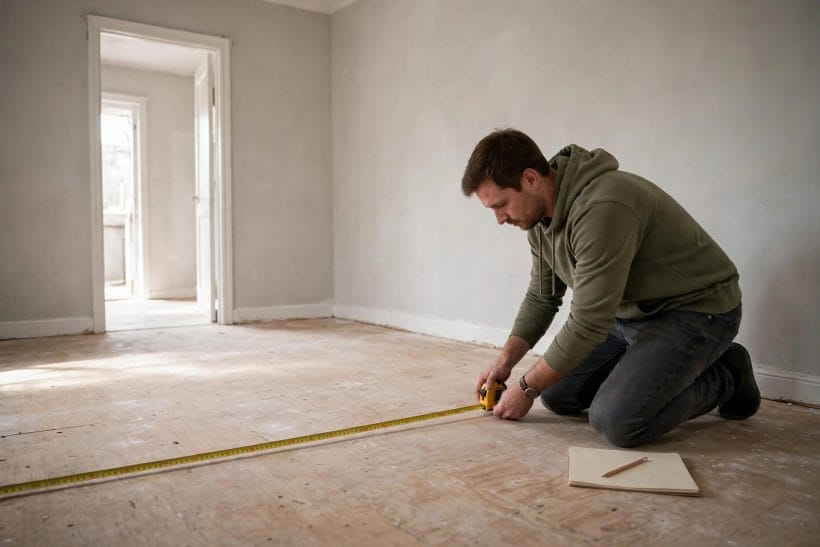
Measure the room as it is, not as the estate agent described it. Take the length and width at several points — rooms are rarely the rectangles they pretend to be — and draw the plan on paper with the alcoves, the hearth, the door swings and the awkward corner behind the door all included. The drawing, not the memory of the drawing, is what the order is built from.
Add the cutting allowance your fitter or the seller advises, and add it honestly. Floors are cut at edges, around obstacles and through mistakes, and the offcuts of a well-planned floor are the price of its fit edges. Ordering to the exact measured area is the one false economy that can strand a nearly finished room waiting on a second delivery — from, potentially, a different batch.
Stairs, hallways and connected rooms deserve their own line on the plan, because they consume boards in cuts out of all proportion to their area. If a professional is fitting the floor, let them check the measurements before the order is placed; the fee for that visit is smaller than one box of the wrong total.
Measure the subfloor’s story as well as the room’s size. A floor that dips, a board that moves, a damp patch by the door: online sellers deliver flooring, not forgiveness, and new boards laid over an unprepared base will announce the fact within the year. Any doubt about the base belongs to a fitter’s inspection before the order, when it is still cheap to hear.
7. Delivery Day: Pallets, Access and Checking Before You Sign
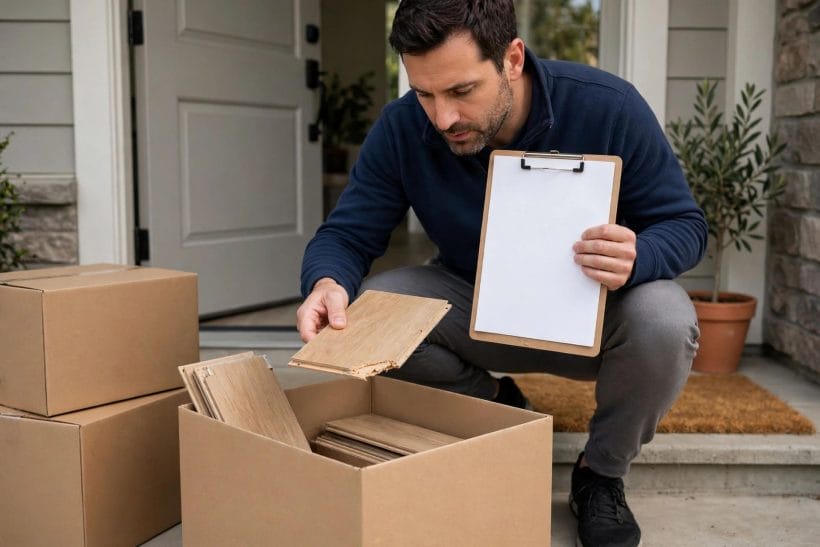
Online flooring arrives as freight, and freight has manners of its own. Confirm before the day whether the delivery is kerbside or carried in, what vehicle size to expect and what access it needs — a pallet of boards that cannot reach the house is a problem delivered, not solved. Have hands, a dry storage space and a clear route ready before the lorry is.
Check the delivery before you sign for it: count the boxes, read the labels against the order — product, colour, batch — and look hard at the corners and wrapping for the crush damage that freight collects. Damage found and noted on the delivery paperwork, with photographs, is a claim; damage found next week is an argument. The driver’s hurry is not your signature’s problem.
Then let the floor rest. Boards and planks acclimatise to the room they will live in, following the manufacturer’s stated instructions for the product you bought — stacked as directed, in the room, for the stated period. Fitting a floor the day it arrives, straight off a cold lorry, is how gaps are scheduled for winter.
Plan the storage corner before the lorry plans it for you. A floor’s worth of boxes is a serious piece of furniture for the days it waits: flat, dry, off a cold floor, out of the walkway and away from radiators and sunny glass, whose heat warps packaging and boards alike. Households that clear the corner in advance describe delivery day as exciting; households that improvise describe it differently.
8. Returns, Shortfalls and the Second-Order Problem
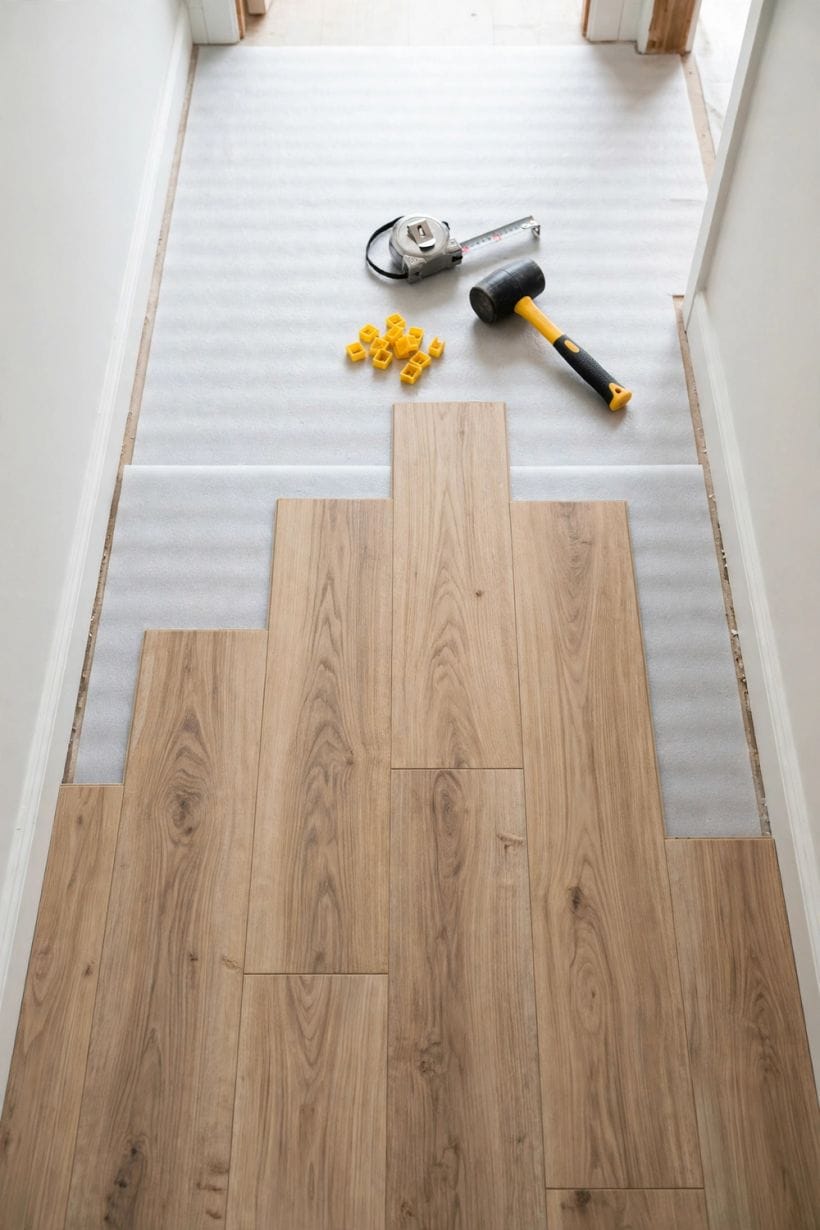
Read the returns terms before the order, not after the problem: they are part of the product. Online sellers commonly accept returns of complete, unopened boxes within a stated window, and the buyer usually carries the return carriage on a product this heavy — which is a strong argument for measuring well rather than over-ordering wildly and trusting the returns page.
The shortfall is the sharper trap. Run out mid-floor and the second order may arrive from a different batch, with the colour shift described earlier standing exactly where the two orders meet. The overage allowance exists precisely to keep the second order unnecessary; buy it, and treat any unopened surplus as the returns page’s business, calmly, within its stated terms.
Keep every paper: the order confirmation, the saved product page, the delivery note with its batch references and the photographs from delivery day. Flooring disputes are won by households who can show what was promised, what arrived and when. The file takes five minutes to keep and settles arguments that memory never will.
One more courtesy protects the whole arrangement: open and inspect the boxes promptly, within whatever window the seller’s terms allow for reporting problems, rather than leaving the pallet sealed until the fitter’s first morning. A fault reported inside the window is a replacement; the same fault reported outside it is a negotiation. The calendar, like the batch number, is part of the purchase.
9. Total Cost: Comparing the Delivered, Fitted Price
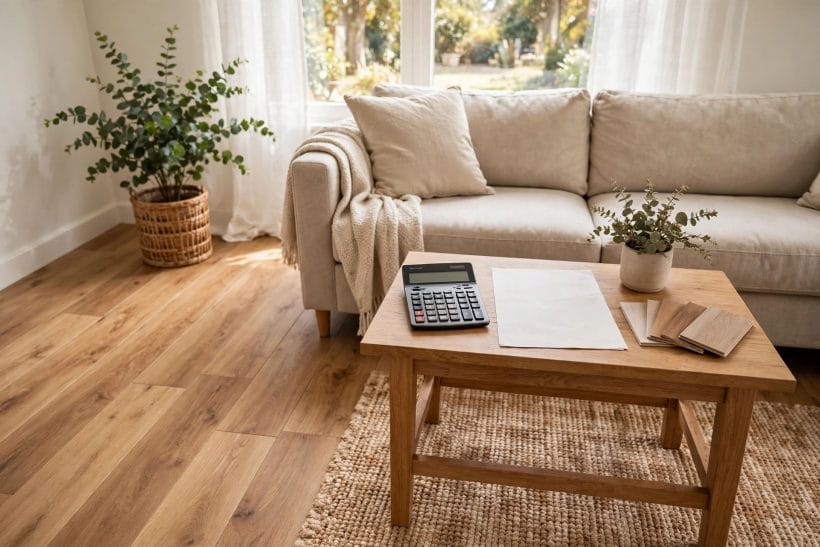
The box price is the beginning of a floor’s cost, never its total. Between the listed price and the finished floor stand delivery charges, underlay, trims and thresholds, the fitting itself — your own skilled time or a professional’s fee — and the removal of the old floor. An online price that looks unbeatable can merely be a price quoted earlier in the journey than the local quote was.
So compare like with like: build the full stack for each candidate — product, delivery, preparation, fitting, finishing — and compare the completed floors, not the opening bids. The general discipline is the same one the basement remodel cost guide applies to a whole room: the honest number is the one that includes every stage between the photograph and the finished thing.
And let value include the risks this guide has priced. A slightly dearer floor that arrives in one batch, matches its sample and carries fair returns terms is cheaper than the bargain that fails on any three of those counts. In flooring, as in little else, the cheapest purchase is the one you only make once.
Do the comparison once, in writing, on one page: the product stack for the online favourite on the left, the local quote rebuilt into the same stages on the right. Written down, the two numbers usually sit closer than the advertisements promised — and the decision becomes what it should have been all along, a choice between services and safeguards rather than between two incomplete prices.
10. Costs and Pulling It Together
Pulled together, the online flooring method is a short discipline: choose by construction, decide by sample, order once and whole, check the delivery like a warehouseman, and judge every price as a fitted floor rather than a box. None of it is difficult, and all of it replaces — task for task — the work a good showroom used to do for you.
The rooms the floor will serve are designed elsewhere on this site — the living room ideas pillar for the room most floors are bought for, the basement ideas collection for the room where flooring works hardest — but the buying method travels unchanged to every one of them. A floor is bought once and lived on daily; the hour this guide asks for is the cheapest hour of its whole life.
Final Considerations
Buy the floor the way a specialist would sell it to you: slowly at the samples, decisively at the order, suspiciously at the delivery. Do that, and the internet’s enormous catalogue becomes what it should be — the largest flooring showroom in the world, with you as its most careful customer.
For the rooms themselves, the house-wide home design ideas hub gathers the collections floor by floor — bedroom ideas and dining room ideas among them — while this guide stays where it belongs: between the catalogue and the doorstep.




0 Comments