

An epoxy floor is a plain slab transformed: a resin coating, laid over concrete or another sound base, that cures into a seamless, glossy, coloured skin. Garages made it famous, but the finish has walked indoors — into basements, workshops, utility rooms and whole living spaces — anywhere a floor must be tough, washable and quietly dramatic.
These seventy-five epoxy flooring ideas collect the finish in its forms — metallic swirls, speckled flake, solid colour and clear coats — across the rooms it serves, with the colour, layout and care judgements that keep a poured floor looking poured rather than painted.
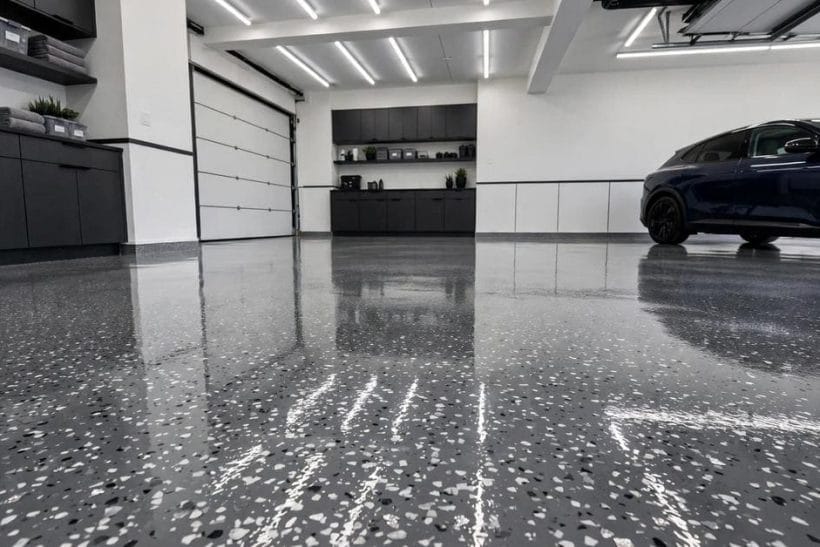
1. Epoxy Flooring at a Glance
Scope first. This post owns epoxy as a floor finish: the resin systems themselves — their finishes, colours, rooms and upkeep, stated in general terms throughout. Flooring as a wider subject is surveyed elsewhere on this site: the bathroom floor as its own topic is in bathroom flooring ideas; ceramic tile as a material is in ceramic tile bathroom; choosing and ordering flooring sight-unseen is the method of online flooring guide; and the small-home take is in the published tiny house flooring ideas. Here, everything is the resin and what it does to a room.
One discipline runs through every section: an epoxy floor is only as good as the base beneath it and the preparation before it. The finishes differ in looks; the failures are almost always failures of prep, moisture or patience — which is why application gets its own section (section 9) stated in the same general terms as the rest.
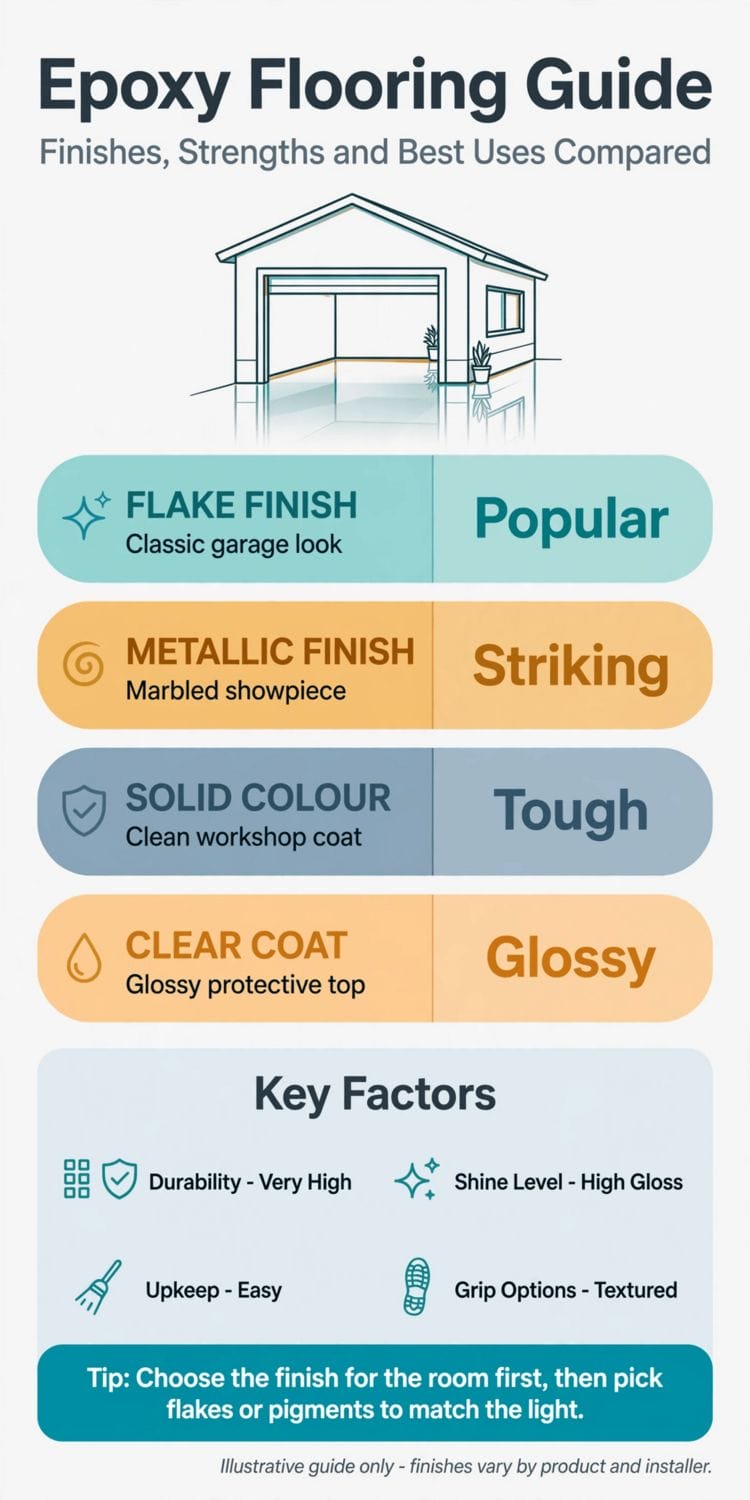
Two choices decide every epoxy floor before any other: its sheen and its scale of pattern. Sheen runs from full gloss — the mirror of the showroom — through satin to near-matte, and it changes both the light in the room and the honesty with which the floor reports dust. Pattern runs from none, in the solid colours, through the fine grain of flake to the full weather-system of a metallic pour. The sections that follow are organised by finish family and room, but the sheen-and-pattern decision is the reader’s own first filter: gloss for drama and light, texture for forgiveness, plainness for work.
| Finish family | Character |
|---|---|
| Flake finish | The speckled classic — coloured chips in a tinted coat |
| Metallic finish | Pigments that swirl and vein like poured stone |
| Solid colour | One clean colour, glossy — the workshop coat |
| Clear coat | A glossy protective skin over concrete or a colour beneath |
2. Metallic Finishes: Swirls, Veins and Movement

Gallery-1 is the metallic finish at full magnification: copper, bronze and amber pigments folded into one another like cooling lava. Metallic epoxy is the family’s artist — no two floors alike, and none of them quiet.
The technique behind it is simple to state and hard to fake: metallic pigments are suspended in the resin and move as it is worked, settling into swirls, veins and pools that the applicator guides but never fully commands. The result behaves like stone that was poured rather than cut — depth you can see into, movement that changes with the light and the hour. Rooms that choose metallic are choosing a floor that will be looked at, and the ideas below are the judgements that keep the looking pleasant.
1. Copper and bronze swirls
Warm metallic pigments swirled together give a floor the movement of polished stone without a single slab. It is the finish for rooms that want their drama underfoot and their walls left plain.
2. Marble-veined metallics
Pale metallics dragged into veins imitate marble at a glance — the veining is drawn by the applicator’s hand during the pour, which is why every metallic floor is a one-off and samples only ever approximate it.
3. Two-pigment blends
Two metallic colours — a base and a drifting accent — give movement without chaos. The blend ratio is the design decision: mostly ground colour, the accent appearing as weather appears in stone.
4. Single-colour metallic wash
One pigment, gently worked, reads as liquid metal under light. It is the metallic finish for minimalists: all of the depth, none of the pattern.
5. Metallic under high gloss
The clear topcoat at full gloss is what makes metallics swim — light moves across the swirls as the viewer does. In matte, the same floor settles into something moodier and more forgiving.
6. Metallic as a room’s only pattern
A swirled floor is a complete decorative scheme. Furniture and walls above it go plain, pale and few, or the room argues with its own floor.
7. Directional swirling
Worked in long passes, metallic pigment can be persuaded to flow one way — down a hall, across a room toward the light. Direction gives big floors a current to swim with.
8. Metallic borders and fields
A plain solid-colour border around a metallic field frames the artistry and gives the edges a calmer finish. The technique belongs to confident applicators and large rooms.
9. Dark metallics: ink and espresso
Near-black metallics with bronze or silver drifting through them are the evening register of the family — the floors of section 7’s showrooms begin here, at the close-up scale.
3. Metallic Statement Floors: Garages and Showrooms

The pin’s garage — a deep blue metallic floor swirling under a dark sports car, lit like a gallery — is epoxy’s showpiece use. Where a car is the room’s furniture, the floor is its stage.
10. The deep blue metallic garage
Blue-black metallic under vehicles reads as water at night: dramatic, forgiving of tyre marks, and endlessly photographable. It is the garage as the house’s theatre.
11. Silver-grey metallic for working garages
A paler metallic keeps a working garage bright while hiding the honest dust of use in its movement. Pattern, in a garage, is camouflage worn beautifully.
12. Matching the floor to the car
Collectors choose the pigment against the vehicle’s colour — dark floors under light cars, bright floors under dark ones. It is interior design by reflection, and the gloss does the work.
13. Showroom gloss, domestic scale
The full-gloss metallic treatment flatters anything parked or placed on it, which is why it suits the garage that doubles as the household’s display shelf.
14. Metallic in the home gym
Rubber mats come and go; a metallic epoxy floor under gym equipment is seamless, sweepable and unembarrassed by dropped weights’ scuffs, stated generally — and it makes a basement gym feel designed.
15. The collector’s plain border
A solid border in a matching tone keeps the metallic field off the walls and gives tyres a defined stage. The border is also where the finish meets its hardest wear with its simplest face.
16. Lighting designed for the floor
Strip and downlighting placed to rake across a metallic floor doubles its movement. In these rooms the lighting plan is a flooring decision, made at the same meeting.
17. A metallic floor in the mudroom entrance
Small, stunning and hoseable: a metallic entrance floor takes boots, bikes and weather in its stride and gives guests the house’s thesis at the door.
4. Flake Finishes: The Speckled Classic
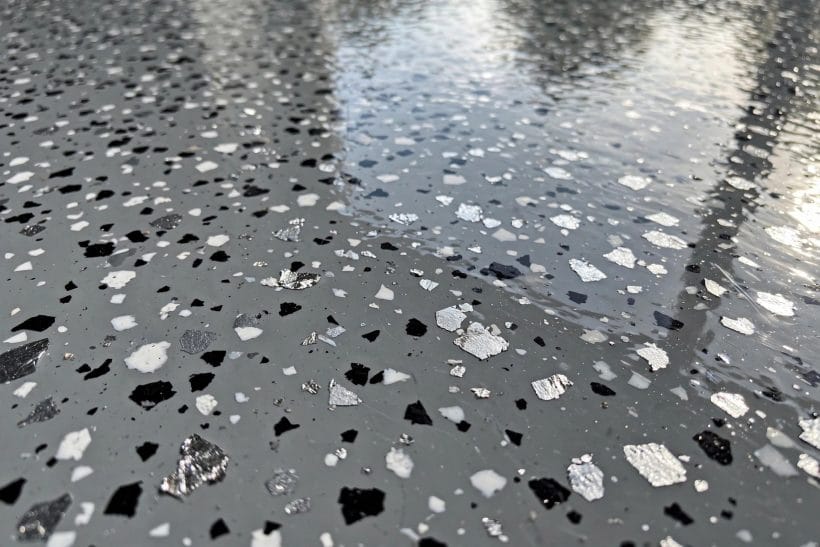
Gallery-2 closes in on the finish that built epoxy’s reputation: grey resin scattered with black, white and silver flakes. Flake is the forgiving finish — speckle hides dust, scuffs and the small sins of the concrete beneath.
The flakes themselves are thin coloured chips, broadcast into the wet coat by the handful and sealed in place. Because they are scattered by hand, density is a craft judgement made in the moment — which is why flake floors are specified by example and photograph rather than by description alone. The family’s range is wider than its garage fame suggests, as the ideas below show.
18. The classic grey flake
A mid-grey base with a black-white-grey chip blend is the default garage floor of a generation, because it looks clean when it isn’t and new when it isn’t either.
19. Full-broadcast flake
Flake scattered to complete coverage gives a terrazzo-like density — the premium end of the family, where the base colour barely shows and texture rules.
20. Partial flake for a softer read
A light scattering over a tinted base reads as stone from standing height and keeps the floor’s colour in charge. Density is a dial, and most rooms want it below halfway.
21. Flake in tans and taupes
Warm chip blends over a tan base take flake out of the garage register into utility rooms, laundry spaces and garden rooms, where grey would feel industrial.
22. Blue-grey flake
The cool blend — slate base, blue and silver chips — suits coastal and contemporary houses, and pairs with the white-painted garages of section 6’s workshops.
23. Flake size as a design choice
Large chips read bold and graphic; fine chips read as grain. The same blend at two sizes makes two different floors, and the choice is made with the room’s scale.
24. Flake over repaired concrete
Where a slab carries patches and history, a medium-density flake is the honest camouflage — the speckle breaks the eye’s ability to find the repairs beneath.
25. Flake with a clear topcoat
Sealed under clear resin, flake gains depth and its easiest-cleaning surface. Unsealed, it keeps a slight texture underfoot — the grip question of section 9, answered by use.
26. The laundry and utility flake
Indoors, a fine warm flake under machines and sinks is washable, cheerful and indifferent to drips — the utility room’s version of the garage classic.
5. Epoxy in Basements and Family Rooms
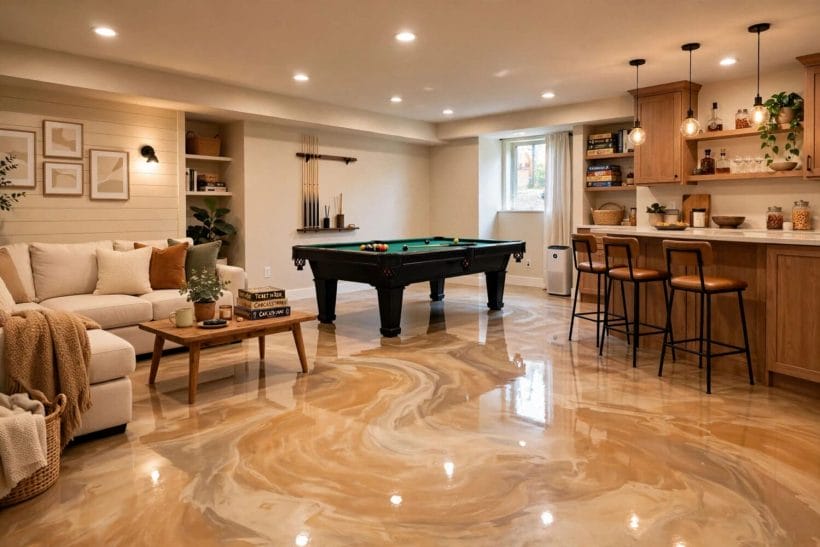
Gallery-3’s basement — warm marbled epoxy under a pool table, a sofa and a small bar — is the finish’s domestic argument. Below-grade rooms are where epoxy’s seamlessness earns its keep, and the basement ideas pillar treats the room whole.
The argument is practical before it is aesthetic. A basement floor is one large slab, often the room’s coldest and hardest surface, and its coverings divide into those that trap moisture beneath them and those that are themselves a sealed skin. Epoxy belongs to the second kind, with the moisture caveat of idea 33 kept firmly in view. Above that skin, the basement becomes the house’s most flexible room — games, guests, gym, cinema — and the floor’s finish is chosen for the flexibility.
27. The warm marbled basement
Amber and honey metallics make a window-poor room feel lamplit all day. Warmth underfoot, even in resin, is a colour decision before it is a material one.
28. Games rooms in mid-tone flake
Pool tables, darts and family tournaments ask for a floor that hides chalk dust and drink rings in its pattern. Mid-tone flake is the games room’s camouflage.
29. A defined bar zone in a second finish
Changing the epoxy at the bar line — solid where the games floor is marbled — zones an open basement without a wall. The seam is a design line, drawn deliberately.
30. Home cinema darkness
Near-black solid or metallic epoxy under a cinema setup kills floor reflections and keeps the screen the room’s only light source. Gloss is lowered here on purpose.
31. The basement gym in solid colour
One tough colour, easily mopped, under mats and machines — with the equipment zones marked by the mats themselves rather than the floor.
32. Kids’ floors that wipe clean
Playrooms over epoxy forgive paint, glue and the archaeology of snacks. A pale flake keeps the forgiveness cheerful rather than clinical.
33. Moisture honesty below grade
Basements are where section 9’s moisture checks matter most: epoxy over a damp slab fails by letting go, and the general rule is test first, coat second, whatever the room’s ambitions.
34. Rugs over resin
Nothing stops a rug softening an epoxy living zone — the floor is the room’s hard-wearing ground, and textiles come and go above it as seasons and children dictate.
6. Solid Colour: The Workshop Workhorse
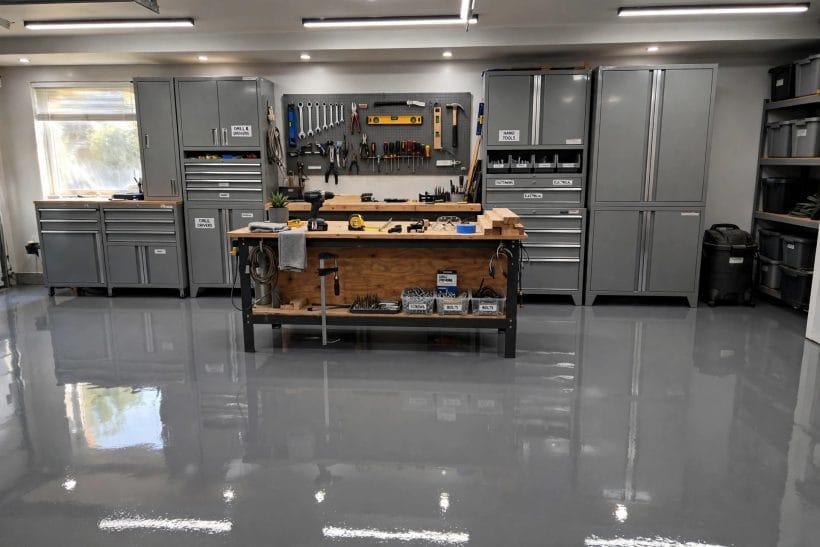
Gallery-4’s workshop — one unbroken grey gloss beneath the benches and tool cabinets — is solid colour’s home ground. No pattern, no swirl: just a clean, reflective, sweepable plane that shows every dropped screw by contrast.
35. The classic workshop grey
Mid-grey solid epoxy is the finish of serious home workshops: bright enough to work by, dark enough to hide a day’s dust, and honest about spills so they get wiped.
36. White and palest-grey solids
A near-white floor turns a garage or studio into a light box — every lumen the windows give is returned by the floor. It shows dirt instantly, which its owners count as a feature.
37. Solid colour in the artist’s studio
Paint-spattered by profession, the studio floor in solid epoxy wipes back to its colour at the day’s end. Pale solids are chosen here for the light they lend the work.
38. Black solid for drama
A black gloss floor is a mirror with a memory — section 7’s showpieces are its family — and in small rooms it can read as depth rather than darkness when the walls are pale.
39. Coloured solids: sage, clay, slate blue
Beyond the greys, muted colours give utility and work spaces a designed calm — sage in a potting garage, slate blue in a photographer’s studio, clay in a pottery.
40. Zoning by colour change
Two solid colours divide an open work floor into its territories — parking from bench, clean from dirty — with a line as crisp as paint because, in effect, it is paint’s tougher cousin.
41. The laundry in solid colour
A pale solid under machines makes leaks visible at a glance — an early-warning system disguised as a floor — and mopping is a two-minute job.
42. Solid colour over clear coat
The order in the glance table matters in practice: colour first for the body, clear over it for the gloss and the protection — the standard build for the family’s working floors.
7. Dark, Glossy and Dramatic

Gallery-5 is the feature’s darker sibling: a black metallic floor mirroring a sports car in a lit showroom. At the dramatic end of the family, the floor stops being a surface and becomes the room’s event.
43. The black mirror floor
Black metallic or solid at full gloss reflects cars, lights and furniture like still water. It demands pale discipline above it and rewards the demand completely.
44. Charcoal metallic with silver drift
A step back from pure black, charcoal with silver movement keeps the drama and loses the starkness — the connoisseur’s version of the showroom floor.
45. Dramatic floors, plain rooms
The rule of section 2 at maximum strength: above a mirror floor, everything is simple, low and few. The reflection doubles whatever is present, so presence is rationed.
46. Strip lighting raked across gloss
Linear lights are the drama floor’s accomplice — their reflections stretch across the surface like light on a harbour. Placement is designed with the pour, not after it.
47. The evening garage
A garage used after dark — music, a project car, friends — wears the dark gloss best. It is the room’s nightclub register, achieved with one finish.
48. Dark epoxy in the home bar
Small, dark and glossy under a home bar counter gives the corner a venue’s glamour at domestic scale, and spills wipe off it without testimony.
49. Black floors with white walls
The sharpest contrast the family offers: white walls, black floor, nothing between. It suits galleries, show garages and owners of great tidiness.
50. Managing the dust truth
Dark gloss shows every footprint and dust mote — its owners keep a soft mop by the door and make peace with the ritual. The drama is rented, and the rent is housekeeping.
51. A dramatic floor in a small room
Counter-intuitively, one small room — a study, a dressing room — in dark gloss gains depth from the reflection, provided the ceiling and walls stay light.
8. Light Epoxy in Living Spaces
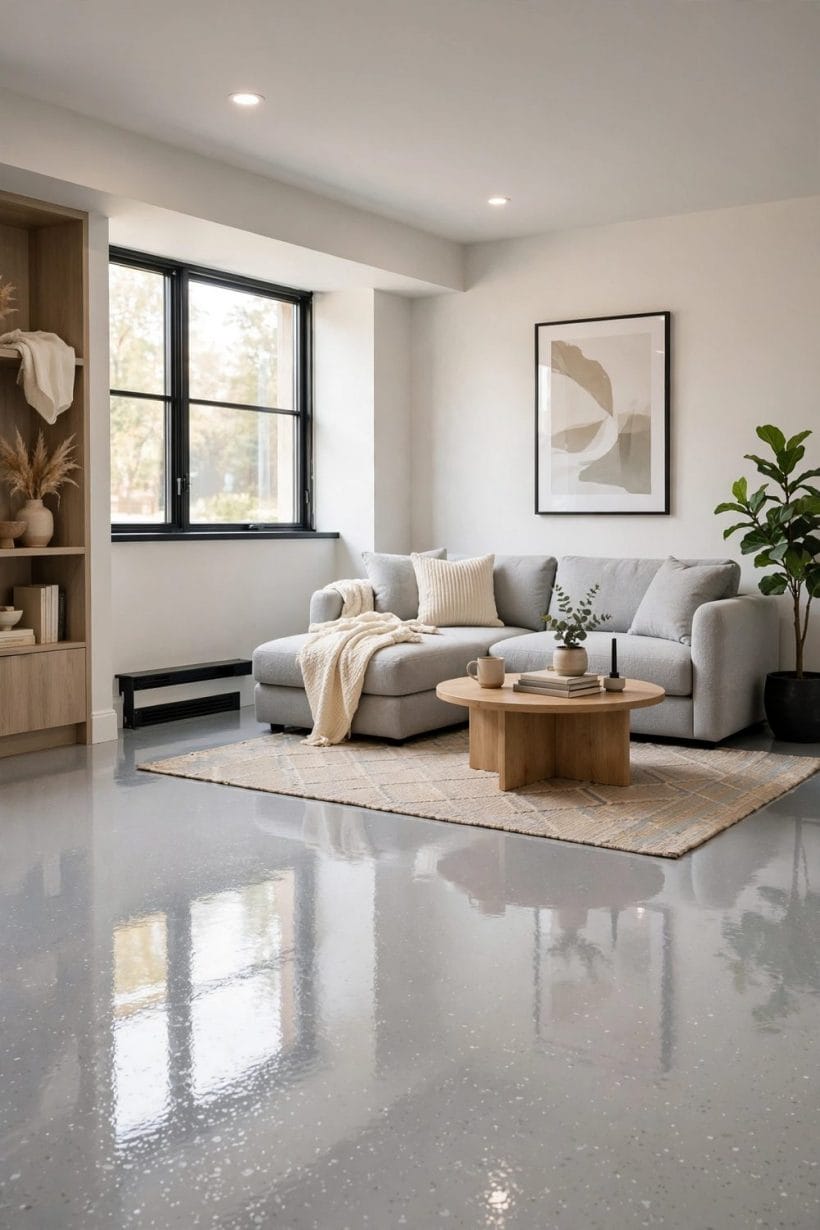
The second pin brings the finish fully indoors: a pale grey flake floor under a sofa and rug in a bright living room. Light epoxy is the family’s quietest voice — a seamless, stone-pale ground that modern rooms wear easily, in the spirit of modern living room ideas.
52. The pale grey living floor
Near-white flake or solid reads as polished concrete’s softer cousin: bright, seamless, and calm under furniture. It is epoxy for people who did not know they liked epoxy.
53. Seamlessness in open plans
Without a joint or a grout line, an open-plan floor in pale epoxy runs kitchen to sofa as one plane — the continuity itself is the luxury.
54. Warm whites for north light
Cool pale floors in cool light go colder; a warm-white pigment keeps a north-facing room’s floor friendly. Colour temperature is chosen at the sample stage, in the room.
55. Rugs define, floors serve
Above a pale living floor, rugs do the zoning and the softening — the resin is the permanent ground, textiles are the changeable rooms within the room.
56. Kitchen runs in fine flake
A fine warm flake in a kitchen area is seamless where tiles would grout, and forgiving of crumbs between sweeps. Under-table zones take a rug for chair comfort.
57. The gallery-white studio flat
White gloss through a whole small flat multiplies its light and makes its few pieces of furniture read as an exhibition. It is the boldest pale use, and the most rewarding.
58. Pale floors and pale furniture
Tone-on-tone — pale floor, pale sofa, pale walls — works when textures differ: matte fabric against gloss resin, rough rug against smooth floor.
59. Heating and sound, honestly stated
A resin floor is a hard surface: it feels cool, sounds bright and carries no softness of its own. Rugs, curtains and upholstered pieces are its acoustic partners, planned with it.
9. Application in General Terms
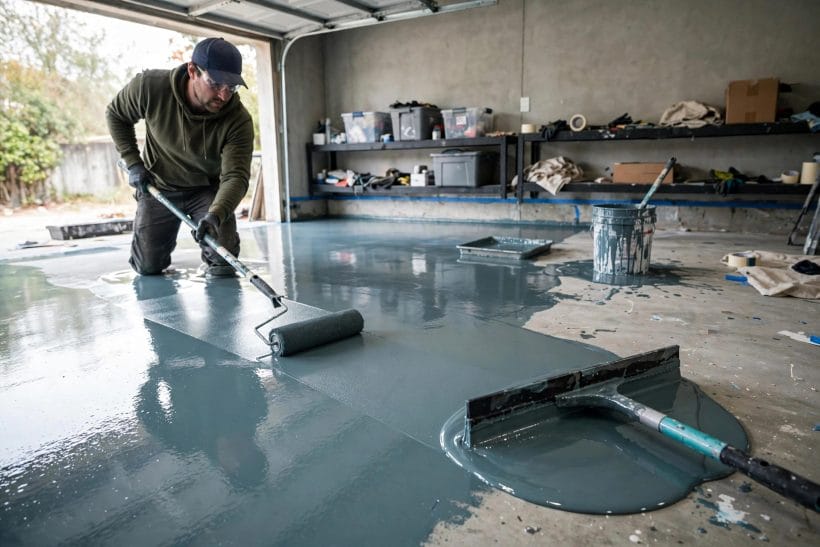
Gallery-6 shows the work itself: a roller, a wet edge, grey resin going over prepared concrete. This section states the application checks in the same general terms as the rest of the post — it is a what-to-check survey, not an instruction set; every product’s own guidance governs its use.
It is included because an epoxy floor is bought twice: once as a finish, in the sections above, and once as an installation, here. The reader who knows what a sound installation involves — in checks, not in steps — can choose between a kit and a professional with open eyes, ask the applicator the questions that matter, and recognise the corners that must not be cut because the floor will announce them for years.
60. Preparation decides the result
The trade’s oldest saying is that epoxy is ninety per cent preparation: cleaning, repairing and keying the base so the coating can grip. Skipped prep is the first cause of every failure below.
61. The moisture check comes first
Concrete that carries ground moisture will push a coating off as it dries. A moisture check before any commitment — and a different floor for a damp slab — is the family’s first rule.
62. Cracks and repairs under the coat
Epoxy bridges hairlines cosmetically and nothing more; real cracks and movement joints are repaired or honoured, not buried, because the coat will otherwise repeat them.
63. Kits and professionals, in general terms
Single-coat kits cover the simple cases; multi-coat systems with metallics belong, in most hands, to professional applicators. The honest check is the room’s value against the finisher’s experience — a floor is a hard mistake to unmake.
64. Coats: base, body, clear
The standard build is primer or base coat, the colour or flake body, and a clear protective top — each with its place, none of them skippable without the finish knowing.
65. Cure patience
Walkable is not cured: the maker’s stated times before furniture, vehicles and rugs return are part of the product, and breaching them marks the floor for its life.
66. Grip and texture choices
Gloss is slippery when wet; textured topcoats and flake densities trade a little shine for surer footing. Wet rooms, entrances and workshop floors make the trade deliberately.
67. Edges, drains and thresholds
Where the resin stops — at drains, door thresholds and expansion joints — is detailed before the pour begins. A floor’s edges are where its workmanship is read.
10. Care, Repair and Keeping the Shine
The last section is the keeping: an epoxy floor asks little, but it asks it regularly, and its enemies are few and nameable.
Everything in this section follows from the floor’s nature: it is a finish, like the varnish on a table, stretched across a room. It is far tougher than varnish — tougher than most surfaces in the house — but it keeps its looks the way finishes do, by being kept clean of the grit that abrades it and the loads that mark it. None of the care below is specialised; it is housekeeping, aimed at a gloss.
68. Sweeping is the whole secret
Grit under shoes and tyres is the gloss’s only real predator. A soft broom or dust mop, used often, is ninety per cent of epoxy care.
69. Mopping with mild cleaners
Warm water and a mild cleaner restore the shine; harsh chemistry is unnecessary and, in general terms, unkind to resin surfaces. The maker’s guidance names the exceptions.
70. Tyre marks and scuffs
Hot tyres can tattoo a young floor and scuff an old one; mats at the parking spots and patience during the cure are the defences, and most marks lift with cleaning.
71. Felt pads and soft wheels
Furniture on felt, castors of the soft kind, and nothing dragged that can be carried — the floor’s gloss survives households that treat it as a finish, not as concrete.
72. Spot repairs in general terms
Small damage is repaired locally by the same system that laid it, with the repair blended at a natural break. The check is matching the original product family, which is why its name is kept on record.
73. Recoating the tired floor
When gloss finally dulls, a fresh clear coat over a prepared surface renews the system without starting again — the floor’s second life is one of its economies.
74. Sunlight and colour shift
Strong sun can warm some pigments’ tone over years; rooms of glass plan for it with the pigment choice and the blind. Stated generally, it is a selection check, not a defect.
75. The floor that disappears
The kept epoxy floor’s final virtue: it stops being noticed. Seamless, shining faintly, asking a broom’s attention — it becomes the ground a household’s life happens on, which is what floors are for.
Final Considerations
Choose the finish for the room’s life first — flake for forgiveness, metallic for drama, solid for work, clear for protection — then choose its colour in the room’s own light, and let preparation, moisture checks and cure times be governed by the maker’s word rather than the calendar’s impatience. An epoxy floor done in that order is a decade’s surface: seamless, washable and quietly spectacular. For the floors it sits beside in a whole-house plan — bathroom floors, ceramic tile and the buying method behind them — the sibling posts linked in section 1 carry those subjects on their own terms.


0 Comments