

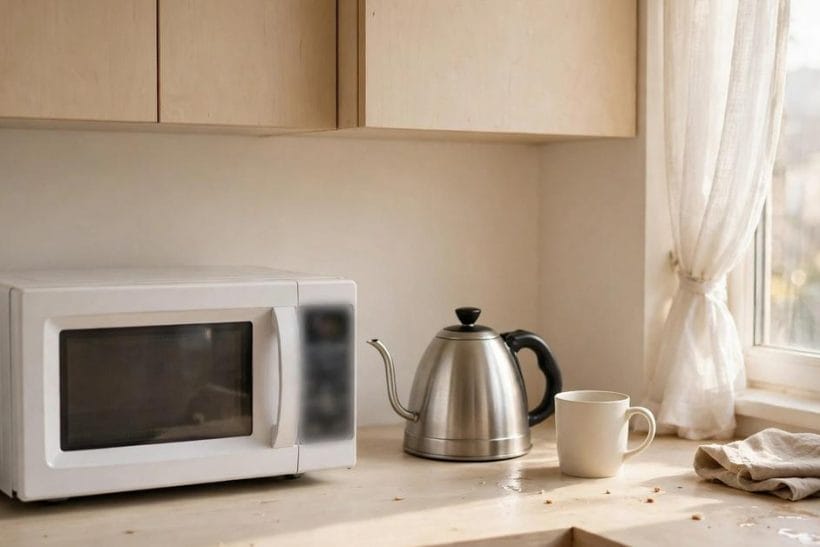
1. The Compact Microwave at a Glance
A compact microwave earns its place by fitting the kitchen you actually have: a short run of counter, a low cupboard overhead, a household that reheats more than it roasts. This guide skips the league tables and works through the checks that decide whether a small microwave will live happily in a small kitchen — the counter it stands on, the cavity inside, the air it needs, the door it swings and the power it cooks with, all in honest general terms.
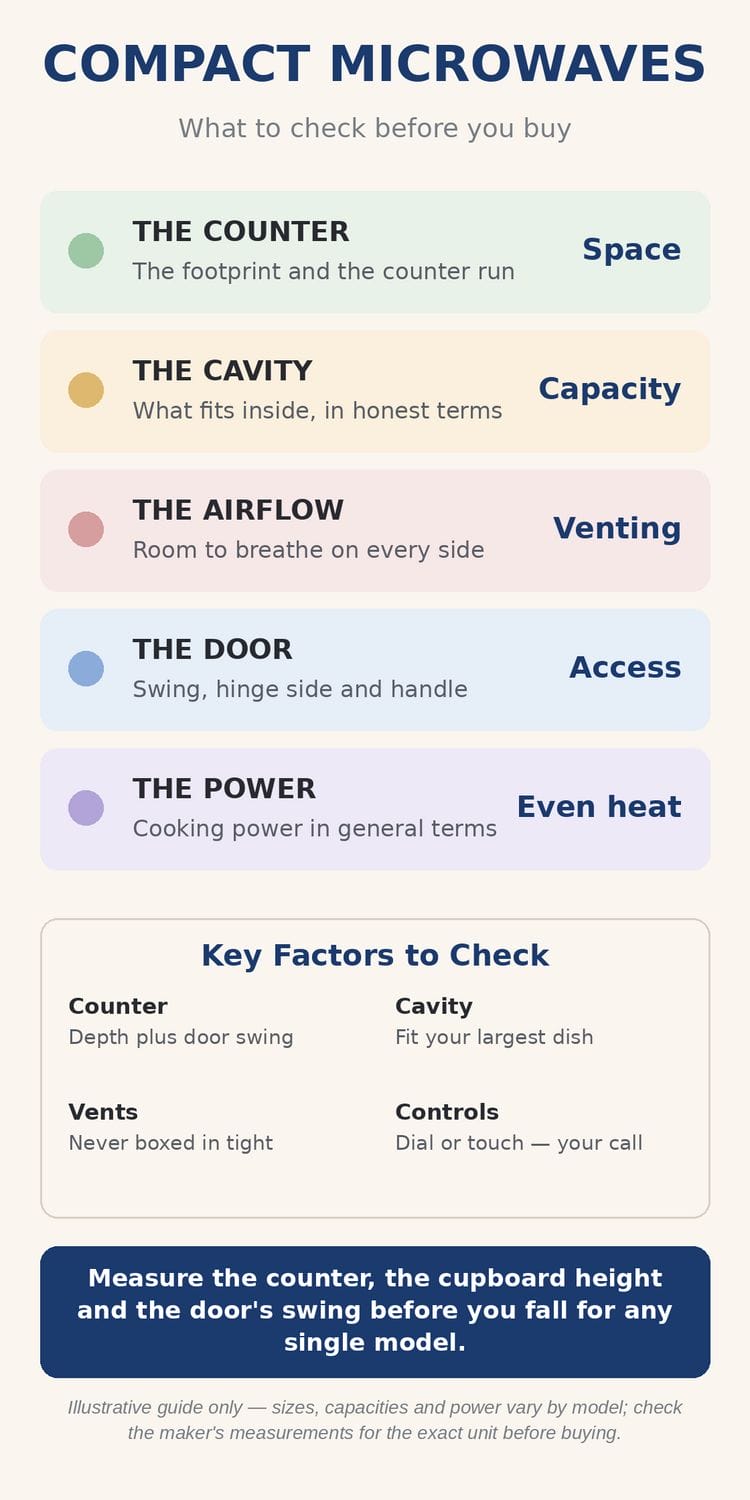
| Part | What It Covers | Why It Matters |
|---|---|---|
| THE COUNTER | The footprint and the counter run | Space |
| THE CAVITY | What fits inside, in honest terms | Capacity |
| THE AIRFLOW | Room to breathe on every side | Venting |
| THE DOOR | Swing, hinge side and handle | Access |
| THE POWER | Cooking power in general terms | Even heat |
Measure the counter, the cupboard height and the door’s swing before you fall for any single model.
That order — space first, features last — is the whole method. A small microwave is a compromise machine by design: something was traded away to make it small, and the checks below are about finding out what was traded, and whether the trade suits the way you cook. Kitchens forgive a modest microwave; they never forgive one that does not fit.
2. The Counter: Footprint Before Features
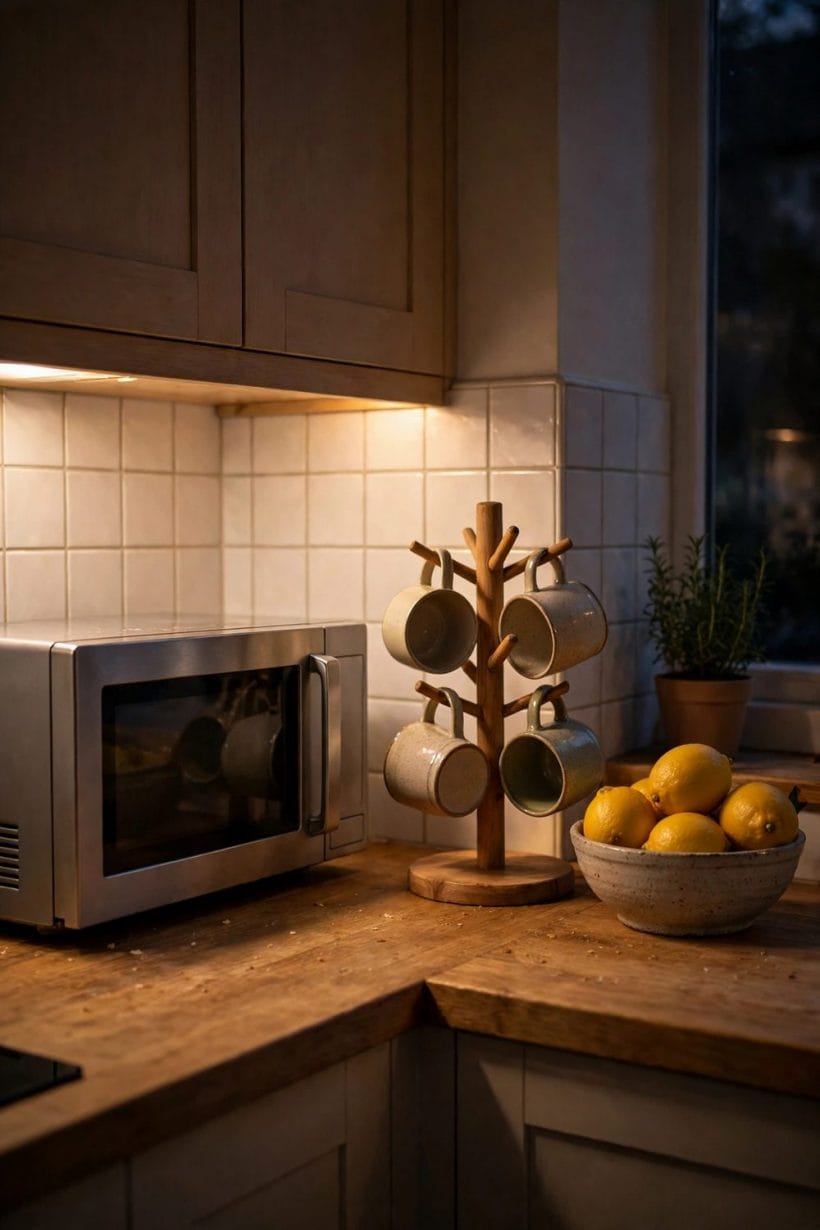
Start where the machine will stand. The companion microwave buying guide covers choosing across every size family; this post stays with the compact end, where the first check is the footprint — the patch of counter the machine occupies, judged against the counter you can honestly spare. Most people searching for a mini microwave are really solving a counter problem, and the footprint is that problem stated plainly.
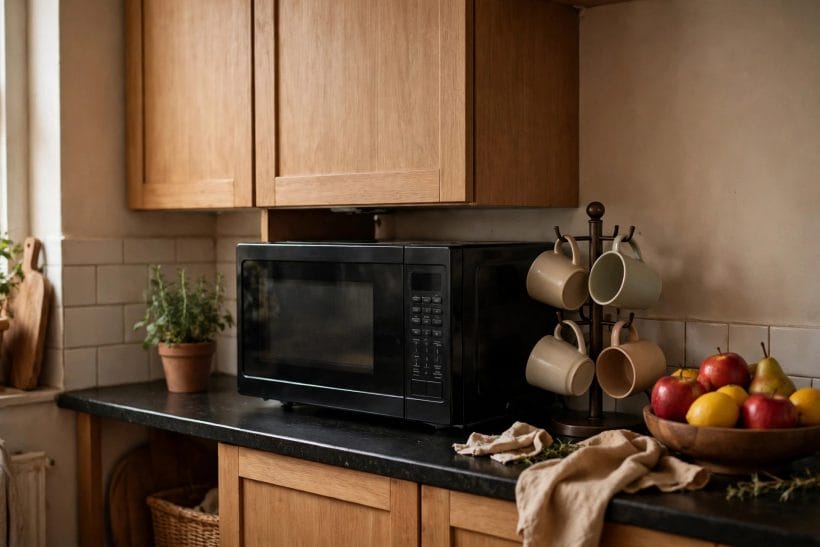
Measure the run, not just the patch. A microwave that fits its square but leaves no landing space beside it — nowhere to set the hot dish down — fails in daily use while passing on paper. The landing strip matters as much as the footprint: a plate’s width of clear counter on the door side is the difference between a machine that serves the kitchen and one that fights it.
Height counts too, and it is the check small kitchens fail most often. The gap between counter and wall cupboard is fixed, and the machine must slide under it with room to spare for the air it moves — a point the ventilation section returns to. A compact model that only just fits the height is a model already in trouble.
Depth is the quiet third dimension. Counters are shallower than they look once a splashback, a socket and the machine’s own rear clearance are accounted for, and a microwave whose door hangs over the counter’s edge is one nudge away from trouble. Judge the depth with the door open as well as shut — the checks in the door section explain why.
3. The Cavity: What Fits Inside
The cavity is the honest measure of a compact microwave, and it is judged by your dishes, not by a number on a box. The household’s biggest everyday dish — the casserole, the dinner plate with a rim, the mug you reheat soup in — is the test kit: if those pass through the door and sit on the turntable with room to turn, the cavity is big enough, whatever the brochure calls it. The small-appliance family this machine belongs to is rounded up in the compact kitchen appliances collection, where the same dish-first logic runs through every category.
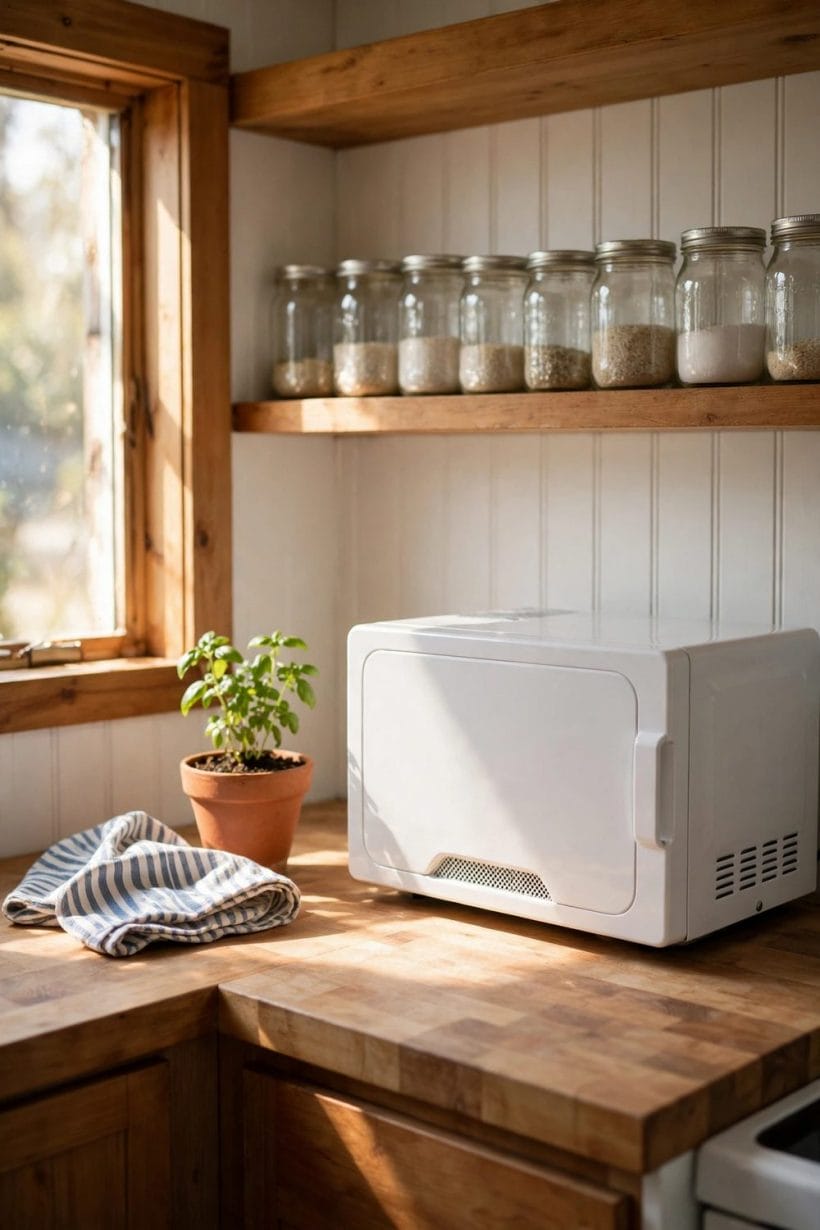
Turntable behaviour is part of capacity. A plate that fits but cannot rotate cooks unevenly, catching hot spots at the edges while the middle stays cool — so the real question is never only will it go in, but will it go round. Square and rectangular dishes are the usual casualties: their corners sweep a wider circle than their width suggests.
Height inside matters for the tall mug and the covered bowl. A cavity can be wide enough and still refuse the jug you heat milk in, and the refusal is discovered at the worst moment — mid-recipe, with the old machine already gone. Test with the tallest thing you own, lid on.
And be honest about the cooking the cavity will never do. A compact cavity reheats, defrosts and cooks for one or two; it does not take the family roasting dish, and pretending otherwise at purchase time just books a disappointment. Buy the cavity for the week you actually live, not the feast you host twice a year.
4. Ventilation: Room to Breathe
Every microwave moves air, and a compact one has less room to spare for the job. Vents sit on the sides, the top or the back depending on the design, and each vent needs clear space around it — which is why the maker’s stated clearances are part of the purchase, not fine print. A machine wedged tight into a niche, however neat it looks, runs hot, steams its surroundings and ages early.
Steam is the second half of the airflow story. Cooking vents moisture as well as heat, and in a small kitchen that moisture lands on cupboard doors and walls. A compact microwave under a low cupboard needs its breathing room partly so the steam escapes instead of soaking the cabinet above — the slow, invisible damage that only shows when the cupboard’s finish dulls.
The practical check is simple: wherever the machine will stand, the space around it should let a hand pass along the vented sides without squeezing. If the spot only works by pushing the machine hard against a wall or a tall appliance, the spot does not work — find another, or choose a model vented for the spot you have.
5. The Door: Swing, Hinge and Handle
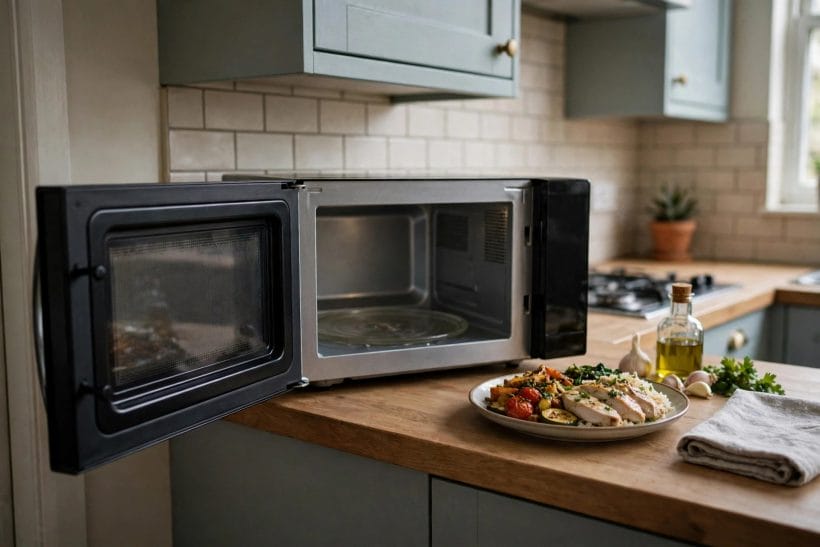
Doors decide more small-kitchen arguments than any other part. Most compact microwaves hinge on the left and swing wide, and the swing needs a clear arc: a door that opens into a wall, a fridge handle or the cook’s hip is a daily irritation that no feature list compensates for. Stand where you will stand, and mime the arc before you buy. Door thinking of a different kind — ovens whose doors slide away instead of swinging — is worked through in the slide-away oven door checks, and the questions transfer: where does the door go, and what does it meet on the way?
Handles and latches deserve a moment too. A chunky handle adds depth the footprint figure may not confess to, and a stiff latch on a light machine can drag the whole unit across the counter every time the door opens — the classic compact-microwave shuffle. In a shop, open and close the door a few times: the machine should stay put.
Drop-down doors exist at this size but change the maths: the open door becomes a shelf that steals the landing space in front, which can be a blessing — a built-in rest for the hot dish — or a theft, depending on the counter. Judge it against your landing strip, honestly.
6. Power and Cooking, in Honest Terms
Power in this class is best understood relatively: compact models cook more gently than their full-size counterparts, and that shows up as longer times and a little more stirring, not as failure. Reheating stays quick; dense foods — a thick lasagne, a frozen ready meal — take the extra minutes that gentler power asks for. The honest expectation is convenience cooking done well, not speed records.
Evenness matters more than strength at this size. A modest machine with a well-behaved turntable and sensible programmes will out-cook a stronger one that leaves cold centres, because the food you serve is judged at the middle of the dish. Reviews and demonstrations that show real dishes, stirred and rested, tell you more than any headline figure.
Programmes deserve the same scepticism as power. A compact microwave with a handful of honest settings — reheat, defrost by weight or time, a few power levels — serves better than one crowded with novelty modes nobody presses twice. This checks-first approach to appliance claims is the same one taken by the quiet refrigerator guide: believe the behaviour you can test, not the badge you cannot.
7. Controls: Dials, Touch Pads and Timers
Controls split into two tribes: the dial and the touch pad. A dial is quick, glove-friendly and honest — turn, press start, done — and on the simplest compact models it is all you get, which for reheating households is genuinely enough. Its limit is precision: a dial guesses at seconds where a keypad states them.
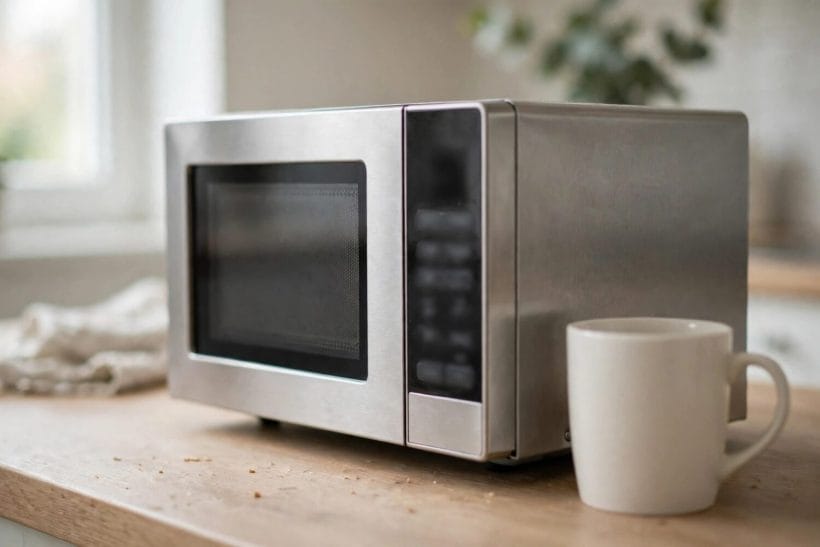
Touch pads bring exact timing, programme shortcuts and child locks, at the cost of a panel that must be wiped to stay responsive and read. In a small, steamy kitchen, a panel you can read at a glance — large figures, plain labels — beats a clever one you squint at. Try the buttons with wet hands in mind; that is their working condition.
Whichever tribe you choose, the quick-start habit test applies: adding another thirty seconds to a running cook should take one press, not a stop and a rethink. That single interaction happens more than every other combined, and it is the one the controls should be built around.
8. Placement: Counter, Cart, Shelf or Cabinet Niche
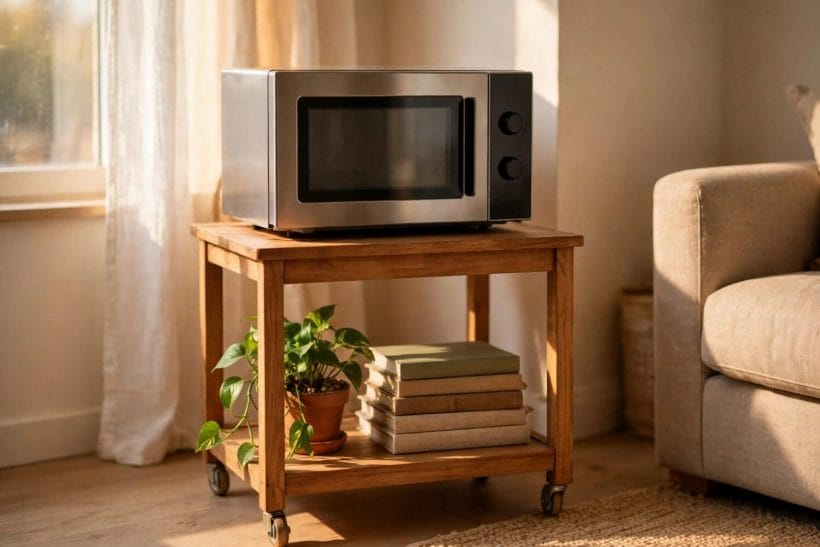
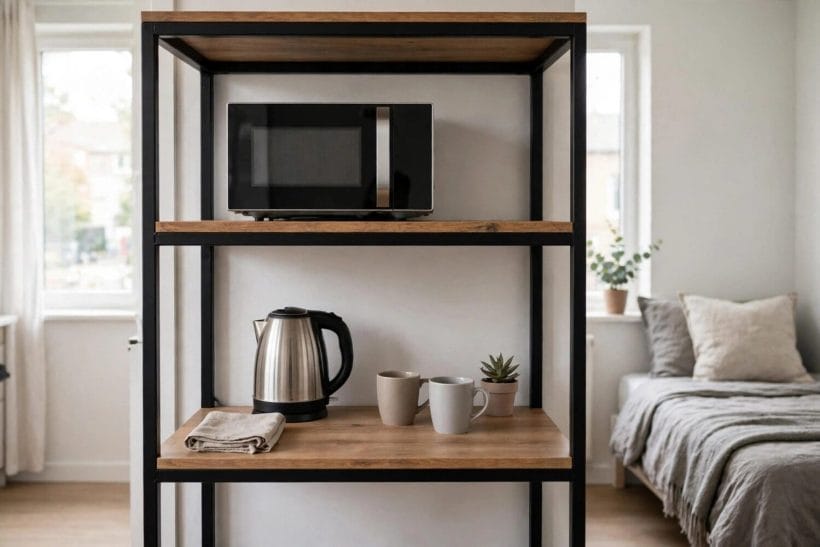
Where a compact microwave lives shapes how it serves. The counter is the default and the easiest — power nearby, landing space beside — but in the tightest kitchens the counter is the one thing there is not enough of, which is why the alternatives matter. A sturdy cart gives the machine its own station and can roll aside; the household that hosts it well plans the socket it parks beside. For the counter you keep, the tiny kitchen storage hacks collection is full of ways to win back working room around it.
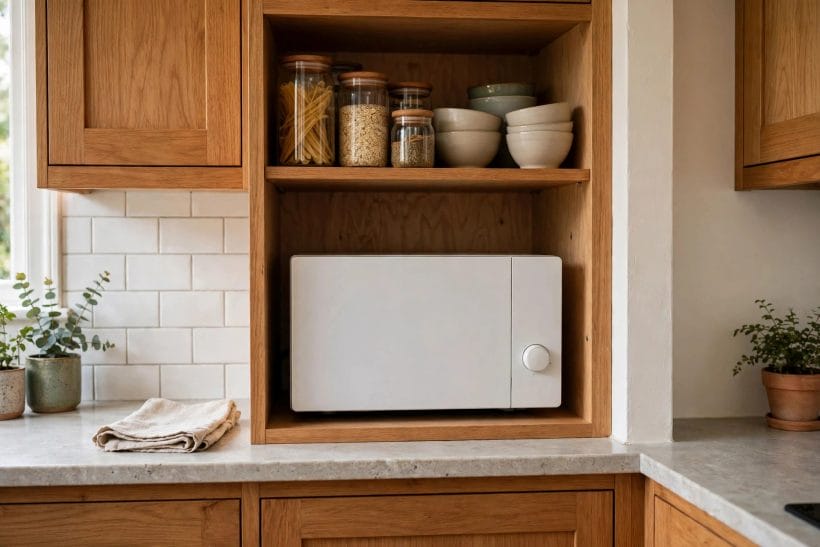
A shelf or cabinet niche lifts the machine off the counter entirely, and pays for the privilege with the ventilation and door checks doubled: the niche must breathe, and the door must swing clear of the shelf edge. Built-in looks achieved by boxing a countertop model tight into joinery are the classic false economy — the machine cannot breathe, and neither, eventually, can the budget that replaces it.
The mounted alternative — a unit fixed over the range — leaves the compact class altogether, and its trade-offs are set out in the over-the-range microwave post: counter fully freed, but height, steam and hob access all renegotiated. For a genuinely small kitchen with a low hob, the countertop compact usually remains the kinder answer.
9. Care, Cleaning and Living With It
A compact cavity cleans quickly precisely because it is small — a bowl of water steamed inside loosens the splashes, and the whole interior is within a cloth’s reach. The turntable should lift out and wash like a plate; models whose plates foul their rollers at every spill turn a weekly wipe into a chore that gets skipped, and the skipping shows.
The door seal and the latch are the wear points to keep an eye on: a door that no longer closes with a clean, single click is telling you something, and microwaves are not machines to argue with — a damaged door or seal is a stop-using-it matter, settled by repair or replacement, never by wedging. Beyond that, living with a compact model is mostly habit: covers on reheats, splashes wiped while fresh, the vent sides kept clear of the tea towels and post that drift towards any flat surface.
For the wider small-kitchen picture — how appliances, storage and worktop divide a tight room between them — the kitchen ideas pillar gathers the whole subject in one place.
10. Before You Buy: The Measuring-Up Checks
Everything in this guide compresses into one short routine, done in the kitchen, before any money moves. Measure the counter run and the cupboard height where the machine will stand, with the landing strip left over. Check the cavity against your biggest everyday dish and your tallest mug, lids on, imagining the turn. Confirm the door’s swing against the room as it is — walls, handles, hips and all.
Then the standing checks: the maker’s clearances can actually be honoured in your spot; the controls pass the one-press test; the power expectations are set to gentle and even rather than fast; and the placement — counter, cart, shelf or niche — suits the socket, the steam and the swing together. A compact microwave that passes those checks will never be the biggest machine in the street. It will be the one that fits, breathes, opens and cooks — which is the whole job.
Final Considerations
The compact microwave question was never really about finding the tiniest machine in the shop; it is about matching a small machine to a small kitchen without lying to yourself about either. Counter first, cavity second, air and door and power after — and every claim in general terms until the maker’s own measurements for the exact model are in your hand. Do the measuring-up honestly, and the little machine stops being a compromise and becomes what it was meant to be: the hardest-working square on the counter.




0 Comments