

A courtyard is not a small garden; it is a room that happens to have sky for a ceiling. Walled, floored and enclosed, it offers what no open plot can — privacy, shelter and warmth held in — and it asks in return that every plant, pot and paving stone be placed like furniture.
These 75 courtyard landscaping ideas gather the room whole: layouts, paving, green walls, planting in pots and beds, trees and shade, water, colour schemes, furniture and fire for the evening, and the practical details of drainage, care and storage that keep an enclosed garden easy to live with.
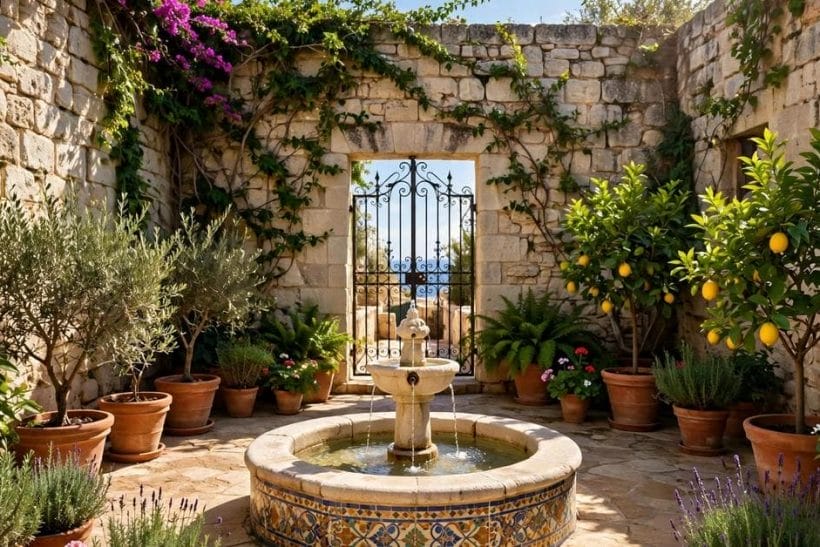
1. Courtyard Landscaping Ideas at a Glance
Scope first. This collection owns one outdoor room: the enclosed courtyard — paved ground, boundary walls, planting in pots and beds against them. Its neighbours keep their own ground: dry-garden technique is in japanese zen rock garden raking layout; gardens for tiny homes generally are in tiny house garden ideas; container growing in depth is in container garden ideas; a garden building is in modern shed ideas; waterside outdoor living is in lake house ideas; and the fire feature as a focus in its own right is in deck with a fire pit ideas. The planted Japanese-style garden — gravel fields, stepping stones and borrowed scenery — is treated as its own subject elsewhere on the site; here the garden is enclosed, floored and furnished.
One discipline runs through the collection: treat the courtyard as a room. A clear floor, green walls, one focus and honest drainage will carry any style you lay over them
The tour follows the room’s making: layout first, then the floor, the walls, the planting, trees and shade, water, colour, furniture and fire, and finally the practical details that keep the room working.
| Element | Courtyard choice | What it brings |
|---|---|---|
| Layout | One clear ground pattern | An outdoor room, not a yard |
| Surface | Stone, brick or gravel | Cool underfoot, quick to drain |
| Green walls | Climbers and espalier | Privacy and softness |
| Planting | Pots grouped with in-ground beds | Flexibility plus permanence |
| Focus | A small tree or water feature | The room’s centre |

2. Layouts for Enclosed Outdoor Rooms
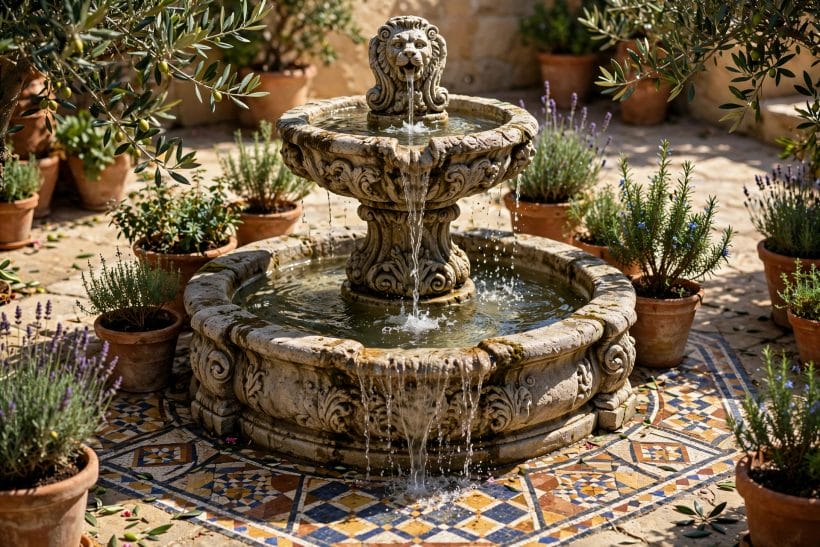
The opening gallery sets the room’s plan: enclosure first, decoration second. These first ideas arrange the ground so the courtyard reads as one composed space rather than a passage with plants in it.
1. Run one ground pattern wall to wall
A single surface, laid continuously from wall to wall, is what turns a yard into a room. The moment the floor splinters into leftover corners of different materials, the space reads as storage; keep one paving language and let the planting provide the variety.
2. Give the room a centre
Every enclosed space wants a middle: a small tree, a fountain, a table, a great pot. A courtyard arranged only around its edges feels like a corridor with furniture; a centre gives the eye a destination and the layout its grammar.
3. Border beds around a paved centre
The classic arrangement: planting in beds against the walls, life happening on paving in the middle. Feet stay dry and clean, roots get real soil, and the room divides itself naturally into the green frame and the lived-in centre.
4. The all-paved pot garden
Where there is no soil at all — over a basement, on a roof terrace, in a rented yard — pave everything and garden entirely in pots. Done with conviction, the pot courtyard loses nothing: the enclosure, not the earth, is what makes it a courtyard.
5. Divide a larger courtyard into two rooms
A planter, a level change or a screen of bamboo can split one long courtyard into a dining room and a quiet corner. Two small rooms feel more generous than one long space, because each arrives as its own discovery.
6. Treat a long courtyard as a gallery
For a narrow plot, repetition is the design: the same pot, the same plant, the same lantern rhythm repeated down its length. A gallery layout flatters length instead of fighting it, and the far end earns a single stronger focus to walk towards.
7. Use a level change to define a zone
One shallow step up to a seating terrace, or a slightly sunken corner, separates uses without a wall.
8. Keep a clear line from door to gate
A courtyard is also the house’s passage: bins, bicycles and visitors cross it. Lay the furniture and pots so one clear walking line survives from the back door to the gate, or the room’s beauty will be re-litigated every bin day.
9. Align the room with the house
Let paving joints, beds and the central focus line up with the doors and windows that open onto the courtyard. Aligned, the room reads as the house’s largest space with the roof removed; unaligned, it reads as an afterthought the house tolerates.
3. Paving and Ground Surfaces
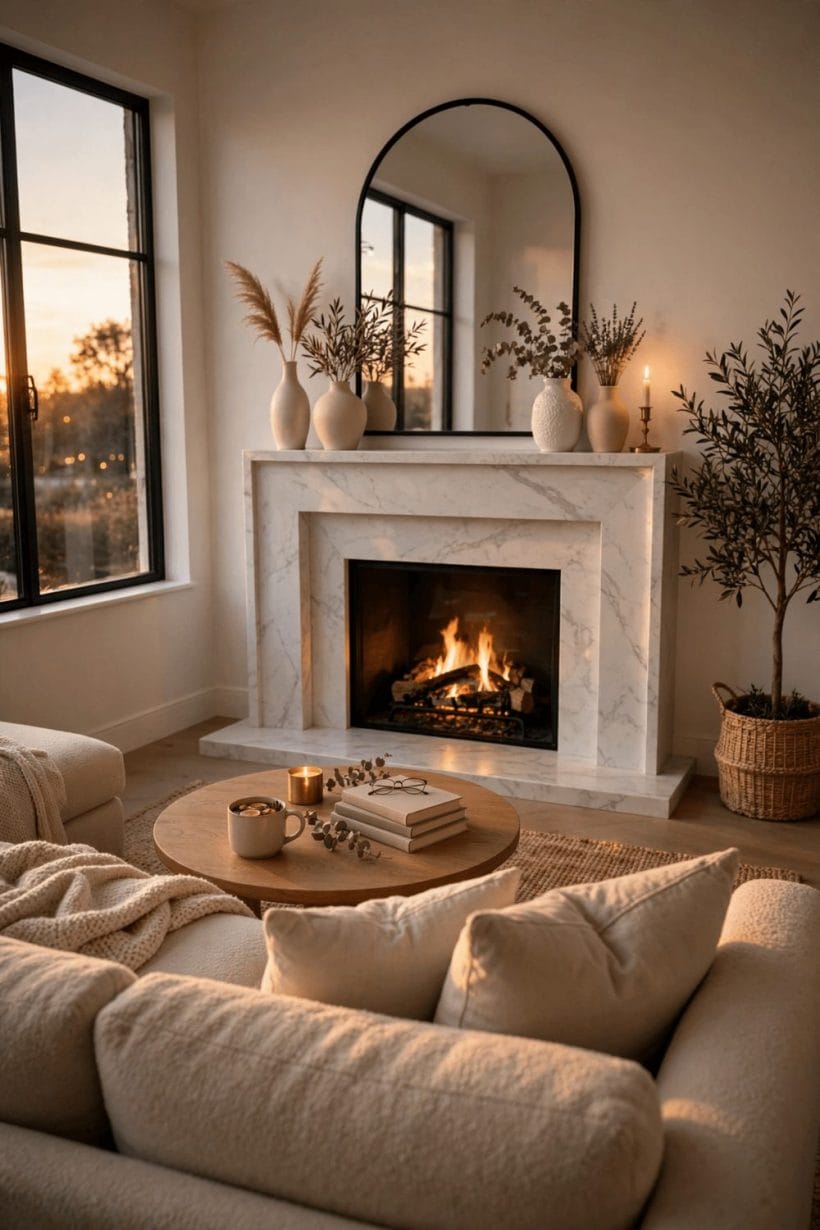
The pin shows the floor at work. In an enclosed garden the ground is the largest surface you own, walked on daily and seen from every window, and these ideas choose and lay it well.
10. Large stone slabs for calm
Big-format stone with few joints makes a small courtyard feel larger and quieter underfoot. The slabs take the visual weight of the room, so keep their colour soft and let the planting provide the pattern instead.
11. Brick for warmth and tradition
Brick paving — herringbone, basketweave or simple stretcher courses — is the courtyard’s oldest floor: warm in colour, forgiving of age and sympathetic to old walls. It suits courtyards that belong to houses with brick in them already.
12. Gravel for the informal courtyard
A gravel floor is soft, permeable and pleasantly audible underfoot, and it plants easily where pots leave gaps.
13. Paved centre, gravel margins
The hybrid that serves most courtyards best: hard paving where you walk and sit, gravel at the margins where pots stand and planting pockets can be opened. Each material does the work it is good at, and the boundary between them becomes a design line.
14. A chequer of stone and green
Alternating stone squares with squares of gravel, moss or low planting gives a courtyard one formal, graphic moment — best near the house, in the part of the room seen from the windows, where its geometry can be appreciated like a rug.
15. Timber decking where stone stays cold
In a shaded courtyard that stone keeps damp and chilly, a decked area gives a warmer, drier sitting surface and a change of texture underfoot. Use it as one zone within the room rather than the whole floor, so the contrast stays deliberate.
16. Let the joints direct the eye
Paving has a grain: run the joints and courses to lengthen a short courtyard or widen a narrow one.
17. Mark the threshold at the house door
A step, a contrasting border or a change of material where the courtyard meets the house announces the room’s beginning. Thresholds matter in enclosed spaces: the courtyard should feel entered, not drifted into.
4. Walls, Screens and Green Boundaries
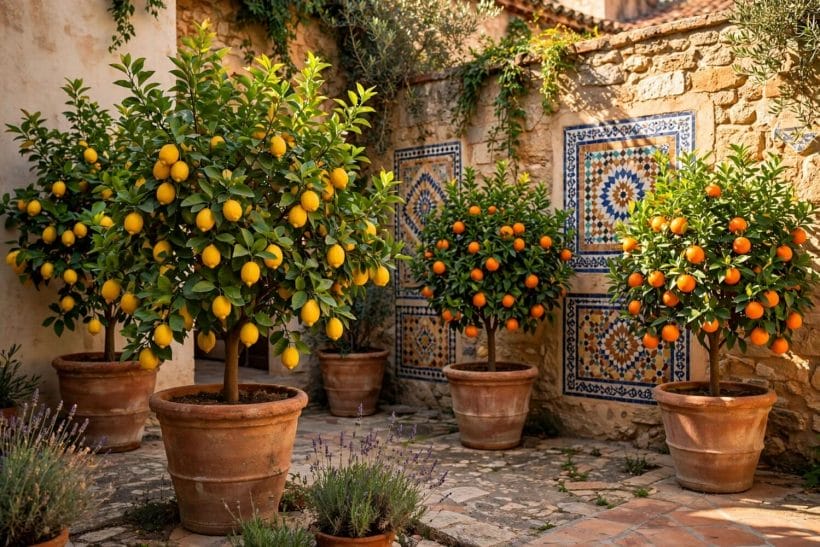
Gallery-2 turns to the room’s walls, the surface a courtyard has most of. Bare boundaries make a yard; green boundaries make a garden, and these ideas clothe the walls without shrinking the room.
18. Climb the walls with green
Climbers trained up the walls on wires or trellis turn the boundary into planting that takes almost no floor. A wall of leaves softens every reflection, cools the room in summer and hides the masonry’s age better than any paint.
19. Espalier a fruit tree against the sunny wall
A tree trained flat in tiers against the warmest wall gives blossom, leaf and fruit in the depth of a hand’s span. Espalier is the courtyard’s oldest technology for growing trees without a garden, and its geometry is beautiful even bare.
20. Plant a hedge inside the fence
Where the boundary is a plain fence, a loose hedge planted just inside it doubles the green and halves the fence. The layered boundary — fence behind, hedge in front — reads as depth, and depth is the one thing a small courtyard cannot buy too much of.
21. Paint shaded masonry pale
In a courtyard the sun visits briefly, a pale wall is a light source: it bounces the daylight down into the room and lifts the planting against it. Keep the colour warm rather than stark, and the wall becomes sky you can touch.
22. Screen only the corner that is overlooked
Privacy problems are usually local — one neighbour’s window, one gap in the wall. A slatted screen, a tall planter or a small tree aimed at that single sightline solves it, without walling the whole room in against problems it does not have.
23. Hang planting at eye level
Wall planters and hanging baskets put green where the eye actually lives. A row of them along a plain wall breaks its height into garden, and trailing plants soften the hard horizontal lines that make courtyards feel like lightwells.
24. A screen of potted bamboo
Tall bamboo in a run of large pots makes a green wall that can be rearranged, taken with you when you move, and thinned when it thickens.
25. Leave one wall deliberately bare
Restraint again: one clean wall — good brick, honest render, a single wall fountain or nothing at all — gives the green walls something to be rich against. A courtyard where every surface shouts planting has no quiet wall for the eye to rest on.
5. Planting in Pots and Beds
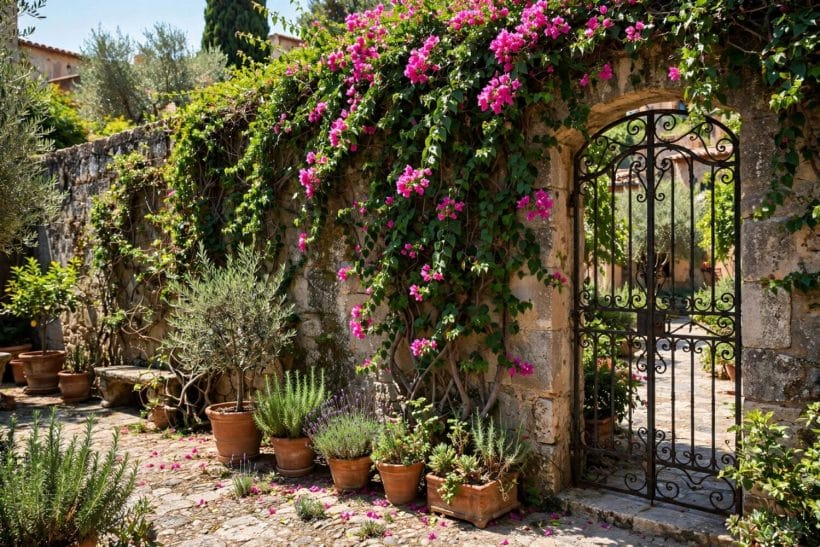
Gallery-3 shows the planting in its two homes: soil and container. These ideas combine beds and pots so the permanent structure holds while the display can change with the seasons.
26. Group pots in clusters, never lines
Pots arranged in odd-numbered clusters of varied heights read as planting; pots in a row read as a queue. Cluster them at corners, beside doors and around the seating, and vary the heights so the group has a skyline like a border’s.
27. Anchor the scheme with one great pot
A single oversized pot — holding a small tree, a clipped shrub or a fountain of grasses — anchors a courtyard the way a hearth anchors a room. Everything smaller arranges around it, and the room gains a centre that can move if the layout changes.
28. Put beds where the sun is, pots where it is not
In-ground beds belong against the walls that receive real sun; the shaded walls get the pots, whose plants can be chosen for shade or rotated into the light in turns.
29. Give the biggest pots the evergreen structure
The plants that hold the room in winter — clipped evergreens, a small conifer, a bay — deserve the largest, heaviest pots and the permanent positions. Seasonal colour comes and goes around a skeleton that never leaves.
30. Herbs by the door you cook from
The courtyard classic: pots of herbs within arm’s reach of the kitchen door.
31. Rotate seasonal pots through the year
Keep a small nursery corner out of sight, and rotate pots in and out as they peak and fade: spring bulbs, summer colour, autumn foliage. The courtyard then always shows its plants at their best, which no fixed border in a small space can promise.
32. Repeat one plant for rhythm
The same grass in three pots, the same shrub down a bed — repetition is what turns a collection of plants into a scheme. In a small enclosed room, one repeated plant does more for coherence than five novelties.
33. Plant scent where people sit
Enclosure concentrates fragrance, so spend it deliberately: jasmine, rose, lavender or scented leaves near the bench and the table, where the evening’s warmth releases them. A courtyard that smells right is remembered longer than one that merely looks right.
6. Trees and Shade for Small Courtyards
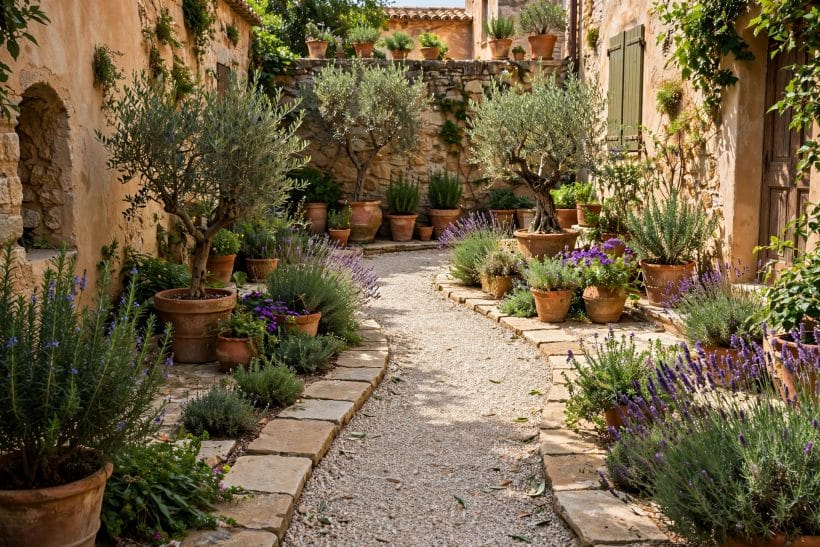
Gallery-4 looks up. A courtyard’s ceiling is its scarcest resource — too much sun bakes it, too little starves it — and these ideas manage trees and shade at room scale.
34. One small tree as the ceiling
A single small tree, especially a multi-stemmed one that branches like a natural umbrella, gives the courtyard its roof of leaves: dappled shade, seasonal change and a living centre in one plant. If a courtyard can have only one large thing, this is the large thing.
35. Grow the tree in a great pot
Where roots must not travel — over structures, in rented ground, near old drains — the courtyard tree lives in its largest pot, watered faithfully. A potted tree is a commitment, but it makes the room’s ceiling portable and its roots a known quantity.
36. Pleach trees along the boundary
Pleached trees — a screen of foliage held on a frame of trained branches above clear trunks — give privacy at exactly the height a courtyard needs it, with the ground beneath still free for beds and pots.
37. Shade the table with a vine-covered pergola
A light pergola over the dining corner, carrying a grape or other climbing vine, gives summer shade that drops its leaves and admits winter sun. The structure also gives the room a second ceiling line, which enclosed spaces wear beautifully.
38. Keep one movable shade in reserve
An umbrella or a simple sail covers the seat the pergola misses and moves as the sun does. In a room where shade is architecture, one flexible piece lets the household follow comfort around the day.
39. Choose deciduous shade for a two-season room
Leaves in summer, light in winter: deciduous trees and vines time the courtyard’s climate to the year for free. Evergreen shade is a one-season answer in a room that must live in all of them.
40. Underplant the tree with shade-lovers
Beneath the tree’s canopy, plant what enjoys the dapple: ferns, ground covers and spring bulbs that finish before the leaves close. The floor under a courtyard tree is a small woodland garden waiting to be admitted.
41. Give roots an honest home
A tree planted in the ground needs its soil volume planned like a piece of furniture: a proper planting area, not a hole in the paving.
7. Water: Rills, Basins and Wall Fountains
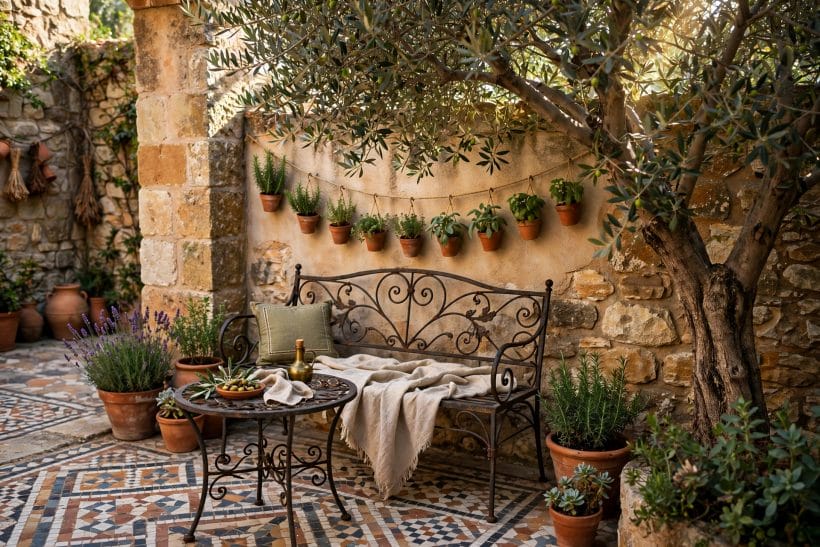
Gallery-5 closes the making tour with water, the element an enclosed room amplifies best — its sound, its reflections and its coolness all stay inside the walls. These ideas size water to a courtyard.
42. Hang a wall fountain on the end wall
A spout, a mask or a simple pipe above a basin on the courtyard’s end wall gives the room its focal sound and a destination for the eye, in the depth of a shelf. It is the smallest complete water feature, and the most courtyard-shaped.
43. Run a rill across the paving
A narrow channel of moving water crossing the floor — from wall fountain to basin, say — turns the room’s ground into a landscape and its walk into a small journey with a bridge moment. Rills are architecture first and plumbing second.
44. Keep a still basin for reflection
A shallow bowl or trough of still water mirrors the sky and the planting, doubles the light in a shaded room and gives the courtyard a pause point. Still water is the quietest focus a room can have, and often the strongest.
45. A spout and trough for the rustic room
In an informal courtyard, a plain spout filling an old trough does water with country manners: useful for watering cans, loved by birds and honest about its plumbing.
46. Leave a shallow edge for birds
Whatever water you keep, give it one shallow, sloping edge where birds can drink and bathe. The room gains daily theatre at no cost, and a courtyard visited by birds feels connected to a world beyond its walls.
47. Choose a self-contained feature where plumbing cannot go
Where no water supply or drain can reach, a self-contained recirculating feature still gives sound and movement from a hidden reservoir. It is the renter’s and the roof terrace’s answer — water as furniture rather than infrastructure.
48. Place water where the seat can hear it
Water in a courtyard is mostly sound, so place it for the ear of the person sitting down: near the bench, under the window, within the pergola’s shade.
49. Winter-proof the water
Before hard frosts, drain what can crack, protect what cannot be moved and let basins become bird tables or leaf catchers by design rather than by neglect. Water features earn their summer glory with a short autumn routine.
8. Colour Schemes in Planting and Paint
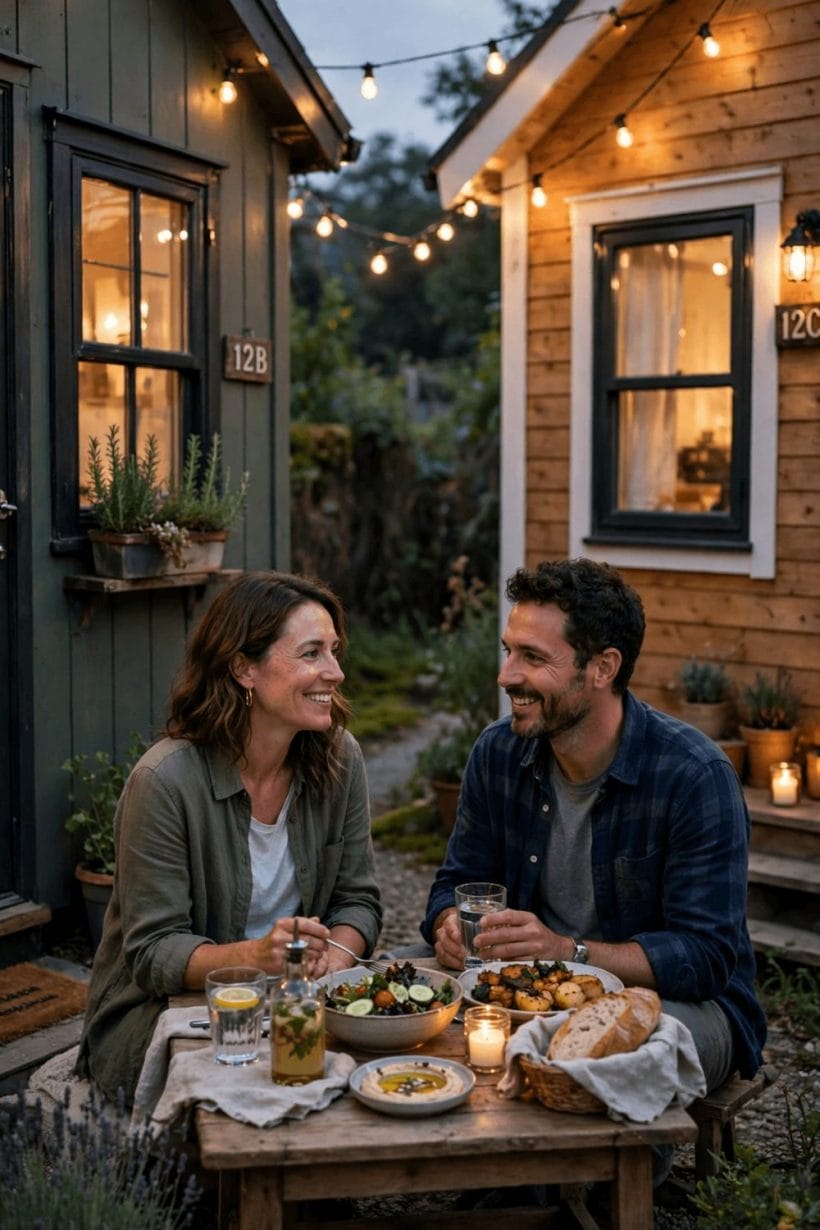
The second pin turns to colour, the cheapest transformation a courtyard owns. Enclosure makes colour schemes behave like interior schemes — walls, floor and soft furnishings all count — and these ideas scheme them as one room.
50. Green on green, with white flowers
The calm classic: foliage in layered greens against pale walls, with white flowers as the only accent. It never dates, it flatters shade, and it makes a small room feel like a deep breath — the scheme against which all others are measured.
51. The Mediterranean scheme
Terracotta pots, olive and silver foliage, lavender, warm stone and a sun-baked wall colour: the courtyard as a southern room. It asks for the sunniest courtyards and rewards them with the feeling of a permanent late afternoon.
52. Let a painted wall carry the colour
One wall painted deep green, indigo or warm ochre gives the room its colour statement while the planting stays quiet against it. Paint is the courtyard’s most reversible drama — a weekend changes the room’s whole temperature.
53. Keep hot colours in the pots
Reds, oranges and magentas sing in an enclosed space and exhaust it just as fast. Confine them to pots and seasonal displays that can be edited, and the room can be vivid in June and calm again by September.
54. Silver foliage for the shaded room
Grey and silver leaves read as light in shade: they lift dark corners, cool hot walls visually and pair with everything.
55. Repeat one colour through everything
Choose a single accent — a blue, a rust, a cream — and repeat it in flower, pot glaze, cushion and door paint. The repetition stitches the room together more powerfully than any single expensive object in it.
56. Plant a second season of colour
Spring and summer plant themselves; scheme deliberately for autumn — foliage that colours, berries, late flowers — and for winter’s bones of bark and evergreen. A courtyard seen from the kitchen window all year owes you four schemes, not one.
57. Scheme for dusk as well as noon
Pale flowers, light paving and silver foliage come alive at dusk, glowing in the room’s last light while dark colours retire. If the courtyard is used most in the evening, choose its palette by evening light, not by the nursery’s midday.
9. Furniture, Fire and Evening Use
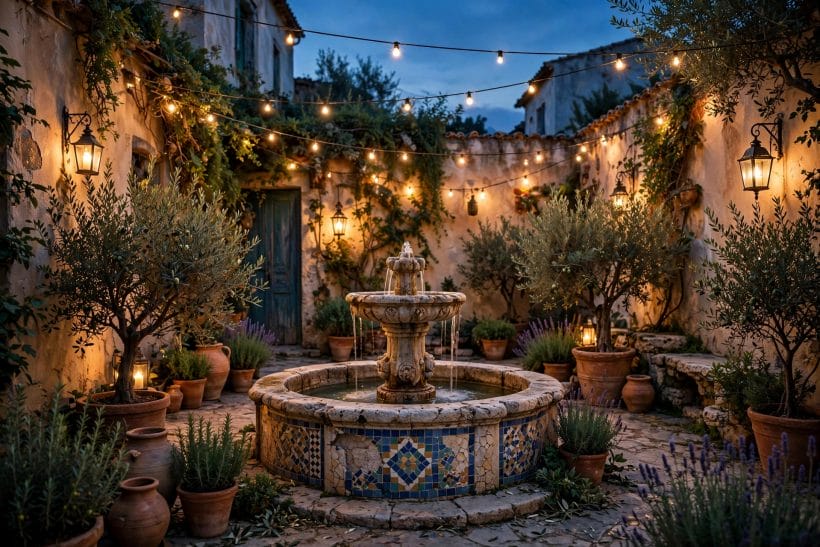
Gallery-6 shows the room after hours. A courtyard earns its keep in the evening — enclosed, private, holding the day’s warmth — and these ideas furnish it for dinner, firelight and the long sit.
58. Put the table where the sun eats lunch
Furniture follows the sun’s schedule: the table where midday light lands, the bench against the wall that holds the evening’s last warmth. Place seating by watching the room for a day, not by where the furniture shop’s photograph put it.
59. Choose furniture that folds, stacks or wheels
A small room must reconfigure: chairs that stack for the party, a table that folds for the delivery, a bench on wheels that follows the sun.
60. Build a bench along a bed edge
A wide bed edge or a low wall capped in timber becomes permanent seating with the best view of the planting — at nose height to the border. Built-in seating costs no floor, seats a crowd along its length and never needs storing.
61. A fire bowl for the evening’s centre
A small fire bowl or pit gives the courtyard its hearth: warmth, light and a reason to stay out past dusk. Keep it clear of planting and boundaries, use it in line with local rules and common sense, and let the site’s fire-feature ideas carry the detail — here it is simply the room’s fireplace.
62. String the ceiling with light
Festoon lights or lanterns strung overhead give the open-air room what every room needs: a ceiling line after dark. The glow stays low and warm, the walls catch it kindly, and the courtyard becomes the house’s best-lit room precisely by being gently lit.
63. One true light by the door
Among the lanterns and strings, keep one honest light at the door for keys, steps and winter evenings. Ambience is a choice made possible by having the practical light already solved and switched separately.
64. Store the soft things in the bench
Cushions, throws and candles live in a storage bench or a weatherproof box inside the room, or they will live in the house and rarely be fetched.
65. Keep a second seat for the shade
One chair or a small bench in the courtyard’s coolest corner serves the hot afternoon as the fire bowl serves the cool evening. Two seats in two climates make the room usable all day instead of at one favoured hour.
66. Plant the evening’s scent by the seats
Night-scented flowers and warm aromatic leaves release their perfume as the air cools — plant them where the seats are, and the courtyard’s last sense comes alive just as its colours fade. It is the cheapest luxury in this entire collection.
10. Practical Details: Drainage, Care and Storage
The tour ends with the unglamorous systems that decide whether a landscaped courtyard stays beautiful or slowly silts into chores. None of these ideas photograph well; all of them are the difference between a room and a burden.
67. Drainage before decoration
An enclosed floor must shed its water somewhere deliberate: falls running away from the house, a channel or gully where the water gathers, and no paving laid to pond against the walls. Decide the water’s route before the first slab, because every later idea in this collection depends on it.
68. A tap within reach of every pot
Pot courtyards drink daily in summer; if watering means hauling cans through the house, the planting will quietly lose. An outdoor tap, a hose that reaches the far corner, or a simple watering system planned with the layout is horticulture’s best insurance.
69. Hide storage in the room’s furniture
Tools, pots, compost and the watering kit need a home that is not the courtyard’s floor: a storage bench, a slim cupboard against the wall, a shed no deeper than it must be. A room whose clutter has an address stays a room.
70. Give pots a holiday plan
Self-watering pots, deep saucers, grouping pots together in the shade before a trip, or a neighbour armed with the tap’s location — decide how the courtyard drinks while you are away before the first summer, not at the airport.
71. Sweep and wash the floor as regular care
Paving in an enclosed, planted room collects leaves, algae and slipperiness in the shaded corners. A regular sweep and a seasonal wash keep the floor safe and the room’s lines sharp — the courtyard equivalent of vacuuming the sitting room.
72. Feet and saucers under the pots
Pot feet lift containers off the paving so air circulates, frost damage lessens and the floor’s stains stay where saucers can catch them. A small detail, repeated under every pot, that protects both the planting and the floor it stands on.
73. Refresh gravel and mulch each spring
Gravel thins and scatters; mulch rots down into the beds it feeds.
74. Protect the working route
The courtyard serves the house as well as the eye: keep the route for bins, ladders, bikes and deliveries passable in the finished design, with the pots and furniture placed around it. Beauty that blocks the house’s plumbing of daily life will be dismantled by it.
75. Write the winter plan into the design
Decide at the drawing stage what stays out, what gets sheltered and what is stored: tender pots, water features, cushions, the movable shade. A courtyard whose winter is planned reads as a sleeping room; one whose winter is improvised reads as a yard again.
Final Considerations
A courtyard succeeds when it is designed as a room and kept like one: one floor, green walls, a centre, a colour scheme, furniture that follows the sun, and drainage and storage solved before they are visible. The ideas above share that order, and it is why the smallest walled yard can hold dining, firelight, a tree and a fountain without ever feeling crowded.
Start with the floor and the water’s route, clothe the walls next, and let pots, colour and furniture arrive as the seasons invite them. Kept swept, watered and edited, a garden courtyard becomes the room the whole house envies — the one with the sky for a ceiling and no ceiling on its evenings.



0 Comments