

A fire pit changes what a deck is for. Without one, the deck is a platform for furniture; with one, it becomes a room with a centre — a place people arrange themselves around, stay in after dark, and use in months when the garden itself is out of season.
These seventy-five deck fire pit ideas collect the forms the fire takes on a deck — built-in stone pits, portable bowls, gas fire tables and rustic cabin fires — with the seating, placement and material judgements that make the combination work. One boundary is stated at the start and kept throughout: this is a design post, not an installation guide. Clearances, heat protection and local rules are spoken of in general terms only, because the figures that govern a real fire on a real deck belong to the fire’s maker, the deck’s material and your local code — check all three before any fire is lit.
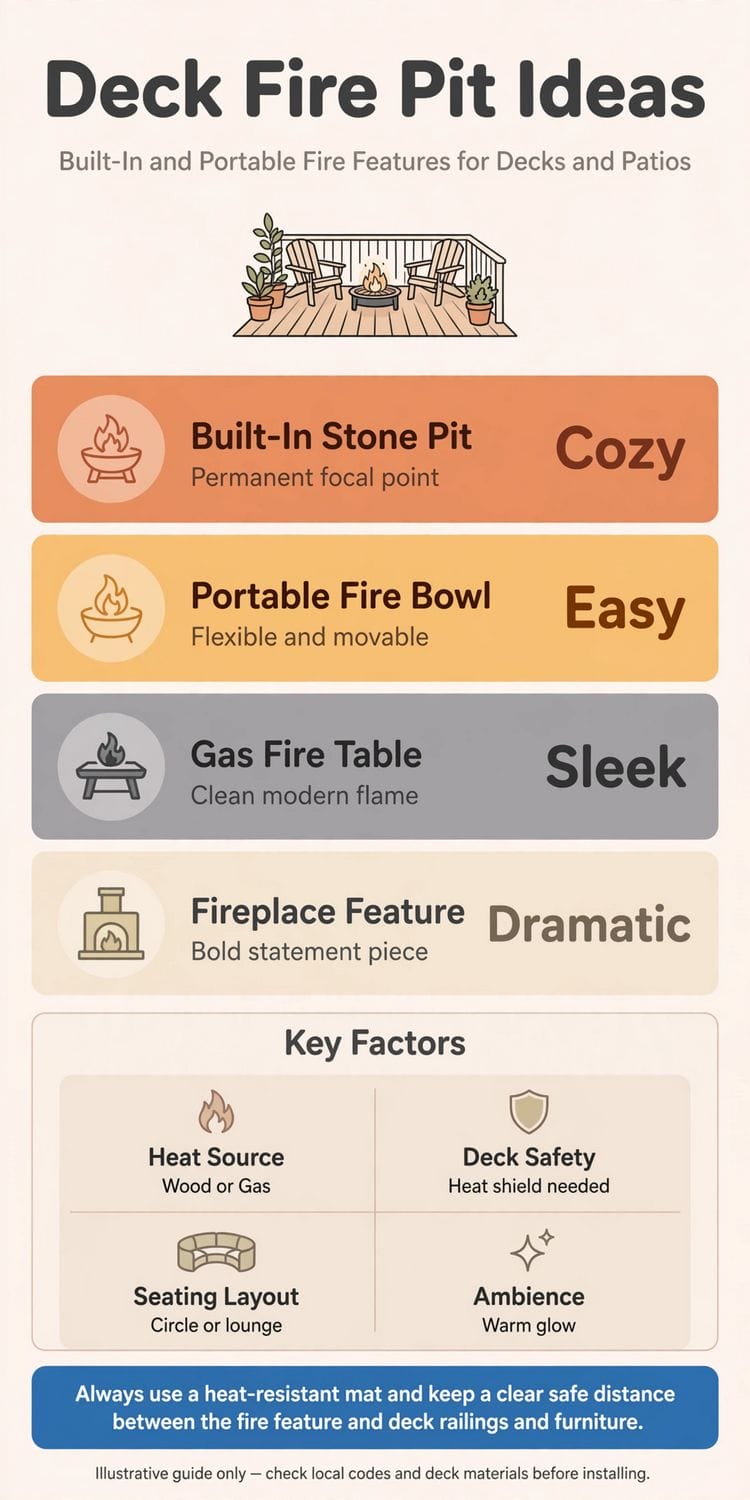
1. Deck Fire Pits at a Glance
Scope first. This post owns fire on a deck: a raised, timber-or-composite platform, with all the placement and protection questions that follow from putting flame on a floor that can burn or mark. The ground-level fire survey — pits in lawns, gravel and stone terraces — is fire pit ideas, and the deck itself, its levels and edges, is designed in ground level deck ideas; the small-deck application is in the published tiny house deck ideas. Indoors, the same instinct is served by modern fireplace ideas and the fireplace living room pillar. Here, everything is the meeting of fire and decking.
The safety framing is part of the design, not a footnote to it. In general terms: a fire feature on a deck belongs on a heat-resistant base or mat sized beyond the fire itself; it keeps the generous clearances its maker states from railings, furniture, walls and overhangs; spark control, supervision and a means of extinguishing are planned, not improvised; and wood-burning may be restricted in some districts and seasons — the local rule is checked before the fire is chosen, not after. Built-in and gas installations belong to qualified installers working to local code. Within that frame, the design freedom is wide.
| Fire form | Character |
|---|---|
| Built-in stone pit | Permanent focal point — the deck designed around it |
| Portable fire bowl | Flexible and movable — the fire comes out for the evening |
| Gas fire table | Clean modern flame — a table by day, a hearth by night |
| Fireplace feature | Bold statement piece — a chimneyed hearth at the deck’s edge |
2. Built-In Stone and Masonry Pits
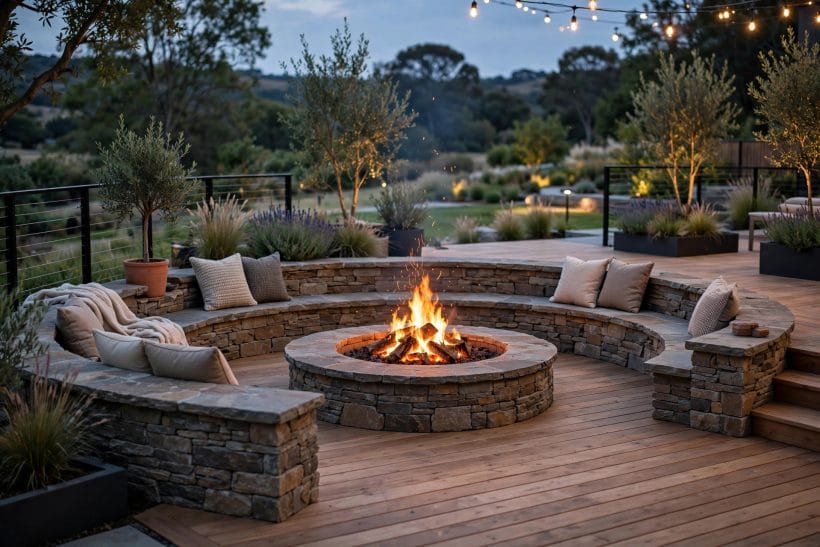
Gallery-1’s composition — a stone pit ringed by its own curved stone bench, the valley beyond — is the built-in at full commitment: the fire is architecture, and the seating is part of the masonry. A built-in on a deck belongs entirely to professional design and local code; what this section designs is its form and its company.
1. The stone circle pit
A round stone pit is the fire’s oldest form, and on a deck it reads as the room’s hearth-stone. The circle gathers seating evenly, and its masonry mass makes the fire feel settled rather than placed.
2. The curved bench embrace
Gallery-1’s bench — stone, curved, cushioned — builds the seating into the pit’s own geometry. The embrace it makes is social as much as visual: everyone is at the same distance from the flame, and the circle has no head.
3. The sunken conversation ring
Stepping the seating zone down, or raising the pit on a masonry plinth within a paved deck panel, gives the fire its own floor within the floor. The level change is the room division — felt by the feet before it is seen.
4. Stone that matches the house
Built-ins earn their permanence when their stone speaks the house’s language — the chimney’s stone, the plinth’s, the garden wall’s. A pit built of the house’s own material reads as original architecture rather than addition.
5. The square masonry pit
Square pits suit rectilinear decks and modern houses: the fire’s geometry repeats the deck boards’ discipline, and the seating arranges in conversational L’s and facing pairs instead of a ring.
6. Raised hearth height
A pit built up to hearth height — its rim a seat, its fire at the level of a fireplace — brings the indoor hearth’s manners outdoors. The rim becomes extra seating, a shelf for drinks, and the fire’s frame.
7. The pit with a cooking ledge
Some built-ins widen one section of rim into a ledge for a grill grate or a kettle — the fire as kitchen as well as hearth, and firmly the maker’s and the code’s business on a deck.
8. Masonry and timber together
Stone pit, timber deck, timber bench seats: the mixed-material composition of gallery-1 softens masonry’s weight and ties the fire zone to the deck it stands on. The heat-resistant panel beneath the pit is where the two materials’ truce is engineered.
9. The permanent pit as plan anchor
Design the deck around a built-in from the first sketch — door swings, traffic lanes and furniture all defer to the fire’s clearances and its view. A permanent pit retro-fitted into a finished deck almost always sits wrong; planned, it sits like it was always there.
3. The Seating Circle: Layouts Around the Fire

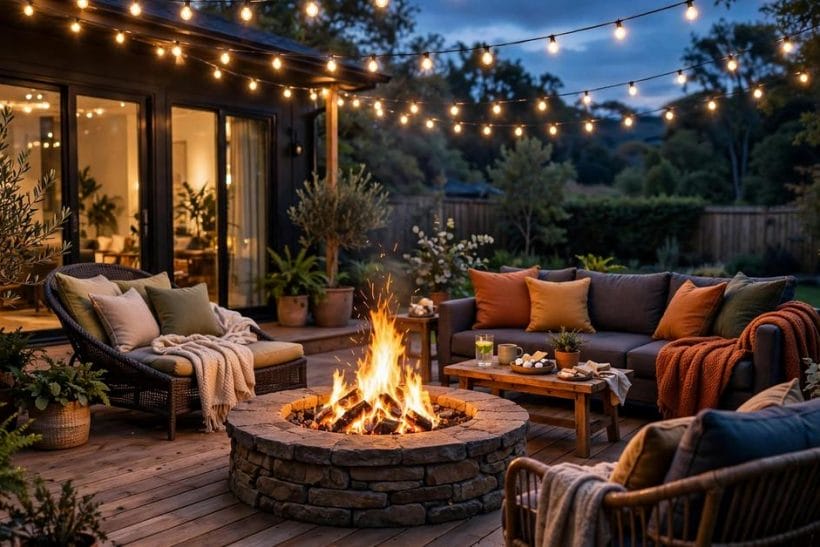
The pin’s evening corner — string lights overhead, cushions and throws, the fire’s glow at the frame’s edge — is the seating idea in its softest form: the fire as the deck’s lamp and magnet. Seating decides how a fire is used more than the fire does, and this section arranges it.
10. The full circle
Chairs in a complete ring suit the round pit and the long evening: everyone sees the fire and each other. Keep the ring’s far side openable — a gap in the circle is its door, and a circle without one makes latecomers climb.
11. The facing pair of sofas
Two sofas facing across a rectangular fire — gallery-3’s arrangement in the next section but one — seats a crowd in conversation formation. It is the fire table’s natural layout and the deck’s most sociable plan.
12. The corner embrace
An L of seating in the deck’s corner, fire at the angle, suits the portable bowl and the small deck: two walls of house or railing give the corner its shelter, and the fire completes the enclosure.
13. Lounge chairs at the fire
Low lounge chairs lean their sitters back toward the sky — the fire for warmth, the stars for the view. The layout suits the wide deck and the unhurried evening, and asks for side tables within reach.
14. The bench-and-chairs mix
A fixed bench on one side — built into the deck’s edge or the railing line — with loose chairs opposite gives a fire zone its permanent half and its flexible half. Numbers can grow; the composition holds.
15. Throws, cushions and the soft layer
The pin’s cushions and knitted throws are not decoration: they are what extend the fire’s season, letting sitters stay out as the evening cools. Outdoor fabrics, stored dry, make the fire corner the deck’s furnished room.
16. String lights above
Festoon lights over a fire corner — the pin and the feature both wear them — layer electric warmth over the fire’s, and light the faces the fire lights from below. Two light sources, two directions: the corner reads as a ceilinged room.
17. The fire as the last seat
Design one seat as the fire-tender’s — nearest the wood store, with room to work. Planning it keeps the tender in the conversation instead of outside it.
4. Portable Fire Bowls
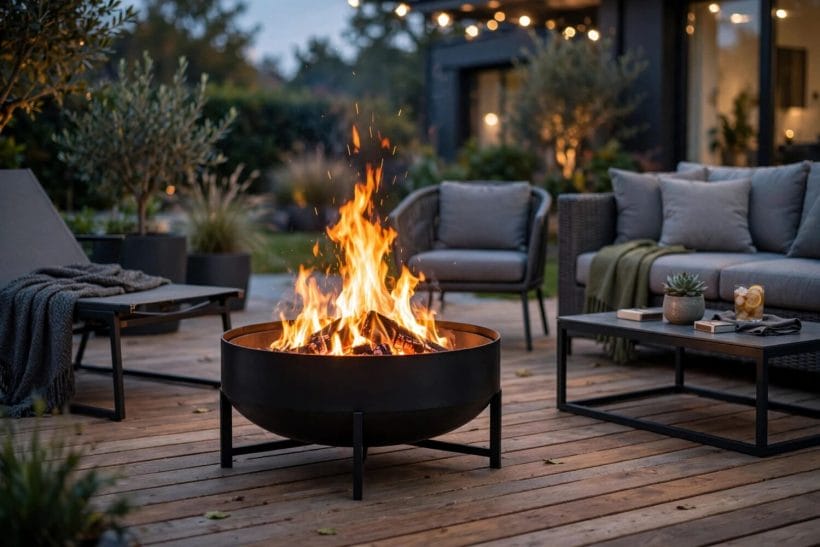
Gallery-2’s black steel bowl — flames up, loungers drawn close — is the portable fire at its best: brought out for the evening, stood on its protective mat, and stored when the season turns. Portability is the bowl’s design argument.
18. The steel bowl classic
A simple spun-steel bowl on legs is the portable archetype: light enough to move, deep enough to hold a real fire, plain enough to suit any deck. On a deck it stands on a heat-resistant mat or panel, always — the pairing is the design, not an accessory.
19. The low wide bowl
Wide, shallow bowls spread the flame picture and warm a wider circle at ankle height. They suit the lounge-chair layout, where the fire is looked down into like a hearth rug made of light.
20. The tall fire column
Column and tower forms lift the flame to standing height — the fire for drinks parties, where nobody sits for long. On a deck their footprint is small and their clearances are read from the maker’s guidance with care.
21. The bowl on a paved panel
A panel of stone or tile within the deck boards gives a portable fire a home position with its protection built in. The panel outlasts any bowl placed on it.
22. Spark-screened bowls
A mesh spark screen is the portable fire’s good manners, most valuable on timber decks and breezy evenings. Bowls designed with their screens — domed, hinged, handled — get used with them; the screen is part of the silhouette.
23. The double-duty bowl table
Some bowls lid into coffee tables by day. On a small deck the double duty is the difference between having a fire and not having room for one — the fire earns its square footage twice.
24. Copper and corten finishes
Portable bowls are where fire finishes live: copper that will verdigris, weathering steel that rusts to a deliberate russet, blackened steel that disappears at night. The bowl is the deck’s fire jewellery; choose its ageing as carefully as its shape.
25. The stored-by-day fire
A bowl light enough to store keeps the deck fully itself by day and a fire room by night. The storage place, dry and near, is part of the design; a bowl that lives by the door gets used.
26. Two small bowls
A pair of small bowls flanking a seating group spreads warmth more evenly than one large fire, and suits long narrow decks where a single centre is awkward.
5. Gas Fire Tables and Linear Flames
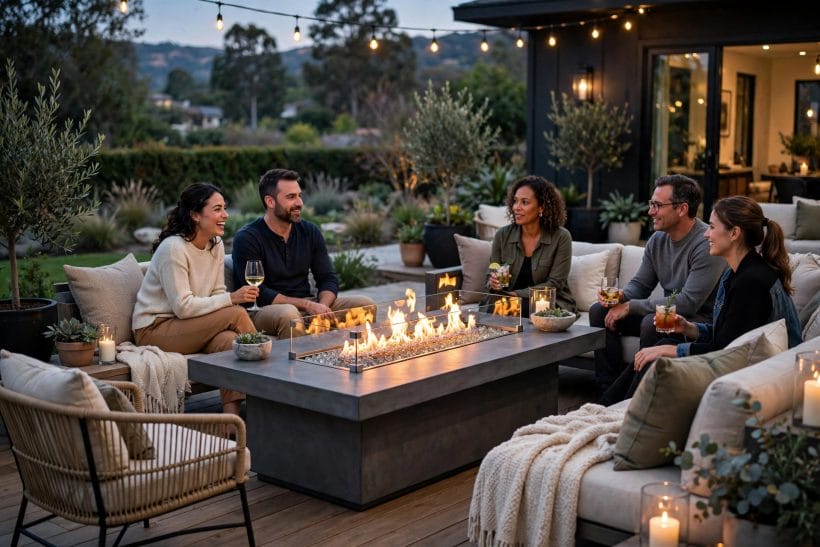
Gallery-3’s fire table — a long ribbon of flame down a table’s centre, friends on both sides, wine in hand — is the gas fire’s social form: instant, controllable, clean, and shaped like furniture. Gas installations on decks are professional work under local code; this section designs their forms and company.
27. The linear fire table
A ribbon of flame along a table’s centre seats people face to face with firelight between them — the campfire translated into dining geometry. It is the most sociable fire form there is, and the deck’s answer to the dinner party.
28. The round gas pit table
A circular burner in a table’s centre keeps the ring formation with gas manners: no sparks, no ash, a flame that lights and leaves on a control. For decks where wood smoke is unwelcome — or unpermitted — it is the fire that remains possible.
29. Fire glass media
Tempered fire glass over a gas burner — the reflective bed of gallery-6’s close cousin — turns flame into jewel-light. Colours are chosen against the deck’s palette; the glass is the modern fire’s ornament.
30. Lava rock media
Gallery-6’s flames rise through lava rock: the volcanic bed reads as geology, hides the burner, and suits rustic and modern decks alike. Media is the gas fire’s visible material; it is chosen like a finish, not a fuel.
31. The fire-and-water pairing
Some tables pair the flame with a water rill — the two elements composed together, installed professionally and enjoyed simply.
32. Wind-guarded flames
Glass wind guards around a table burner keep the flame picture steady on exposed decks and are part of the table’s designed silhouette. On a breezy site they are the difference between a flame that performs and one that merely survives.
33. The switch-on fire
Gas’s real luxury is temporal: a fire for twenty minutes, for one drink, with no building and no clearing. Decks with gas fires get used on weeknights.
34. Concealed fuel, clean lines
Tables that hide their fuel within the furniture keep the deck’s lines clean. The concealment is the luxury detail; servicing access is the maker’s design.
35. The fire table as the deck’s dining centre
Planned as the main table — sized for meals, surrounded by the good chairs — the gas fire table stops being an extra and becomes the deck’s reason. The feature fire stays the evening’s; the table fire is the day’s as well.
6. People, Evenings and Ambience

Gallery-4 is the point of all of it: five people, blankets, drinks, firelight. This section designs the atmosphere deliberately, because ambience is a set of decisions, not an accident.
36. Firelight as the lighting plan
A lit fire is a light source no fitting matches. Design the deck’s electric light to support it — low, warm, peripheral — and let the flame be the room’s lamp.
37. The blanket basket
A basket of throws by the door, as gallery-4’s sitters have discovered, is the fire corner’s essential furniture. The fire warms the front; the blanket warms the back; the evening lengthens.
38. Drinks within reach
Side tables, a ledge, the pit’s own wide rim — every seat at a fire needs a landing place for a glass that is not the deck boards. Plan the surfaces with the seating, at the distance a seated arm actually reaches.
39. The fire for two
Not every fire is a party: two chairs, one bowl, the quiet end of the day. Design the small arrangement as carefully as the crowd’s — it will be the one used most.
40. Children’s places at the fire
Families design the fire’s geography honestly: the clear zone the maker states is also the children’s boundary, seating for the young is placed outside it, and supervision is a person, not a hope. The fire’s rules are the house’s rules, stated once and kept.
41. The dog’s spot
Every deck dog chooses a fire spot — near enough for warmth, clear of the clear zone. A mat in that place acknowledges the household as it is, and keeps the chosen spot a safe one.
42. Music and the quiet deck
A fire has a sound of its own; the decks that honour it keep speakers small and volumes low. The crackle is the evening’s music.
43. The fire in the shoulder seasons
Spring and autumn evenings are the deck fire’s finest hours — too cool without it, perfect with. The fire is not a summer feature; it is the device that gives the deck a nine-month year.
44. The last-look layout
Compose the fire corner for the view from the house’s windows as well as from its seats. The fire watched from the sofa is part of the house’s picture.
7. Placement: Where the Fire Sits on the Deck
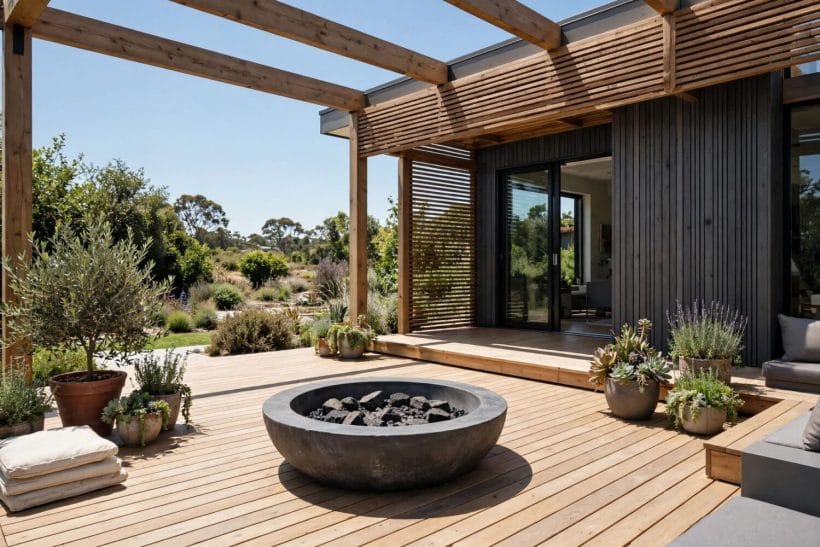
Gallery-5’s concrete bowl waits on a pale deck beside the house — placed, not yet lit, its position already a design decision. Placement is where the safety framing and the composition meet, and it is decided by clearances, wind, traffic and view together.
45. The deck’s centre
A central fire makes the deck a room arranged around it — the feature image’s plan. It suits wide decks where the traffic can pass around the clear zone without squeezing, and it gives every seat the fire.
46. The deck’s edge
Fire at the edge — against the railing line, facing inward — keeps the deck’s middle open and turns the view outward beyond the flame. The fireplace-feature form belongs here, its back to the boundary.
47. The corner station
A corner placement serves the small deck: the fire takes the least useful floor and radiates into the diagonal. The corner embrace of idea 12 is its seating; the bowl or a small table is its fire.
48. Under a pergola — with care
Overhead structure and open flame are a combination governed strictly by the maker’s clearances and local code, and by the pergola’s material; gallery-5’s bowl sits beside its pergola, not beneath it. Where it is permitted and properly cleared, the roofed fire corner is the deck’s cosiest room — where it is not, it is not attempted.
49. Reading the wind
Prevailing wind decides where smoke and sparks travel, and therefore where seats and open windows should not be. A season of evenings teaches a deck’s wind; the fire’s station is chosen after that education.
50. Clear of the traffic lane
The route from door to garden crosses most decks; the fire and its clear zone belong off that lane. A fire people must skirt with drinks in hand is a fire placed by the plan, not by the photograph.
51. Near the door, far from the wall
The social gravity of a deck fire pulls it toward the house — drinks, kitchen, blankets — while its clearances push it away. The balance point, measured against the maker’s stated distances from walls and overhangs, is the fire’s true address.
52. The view axis
Seat the fire where its sitters face the garden’s best view, and the flame becomes the landscape’s foreground — gallery-1’s valley composition.
53. Level, stable, standing true
Every fire form assumes a level, stable footing; decks slope for drainage and boards flex. The fire’s station is the spot made or chosen to be true — and a fire that rocks is a fire moved, immediately.
8. Rustic and Cabin Deck Fires

The second pin’s rustic deck — Adirondack chairs, a plaid throw, a rough railing and the garden below at sunset — is the cabin register: the fire as frontier furniture, plain, wooden and unhurried. The rustic deck belongs to the same family as front porch ideas‘ country register; here it is the fire’s styling that turns rustic.
54. Adirondacks around the bowl
The Adirondack chair was designed for exactly this: reclined, wide-armed, pointed at a view or a fire. A ring of them around a steel bowl is the rustic deck’s complete sentence.
55. The log-store as furniture
A stacked woodpile is the rustic fire’s backdrop and its fuel in one — a wall of rounds beside the fire, as handsome as it is useful. Stored off the deck boards on its own bearers, kept dry, it is the fire’s pantry and portrait.
56. Rough timber and stone
Unpeeled posts, rough-sawn rails and a stone or steel fire: the rustic palette accepts weathering as a finish. The fire forms that suit it are the plain ones — bowl, ring, chimney — without polish to lose.
57. The chiminea on the deck
The chiminea — the bulbous, chimneyed clay or iron fire — directs its smoke upward and its heat forward, and it has sheltered more small decks than any other form. On decking it stands on its stand and mat, clearances read from its maker, as every fire here does.
58. Plaid, enamel and lantern light
The rustic evening’s props are enamel mugs, plaid wool and lamplight alongside the flame — a memory of camps and cabins, with the fire as its living centre.
59. The fire with the garden below
A raised rustic deck over a garden — the pin’s arrangement — lets the fire’s sitters look down into the planting at dusk. Height is the rustic deck’s luxury.
60. The breakfast fire
A small morning fire with coffee is the cabin deck’s secret ceremony — the day begun outdoors. The fire forms that light quickly and die cleanly serve it; the ritual outlasts the novelty.
61. Rustic restraint
The rustic register fails by excess. Keep it to wood, wool, iron and flame, as the pin does, and the deck reads as a place rather than a theme.
9. Flame Details: Media, Screens and Finishes
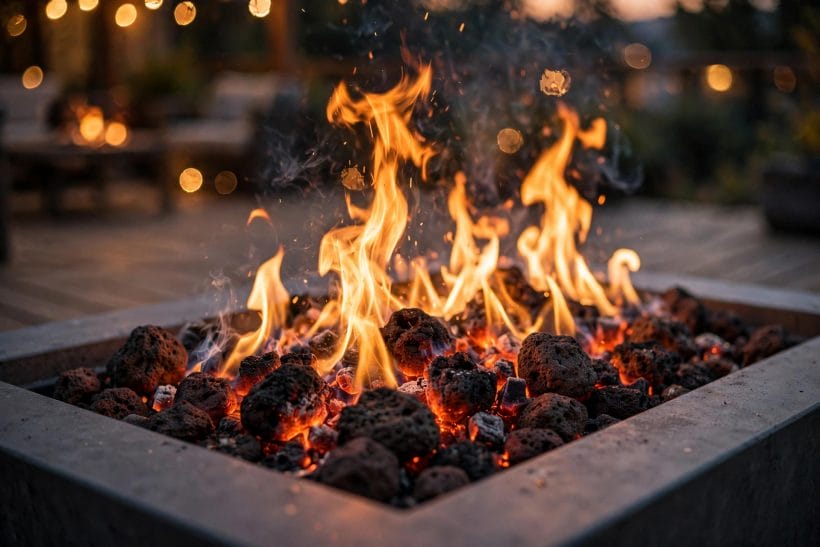
Gallery-6 is the fire at reading distance: flames through lava rock, every tongue of fire distinct. The details at this range — what the flame rises through, how it is screened, what contains it — are the fire’s finish carpentry.
62. Lava rock beds
Lava rock hides burners, spreads flame and holds a rustic-modern neutrality that suits most decks. Its texture is the gas fire’s answer to logs — geology instead of forestry.
63. Ceramic log sets
For gas fires that want the wood picture: ceramic logs give the composition without the smoke. Arranged loosely they carry the illusion; in a neat stack, they confess it.
64. Fire glass colours
Fire glass is the modern fire’s one colour decision — clear, bronze, deep blue, black. It should be taken from the deck’s own palette, once, and then forgotten; the flame is the colour that matters.
65. Spark screens and lids
The screen for wood fires, the lid for all: a lid keeps rain from the bowl, ash from the wind and the fire’s remains from the morning’s view. Fires designed with their lids look finished unlit — the state they are in most of the time.
66. Poker, tongs and the tool set
A fire’s tools stand by it like a fireplace’s always have — poker, tongs, brush, in one place: the fire’s cutlery, kept near and kept tidy.
67. The ash and ember discipline
In general terms: ash is left to cool completely — far longer than it looks — and moved only into a metal container kept clear of the deck and the house, per local guidance. It is the fire’s least glamorous rule and its least negotiable.
68. Finishes that weather well
Steel that will rust by design, stone that will smoke-darken, copper that will green: a deck fire lives outdoors and its finishes should be chosen for their aged state, not their first evening. The fire’s patina is its biography.
10. Safety and Care: The Checks That Frame the Design
The final section collects the framing kept throughout — stated generally, because the specifics belong to the maker’s instructions, the deck’s material and local code, all checked before a fire is chosen.
69. Heat protection under the fire
Every fire on a deck stands on the heat-resistant base, mat or panel its maker specifies, sized beyond the fire’s own footprint so sparks and radiant heat meet protection, not boards. Timber and composite decks are both entitled to this respect; composite can mark and soften with heat in ways timber does not.
70. Clearances, kept generously
The distances to railings, furniture, walls, overhangs and planting come from the maker and the code, and the design treats them as minimums to exceed, not targets to meet. The clear zone is drawn on the deck plan before the fire is bought.
71. Local rules and burn permissions
Some districts restrict wood-burning, some seasons ban open fire entirely, and some buildings carry their own rules. The check is made before the choice — and where wood is not permitted, the gas forms of section 5 keep the fire possible.
72. Supervision and extinguishing
A deck fire is attended while it burns and extinguished deliberately when it is done — water, sand or the extinguisher the household keeps for the purpose, per the maker’s guidance. The evening ends when the fire is out, not when the sitters go in.
73. Fuel stored properly
Wood is stored dry, off the boards and away from the fire’s clear zone; gas fuel is stored and connected only as its maker directs. Fuel is part of the fire’s geography, planned like its seating.
74. Covers and the off-season
A cover keeps rain from bowls and burners, and the off-season check — rust, blockages, seals, the maker’s service guidance — keeps the fire ready. Gas installations are serviced professionally.
75. When the answer is a different fire
The honest last check: some decks — too small, too overlooked, too restricted — should not hold an open fire at all. For them the design answer is the fire’s atmosphere without its flame: the lantern-lit corner, the outdoor hearth’s electric and candlelit cousins, the fire watched from indoors. A deck fire is a joy where it belongs, and a design knows where that is.
Final Considerations
Choose the fire form by the deck’s size and the household’s evenings, place it by clearance and wind and view, seat it like a room, and keep the safety framing part of the design from the first sketch. The seventy-five ideas here are one ancient arrangement — people, a platform, a flame — made deliberately. A fire pit does not finish a deck; it begins its evenings.



0 Comments