

Sunlight, stone and shadow do most of the decorating in a desert home. When the view is rocks, sky and dry planting, the interior does not need to compete — it needs to calm down, cool down and frame what is already outside.
That restraint is harder than it looks. Get the layout, palette and materials right, and even a compact room feels spacious, grounded and quietly warm through the hottest part of the day.
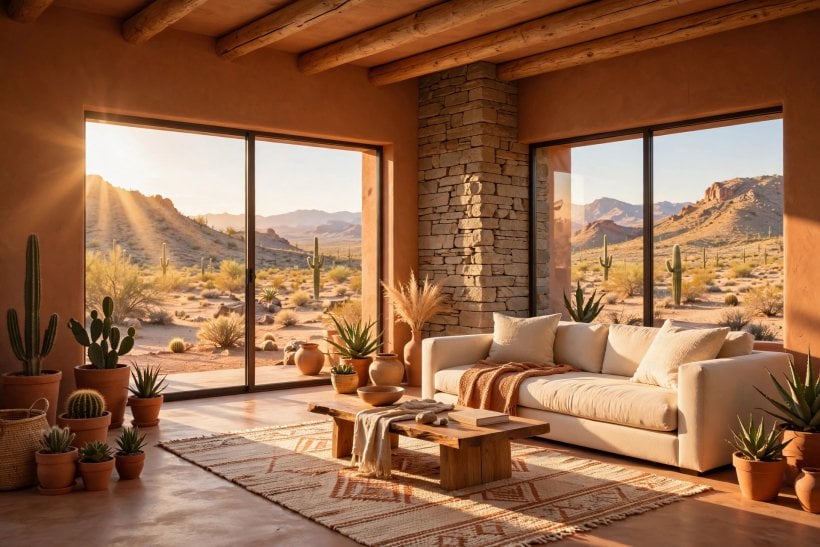
1. Desert Modern Interiors at a Glance
What people mean by desert modern interiors is a regional modern style that fuses the clean, low lines of mid-century design with the materials and colours of the desert itself: lime plaster and stucco, stone and rammed earth, warm woods, and sand, terracotta and clay tones, with wide glass pulling the landscape into the room. Rooms flow indoors and out, furniture stays minimal and warm, and shade, mass and orientation do as much work as decoration.
| What defines the style? | Low horizontal lines, open plans, honest natural materials, a warm earth palette and a direct connection to the landscape, usually through courtyards, patios and large shaded glass. |
| Which colours belong? | Warm white and sand as the base, terracotta, clay and warm brown in the middle, and charcoal or deep brown only in small accents for contrast and definition. |
| Which materials matter most? | Stucco and plaster walls, stone, rammed earth, warm woods such as walnut or weathered timber, plus leather and woven textiles to soften the hard surfaces. |
| How does it handle heat and light? | By design rather than decoration: shaded glass, clerestory light, thermal mass in floors and walls, and layouts that control glare while keeping rooms bright and ventilated. |
| Does it work in a small home? | Yes. Fewer pieces, one consistent palette and materials carried from room to room make compact spaces feel larger, calmer and more connected to the outside. |
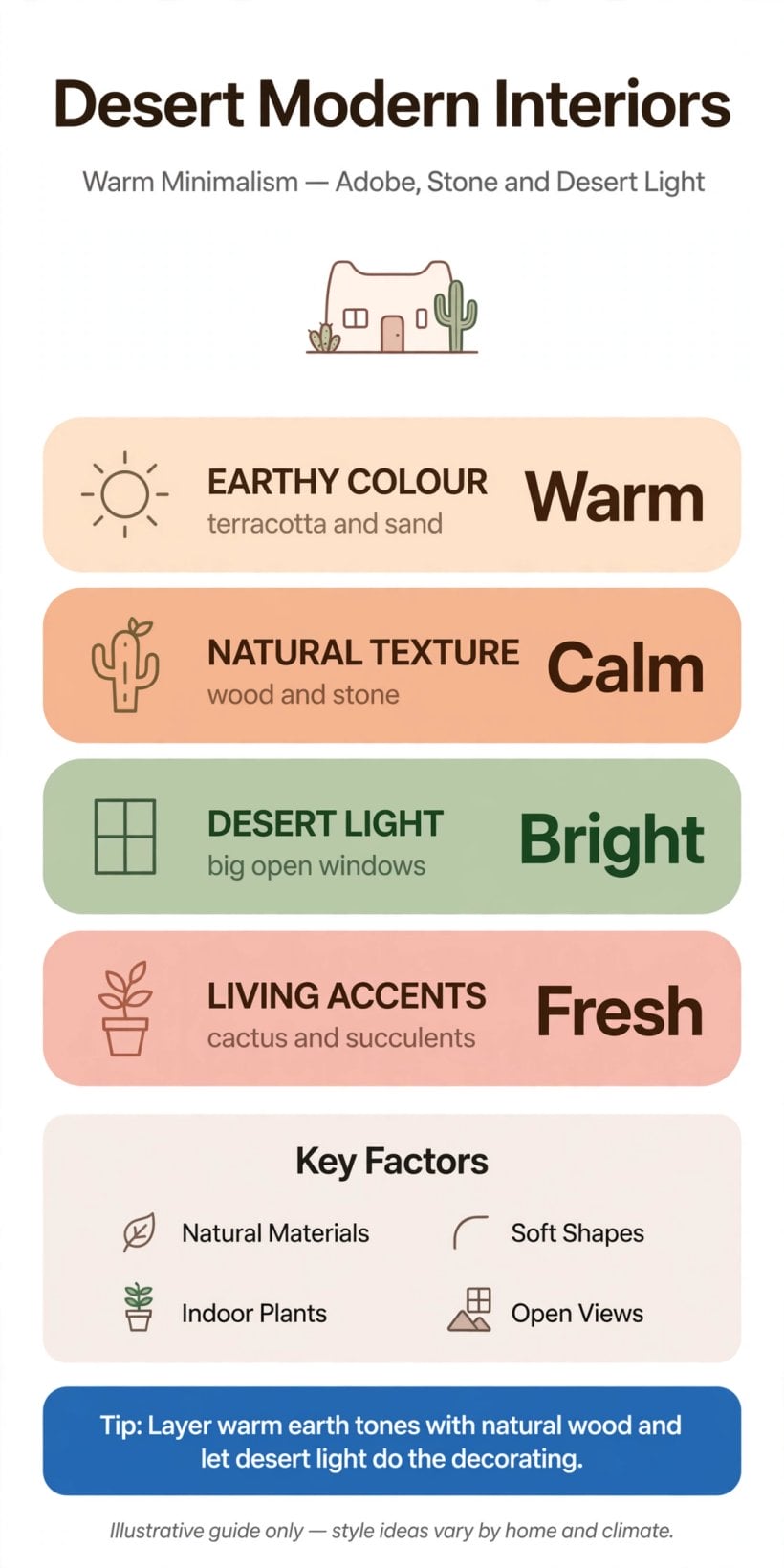
At a glance: low lines, warm earth colours, honest stone and plaster, big shaded glass, and a calm flow between inside and the landscape beyond.
2. Layout First: Low Lines, Open Plans and Indoor-Outdoor Flow
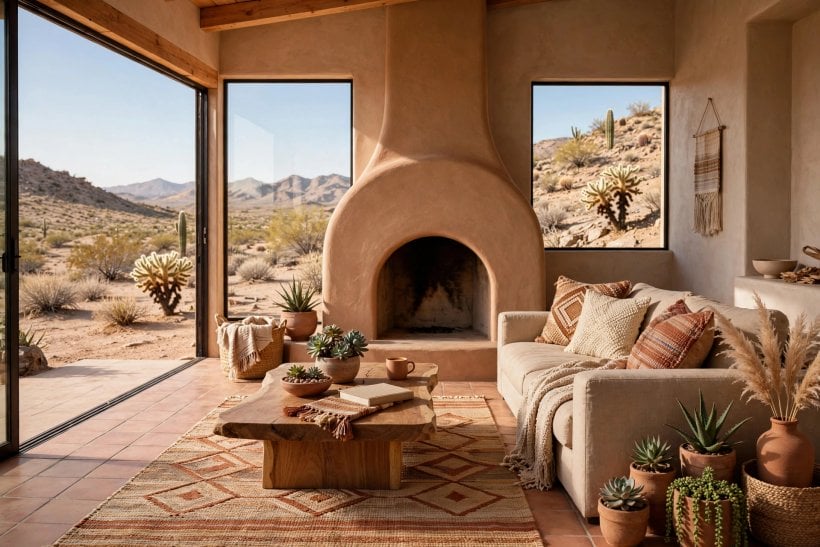
Layout comes before any colour chart. Keep the main room open, keep sightlines long and low, and let one outdoor space — a courtyard, patio or shaded terrace — work as a second room. The discipline behind modern tiny house interiors with clean lines for compact living applies here at any scale: every partition must earn its place, and everything left open gains light, air and a borrowed view.
1. Keep the Plan Low and Horizontal
Let the room stretch sideways rather than upwards. Choose low-profile seating, long low shelving and wide, shallow consoles instead of tall bookcases and high-backed chairs that chop the view into pieces. Keep window sills, shelving and artwork aligned on a few calm horizontal lines where you can. That stretched, grounded proportion is the quiet signature of the style, and it makes ceilings feel higher and rooms feel wider without moving a single wall.
2. Open the Main Room to a Courtyard or Patio
Give the living space one true outdoor partner. Sliding or folding glass to a courtyard, patio or shaded terrace doubles the room in fair weather and pulls planting, stone and sky into the everyday view. Carry the same floor tone or material family across the threshold if you can, keep the planting outside sculptural and simple, and treat the outdoor room to the same restraint as the indoor one: a bench, shade and one strong plant beat a crowd of small ornaments.
3. Zone with Rugs, Levels and Ceiling Lines Instead of Walls
Open plans still need definition. Use a large woven rug to hold a seating group, a single step or change of floor material to mark the dining area, and a beam, lowered ceiling plane or change of finish overhead to signal a shift in use. Each move separates activities without blocking light or air, so a compact home keeps its openness while each corner gains a clear job. Keep the zoning moves few and consistent, repeated rather than reinvented in every corner.
3. The Desert Palette: Sand, Terracotta, Clay and Charcoal
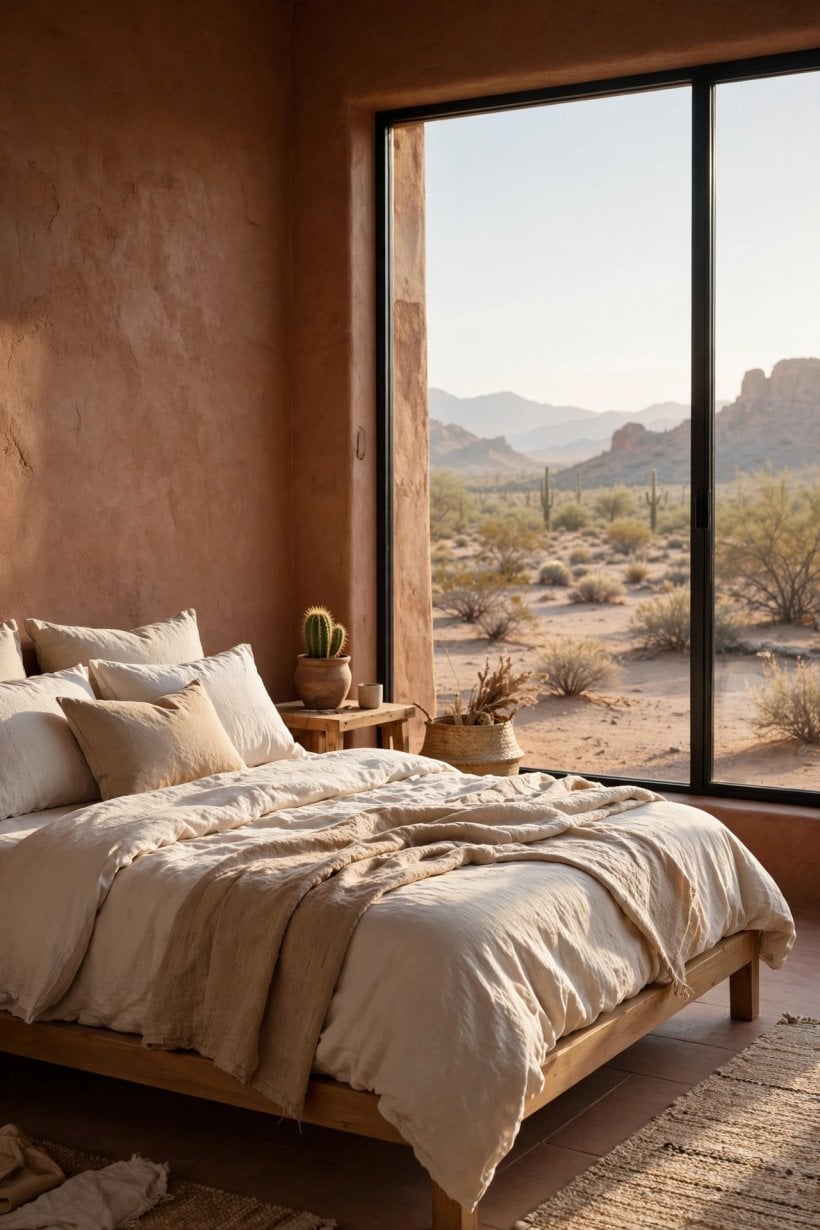
Colour in this style is borrowed, not invented: look at dry ground at different hours and you have the whole scheme. Pale sand and warm white in the morning, terracotta and clay deepening towards evening, and almost-black shadow in the crevices of rock. Build the palette in that order — light base first, earthy middle second, dark accent last and least — and rooms stay warm without turning orange, brown or heavy.
4. Start with Warm White and Sand as the Base
Paint the main walls in a warm white or pale sand tone and let that base carry most of the room. These shades bounce soft light around, make plaster and stone look richer, and give darker furniture a calm ground to sit on. Avoid a cold, blue-leaning white, which fights every warm material placed against it. Test large swatches on more than one wall, because a base colour that looks creamy at noon can turn grey or yellow by late afternoon.
5. Layer Terracotta and Clay as the Middle Tones
Bring warmth in through the middle layer: terracotta tiles, clay-toned cushions, a rust-coloured throw, warm leather or an earthy rug. These tones connect the pale walls to stone, timber and the planting outside, and they tolerate strong sunlight without fading into insignificance. Keep them muted and dusty rather than bright — the desert reference is sun-baked earth, not a festival banner. Repeat each middle tone at least twice in a room so it reads as a decision, not an accident.
6. Use Charcoal and Deep Brown Sparingly for Contrast
A pale earth palette needs a few dark notes or it drifts into softness. Use charcoal or deep brown in small, deliberate places: a window frame, a fireplace surround, lamp bases, a single chair or the legs and edging of larger pieces. That contrast sharpens the stone, outlines the low lines of the furniture and gives the eye somewhere to rest. Resist spreading it widely — as wall colour or large upholstery it quickly overwhelms the light, desert feeling.
4. Walls and Materials: Stucco, Stone, Rammed Earth and Warm Wood
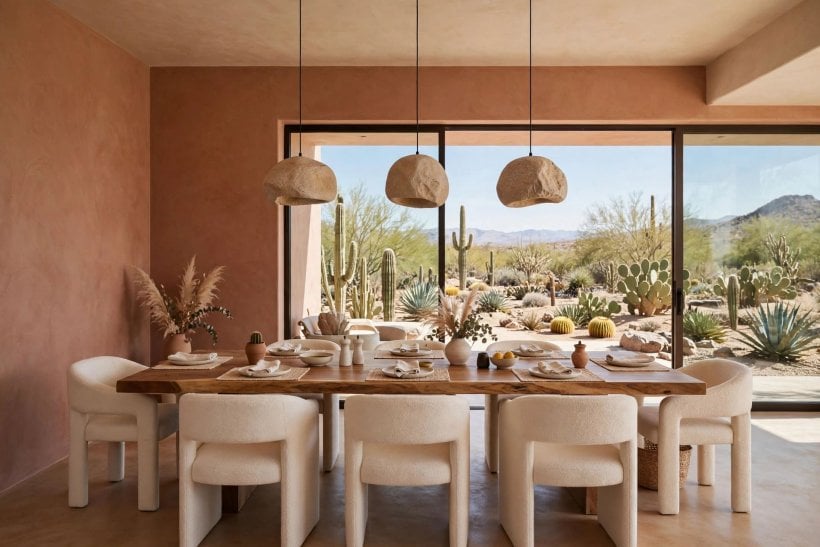
Materials carry this style more than pattern or ornament ever will. The aim is surfaces that look dug, built or woven rather than printed: matte plaster with a faint movement in it, stone with real variation, timber with visible grain, and textiles you can feel. Choose fewer materials and repeat them through the home, so a small house feels composed instead of sampled. Honesty matters more than expense — a simple plaster wall, well finished, beats an imitation of anything.
7. Choose Plaster or Stucco for Soft, Matte Walls
Plaster and stucco finishes soften modern rooms in a way flat paint cannot. Their slight texture catches raking light, hides minor unevenness and gives large blank walls a quiet presence that suits low, simple furniture. Keep the finish fine rather than heavily rusticated inside, and let one or two walls carry a slightly deeper earth tint if the room needs weight. In a bathroom or kitchen, pair the plaster look with plain, practical splashback surfaces and keep the detailing simple and wipeable.
8. Bring in Stone or Rammed Earth for One Honest Feature
One wall of stone or rammed earth can anchor a whole home: behind a fireplace, at the end of a living room, or as the wall the entry opens onto. The layered bands of rammed earth and the variation in natural stone both echo the landscape directly, and their mass helps moderate indoor temperature through the day. One feature is enough — stone on every wall turns calm into cave. Keep the surrounding walls plain plaster so the feature keeps its gravity.
9. Warm the Structure with Timber, Leather and Woven Fibre
Hard desert materials need warm partners. Use timber for beams, shelving, door leaves or a long dining table, choosing warm mid-tones with visible grain over pale, grey-washed finishes. Add leather on a chair, bench or cushion where its patina will deepen with use, and woven textiles — baskets, rugs, wall hangings, chair seats — wherever a room feels too smooth. These organic layers stop stone and plaster feeling austere, and they age gracefully alongside them rather than dating against them.
5. Glass, Shade and Clerestory Light
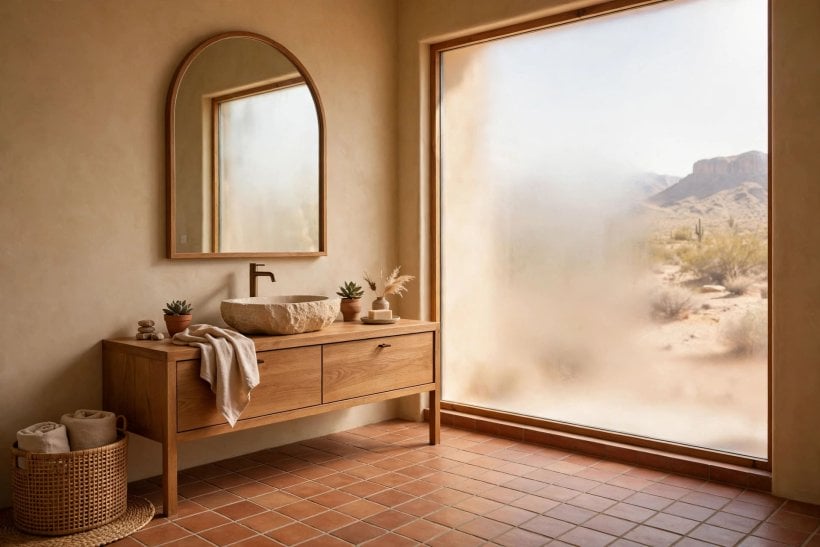
Desert light is both the prize and the problem. Unshaded glass can turn a beautiful room unusable by midday, while well-placed, well-shaded glass gives you the view, the brightness and the connection to the landscape that define the style. Plan glass, shade and ventilation together, on the actual orientation of the home, and treat curtains and screens as architecture rather than afterthoughts. The goal is bright shade: rooms lit by the landscape without being baked by it.
10. Give the Best Wall to Glass — Then Shade It Properly
Concentrate large glass on the wall with the best view and the most manageable sun, then protect it: a deep overhang, an external screen, a pergola or a shaded terrace outside the glass will do more for comfort than any blind inside it. External shade stops heat before it enters the room, and it preserves the view in a way internal coverings cannot. Keep frames slim and dark or timber-toned, so the opening reads as landscape framed, not as a wall of hardware.
11. Borrow Light from Above with Clerestory Windows
A band of high clerestory glass brings steady daylight deep into a room while walls below stay free for furniture, storage and art. It suits this style perfectly: light arrives without direct glare on seating, privacy is kept on tight plots, and the eye reads the low room and bright ceiling line as spacious. Clerestories work especially well over a kitchen run, along a hallway or above the long wall of a living room, and they pair naturally with the style’s low horizontal lines.
12. Design for Glare as Carefully as for Light
Glare is what makes bright rooms tiring, so soften light at every surface it touches. Choose matte floors and low-sheen finishes that do not throw reflections, sheer woven curtains that diffuse direct sun while keeping the outline of the view, and pale ceilings that spread light evenly. Position seating and screens away from the direct bounce of the main glass, and check the room at the harshest hour before fixing anything in place. A room that stays comfortable at midday has been designed, not decorated.
6. Floors, Fireplaces and the Weight of the Room
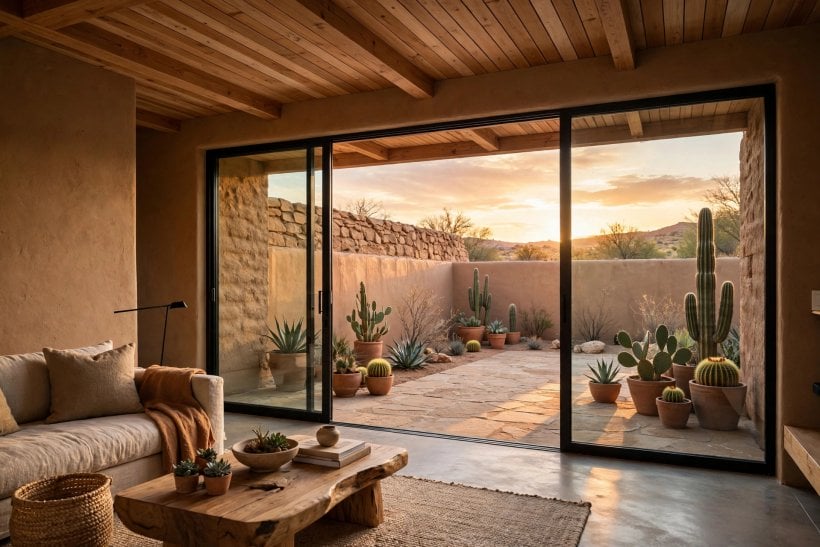
The lower half of the room decides how grounded it feels. Heavy, cool floors and a strong fireplace give desert-modern rooms their sense of permanence, balancing the lightness of big glass and pale walls. Think in terms of weight and temperature underfoot as much as colour: a floor that stays cool, takes rugs well and runs continuously through the main spaces will quietly hold the whole scheme together, indoors and out.
13. Lay Stone, Large-Format Tile or Polished Concrete Underfoot
Choose one hard floor for the main rooms and run it through: natural stone for variation and age, large-format tile in a stone or clay tone for a cleaner, lower-maintenance surface, or polished concrete for a smooth, continuous plane that suits the architecture. All three feel cool underfoot, take woven rugs beautifully and handle sandy shoes better than timber near the doors. Keep grout lines and joints minimal, and let rugs, rather than changes of flooring, mark each zone.
14. Make the Fireplace the Room’s Quiet Focal Point
A fireplace suits this landscape emotionally as much as practically — desert days can end in cold evenings. Keep the design sculptural and simple: a plastered mass, a stone surround or a low, wide hearth that doubles as seating or a shelf for a single object. Avoid busy mantels and competing ornament; the fire itself is the decoration. Arrange seating around it at a conversational distance, and let the same stone or plaster appear once elsewhere in the room to tie the composition together.
15. Let Thermal Mass Work for Comfort, Not Just Looks
Stone floors, thick plaster and masonry features do quiet practical work: they absorb warmth during the day and release it slowly as the air cools, softening the swing between hot afternoons and cold desert nights. Help them work by letting winter sun reach the floor where orientation allows, shading that same floor in high summer, and avoiding wall-to-wall coverings that insulate the mass from the room. It is a traditional desert building principle, and it costs nothing once the materials are in place.
7. Furniture: Minimal, Warm and Sculptural
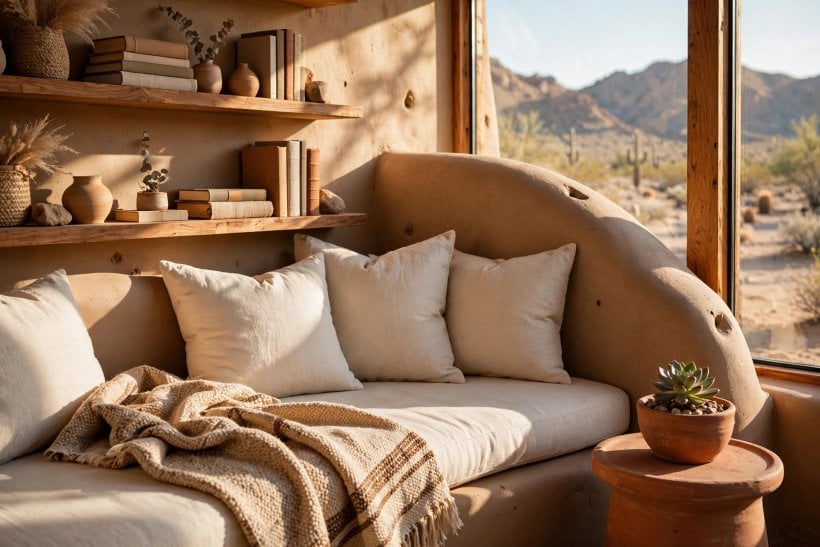
Furniture in this style is edited hard and chosen warmly. Think of each piece as a small sculpture with a job: a low sofa with a clean frame and natural fabric, a solid timber table, a leather chair that will improve with age. The principles in collections of modern tiny house interior ideas — multi-use pieces, clear floor space, nothing without a purpose — are exactly the principles that keep a desert-modern room calm in a home of any size.
16. Choose Fewer, Lower and More Sculptural Pieces
Start with less furniture than you think you need, and let each piece have presence. A single well-shaped sofa beats a matched suite, a broad low coffee table beats two small ones, and a sculptural armchair earns its corner better than a pair of ordinary ones. Look for clean mid-century lines softened by curved edges, rounded backs or hand-finished timber, so the silhouettes feel carved rather than manufactured. Empty space between pieces is part of the design, not a gap waiting to be filled.
17. Mix Clean-Lined Frames with Soft, Natural Upholstery
Keep frames simple — timber, dark metal or cane — and put the comfort in natural upholstery: linen, cotton, wool and leather in the room’s sand, clay and warm white tones. Avoid synthetic sheen and busy patterns, which fight the matte architecture; a single woven stripe, a hand-loomed texture or the variation in a natural hide adds all the interest needed. This mix of strict lines and soft surfaces is what makes minimal rooms feel warm rather than showroom-cold.
18. Leave Breathing Room Around Every Piece
Space is the style’s main luxury, and it is free. Pull sofas slightly off the wall where the plan allows, keep circulation paths clear and wide, and let windows, the fireplace and the feature wall hold their own empty margins. In a tiny home this discipline matters most: one low sofa, one flexible table and movable side seating will serve better than a full set squeezed in. When a room feels crowded, remove a piece before you add storage — the calm usually returns immediately.
8. Plants, Textiles and Handmade Detail
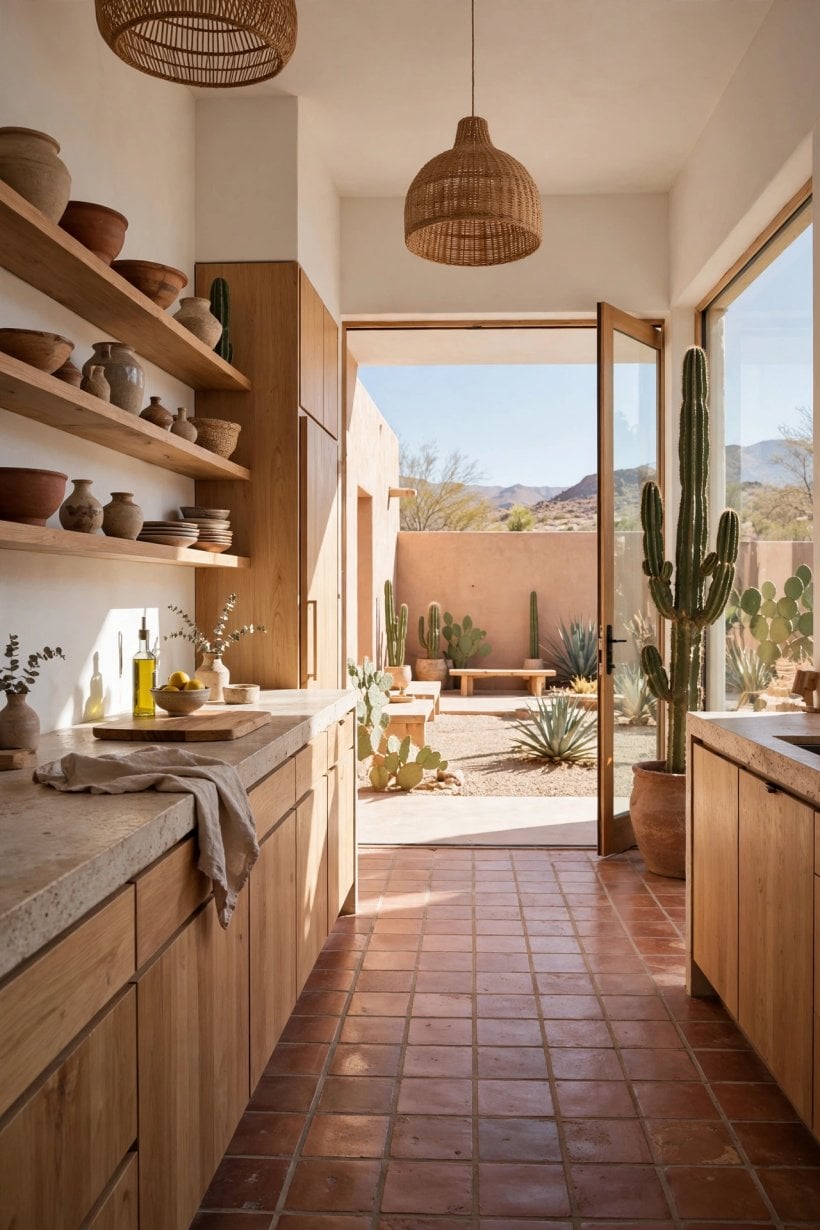
Detail in this style is sparse, natural and mostly handmade. A few sculptural plants, woven layers and simple pottery give rooms life without breaking their calm, and they connect the interior to the dry planting outside. Take planting cues from a rock and succulent garden with a desert-inspired planting scheme and repeat the same shapes indoors at a smaller scale — a spiky silhouette in a plain clay pot can do the work of a whole shelf of ornaments.
19. Plant Sculptural Desert Specimens Indoors
Choose plants for shape first: a tall cactus or euphorbia as a living sculpture near the glass, an agave or sculptural succulent on a low plinth, and one softer trailing plant to relax a shelf edge. Keep pots simple — clay, stone or matte ceramic in the room’s palette — and group sparingly rather than scattering small pots on every surface. Remember that indoor desert plants still need the brightest spot you have, free-draining soil and a light hand with water.
20. Layer Woven Textiles for Warmth Without Clutter
Textiles are where a minimal room gains its comfort. Layer a flat-woven rug in sand and clay tones over the hard floor, add cushions in linen and wool with visible weave rather than print, and keep one good throw within reach of the main seat. These layers soften sound in stone and glass rooms, warm the palette and can be changed with the season at little cost. Keep patterns geometric, striped or plain, and let texture — not colour contrast — do the decorative work.
21. Add Handmade Pottery, Baskets and Art with Restraint
Finish with a few handmade things, well spaced: a group of clay vessels on the hearth, woven baskets doing real storage work, and one large piece of art rather than a wall of small frames. Choose work with an earthy palette and a landscape feeling — abstract desert forms, woven hangings or photography of rock and sky all sit naturally here. Restraint is the skill: each object needs empty space around it to be seen, and a shelf that looks sparse is usually the one that looks expensive.
9. Practical Checks: Heat, Glare, Costs and Care
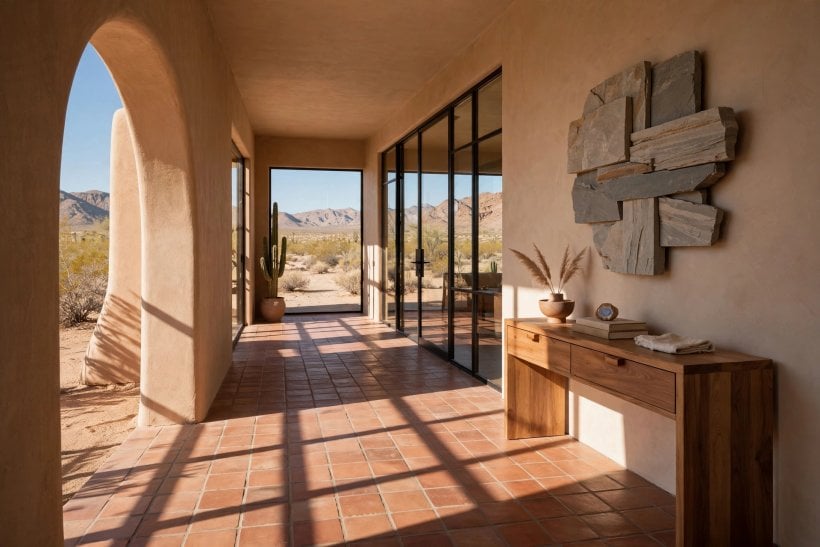
The final ideas are checks, not decorations, and they protect everything decided above. Heat, glare, dust and strong sun test every material in a desert climate, and the setting just outside the glass shapes the comfort inside it — the planting and ground cover principles in guides to landscaping rocks for high desert climates matter indoors too, because pale gravel, shade planting and rock placement all change how much heat and glare a room receives. Run these checks before ordering, not after installing.
22. Check Orientation, Shading and Ventilation Before Decorating
Walk the home at different hours and note where sun lands, where glare strikes seating and where air can move through. Fix problems at that level first: external shade on exposed glass, openings that allow cross-ventilation on cooler evenings, and ceiling fans in the tallest rooms to keep air moving. No fabric or finish can rescue a room whose orientation has been ignored, while a well-shaded, ventilated room needs very little mechanical help to stay pleasant through a hot day.
23. Understand What Drives Cost — Glass, Stone and Custom Joinery
Budgets in this style concentrate in a few honest places: large glazed openings and their shading, natural stone and rammed earth work, and any custom timber joinery. Save by keeping those elements fewer and better rather than thinner and more numerous — one excellent glass wall, one stone feature, one solid table. Paint, plaster-look finishes, woven textiles and vintage or simple furniture can carry the rest of the scheme modestly. Get the expensive elements quoted as complete installed work, including shading, sealing and finishing, before comparing figures.
24. Test Materials in the Room’s Real Light Before Committing
Desert light is strong enough to change every colour and expose every imitation. Borrow or buy samples of the floor, stone, plaster tint, timber and main fabrics, and live with them in the actual room for a few days: check them at midday glare and in warm evening light, wet the stone and timber once to see their deeper tone, and hold textiles against the wall they will sit on. Reject anything that turns grey, shiny or orange under that light — it will only do so more at full scale.
25. Plan Care for Dust, Sun and Dry Air from the Start
Dry climates bring dust, intense sun and low humidity, and the style’s materials mostly cope well if you plan for them. Choose washable or brushable textiles, keep delicate pieces out of the harshest direct sun, condition leather and timber occasionally so they do not dry and crack, and favour simple shapes that can be dusted in moments over intricate carving that traps grit. A home that is easy to keep clean in this climate stays calm-looking with little effort, which is the whole point of the style.
10. Pulling It Together in Small and Tiny Homes
This style scales down gracefully because its rules are about editing, not area. In a small or tiny home, carry one palette and one floor through every room, keep furniture low so sightlines run unbroken to the windows, and let a single stone or plaster feature — often the fireplace wall — give the whole home its anchor. The broader planning in modern interior design ideas for tiny houses shows the same logic at work: consistency between rooms is what makes a compact footprint feel intentional rather than squeezed.
Adapt rather than imitate where the format demands it. A minimal interior in a tiny house might swap a full courtyard for a single glazed door to a deck, trade rammed earth for one stone-clad wall, and borrow its mid-century lines from the compact furniture tradition explored in mid-century modern tiny house design ideas. Nothing essential is lost: warm white and sand walls, terracotta and clay in the textiles, one sculptural plant, and a room that opens its best side to the light will still read unmistakably as desert modern interiors, at almost any size.
Final Considerations
The whole style rests on a simple exchange: give the room light, landscape and honest materials, and ask for very little decoration in return. Low horizontal layouts, courtyards and shaded glass handle the architecture; sand, terracotta, clay and warm white handle the colour; stucco, stone, rammed earth, warm wood, leather and woven textiles handle the feeling. When those three layers agree, even an ordinary room takes on the calm of the desert outside it.
Work in that order — layout and shade first, palette and materials second, furniture and detail last — and test every major choice in the room’s real light before committing. Start with one room if the whole home feels daunting, live with its quiet for a while, and let the rest follow. Done patiently, this is a style that cools the day, warms the evening and asks remarkably little of you in between.

0 Comments