

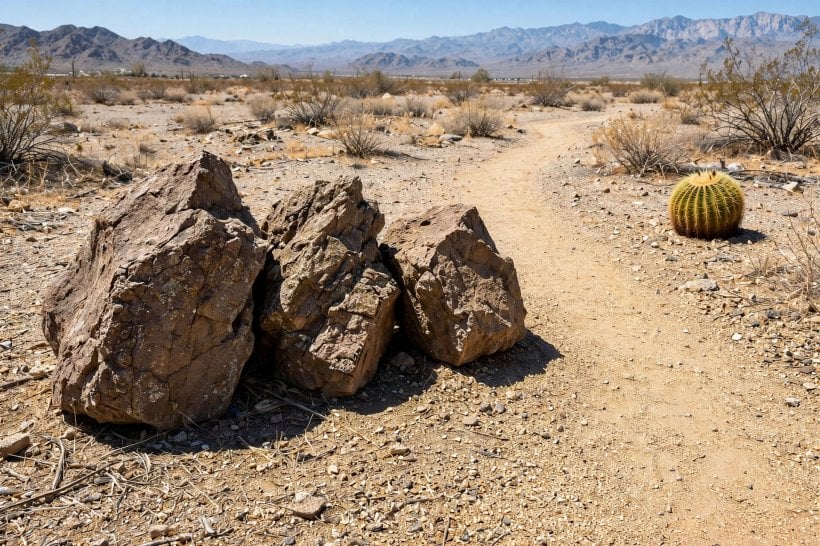
Eight inches of rain a year, freezing nights, and sun that bleaches paint off a shed in two summers. The high desert is honest about what it will support, and a thirsty green lawn is not on the list. Rock was the desert’s answer long before landscapers showed up — it just needs a human hand to arrange it into something deliberate, modern, and quietly beautiful.
1. Landscaping with Rocks at a Glance
Landscaping with rocks is the high desert’s native design language: stone does the work that lawn, mulch and irrigation do in wetter climates, and it does it permanently. A modern desert backyard is built in layers — a hardscape foundation of decomposed granite, boulders and gravel that acts as architecture, a plant palette of species that evolved for drought and cold at once, hydrozones that ration what little water is used, and drainage engineered for the monsoon deluge that arrives after months of drought. The table gathers the whole approach in one place; the sections after it take the climate, the stone, the plants, the water and the storm apart in turn.
| Attribute | Detail |
|---|---|
| The Climate | 4,000–7,000 ft elevation, 8 inches of rain a year, 30–40°F daily temperature swings, intense UV and desiccating wind |
| The Soil | Caliche, decomposed granite or sandy loam — alkaline, low in organic matter, often over a hardpan layer |
| The Groundcover | Decomposed granite paths and patios at $3–6/sq ft installed — permeable and natural-looking |
| The Gravel Mulch | 3–4″ of 3/4″ gravel over weed barrier — the lawn replacement that suppresses weeds and holds soil moisture |
| The Boulder Rule | Local stone grouped in odd numbers — 3, 5, 7 — and half-buried, as if it had always been there |
| The Plant Rule | 70% native or adapted plants — they evolved for this climate and outlive anything imported |
| The Water System | Hydrozones — oasis, transition, xeric — on drip only; overhead spray loses 50% to evaporation |
| The Drainage Rule | Grade everything away from structures at 2% minimum slope; dry creek beds sized for the 100-year storm |
| The Maintenance | 4–6 hours a year for a tiny lot — seasonal work, not weekly |
| The Cost | $2,000–5,000 for a complete tiny-lot desert landscape, and a water bill that drops to near zero permanently |
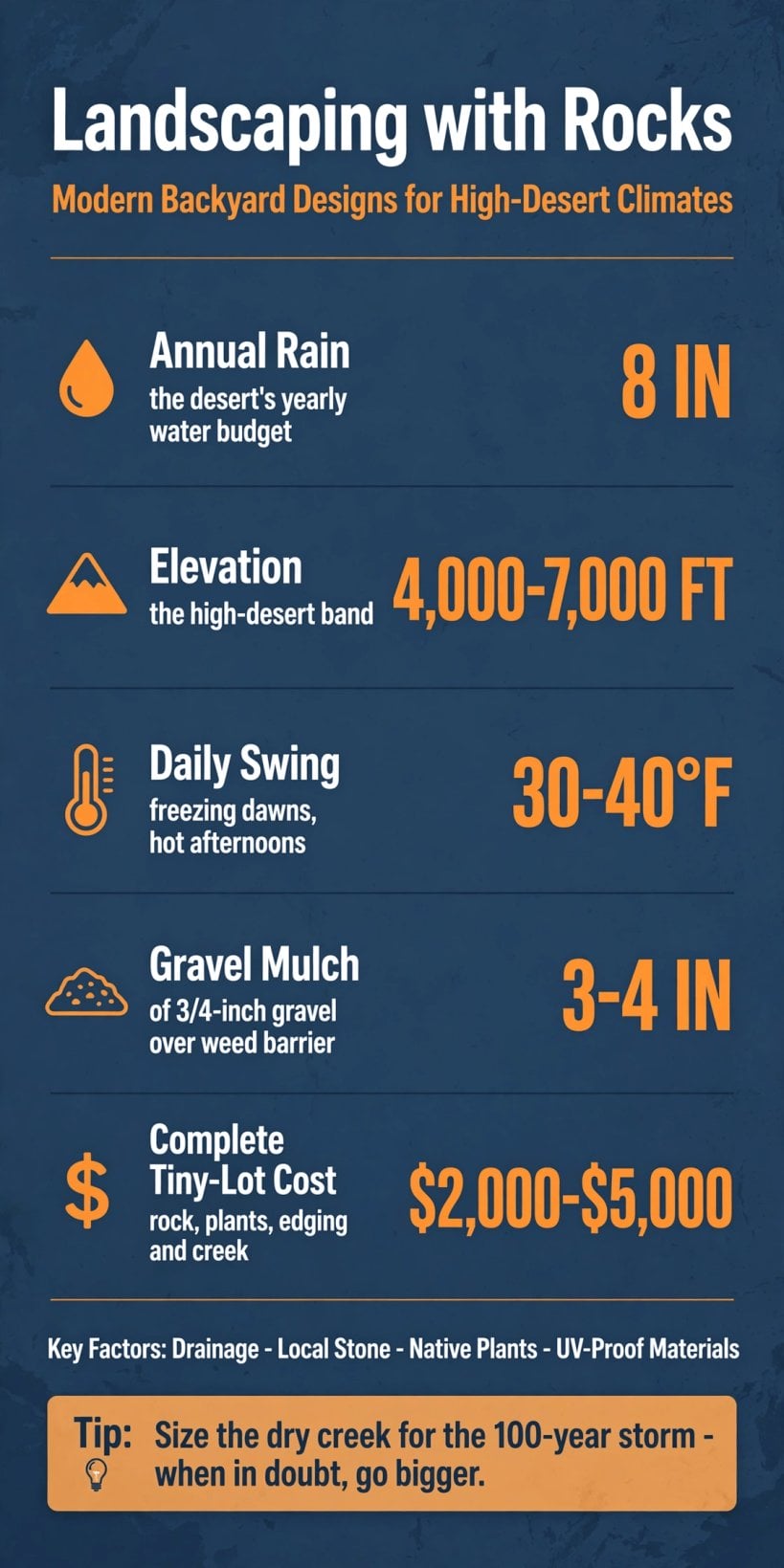
Eight inches of rain, a 30–40°F daily swing and stone that never needs watering — the high-desert landscape on one card.
Read the table as the desert itself reads a design: climate first, stone second, plants third, water last and least. Every choice that follows is downstream of the first two rows. A yard designed in that order gets better looking the less it is watered, because nothing in it is fighting the place it stands in. A yard designed plants-first in the high desert is a subscription to replacement costs and a hose that never quite gets put away.
2. Reading the High Desert: Elevation, Swings and Soil
The design approach starts with the site’s own numbers. High-desert lots sit at 4,000–7,000 feet of elevation, where the air is thin, the UV is intense and the daily temperature swing runs 30–40°F — a yard can freeze at dawn and bake by afternoon. Rain averages 8 inches a year, and it does not arrive politely: the pattern is months of drought punctuated by monsoon bursts, violent downpours that test every slope and channel on the lot. Desiccating wind works the rest of the year, pulling moisture out of soil and leaf alike.
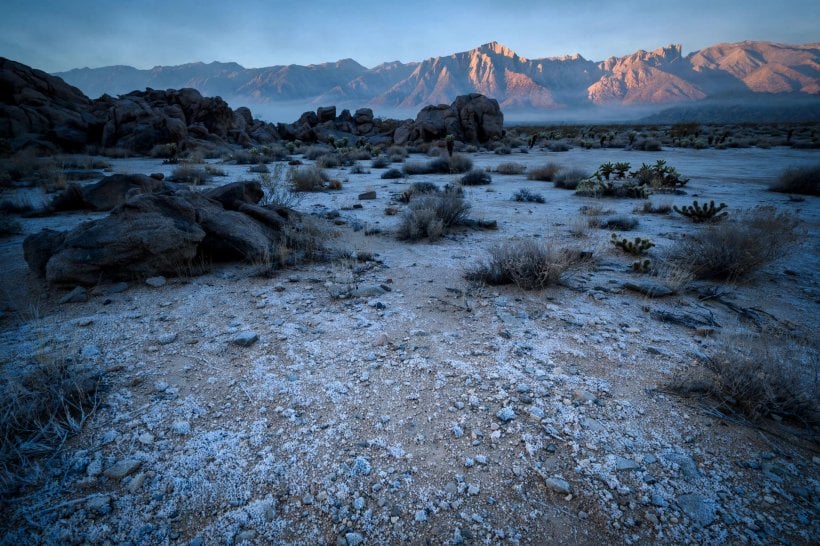
The soil sets the second set of constraints. High-desert ground is caliche, decomposed granite or sandy loam — alkaline, low in organic matter, and often floored by a hardpan layer that water crosses slowly or not at all. Three design implications follow directly. Plants must handle drought AND cold, because high desert gets a real winter. Drainage must handle flash floods, because monsoon rain on hard soil runs off fast instead of soaking in. And materials must survive UV: plastic edging crumbles in two years here, so the palette is stone and steel. The aesthetic conclusion is the original’s own: the desert is already beautiful — the landscape should echo it, not fight it.
Reading the site also means reading its microclimate, the small geography inside the lot. The hardpan decides where monsoon water will stand and where it will run. The wind’s prevailing direction decides which corner dries fastest and which planting pocket stays sheltered. The shadow of the house itself carves the lot into zones of full bake and partial relief across a single day. None of that appears on a plan drawn indoors; all of it appears in the first storm and the first hard frost. The design that follows — stone placed as architecture, plants zoned by thirst, drainage sized for the deluge — is simply the site’s own reading, written back into the ground in rock.
3. Rock as Architecture: Granite, Boulders and Gravel Mulch
In this design language, rock is not decoration scattered over a yard; it is the architecture the yard is built from. Decomposed granite — DG — is the groundcover of the system: compacted into paths and patios, permeable underfoot, natural-looking, at $3–6 per square foot installed, with a stabilizer additive where traffic is heavy. It reads as the desert floor itself, tidied — which is precisely the effect the modern desert backyard is after.
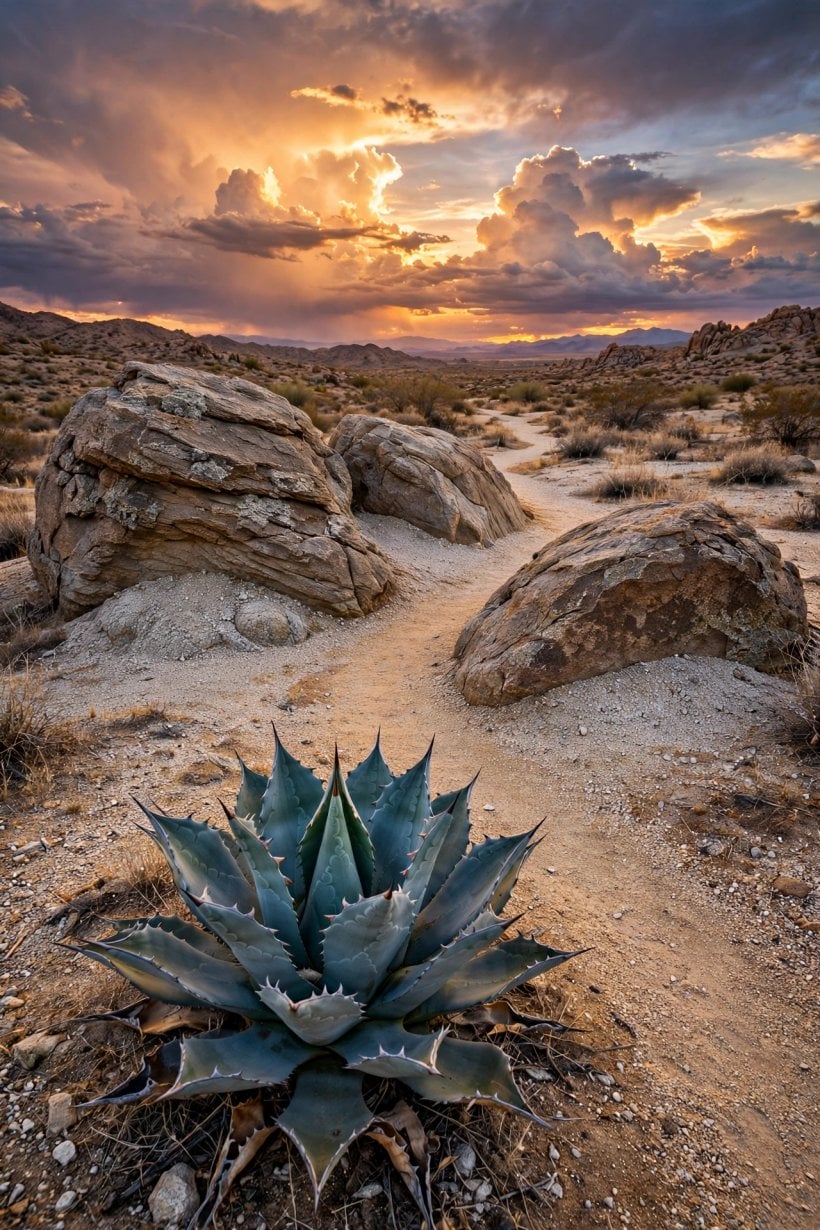
Boulders are the vertical events. The rule for placing them is local stone, grouped in odd numbers — 3, 5, 7, the naturalistic rule — and half-buried, as in the alpine rock garden discipline, so each stone looks arrived rather than delivered. The fine mechanics of seating and grouping big stone are worked through in the guide to laying out boulders and landscape rocks. Gravel mulch is the third element and the true lawn replacement: 3–4 inches of 3/4-inch gravel over weed barrier, suppressing weeds, retaining soil moisture, and bouncing heat around plant crowns — which is why the colour matters: choose light-colored gravel to reflect heat up and away from roots rather than cooking them.
4. Dry Creek Beds and Steel Edging: The Functional Bones
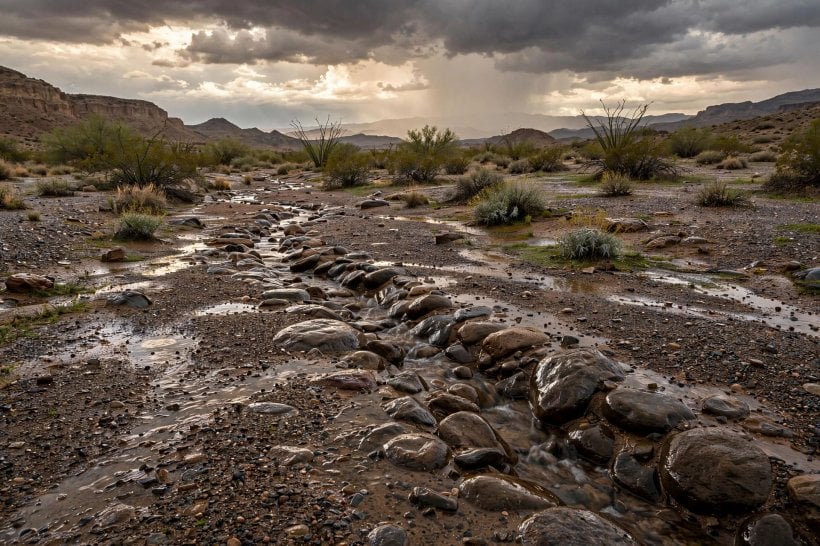
Two elements hold the composition together while doing unglamorous work. The dry creek bed is functional drainage disguised as design: a stone-lined channel that gives monsoon water a deliberate path through the lot instead of letting it choose its own. It earns its own treatment in the river-rock dry creek bed guide, because in the high desert the creek is not an ornament that occasionally gets wet — it is the drainage spine the whole grading plan hangs on, and §8 sizes it.
Steel edging is the other bone. Corten or powder-coated steel holds the gravel lines crisp where DG meets gravel and gravel meets planting, and it survives UV forever — the exact property the climate destroys in plastic within two years. Between the creek and the edging, the hardscape has its full skeleton: channels that move water, edges that hold planes apart, and stone everywhere doing the work that softer materials do in gentler climates, at a fraction of the replacement cycle.
5. The Plant Palette: Sculptural Anchors and Desert Colour
Against the stone, the planting is chosen for sculptural value first and thirst last. Agaves and yuccas are the anchors — Agave americana and Yucca rostrata, dramatic, zero water once established, and sharp enough that they are placed away from paths as a matter of respect. Ornamental grasses give the composition its movement and softness: blue grama, deer grass and Mexican feather grass, cut back once a year. Desert perennials carry the colour — penstemon, desert marigold, blanket flower and salvia, colour without thirst, and the pollinator magnets of the yard. Cacti are the authentic high-desert signature: prickly pear, cholla and barrel cactus, handled with tongs and respect. And the small trees — desert willow, palo verde and piñon pine — give a tiny lot shade without the water bill of a cottonwood.
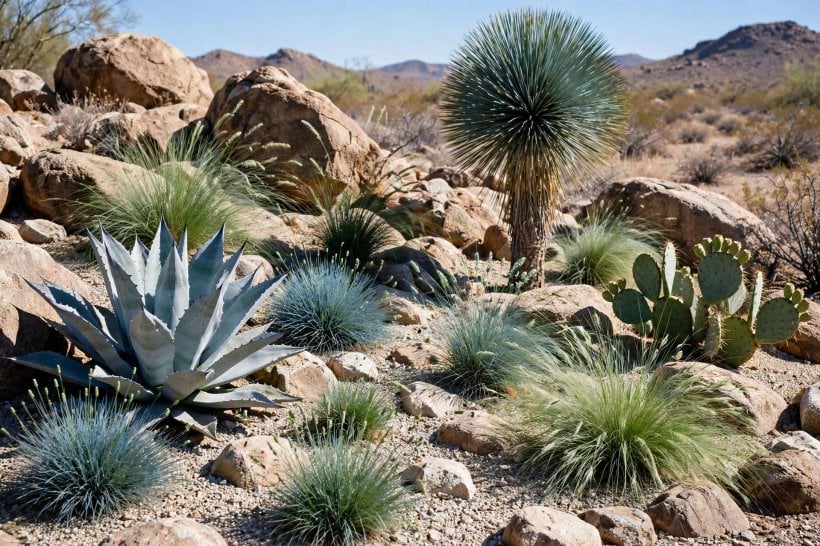
One rule governs the whole palette: 70% native or adapted plants. They evolved for exactly this brutality — the swings, the alkalinity, the drought broken by deluge — and they will outlive anything imported to imitate them. The remaining share is where the gardener’s personal exotics live, close to the house where they can be watched and watered, a zoning logic the next section formalises. The wider native palette for rock planting is catalogued in the guide to native plants for rock gardens, and the water-wise planting philosophy behind it is the same one the xeriscaping with rocks and native plants approach builds on.
6. Hydrozones: Water Rationed by Design
Hydrozoning is the professional system underneath the whole planting: group plants by water need, and irrigate each group on its own terms. The oasis zone sits near entries and patios — the few thirstier plants, containers, and a small lawn alternative such as a buffalo grass patch, where the hose reaches and the eye lands first. The transition zone runs mid-lot: adapted perennials and grasses on drip irrigation, the working middle of the garden. The xeric zone takes the perimeter: pure desert — cacti, agaves, gravel — with no irrigation at all after establishment.
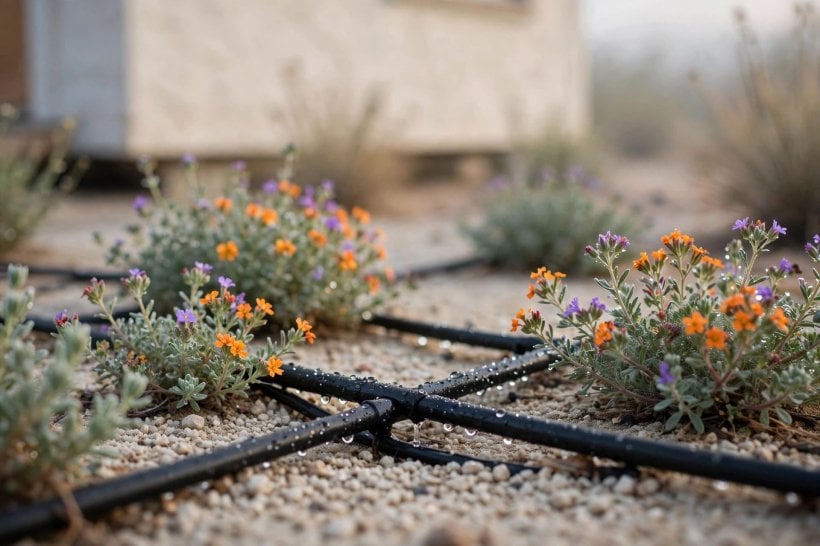
The delivery method is as fixed as the zoning: drip only, on separate zones per hydrozone. Overhead spray in the desert loses 50% to evaporation before the water reaches a root; drip puts the water at the roots, under the gravel mulch, where the wind and sun cannot take it first. On a lot that receives 8 inches of rain a year, that single efficiency decision is the difference between an irrigation system that supplements the climate and one that fights it at full price, forever.
7. The Modern Aesthetic: Lines Against Chaos
High-desert modernism is a deliberate contrast: crisp geometry against wild planting. Rectilinear patios of poured concrete or large pavers draw the clean lines; corten steel planters — the rusted-steel rectangles that patina to match the landscape — are the desert-modern signature; and honed gravel planes, large uninterrupted fields of gravel, supply the negative space that makes the plants read as sculpture. On a tiny lot the composition has to be edited harder still, and the small-space version of the same vocabulary is laid out in the small backyard rockscaping guide.
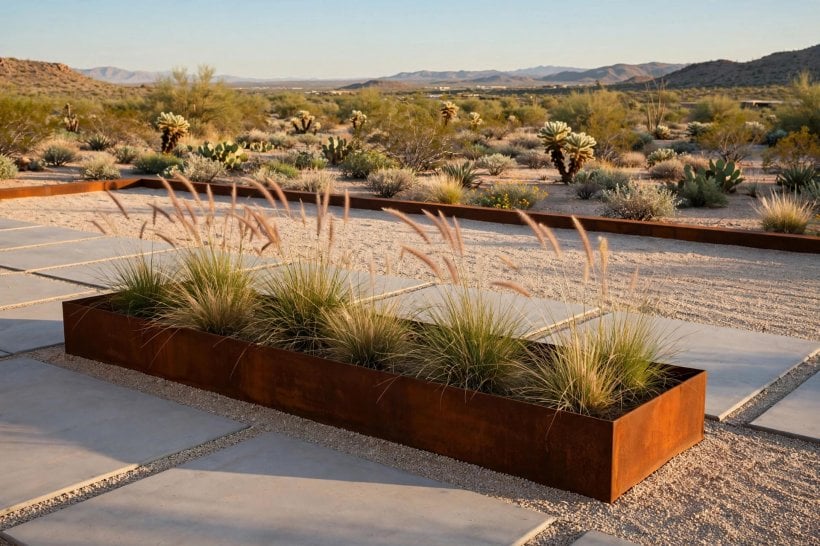
Night is when the design pays its second dividend. The desert garden is dramatic after dark: uplights on agaves and boulders — solar LED spots at $20 each — turn the sculptural anchors into the evening’s architecture for the price of a fitting. And restraint governs all of it, in the original’s modern rule: fewer elements, bigger gestures. One heroic agave beats twelve small ones. The gravel plane, the single boulder group, the one lit yucca — the composition is what is left out as much as what is put in.
8. Monsoon-Proofing: Designing for the Deluge
Every dry month is borrowed time; the design is graded for the week the rain arrives all at once. Grade everything away from structures at a 2% minimum slope — the desert’s hard soil sheds water fast, so give it somewhere to go. The dry creek beds of §4 serve as the drainage spine, sized for the 100-year storm: the county flood maps tell you the flow, and when in doubt, go bigger. A creek that is oversized on a dry day is invisible; one that is undersized in a monsoon is a river through the patio.
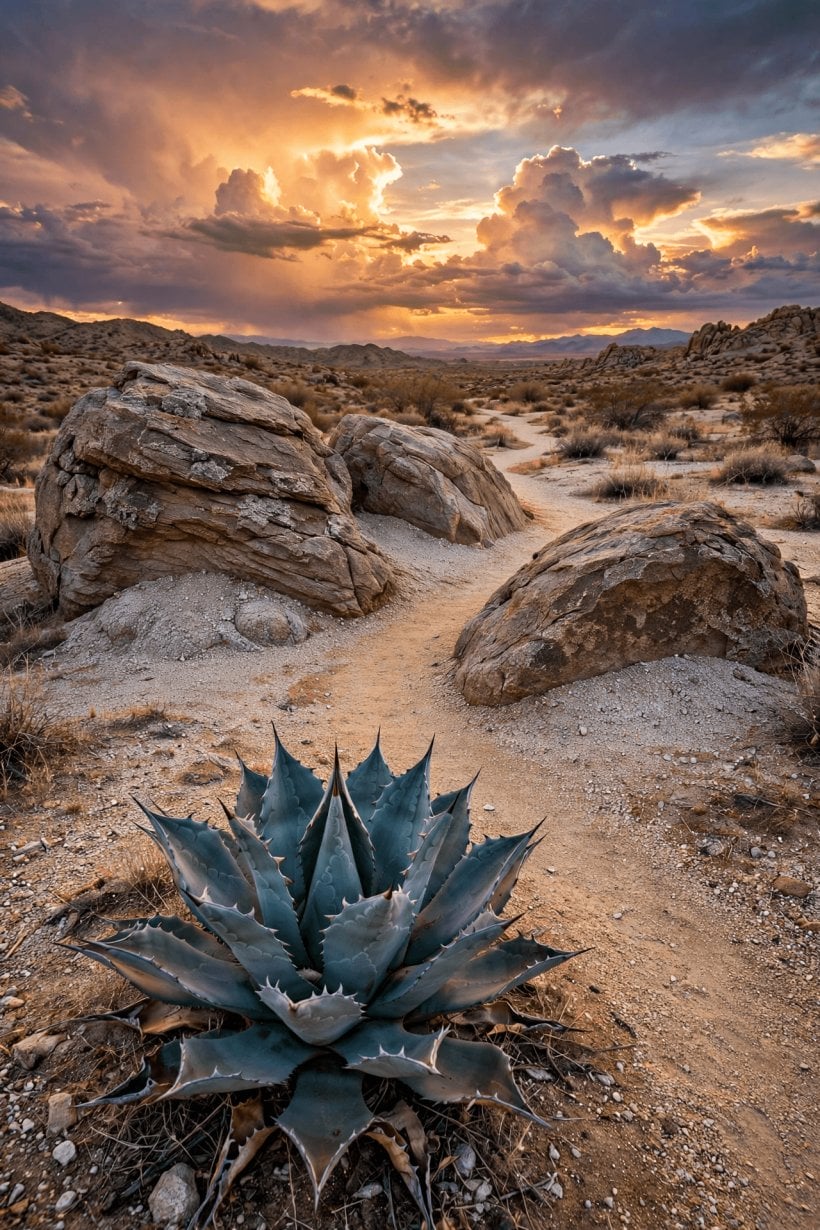
Retention is the second half of the system: shallow basins held by berms — the desert permaculture technique — capture monsoon rain where it falls and let it infiltrate, banking the deluge in the soil instead of exporting it downstream. Mulch depth does quiet work here too: 3–4 inches minimum protects the soil from the hammering rain and slows runoff across the surface. And one prohibition closes the section: never lay solid concrete across drainage paths. It accelerates flooding downstream; permeable, always, is the rule the whole hardscape was chosen by.
9. Sourcing Stone and the Cost Ledger
The economics of the system start with a geographic fact: the best stone for a high-desert yard is the desert’s own. Local stone matches the landscape it sits in — the boulders read as geology rather than cargo — and it avoids the haulage cost that makes imported rock the budget-breaker of rock landscaping generally. The sourcing discipline, from quarry offcuts to legitimately collected stone, is mapped in the guide to sourcing free landscaping rocks, and it pairs with the boulder rule of §3: stone that began nearby belongs nearby.
The ledger then runs in the design’s favour. Decomposed granite installs at $3–6 per square foot; solar LED spots run $20 each; and the complete figure for a tiny lot — rock, plants, edging, creek and all — is $2,000–5,000.
Where the money goes is instructive. The largest share is the hardscape itself — the granite, the gravel, the boulders and the steel that frames them — because the hardscape is the permanent part, bought once and never replanted. The plants are the smaller share, and the 70% native rule keeps even that share honest: adapted species establish on the first year’s watering and then ask for almost nothing, where imported thirstier plants would carry a lifetime of irrigation and replacement. It is a budget shaped like the landscape itself — heavy on stone, light on everything that can die.
Set against it is the line that disappears: the water bill drops to near zero permanently. A lawn in the high desert is a meter running against the climate every month of its short life; the rock landscape is a single capital cost followed by a yard whose main consumable is the owner’s occasional attention.
10. Establishment and Care: The First Year and the Quiet Years
The establishment paradox governs year one: water deeply but infrequently, training roots deep — pamper initially, then abandon. Desert plants are establishing the root systems that will carry them through decades of neglect, and shallow daily watering trains exactly the wrong roots. Weed control is pre-emergent plus hand-pulling; desert weeds are fierce after monsoons, and the gravel mulch over weed barrier handles 90% of the problem before it starts — the natural-control side of that remaining share is covered in the guide to eco weed control for rock gardens.
After that, the maintenance is seasonal, not weekly: 4–6 hours a year for a tiny lot, spent on the annual grass cutback and agave dead-leaf removal. Replacement is planned rather than mourned — desert plants are tough but not immortal, and agaves bloom once and die, in the original’s phrase the spectacular death, so pups are kept ready to replace them. It is the closing argument of the whole design: a landscape whose care is measured in hours per year, whose water bill is near zero, and whose beauty does not depend on either.
Final Considerations
Read the desert first — drought, cold nights, monsoons — then build the hardscape in local stone and decomposed granite, plant 70% native, hydrozone the irrigation, compose with modern restraint, and engineer for the deluge. The high-desert rock landscape is not a compromise for a harsh climate; it is the landscape the climate was asking for all along. Stop fighting the desert, and start designing with it — the yard that results gets better looking the less you water it.

0 Comments