

Choosing a floor for a tiny home is a weight, moisture and movement decision as much as a colour decision. The board that looks right in a showroom still has to lock tightly, sit flat and cope with tracked-in rain.
This guide takes one European maker as its worked example, works through its laminate and rigid vinyl families in general terms, and turns every claim into a check you can make on a box or a sample.

1. BerryAlloc Flooring at a Glance
BerryAlloc is a European flooring maker with Belgian and Norwegian roots, whose ranges span laminate and rigid vinyl and are sold through flooring retailers rather than as a single house line. Sold through those retailers and their catalogues, berry alloc flooring is best understood not as one product but as two families sharing a badge: wood-based laminate boards for a traditional board feel, and rigid vinyl boards and tiles for rooms where water is a daily fact. Between those families sit the shared attributes that matter most in a small home — the locking system on the long and short edges, whether underlay is attached to the board or bought separately, how the surface is described for wear and water, and what the written warranty actually covers for the exact line you choose.
| What does BerryAlloc sell? | Flooring in two main families: laminate boards and rigid vinyl, often described as luxury vinyl tile or plank, sold through flooring retailers in a range of wood and stone effects. |
| Is it laminate or vinyl? | Both. The brand covers laminate lines and rigid vinyl lines, so the first check on any box is which family that specific product belongs to, because care, water guidance and subfloor advice follow the family, not the badge. |
| How does it install? | Most lines in this class use a click-locking system and are laid floating over a prepared subfloor, without glue across the whole floor. Confirm the locking method and expansion guidance printed for your exact line. |
| Does it include underlay? | Some lines are sold with underlay already attached to the board, while others need a separate underlay. Check the packaging for your line, and do not add a second layer unless the instructions allow it. |
| How should I choose a line? | By room, not by photograph. Match the family to water and wear in that room, test a sample at home in real light, then check the stated wear, water and warranty terms on the box before you order. |
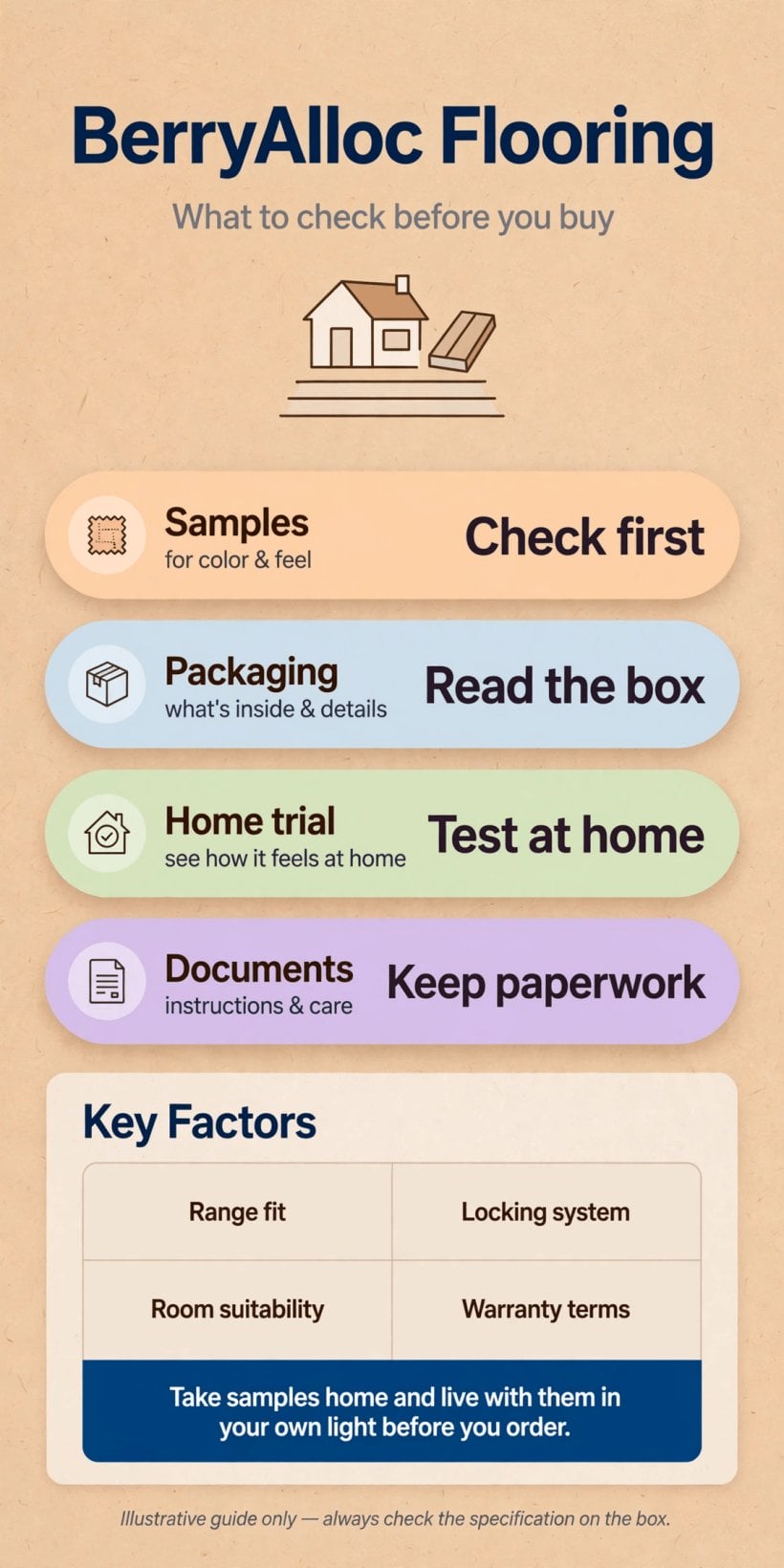
At a glance: a European maker, two families — laminate and rigid vinyl — and a short list of box checks on locking, underlay, wear and warranty that decide whether a line fits your room.
2. Who BerryAlloc Is and What It Sells
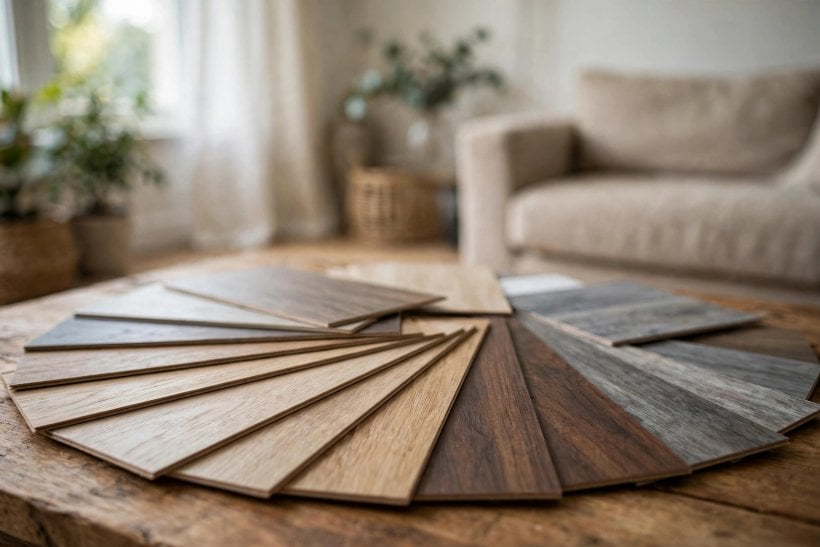
BerryAlloc sits in the European flooring industry rather than in the world of general building merchants. Its home ground is the specialist flooring retailer: the shop that sells boards by the pack, keeps sample stands for each collection, orders in the matching trims and profiles, and can talk you through underlay and door bars as part of the same purchase. That channel matters for a tiny house buyer. You are rarely buying a floor alone; you are buying the board, the edge profiles where it meets a shower tray or a front door, the transition into another room, and advice on what goes underneath it. A retailer-led brand makes those extras easier to source in the same finish, provided you order them at the same time.
What it sells, in general terms, is surface flooring for homes: laminate that recreates wood in a wood-based board, and rigid vinyl that recreates wood or stone in a waterproof-core board format. Around those boards sits the usual supporting cast for this kind of flooring — underlays where they are not already attached, skirting and profiles, and cleaning guidance written for the surface you have chosen. The practical lesson is to shop the system, not just the board face. Before you fall for a colour, ask the retailer to lay the sample alongside its matching profile and threshold pieces. In a compact interior every junction is visible, and a close match at the edges is worth as much as the grain in the middle of the room.
3. The Ranges: Laminate vs Rigid Vinyl

When you compare berry alloc flooring across its two families, the practical question is not which family is better in the abstract, but which one matches the room under your feet. Laminate is a wood-based board with a photographic wood or stone image protected by a hard surface layer. It tends to feel firm and board-like underfoot, it takes a convincing wood grain and bevel detail, and it suits living spaces, bedrooms and hallways where water is occasional rather than constant. Its guidance will typically ask you to wipe spills promptly, keep standing water off the joints and follow the specific water guidance printed for that line, because a laminate board and its joints should be treated according to their own stated rating, not a general assumption.
Rigid vinyl — sold in this market as rigid LVT, meaning luxury vinyl tile or plank with a rigid core — is built differently. The board is made to handle water on its surface as a normal part of use, which is why this family is the usual suggestion for kitchens, bathrooms and entrances. It is often a little quieter and less board-like in feel than laminate, and stone-effect tiles in the format can work well where a tiled look is wanted without tile weight or grout. That weight point matters in a small or movable home, so run the numbers for your build with this flooring weight calculator before committing to any heavy floor finish. Neither family wins everywhere: laminate for the main living platform where its feel and grain do the work, rigid vinyl where water lives, is a common and sensible split — and many homes use both, matched as closely as the two materials allow.
4. Locking Systems and Installation Feel
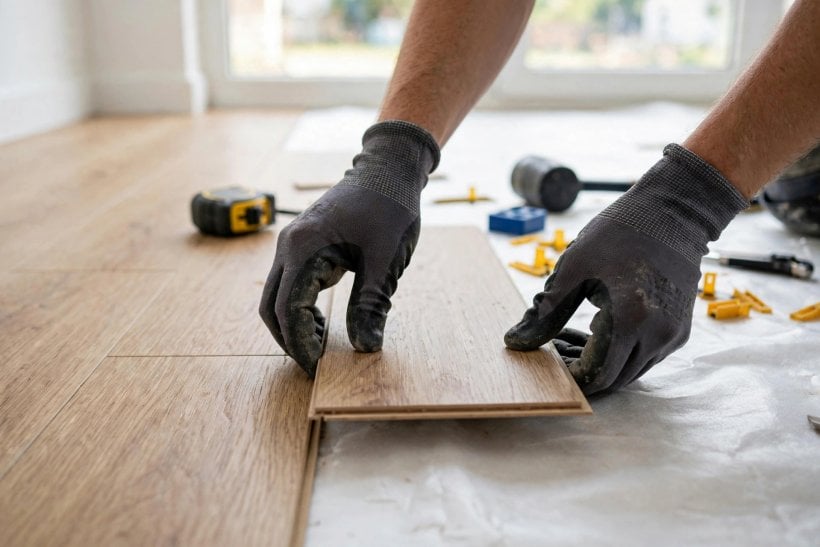
Locking is the attribute buyers feel with their hands, and it deserves more attention than the catalogue photograph. Boards in this class lock together along the long edge and at the short end, and makers use different click profiles to do it — some angle in and drop, some tap or fold down at the end joint. BerryAlloc has built part of its reputation around its locking approaches, including high-strength locking ideas on some laminate lines, but the name of a system tells you less than a test joint does. In the shop, take two sample boards and lock and unlock them yourself. A good joint for a small home feels positive without needing force, sits flush with no lip between boards, and comes apart again without damage if the instructions say it should — because in a tiny floor, you will almost certainly need to lift and relay a board around a cut at some point.
Installation is usually floating: the boards lock to each other, not to the subfloor, and the whole raft is free to expand and contract as one sheet inside the expansion gap left around the edges. That has three consequences worth planning. First, the floor is only as flat as what lies beneath it, so subfloor preparation is the real installation work. Second, the expansion gap is not a suggestion — skirting or a profile must cover it while still letting the floor move. Third, heavy fixed units should be planned with the floating floor in mind, following the line’s own guidance on what can sit on top of it. A kitchen run, for example, should be sequenced with the layout thinking in this guide to tiny house kitchen design, so cabinets, appliances and floor edges are decided together rather than discovered together on fitting day.
5. Wear, Water and the Claims to Check on the Box

This is the section where soft language needs to turn into hard checks. Flooring is sold with words like durable, water-resistant and suitable for bathrooms, and those words mean slightly different things from line to line. Your job is to translate them on the box in front of you. For wear, check the stated wear layer or surface rating on the packaging and in the technical sheet for that exact line, and check which rooms and levels of use the maker says that rating is intended for. Do not carry a figure from one collection across to another, even under the same badge. If a retailer quotes a number, ask to see it printed for the product you are actually buying, and keep the sheet with your paperwork.
For water, separate two different claims. Surface water behaviour — how the top of the board handles splashes — is not the same as joint behaviour, where water sitting on a seam can work its way in over time, especially on a wood-based board. Check what the line claims about standing water, how long spills may sit according to its guidance, and whether it is approved by its maker for a bathroom at all. In a wet room the floor is only one part of the defence, so read it alongside the room strategy in this guide to a waterproof tiny house bathroom and wet bath before assuming any board makes a shower space safe on its own. For cleaning, check the approved products list on the box: steam cleaning, strong detergents and wax-based products are restricted for many boards in this class, and the printed guidance for your line overrules any general tip.
6. Underlay, Subfloor and Room Fit

Underlay is where many good floors are quietly spoiled. Some lines in this brand family arrive with underlay already attached to the underside of each board, which speeds fitting and removes one buying decision. Others need a separate underlay, chosen for the subfloor and the room. The check is simple and absolute: read whether your line has attached underlay on its packaging, and if it does, do not add a second soft layer unless the instructions explicitly allow it. Too much softness under a click floor lets the joints flex as you walk, and flexing joints are unhappy joints. If a separate underlay is needed, confirm its type and thickness as stated for the line, and whether it is approved over your heating or subfloor type.
The subfloor itself needs to be clean, dry and flat within the tolerance stated in the fitting instructions — check that stated tolerance rather than working to a rule of thumb. On a trailer or framed floor, that preparation connects directly to how the deck is fixed and levelled, as covered in this guide to fastening a subfloor to a steel trailer. Cold floors need thought too: use this floor insulation calculator for a tiny house to sense-check what is happening beneath the finished surface, because no decorative board insulates a cold deck on its own. If you plan heated floors, check compatibility in both directions — the flooring line’s stated limits and the system guidance in this overview of underfloor heating for tiny houses — before either is ordered, since temperature limits for boards in this class are printed per line and must be followed as written.
7. Samples: The Home Test
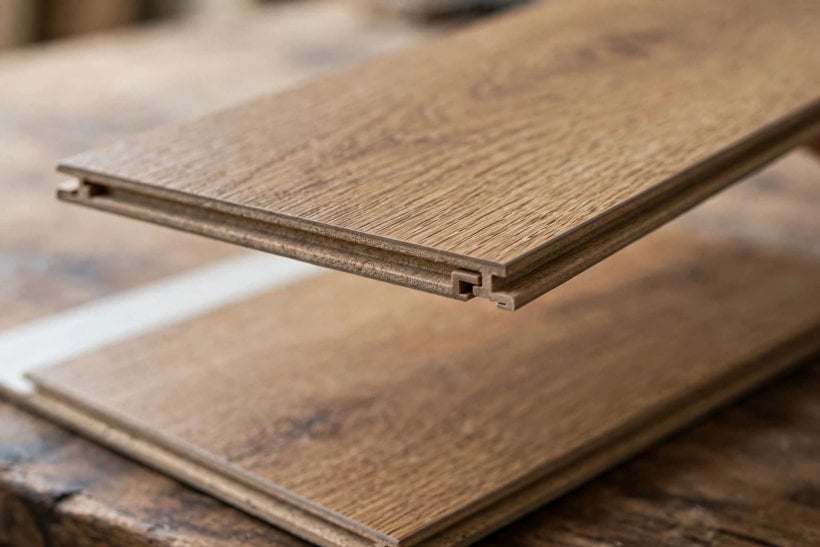
A sample is the cheapest research you will ever do on a floor, and for this brand family it should be treated as a test kit, not a colour swatch. Order or borrow the largest sample the retailer offers for your shortlisted lines, ideally a full board or a cut board showing the bevel and the locking edge, not just a small chip. Live with it for several days. Look at it in morning and evening light, under your actual lamps, and next to your walls, cabinets and soft furnishings. Wood effects that read warm in a bright showroom can turn grey at home, and stone effects can do the opposite. The breadth of looks in this collection of tiny house interior designs is a useful reminder that the same floor colour changes character completely with wall colour and light direction.
Then test how it lives. Walk on the sample in socks, shoes and bare feet, and note how the surface texture feels and how much dust and hair it shows — a very pale, very matt board and a dark, satin board forgive completely different kinds of daily mess. Put a wet mug and a dripped spoon beside the sink end of your test for an ordinary evening, wipe them up as you normally would, and look at the joint and surface afterwards, following the care guidance for that line while you do it. Drag a chair leg and drop the things you actually drop. None of this proves a lifetime of wear, and it should not be stretched into a laboratory test the maker never claimed, but it will quickly tell you whether you enjoy living with that surface — which, in a home where the floor is always in view, is half the decision.
8. Warranty and Paperwork

Warranties in this product class are written per line, not per brand, and that single fact should shape how you read them. Check the warranty document for the exact collection and family you are buying, and read four things in it: what is covered for the surface and the board, how the cover differs between residential and any other use, what conditions it depends on — correct underlay, correct rooms, correct cleaning and fitting by the stated method are typical conditions in this class — and what the remedy is if a claim is accepted. Do not rely on a headline term quoted in a shop or a headline on a box front; the document is the contract, and the back of the box and the maker’s technical library are where it lives.
Paperwork is a small habit with a long payoff, and tiny homes change hands and get re-registered in ways that make it pay twice. Keep the invoice showing the exact line name, a photograph of the box label and batch information, the fitting instructions you followed, and the warranty sheet, together in one folder. Keep spare boards from the same batch too — a pack stored flat under a bed or bench is the only reliable colour match for a future repair, because a later production run of the same design may not match exactly. If you buy through a retailer, confirm in writing who handles a claim — retailer or maker — and what evidence they would need. None of this is specific to one badge; it is how any branded floor should be bought, and a retailer who is happy to supply the documents is giving you useful information about the purchase itself.
9. How It Compares With Other Routes

Set against the wider market, a European branded family like this one is one of three broad routes, and the honest comparison is between routes as much as between badges. The first route is the flagship brand: makers who sell heavily on a named technology, a wide design library and a strong retailer network. You typically get deep sample support, matching trims in the same design and clear per-line documents, and you choose the line within the brand that fits the room rather than stretching one product across the whole home. The second route is the retailer-exclusive line, sold under a store’s own name or made for a single chain. These can be good value and convenient to buy with everything else, but the checks in this guide matter even more there: who actually makes it, what its stated wear and water terms are, and whether you can still buy the same design and its profiles in a few years if you need a repair pack.
The third route is the trade line, aimed at fitters and landlords, where the offer is usually a serviceable board at a keen price with a thinner design library and less in the way of trims and samples. For a rental or a utility space that may be exactly right. For a main living floor in a small home — where one surface runs through most of what you see, in the spirit of the modern tiny house interior design with clean lines for compact living — the branded routes usually earn their place through finish choice, joint feel and paperwork rather than through any single dramatic claim. Whichever route you take, run the same tests: lock two boards, read the wear and water terms for that exact product, confirm underlay and bathroom approval in writing, and price the complete system including profiles and spare pack, not just the headline pack price.
10. Who Should Pick BerryAlloc: The Verdict and Buying Checklist
Pick a line from this brand family if you want a retailer-supported European range where you can choose laminate for the living platform and rigid vinyl for the wet rooms under one badge, see both as full samples before you commit, and source matching profiles from the same place. It suits a buyer who is willing to choose per room rather than hunting for one board that claims to do everything, and who values a locking joint they have tested with their own hands. It also suits a phased build well: fit the main room first, keep the batch details, and add the bathroom or entrance later in the complementary family, accepting that the two materials will be close companions rather than an invisible match.
Another route may suit you better if your priority is the lowest possible pack price with minimal trims, if you want a floor fixed down rather than floated, or if you need a material outside these two families altogether — solid timber, tile or sheet flooring each answer different briefs, and no laminate or rigid vinyl line should be stretched into those jobs. Before you order any line, work through this checklist in order and only proceed when every line has an answer from a box, a document or a sample, not from memory.
- Family confirmed on the box: laminate or rigid vinyl, and approved for the room you intend.
- Stated wear terms read for that exact line, and matched to the traffic the room will see.
- Water claims read in full, including joint guidance, spill guidance and bathroom approval where relevant.
- Locking tested by hand on two boards, with a flush joint and a clean release as instructed.
- Underlay position settled: attached to the board or separate, with no extra layer added unless allowed.
- Subfloor flatness, dryness and heating compatibility checked against the printed instructions.
- Sample lived with at home in real light, and tested with ordinary spills, shoes and chair legs.
- Warranty document for the exact line read, filed with the invoice and a photograph of the box label.
- Profiles, thresholds, spare pack and cleaning products ordered or listed at the same time as the floor.
Final Considerations
A good floor from this brand family is chosen line by line, not badge by badge. Treat BerryAlloc as a well-supported starting point with two useful families — laminate for feel and grain in dry rooms, rigid vinyl where water is routine — and let the box checks on wear, water, locking, underlay and warranty decide which specific line, if any, earns a place in your home. A buyer who does that work is comparing real products, not brochures.
If the checks line up, order with confidence, keep the paperwork and spares, and fit the floor as the floating system it was designed to be. If they do not, the same checklist travels with you to a flagship rival, a retailer-exclusive line or a trade board, unchanged — and that, more than any single brand decision, is what protects a small home’s biggest surface.




0 Comments