

A stale room does not need a renovation — it needs a weekend, a paintbrush and a few rescued materials. After a decade of off-grid tiny living, these are the DIY home decor hacks I reach for first: ten easy projects that turn thrift scraps and kitchen leftovers into a home that feels fresh, functional and unmistakably yours, without emptying your wallet.
DIY Home Decor Hacks: At a Glance
Every project in this guide follows the same three rules: it costs a fraction of the store-bought version, it can be finished in a weekend, and it adds story as well as style. That is what separates durable DIY home decor hacks from throwaway crafts — the savings are real, the materials are mostly rescued or foraged, and each finished piece is one nobody else owns. The table below maps all ten projects, their headline costs and the rooms they refresh, in the order the guide works through them.
| Topic | What It Covers | Key Fact or Figure |
|---|---|---|
| 1. Why DIY Decor Pays | The savings, the customization, the well-being | Average furnishings spend: $2,606 a year |
| 2. Thrift Store Picture Frames | A chalk-painted gallery wall from rescued frames | Frames $2–3 each; the whole wall under $25 |
| 3. No-Sew Fabric Wall Hanging | Indigo cotton on a dowel, hems without a stitch | Under $20 — and renter-friendly |
| 4. Mason Jar Storage | Clamp-mounted jars for bathroom and kitchen | $15 total; visible clutter cut by up to 15% |
| 5. Upcycled Furniture Paint | A yard-sale table in navy with gold-dipped legs | Under $30; furniture waste runs 9.8M tons a year |
| 6. Accent Wall Alternatives | Washi tape geometry and half-wall color blocks | $15 of tape; nothing permanent |
| 7. Repurposed Wall Art | Driftwood, wood slices and an antique window frame | 10 pounds of material kept from landfill |
| 8. Textiles & Botanicals | Natural dyes, added fringe, foraged arrangements | Textiles shape 60% of a room’s visuals |
| 9. Kitchen Updates, No Renovation | Pulls, spray paint, vinyl tile, countertop kits | Under $200 against a $23,000 renovation |
| 10. Photo Art & Upkeep | Your own photos as gallery art — and making it last | Painted pieces last 3–5 times longer, maintained |
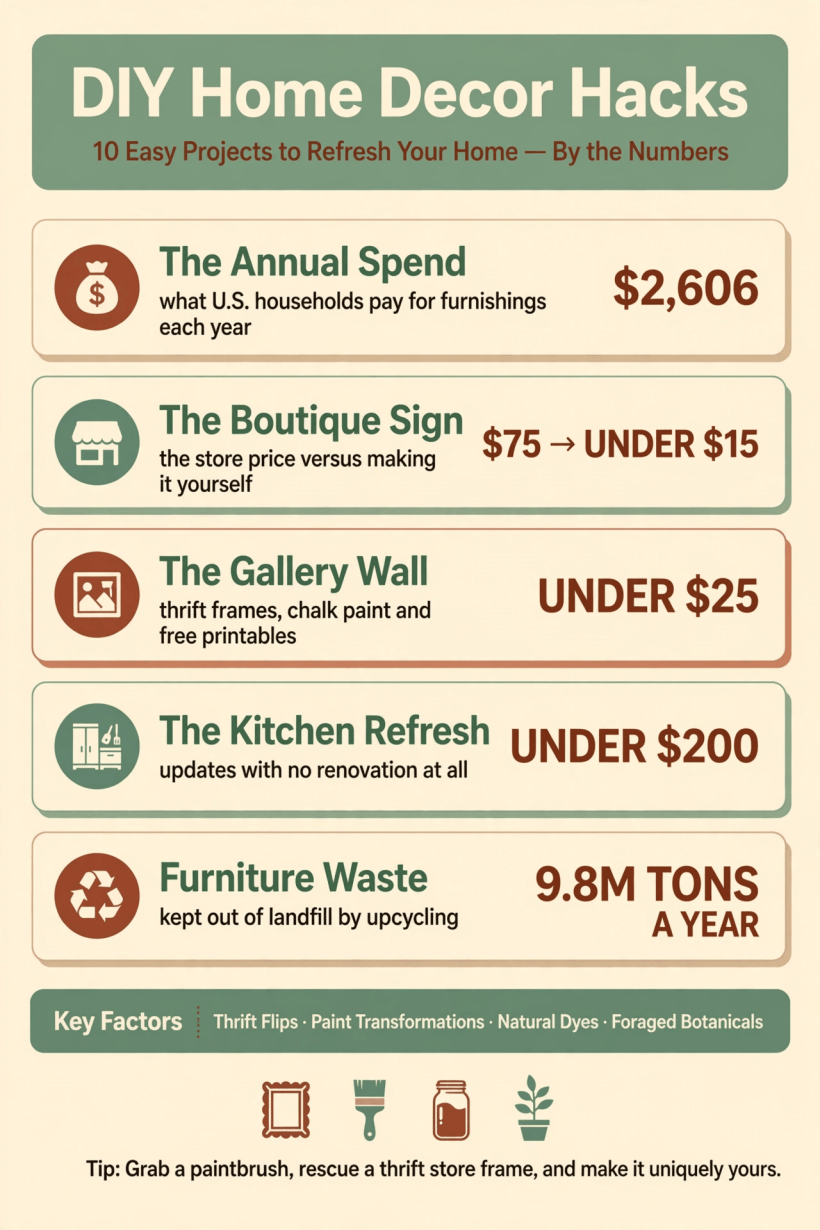
The numbers behind the making: what households spend, what the handmade versions cost, and the waste that upcycling keeps out of landfill.
1. Why DIY Decor Pays: Savings, Customization and Place Identity
Start with the money, because the money is what makes the rest possible. The U.S. Bureau of Labor Statistics reported in 2022 that the average annual expenditure on household furnishings and equipment was $2,606 — furniture, appliances and decor that most homes buy new, at retail pace. Making instead of buying bends that curve hard: a vintage-inspired wooden sign that costs $75 in a boutique can be made for under $15 with reclaimed wood and craft supplies. The control matters as much as the total. When you make a piece, you choose the budget, the materials and the finish, and you bank a wealth that is measured in skills and creative problem-solving, not just money saved.
The second dividend is customization no store can sell. My tiny house holds a coffee table built from river rocks I collected, botanical prints made from local plants, and handwoven throw pillows dyed with garden berries — every one of them carrying a story a guest can ask about. Store-bought decor is identical in a thousand homes; handmade decor exists exactly once. That uniqueness is also why small, alternative homes lean so naturally on making: the same rescue-and-build mindset runs through small dome homes: redefining affordable living, where the structure itself is the first DIY decision.
The third dividend is psychological, and it is documented. Environmental psychology research — Korpela and Hartig (1996) among it — links customizing a living space to “place identity,” the feeling that your home reflects who you are, with real gains in well-being. I have felt it in both directions: rearranging furniture and adding handmade elements during snowbound winters staves off cabin fever, and after I lost my job in 2012, building a canopy from foraged branches and repurposed fabric gave me back a sense of control when very little else felt controllable. DIY home decor hacks, practised this way, are not decoration at all — they are how a house becomes a home that steadies the people inside it.
2. Transformed Thrift Store Picture Frames: The Under-$25 Gallery Wall
The gallery wall is the fastest full-room refresh in this guide, and it starts at the thrift store. Hunt for mismatched wooden frames — at Goodwill they run $2–3 each, and the mismatching is a feature, not a flaw: varied shapes and profiles are what make a gallery wall look collected rather than bought as a set. Sand each frame lightly, paint it with chalk paint (about $15 a can, and one can covers a whole wall of frames), then seal with wax for protection against handling and humidity.

Fill the frames with things that cost nothing and mean something: free online botanical printables, pressed flowers from your own garden or walks, and black-and-white family photos, which unify mixed frames better than color prints because the monochrome palette ties different subjects together. Price the whole project honestly and it lands under $25 total — frames, paint and prints included — for the single most personality-dense wall treatment in the home. Lay the arrangement out on the floor first, photograph it, and hang from the center outward. The same collected, layered approach scales up to a whole room in our guide to how to decorate a tiny living room.
3. No-Sew Fabric Wall Hanging: Big Wall, No Stitches, No Holes
A large bare wall makes a room feel unfinished, but large art is expensive and heavy frames are unkind to small walls. The no-sew fabric wall hanging solves all three problems for under $20. The materials are a $5 wooden dowel, indigo-dyed cotton at about $7 a yard, scissors and iron-on hem tape. Cut the fabric to size, fold the edges and hem them with the tape and a hot iron — no sewing machine, no stitches — then fold the top edge over to form a pocket, slide the dowel through, and hang the whole piece from twine.

Because the hanging weighs almost nothing and mounts from a single small point, it is perfect for renters who cannot commit to anchors or patching. Fabric also does quiet acoustic work in hard-surfaced tiny spaces, softening echo in a way framed glass never will. A neighbor of mine made hers from a hand-painted drop cloth, which is the same project with the pattern painted on instead of dyed in — proof that the technique matters more than the textile. Choose a fabric with a large-scale pattern or a deep natural dye color, hang it where the eye lands when you enter the room, and the wall is finished in an afternoon — one of the gentlest DIY home decor hacks in this guide for anyone renting.
4. Mason Jar Storage Solutions: $15 of Order for Two Rooms
Storage is decor in a small home, because everything stored is visible. Mason jars turn that constraint into a style: mounted on a reclaimed wood board with $2 pipe clamps, a row of jars holds bathroom essentials — cotton, swabs, brushes — up off the counter and behind glass that wipes clean. In the kitchen, the same jars hang under cabinets, their lids painted with $8 chalkboard paint so each jar labels itself in chalk: flour, beans, tea, whatever the week holds.
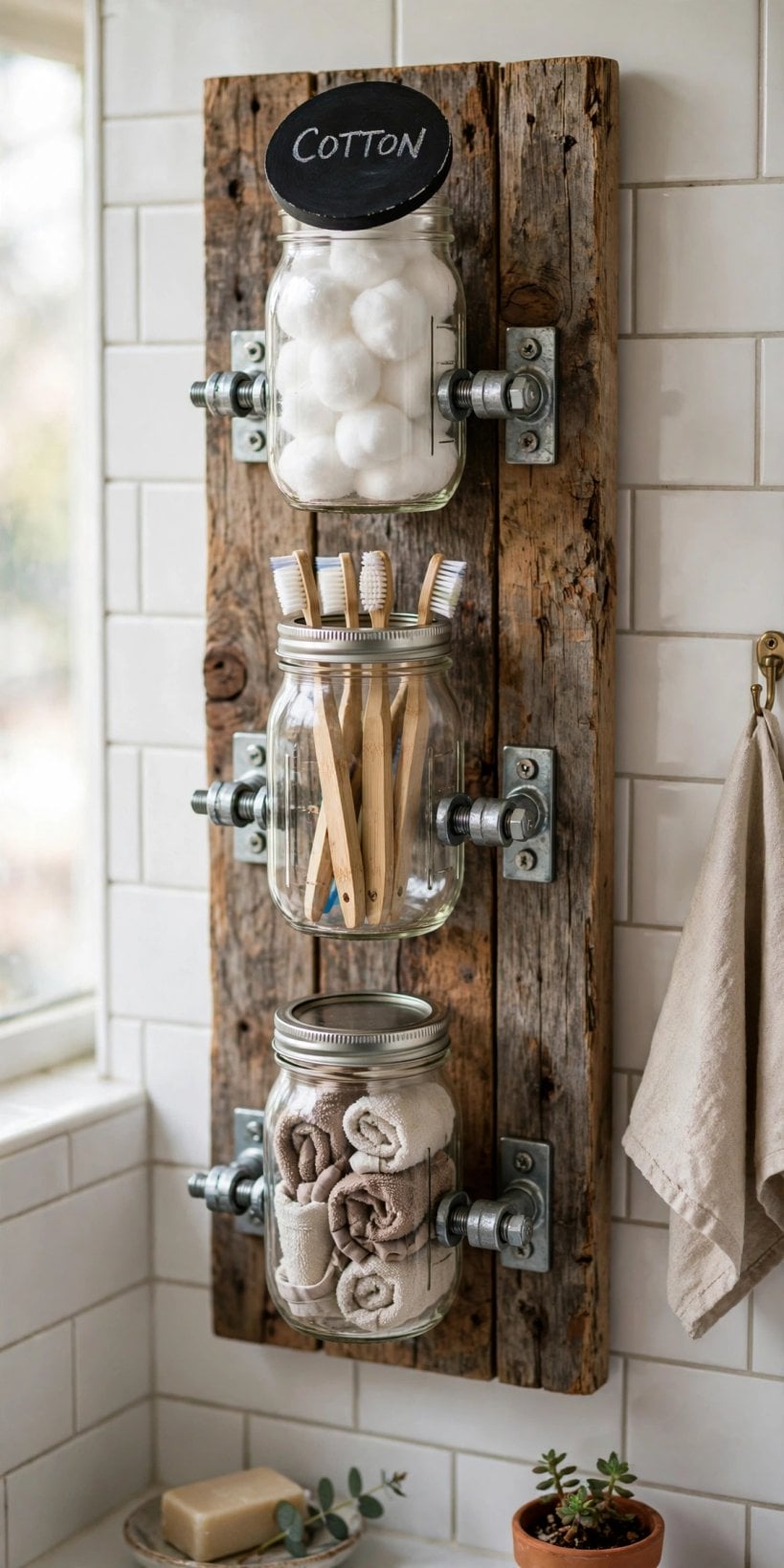
The full setup totals about $15 across both rooms, and storage experts credit visible-clutter reductions of up to 15% to getting daily items off horizontal surfaces — in a tiny house, that difference is felt immediately, because counters are cooking space, not display space. Glass is the right material for the job: it does not stain, it shows contents at a glance so nothing duplicates in the back of a cupboard, and a jar that outlives its job in the bathroom moves to the workshop or the pantry without missing a beat. It is the same build-it-yourself logic that shapes storage across DIY-friendly tiny house plans: small, cheap, exactly fitted to the space.
5. Upcycled Furniture With Paint Transformations: The $30 Custom Piece
If frames are the quickest refresh, painted furniture is the deepest. The method, start to finish: find a solid but tired piece — mine was a $25 yard-sale pine table — sand it, prime it ($15 covers primer and furniture paint), and paint it a color with presence; this table went navy, with its legs dipped in $8 metallic gold paint for the contrast that makes visitors assume it was commissioned. A coat of polyurethane over the top protects the finish from cups, keys and daily life. Total: under $30 for a piece that reads as custom furniture.

This is the project where the best of the DIY home decor hacks prove themselves twice — once in the budget and once in the waste stream. The EPA estimates furniture waste at 9.8 million tons a year in the U.S. alone; every rescued table is a small refusal of that pile, and a solid old piece is usually better built than its flat-pack replacement anyway. My neighbor transformed her whole bedroom set with the same primer-paint-protect sequence, which is the real lesson: learn the sequence once and it applies to dressers, chairs, cabinets and doors. Budget discipline across a whole small home is the theme of our guide to super-affordable tiny homes — paint is simply where that discipline shows fastest.
6. Hand-Painted Accent Wall Alternative: Pattern Without Permanence
An accent wall changes a room’s whole geometry, but painting a full wall is a commitment renters cannot make and small-space dwellers sometimes should not — a dark full wall can swallow a tiny room. The alternative is pattern applied with tape. Washi tape, about $15 a roll, lays down a crisp geometric pattern directly on the wall: diamonds, herringbone, a scattered constellation. It peels away cleanly when you tire of it, which makes it the lowest-risk experiment in this entire guide.

The second route uses painter’s tape as a mask for a half-wall color block: tape a level line at chair-rail height or lower, paint below it, and peel the tape while the paint is still tacky for a clean edge. Color psychology research supports the restraint — a partial field of color gives the eye interest without the overwhelm a full saturated wall can produce in a small space. Both versions share the same virtue: the room gains a focal wall for the price of a pizza, and the decision is reversible in an afternoon. Start with the wall you see from the main seat in the room; that is the one doing the visual work.
7. Repurposed Materials for Wall Art: The Free Gallery
The most original wall art costs the least, because it is made from what the landscape and the junk drawer were already holding. A driftwood hanging — branches gathered free from the beach, cleaned, and strung or mounted — brings line and shadow no print can copy. Wood slices from arborists, finished with about $20 of sandpaper and finish, become a clustered organic installation. And a $12 antique window frame, its panes backed with botanical prints, turns one thrift find into a six-panel gallery in a single object.

The environmental accounting is part of the appeal: projects like these diverted some 10 pounds of material from landfills in my own tally, and the pieces carry their origins visibly — guests ask about the driftwood because it looks like where it came from. Sourcing is a habit, not an event: beach walks after storms, arborists and tree services for offcuts, the free listings and curbs of your own neighborhood. It is the same found-material thinking that builds shelters as well as decor, as in escape the ordinary: build your Quite Lite cabin. Keep a small “future art” shelf of gathered pieces, and the next empty wall decorates itself.
8. DIY Textile Refreshes and Botanical Arrangements: Color From the Kitchen, Life From the Field
Textiles are the highest-leverage surface in any room: trend reports credit them with shaping 60% of a room’s visuals for about 20% of the budget. Refreshing them with natural dye costs almost nothing, because the dye bath is kitchen scraps — avocado pits for blush pink, onion skins for amber, black beans for slate blue-grey. Simmer the scraps, steep the fabric, and pillow covers and throws come out in colors that match nothing in a store and everything in a garden. Adding $5–10-a-yard fringe to existing blankets finishes the transformation at the edges, where the eye notices first.
Botanicals complete the pairing. Foraged flowering branches, wildflowers and grasses — gathered free, then dried for year-round use — arranged in vintage tins or wooden boxes bring the season indoors on a rotation no budget has to approve. Biophilic design research links indoor plants and natural materials to stress reductions of about 16%, which in a small home is not decoration but atmosphere engineering. The interplay between textiles, plants and light is what makes small interiors feel designed rather than merely furnished, a theme explored across tiny houses inside designs.

9. Budget-Friendly Kitchen Updates Without Renovation: Under $200, Not $23,000
The kitchen is where refresh budgets usually go to die, because the default assumption is renovation. Price the alternative honestly: a full kitchen renovation runs to $23,000, while every update in this section together costs under $200. Swap the cabinet knobs for $30 leather pulls — a five-minute, one-screwdriver change that alters how every door feels in the hand. Spray-paint the existing hardware with $8 cans instead of replacing it. Lay $40 removable vinyl tiles as a backsplash: peel, stick, and removable when you move or change your mind.
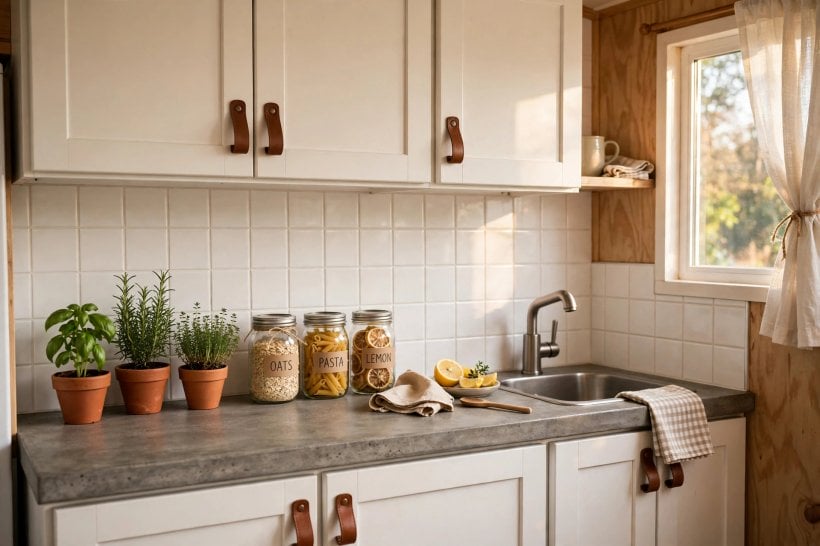
The biggest single move is the $100 countertop kit that fakes a poured-concrete surface over the counter you already have — the visual centerpiece of the kitchen, transformed in a weekend of coating and curing. Sequence matters: pulls and hardware first (instant morale), backsplash second, countertop last so drips and dust land on surfaces that are already finished. None of it touches plumbing, wiring or structure, which is precisely why it is affordable — and why a renter with a cooperative landlord can do most of it too.
10. Personalized Wall Art From Your Photos — and Keeping It All Alive
The last project is the most personal: your own photographs, printed large. A 16×20 print costs $15–25; stretched on canvas it reads as gallery art, and mounted on wood with Mod Podge it gains a matte, painted texture that suits handmade rooms even better. A run of your own images — the places you have lived, the people at your table — gives a home an authenticity interior designers chase with expensive commissions, at print-shop prices.
Then keep the whole body of work alive, because DIY decor maintained is DIY decor that compounds. The sustainability case is in the original numbers: American households discard about 70 pounds of textile waste a year, and sourcing from thrift stores, Facebook Marketplace and freecycle groups cut the carbon footprint of my projects by some 60%. Build pieces so they come apart — screwed, not glued — and end-of-life becomes reuse or recycling instead of landfill. Maintenance is a small, set rhythm: painted furniture gets a quarterly cloth dusting and an annual waxing, which sustainability experts credit with making pieces last 3–5 times longer; naturally dyed textiles wash in pH-neutral soap, store in cotton bags, and rotate seasonally so each set rests. It is a fitting close for a guide rooted in off-grid habits — the same make-it-last discipline behind build your tiny off-grid haven in no time.
Final Considerations
Your home is not a showroom; it is a living story, and the moral of every project here is the same: the refresh that matters is the one you make yourself. These DIY home decor hacks ask for a weekend, a handful of rescued materials and the willingness to begin before everything is perfect — because every imperfection adds character, and character is the one finish no store sells. So grab that glue gun, raid your recycling bin, and when someone asks where a piece came from, enjoy the best sentence in home decor: “I made that.” Happy making!

3 Comments