

Ten years ago I woke up for the first time in my 180-square-foot tiny house, sunlight falling through the skylight above my loft bed, and folded my desk out of the wall to begin the day. That morning taught me the lesson a decade of off-grid tiny living has only sharpened: tiny living does not shrink your life — it sharpens it, and the sharpening starts before breakfast.
Tiny House Morning Routines: At a Glance
Mornings set the tone for the entire day, and in a small home they set the space as well. The ten tiny house morning routines in this guide turn compact rooms into engines of productivity, wellness and joy: reset the space, transform it, move, breathe, eat, focus, open it to the light, take it outside, clean it, and align it with the earth — then adapt the whole sequence to the season, the technology on hand and the people around you.
| Routine | What It Does | The Tiny-House Key |
|---|---|---|
| 1. The 5-Minute Declutter | Clears surfaces and decisions | Every item already has a home |
| 2. Foldable Furniture | One room becomes three | Every inch earns its keep |
| 3. Micro-Workouts | Energy without a gym | Fitness happens where you stand |
| 4. Mindful Breathing | Calm on demand | Five minutes in one small nook |
| 5. Batch Breakfast Prep | Fuel without the scramble | Sunday prep, weekday speed |
| 6. The Daily Priority List | Focus in limited time | Three priorities, 25-minute sprints |
| 7. Natural Light | Waking with the sun | Light regulates the rhythm |
| 8. Outdoor Stretching | The home extends outside | Porch, garden, bare feet |
| 9. The 10-Minute Cleanup | Order that sustains itself | Clean as you go |
| 10. Eco Habits | Aligning with the earth | Solar checks, compost, greywater |
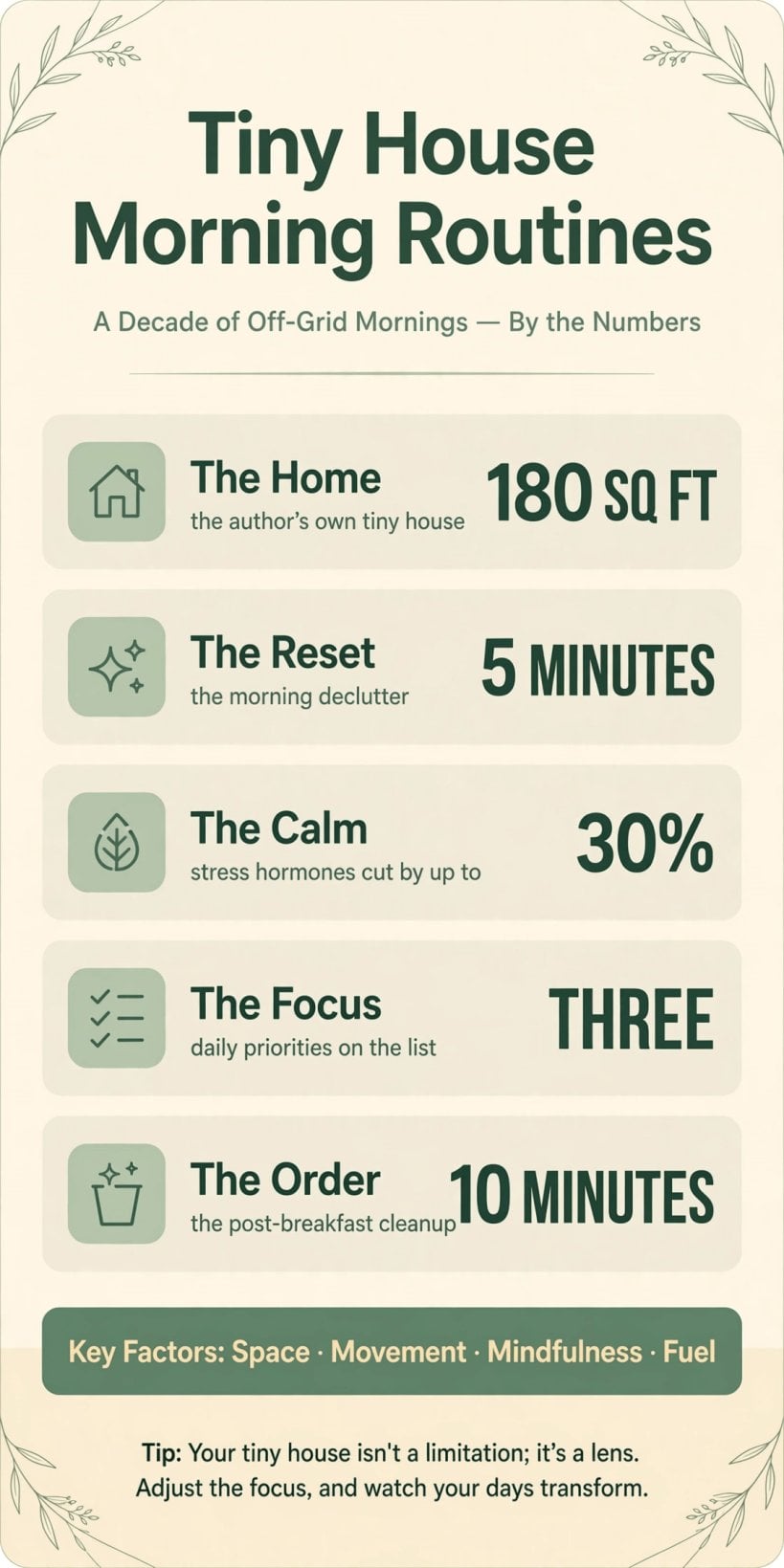
The morning by the numbers: 180 square feet, a five-minute reset, three priorities and a ten-minute cleanup — the small figures a decade of tiny mornings runs on.
1. The 5-Minute Declutter: Start Fresh in a Calm Space
Clutter in a tiny house is not just messy — it is paralyzing, because there is nowhere for it to hide. So the day begins with a rapid sweep of the whole space: laundry tossed into the hidden hamper under the stairs, dishes stacked in a collapsible drying rack, work materials tucked back into their wall-mounted organizer. It is the first of the tiny house morning routines for a reason: nothing else on this list works well in a room that is still carrying yesterday.

Minimalist advocates put it bluntly: “Clutter is postponed decisions.” The declutter works because those decisions were already made the night before — during the evening wind-down, every item was assigned a home, so the morning reset is pure motion, not deliberation. One tiny house owner in Oregon shared the result: “A five-minute reset each morning keeps my 140-square-foot home feeling like a sanctuary, not a storage unit.” Small hardware multiplies the effect: magnetic strips hold knives and tools on the wall, and vertical pockets on the backs of doors swallow toiletries. The goal is not perfection. It is mental clarity before breakfast — the calm surface the rest of the morning is built on, and the same thinking behind these easy DIY projects to refresh your home.
2. Foldable Furniture: Transform Spaces in Seconds
In a tiny house, your dining table might also be your office, your craft station and your breakfast bar — sometimes before nine o’clock. The second routine is the transformation itself: a wall-mounted desk that folds flat, stools that slot under the countertop, a bed with drawers that double as seating. Furniture here does not occupy the room; it takes turns with it.

A convertible sofa can shift from lounging to workspace with a click, a Murphy bed can lift to reveal shelving, and a drop-leaf table expands only when it is needed and vanishes when it is not. Dee Williams, the tiny house pioneer, and other enthusiasts emphasize the rule behind all of it: “Every inch must earn its keep.” That is why this is less furniture than choreography. The morning becomes a dance of purposeful movement — bed away, desk down, table up — each piece serving its role without crowding the stage, and each transformation marking the boundary between one part of the morning and the next. Alternative small homes live by the same principle; the builders of small dome homes design around transformable space for exactly the same reason.

3. Micro-Workouts: Energize Without a Gym
Forget the treadmill. In a tiny house, fitness happens where you stand. A 7 AM yoga flow unrolled on a rug by the door, resistance bands anchored to a loft beam, or a five-minute high-intensity interval training session using the stairs as a step platform can kickstart the metabolism as surely as any gym membership — with no commute and no floor space given up to equipment.

One Colorado couple uses their porch for sunrise yoga: “Rolling out our mats facing the mountains makes exercise feel like a privilege, not a chore.” Apps offer routines tailored for small spaces with no equipment needed, so the session can be chosen by the morning rather than the other way round. The key is consistency, and consistency comes from the habit stack: pair the workout with something that already happens every day — squats while the coffee brews in the solar-powered moka pot, stretches while the oats soak. The workout is short because the day is full; it is daily because it is short.
4. Mindful Breathing: Claim Your Calm
Tiny living means constant proximity to your environment, and the mind needs a reset as much as the room does. Carve out a meditation nook — a corner with a cushion, a window shelf with a plant, or the loft bed itself — and sit for five minutes, focusing on breathwork or a short gratitude practice. Few of the tiny house morning routines in this guide cost less and return more.

Studies show morning meditation can reduce stress hormones by up to 30%, and in a small home the effect is amplified: the calm has nowhere to dissipate. A Washington tiny house dweller describes the setup: “My meditation spot is a foldable bench by the east window. Watching the sunrise while I breathe deeply grounds me for the day.” Guided sessions from an app work well, but so does simply counting breaths. The space does not need to be large — just intentional, defended for five minutes against the phone, the list and the day.
5. Batch Breakfast Prep: Fuel Up Efficiently
A tiny kitchen demands strategy, and the strategy is to move the work out of the morning. Pre-soak oats in mason jars overnight, blend smoothies in a compact blender, or prep breakfast wraps with scrambled eggs and vegetables during Sunday meal prep, so the busiest hour of the day runs on reheating and assembly rather than cooking from scratch.

Solar-powered appliances extend the trick off-grid: a solar grill can toast bread or simmer oatmeal on sunshine alone. One family in Arizona swears by their breakfast station — a tiered cart holding the coffee maker, spices and stacked containers for grab-and-go meals, so everything the morning needs lives in one rolling square foot. The principle is the one behind all good tiny house kitchen ideas: small kitchens reward systems, not improvisation. And the rule underneath it is non-negotiable — nutrition is not optional. A protein-rich breakfast in a tiny house takes minutes to serve but fuels hours of productivity.
6. The Daily Priority List: Focus in Limited Time
In compact living, distractions are costly: there is no spare room to hide from them in. So the morning includes its own orders. Write three daily priorities on a chalkboard wall or in a digital app, then work them in time-blocked 25-minute sprints using the Pomodoro technique, rewarding each finished sprint with a walk outside. Of all the tiny house morning routines here, this is the one that pays for the rest — it decides what the transformed space, the workout and the breakfast were for.

A freelance designer in Vermont shares the pattern: “I schedule my most demanding tasks before 10 AM. My fold-down desk faces away from the kitchen, minimizing temptations to multitask.” Zoning does the rest: assign specific zones to specific tasks — the loft is for deep work, the kitchen table is for brainstorming — so sitting down in a place becomes a cue to start the work that belongs there. The same zoning instinct scales up into full home office ideas when the tiny house doubles as the workplace. Three priorities, honestly chosen, beat a page of wishes: in a small home, focus is a space-saving device too.
7. Natural Light: Wake with the Sun
Tiny houses thrive on light, and the morning is when to collect it. Open the blackout curtains the moment you rise, position mirrors to reflect the sunrise deeper into the room, or — the original luxury — install a skylight above the bed so the day announces itself. Exposure to morning light regulates circadian rhythms and boosts alertness more reliably than any alarm. Light is the trigger the remaining tiny house morning routines hang on: it tells the body the day has started before the list tells the mind.

Where the architecture will not cooperate, improvise. If the house lacks windows, LED bulbs that mimic natural light can stand in for the sunrise, and a Texas tiny homeowner went further: “I replaced one wall with frosted glass panels — it’s like waking up inside a lantern.” Light shapes mood and efficiency in a small space more than in a large one, because there is less of everything for it to work on. Harness it ruthlessly: the brightest hour of the tiny house day should be the first one.
8. Outdoor Stretching: Merge with Nature
Step outside. Stretch on the porch, sip tea in a hammock, or walk barefoot on dewy grass. Tiny living blurs the indoor/outdoor boundary more than any other kind of housing — the garden, the deck and the land are effectively extra rooms — and the morning is the best time to claim them.

A community in California starts each day with group tai chi in their shared garden. “Moving outdoors first thing reminds us that our home isn’t just the house — it’s the land around it,” says one participant. The outdoor stretch does what no indoor routine can: it puts the smallness of the house in perspective before the day begins, and it anchors the morning in weather, season and place. Even in cities, a balcony herb garden or a rooftop view can do the anchoring. The tiny house is the base camp; the morning begins outdoors.
9. The 10-Minute Cleanup and Eco Habits: Order That Sustains Itself
After breakfast, the loop closes: wipe the counters, sweep the floors with a compact cordless vacuum, and sanitize the surfaces. Multi-purpose cleaners save the cupboard space that a shelf of single-job bottles would eat, and cleaning supplies live in a caddy that clips under the sink — out of sight, but never out of reach. The last two of the tiny house morning routines protect everything the first eight built: the cleanup protects the space, and the eco habits protect the systems the space runs on.

A British Columbia resident swears by her “clean as you go” rule: “I never leave a room without tidying one thing. It’s how my 160-square-foot home stays guest-ready.” The eco habits run alongside: compost the coffee grounds in an odor-free Bokashi bin, collect greywater for the garden, charge devices from the solar panels. One off-grid family in New Mexico folds the whole system into one check: “Our morning ritual includes checking the solar battery levels and adjusting our energy use accordingly. It’s a small act, but it connects us to our resources” — the same daily discipline priced out in our guide to how much solar panels cost for a tiny house. Homes designed around this ethic, from Honomobo homes to earthship homes, treat the morning check as the house’s heartbeat.

10. Seasons, Technology, Community — and a Routine That Evolves
A routine that works in May can fail in January, because in a tiny house thermal dynamics, daylight patterns and outdoor access vary dramatically through the year. Winter mornings demand condensation management first — wipe the windows immediately — heating started 15 minutes before rising, and light therapy lamps to compensate for darker mornings, with the flow of activities arranged to minimize heat loss through doors. Summer reverses the logic: mornings shift earlier to capture the cool hours, and ventilation is optimized before the day heats up. The core routines are reviewed and adjusted each season, never abandoned — that flexibility is one of tiny living’s greatest strengths, because a compact space gives immediate feedback on what works.

Technology earns its place by the same test. The principle is intentional minimalism: multi-functional devices with minimal power draw — programmable LED lighting that shifts color temperature with the circadian rhythm, compact air quality monitors for well-sealed small spaces, automation that removes repetitive tasks and cognitive load while preserving mindfulness for the work that matters. Every device must justify its footprint, exactly like the alternative dwellings in our guide to portable capsule homes. Community adds the final layer: shared quiet hours, rotation systems for communal kitchens and laundry, and morning check-ins that double as security, resource sharing and neighbourliness — tight agreements about consideration, loose structures for coffee circles and skill shares.

And underneath it all, the routine itself evolves. Over a decade of tiny living, these mornings transformed: the first systems were about physical organization and basic functionality — simply making the space work — and as the technical challenges became second nature, the emphasis shifted toward wellbeing, creativity and connection with the surroundings. What keeps tiny house morning routines working in year ten is that they are allowed to change. The most enduring part is not any single practice but the framework of intentionality: in condensed spaces, where every object and activity affects everything else, consciousness about how the day begins is not just beneficial — it is necessary.
Final Considerations
Tiny house mornings are not about cramming more into less — they are about designing a routine that aligns with your values. Whether it is folding a desk into a wall or meditating in a nook the size of a suitcase, each habit proves that space constraints can spark boundless creativity. The tiny house morning routines that last are the ones built around your own priorities and your own square footage, reviewed with the seasons and adjusted without guilt. Your tiny house isn’t a limitation; it’s a lens. Adjust the focus, and watch your days transform.


1 Comment