

Florida doesn’t just have tiny houses — it has whole tiny villages: gated communities, eco-ponds, lakefront lots and resort parks where the small life comes with neighbours built in. Six communities anchor the map, lot rents start under $600 a month, and joining takes a single season. This guide compares them side by side.
Florida Tiny House Communities: At a Glance
Florida tiny house communities are the most developed in America: purpose-built villages where you buy the home and rent the lot, bring-your-own parks on the water, an eco-community organised around a pond, and a resort that lets you trial the life by the night. This guide works through them in the order a decision happens — the map, the costs compared honestly, the cultures that decide whether you will be happy, the step-by-step of joining, bringing your own tiny house on wheels, the two community models, the lease and the rules, daily and seasonal village life, the investment angle and the exit, and finally how Florida stacks up against other states and where it is heading.
| Topic | What It Covers | Key Fact or Figure |
|---|---|---|
| 1. The Community Map | Six communities from Tampa Bay to Sarasota | Village, eco-pond, lakefront, park, resort, pilot |
| 2. The Costs Compared | Home prices, lot rents and the trial night | Lots from $575–625 a month; homes $100k–140k |
| 3. The Cultures Compared | Gated, eco, lake, settled and resort social styles | Visit before committing — culture is the decision |
| 4. How to Join | Research, visit, apply, secure, move, settle | The full process takes 3–4 months |
| 5. Bringing Your Own THOW | BYO parks, size and certification, hookups | Homes up to 35–40 ft; 30/50 amp hookups |
| 6. Village vs. Park | Purpose-built design vs. the adapted park | Curated village or organic park — a lifestyle choice |
| 7. The Lease and the Rules | Terms, pets, quiet hours and the checklist | 6–12 month leases; typically a one-dog rule |
| 8. Village Life | Days, seasons, snowbirds and the first month | A $600 winter base for the seasonal strategy |
| 9. Investment and the Exit | Equity, rental income and leaving well | The $100k village home as the asset |
| 10. Florida vs. Other States | NC, Texas, Oregon — plus the future and the decision | Florida wins on village infrastructure |
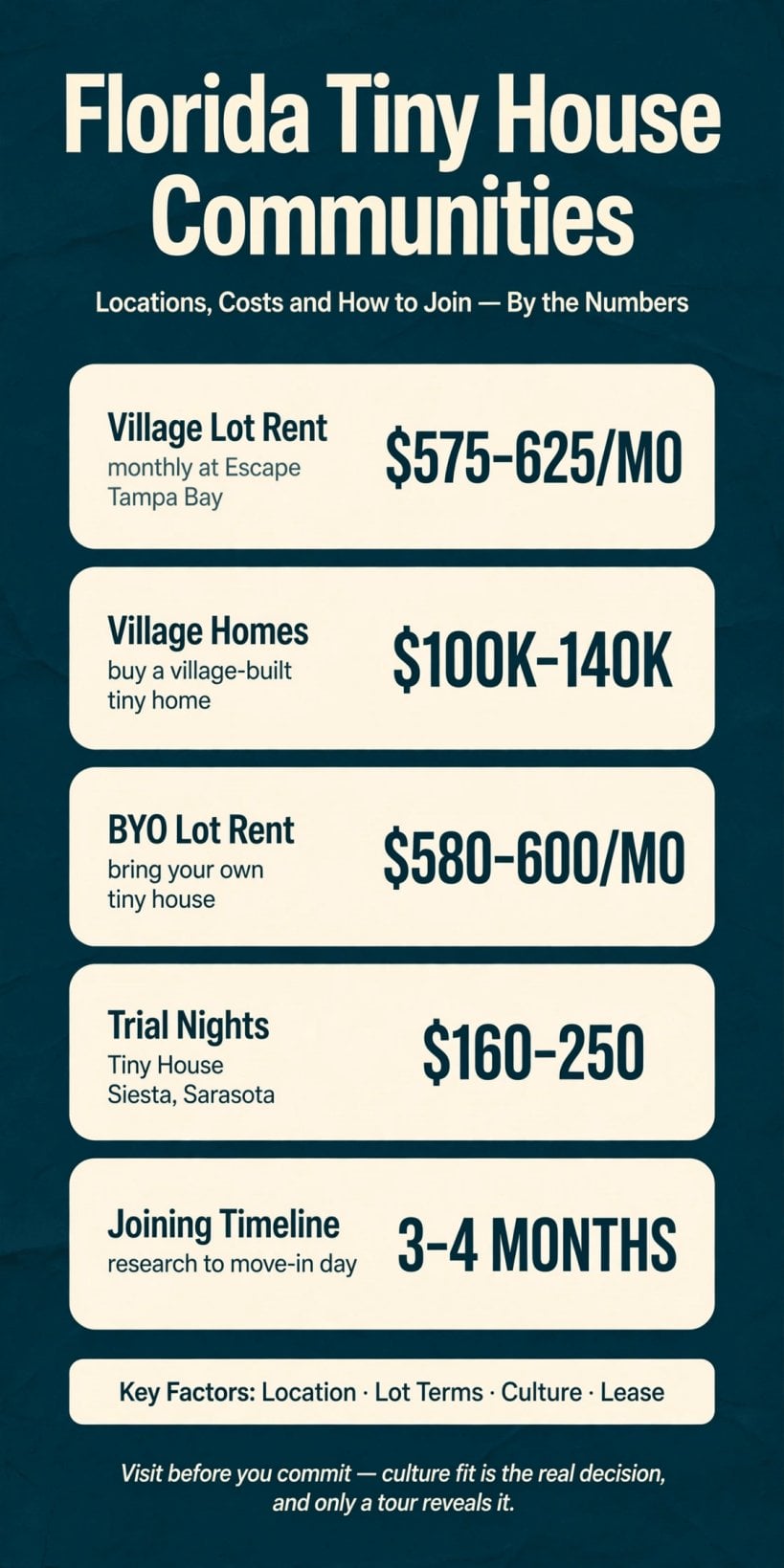
The comparison by the numbers: village lot rent of $575–625 a month, village homes at $100K–140K, bring-your-own lots at $580–600 a month, trial nights at $160–250 — and 3–4 months from research to move-in.
1. The Community Map: Six Communities, One Coast-to-Coast Choice
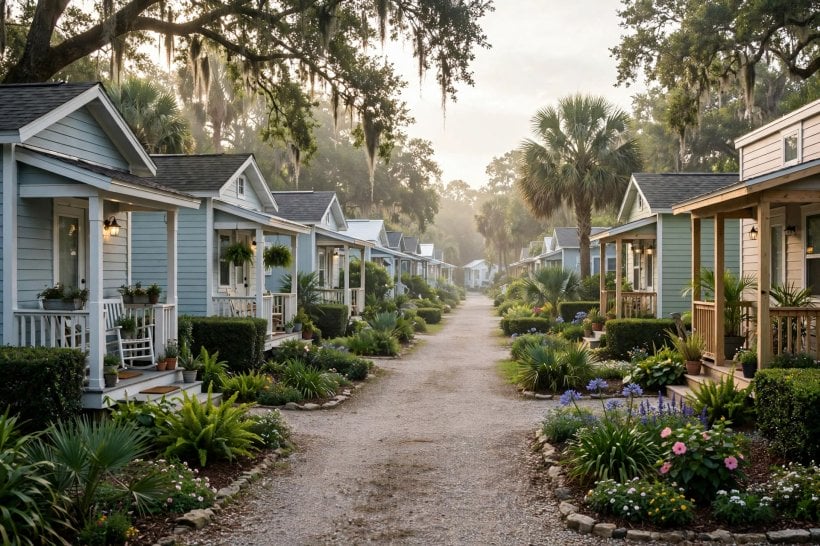
Start with the map, because each community is a different answer to the same question. In Tampa Bay stands the flagship: Escape Tampa Bay, a gated, purpose-built village — the suburban tiny, designed from the ground up. In Ruskin, Circle Pond is the green option, an eco-conscious community organised around its pond and garden beds. Winter Haven holds The Preserve, the lakefront choice, where social life runs on waterfront time. On Lake Okeechobee, Gracious Park is the BYO waterfront — an adapted park of full-time, settled residents. Sarasota’s Tiny House Siesta is the resort: the trial, where you rent the life by the night. And DeLand hosts the container pilot, the mission-driven experiment pointing at where legal tiny living goes next.
That spread is the point. Between them, the six cover every Florida tiny lifestyle — the buyer who wants a turn-key village home, the owner who already has a house on wheels and needs a legal lot, the gardener, the lake lover, the snowbird and the merely curious. Year-round living is the default: the villages are built for full-time residents, with the seasonal option layered on top. Our companion guide walks each Florida community village by village in profile form, while this guide does the comparing: costs against costs, culture against culture, model against model.
2. The Costs Compared: Lots, Homes and the Trial Night
The money sorts into three paths. The village path is Escape Tampa Bay: homes at $100k–$140k, plus lot rent of $575–$625 a month — the turn-key purchase, and the highest entry cost on the map. The bring-your-own path is the cheapest way in: Circle Pond’s lots run about $600 a month with utilities included, and The Preserve’s lakefront lots are $580 a month — you supply the house, they supply the lot, the hookups and the community. Gracious Park prices as the BYO waterfront park it is, and the trial path is Siesta, at $160–$250 a night: not a home, but the cheapest way to learn whether the life fits before committing.

Read the range whole and it runs from $580 a month to $100k-plus — a genuine spectrum, which is why the budget decides the shortlist before taste gets a vote. The FAQ answer is the same in one line: BYO lots at $580–$600 a month are the cheapest path in; village homes cost more and deliver the turn-key community. Set against conventional Florida renting, a sub-$600 lot with your own home on it is the controlled-cost proposition the whole movement rests on — our breakdown of what a tiny house costs to buy and run puts these community numbers in the wider frame of purchase prices, delivery and monthly running costs.
3. The Cultures Compared: The Village, the Pond, the Lake, the Park, the Resort
Costs are countable; culture is not, and culture is the real decision. Escape Tampa Bay runs as the gated village — curated, suburban-tiny, everything designed. Circle Pond is the eco-conscious community: garden beds, pond ecology, residents who chose the green version of the life. The Preserve is the lake life — waterfront social, days organised around the water. Gracious Park is the settled park: full-time residents, an evolved rather than designed feel. Siesta is the resort — holiday energy, short stays, the trial crowd.
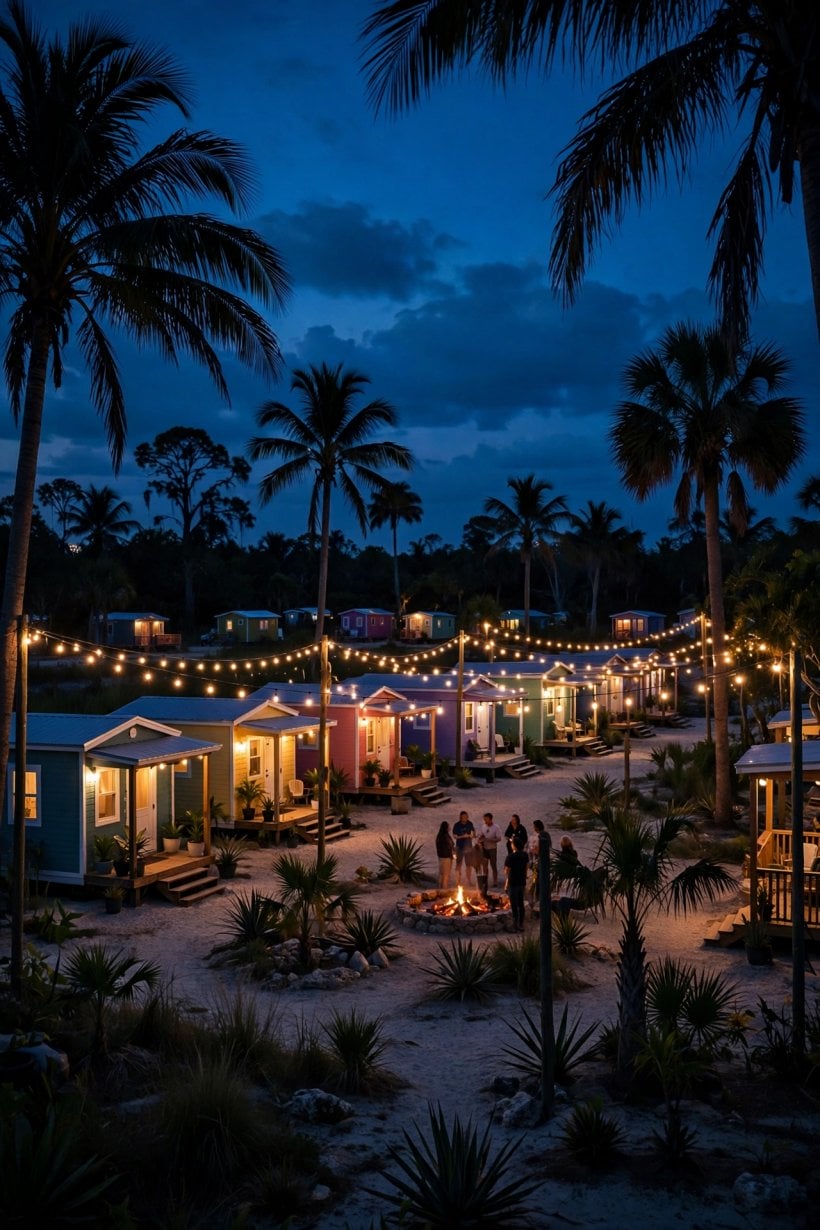
None of these is better in the abstract; each is better for somebody. The original advice stands because it is the whole game: the fit matters, and you find it by visiting before committing — a community can read perfectly on paper and feel wrong in an afternoon, or read plainly and feel like home in an hour. When people ask what actually differs between the communities, this section is the answer: not the houses, which are small everywhere, but the model and the social weather it creates. Choose the weather you want to live in, then check its costs against the budget — in that order, because a budget renegotiates more easily than a daily atmosphere.
4. How to Join: Research, Visit, Apply, Move
The joining process is refreshingly un-mysterious — five steps, in order. Research comes first: work the community profiles and build a shortlist of two or three that fit your budget path and your culture. Then visit: the tour is the non-negotiable step, the one no amount of photography replaces. Then apply — every community has an application and standards, covered in detail below. Then secure: the home or the lot, village purchase or BYO placement, which is the commitment step. Then move — delivery and arrival — and settle, the integration into village life that the last sections describe.
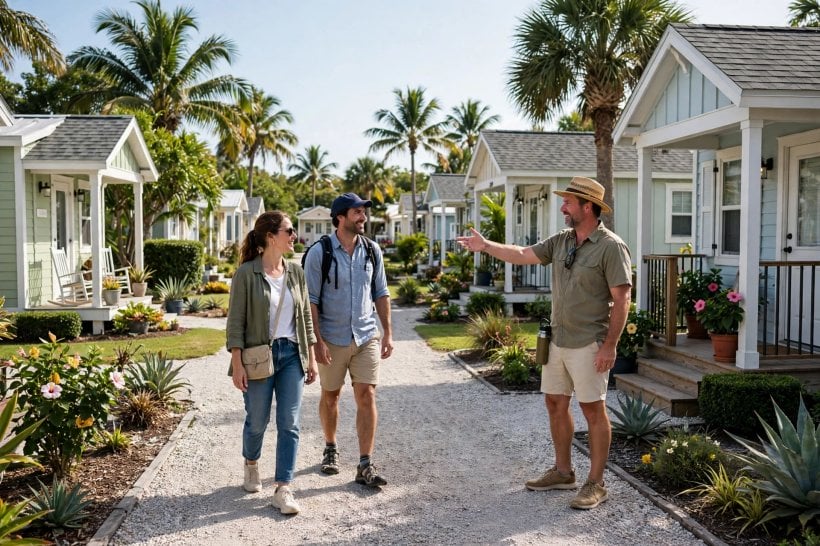
The timeline gives the process its honest pace: weeks 1–2 on research and the shortlist, weeks 3–4 on visits and tours, month 2 on the application, month 3 on securing the home or lot, month 4 on the move — 3–4 months in total, deliberate rather than slow. Two warnings ride along. The popular communities run waiting lists; Escape Tampa Bay has historically run full with one, so apply early, stay in touch, and keep an emerging community with immediate availability as a parallel track. And the application itself is predictable: the home (certification — the RVIA question — matters to the village model), a background check against community standards, lease terms at 6–12 months, and the pet policy, typically a one-dog rule. Ask everything, and read the fine print, before you sign. The buying mechanics behind the secure step are the same as any tiny purchase — our guide to how to buy a tiny house covers the process from budget to keys.
5. Bringing Your Own THOW: The BYO Parks and Their Requirements
If the house already exists — built, bought, or parked in a driveway — the BYO communities are your map. Circle Pond, The Preserve and Gracious Park welcome outside tiny houses on wheels; Escape Tampa Bay is the village-home model instead, where the home comes with the community. The requirements are consistent across the BYO parks: size first, typically up to 35–40 feet; certification second, with standards the application checks; and hookups third — full hookups at 30/50 amp, the standard the lot is wired and plumbed for.
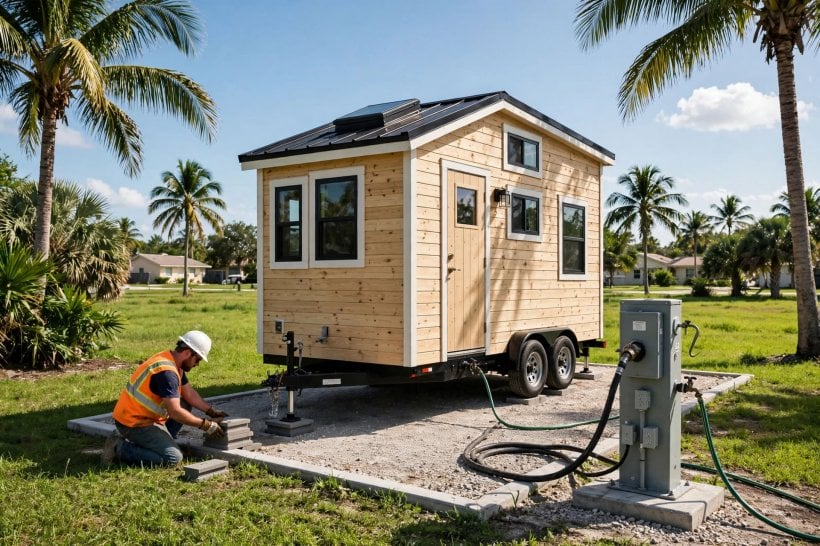
The advantage is the arithmetic from §2: the $580 lot instead of the $100k village purchase — the lowest-cost legal route into Florida community living, in a home you already own. The wider question of where a house on wheels may legally sit is bigger than any one park — our guide to where to park a tiny house works through the options state by state. And for the comparison the original itself pointed to: the same BYO logic operates beyond Florida, as the tiny house communities in Austin show — Texas runs its own version of the park model, on land-first terms.
6. The Village vs. the Park: Two Models of Community
Underneath the six names sit just two models, and telling them apart clarifies every other choice. The village is purpose-built: Escape Tampa Bay is the designed community, planned as a tiny village from the first drawing — matched homes, curated landscaping, amenities placed where a designer put them. The park is adapted: Gracious Park is the evolved community, a waterfront park that grew into tiny living, its character accumulated rather than specified. The difference is intention: designed versus grown, and the experience follows it. The village is curated, the park is organic; one hands you a finished community, the other a living one to find your place in.
Neither model wins outright — the choice is a lifestyle preference, and it is personal. Buyers who want certainty, uniformity and a turn-key arrival tend to the village; owners who want lower costs, looser texture and an established full-time neighbourhood tend to the park. The legal backdrop differs subtly too: purpose-built villages are typically entitled as communities from day one, while adapted parks carry their zoning history — one more reason the question of where you can legally live in a tiny home is worth understanding before the deposit, whichever model you choose.
7. The Lease and the Rules: Reading What You Sign
The lease is the community’s constitution, and it rewards a slow read. Duration first: 6–12 month terms are the standard commitment. Rent next: the $580–$625 band across the map — and the operative question is what is included, because Circle Pond’s roughly $600 with utilities included can beat a cheaper lot once bills land separately. Then the clauses people skip: escalation — are increases capped?; termination — what notice, whose exit rights?; and the sublet policy, restricted as a rule. The original’s advice is the section in five words: read every line — the lease is the law of your lot.
The rules layer over the lease, and they are the good-neighbour code written down: exterior standards — the kept appearance the village’s look depends on; quiet hours — respected because walls are thin and lots are close; a guest policy — defined rather than assumed; and pets, where the policy is generally friendly — most communities allow pets, typically one dog, sometimes two with approval — but confirm your specific community’s rule before the application, not after. Run the pre-signing checklist the original ends with: tour completed and felt; lease terms read and understood; community standards accepted; all-in costs budgeted; culture fit confirmed. All five checked — welcome home.
8. Village Life: Days, Seasons and the First Month
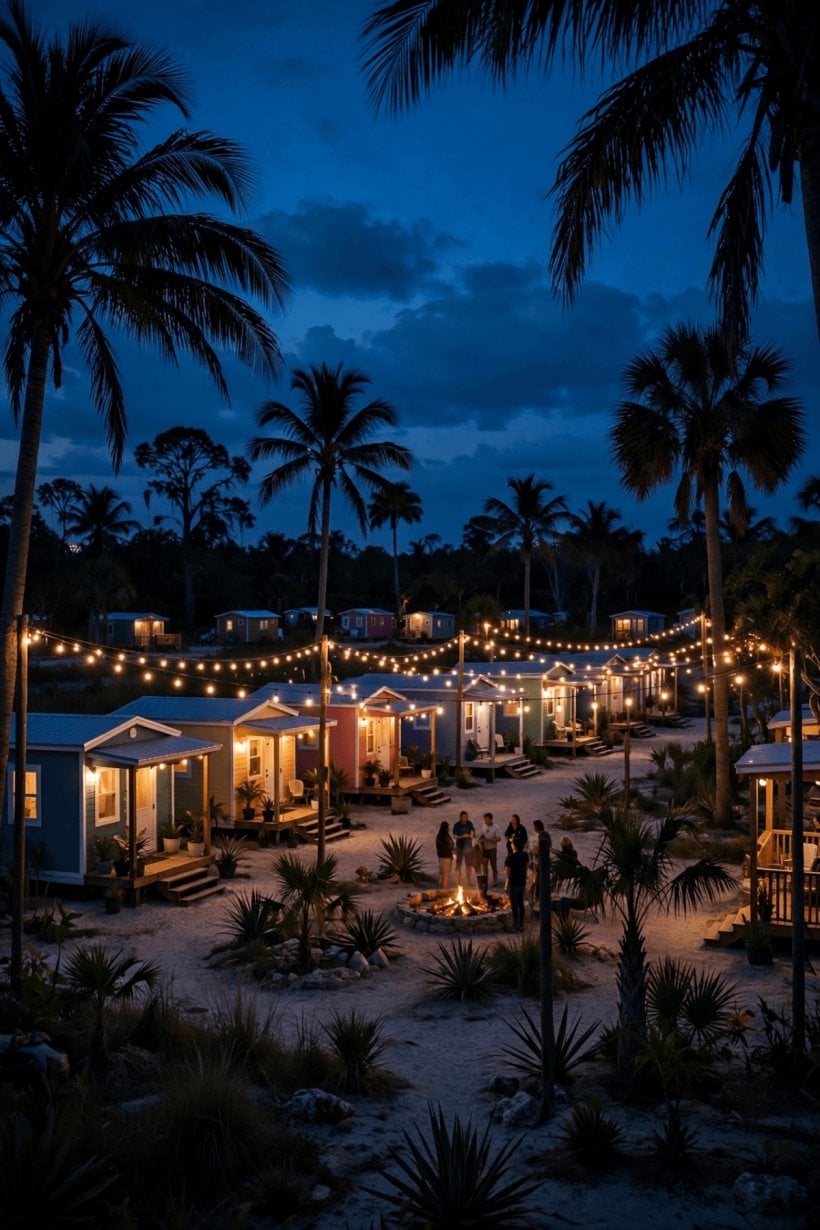
A day in the village has a rhythm the brochures can’t quite sell: morning coffee and the neighbour wave; midday remote work — the $600 office with a lake or garden outside the window; the afternoon at the pool or the lake; the evening at the fire pit, the community’s natural gathering point and social engine. Making friends here is mostly showing up — the events calendar, the shared spaces — because the community rewards participation in direct proportion to presence. The village is, by design, the social version of tiny living: the connection is the amenity.
The seasonal strategy layers on top: the snowbird winter in the village, on flexible leases, with summer storage secured while you are north — a roughly $600 winter base against northern heating bills and grey skies; the verdict is the best of both. Trying the rhythm before renting a lot is what Siesta’s nightly model, and the wider market of >places to rent a tiny house, exist for. And the first month runs its own small curriculum: hookups learned, introductions made, the village rhythm found, the final downsizing edit — and underneath it, the feeling the whole process aimed at: belonging.
9. The Investment Angle — and Leaving Well
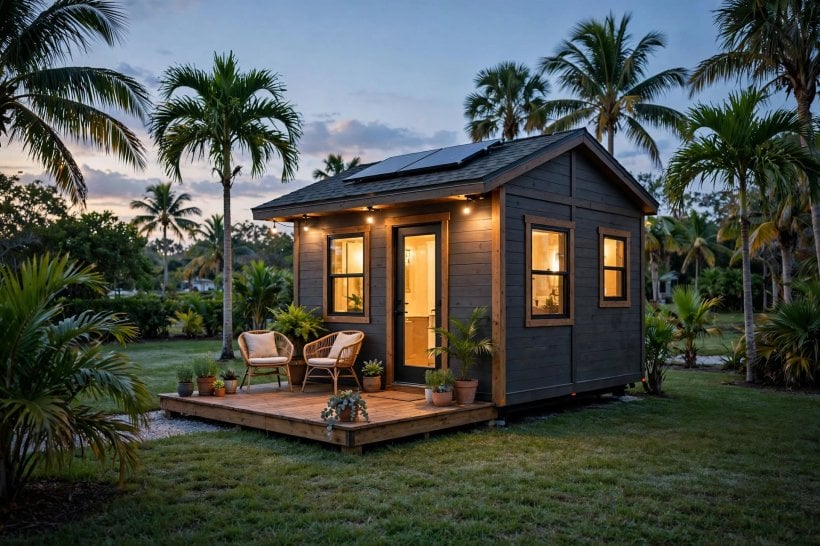
Run the numbers as an investor would, because the village model has a genuine financial shape. The village home is the $100k asset: real equity in a built home, with lot rent — the $600 band — as the controlled cost underneath it. The rental angle follows the Siesta model: nightly and seasonal demand in Florida is proven, and a community that permits it turns the home into income when you are elsewhere. Appreciation is the speculative line — the village premium is the potential, not a promise — and the discipline is the original’s: numbers first, romance second.
The exit deserves the same clear eyes, because every joining is also a future leaving. The mechanics: give the required notice; sell the home in place or move it — both are real options in the BYO parks, and the village home sells as village homes do; restore the lot and leave it clean. The soft part matters more: the relationships, kept — because the tiny world is small, and the network you leave well is the network that helps your next move. Readers weighing community life against the other ownership route entirely will find the alternative in our guide to tiny houses for sale with land — your own lot, no lease, a different freedom with a different price.
10. Florida vs. Other States, the Future, and the Decision
Florida’s claim is specific: the most developed tiny-community scene in America — the villages are the infrastructure, and no other state has built them at this maturity. The comparisons sharpen it. North Carolina is the pioneer — the Simple Life tradition, community living with a head start; our guide to tiny house communities in North Carolina walks that scene. Texas is the independent — land-first, community-second, as the tiny houses for sale in Texas market shows. Oregon is the progressive — the green, policy-forward version. Florida wins on village infrastructure, and the future points one way: the DeLand pilot is the legalisation signal, new villages are in the pipeline, affordability is the demand driver — the bet is that the villages multiply toward 2030.
So the decision framework, name by name, as the original framed it. Want the village? Escape Tampa Bay, the flagship. Want the eco? Circle Pond, the green. Want the lake? The Preserve, the waterfront. Want BYO? Gracious Park, the park. Want the trial? Siesta, at $160 a night and up. “Best” was never a single community — Escape is the flagship standard, but best is the fit, found one way only: visit, feel, choose. What the village promises, once chosen, is the package the previous sections itemised — neighbours found, affordability controlled at the $600 band, the endless summer lived, belonging that turns a small house into a home. Florida tiny house communities reward exactly one behaviour above all others: showing up in person. The tour awaits.
Final Considerations
Florida’s communities are the most developed in America — the gated village, the eco-pond, the lakefront, the BYO waterfront park, the resort trial and the container pilot cover every version of the life. The costs are a genuine spectrum, $580-a-month lots to $100k-plus village homes; the joining process is a straightforward 3–4 months of research, visiting, applying and moving; the lease, the one-dog rule and the quiet hours are all readable in advance. The culture fit is the real decision, and only a visit reveals it. One honesty note, carried from the original: details and prices change — verify current offerings directly before relying on any figure here. Then come and see your community in person.

0 Comments