

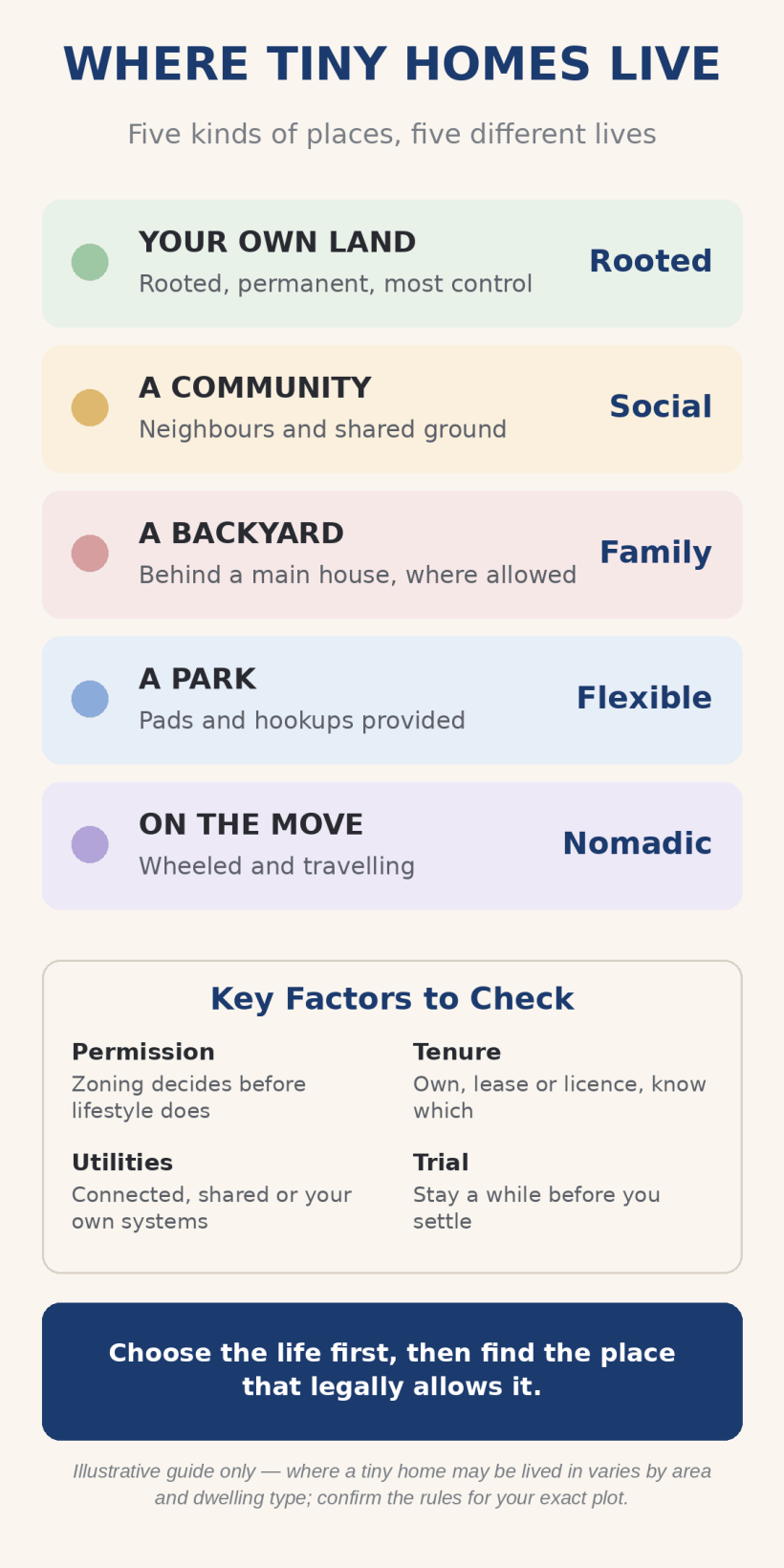
You can live in a tiny home on your own land, in a tiny house community, in a backyard, at a park that welcomes long stays, or on the road itself — and the honest answer to “where?” is that it is two questions wearing one coat. There is the life question: which setting suits how you want your days to feel? And there is the permission question: where is a tiny home of your type legally allowed to be lived in? The right answer needs both.
This guide walks the settings one by one — rooted, communal, urban and nomadic — and what each is really like to live in, then closes with the choosing. The parking companion to this post, covering spots and setups in practical detail, is our guide to where to park a tiny house; here, the subject is the life each place makes.
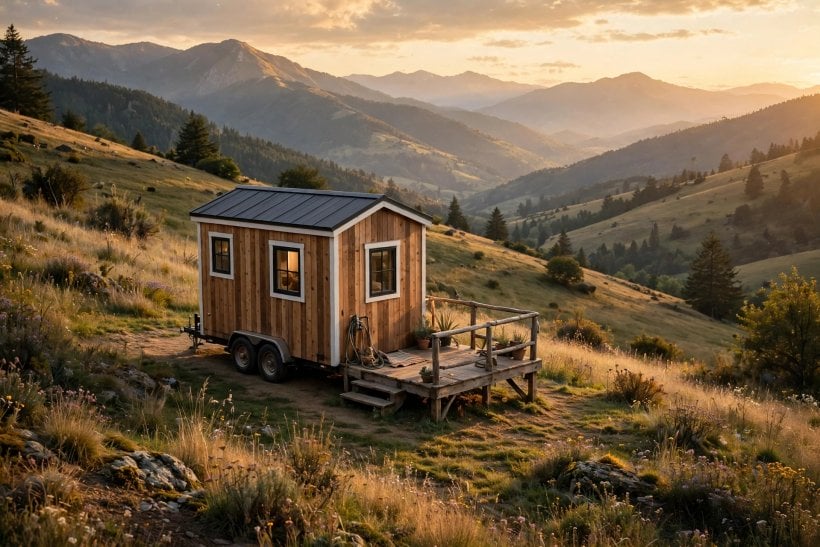
1. The Short Answer: Permission First, Lifestyle Always
Every option in this guide is governed by the same quiet rule: a tiny home may be lived in where local zoning, the dwelling’s classification and the landowner’s or park’s terms all say yes at once. A house on wheels is often treated by rules as a recreational vehicle; a house on a foundation is treated as a small dwelling — and the places open to each are different. That classification, decided before you shop, is the lens for everything below.
The state-by-state laws index gives you the legal landscape, and our guide to where you can place a tiny house covers the land side in depth. With that frame in mind, the lifestyle tour can begin — because once permission is understood, the real choice is about how you want to live, and that choice deserves the longer half of your attention.
2. Your Own Land: The Rooted Life
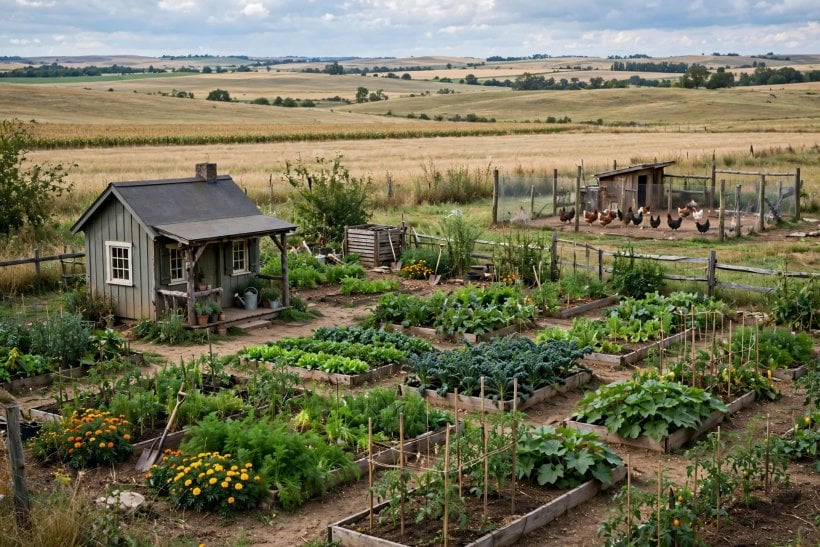
Owning your plot is the most settled way to live tiny: no landlord, no park rules, nobody else’s notice period hanging over your home. You choose the view, plant for the long term, and build the outdoor life — garden, workshop, fire pit — that small interiors push you toward anyway. For many people this is the dream the whole movement points at, and where permission allows a foundation build, it is also the most house-like and mortgage-friendly form of tiny living.
Rooted living also has a social shape worth picturing honestly. Your neighbours are whoever already lives along your lane — which can mean community of the unchosen, everyday kind, or it can mean real privacy and a gate you close. Visit at different times, walk the boundary, and trust your instincts about the specific place rather than the category. Rootedness rewards people who researched the land and its people with the same care they gave the house.
The costs of rootedness are responsibility and homework. Permission must genuinely allow a dwelling of your type on that parcel, services are yours to arrange and pay for, and the land itself needs the checks any land purchase needs — boundaries, access, soil and water. You also give up the easy exit: a rooted tiny home moves house the way houses do, by being sold. Buyers who want this life usually want exactly that trade, permanence and all.
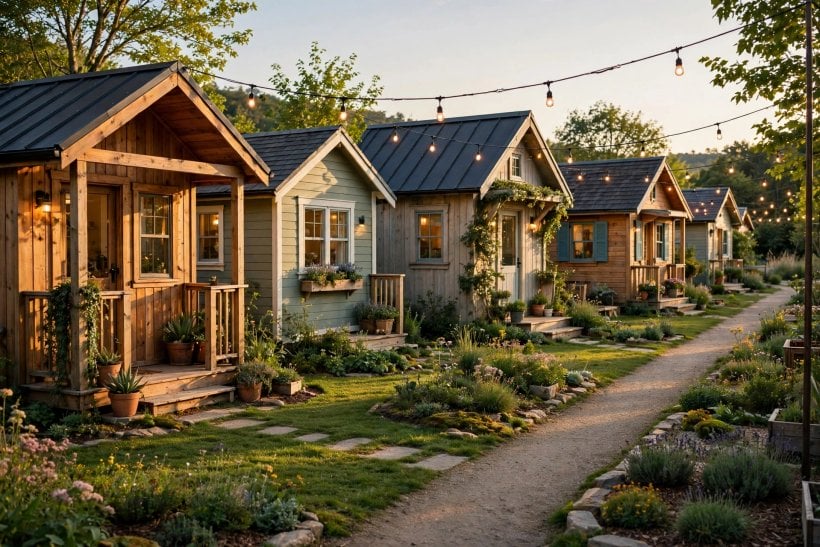
3. Tiny House Communities: The Social Setting
Communities are neighbourhoods built at tiny scale: rows or clusters of small homes around shared ground, with tenure arrangements that range from renting a lot to owning a share of the whole place. The social life is the product — porches, shared gardens, neighbours who chose the same trade-offs you did. For people who worry that tiny living means isolated living, a village is the direct answer, and it is why communities are the fastest-growing setting in the movement.
Practically, communities also solve the permission problem for you: the zoning, services and dwelling types are settled by the community itself, so you move into legality rather than negotiating it. In exchange you accept house rules, fees and neighbours at close quarters — read the tenure and the rulebook with the same care as a deed. Our guide to tiny house communities in North Carolina shows how one state’s villages are organised, and the wider tiny home communities overview maps the types.
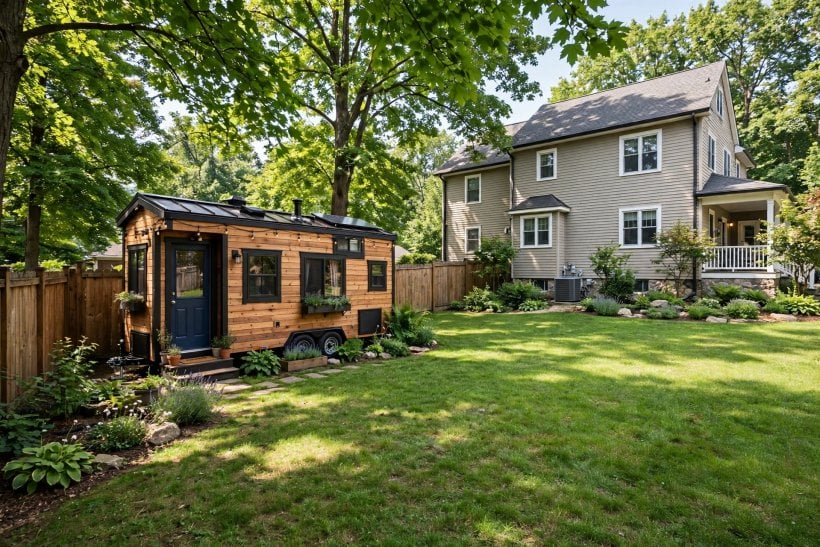
4. Backyards and Family Land: Close to Home
The backyard setting — a tiny house behind a main house, often a family’s — is the gentlest on-ramp in tiny living. The land is known, the neighbours are relatives or a friendly host, help is through the garden gate, and the economics can be kind to both households. Where accessory-dwelling rules allow a second small home on a residential lot, this is frequently the easiest permission a city offers a tiny house.
The arrangement lives or dies on clarity. Utilities, access, privacy, guests, and what happens if circumstances change all deserve a written agreement, however warm the relationship — especially because the relationship is warm and worth protecting. Rules vary sharply: some places welcome backyard dwellings, some ban wheeled homes in residential areas outright, and some allow the house but not full-time living in it. Check before the house arrives, not after.
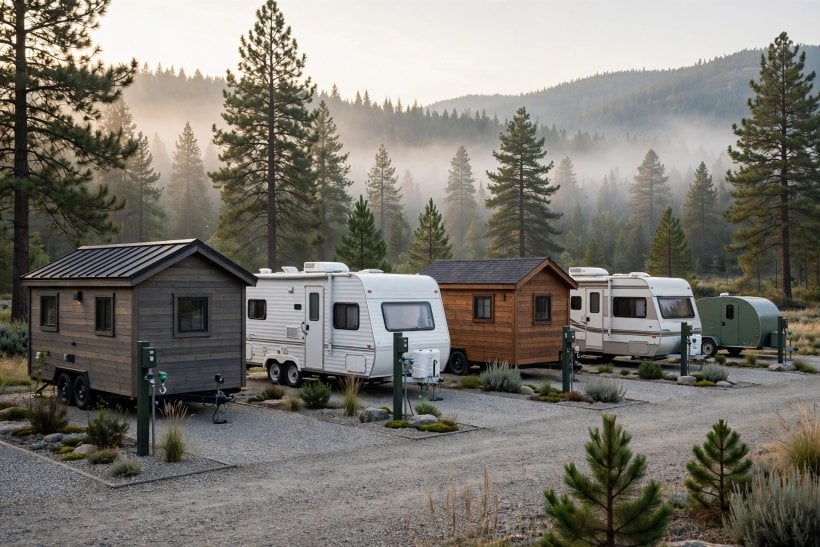
5. RV Parks and Campgrounds: The Flexible Base
Parks are the ready-made setting for houses on wheels: a pad, hookups for power, water and waste, and permission that comes with the booking rather than a planning office. They suit new owners beautifully — you can live legally from the first night, learn your house, and move on when the season or the mood changes. Many parks now court tiny houses specifically, with longer-stay arrangements for exactly this household.
Costs in parks are their own discipline: pitch fees, metered utilities and park charges replace the land costs of the rooted life, and they can rise on the park’s schedule rather than yours. Compare parks on the whole arrangement — stay length, services, atmosphere, and how long-term residents are treated — not on the monthly figure alone. A slightly dearer park that lets you settle for years is often cheaper, in money and in peace, than a bargain pitch reviewed every season.
The limits are the park’s own: stay lengths, house age or appearance rules, and the reality that a pitch is a licence, not a tenure — your home is secure month to month, not year to year. Treat a park as a brilliant base and a bridge, and if you settle long-term in one, keep the agreement, the exit plan and the tow vehicle all current. The comparison with the RV life it borders is drawn in our guide to tiny house versus RV full-time living.
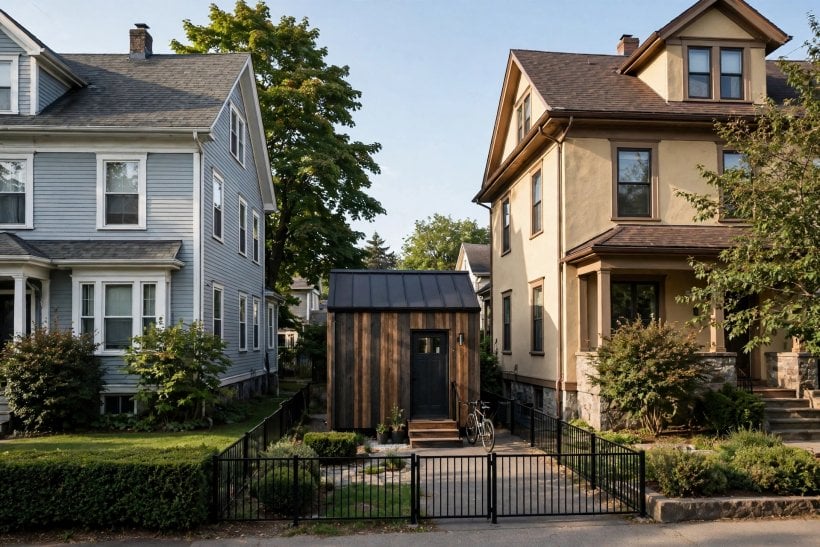
6. The Urban Edge: Small Lots and City Life
Cities are the newest tiny frontier. A small infill lot, a backyard dwelling, or a foundation tiny house on a narrow plot can put you in a walkable neighbourhood at a scale older housing stock never offers — and a growing number of cities have adjusted their rules to allow exactly this, usually through accessory-dwelling or small-lot provisions. Urban tiny living trades land for location: your garden shrinks, and the city’s parks, cafés and libraries become your extended floor plan.
Expect the tightest rules of any setting here: size minimums or maximums, design standards, parking requirements and neighbour notification are all common, and wheeled homes are often excluded from residential streets entirely. The urban tiny life is real and growing, but it belongs to foundation builds and formal permissions. If the city is the dream, start at the planning office with a specific lot in hand — “sometimes, somewhere in this city” is not a plan.
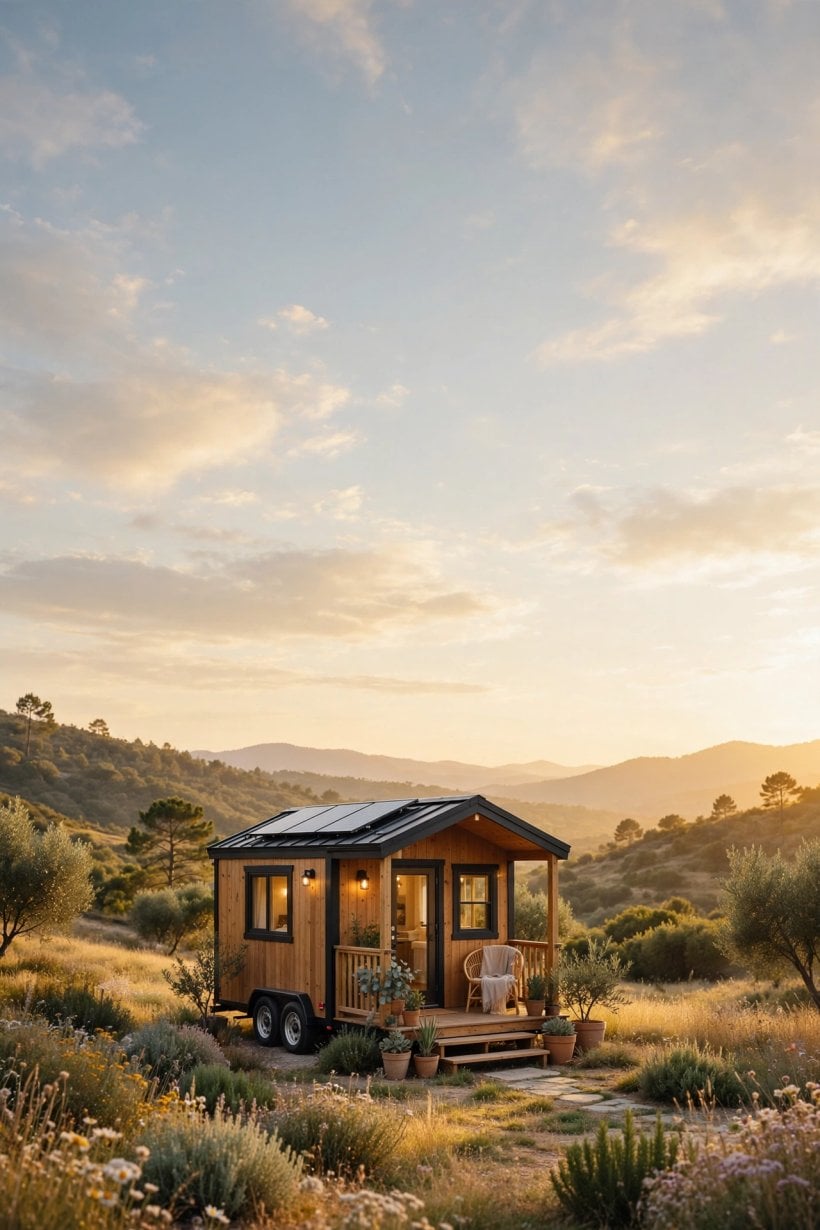
7. The Nomadic Life: Home Is Where You Park It
For some, the answer to “where can you live” is “everywhere, in turn.” A house on wheels can follow seasons, work, family and curiosity — a winter in the warm south, a summer near the mountains — with home constant throughout. It is the setting the wheels were invented for, and the people who thrive in it treat movement itself as the lifestyle, not a commute between real homes.
Nomadic living runs on rhythm and rules: stays are booked or permitted place by place, hookups and waste are a weekly logistics, and the house must stay genuinely road-ready — maintained, towable and legal on the road as well as off it. It also costs differently: less in tenure, more in fuel, fees and wear. Households who love it plan loosely and check constantly; those who struggle usually wanted one rooted home and bought a travelling one by mistake.
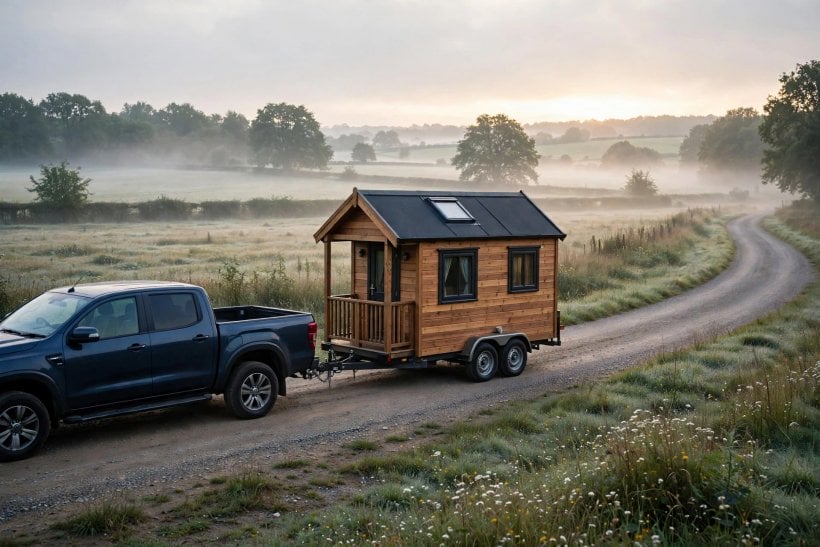
8. Renting First: Live in Someone Else’s Answer
Before buying into any setting, you can rent your way into it. Tiny houses are rented in backyards, communities, parks and holiday settings across the country, and a month of rented tiny living teaches more than a year of videos — about the space, the setting and yourself. Rent in the setting you think you want: a village if community tempts you, a rural plot if rootedness does, a park if you are not sure.
Our guide to where you can rent a tiny house covers the routes. Treat the rental as research with a view: note what the setting gives you daily — quiet, company, convenience — and what it quietly takes. Many rooted owners started as community renters, and many nomads discovered, one rented month in, that what they actually wanted was a village with a gate they could open.
9. Choosing: Life First, Then the Plot
Here is the order that works. Choose the life first: rooted or moving, solitary or social, rural-quiet or city-connected. Then filter by permission: which settings legally accept your house type, verified at the level of the exact plot or park — not the county map, not a forum’s memory. Then visit before you commit: stay a night, walk the lane at dusk, talk to the people who already live the life you are pricing.
And hold the decision loosely where you can. Tiny living’s secret advantage is that settings can be sequenced — rent, park, community, land is a well-worn path, each stage teaching the next. The best place to live in a tiny home is the one whose daily life you have actually tasted and whose paperwork you have actually read. Everything else is scenery.
One thread runs under every setting and is worth naming plainly: mail, healthcare, schooling and work all attach to an address, and each setting handles them differently — a park’s terms, a community’s address, your own recorded plot. Solve the address question for your chosen setting early, especially if you will work remotely, register a vehicle or enrol a child from it. It is the least picturesque part of the decision and the part most likely to ambush you in month one if it is left vague.
Weather deserves a sentence in the choosing, too, because settings behave differently across the year. The rural plot that is paradise in June can be a mud-and-darkness test in January; the park that hums in season can feel emptied out of it; the city lot barely changes at all. If you can, visit your favoured setting in its worst month before committing — or at least interrogate someone who has wintered there. A place chosen for all four seasons rarely disappoints in any of them.
10. Frequently Asked Questions
Where can you live in a tiny home?
On your own land where a dwelling of its type is permitted, in a tiny house community, in a backyard as an accessory dwelling where allowed, at RV parks and campgrounds that accept tiny houses, in cities under small-lot or accessory-dwelling rules, or on the move if the house is on wheels. Permission is local in every case.
Can I live in a tiny home anywhere I like?
No. Zoning, dwelling classification and landowner or park terms decide, and they vary street by street. A spot can be physically perfect and legally impossible. Verify at the exact address — with the planning office for land, and with written terms for parks, backyards and communities.
What is the best place to live in a tiny home?
The one matched to the life you want: rooted owners prize their own land, social households thrive in communities, the undecided do well starting in a park, and travellers belong on wheels. Visit and, better, rent in your favoured setting before committing — taste beats theory at this decision.
Can I live in a tiny home in the city?
Sometimes. Cities increasingly allow small foundation homes and backyard accessory dwellings under specific rules, while wheeled homes are often excluded from residential areas. Bring a specific lot to the planning office and ask about that address; city permission is real but it is formal.
Is tiny home living lonely?
Only if you set it up that way. Communities and villages are built for company, backyard living keeps family close, and the outdoor-forward life tiny houses encourage is naturally social. Solitude is available in the rural settings for those who want it — the setting, not the square footage, decides.
Can I live in a tiny home on family land?
Often, yes — as a backyard dwelling or a second home on a larger parcel, where rules allow it. Put the arrangement in writing anyway: utilities, access, privacy and what happens if circumstances change. Warm relationships survive clear agreements; they are what vague ones die of.
How do I find tiny home communities near me?
Start with community directories and registries, local tiny house groups and builders, and the communities’ own sites — then visit in person and talk to residents. Check the tenure and rules of any community as carefully as its photographs; what you are joining is a legal arrangement with a social life attached.
Final Considerations
Where you can live in a tiny home is wherever the life you want and the rules of the place agree — your own land, a community lane, a family backyard, a friendly park, a city lot, or the whole map in rotation. Decide the life, verify the permission at the exact address, and taste the setting before you buy it. The houses are small; the choice of where to put them is the biggest one in the whole project. This guide is general information only, not legal advice.



1 Comment