

Yes, tiny house communities do exist in North Carolina, and the honest way to find the right one is to stop searching for a perfect named listing and start by choosing the type of community you want, the region that suits your life, and the legal setup you can verify in writing. North Carolina has no single statewide answer for tiny living. Permission, pricing structures, and day-to-day rules are set community by community and county by county, so two places an hour apart can work in completely different ways. This guide explains the main community types, which costs to ask about, how joining usually works, and the checks that protect you before you sign. It deliberately names no specific places or prices: names, vacancies, and fees change, and any figure you rely on should come from the community itself, in writing, when you apply.
1. What Counts as a Tiny House Community in North Carolina
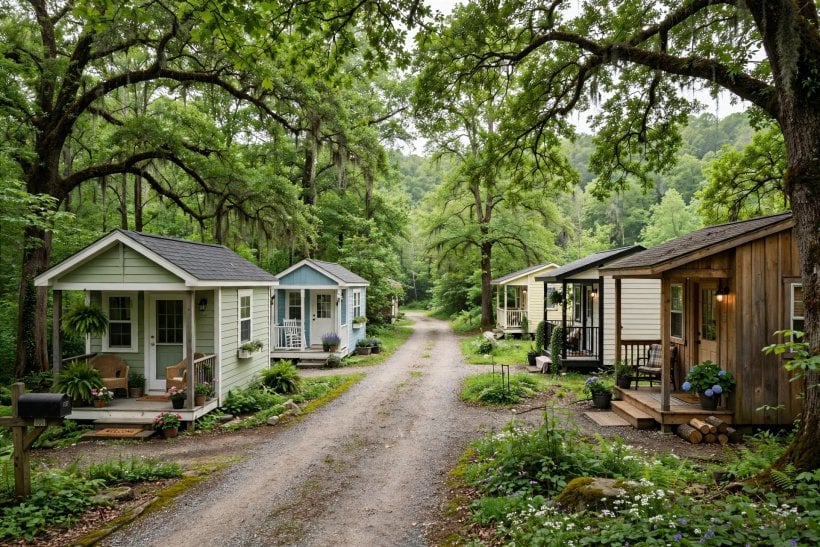
A tiny house community is land planned or approved for more than one small home, where residents share a legal arrangement for the land, shared spaces, and basic services. That arrangement matters more than the look of the place. A row of small homes on one owner’s land, a resident-owned cooperative, and a rural property shared by a small group can all call themselves a community, yet your rights, monthly costs, and ability to sell or move your home differ greatly in each.
It also helps to separate two kinds of tiny home, because communities are usually built around one or the other. A tiny house on wheels sits on a trailer and is treated, in many rule systems, more like a vehicle or temporary dwelling than a conventional house. A foundation home is fixed to the ground and is more often handled under ordinary residential rules. Before you fall for a community’s photos, ask which kind it accepts. For the state-level picture behind those distinctions, start with our guide to tiny house laws in North Carolina.
Finally, a community is not the same as permission to park. A friendly landowner and a handshake are not a community in any legal sense. A real community can show you its paperwork: how the land is owned, what your agreement is called, and what happens if the land is sold. If a place cannot explain those basics, keep looking.
2. The Main Types of Community You Will Encounter
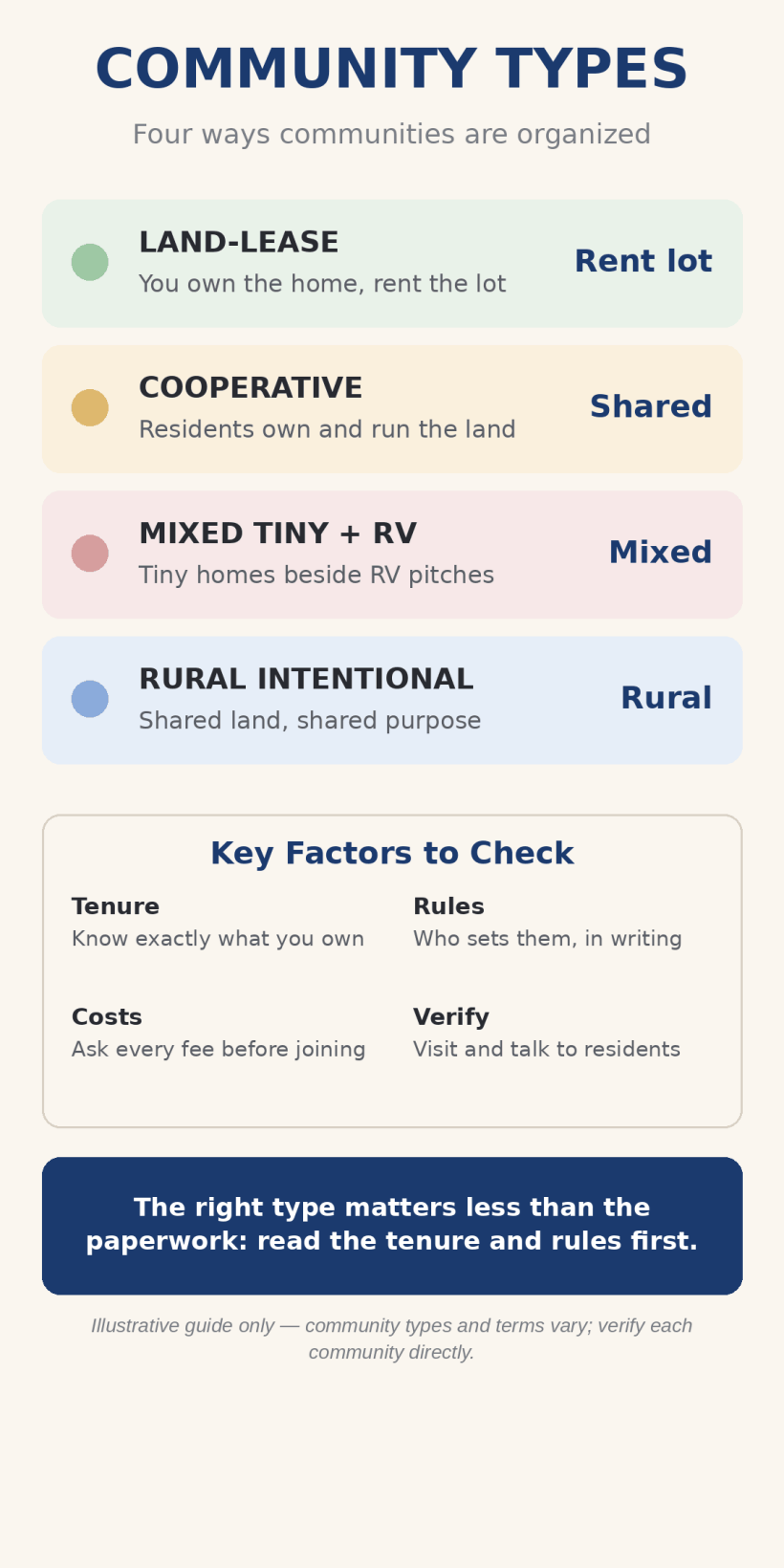
Land-lease communities
You own or rent the tiny house and pay for the use of the lot underneath it. The landowner keeps responsibility for shared roads, shared spaces, and usually the main utility connections, while you maintain your home and follow the rules. This is often the simplest route in, because you do not have to buy land, but the small print matters most: how the lot payment can change, how much notice you get, what happens if the land is sold, and whether you could be required to move your home when the agreement ends.
Resident-owned and cooperative communities
Here residents collectively own or control the land, often through a shared organization, and each household holds a membership or share alongside the right to occupy a lot. Rules, budgets, and shared projects are decided together rather than handed down by a landlord, which brings stability and a real say in how the place is run. It also brings duties: meetings, shared maintenance, and collective costs when something big needs repair. Ask how decisions and disputes are handled, and what joining and leaving involve.
Mixed tiny house and RV communities
Some communities accept a mix of tiny houses on wheels, RVs, and sometimes park-model homes. These can be more flexible about timing and home types, and may suit people testing tiny living before committing to land or a foundation build. The trade-off is a more transient feel, and rules written mainly for recreational vehicles. Ask whether full-time living is allowed, whether there is a maximum stay, and whether the site is approved for permanent residence or only extended stays.
Rural intentional communities
North Carolina also has a long tradition of small rural communities built around a shared outlook: gardens, shared work, quiet living, or self-reliance. Homes may be tiny or self-built, and the social agreement is usually as important as the legal one. Expect a slower joining process, often including visits and a trial stay. These places can be wonderful for the right person and a poor fit for someone who simply wants low rent and privacy.
Foundation-based small-home developments
Some developments are simply small-home neighborhoods: compact houses on foundations, sold and governed much like any other residential development. The home is usually a permanent house in the eyes of local rules, which can make financing, insurance, and resale more straightforward, while association rules and size limits may apply. If you are comparing this route with buying your own plot, our guide to where to buy tiny house lots walks through what to check on any piece of land before you buy.
3. Locations, Answered Honestly: Regions, Not Listings
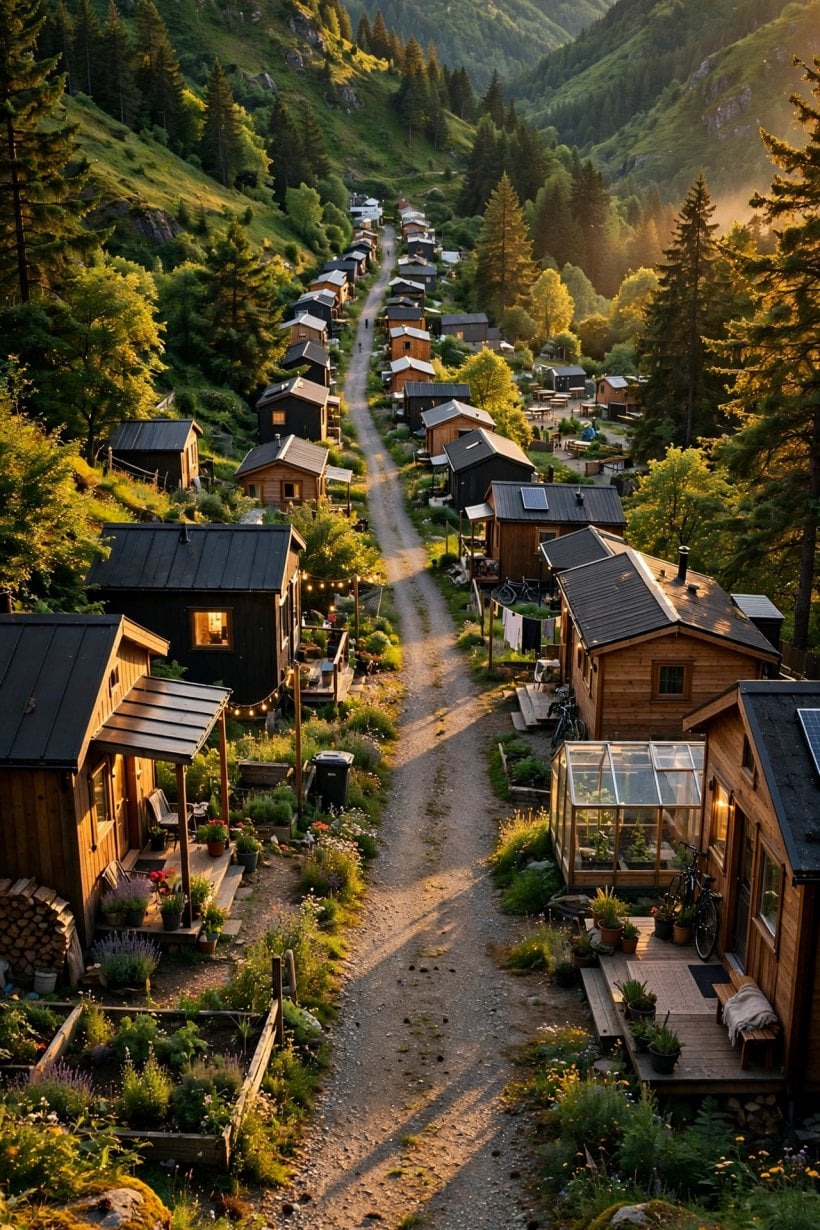
Readers often ask for a list of the best locations, and the responsible answer is a map of regions and trade-offs rather than named places presented as current listings. Communities open, fill up, change rules, and sometimes close, and no article can keep a named list accurate. The character of North Carolina’s three broad regions does not change, and choosing your region first narrows your search far better than chasing names.
The western mountains offer cooler summers, steep and scenic land, and a strong culture of cabins and small homes; the checks there are slope, winter road access, hillside water and septic arrangements, and distance to work and healthcare. The central Piedmont, where the larger cities and employment centers sit, offers shorter commutes and more services, but land pressure is higher and rules in built-up areas can be tighter. The eastern coastal plain offers flatter land and a slower pace, with its own checks: drainage, flooding, storm exposure, and insurance.
Whichever region you favor, test it in person and out of season if you can. Visit at different times of day, drive the route to the nearest town, check phone signal and internet, and talk to people who live there. A community that looks perfect in spring photographs is still the place you will live in February and in August.
4. What It Costs: The Parts to Ask About, Not a Quoted Price
Any page that quotes one neat monthly figure for community living in North Carolina is guessing, because costs are set by each community and change over time. What protects your budget is asking every community for the same complete list of cost parts, in writing, and comparing like with like. Our broader breakdown of how much a tiny house costs will help you place those parts inside your total budget.
The regular costs
- Lot or land payment: what it covers, how often it can change, and how much notice you receive before an increase.
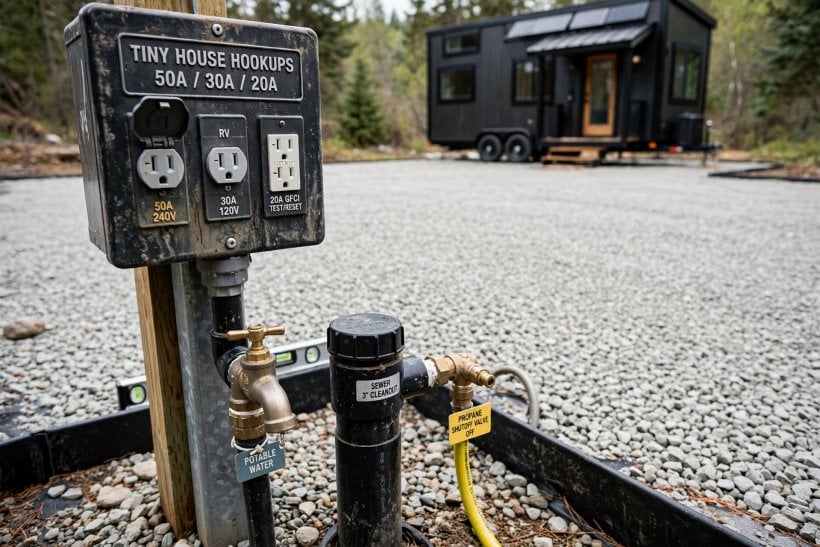
- Utilities: which of water, sewer or septic, electricity, trash, and internet are included, which are billed separately, and any connection charges at move-in.
- Community charges: any membership, association, or amenity fees, and what they pay for.
- Your home’s own costs: insurance, any loan payment, maintenance, and heating and cooling.
The one-time and occasional costs
- Joining costs: application or buy-in payments where they apply, and whether any part is refundable.
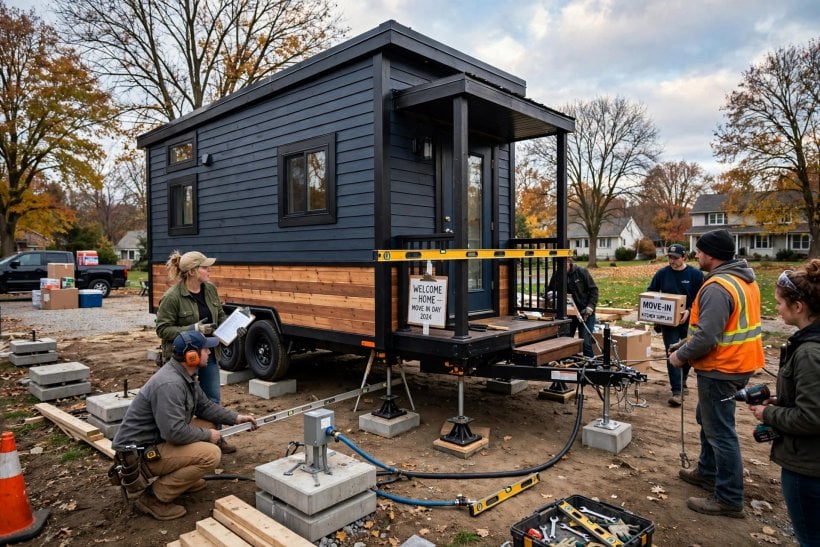
- Moving and siting costs: transporting, siting, and leveling your home, and utility hookup work.
- Exit costs: the cost of selling or removing your home, any buyer-approval rule, and the notice period.
Ask one more question: what has changed here in recent years, and what is planned? A community that answers openly is showing you how it treats residents. One that will not discuss costs in writing is asking you to budget blind.
5. North Carolina Rules in Plain Terms
There is no single tiny house rule for the whole state. Whether you can live in one, and where, is shaped by layers: state building standards for permanent dwellings, county and municipal zoning deciding what kind of dwelling is allowed on a piece of land, local minimum-size rules where they exist, and health requirements for wells and septic systems. Which layers apply depends on whether your home is on wheels or on a foundation, and on the exact place.
That is why verification is a habit, not a formality. Ask the community for the paperwork behind its approval, and check with the county or municipal planning office that its use is permitted at that address. Our step-by-step advice on talking to officials about zoning for tiny houses shows how to have that conversation and what to ask for in writing. For a wider view of how much the answer changes across state lines, see our overview of tiny house laws by state.
Two cautions deserve emphasis. First, a community being open and occupied does not prove every use is approved; ask about approval for full-time living specifically. Second, rules change, so date every answer you are given and re-check anything important before you sign.
6. How to Join, Step by Step
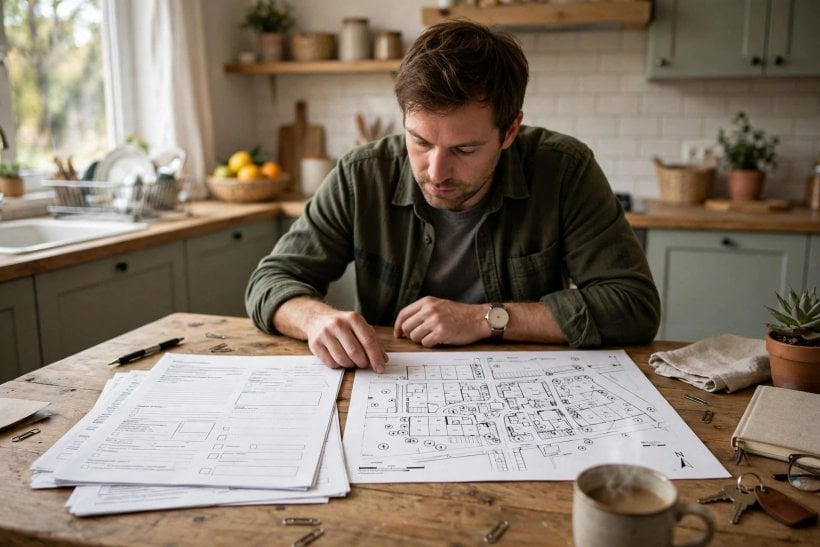
- Choose your type first. Decide which community type fits your budget, your home, and the involvement you want.
- Shortlist by region. Pick the region that fits your work and climate, then look for communities of your type there.
- Ask the hard questions early. Home type accepted, full-time living, vacancies, complete costs, and the agreement you would sign.
- Tour in person. Walk the lots, check drainage and shared spaces, and talk to residents away from the tour if you can.
- Read everything. The lease or membership documents and the full rules, covering resale, guests, pets, and home standards. Read them twice, at home.
- Verify independently. Check approval with the local planning office, and confirm utilities rather than assuming them.
- Apply honestly. Expect questions about your home, household, and finances, and a waiting period for popular places.
- Plan the move. Transport, siting, and hookups, arranged before your home leaves its current spot.
For comparison, our guide to tiny house communities in Alabama covers the same joining checks under a neighboring state’s rules.
7. What to Check Before You Sign Anything
Tenure: what exactly do you hold?
Know the name and length of your agreement, what would end it, how much notice each side must give, and what happens to your home if the agreement ends or the land is sold. Vague tenure is the biggest risk in community living, because your home is expensive to move and may have nowhere approved to go.
Rules you will actually live under
Read for the daily realities: guests, pets, parking, quiet hours, exterior upkeep, whether you may add a deck or shed, whether renting out your home is allowed, and whether you may build on site or must arrive with a finished home. Minor-sounding rules are the ones you will meet every week.
Utilities and practical services
Confirm, service by service, what is provided and what it costs: water source, sewer or septic, electrical capacity, trash, mail delivery, and internet strong enough for your work. In rural settings, also ask who maintains shared roads.
Resale and leaving
Ask how homes are usually sold, whether the community must approve your buyer, whether your lot arrangement transfers to a buyer, and what fees apply when you leave. A home that is easy to buy and hard to sell is not a bargain.
8. Community Life: The Part That Decides Whether You Stay
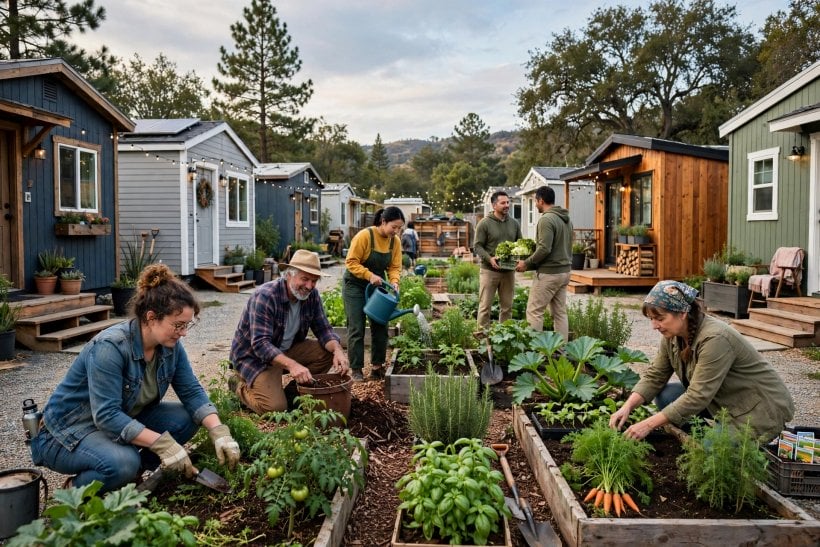
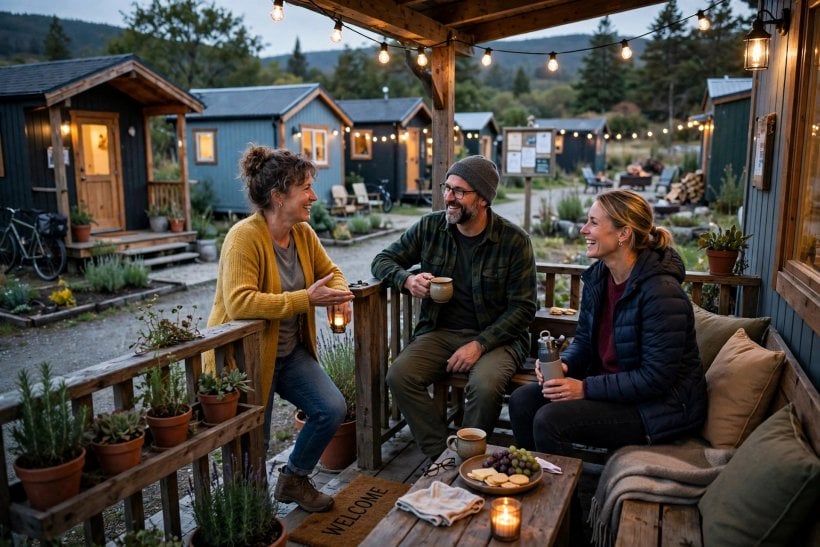
People join communities for land and costs, and they stay, or leave, because of daily life. Gardens, workshops, and gathering spaces are assets when cared for and friction points when they are not. On your tour, look less at the amenity list and more at its condition, and ask who does the work and how shared costs are divided.
Privacy deserves honest thought too. Community living usually means close neighbors and a social life that is easy to join and sometimes hard to step back from. For many residents that closeness is the whole point: help nearby, shared meals, borrowed tools. For others, the right answer is a quieter rural community or their own land. Judge the community’s actual social temperature by visiting, staying overnight if a trial stay is offered, and talking to residents who were not chosen to sell you the place.
Questions residents answer best
- What do you wish you had known before moving in?
- How are disagreements handled?
- What has changed here since you arrived?
- How long do people stay, and why do they leave?
9. Frequently Asked Questions
Are there tiny house communities in North Carolina?
Yes, in several forms: land-lease, resident-owned cooperative, mixed tiny house and RV, rural intentional, and foundation-based small-home developments. Availability changes, so treat any specific place as a lead to verify directly.
How much does it cost to live in one?
There is no honest single figure. Your total combines a lot or land payment, utilities, any community charges, and your home’s running costs, plus one-time joining and moving costs. Ask each community for its complete cost list in writing and compare totals.
Can I legally live in a tiny house in North Carolina?
It depends on the home type and local rules. Foundation homes are generally handled as permanent dwellings, while homes on wheels are treated differently in many places. Verify your situation with the local planning office before you buy or move.
Can I build my own tiny house in a community?
Sometimes. Some communities accept finished homes only, some allow building on site under standards and approvals, and some require particular certifications. Ask before you build, because a home a community will not accept is an expensive problem.
Can I visit before joining?
Usually, yes, and you should. Tours, open days, and, in intentional communities, trial stays are the normal way to judge fit. A community that discourages visiting is telling you something important.
Final Considerations
Tiny house communities in North Carolina reward people who choose deliberately: pick the type that matches the rights and responsibilities you want, choose your region for the life you will actually live there, verify the legal position with official sources, and demand the complete cost picture in writing before you sign. Do not build plans on named listings or quoted prices from any article, including earlier versions of this one, because places fill, fees change, and rules are revised. Tour in person, read every document twice, and talk to residents. Done that way, joining becomes a clear-eyed decision about home and neighbors, not a gamble.

0 Comments