

You can park a tiny house in more places than most people expect — your own land, a backyard, an RV park, a tiny house community, or a leased patch of rural land. The catch is that “somewhere to park” and “somewhere you may legally live” are not the same thing. Almost every parking problem comes from confusing the two: a spot can be physically perfect and still be the wrong answer because the local rules, the landowner’s permission, or the park’s own terms do not allow full-time living there.
This guide works through each kind of parking place, what it suits, and the checks to run before you commit — because the right question is never just “where can I park my tiny house?” but “where can I park it, live in it legally, connect it properly, and stay as long as I plan?”
1. The Five Kinds of Parking Places at a Glance
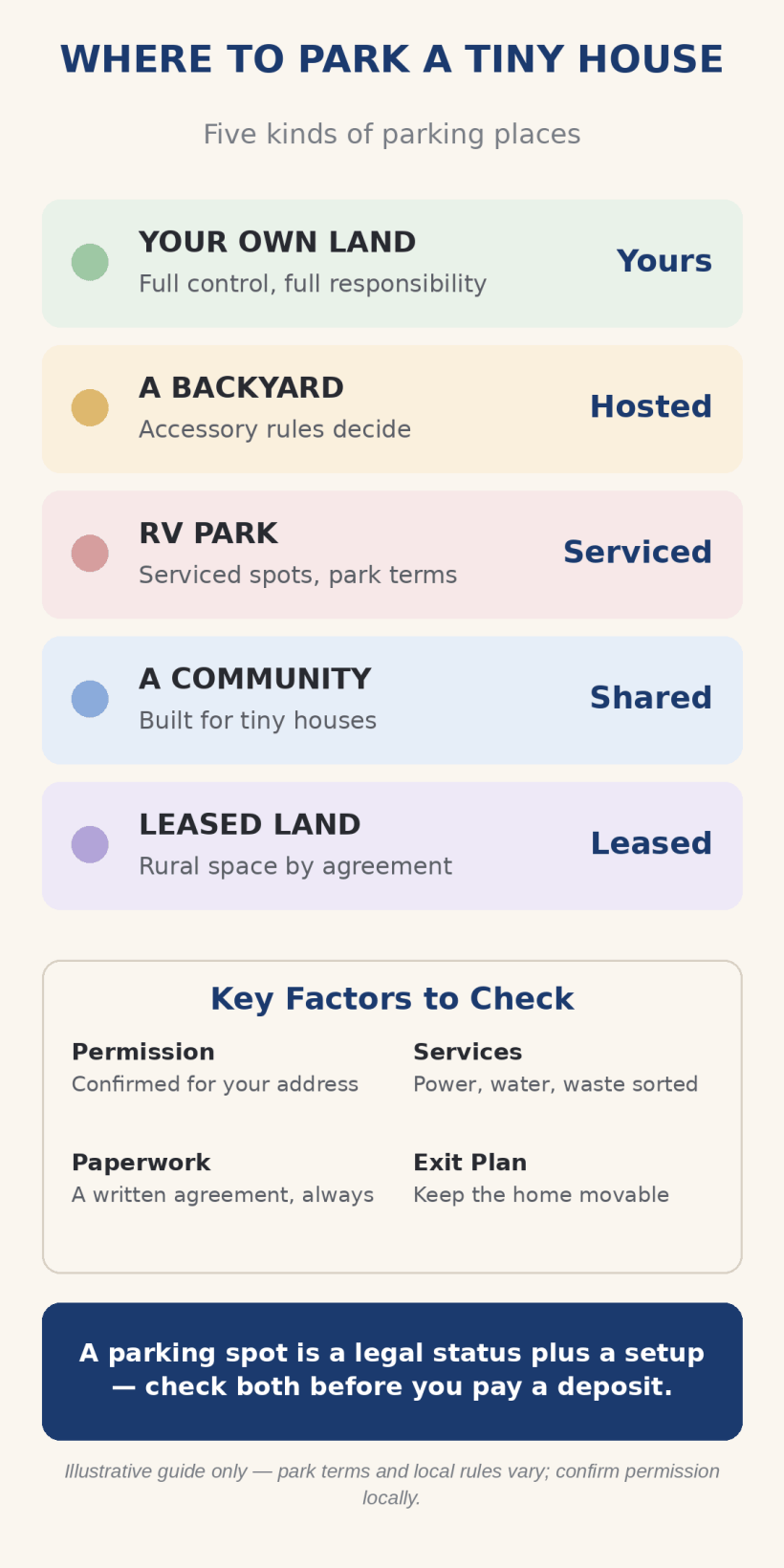
Nearly every legal parking arrangement falls into five kinds. You can park on land you own, in a backyard — your own or someone else’s — at an RV park or campground that accepts tiny houses, in a community built for them, or on leased land, often rural. Each kind trades money, freedom, security, and paperwork differently, and each is governed by a different mix of local rules and private terms.
Two decisions shape which kinds are even open to you. The first is your home’s classification: a house on wheels is treated by many officials and parks much like a recreational vehicle, while a house set on a foundation is treated like a small dwelling — and the parking rules follow that classification. The second is time: a spot that welcomes you for a month may not allow you to live there for a year. Decide how long you want to stay before you judge any option.
2. Parking on Your Own Land
Owning the land gives you the most control — and the most responsibility. Whether you may live in a tiny house on your own parcel is decided by local zoning and building rules, not by ownership alone. Some areas allow a tiny house as the main dwelling on a lot; others allow one only as an accessory dwelling beside an existing house; others restrict wheeled homes to approved parks regardless of who owns the land.
Before buying land for parking, confirm the exact parcel: permitted use, whether wheels change the answer, any minimum dwelling size, setbacks, and how water, sewer or septic, and power will be provided. If the answers work, owning your spot removes rent and park rules from your life — but adds site costs and maintenance. Our guide to where to buy tiny house lots covers finding land with parking in mind from the start.
One warning that applies to every kind of spot on this page: parking out of sight does not change the legal answer. People do park discreetly and hope not to be noticed — the “stealth” approach — but a complaint, a utility problem, or a change of neighbours can end it at any time, usually with short notice to move. If you rely on a spot for your home, rely on permission, not on nobody minding. That principle is what separates a parking spot from a gamble.
3. A Backyard: Yours, Family, or a Host’s
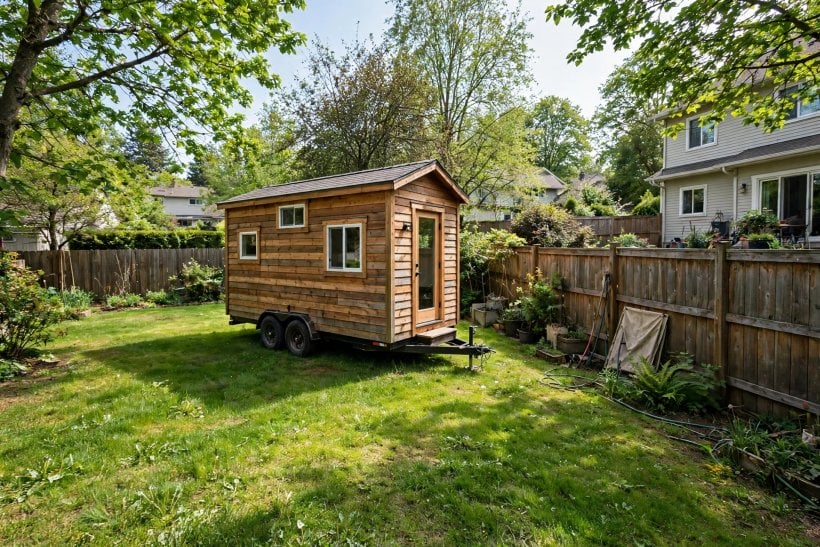
The backyard is the classic first parking spot. Where local rules allow an accessory dwelling, a tiny house behind an existing home can be entirely legal — sometimes as a permitted second unit, sometimes under guest-house or temporary provisions. Where the rules do not allow it, the same backyard is simply not a legal home site, whatever the homeowner says.
If you park in someone else’s backyard, treat it like the tenancy it is. Agree in writing how long you may stay, what you pay, how utilities are shared and metered, where you park and how you get in and out, and how much notice either side needs to end the arrangement. Family land feels informal until it is not; a short written agreement protects the relationship as much as the parking. Access matters day to day, too — think about mud in winter, getting the house in and out through gates, and where your car goes.
4. RV Parks and Campgrounds
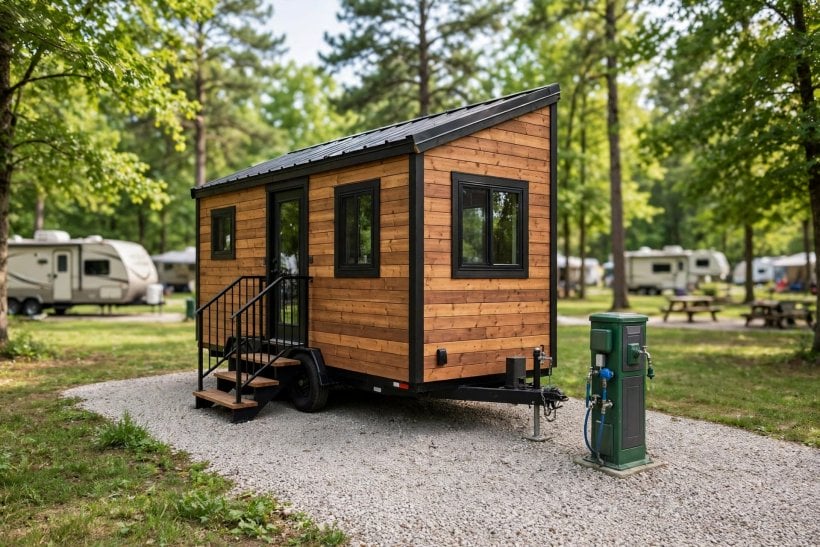
An RV park is the fastest route to a serviced spot: the pad, power, water, and waste connections are already there, and check-in is simple. The limits are in the park’s terms. Many parks cap how long a guest may stay, set standards for the age or appearance of homes, treat a tiny house under their RV rules only if it is certified or built like one, or reserve the right to move you on. A park that accepts tiny houses is not automatically a park that accepts full-time residents.
Ask directly: Do you accept tiny houses on wheels? What is the longest stay allowed, and can it be renewed? What does the rate include — which utilities, and are any metered? What are the rules on skirting, porches, and outdoor items? Getting clear answers before you arrive always beats negotiating from the driver’s seat. If park living appeals to you, our comparison of tiny house versus RV full-time living covers how the two lifestyles differ in practice.
5. Tiny House Communities
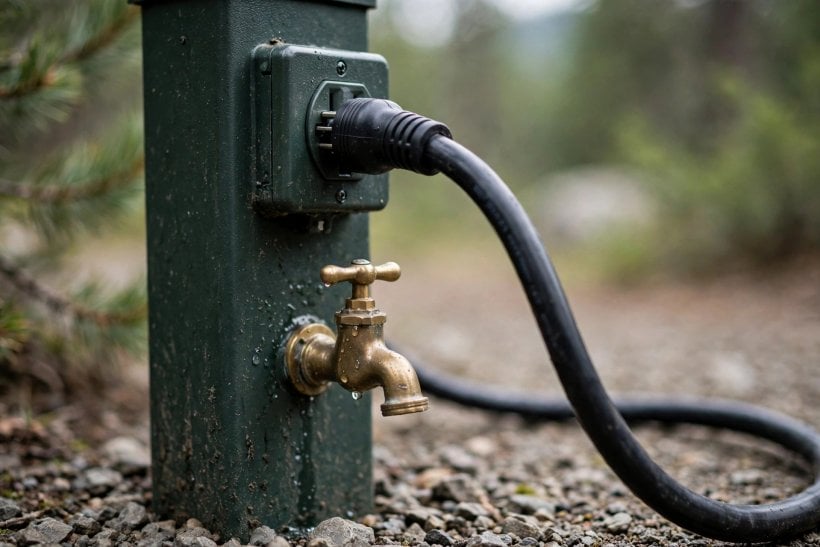
Communities built for tiny houses remove the guesswork: the spots are designed for these homes, the neighbours expect them, and the local permissions have usually been worked through by the community itself. In exchange you accept community rules, ongoing lot costs where they apply, and whatever wait or application process the community runs.
Communities come in different shapes — you might rent a lot in a community you do not own, share ownership of the land with other residents, or buy into a development of small cottages. Read the tenure documents as carefully as the brochure: what you own, what you rent, what you may be charged for, and what happens to your home if you leave. A community is a long-term arrangement, so visit, talk to residents, and stay a night or two if the community allows it before you commit.
Good communities can have waiting lists, and that is itself useful information: it tells you the spot is in demand and the arrangement works for the people living there. Join the list early if a community is your first choice, but keep a workable plan B running in parallel — a park stay or a leased spot — rather than putting your moving date at the mercy of a queue you do not control.
6. Leased Rural Land and Farm Stays
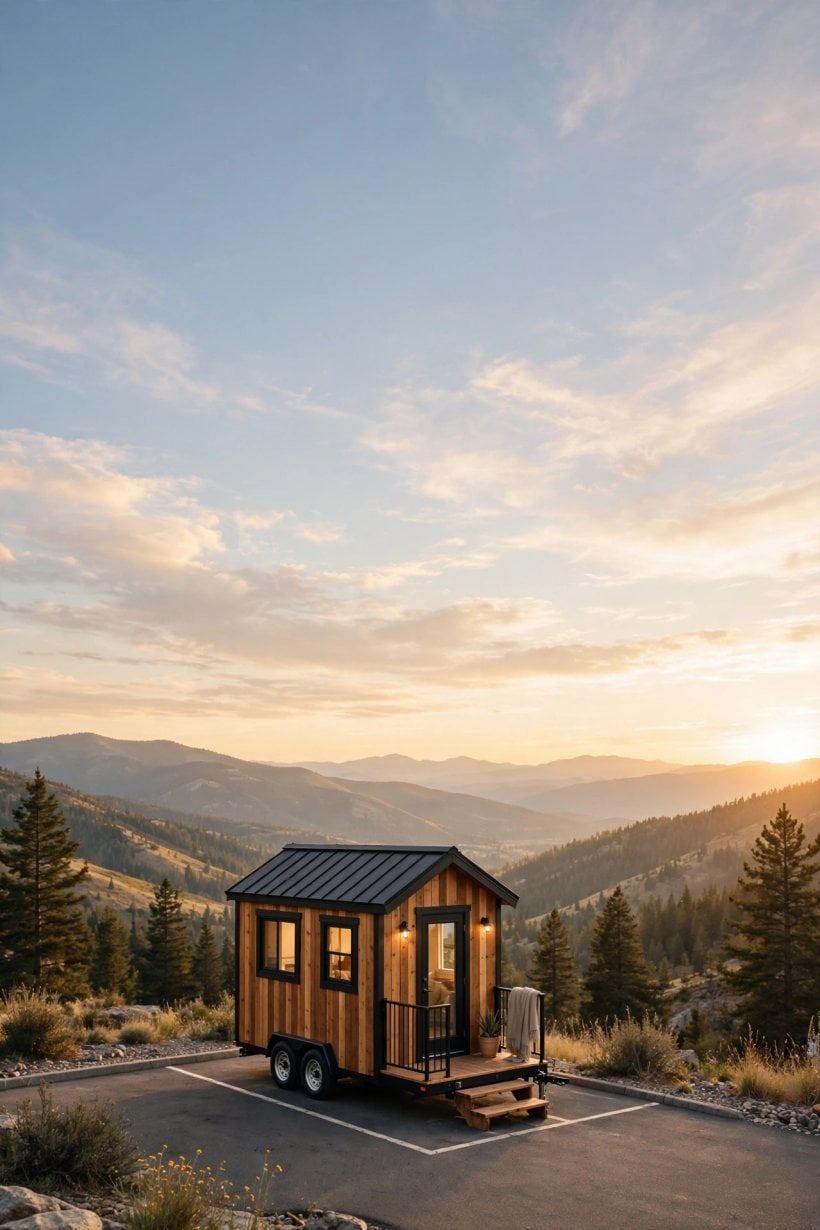
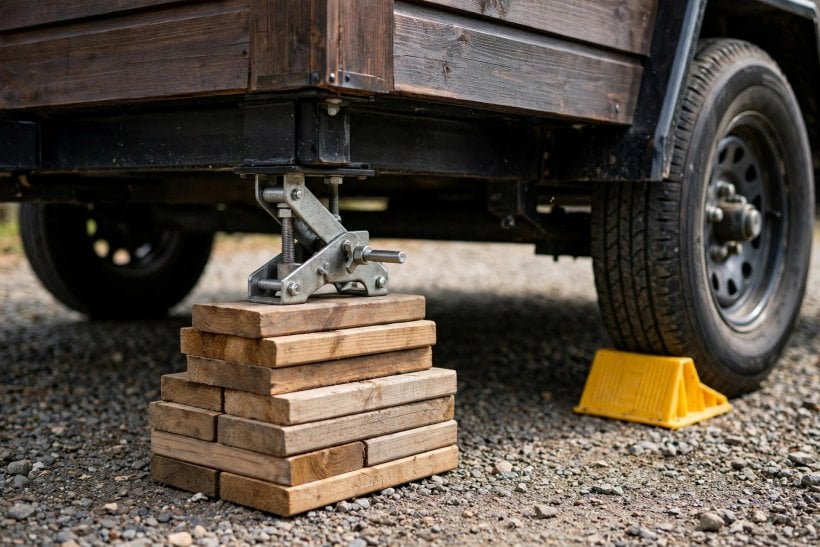
Outside town, landowners sometimes lease a corner of a field, farm, or large property for a tiny house. It can be peaceful, spacious, and simple — and it is the arrangement most often done on a handshake, which is exactly its risk. Rural does not mean rule-free: counties regulate dwellings too, and a lease on land where living is not permitted leaves you exposed however friendly the arrangement feels.
Before you settle, confirm the county’s position on a tiny house at that address, then put the lease in writing: the term, the rent and what it covers, how water and waste are handled, access for you and for a tow vehicle, and the notice period on both sides. Practical points matter as much as legal ones — a spot that floods, freezes its water line, or turns to deep mud in spring is a bad spot at any price.
Farm and rural stays often involve shared routines — gates, livestock, machinery, seasonal work — that a town spot never raises. Ask how deliveries and guests reach you, whether the access track is maintained year-round, and what happens around harvest or calving if the land is worked. None of this needs to be a problem; it simply needs to be agreed before your home is sitting in the middle of it.
7. The Checks to Run Before You Commit Anywhere
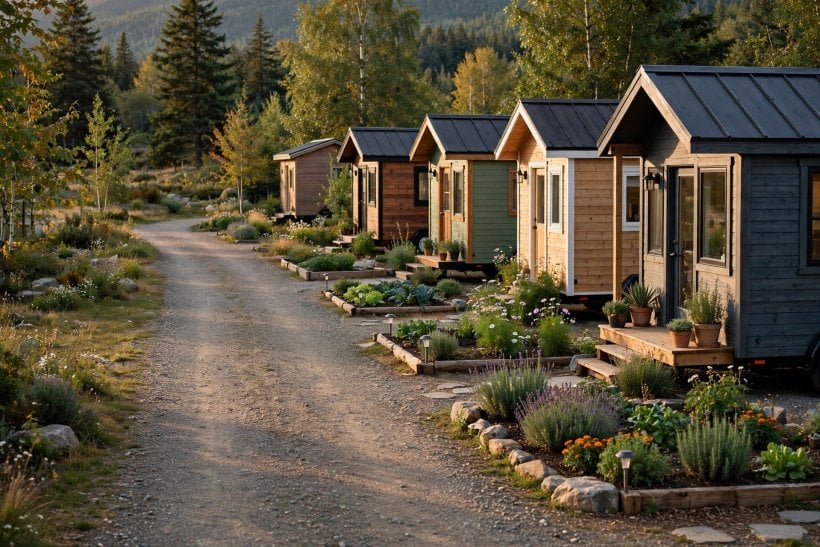
Whatever kind of spot you choose, three checks protect you. First, permission: confirm with the local zoning or planning office that a tiny house may be lived in at that address, in your home’s classification — our guide to where you can place a tiny house walks through the placement rules in more depth, and tiny house laws by state gives the wider picture. Second, services: how power, water, and waste will actually work at that spot, in winter as well as summer. Third, paper: a lease, park agreement, or community contract that says what you agreed, in writing.
Talking to the officials who enforce the rules is not a risk — it is the cheapest insurance in tiny house living. Our guide to zoning laws and talking to officials explains how to ask so you get an answer you can rely on. A verbal yes from a seller, a park host, or a landowner is a lead to verify, never the verification itself.
8. Setting Up Properly Once You Arrive
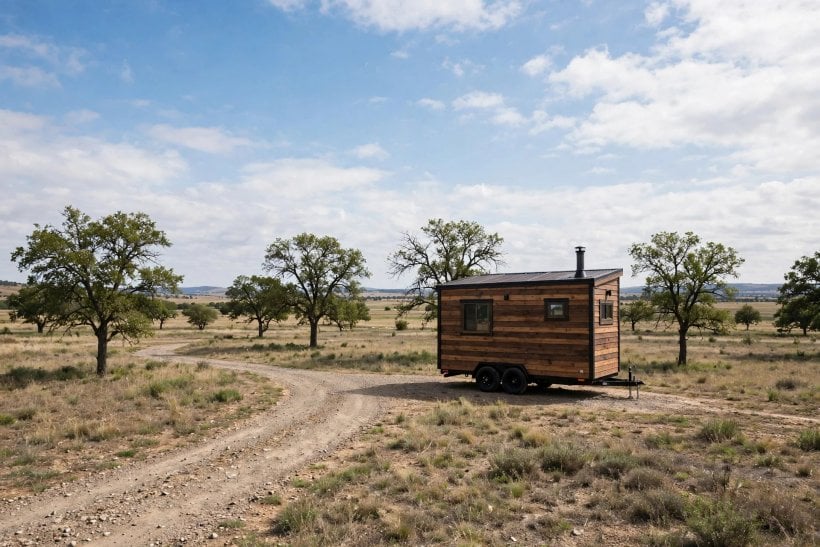
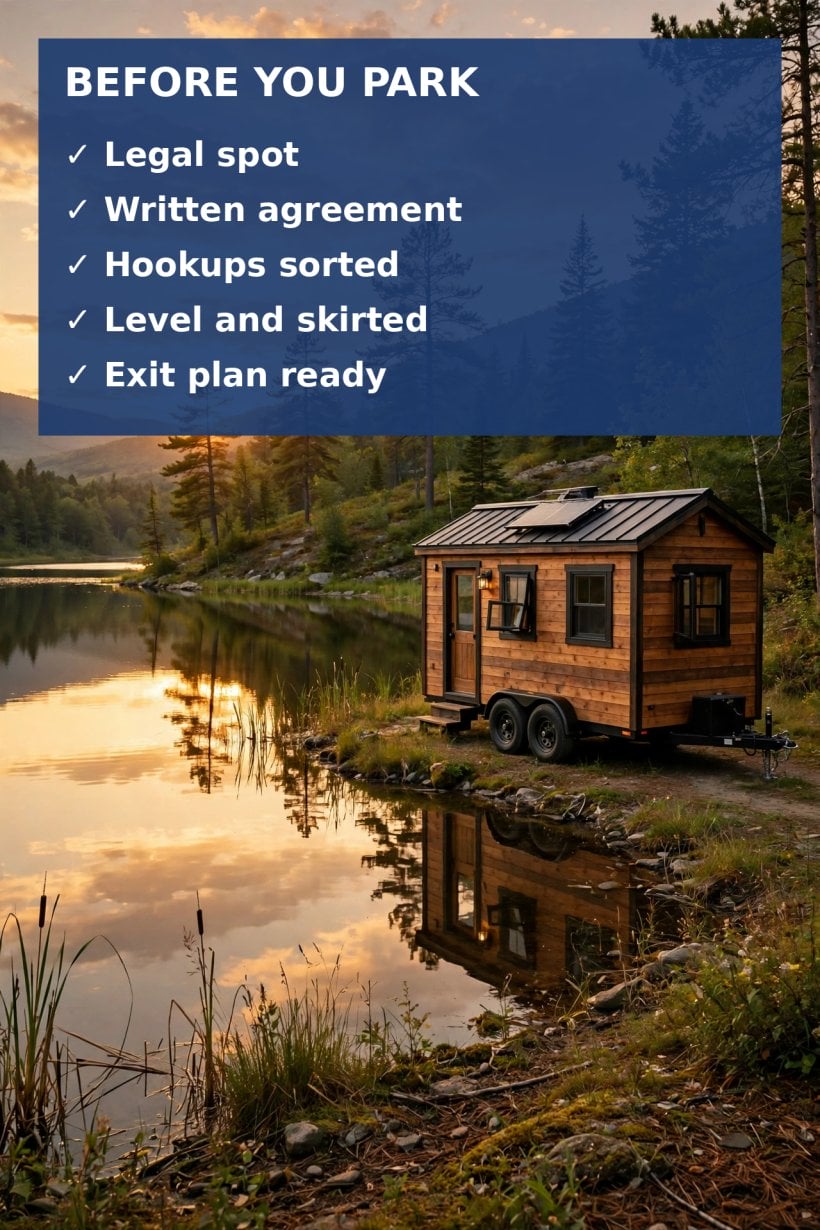
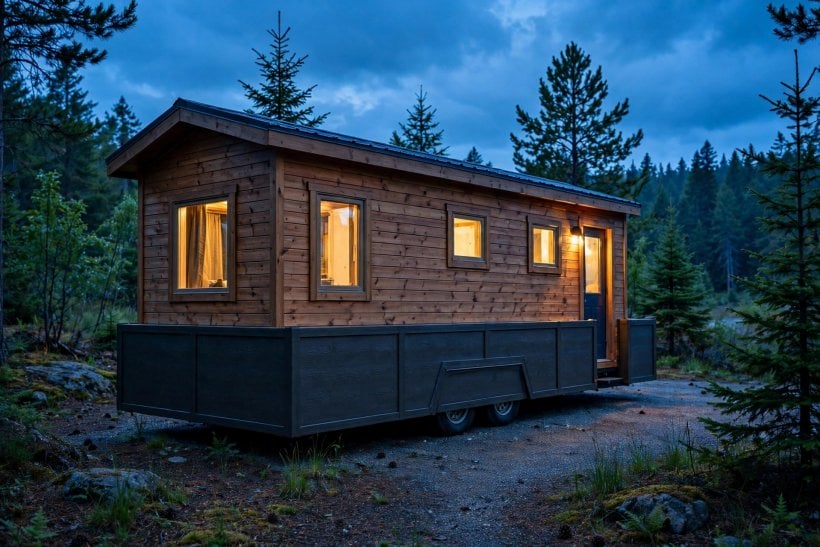
A good parking job is unglamorous: the house level and stable, wheels chocked, stabilisers down, and the underside closed in with skirting where the climate or the park requires it. Level matters more than it looks — doors, drains, and appliances all assume it. Connect utilities properly rather than improvising: a drinking-water-safe hose for water, a sealed waste connection, and electrical hookup matched to the home’s supply. Shortcuts here cause the smells, leaks, and trips that give tiny houses a bad name with hosts and neighbours.
Think about the seasons before they arrive. Freeze protection for exposed pipes, shade or airflow in summer heat, drainage so storm water runs away from the base, and a plan for emptying tanks or servicing a composting toilet. Our guide to how to prepare land for a tiny house covers pad, access, and connections step by step if you are setting up on raw land rather than a serviced spot.
9. What Parking Costs, and Finding a Spot Near You
Parking costs vary too much by place and arrangement for any single figure to mean anything — which is why this guide does not print one. What you pay for is some combination of lot rent or a land payment, utility charges (sometimes included, sometimes metered), deposits, and one-off setup costs like a pad, connections, or skirting. A serviced park spot, a community lot, and a field lease price those pieces very differently. Compare spots on the full monthly picture, including what utilities and services are actually covered, not on the headline rent.
To find a spot near you, work outward: search for tiny house communities and RV parks that accept tiny houses in your area, ask local tiny house and RV groups where members park, talk to builders — they hear about spots constantly — and approach landowners with land that suits. If you would rather rent the whole arrangement, start with where you can rent a tiny house to see the rental routes. Always view a spot in person, run the three checks from section 7, and never pay a deposit on a spot that cannot show you its permission to host you.
Search differently depending on your horizon. For a short stay, availability and hookups are the whole question, and parks answer it fastest. For a long stay, the search is closer to house-hunting: allow weeks rather than days, view several spots, compare the paperwork as much as the view, and be ready to explain your home, your setup, and how you will keep the spot tidy — hosts and communities choose residents, and a prepared applicant is an easy yes.
10. Frequently Asked Questions
Can I move my tiny house between parking spots?
Yes — mobility is the point of a house on wheels. Each new spot needs the same checks as the first: permission at that address, suitable access for the move, and services when you arrive. Factor the cost and effort of each move — towing, setup, reconnection — into how often you realistically want to relocate.
What if my parking spot falls through?
Protect yourself before it happens: keep a written agreement with a fair notice period, know your fallback options locally, and keep the home genuinely movable — connections you can undo, nothing built-in that ties you to the spot. If a spot ends suddenly, RV parks that accept short stays are the usual bridge while you find the next place.
How do I find tiny house parking near me?
Search for communities and tiny-friendly RV parks first, then local owner groups, builders, and direct approaches to landowners. Section 9 sets out the full method. Verify before you pay: permission, services, and a written agreement.
Can I park a tiny house long-term in one place?
Yes, where the rules and the arrangement allow it — your own land with the right permissions, a community lot, or a park that permits long stays. Long-term parking is a status question, not a parking question: confirm that living there full-time is permitted, not merely tolerated, and that your agreement actually runs for the term you need. Where a park or host allows long stays only month to month, you can still settle — just keep your exit plan and fallback options current rather than assuming renewal.
What is the cheapest place to park a tiny house?
Usually land you already have access to — your own parcel or a family backyard — provided living there is legal. The cheapest spot is the one that is permitted, serviced, and secure; an inexpensive spot that ends in a forced move is the most expensive kind there is.
Final Considerations
Good parking is a legal status plus a practical setup: a spot where your home’s classification is permitted, services that work in every season, a written agreement, and a level, well-connected setup. Choose the kind of spot that fits how long you want to stay and how much control you want, run the permission-services-paper checks every single time, and keep the home genuinely movable even when you plan to stay put for years. Rules, park terms, and availability change, so verify the current position with local officials and the spot’s owner before you commit. This guide is general information only, not legal advice.

4 Comments