
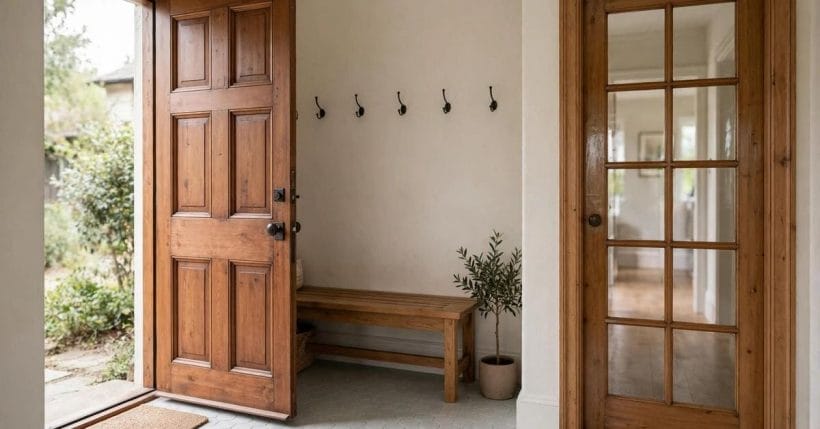
A front vestibule is the small room that greets you the moment the front door closes behind you. It is not a hallway and it is not a porch. It is an enclosed chamber at the front entrance, with the outer front door at one end and an inner door at the other, and its whole job is to make arriving home easier: coats off, boots off, wet weather stopped, and the rest of the house kept warm, quiet and clean.
Every idea in this guide stays inside that front-door chamber. Layouts, doors, storage, light and weather handling are all considered from the point of view of someone standing at the front entrance, coming in from the street. Nothing here wanders into back entries, mudrooms or general entry rooms, because the front vestibule has its own demands: it must welcome guests, survive the worst weather, and still feel like part of the home rather than a draughty box.
1. Front Vestibule Ideas at a Glance
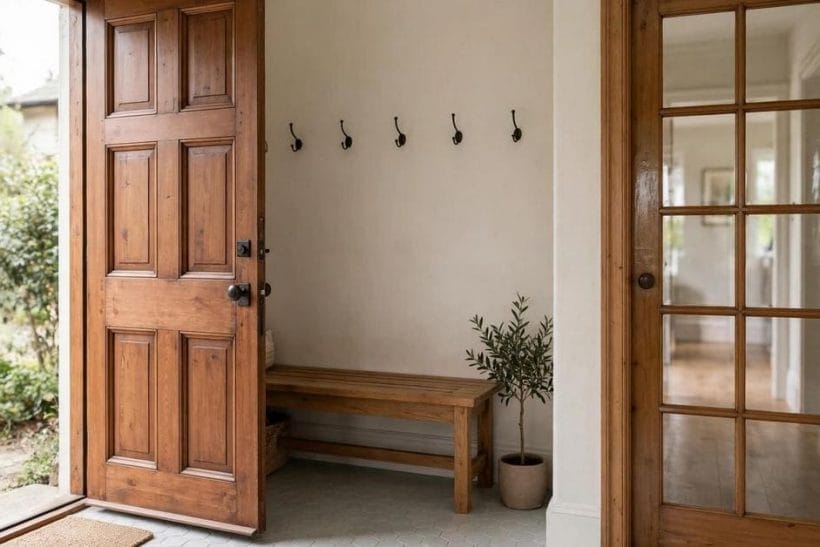
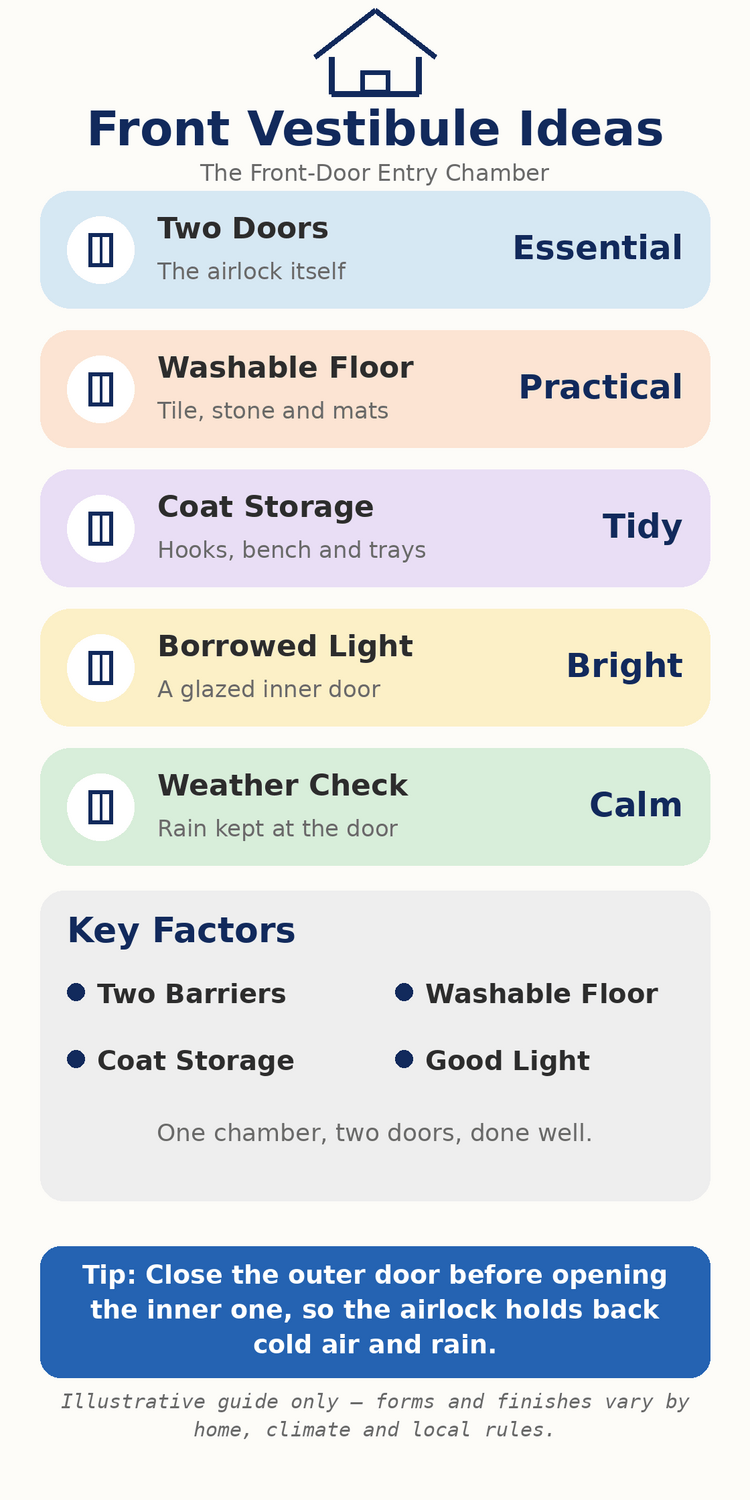
A front vestibule works as a small system, and each part earns its place by doing one job well. Two doors working as an airlock hold back cold air and noise. A floor that forgives wet shoes keeps the rest of the house clean. Somewhere to sit, somewhere to hang a coat, and light borrowed from the hall turn a bare passage into a room worth pausing in. When one of those parts is missing, the chamber feels unfinished; when all of them are present, even a modest front entry feels considered and calm.
The five families below sort front vestibules by character, so you can spot the kind that suits your front door before worrying about finishes.
| Family | Character | What it means |
|---|---|---|
| Double-Door Airlock | Two doors, one draught stopped | Sealed |
| Glazed Inner Doors | Light borrowed, hall kept private | Bright |
| Bench and Hooks | Sit, hang and go in one place | Ordered |
| Tiled Chambers | Hard floor that shrugs off wet | Practical |
| Warm Front Rooms | Lamp light and deep colour | Welcoming |
Scope, so the lanes stay clear. The general vestibule topic is owned by the earlier article vestibule ideas, which introduces the entry airlock in twelve ideas; this post is its front-entry companion and stays strictly at the front door, covering only the chamber a visitor meets on arrival. The fuller general-chamber treatment, 75 Vestibule Ideas, covers the same room in its wider forms and is a separate sibling, not repeated here. An open entry area with no inner door is a different subject again, covered in small entryway ideas. If your front entry has no second door, that is the guide to reach for; if it has two doors and sits at the front of the house, you are in the right place.
The sections below walk the chamber the way an arrival uses it: layout and the airlock first, then glazed doors and light, floors, benches and hooks, colour, draughts and warmth, mirrors and welcome, tiny shapes, and finally choosing, costs in general terms, and care.
2. Layouts and the Double-Door Airlock at the Front Door
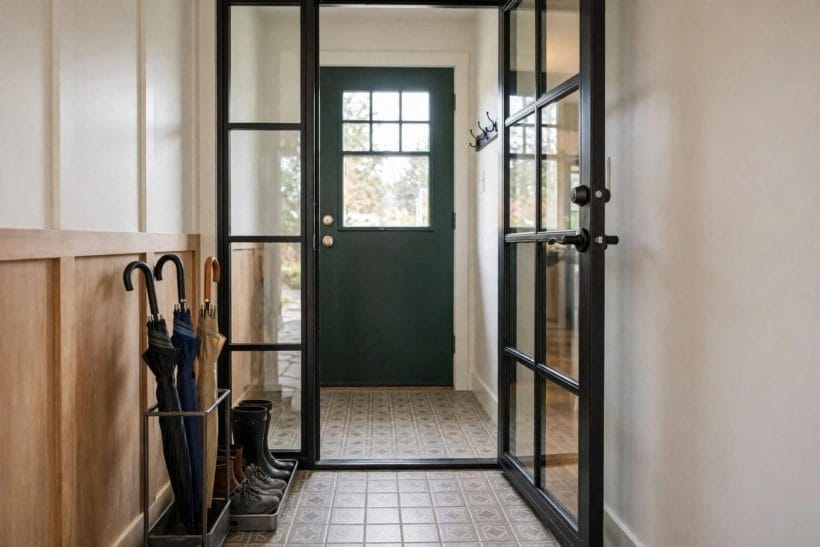
The front vestibule is defined by its two doors, and layout begins with the space between them. The outer door meets the street, the path and the weather; the inner door meets the hall and the life of the house. Between them there must be room to step inside, close the outer door, turn around, take off a coat and put down a bag, all without backing into the street or blocking the inner door. That turning and settling space is the real measure of a front vestibule layout, far more than its floor area alone.
Doors set directly opposite each other give the simplest airlock: walk in, close one door, open the other. The line is short and the draught path is easy to understand, which suits narrow front entries and older houses where the front door opens straight into a small lobby. Doors set at an angle, with the inner door on a side wall, suit wider chambers and give wall space for a bench or hooks where a straight-through layout would leave none. Either arrangement works, provided the swing of each door is planned: a door that sweeps across the bench, the boot tray or the only standing space will annoy its owners every single day.
Think about the approach outside, too. The porch or step that leads to the front door sets the tone for the chamber inside, and the covered approach in tiny house porch ideas shows how a small roofed landing can shelter the outer door and keep rain from blowing straight into the vestibule when the door opens. Inside, a clear threshold line helps: a change of floor, a mat well, or a strip of tile at the outer door tells everyone, guest and family alike, where outdoor shoes stop and the house begins.
For households with pushchairs, wheelchairs or large parcels, the airlock needs a different test. Can a person enter, close the outer door, and still have room to manoeuvre before opening the inner one? If the answer is no, the chamber is a passage, not a vestibule, and storage should be kept to one wall only so the turning space stays genuinely usable. A front vestibule that cannot be used one door at a time is not doing its main job.
3. Glazed Inner Doors and Borrowed Light
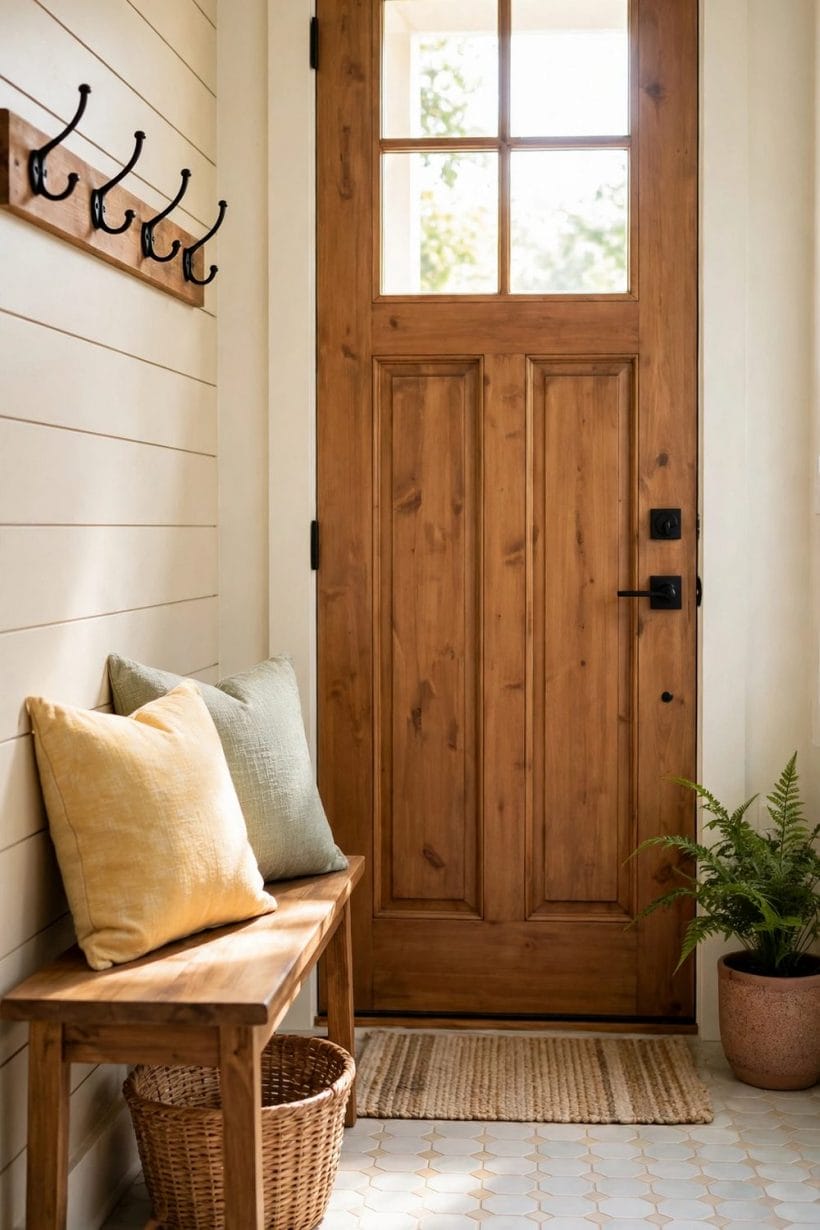
A front vestibule with a solid inner door can feel like a cupboard, especially in a small house where the chamber has no window of its own. Glazing changes that completely. A glazed inner door borrows daylight and lamplight from the hall, so the vestibule feels bright even when the outer door is closed, and it lets a person inside see a silhouette at the front door without opening up the whole house. Frosted, reeded or small-paned glass keeps privacy while still passing light, which matters when the hall beyond is a living space rather than a corridor.
Choose the glazing for the hall you actually have. Clear glass suits a hallway that is tidy and well lit, and it makes the vestibule feel like an extension of the home rather than a separate cell. Obscured glass suits a busy family hall, a stairwell, or any home where the vestibule opens directly onto a room you would rather not display to every caller. Small panes with glazing bars suit period houses and break up reflections, while a single large pane suits plainer, more modern front entries. The frame matters as much as the glass: a painted inner door reads calm and quiet, while a timber door with visible grain warms a plain chamber.
Light can also be borrowed from above and from the sides. A fanlight over the inner door, a narrow sidelight beside the outer door, or a borrowed-light panel high in the wall all feed daylight into a chamber that would otherwise depend on a single bulb. Where none of those is possible, a well-placed ceiling light and a pale ceiling do much of the same work. The aim is a vestibule that never feels like a dark box between two closed doors, because a dark chamber is one people hurry through rather than use properly.
One caution: glazing in the inner door must still close firmly and seal well, or the airlock fails. Check the fit, the hinges and the latch before admiring the light. A beautiful glazed door that whistles in a wind is worse than a plain solid door that shuts tight, and draught-stripping is covered properly in the section on seals later in this guide.
4. Floors, Mats and Wet-Weather Handling
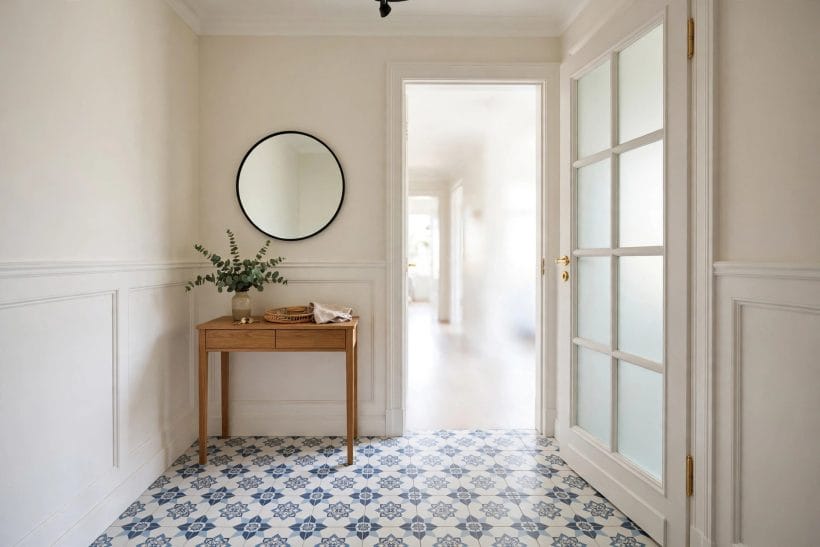
No part of the front vestibule works harder than its floor. It takes wet boots, muddy paws, gritty shoes, dripping umbrellas and the daily traffic of an entire household, and it must do so without staining, swelling or sending dirt onward into the hall. Tile and stone are the natural choices: they wipe clean, they shrug off water, and they can be mopped without worrying about the finish. Patterned tile adds character and hides the odd mark between cleans, while plain stone or large-format tile keeps a small chamber feeling calm rather than busy.
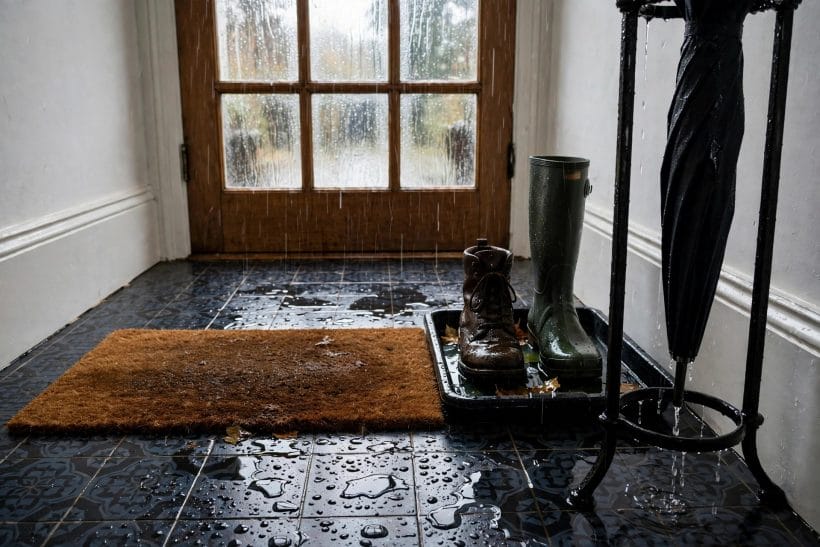
Think of the floor as a system, not a single surface. A mat at the outer door catches the worst of the grit; a boot tray beside it holds wet footwear; the hard floor beneath handles whatever gets past both. Coir mats scrape well and suit covered front doors, while rubber-backed mats stay put on tile and are easy to shake out. Two mats in rotation, one in use and one drying or being cleaned, keep the system working through wet weeks when a single sodden mat would simply spread damp around.
Drainage and drying deserve a thought in the wettest climates. A floor that stays damp grows musty, and a mat that never dries smells. Ventilation helps enormously: an inner door left ajar when the house is occupied, a trickle vent, or simply a vestibule that warms with the rest of the house will dry faster than a sealed cold box. Boot trays with raised ridges keep soles out of standing water, and a drip tray under the umbrella stand protects the floor where wet umbrellas gather.
Timber floors can work in a front vestibule, but they need the wet zone handled honestly. A tiled or stone landing at the outer door, with timber beyond it, gives the look of wood without asking it to survive puddles. Whatever the surface, keep the threshold detail simple and level enough to step over comfortably: a high lip trips visitors, while a flush or gently ramped threshold welcomes everyone and still keeps the weather line clear.
5. Benches, Hooks and Front-Door Storage
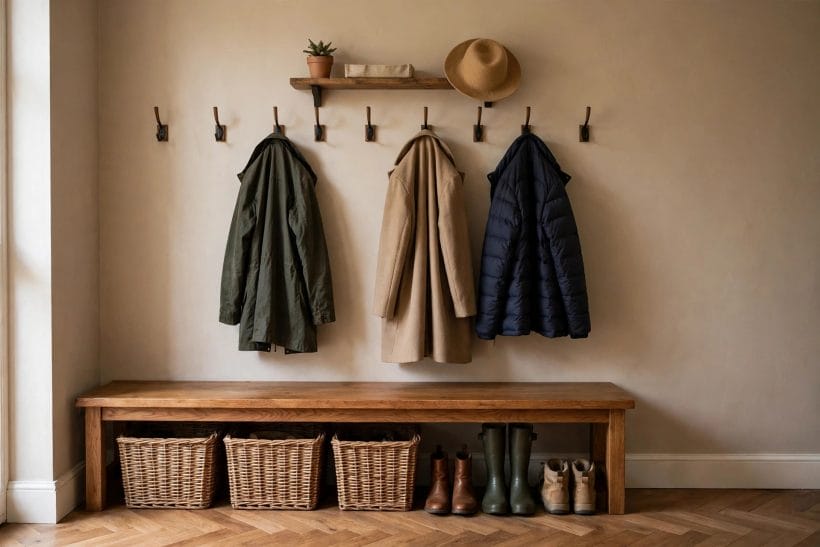
Storage is what turns a front vestibule from a passage into a working room. Without it, coats pile on the stair rail, boots colonise the hall, and every arrival becomes a small negotiation. With it, the chamber quietly absorbs the clutter of coming and going, and the rest of the house stays clear. The essentials are few: somewhere to sit while putting on shoes, somewhere to hang coats, somewhere for boots and shoes, and a small place for keys, post and the things that leave the house with you.
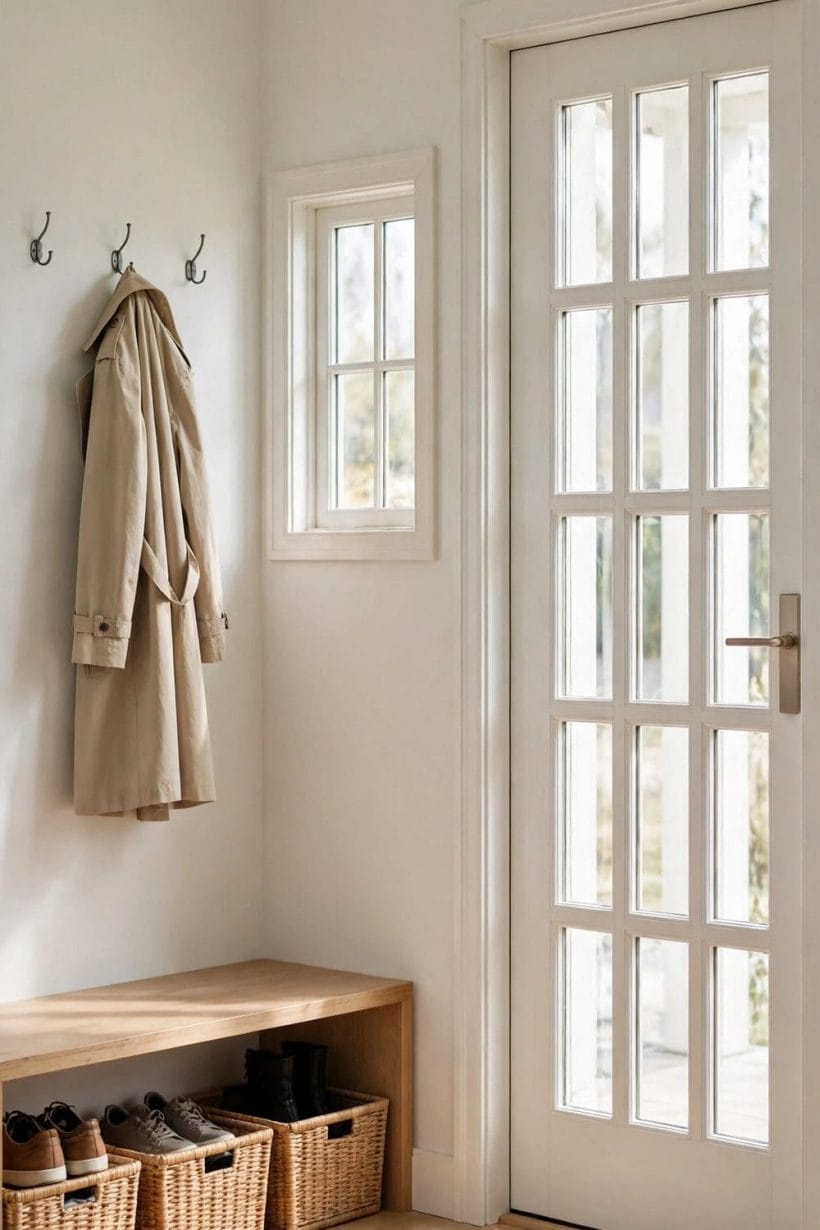
A bench is the single most useful piece in a front vestibule. It gives children and older visitors somewhere to sit, it tops a shoe store, and it anchors the wall so the chamber reads as a room rather than a corridor. A bench with open baskets below keeps shoes visible and ventilated, while a bench with closed cupboards hides the same shoes and suits a more formal front entry. Height matters: a bench too high is awkward to sit on, and one too low is hard to rise from, so test the sitting height against the people who will actually use it, not against a catalogue picture.
Hooks should be planned by household, not by wall length. One hook per regular user, plus two for guests, is a practical starting point, and hooks at two heights serve children as well as adults. A rail of hooks above the bench keeps coats within reach of the seat, while a separate row near the outer door serves visitors who will not venture further in. Pegs with a rounded end hold coats without stretching them, and a small shelf above the hooks takes hats, gloves and scarves that would otherwise drift onto every flat surface in the house.
Small storage completes the system. A dish or tray for keys, a hook or clip for the dog lead, a basket for post, and a lidded box for the odds and ends that arrive with the shopping all prevent the bench from becoming a dumping ground. Keep the count of containers low: three or four well-chosen baskets beat a dozen small boxes that nobody can remember. And leave one stretch of wall deliberately empty, so the chamber has breathing room and a place for a mirror, a picture, or simply a calm painted surface.
6. Colour, Paint and Small-Chamber Finishes
Colour in a front vestibule does more work than in most rooms, because the chamber is small, seen briefly, and judged instantly by visitors. A colour that feels rich in a large room can feel oppressive in a tiny entry, while a colour that feels bland elsewhere can feel clean and welcoming here. The safest approach is to decide what the vestibule should do to a visitor: calm them, impress them, or simply get out of the way, and then choose colour to serve that purpose.
Pale, warm neutrals make a small front vestibule feel larger and brighter, and they bounce what little light the chamber receives. They also show scuffs and fingerprints sooner, so choose a washable finish and accept that the walls near the door will need touching up more often than the rest of the house. Mid-tone colours, soft greens, warm greys and dusty blues, hide wear better and still keep the chamber light, especially with a pale ceiling and a glazed inner door. Deep colours, dark green, navy or charcoal, can be striking in a front vestibule with good light and a lamp, turning a small chamber into a jewel box; in a dark, windowless chamber they can feel like a cave, so reserve them for entries with borrowed light or a generous ceiling light.
Continuity with the rooms beyond matters, because the inner door will often stand open. A vestibule colour that clashes with the hall or the first living room makes the whole entrance feel disjointed, while a colour picked up from a neighbouring room, even as an accent on one wall, ties the entry to the house. The same thinking shapes colour choices in small living room ideas, where a small space must feel connected to the rooms around it rather than cut off from them. Paint the inside of the outer door to match the vestibule rather than the exterior, so the chamber reads as one room when the door is closed.
Finishes should be chosen for cleaning as much as for looks. Eggshell or satin paint wipes down after muddy hands and wet coats, while flat matt marks easily at exactly the height where bags and shoulders brush past. Washable paint on the lower walls, or a painted dado that takes the knocks, keeps the chamber looking cared for between redecorations. Skirting boards in a hard-wearing finish, and door frames painted to match, complete a chamber that can be cleaned quickly and still look intentional.
7. Draughts, Warmth and the Front-Door Seal
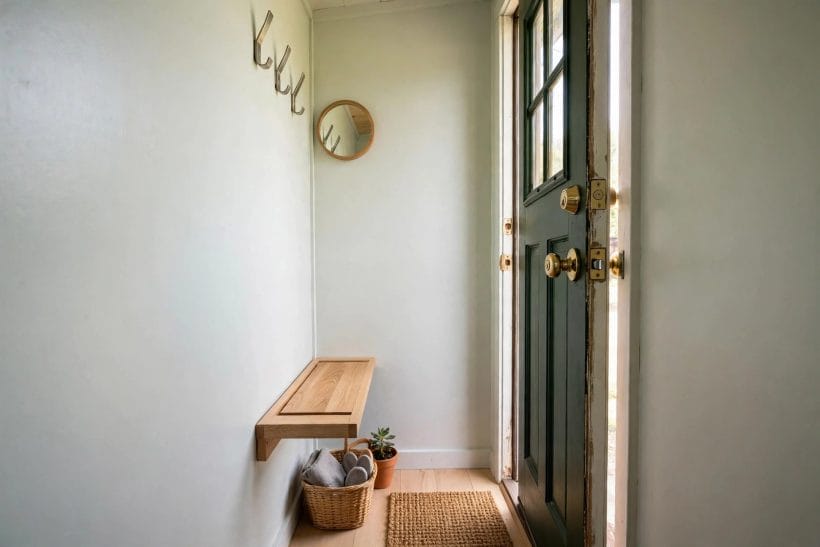
The front vestibule is, at heart, a draught device. Its two doors exist so that one is always closed while the other opens, and the chamber between them traps the cold air that would otherwise rush straight into the hall. That only works if both doors seal properly. A front door that lets daylight show around its edges is also letting in cold air, noise and dust, and no amount of decoration inside the chamber will fix it.
Start with the outer door. Check the hinges, the latch and the frame for movement, and fit draught-stripping that compresses evenly when the door closes. A threshold strip or drop seal closes the gap at the bottom, where most draughts creep in, and a letterbox brush stops the thin whistle that a bare letterbox can produce on a windy night. The inner door deserves the same attention: its seal is what keeps the trapped cold air in the chamber rather than letting it drift into the house, and a well-fitted inner door also cuts the noise of the street, the stairs and the hall.
Warmth in the vestibule itself is a judgement call. A chamber that is freezing will never be used properly: coats stay damp, boots stay wet, and everyone hurries through with the inner door open, defeating the airlock. A small radiator, a heated towel-style rail, or simply a share of the hall heating through an ajar inner door keeps the chamber dry and usable. Avoid heating the vestibule to living-room warmth, which wastes energy on a room nobody sits in; aim for dry and temperate, warm enough that coats dry and boots do not freeze to the tray, and no warmer.
Test the airlock as a household, not as a theory. Stand in the chamber, close the outer door, and feel whether the inner door still pulls or whistles. Open the outer door on a windy day and watch whether papers on the hall table stir. If they do, a seal has failed somewhere, and finding it is cheaper and more effective than any amount of extra heating. The vestibule earns its keep silently, one closed door at a time.
8. Light, Mirrors and the Front-Door Welcome
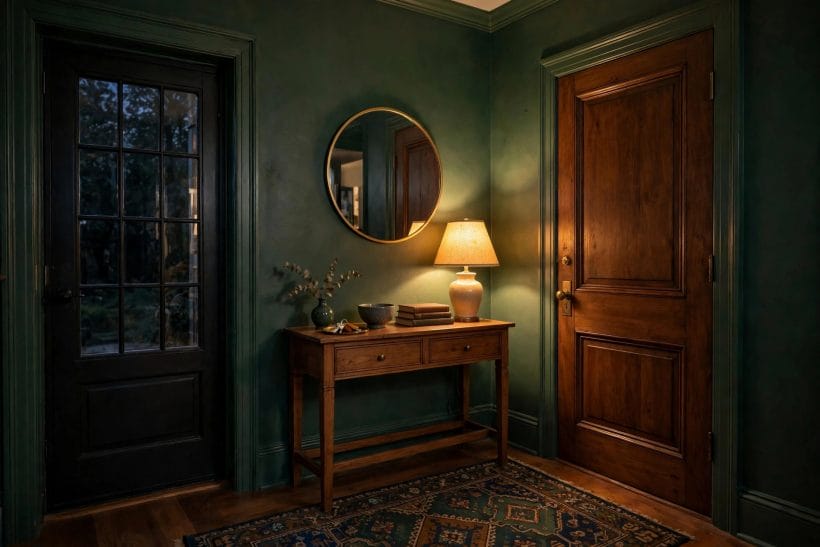
A front vestibule is the first room a visitor sees and the last room a householder sees when leaving, so its light and its welcome matter out of proportion to its size. A single bare bulb in the middle of the ceiling flattens everything and makes the chamber feel institutional. Layered light, a ceiling light for general brightness plus a small lamp or wall light for warmth, makes the same chamber feel like a home. A lamp on a console, switched on in the evening, turns the vestibule into a beacon that says someone is home, which is both welcoming and reassuring.
Mirrors are the front vestibule’s best friend. A mirror above the bench or console lets a person check their coat and hair before stepping out, it doubles the sense of space, and it bounces light from the glazed inner door or a lamp deeper into the chamber. Hang the mirror where it catches something pleasant, the light from the hall or a picture on the opposite wall, rather than where it reflects the back of the outer door or a cluttered hook rail. A round mirror softens a chamber full of straight lines, while a tall rectangular mirror suits a narrow entry and helps with a last full-length check.
Small welcome details complete the room without cluttering it. A vase of fresh stems on the console, a framed picture at eye level, a runner rug over the hard floor for softness underfoot, and a bowl for keys all signal care. Keep the count low: a vestibule crowded with ornaments becomes an obstacle course, and every object in it must survive being brushed by coats, bags and umbrellas. Choose things that can be wiped, that will not shatter if knocked, and that look good in the half-light of an evening arrival.
Scent and sound belong in the welcome too, though they are easy to overlook. A chamber that smells of damp coats or stale shoes undoes the prettiest decoration, so ventilation, dry mats and clean trays matter more than any diffuser. A draught-free chamber is also a quieter one, and the hush of a well-sealed vestibule, after the noise of the street, is itself a welcome: the house has closed its doors, and the day outside is over.
9. Tiny Front Vestibules and Awkward Front Entries
Not every house can spare a generous chamber at its front door. Tiny houses, flats, terraces and older cottages often offer only a shallow lobby, a corner by the stairs, or a passage barely wider than the door itself. The front vestibule idea still applies, but it must be fitted to the space rather than imposed on it. A wall-mounted folding bench, hooks instead of a coat cupboard, and a single boot tray rather than a full storage wall can give a tiny front entry the same working system as a large one, scaled down honestly.
In a tiny chamber, every centimetre must do double duty. A mirror doubles light and space; a bench lid lifts to reveal shoe storage; a shelf above the hooks holds hats and also carries a small lamp; a glazed inner door borrows light so no floor area is spent on a window. The discipline of small rooms is well covered in tiny bedroom ideas, where storage must be fitted to the wall rather than freestanding, and the same rule holds here: in a tiny vestibule, furniture that stands in the middle of the floor is an obstacle, while furniture fixed to the wall leaves the turning space clear. Compact living rooms teach the same lesson in tiny living room ideas, where a room works because each piece earns its footprint, and a tiny front entry should be judged by exactly that standard.
Awkward shapes need their own answers. A vestibule under the stairs can take low shoe drawers and high hooks, using the slope rather than fighting it. A long narrow entry suits a slim console and a runner, with storage on one wall only so the passage stays passable. A chamber with a door that opens awkwardly can be eased by rehanging the inner door to swing the other way, or by replacing a solid inner door with a sliding or glazed door that needs no swing space at all. None of these changes requires rebuilding the house; they require looking at the awkwardness honestly and fitting the answer to it.
When space is truly minimal, protect the airlock above all else. A tiny chamber with two working doors still stops draughts, still traps mud, and still gives a place to pause, even if that place is only a single hook and a small mat. A larger entry with only one door, however pretty, is not a vestibule at all. Keep the two doors, keep the floor washable, and let everything else shrink to fit.
10. Choosing, Costs in General Terms and Care
Choosing a front vestibule scheme starts with the door, not the decoration. Confirm that both doors close and seal, that the floor can be mopped, and that there is somewhere to sit and somewhere to hang a coat. Those four decisions carry the whole room. Everything after them, colour, mirrors, lamps, baskets, is refinement, and it can be added gradually without disturbing the working system. A scheme chosen in that order rarely disappoints, because it is built on use rather than on a picture.
Costs, in general terms, follow the same order. The most worthwhile spending goes on the doors and their seals, the floor, and the bench, because those are the parts that work hardest and last longest. Decorative spending, paint, mirrors, lamps and baskets, can be modest and still transform the chamber, and it can be spread over time as the household learns how it actually uses the entry. Reusing what the house already has, an old bench repainted, a mirror moved from another room, hooks already in a drawer, keeps the project gentle on the budget while the working parts are put right. Durable, wipe-clean surfaces of the kind used in kitchens, as seen in kitchen ideas, are a sensible guide here: a finish that survives daily cooking and cleaning will usually survive a front entry too, and choosing it once avoids replacing a prettier but fragile finish later.
Care is mostly routine, and routine is what keeps a vestibule welcoming rather than worn. Shake out mats regularly, empty boot trays before they overflow, wipe the floor after wet weather, and touch up paint where bags scuff it. Check door seals when the seasons change, because stripping compresses and frames move, and a seal that worked through summer may whistle by winter. A few minutes of care each week keeps the chamber doing its quiet job, and a deeper clean and a fresh coat of paint every few years renews it completely.
Finally, judge the finished chamber by using it, not by photographing it. Come in with wet boots and shopping bags, send a guest in with a coat and an umbrella, leave through it on a dark morning. If coats find hooks, boots find trays, cold air stays outside, and the hall beyond stays clean and warm, the front vestibule is doing everything it was built to do.
Final Considerations
A front vestibule is a small room with an outsized effect on daily life. It stands at the boundary between the street and the home, and it decides, several times a day, how much of the outside world comes in with you. Two doors, a washable floor, a bench, hooks, borrowed light and a good seal are not grand gestures, but together they make arriving home calmer, warmer and tidier, and they make leaving home smoother too.
Keep this post’s boundary in mind when planning. It covers only the front-door entry chamber. For the wider story of the entry airlock, return to the earlier vestibule guide linked at the start of this article, and for an open entry with no inner door, see the small entryway guide linked earlier. Within its own lane, though, the front vestibule repays careful thought many times over: it is the first room you meet, the last room you leave, and the room that quietly keeps the rest of the house clean, warm and calm.


0 Comments