
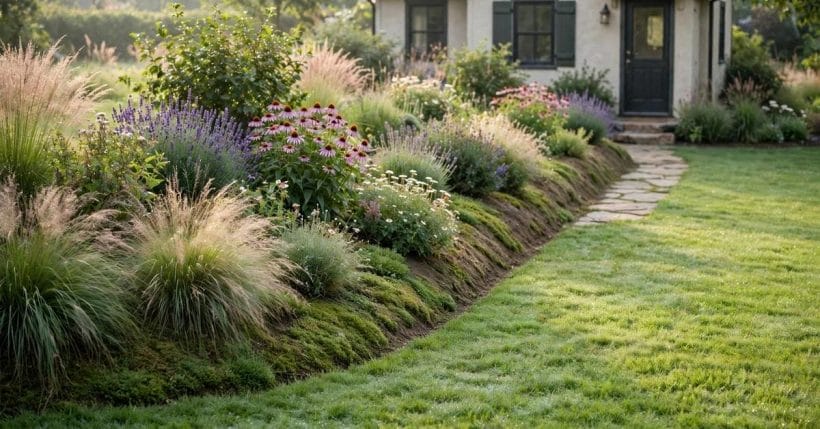
The front of a house is the part of the garden that is seen most and lived in least. Neighbours pass it, visitors arrive through it, and the people who live in the house glimpse it from the windows and the porch many times a day, yet it is rarely a place where anyone sits for long. That double character is what makes the front garden such a particular design problem. It has to look composed from the street, welcome a visitor toward the door, and still leave room for the practical things a front garden must do: a path that is easy to walk, a driveway edge that stays clear, a boundary that feels settled rather than abrupt. A raised planted bank, placed with care at the front of the house, can answer all three at once, because it shapes the ground itself into something the eye can follow from the gate to the door.
This guide is about front yard berms only, and about the front garden in particular. The general idea of a raised garden bank, its forms, its planting by position and its seasonal care, is explained in the companion guide to the berm as a garden feature, and this post does not repeat that general teaching. What follows is the front-garden application of it: where a bank sits well between the street and the house, how it behaves beside a path, a porch, a boundary and a driveway, how its planting is chosen for a place that is seen from outside as much as from within, and where a front bank is the wrong answer. Wherever the ground, the drainage or a shared boundary is involved in any substantial way, the work belongs in conversation with a landscape professional, who can judge that particular place.
1. What a Front Garden Berm Does Differently
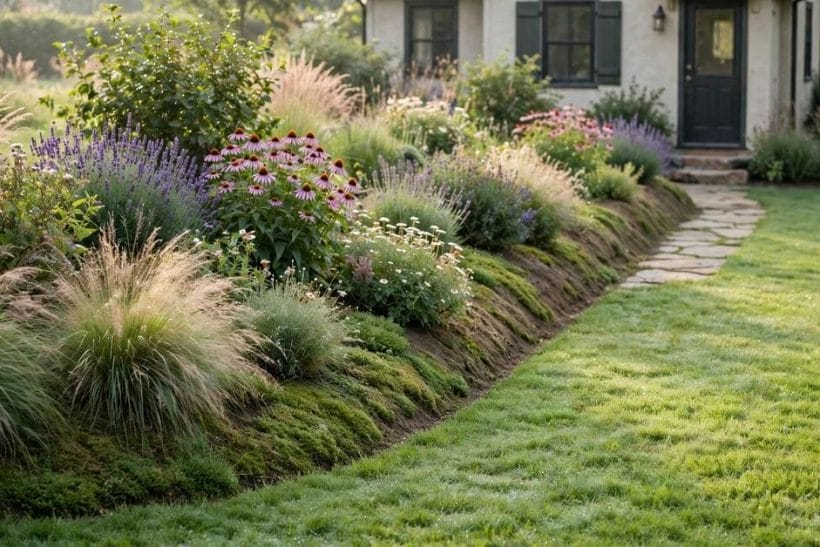
A berm at the front of a house does a different job from the same feature at the back, because its audience is different. A back-garden bank is made for the people who live there, seen from the seating areas and the windows they use most. A front bank is made first for the street and second for the household: it is the planting that a passer-by notices, the shape that frames the house in a first glance, and the green foreground that a visitor walks beside on the way to the door. That outward-facing role changes every choice that follows, from the height of the planting to the tidiness of the edges, because a front bank is always on show, even when nobody is gardening.
The front bank also has to work harder as a piece of composition. A back garden can absorb a generous, flowing shape, with room to walk around it and see it from several sides. A front garden is usually narrower, bounded by the street on one side and the house on the other, and crossed by a path and often a driveway. A bank here must therefore earn its place in a tighter frame: it lifts the planting where it will be seen, softens a hard junction where the garden meets the street or the drive, and gives the approach to the house a sense of arrival, all without crowding the route in or blocking the view of the door. When it succeeds, the house looks settled in its plot, as though the ground itself had risen gently to meet it.
There is a further difference worth naming at the start. A front garden is a shared view. The planting at the front is part of the street as much as part of the house, and a bank that is generous, tidy and well planted contributes to the whole road, while a bank that sprawls, thins or blocks a sightline affects neighbours too. That is not a reason to avoid a front bank, but it is a reason to choose its shape and its planting with the street in mind, and to keep its edges clean through the year. The sections that follow take that outward view as their starting point, and return to it whenever a choice has to be made.
2. Reading the Front Garden from the Street
Every front-garden decision should begin at the street, standing where a passer-by stands and looking back at the house. From there, the garden reads as a single picture: the roofline, the porch, the windows, the path, the lawn, and the planting that sits between them. A flat front garden often reads as two separate things, a house and a strip of lawn, with little to connect them. A low planted bank changes that reading, because it introduces a middle layer between the lawn and the house, a band of foliage and flower that the eye crosses on its way to the door. The house gains a foreground, and the garden gains depth, without any hard structure being added.
Standing at the street also reveals what the front garden actually needs, which is rarely what it seems to need from inside the house. From the windows, a bare patch of lawn near the boundary may look harmless; from the street, it may read as an empty gap that makes the whole plot feel unfinished. From the porch, a shrub by the door may look generous; from the street, it may be the only planting in view, with flat lawn on either side. A bank answers the street view precisely because it is a shape rather than a single plant: it fills a stretch of ground with a continuous, planted form, so the eye finds something composed wherever it lands, rather than a collection of isolated shrubs in a sea of grass.
It is worth making this street reading at different times of day and in different seasons before settling anything. Morning light from one side and evening light from the other will show different parts of the front garden, and a bank that glows in the morning may sit in shade by evening. Winter, when leaves have fallen, shows the bare bones of the plot: the lines of the path and the drive, the shape of the boundary, and the places where a bank would give the garden structure when flowers cannot. For the wider composition of the front garden, from planting to paths, these front yard landscaping ideas sit naturally alongside the bank notes here, since a front berm is one element of a street view that has to work as a whole.
3. Berms Beside the Entrance Path
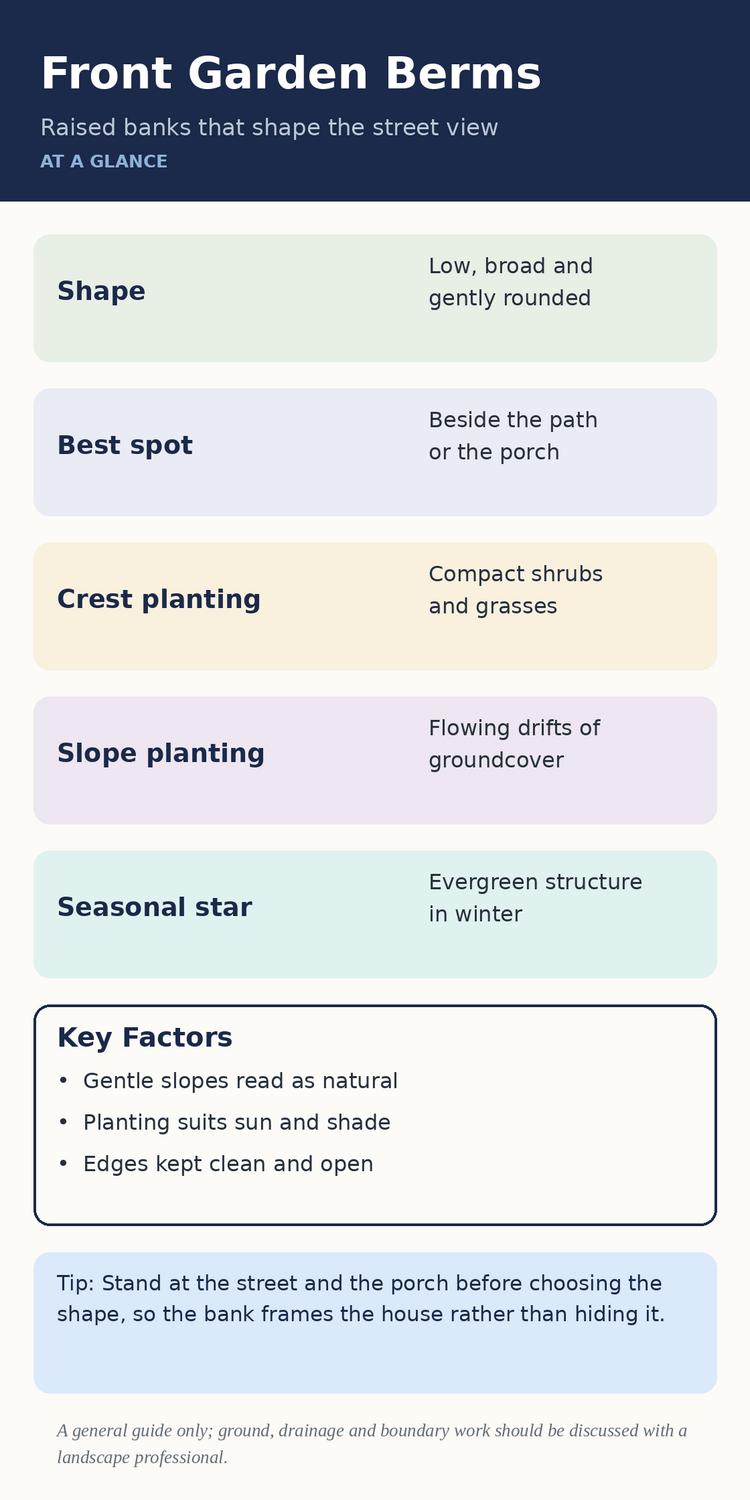
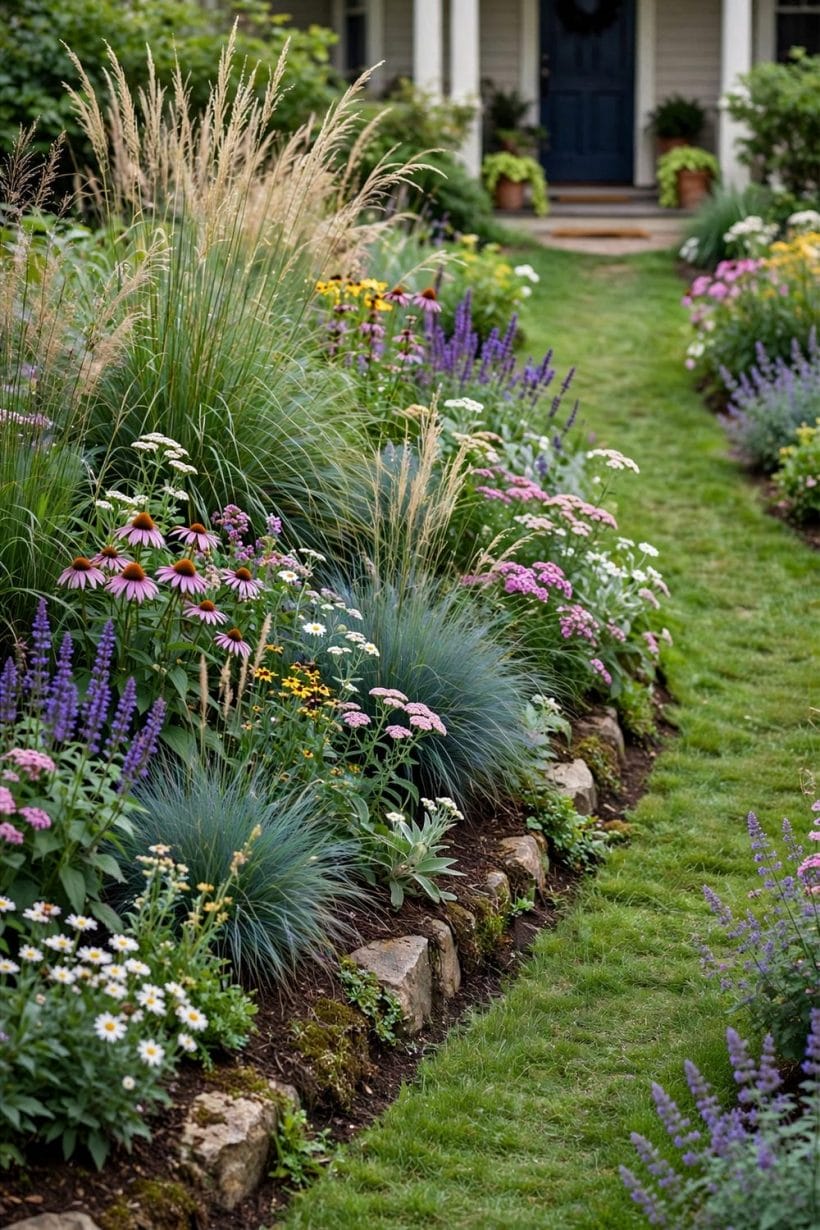
The entrance path is the spine of the front garden, and a bank beside it is the most rewarding place to put one. A visitor walking from the gate to the door passes the bank at close quarters, so its planting is seen in detail: the texture of grasses, the colour of perennials, the scent of a shrub in flower. A low bank on one side of the path lifts that planting to the walker’s eye level, turning a plain walk into a walk among plants, and it gives the path itself a gentle curve to follow, since the eye follows the line of the bank rather than the straight edge of the paving. A bank on one side is usually enough. Banks on both sides of a narrow front path can make the walk feel hemmed in, and can crowd the very route they were meant to accompany.
The planting beside a path deserves plants that reward close attention, because this is the planting that visitors will actually notice. Grasses that move in the breeze, perennials with a long season of flower, and shrubs that hold their shape without sprawling across the paving all suit a path-side bank, and they suit it for a practical reason as well as a visual one: a path-side bank must never narrow the walk, drop soil onto the paving, or hide the step up to the porch. Keeping the edge where the bank meets the path clean and trimmed is therefore part of the design, not an afterthought, and the plants chosen should be ones that can be kept within their bounds with ordinary care.
A path-side bank also sets the pace of arrival. A bank that begins near the gate and rises gently toward the house draws a visitor forward, with the planting growing a little taller and fuller as the door approaches, so that arrival feels gradual rather than sudden. A bank that starts abruptly at the porch, or that stops halfway along the path, can feel like an afterthought. The most successful front-path banks read as a single gesture from the street to the door, with the planting changing along the way but the shape holding steady, so that the walk itself feels designed rather than merely surfaced.
4. Berms Beside the Porch and the Front Door
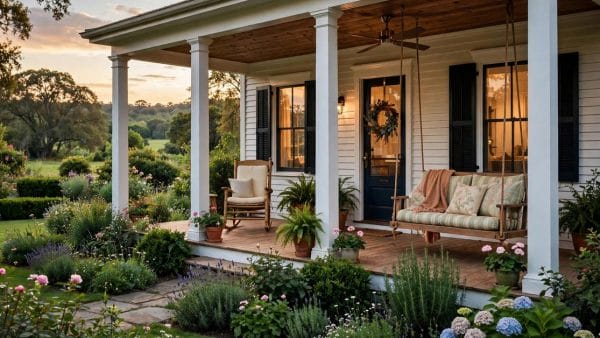
Beside the porch, a bank works as a green foreground to the entrance itself. A porch that opens onto flat lawn can feel exposed, with nothing between the door and the street but grass. A low planted bank beside the porch steps gives the entrance a setting: foliage at the side of the door, flowers at the height of a visitor standing on the step, and a sense that the house is approached through a garden rather than across a lawn. The bank should frame the door, never hide it. The porch, the house number and the step itself must stay clearly visible from the street and the path, and the planting should sit to the side of the entrance, not across it.
The plants beside a porch earn their place by rewarding attention at very close range, since this is where visitors pause, wait and look around. Fragrant shrubs, perennials with a long flowering season, and evergreen foliage that holds the composition through winter all suit a porch-side bank, because they give the entrance something to offer in every season. A porch bank also benefits from a little restraint. A single well-chosen shrub on the crest, with flowing groundcover on the slopes beneath it, will frame a door more gracefully than a crowded bank of competing plants, and it will be easier to keep tidy in the small space beside a porch, where every stray stem is on show.
It is worth thinking about the porch and its planting together, as one composition, rather than treating the bank as an addition to a finished entrance. The colour of the door, the material of the steps, the style of the porch itself and the planting beside it all contribute to the first impression a visitor receives, and a bank that echoes the character of the porch, cottage planting beside a cottage porch, or simple grasses beside a plain modern entrance, will feel intentional in a way that unrelated planting never does. For the entrance as a whole, these tiny house porch ideas show how porch and planting can be composed together, and a low bank beside the steps can carry the same thinking into a garden of any size.
5. Berms Along the Front Boundary and the Driveway Edge
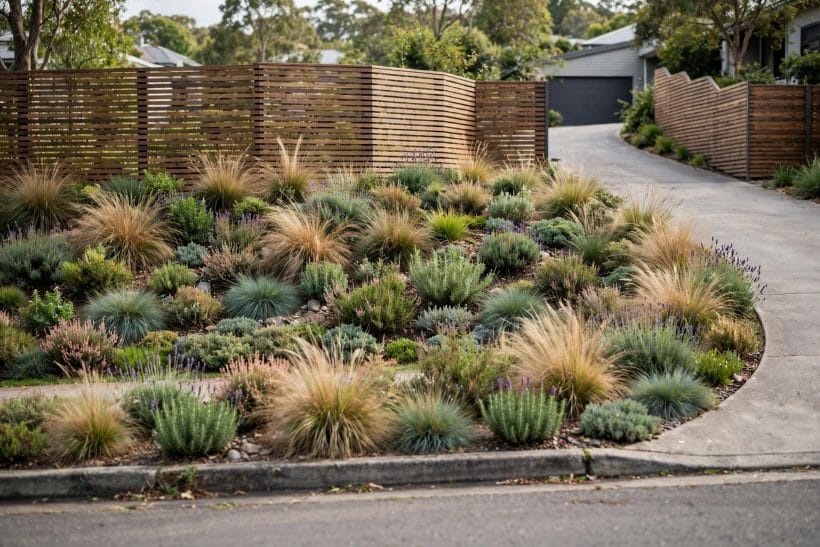
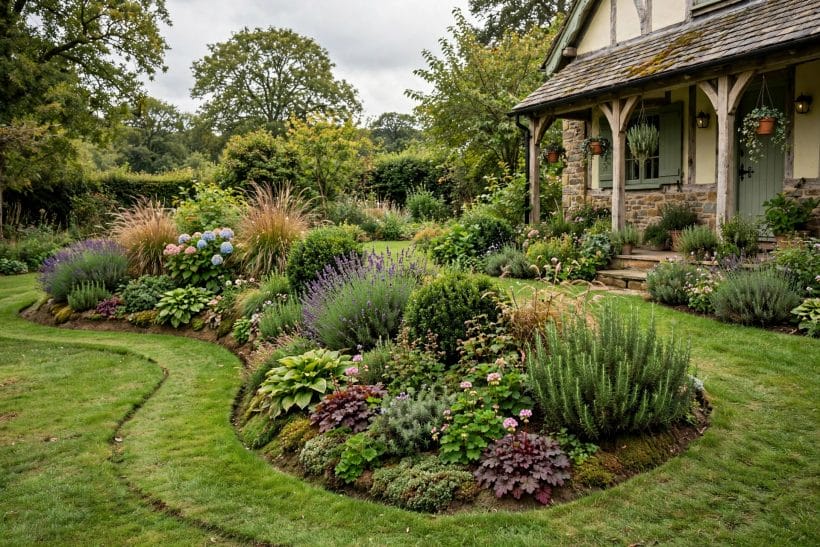
Along the front boundary, a bank changes the character of the edge entirely. A fence or a low wall on flat ground is a line, and the eye stops at it. A fence behind a planted bank becomes a backdrop, glimpsed through foliage and softened by the rising ground in front of it, and the boundary reads as a deep, layered border rather than a thin screen. This is one of the most useful roles a front bank can play, because the front boundary is often the least loved part of the garden, a place where a fence meets a lawn with nothing to mediate between them. A bank gives that junction depth, and it gives the boundary planting room to be generous, with shrubs at the crest, mid-height plants on the slopes and groundcover at the base.
Beside a driveway, a bank needs more discipline than anywhere else in the front garden, because a driveway is a working surface. The bank must never narrow the drive, spill soil onto it, hide the edge where a car turns, or block the view of the street when a vehicle leaves the plot. Sightlines at the driveway entrance matter to everyone who uses the road, not only to the household, so planting near the driveway mouth should stay low and open, and the bank itself should sit back from the turning area rather than crowding it. A bank that runs along the side of a drive, well clear of the turning space, can still soften a long straight edge of paving beautifully, but it must be placed with the car in mind as well as the eye.
Where a front garden has both a boundary and a driveway to deal with, the bank should be planned as one continuous shape rather than two separate gestures, if the plot allows it. A bank that runs along the boundary and then turns gently to follow the driveway edge gives the whole frontage a single, flowing line, and the garden reads as composed from every angle of approach. Where the plot does not allow a continuous bank, it is better to choose one clear role, a boundary bank or a driveway-side bank, and do it well, than to squeeze in two cramped banks that crowd the path, the drive and the view of the house at once.
6. Planting the Crest, Slopes and Base at the Front
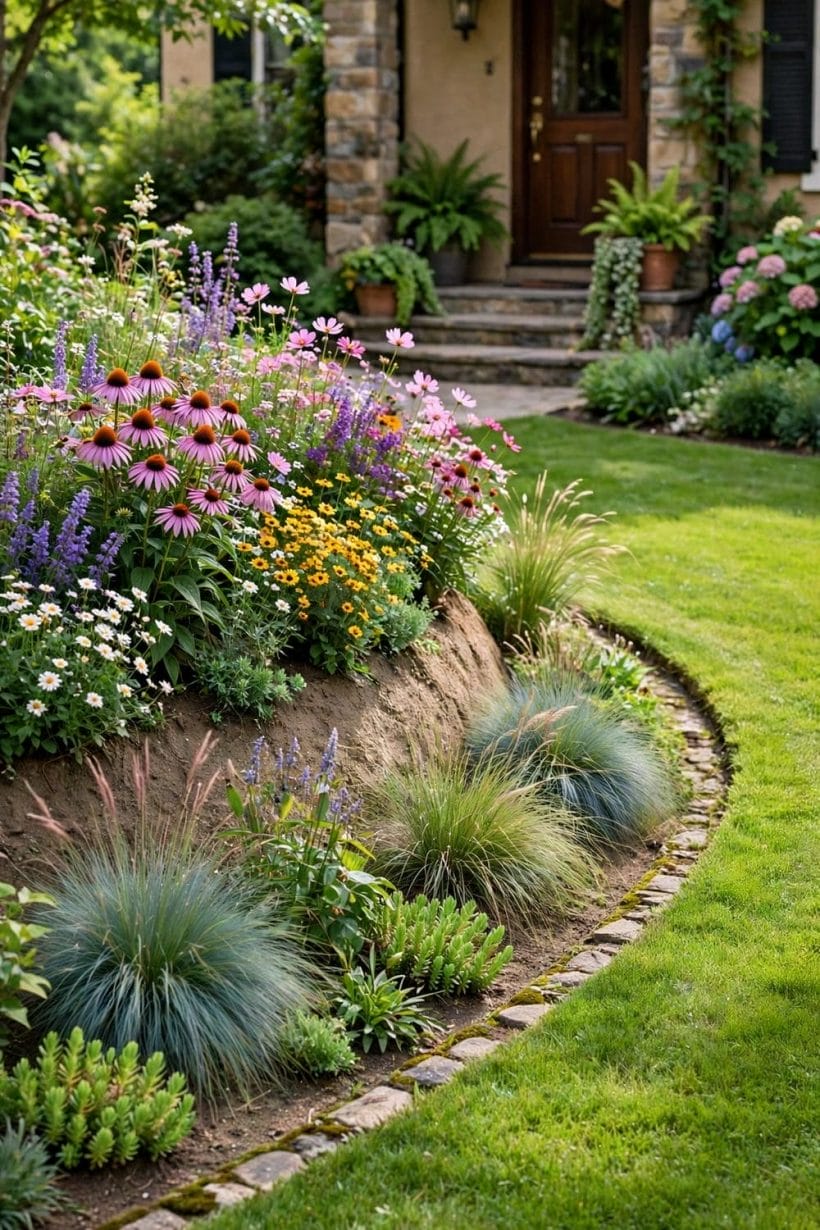
Planting a front bank follows the same positions as planting any bank, but each position has a front-garden twist. The crest is the most visible part of the bank from the street, and it carries the silhouette of the whole feature, so it suits plants that hold a clear shape through the seasons: compact shrubs, ornamental grasses, and perennials that do not collapse after flowering. A single specimen plant on the crest, a well-chosen shrub or a small tree, can anchor a front bank and give the house a focal point that is visible from the road, but it must be chosen with its mature size in mind, since a crest plant that outgrows its place will eventually hide the windows or the porch it was meant to frame.
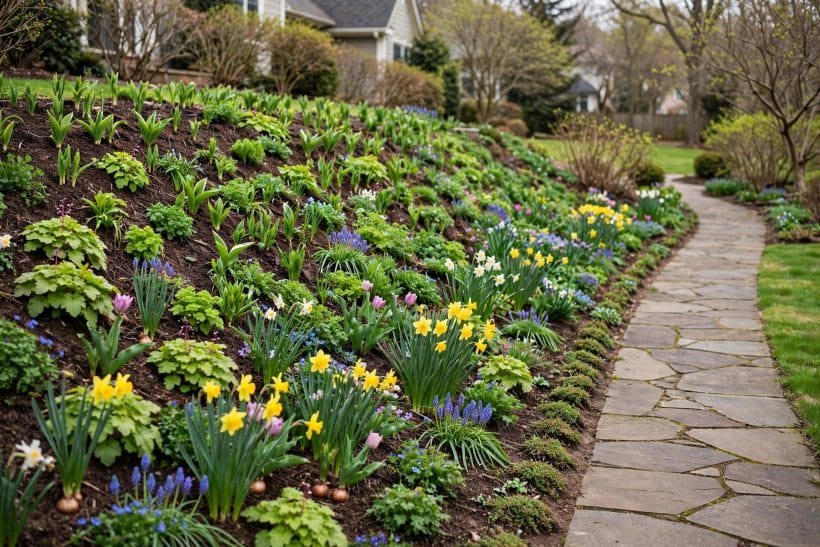
The slopes are the working part of a front bank, and at the front they have a particular job: to look tidy from the street in every season. Spreading shrubs, groundcover perennials and drifts of grasses knit the slope together, covering the soil so that the bank reads as a planted surface rather than bare earth, and they are best planted in generous groups that follow the curve of the bank rather than in straight rows that fight it. At the front, evergreen groundcover earns its place twice over, because it keeps the bank looking intentional through winter, when the street view has little else to offer, and because it hides the soil at the very moment when a bare slope would be most conspicuous.
The base of the bank is where it meets the lawn, the path or the drive, and the planting here should make that meeting gentle. Low, spreading plants that spill a little over the edge soften the junction and hide the line where bank meets flat ground, while spring bulbs planted through the base and the lower slopes give the front garden an early season of colour before the main planting wakes. Throughout, the planting palette should suit the garden as a whole, and the street as well: a front bank planted with the same shrubs, grasses and perennials as the surrounding borders will feel like part of the garden, while one planted in an unrelated style will always look like an addition. For planting combinations that translate well onto a bank, from flowing perennial drifts to structured shrub groupings, these flower bed ideas offer a useful starting point, adapted here to the open, unframed shape of a bank rather than a contained bed. The contrast is worth keeping in mind: where a garden already uses contained beds for growing, as these raised garden bed ideas show, a front bank elsewhere in the garden can complement them without repeating them, since the bank is open ground shaped and planted, not a frame holding soil.
7. Berms on a Corner Plot and a Small Front Garden
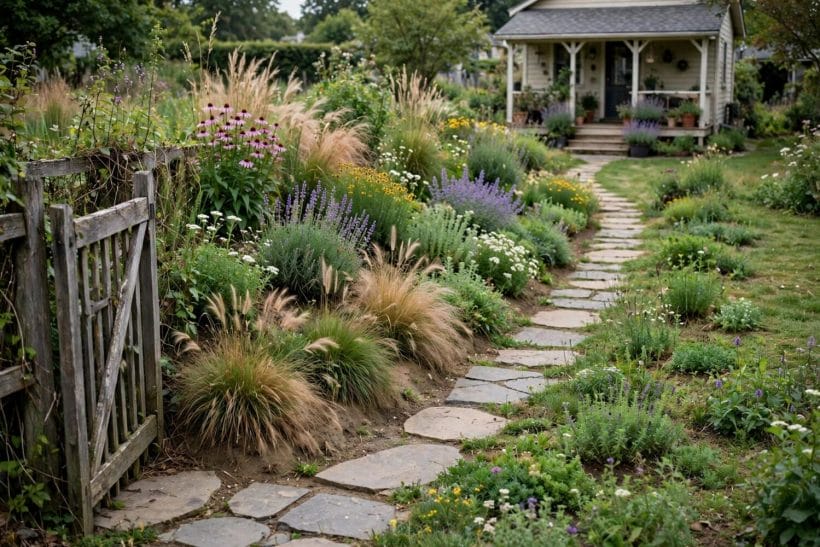
A corner plot gives a front bank its largest stage and its strictest limits at the same time. The garden is seen from two streets rather than one, so a bank that wraps the corner can give the whole plot a composed, generous character, with planting visible from every approach. At the same time, a corner is where sightlines matter most, for drivers, cyclists and pedestrians alike, and a bank near the corner itself must stay low and open, with planting that never blocks the view of the road. The safest shape on a corner is a bank that sits back from the corner point, following the boundary on one or both frontages, and leaving the corner itself clear and readable.
In a small front garden, a bank needs the most careful judgement of all, because raised ground takes up room that a level garden would give to lawn or path. Here the border bank is usually the wiser choice: a raised strip along one boundary adds shape and planting height while leaving the centre of the garden open and usable, and it gives a small house a planted foreground without swallowing the plot. A small island bank can still work in a modest front garden if it is kept low and generous in outline, planted simply, and given enough lawn around it to breathe. What rarely works in a small front garden is a bank that crowds the path, pinches the porch steps or blocks the view from the windows that matter most, since a small garden has no spare room to absorb a shape that is too large for it.
Both cases reward the same habit: measuring the garden as it will be used, not only as it looks on a plan. Walk the path, open the car door, stand at the gate with a pram or a parcel in mind, and look from the corner along both streets before settling the shape. A bank that leaves every practical movement comfortable, and still gives the street a composed view, is a bank that belongs in that particular front garden. A bank that looks fine from the porch but pinches the path, or fine from the street but blocks the drive, is a bank in the wrong place, however handsome its planting may be.
8. The Front Garden Through the Seasons
A front bank repays attention through the year, and each season asks something slightly different of it, with the added pressure that the front garden is always on show. In spring, the bank wakes early: the sunny slopes warm sooner than flat ground, bulbs planted through the base and the lower slopes flower first, and the first growth of grasses and perennials softens the winter outline. Spring is the season for tidying the front bank, cutting back the previous year’s growth, refreshing mulch where it has thinned, and checking that the slopes are fully covered before the growing season gathers pace, since a thin patch at the front is visible to everyone who passes.
Summer is the front bank’s show season. The crest planting is in full leaf and flower, the slopes are covered, and the bank reads as a lush, planted form from the street. Care in summer is mostly a matter of watering in dry spells, especially on the crest, which dries first, and of keeping the edges where the bank meets the lawn and the path neatly trimmed so that the shape stays readable. A front bank that is allowed to sprawl into the lawn or across the path loses its outline quickly, while one whose edges are kept clean holds its curve all season, and deadheading spent flowers keeps the planting in proportion to the bank beneath it.
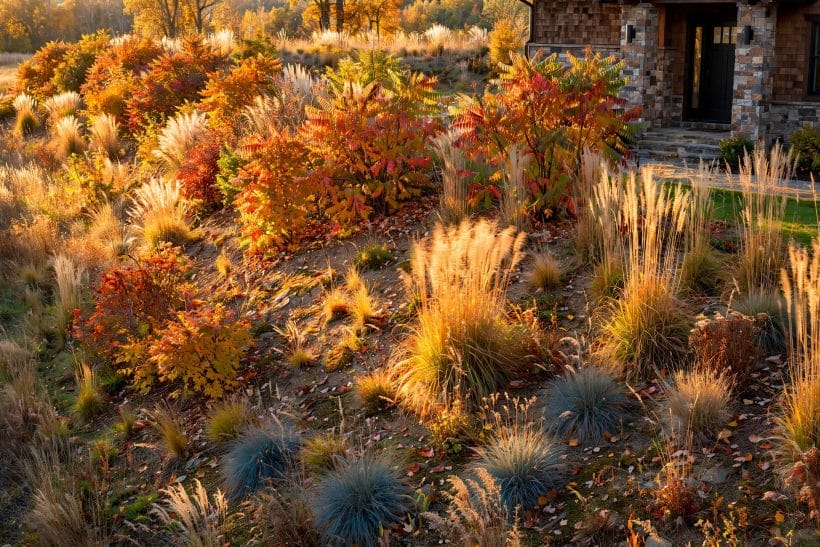
Autumn and winter ask for a lighter hand, and for evergreen structure above all. Autumn colour on a bank can be striking, with shrubs and grasses turning together across the slope, and the falling leaves can simply be left to settle as a natural mulch or gathered for the compost. In winter, the shape of the bank itself carries the front garden: the crest against the sky, the evergreen shrubs holding the slopes, the bare stems of grasses catching frost. A front bank with a good evergreen backbone never looks abandoned, even in the quietest months, and that winter readability is what separates a front bank that works all year from one that only works in summer.
9. What to Avoid at the Front of the House
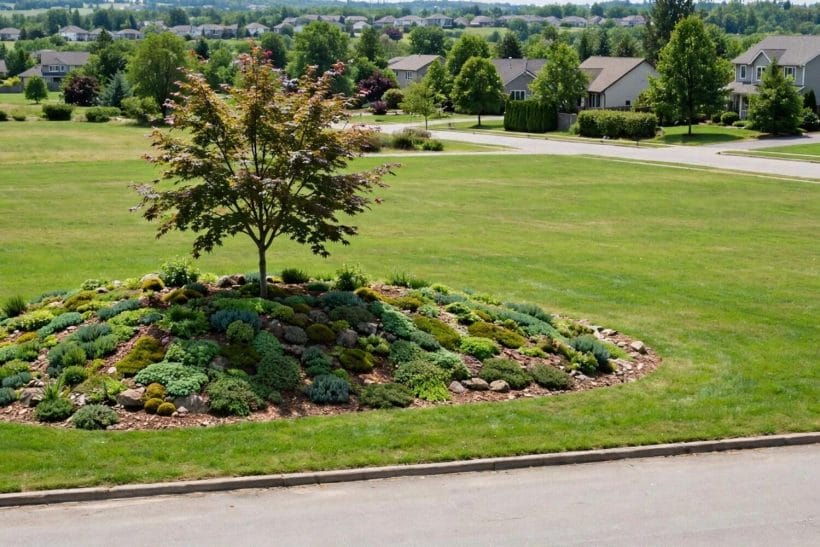
Several mistakes recur at the front of the house, and most of them come from forgetting that the front garden is a shared, practical space as well as a picture. The first is a bank that is too steep or too narrow for its place. A steep face looks artificial, is harder to keep planted, and tends to shed soil and mulch onto the path or the lawn beside it, while a narrow crest looks pinched from the street and gives the planting nowhere to settle. A broad, gently rounded crest with easy slopes looks like a natural rise in the ground, is easier to plant and to keep tidy, and reads as intentional from every angle. If the shape would look at home in a meadow or a park, it will look at home in a front garden; if it looks like a construction, it will always read as one.
The second mistake is planting that blocks what needs to stay open: the view of the house number, the step up to the porch, the sightline at the driveway mouth, and the view from the windows that matter most. A front bank should frame the house, and framing means leaving the important things visible. Tall or fast-spreading plants belong away from the porch, the drive entrance and the corner of the plot, and any plant chosen for the crest should be judged at its mature size, not at the size it is when planted. A bank that hides the door it was meant to welcome visitors toward has failed at its first job, however beautiful its flowers may be.
The third mistake is treating the front bank as a solution for problems it cannot solve. A bank is not a substitute for a retaining wall where the ground needs holding, not a screen that can be relied on for privacy at the front, and not a remedy for ground that is wet, unstable or shared with neighbours without proper advice. Where any of those conditions apply, a landscape professional should be part of the conversation before any ground is moved, and the same professional advice applies to anything involving drainage, levels near the house, or a boundary. For an enclosed front space that is shaped differently, where walls rather than open banks define the garden, these courtyard landscaping ideas show a contrasting approach, and the contrast is a useful check: if what the front garden really needs is enclosure, an open bank is the wrong feature to reach for.
10. Questions to Settle Before Choosing a Front Berm
Before settling on a front bank, a few honest questions save disappointment later. The first is about room: is there enough open ground for a bank with gentle slopes and a broad crest, without crowding the path, the driveway, the porch steps or the views from the house? A bank squeezed into too small a space will always look pinched, and a level border would serve such a spot better. The second question is about purpose: is the bank there to lift a border, to soften a boundary, to frame the porch, or simply to add shape to a flat front garden? A clear purpose leads to a clear form, while a bank built without one tends to drift into an awkward shape that pleases nobody.
The third question is about planting, and it should be answered with the street in mind as well as the household. Does the planting suit the position, sun or shade, exposure, and the character of the rest of the garden and the road? Is there enough evergreen structure to carry the bank through winter, when the front garden is at its barest? Are the plants ones that are already thriving nearby, since they have proven themselves in the same soil and climate? A front bank planted with proven, well-suited plants will settle quickly and stay tidy with ordinary care, while a bank planted with unsuitable plants will demand constant attention and still look thin.
The final question is about the long view, and about the neighbours as well as the household. Does the shape still work when the shrubs are fully grown? Does it still leave room for the path, the drive and the porch to be used as they are now? Does it keep every sightline open, and does it contribute to the street rather than merely filling the plot? Gardens change, and a front bank that is planned with its mature size in mind will grow gracefully into the garden around it. Where any of these questions points to a substantial change of level, to ground that is already wet or unstable, or to a boundary shared with neighbours, a landscape professional should be part of the conversation before any ground is moved, just as the wider setting of the garden behind the house, from seating to planting, is a separate composition, where these backyard patio ideas belong rather than the front-bank notes here.
Final Considerations
A front garden bank is one of the quietest ways to give the front of a house shape. It asks for no structure, no hard materials and no display, only earth shaped with a gentle hand and planted with care, placed where the street, the path and the porch can all benefit from it. Done well, it lifts a border, softens a boundary, frames a door and gives the approach to the house a sense of arrival, and it does all of that while remaining, to a visitor, almost invisible as a separate feature. Visitors notice the effect instead: a front garden that feels composed, a house that looks settled in its plot, a walk to the door that feels like a walk through a garden.
Its limits are worth respecting, and they are sharper at the front than at the back. A front bank must never crowd the path or the drive, block a sightline or a house number, hide the porch it frames, or pretend to solve a problem of levels, drainage or boundaries that needs professional advice. Its slopes must stay gentle, its planting must stay in proportion to the bank, and its edges must be kept clean so that the shape reads clearly from the street in every season. Where those conditions are met, a front bank is a feature that grows better with age, as its plants knit together and its outline softens into the garden around it.
Start, then, at the street. Stand where a passer-by stands, walk the path to the door, and look for the place where the ground itself seems to want a little lift: a flat border that never quite catches the eye, a boundary that feels too hard, a porch that opens onto bare lawn, a driveway edge that runs straight and unsoftened to the road. That is where a front bank belongs, and the general companion guide to the berm explains the feature itself for anyone who wants the fuller picture. Shape it gently, plant it generously, and give it time. The best front banks are the ones visitors admire without quite knowing why the front of the house feels so composed, and that quiet, almost invisible success is exactly what the feature is for.



0 Comments