

A protection plan is easy to add at the till and hard to judge later, when a stain, tear or scratch is already on the sofa. The value is never in the sales pitch — it is in the terms you agreed to on the day you bought.
This guide explains, in general terms, what these plans usually do, how claiming usually works, and the checks to make before you pay.

1. Furniture Protection Plans at a Glance
A furniture protection plan is an optional add-on, usually offered at the point of sale, that promises help with certain accidental damage to a specific piece of furniture for a set period. Plans typically sit alongside — not instead of — any warranty that came with the furniture itself, and they are governed by their own written terms. That paperwork, not a verbal summary in the shop, decides what counts as covered damage, how quickly you must report it, what evidence you will be asked for, and what outcome you may be offered. Terms vary widely between plans, administrators and retailers, so the habit that protects you most is simple: read the document for the exact plan in front of you, keep it, and treat every general description in this guide — including the furniture protection plan claims process outlined below — as a starting point for questions, not as a promise about your own cover.
| What is a protection plan? | An optional, paid agreement covering certain accidental damage to a named piece of furniture for a stated term. Plans typically cover defined incidents only, and everything depends on the written terms for that plan. |
| Is it the same as a warranty? | No. A manufacturer’s warranty typically deals with defects in materials or workmanship. A protection plan typically deals with accidents in use. The two run separately, with separate paperwork and separate claim routes. |
| What is typically covered? | Plans typically list specific accidental events such as certain stains, rips, tears or scratches, as defined in the terms. If an event is not listed, do not assume it is covered — check the wording. |
| How does a claim usually start? | Typically by reporting the incident within a stated window, with photos, proof of purchase and a description of what happened. The administrator may then arrange an inspection or a repair visit before deciding an outcome. |
| What should I check before buying? | The term length, what is covered and excluded, the reporting window, who administers the plan, whether it transfers if you sell the piece, and the cancellation and refund terms — all in the written document. |
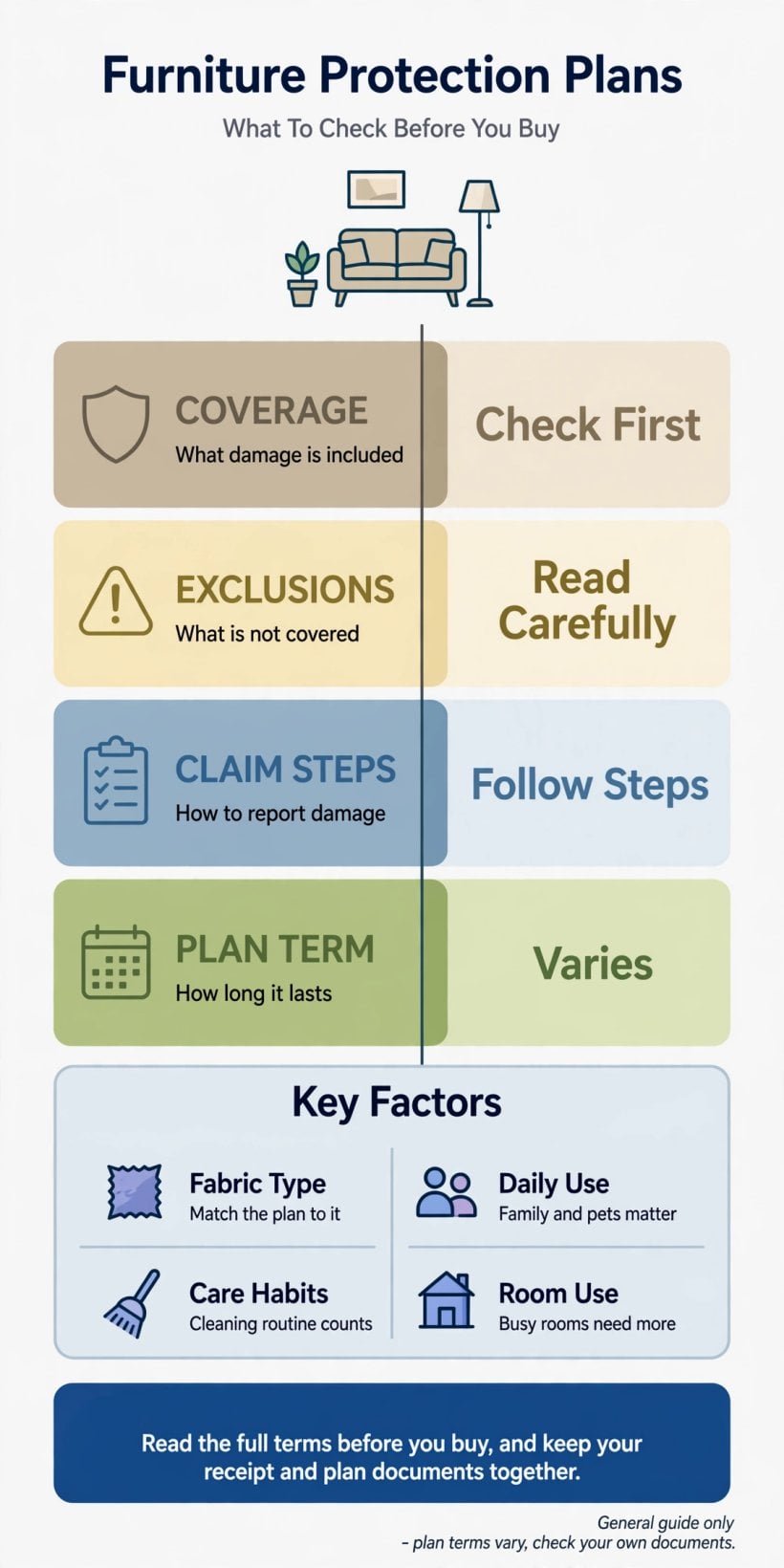
At a glance: an optional add-on for defined accidental damage — separate from a warranty, decided by its own written terms, and worth buying only after you have read the cover, the exclusions and the claim steps.
2. What a Protection Plan Is — and How It Differs From a Warranty

Start with the distinction that causes the most confusion at claim time. A manufacturer’s warranty is part of the product itself. It typically promises that the furniture was made properly — that frames, springs, stitching, mechanisms and finishes were free from defects when the piece left the maker, for the period the warranty states. If a joint fails because it was badly made, or stitching comes apart without any accident, that is warranty territory, and the route is usually back through the retailer or maker with your proof of purchase. A warranty typically does not deal with what life does to the furniture afterwards: the spilled drink, the dropped tool, the child’s pen or the move that scraped a leg.
A protection plan is a separate agreement, bought for an additional cost and attached to a specific item. Its subject is accidents, not defects. In general terms, plans typically name a set of accidental events and a set of conditions, and promise a defined response — usually an attempt to clean or repair first — if one of those events happens during the term and is reported in the way the terms require. The plan is commonly administered by a third-party company rather than by the shop that sold you the sofa, which is why the name of the administrator, and how to contact them, belong in your paperwork from day one. Reading local options through a guide to furniture stores near me is a useful reminder that the shop, the maker and the plan administrator are three different parties — and a claim goes to the one named in your plan document, not automatically to the person who took your payment.
3. What Is Typically Covered

Coverage is always a list, not a feeling. Plans typically describe cover in terms of specific, accidental, one-off incidents to upholstery, leather, wood or other named surfaces, and the exact list in your document is the only list that matters. Events commonly described in this kind of plan, in general terms, include accidental stains from food and drink, accidental rips or tears, accidental scratches or chips to a finished surface, and damage from a single described incident rather than from gradual use. Some plans also describe cover for specific parts — for example a recliner mechanism or a dining table surface — but only where the schedule names that piece and that surface. If your furniture has several materials in one piece, such as fabric cushions on a wooden frame, check whether the plan covers each material or only one of them.
Two wording habits deserve attention. First, plans typically define an accident as sudden and unintended, which is why the account you give when you report matters: describe exactly what happened, when it happened and what was spilled, dropped or caught, and keep that account consistent. Second, cover is typically tied to the named item at the named address, bought on the date shown. A plan bought for one sofa does not drift across to a replacement sofa, an armchair in the same suite or a piece you buy later, unless the terms say it does. This is especially worth checking with multi-use pieces chosen from ideas for convertible furniture in a tiny house, where a sofa-bed or folding table works in two modes and takes wear in both — ask whether both uses of the piece are within the plan’s description of normal household use.
4. What Is Typically Excluded

Exclusions are not fine print to skim; they are half the contract. Plans typically exclude damage that builds up gradually rather than arriving in a single incident. General wear and tear, fading from sunlight, softening of cushions, pilling of fabric and the slow dulling of a finish are typically treated as the natural life of the furniture, not as accidents, however disappointing they feel. Accumulation matters too: a collection of small marks gathered over months is typically read differently from one described spill on one date, so reporting promptly protects you in a way that saving up problems does not.
Plans also typically exclude misuse and anything outside normal household use as the terms define it — for example damage from using furniture outdoors when it was made for indoors, standing on pieces, moving them carelessly, or attempting a repair with an unapproved product before reporting. Pre-existing damage is typically excluded, which is why noting the condition of the piece on delivery day, with dated photos, is such a valuable habit. Damage connected with pets is an area where plans differ a great deal in general terms: some describe limited cover, some exclude it, and some treat it as a separate add-on, so never assume — find the line in your document. The same caution applies to outdoor pieces and the finishes that protect them, covered in this guide to protecting outdoor log crafts with sealants and stains: a plan written for indoor furniture should not be stretched, in your expectations, over garden pieces living in the weather.
5. How a Claim Usually Runs, Step by Step

Although every administrator runs its own process, furniture protection plan claims usually follow a recognisable sequence, and knowing it in advance removes most of the stress from the moment something goes wrong. The steps below describe a typical route in general terms; your own document may order them differently or add requirements, and where the two differ, your document wins.
- Report promptly. Plans typically require you to report an incident within a stated window after it happens. Find that window in your terms now, before you need it, and do not wait to see whether a stain fades on its own.
- Give a clear account. You will typically be asked what happened, when it happened, which item is affected and where the damage is. Keep the account factual and consistent with the photos you send.
- Provide evidence. Expect to supply proof of purchase, the plan reference, and clear photographs of the whole piece and of the damage close up, in good light. Do not attempt a deep clean or repair first unless the terms tell you to, as early treatment can complicate assessment.
- Inspection or advice. The administrator may deal with the report on the evidence alone, send a technician to inspect, or arrange a cleaning or repair visit. Keep any appointment notes and the names or references you are given.
- Outcome. Where a claim is accepted, plans typically try cleaning or repair first. If a repair is not possible under the terms, the stated alternatives may include a replacement of the affected part, a replacement item, or store credit — the exact options and how they are valued are defined in your document, not in general descriptions like this one.
- If a claim is declined. Ask for the reason in writing and the term it relies on. That letter lets you check the decision against your own copy of the terms, and it is the starting point for any further enquiry through the retailer or administrator.
Throughout, keep a simple log: dates, who you spoke to, what was agreed and any reference numbers. In a small home, where a damaged piece may also be your bed, desk or only seating, tell the administrator about that practical pressure politely and early — it does not change the terms, but it helps scheduling, and it costs nothing to ask about timescales.
6. Paperwork to Keep From Day One

Most claim difficulties are paperwork difficulties in disguise. Keep one folder — paper, digital or both — for each major piece, and build it on delivery day rather than on the day something spills. The folder should hold the itemised receipt showing the piece and, where the plan cost is shown separately, that amount as well; the full plan terms and schedule, not just the summary leaflet; the delivery note; and dated photographs of the piece as delivered, including any mark you noticed and reported at the time. If the plan was registered or activated in some way, keep the confirmation and the reference together with the terms, along with a note of who administers the plan and the contact route the document gives for reporting an incident.
Add to the folder as life happens. Care labels and any cleaning guidance from the maker belong there, because using a product the maker warns against can become relevant if a later claim is assessed. Keep correspondence about delivery faults separate from correspondence about accidents, so a warranty question and a plan question never blur into one thread. For handmade or self-built pieces, such as the benches and planters in these log projects for outdoor furniture and garden planters, a plan may not apply at all — but the same folder habit still pays, in receipts for materials, finish products used and dated photos, if you ever need to remake a part or match a finish. Review the folder once when the plan arrives, once about a month later to confirm the details match the piece in your room, and then leave it to do its quiet work.
7. The Checks to Make Before You Buy
The cheapest time to understand a plan is before you pay for it, when walking away costs nothing. Work through the written terms — the full document, not a summary card — and answer these checks for the exact plan being offered. First, the term: how long does cover run, when does it start, and does it start on delivery or on purchase if those dates differ? Second, the scope: which items, materials and surfaces are named, and does the description match the piece in your basket? Third, the reporting rules: how quickly must an incident be reported, through what route, and what evidence will be required? Fourth, the outcomes: what does the plan say it will do if a repair is not possible, and how are any alternatives described?
Then check the ownership questions that buyers most often forget. Who administers the plan — the retailer, the maker or a separate administrator — and is that name and contact route printed in the document? Is the plan transferable if you sell or give the piece away, and if so, what must the new owner be given or told? What are the cancellation and refund terms, both in any initial period after purchase and later in the term, and do they change if you have already made a claim? Finally, check how the plan sits alongside the maker’s warranty and any care products you intend to use, so one agreement is not quietly undermined by another. Browsing broader context in these tiny house interior design ideas can help you judge how hard a piece will actually work in your layout — daily dining, sleeping and storage in one item is a different risk picture from occasional use in a spare corner, and your decision should reflect the real use, not the showroom use.
8. Red Flags and Questions to Ask the Retailer

A good plan survives questions; a weak sale avoids them. Treat any reluctance to hand over the full written terms before purchase as information in itself — the document is the product, and you are entitled to read it before deciding. Be cautious, too, with sweeping verbal summaries that the wording does not support, with pressure to decide at the till without time to read, and with any suggestion that cover is unlimited, automatic or free of conditions. Plans in general terms always have conditions: defined events, defined exclusions, a reporting process and stated outcomes. Language that hides those facts is not a better plan; it is a poorer description of one.
Ask direct questions and note the answers against the document, not instead of it. What accidental events are listed, in the plan’s own words? What are the main exclusions, including wear, pre-existing damage and pets? How many days do I have to report an incident, and to whom? Who administers this plan, and how do I contact them if the shop closes or I move house? Can the plan transfer to a new owner? How do I cancel, and what refund terms apply at the start and later? What happens if a stain cannot be removed or a tear cannot be repaired invisibly? If an answer and the document disagree, the document governs — say so politely, ask the retailer to point to the relevant term, and decide on the wording you can see. A retailer who answers by turning to the same page you are reading is giving you the most reassuring answer available.
9. Why It Matters More in a Small or Tiny Home

Small homes change the arithmetic of furniture damage, because there is so little furniture to begin with. In a larger house a stained chair can be moved to a quieter room, a scratched table can be swapped with another, and a repair visit is an inconvenience rather than a disruption. In a tiny home, each piece typically earns its place several times over: the sofa is also the guest bed, the table is also the desk, and the single storage bench holds the bedding it serves. Damage to one piece is therefore damage to a whole function of the home, and a repair that takes the piece out of use, even briefly, needs planning around in a way it simply does not in a bigger floor plan. That concentration of use also means small-home furniture tends to work harder per item — more sittings, more foldings, more spills per square metre of upholstery — which belongs in your thinking when you weigh any plan.
It also cuts the other way. With fewer pieces, the total cost of covering everything is smaller, but so is the case for covering pieces that are cheap to clean, easy to re-cover or simple to replace. The honest small-home approach is selective: think hardest about the one or two pieces whose loss would genuinely disrupt daily life and whose surfaces you cannot maintain yourself, and be cooler about add-ons for everything else. Design thinking helps here too — the compact layouts in this look at home interior design ideas for a tiny house show how washable throws, removable covers and hard-wearing finishes can be designed in from the start, reducing the accidents a plan would ever be asked about. In a small home, prevention and a plan are not rivals; prevention is the first layer, and a plan, if you buy one, is only the backup.
10. Alternatives to a Plan — and Who Should Pick One
A plan is one way to handle accident risk, not the only way, and for some households it is not the best way. The plainest alternative is self-insuring: setting aside the money a plan would have cost, in a household repairs pot, and paying for cleaning or repair yourself if something happens. That route keeps full control — you choose the cleaner or repairer, the timing and the standard — and it suits pieces that are sturdy, second-hand or inexpensive to put right. A second alternative is prevention as a system: fabric protection applied as the maker allows, washable or replaceable covers on the hardest-working seats, throws where drinks actually travel, and a prompt, correct response to spills using the maker’s own care guidance. For many stains, speed and the right method matter more than any agreement. A third alternative is choosing the furniture itself differently — performance fabrics, darker or patterned weaves that forgive marks, and surfaces that can be refinished — an approach that sits naturally alongside the calm, hard-wearing schemes in this guide to modern tiny house interior design with clean lines for compact living.
So who should pick a plan? It may suit you if the piece is a significant purchase you cannot easily repair or replace, if it will live a high-risk life — daily family use, frequent guests, food and drink nearby as a matter of routine — and if, having read the full terms, the listed cover genuinely matches the accidents you actually fear, with a reporting process you know you will follow. It may suit you less if the piece was inexpensive, if its covers wash or unclip, if you are comfortable with visible mending and lived-in character, or if the exclusions in the document remove most of the events you were imagining. Neither answer is the clever one; the match between the wording and your household is the decision.
- Read the full terms before paying — cover, exclusions, reporting window and outcomes.
- Confirm who administers the plan and keep their contact route with your receipt.
- Check term length, transferability and the cancellation and refund wording.
- Photograph the piece on delivery day and file the paperwork in one place.
- Weigh the plan honestly against self-insuring, prevention and washable covers.
Final Considerations
A protection plan is a contract, not a comfort blanket. Bought with the terms read, the paperwork filed and the reporting window understood, it can be a sensible backup for a hard-working, hard-to-replace piece — particularly in a small home where one piece carries several jobs. Bought on a verbal summary, it is just an extra line on a receipt, and the disappointment people feel at claim time usually begins there, not with the stain itself.
Let the document make the decision. If the listed cover matches your real risks, the exclusions leave that cover meaningful, and the process is one you will actually follow on a bad evening, the plan has made its case. If not, put the same money and attention into prevention, washable layers and a repairs pot — and enjoy the furniture without keeping one eye on it, which is what any of these routes is really for.




0 Comments