

A damp basement announces itself politely at first: a window that fogs from the inside, a cardboard box gone soft in the corner, air that smells like the underside of a stone. The machine aisle of the home store promises a fix in a box — but the dehumidifier is the last step of the answer, not the first.
This guide works through what to check before buying or installing anything: where the moisture is coming from, the two families of equipment that remove it, how capacity matches a space, where the collected water goes, and the checks that separate a dry home from a busy machine in a still-damp room.
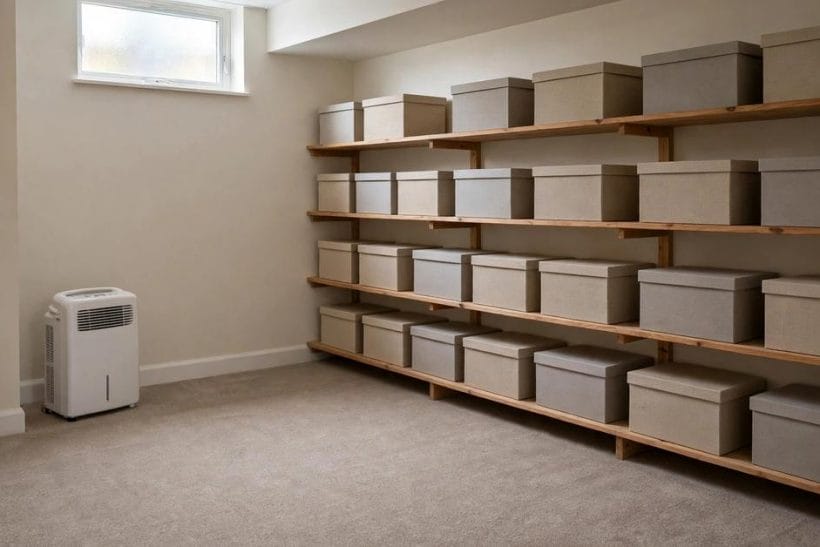
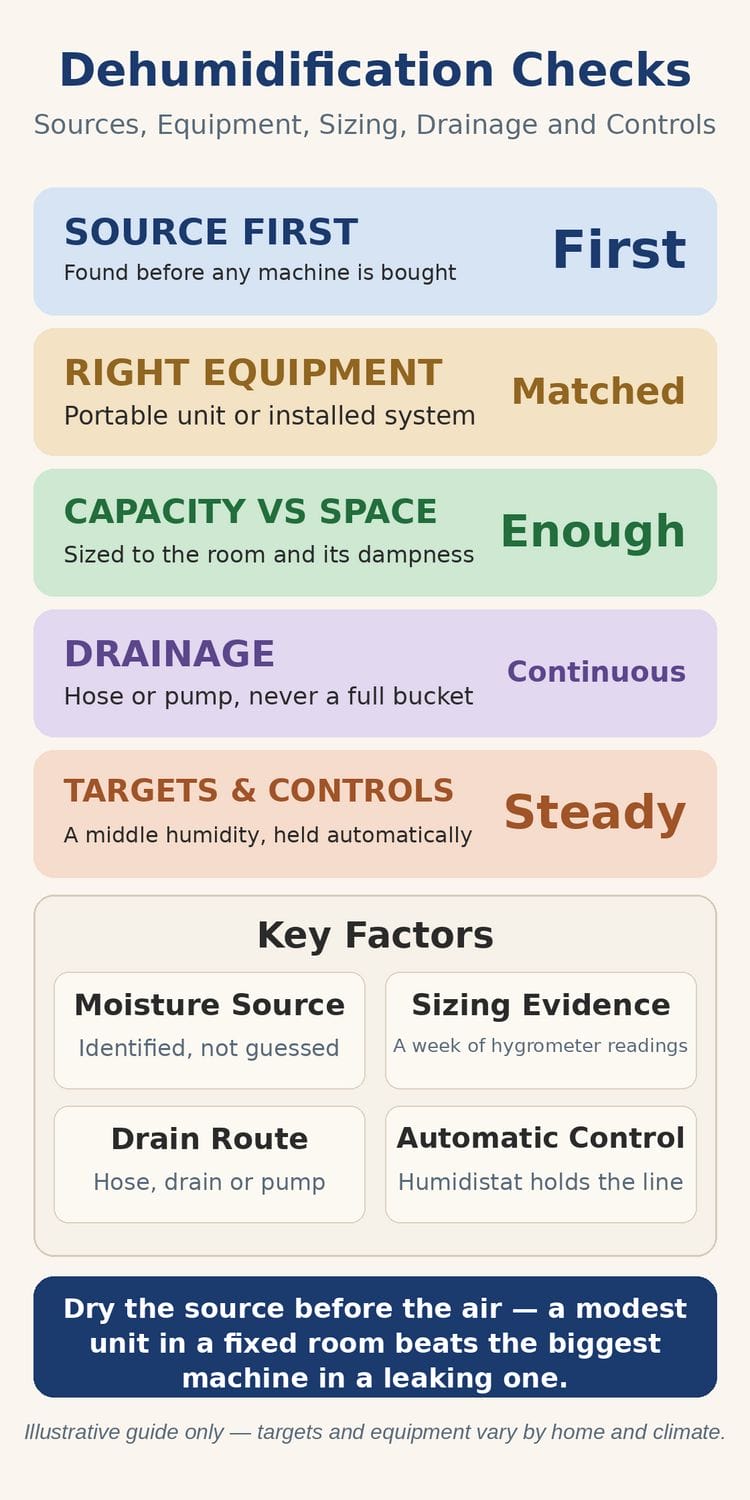
1. Home Dehumidification at a Glance
Scope first. This guide owns the checks for drying a home’s damp spaces — basements, crawl spaces and the rooms above them. It sits inside the below-ground family held by basement ideas, alongside the finished-room context of basement interior design ideas and the fit-out budgeting of basement remodel cost. A basement bathroom joins this batch’s frontier in a later row and will link back here from its own side; it is deliberately not linked before it exists. Two honesty rules govern everything below, and they are stated once, here: moisture problems are framed as find-the-source-first — a dehumidifier manages water vapour, it does not repair the leak, the failed drainage or the unsealed ground that produces it — and this guide makes no mould-remediation, air-quality or health claims whatsoever. Where growth, staining or damage is already established, that is a specialist’s assessment, not a shopping trip.
The order of operations matters more than any single product. Source first, then the space (vents, barriers, drainage outside), then the machine sized to what remains. Worked in that order, modest equipment keeps a home dry. Worked backwards, the largest machine in the shop runs forever and the room stays damp.
| Check family | Question it answers |
|---|---|
| The source | Where is the water actually coming from? |
| The equipment family | Portable unit, or an installed ventilation-dehumidification system? |
| Capacity vs space | Is the unit sized to this room and this dampness? |
| Drainage | Where does the collected water go, every day, unattended? |
| Targets and controls | What humidity are you holding, and who is watching it? |
2. Know Your Moisture: Sources First

The window in gallery-1 — fogged glass, a hygrometer on the sill — is where every honest dehumidification story starts: with measurement and suspicion, not machinery. Damp has a short list of usual sources, and each has a different cure.
1. Find the source before buying anything
Water arrives by leak (plumbing, roof, foundation cracks), by ground (rising through floors and walls, pooling against foundations), by air (warm moist air condensing on cool surfaces) and by use (showers, cooking, indoor laundry drying). Only the last two are a dehumidifier’s business. The first two are repairs — and until they are made, any machine is bailing a boat with the hole still open.
2. Read the signs, room by room
Condensation on windows and cold pipes, peeling paint at a wall’s foot, efflorescence on masonry, soft cardboard and a persistent earthy smell are the damp home’s vocabulary. Note where each sign lives: a pattern localised to one wall points to that wall’s problem; a whole-room pattern points to the air itself. Signs are evidence, and this guide draws no conclusions from them beyond moisture — anything beyond damp’s presence is for a professional assessment.
3. Measure before you spend: the hygrometer habit
A simple hygrometer in the suspect room, read over a week of ordinary living, turns suspicion into knowledge. You learn which rooms are wet, when they peak (after showers, after rain, overnight) and — later — whether the equipment you chose is actually holding the line. Every later check in this guide assumes this small instrument is in place.
3. The Two Families: Portable Units and Installed Systems

The pin shows the portable family’s typical station — a single unit working a single room, hose to a drain. The other family never appears in photographs at all: equipment installed in the basement or crawl space, ducted or vented, drying the home’s underfloor air as a system. Choosing the family is the guide’s biggest decision.
4. Portable dehumidifiers: one room, one machine
The portable unit is a self-contained appliance: it draws room air across cold coils, condenses the vapour, and collects or drains the water. It suits a single damp room, a seasonal problem, a rented home, a first experiment. Its limits are its virtues inverted — one room at a time, a bucket or hose to manage, and a presence in the room it serves.
5. Installed systems: ventilation and dehumidification as plumbing
Installed systems treat the whole below-ground zone: a unit fixed in the basement or crawl space, exchanging or drying that air continuously and draining automatically — the class of equipment sold as whole-home and crawl-space ventilation-dehumidification systems. They suit chronic, whole-zone damp and finished basements worth protecting. They are installations, with ducting, drainage and electrical work, and belong to professional fitting and local rules.
6. The home’s own systems help, or hinder
Bathroom extractors, cooker hoods that vent outside, and tumble dryers that are properly vented all export moisture at its source — the cheapest dehumidification there is. The moisture-heavy rooms deserve their checks before any machine is bought: the bathroom routines in modern bathroom ideas and the indoor-drying habits that gather around laundry room ideas are where a surprising share of a home’s vapour is born.
4. Capacity Against Space

Gallery-2’s unit stands alone in open floor with air on every side — placed, and sized, for the whole volume it serves. Capacity is the check most often failed at purchase, because the rating on the box is a laboratory promise and the room is not a laboratory.
7. Size to the space and its dampness
Capacity ratings describe how much water a unit can extract in a day under test conditions; the room’s need is set by its volume, its temperature and how wet it truly is (§2’s hygrometer week is the evidence). Makers publish sizing guidance by room size and dampness level — use it, and be honest about which dampness row your room is in.
8. Too small fails loudly; too large fails quietly
An undersized unit runs without rest and never arrives — the classic wasted purchase. An oversized one short-cycles, cooling its coils and switching off before the room’s air is truly worked, and can leave the space feeling clammy at the very reading it claims. The middle, matched to the room, is the only correct size.
9. Closed doors make small rooms of big ones
A unit dries the air it can reach. A basement divided into closed rooms is several spaces wearing one address; either the air must circulate between them (open doors, transfer grilles, a system with ducting) or each closed room is its own sizing problem. Decide the air’s route before deciding the machine.
5. Drainage: Where the Water Goes

The hose in gallery-3 is the difference between a dehumidifier and a chore. Every unit collects real water, daily, in quantities that surprise first-time owners — and the drainage decision, made once, determines whether the machine works unattended or stops full at midnight.
10. The bucket is a trial, not a plan
Internal buckets are for testing a room and for occasional use. A bucket left full switches the machine off and returns the room to damp, so any permanent installation should drain continuously. Treat the bucket as the audition and the hose as the job.
11. Gravity drainage: the simple ideal
Where a floor drain, sink or sump sits below the unit, a hose falling gently to it is the whole system — no moving parts, nothing to fail. Route it without kinks or uphill runs, secure its end, and check it when the seasons change.
12. Pumps and lifts where no drain is near
Where the only drain is above or across the room, units with a built-in pump, or an accessory condensate pump, lift the water to it. It is one more component to maintain, and the honest trade for a dry room in a drain-less space. Whichever route is chosen, the question is identical and non-negotiable: where does the water go, every day, with nobody watching?
6. Humidity Targets and Controls
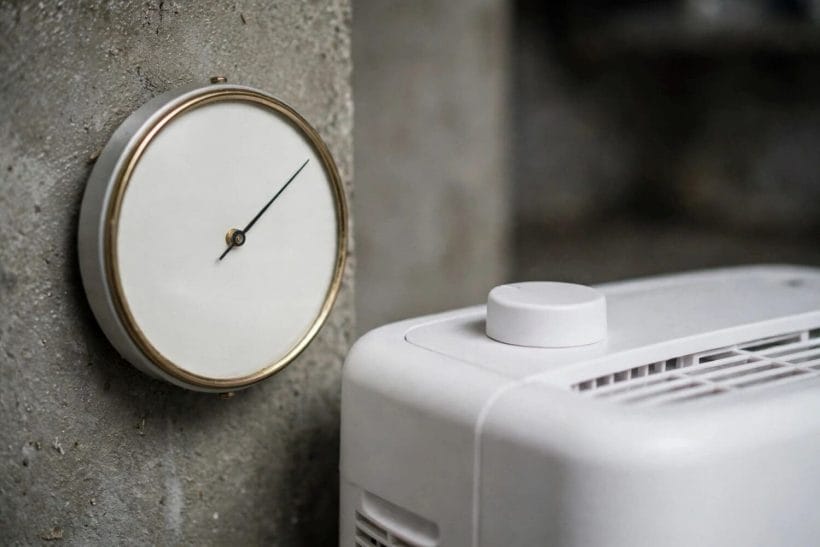
Gallery-4 pairs the two instruments of the whole subject: the gauge that tells the truth and the dial that holds the line. Targets are stated generally in this guide, as they should be — the right level for a given home is the one its own evidence supports.
13. Aim for the comfortable middle
Homes are held in a middle band of humidity: dry enough that condensation stops forming on the coldest surfaces and stored things keep, moist enough that timber, instruments and throats are not parched. The practical target is found by the room itself — lower the setting until window condensation disappears on cold mornings, then hold there, rather than chasing the driest number the machine can reach.
14. A humidistat is the autopilot
Units with a built-in humidistat switch themselves to hold the set level; without one, the machine runs until someone remembers it. For any permanent installation the automatic control is close to essential — it is what turns an appliance into a system.
15. Seasons change the setting
Summer air arrives loaded; winter air arrives dry and the home’s risk shifts to condensation on cold glass. Expect to adjust the target with the seasons and to re-check after changes — a finished basement conversion, new windows, a sealed crawl space — because every change moves the balance the setting was found for.
7. Placement and Airflow
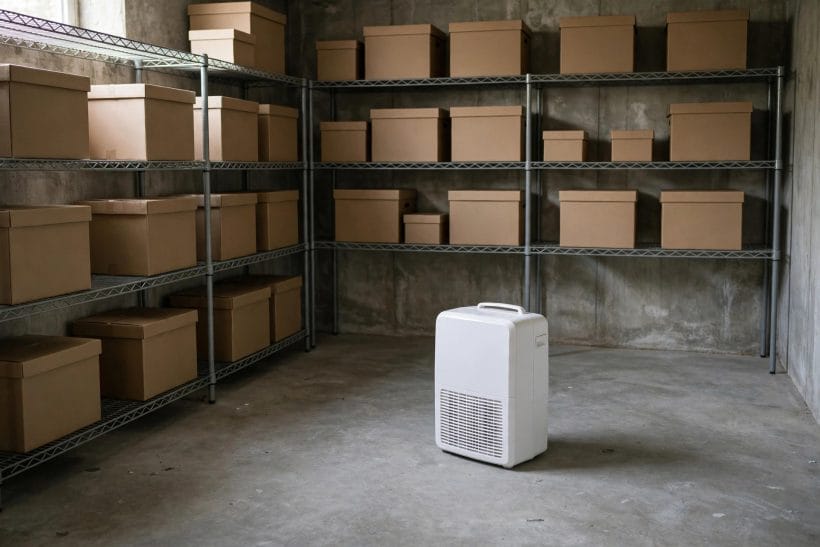
The corner in gallery-5 holds the usual temptation — the unit pushed among the stored boxes it is meant to protect. Placement decides how much of the room’s air the machine ever meets, and it is free to get right.
16. Central, clear and level
Place the unit where the room’s air gathers, with open space at its intake and outlet, on a level floor so its drainage and cut-off switches behave. A unit hemmed into a corner dries that corner heroically and the room hardly at all.
17. Work with the room’s own air movement
Warm moist air rises from showers and kitchens; cool damp air settles in below-ground rooms. The machine belongs where the damp collects, not where the damp is made — and connecting the two (an extractor at the source, the dehumidifier in the reservoir) is the system thinking this guide keeps returning to.
18. Cold rooms are harder rooms
Refrigerant dehumidifiers lose their powers as rooms grow cold — their coils frost and rest — which is why genuinely cold spaces (unheated basements, garages, crawl spaces in winter) are a recognised special case: desiccant-type units and purpose-built crawl-space machines exist for exactly this duty. State your room’s winter honestly when choosing; the standard unit’s fine print already has.
8. The Space Itself: Ground, Vents and Outside Water

The pin looks under the house, where the guide’s argument ends: the ground a home stands on is either exporting moisture into it or has been taught not to. No machine outruns its building, and this section is the building’s half of the bargain.
19. Ground moisture and vapour barriers
Bare earth beneath a floor evaporates water into the home continuously. In crawl spaces, a ground vapour barrier — the ground covered fully, as a system with the space’s vents and drainage — is the established countermeasure, and in basements the equivalent thinking applies to floors and walls. It is building work, assessed for the specific house, and it reduces the machine’s job from hopeless to modest.
20. Keep outside water outside
Gutters that overflow against the wall, ground that slopes toward the house, downpipes discharging at the foundation — each is a moisture source no indoor machine should be asked to forgive. The water-management thinking is the same as the slope-drainage discipline in building a house on a hillside: water is directed, by design, away from the structure, or it arrives inside on its own schedule.
21. Foundation vents: two schools, honestly stated
Traditional crawl spaces vent to the outside; sealed and conditioned crawl spaces close the vents and manage the air mechanically. Both schools have their climates, their codes and their evidence, and local practice and rules decide between them — this guide takes no side, beyond insisting the choice be one system or the other, never an accidental mixture of half of each.
9. Running and Caring, in General Terms

Gallery-6 shows the whole maintenance contract in one gesture: a filter, lifted out by hand. Dehumidifiers are honest machines — their care is minutes, their neglect is visible in the hygrometer within a fortnight.
22. Filters, coils and the water path
Wash or replace the air filter on the maker’s rhythm, keep the coils dust-free, and flush the drain line before it teaches you why. A machine breathing through a clogged filter is a smaller machine than you bought, at the same running cost.
23. Running costs, stated generally
A dehumidifier is a modest electrical load run for long hours; the honest way to think about its cost is against the alternative — damp stored goods, spoiled finishes, a finished room unusable — and against its own efficiency: a correctly sized unit that reaches its target and rests costs less than an undersized one that never stops. Energy labels and the maker’s figures, checked at purchase, carry the specifics.
24. The machine that never rests is sending a message
Constant running after the first settling weeks means one of three things: the source was never fixed (§2), the unit is undersized (§4), or its drainage or filter has quietly failed (§5, point 22). Treat the behaviour as a diagnosis prompt, not as diligence — and re-run the guide’s checks in order.
10. Buying Checks and the Professional Line
The final section gathers the purchase itself into the same what-to-check discipline, and draws the line — clearly — between the owner’s shopping and the professional’s work.
25. The showroom checks
Handle the unit: the bucket’s size and how it lifts out, the hose connection’s position, the control’s legibility, the filter’s access, the noise at arm’s length (it will live in your home’s quiet rooms’ neighbourhood). Check the drainage story the box is actually offering — bucket only, hose included, pump built in — against §5’s plan for your room.
26. Paperwork: warranty, ratings and returns
Confirm the warranty’s length and what it asks of you, that the capacity rating follows the recognised test standard named on the label, and the retailer’s returns terms if the room defeats the first choice. Keep the paperwork with the home’s documents; dehumidifiers outlast memories.
27. When the job is a professional’s
Standing water, structural damp, drainage design, anything electrical beyond a socket, and any installed system (§3) belong to qualified trades working to local codes — as does any established mould or damage assessment, which this guide has deliberately never attempted. The owner’s expertise is the checklist; the professional’s is the cure. Knowing which side of that line a problem sits on is the real skill this guide teaches.
Final Considerations
Dry the source before the air, size the machine to the measured room, give its water somewhere to go forever, and hold a sensible middle humidity with an automatic control. Work in that order and dehumidification stops being a product category and becomes what it should be: a quiet property of a well-kept home, checked twice a year and thought about hardly at all.



0 Comments