

A television asks very little of a room — a wall, a socket, somewhere to sit. The stand beneath it is where the room’s character gets decided: the long walnut credenza, the floating oak shelf, the barn-door cabinet swallowing every cable and console in the house.
These seventy-five living room TV stand ideas collect the furniture that carries the screen — low modern benches, floating consoles, corner cabinets, built-in walls, rustic reclaimed pieces — with the layouts, styling and storage sense that make the TV corner the calmest part of the room.

1. Living Room TV Stands at a Glance
Scope first, because the TV corner has several owners. This post is about the stand itself — the furniture the screen stands on, floats above or sits within. The full wall composition belongs to media wall living room ideas, and the screen itself — its size, height and placement — is covered by living room TV ideas. Style families are linked where they meet: modern living room ideas for the minimal end, traditional living room ideas for the formal one. Here, everything is the stand: its form, its storage and the styling that settles it into the room.
One discipline runs through every section: the stand is furniture first. It must be wider than the screen it carries, deep enough for the equipment it hides, and finished like something chosen — because in most living rooms it is the single most-looked-at piece of furniture in the house.
The stand’s dimensions deserve their reputation as the boring decision that decides everything else. Width is the visible one — a stand narrower than its screen looks like a stool under a wardrobe, and one modestly wider reads as a stage. Height is the comfort one: the screen’s centre belongs near the eye level of a seated viewer, so a low stand under a wall-mounted screen, or a modestly taller one under a screen that sits on its surface, is chosen by the sofa’s seat height more than by taste. Depth is the hidden one, settled by the deepest box that must disappear inside — measure the equipment, not the catalogue photograph, and leave air behind it. Get those three numbers right and almost every style in this post becomes available; get them wrong and no style will rescue the corner.
Materials follow the same practical order. Timber and veneer bring warmth and repair well; painted finishes let the stand match the room’s woodwork exactly; glass and metal lighten the visual load in small rooms at the price of showing every fingerprint and cable. There is no hierarchy among them — only the match between the material, the room’s light and the household’s tolerance for dusting.
| Stand form | Character |
|---|---|
| Low-profile bench | Long, low and minimal — the screen floats visually above it |
| Floating console | Wall-hung, floor kept clear, the smallest-room friend |
| Corner cabinet | Turns a dead corner into the room’s focal point |
| Built-in media wall | Stand, shelving and storage composed as one joinery |
| Credenza | Closed storage with furniture presence — mid-century to rustic |

2. Low-Profile Modern Stands

The black bench in gallery-1 is the modern stand reduced to essentials: one long, low volume, the screen above it, nothing competing. Low stands work because the eye reads them as a horizon — the room arranges itself along the line and the television stops feeling like an appliance and starts feeling like a picture window.
1. The long black bench
A matte black bench under a big screen is the contemporary default for good reason: black recedes, the screen’s own black glass continues the line, and colourful rooms can change around it forever without the stand ever arguing back.
2. White on white
A white stand against a white wall in a bright room nearly disappears, leaving the screen floating in light. It is the stand for rooms where the view out of the window, not the television, is meant to be the picture.
3. Low and leggy
Short tapered legs lift a low stand just enough to show floor beneath it, and that shadow gap is what keeps a long piece from feeling like a block. The room reads larger because the floor plane runs unbroken.
4. The slab on a plinth
A thick timber or stone slab on a recessed plinth gives the stand architectural weight without height. It suits screens that sit on the surface rather than the wall, and it never wobbles, visually or otherwise.
5. Two benches, one line
Two identical low benches pushed together make a stand of any length, and the pair can split later — one under the TV, one as a sideboard — when the room changes. Modularity disguised as minimalism.
6. Open-shelf minimalism
An open frame stand with a single shelf keeps equipment visible and ventilated. It demands tidy kit and few boxes; given both, it is the lightest-looking stand of all, and the easiest to dust around.
7. The soundbar ledge
A stand designed with a shallow top ledge gives the soundbar its own shelf, centred under the screen and clear of the cabinet doors below. Sound and storage stop competing for the same surface.
8. Handle-free fronts
Push-latch doors and drawer fronts without handles keep the low stand’s line unbroken. In a modern room the absence of hardware reads as calm; the mechanism is invisible until the moment it is used.
9. Low stands in dark rooms
In a media room or snug painted deep colours, a low dark stand lets the screen be the only light source that matters. The furniture disappears at film time, which is precisely the point.
3. Floating Consoles
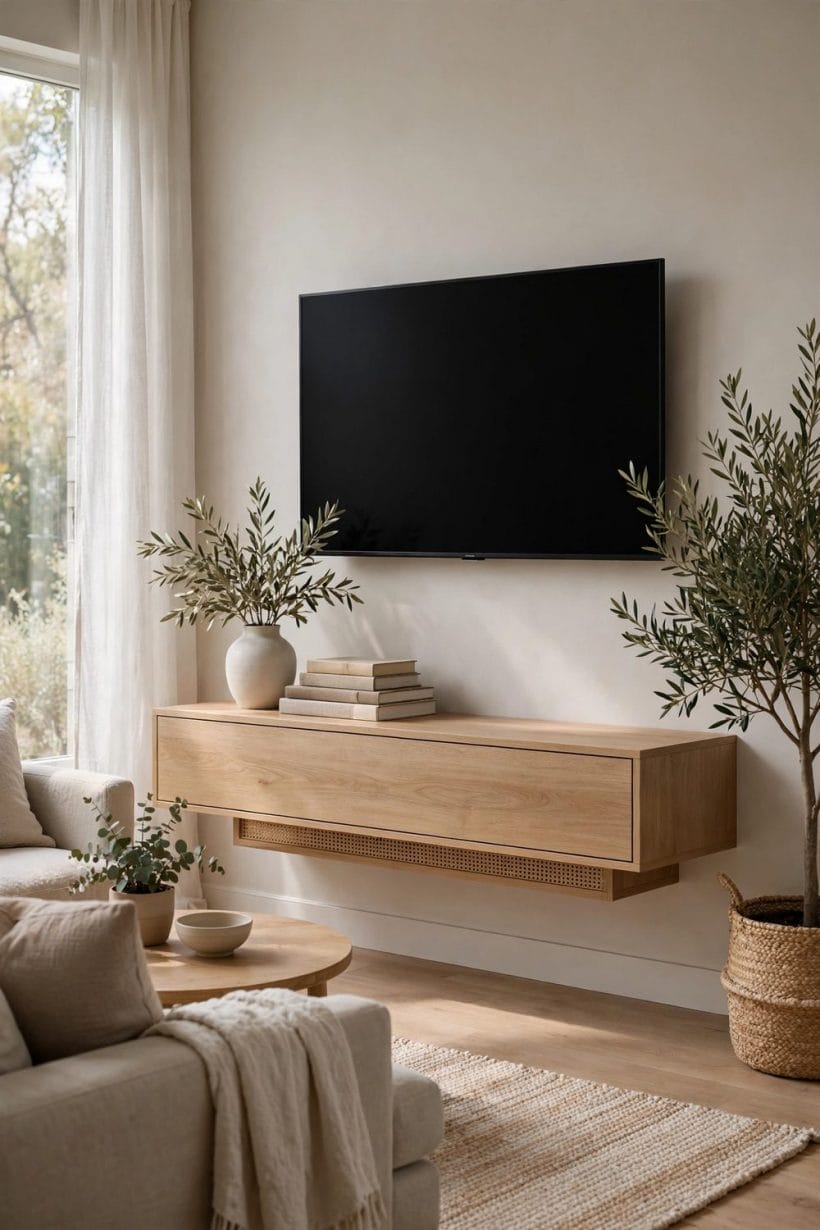
The pin shows the floating console at its best: a pale oak box hung beneath the screen, floor completely clear below, a plant and a stack of books its only cargo. Floating stands trade storage volume for air — and in small rooms, air is the more valuable currency.
10. The single floating box
One wall-hung cabinet, centred under the screen, is the whole idea. Everything else — the clear floor, the easy vacuuming, the sense of space — follows from that one decision to lift the furniture off the ground.
11. Floating with a dropped shelf
A console with an open shelf beneath the closed cabinet gives remotes and a games controller a landing strip that is neither hidden nor displayed — the everyday objects live in the shadow line.
12. Asymmetric floats
Hang the console off-centre, longer on one side, and the composition gains movement: screen centred on the wall, storage reaching toward the reading chair. Symmetry is safe; a deliberate offset is designed.
13. The floating corner run
Two floating cabinets meeting in an L turn the corner trick (section 4) weightless. The corner of the room becomes storage without a single leg touching the floor.
14. Float and floor lamp
With no legs and no floor cabinet, the space beside a floating console belongs to a floor lamp or a tall plant. Vertical accents at each end frame the screen the way curtains frame a stage.
15. Hidden-cable floats
The floating stand’s one non-negotiable is cable discipline: power and signal must run inside the wall or in a paint-matched channel, because a dangling cable under a floating box undoes the entire effect.
16. Floating in the bedroom-adjacent studio
In studio flats and guest suites, a floating console keeps the TV zone weightless enough to share space with a desk or dressing table. One wall does two jobs without either feeling squeezed.
17. The double float
Two slim floating shelves at staggered heights — equipment on the lower, the screen above the upper — replace the cabinet entirely. It is the stand as pure line, for rooms that take minimalism seriously.
4. Corner TV Stands
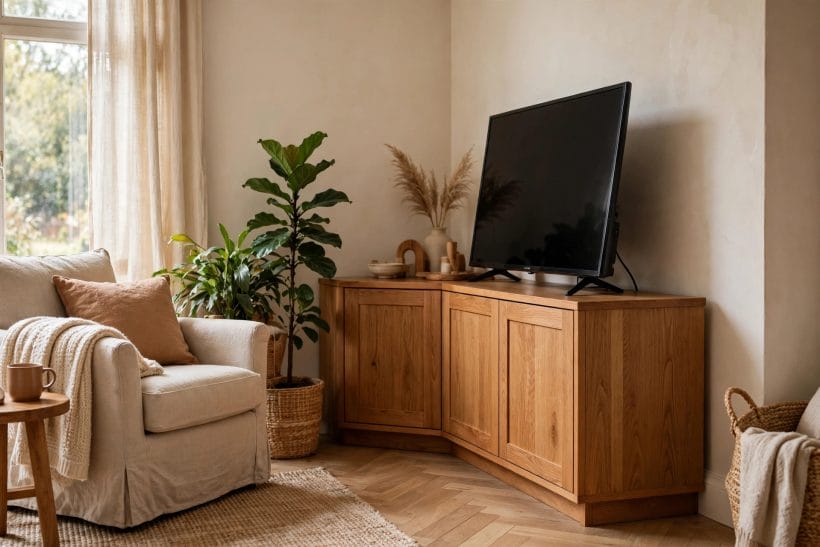
Gallery-2’s oak cabinet sits angled across the corner, turning the room’s most wasted wedge into its focal point. Corner stands earn their place wherever the seating faces a corner — older houses, odd-shaped rooms, anywhere the straight wall is already spoken for.
18. The angled cabinet
A cabinet cut or placed at forty-five degrees across the corner aims the screen at the room’s centre, where the sofas actually are. The dead triangle behind it swallows cables and rarely touched equipment.
19. The true corner wedge
Wedge-shaped stands built for the corner leave no wasted gap at all. In a small room, reclaiming that triangle can be the difference between a TV zone and a TV squeeze.
20. Corner stand, swivel screen
Mount the screen on a swivelling bracket above a fixed corner cabinet and the same TV serves the sofa by day and the dining table by night. The cabinet anchors; the screen travels.
21. Fireplace-corner diplomacy
Where a fireplace owns the main wall, the corner stand is the peace treaty: fire keeps its wall, the screen takes the corner, and neither has to pretend the other isn’t there.
22. Tall corner units
A corner cabinet with shelving rising above the screen uses the corner’s full height — display shelves where the walls meet, storage below, the television held between like a picture in a frame of books.
23. The corner reading hybrid
Pair a corner stand with an armchair angled beside it and the TV corner doubles as the reading corner: one lamp, one chair, two pastimes sharing the room’s quietest wedge.
24. Corner stands in square rooms
Square rooms have no obvious TV wall; the corner stand gives them one. Seating arranged diagonally feels deliberate rather than compromised once the screen commits to the corner.
25. Painted corner cabinets
A corner cabinet painted to match the walls nearly vanishes, leaving the screen and its styling to carry the corner. It is the modest option, and in busy rooms often the wisest.
5. Built-In Media Walls and Full-Length Joinery

The built-in in gallery-3 is the stand grown into architecture: cabinets below, shelves above and beside, the screen recessed into the composition’s centre. Where a media wall is planned as a whole it belongs to its own post (linked in section 1) — here the focus is the stand’s role inside the joinery.
26. Cabinets below, shelves above
The classic media-wall section — closed cabinets at the base, open shelves above — puts storage where hands reach and display where eyes rest. The stand becomes the wall’s ground floor.
27. The recessed screen bay
Building the screen into a shallow recessed bay, flush with the surrounding joinery, gives the television a frame and the wall a centre. Off, it reads as panelling; on, as a window.
28. Symmetry around the screen
Matching shelf towers on both sides of the screen give formal rooms their balance. Books and objects can be arranged as loosely as liked; the architecture underneath keeps the order.
29. The library media wall
When books outnumber boxes, let the shelves dominate and the stand shrink to a simple cabinet under the screen. The room stays a library that happens to show films, not the reverse.
30. Joinery in one material
Running stand, shelves and wall panels in a single timber makes the whole composition read as one gesture. Mixed materials can work, but unity is what separates built-in from merely built-alongside.
31. The window-seat media wall
Extend the base cabinets into a window seat at one end and the media wall gains a second life: reading in daylight, films after dark, one continuous piece of joinery serving both.
32. Sliding panels over the screen
Panels that slide across the screen bay hide the television entirely when the room wants to be a sitting room. It is the old armoire trick, rebuilt flat and modern.
33. Built-ins in rented rooms
A freestanding shelving system arranged as a media wall gives renters the composition without the carpentry. When the tenancy ends, the wall packs flat and moves with its owner.
6. Credenzas with Character: Fluted, Slatted and Mid-Century

Gallery-4’s fluted walnut credenza — soundbar above, vinyl beside — is the stand as furniture with a past and a texture. Credenzas are where TV stands stop apologising: pieces with legs, grain and fronts worth looking at when the screen is dark.
34. The fluted front
Vertical fluting catches light in stripes and hides door divisions inside the rhythm. A fluted credenza has texture at conversational distance and calm at screen distance — both rooms served.
35. Mid-century tapered legs
The mid-century sideboard — warm wood, splayed legs, sliding doors — is the most borrowed furniture form in TV history, because it was designed for exactly this: handsome storage at sitting height.
36. Slatted doors that breathe
Slatted or louvred fronts let air reach warm equipment and let remote signals through, solving the closed-cabinet problem with joinery instead of gadgetry. The stripes are the style and the ventilation.
37. The record-player credenza
Give the turntable the credenza’s top beside the soundbar and the stand becomes the music cabinet too. Vinyl storage below, screen above — two eras of entertainment in one piece.
38. Two-tone credenzas
A painted frame with timber doors, or timber frame with painted doors, lets a credenza mediate between the room’s wood tones and its wall colour. It is the diplomat of the TV wall.
39. The long dresser conversion
A bedroom dresser or sideboard of the right height converts to a TV stand with nothing but a cable hole drilled at the back. Antique pieces earn a second career and the room gains a story.
40. Brass and cane
Cane-webbing doors with brass details bring the holiday-house softness of rattan to the TV wall. Behind the cane, equipment hides in dappled shadow; remotes still work through the weave.
41. The credenza as room divider
Back a credenza to a sofa in an open-plan room and it divides living from dining while carrying the screen on the living side. Finished backs matter here — the dining side must look intentional.
7. Small-Room and Apartment Stands

The compact stand in gallery-5 — white frame, glass shelf, small screen — knows its room cannot spare depth. Small-room stands are a discipline of centimetres: shallow cabinets, light colours, storage that works vertically, and nothing on the floor that doesn’t have to be there. For the wider small-room picture, see small living room ideas.
42. The shallow cabinet
A slim-depth cabinet gives up the rarely used deep storage and keeps the floor. Most equipment is shallower than furniture tradition assumes; the stand should be sized to the kit, not the custom.
43. Glass shelves, light frame
Glass and pale metal carry the screen without visual weight. In a small room the stand should be felt as little as possible — a shelf that happens to hold a television.
44. The stand on wheels
A rolling stand turns one screen into a servant for the whole flat: films at the sofa, recipes in the kitchen, matches on the balcony. Castors are unfashionable until the first time they are needed.
45. Folding and flip-top stands
Stands that fold flat, or whose top flips to a table, suit rooms that change jobs daily. The TV corner assembles for the evening and the room returns to work by morning.
46. Under-window stands
The low wall under a window is often a small room’s only free run. A low stand there keeps the screen out of the light’s worst glare and leaves taller walls for storage and art.
47. The ladder-shelf stand
A leaning ladder shelf with the screen on its wide lower tier gives display space above and equipment below in one narrow footprint. It is the stand for renters and the storage-starved.
48. One stand, two rooms
In bedsits, a stand placed between bed and sofa — screen on a rotating mount — lets one television serve both ends of the room. The furniture stays put; the picture turns.
49. Stacked cubes
Storage cubes stacked as a stand build storage and screen support in a single gesture, rearranged as collections grow. It is the least formal stand here and, for first flats, often the most honest.
8. Rustic and Reclaimed Wood Stands

The pin’s weathered cabinet — baskets below, candles lit beside the sofa — shows what rustic stands do that sleek ones can’t: they make the newest object in the room feel at home among old ones. Reclaimed timber forgives the screen its century.
50. The barn-door cabinet
Sliding barn doors on a chunky frame hide equipment behind the farmhouse’s favourite door. The doors slide rather than swing, which in tight rooms is as practical as it is picturesque.
51. Reclaimed scaffold and beam timber
Stands built from old scaffold boards or beams carry dents with honour. Against their weathered grain, a black screen reads as just another dark rectangle in a room full of them.
52. The farmhouse dresser base
A pine dresser base — drawers, cupboards, a top worn by a century of use — is the rustic stand already built. Its storage was designed for linen and cutlery; consoles and games fit it just as well.
53. Baskets below
Open lower shelves filled with baskets give the rustic stand its soft storage: blankets, games, the children’s clutter, each in a basket that lifts out. The look is tidy without a single door.
54. Black iron and rough wood
Iron legs, hinges and handles on rough-sawn timber make the industrial-farmhouse stand: heavy, honest, and indifferent to knocks. It suits rooms with beams, stoves and dogs.
55. The cabin stand
In a cabin or lodge room, a stand of stacked-log or rough-board construction keeps the television from breaking the spell. The screen is the guest here; the timber is the resident.
56. Whitewashed rustic
Limewash or white paint over old timber softens the rustic stand for coastal and Scandinavian rooms — the grain shows through, the heaviness doesn’t. Rustic manners, light dress.
57. Trunk and chest stands
A stout blanket chest or steamer trunk under the screen stores the room’s blankets in the furniture that holds its entertainment. Two storage problems, one handsome box.
58. Live-edge tops
A live-edge slab as the stand’s top keeps the tree in the room. The wavy edge under a rectilinear screen is the contrast that makes both look better.
59. Rustic stands in modern rooms
One rough piece in a smooth room is a classic recipe: the reclaimed stand warms a modern interior the way a single antique warms a white kitchen. Keep everything else quiet and let it speak.
9. Closed Storage, Cables and the Tidy Front

Gallery-6’s dark cabinet stands with a door slid open: folded blankets, stacked boxes, everything in its compartment. This is the stand’s unglamorous half — where consoles, chargers, routers and remotes actually live — and the half that decides whether the TV corner feels calm or cluttered.
60. Doors on everything
The simplest tidy-front rule: if it has a light, a cable or a logo, it lives behind a door. Closed storage is why some TV corners look serene in photographs and others never do.
61. The cable channel
A channel or raceway down the stand’s back, with one power strip inside the cabinet, turns the cable nest into a single managed run. Every tidy stand in this post is secretly this idea.
62. Ventilation without fans
Closed cabinets need air: slatted backs, mesh panels or simply an open back against the wall. Equipment that breathes lasts longer and the cabinet stays a cabinet, not an oven.
63. The charging drawer
A shallow drawer fitted with power turns the remote-and-tablet sprawl into a drawer that closes. Charge inside, close the drawer, and the stand’s top stays clear for better things.
64. Router diplomacy
The router wants height and air; the room wants it invisible. A stand’s top shelf behind a woven or slatted door is the usual treaty — signal passes, blinking lights don’t.
65. Labelled baskets inside doors
Inside a big cabinet, small labelled baskets keep cables, controllers and manuals findable. Closed storage only works if opening the door doesn’t reveal a different kind of mess.
66. The remote’s home
A tray, a small bowl, a slot in the stand’s top — remotes with an assigned home stop migrating into the sofa. Every stand should be designed with the remote’s parking space included.
67. Sound without sight
Speaker fabric fronts and acoustically open weaves let a soundbar or centre speaker live inside the cabinet invisibly. The room hears cinema and sees furniture.
10. Styling the Stand and Around It
The stand is chosen, the cables are buried — what remains is the surface. Styling a TV stand is composition under a constraint: the screen takes the centre and the height, and everything else must arrange itself in the margins without competing. Rooms that do this well, like the farmhouse living room ideas in the wider collection, treat the stand’s top as a mantelpiece: a few considered objects, changed with the seasons, never a crowd.
68. The rule of three objects
One stack of books, one plant, one object with a story — three groupings are all a stand’s top can hold beside a screen. More becomes a shelf sale; fewer leaves the stand looking unpacked.
69. Height at the ends
A lamp or tall plant at one or both ends of a long stand frames the screen and lifts the composition. The ends are where height belongs; the middle belongs to the picture.
70. Books lying down
Horizontal stacks of books give the stand’s top its architecture — low platforms other objects stand on. Spines inward or outward is taste; flat is the rule.
71. A tray for the small things
A shallow tray corrals the remote, the coasters and the candle into one composed group. Trays turn scattered objects into a vignette at zero cost.
72. Art above, screen below — or neither
If the screen is wall-mounted, the stand below can carry low art leaning against the wall instead of objects standing. Never hang art above a mounted screen; two pictures compete and both lose.
73. Plants that forgive shade
The stand’s ends are often the room’s dimmest spots. Choose plants that forgive low light, or use dried stems and grasses, which ask nothing and last for seasons.
74. Seasonal swaps
Change two objects with the season — candles in winter, shells or a jug of branches in summer — and the TV corner stays awake. The stand is the room’s mantelpiece; treat it as one.
75. Leave the middle empty
The final discipline is emptiness: the surface directly under the screen stays clear. Soundbars excepted, nothing should stand between the viewer and the picture’s lower edge. Calm is a styling choice.
Final Considerations
Match the stand to the screen’s width, the room’s size and the household’s honest storage needs, in that order. A stand slightly too large reads as generous; one slightly too small reads as a mistake every single day. Whatever form you choose — floating, corner, credenza or built-in — bury the cables, close the storage and style the top with restraint. Do that, and the largest black rectangle in the house becomes just another well-furnished wall.


0 Comments