

Weight decides almost everything about a tiny house on wheels: the trailer it sits on, the vehicle that tows it, and whether the finished home is safe to move. If you are asking how much does a tiny house weigh, the honest answer is that the figure comes from your build choices, not from a brochure.
This guide breaks the total down by size, build and trailer, so you can plan a house that stays safely below its limit.
1. Tiny House Weight at a Glance
Every tiny house weight total is a sum, not a guess. The trailer sets the ceiling, the structure and materials build the running total, the systems and finishes add quiet load on top, and a safety margin decides whether the finished house tows calmly or constantly pushes its luck. The summary below follows the weight drivers in this guide’s infographic, because those drivers are where the total is really decided.
| Weight driver | At a glance | What it means for your build |
|---|---|---|
| Trailer | GVWR is the ceiling | The finished house must stay under the trailer’s gross vehicle weight rating, so the trailer is chosen before the build begins. |
| Framing | Wood vs steel adds up | Frame material changes the running total early, long before finishes and furniture go in. |
| Systems | Water and batteries weigh | Tanks, batteries and appliances add heavy, easy-to-forget load that brochures rarely mention. |
| Finishes | Tile and stone are heavy | Beautiful surfaces carry a real weight cost, so they need planning rather than impulse. |
| Margin | Leave room below max | A safety margin protects towing, braking and the structure on every single trip. |
The key factors behind the table are the trailer rating, the length of the house, the materials chosen, and the tow vehicle that has to move the finished weight. Change any one of them and the whole calculation changes with it, which is why weight is a design decision made at the start of a project rather than a surprise discovered at the end of one.
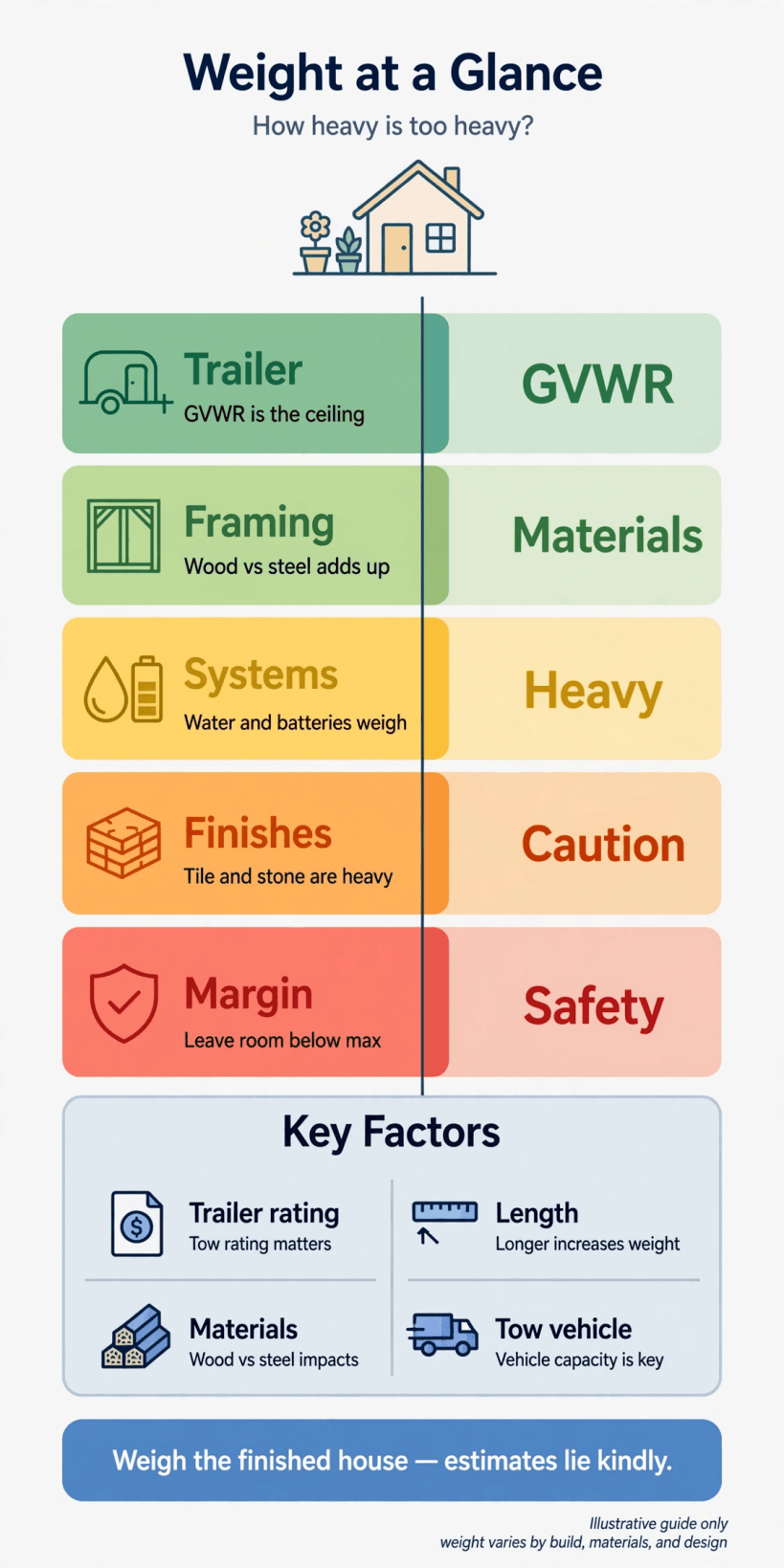
Weight at a glance: the trailer sets the ceiling, framing and systems add the load, finishes need caution, and a safety margin keeps the finished house towable.
2. Why Weight Matters Before Anything Else
Weight is the one specification that touches safety, legality and money at the same time. A house that runs too close to its trailer’s ceiling tows poorly, brakes late and stresses its frame, axles and tyres on every journey. A house that stays comfortably within its limits feels calm behind the tow vehicle, and that calm is what makes moving home a routine task instead of a white-knuckle event that everyone dreads repeating.
The total also shapes paperwork. Classification, registration and insurance all pay attention to what a tiny house is and how it travels, and lenders do the same when they decide how a purchase fits their products. Planning the build and the budget together helps, and our guide to how to get a tiny house built, from first sketch to finished shell, walks through that sequence, while the financing side is covered in how to get a loan for a tiny house. Decide the weight first and those later conversations become much simpler, because everyone is working from a house that was designed to move legally and safely from day one.
3. The Trailer Sets the Ceiling
The trailer is the foundation, the chassis and the legal ceiling of the whole project rolled into one. Its gross vehicle weight rating — the GVWR in the infographic — is the maximum the trailer, house and everything inside it may weigh together. That single rating is why experienced builders start with the trailer and design upward from it: the rating decides how much structure, system and finish the project can honestly carry.
A trailer built specifically for tiny houses spreads load along the frame, places the axles where the finished house will balance, and leaves sensible room for the tongue weight that keeps towing stable. A borrowed or undersized trailer does the opposite, forcing compromises into every later decision. Treat the trailer as part of the architecture rather than a delivery accessory, check its rating plate before money changes hands, and remember that the ceiling it sets includes water, belongings and people travelling inside the plan — not just the empty shell photographed on delivery day.

4. Framing and Structure: Wood Versus Steel
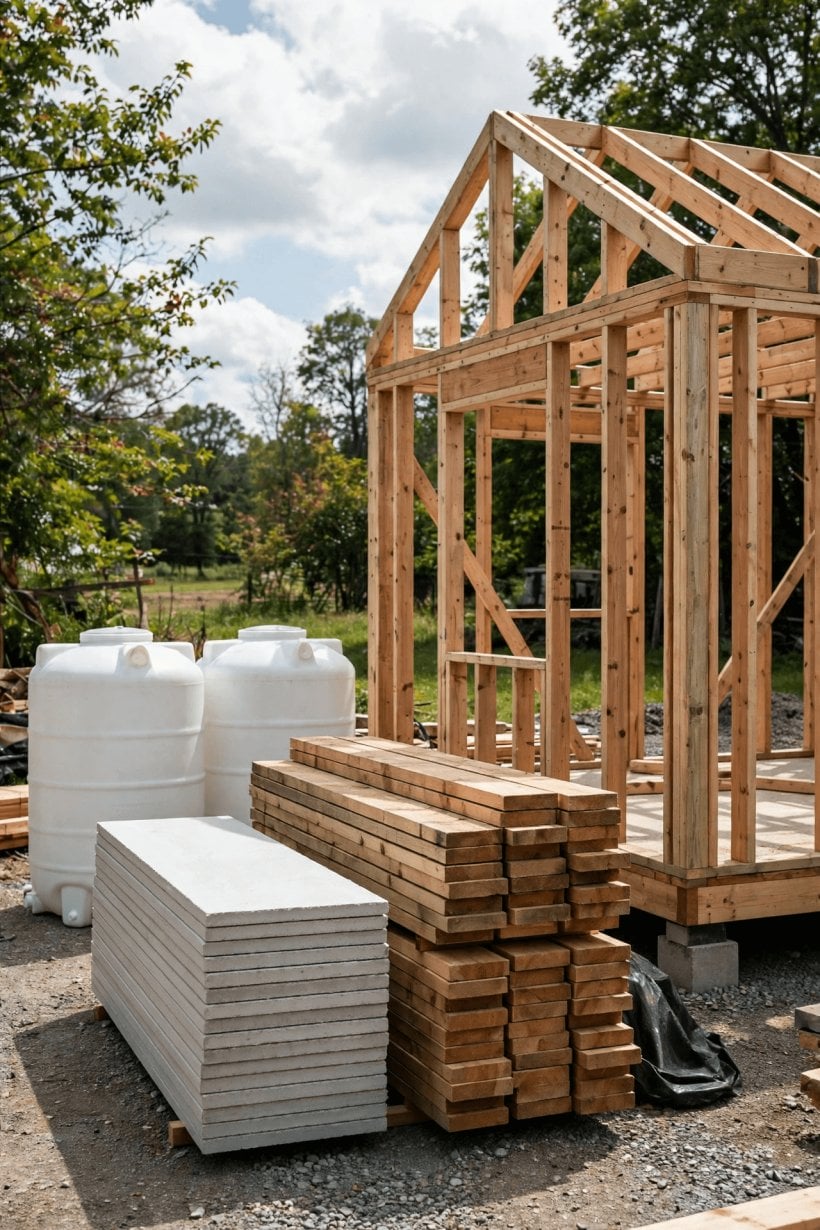
Once the ceiling is set, framing starts spending it. Traditional timber framing is familiar, forgiving to work with and easy to repair, while steel framing offers slim, straight members and a different balance of strength to weight. Neither is automatically lighter in a finished wall, because sheathing, insulation, cladding and roofing all add their own share on top of the skeleton, and it is the complete assembly — not the catalogue weight of a single stud — that the trailer ultimately carries.
This is where a good builder earns their fee, weighing assemblies as the design develops instead of discovering the total at the end. When you compare approaches, our guide to choosing tiny house builders in Connecticut shows the kinds of questions that reveal whether a builder tracks weight honestly. Ask how the frame, skin and roof combine, what the design assumes for cladding, and where the build can save load without losing strength. Small savings repeated across walls, roof and floor add up to real margin, and margin, as the later sections show, is the most useful thing a finished house can own.
5. Systems That Carry Hidden Weight
Systems are the stealth weight of a tiny house. Water is the classic example: a full fresh tank, a grey tank on its way to full, and a water heater holding its charge together add far more than most first-time builders expect, and every drop of it travels with the house. Batteries run a close second, because a serious off-grid bank is dense, concentrated load that also has to sit where it does the least harm to balance.
Appliances and heating add their share too. A full-size fridge, a washer, a wood stove with its hearth materials, and air conditioning all look harmless on a floor plan and all arrive with real mass. None of this argues against comfort; it argues for honesty. List every system the house will carry, treat full tanks and full storage as the normal case rather than the exception, and let the total influence the trailer and layout decisions early. A house designed around its true travelling weight never has to choose between carrying water and travelling safely.
6. Finishes, Fixtures and the Pretty Weight
Finishes are where weight creeps in disguised as beauty. The infographic flags this plainly: tile and stone are heavy. A tiled shower, a stone worktop and a solid timber floor can transform how a tiny interior feels, and each of them spends margin that structure and systems may already have claimed. The answer is rarely to ban beautiful materials; it is to place them deliberately, in smaller areas, over properly supported structure, and balanced against lighter choices elsewhere.
Lightweight alternatives have become genuinely good. Sheet and panel systems that mimic tile, slim engineered worktops, and vinyl or cork flooring can deliver most of the look for a fraction of the load, freeing budget for the one or two places where the real material matters most. Cabinets, doors and built-in furniture deserve the same thinking, because solid joinery throughout a whole house is another quiet total. Design the interior as a weight budget as well as a style board, and the finished room will look considered rather than compromised — because it was planned, not rationed.
7. Size, Length and Layout
Length is the most visible weight driver of all: longer houses need longer trailers, more framing, more cladding, more roofing and more of almost everything, so the total climbs with every extra stretch of floor plan. The infographic lists length as a key factor for exactly this reason. That does not make longer houses wrong — for full-time families they can be the honest answer — but it means the decision to go longer should be made with the trailer rating and tow vehicle already in view.
Layout spends weight as surely as length does. Lofts add structure and access, bump-outs add framing and skin, and spreading heavy rooms — bathroom, kitchen, water storage — along the house affects balance as much as total. Concentrating the heavy, wet rooms sensibly, keeping dense storage low and near the axles, and avoiding heavy features at the far ends all help the finished house tow straight and steady. Draw the plan, then draw it again as a weight map: where the load sits matters almost as much as how much of it there is.
8. Weighing the Finished House
However carefully a build is estimated, the infographic’s closing advice stands: weigh the finished house, because estimates lie kindly. A trip to a public weighbridge turns guesses into facts — the total, the load carried by the axles, and the tongue weight that the tow vehicle’s hitch has to manage. Those three readings tell you whether the house sits inside its ceiling, how it will behave behind the vehicle, and how much room remains for belongings, water and travel supplies.
Ask about weighing before the build is finished, not after. Reputable builders expect the question, and the state guides in this series, including choosing tiny house builders in Oklahoma, show how to raise it when you compare quotes. Weigh the house as it will actually travel, then weigh it again after major changes — new batteries, a different stove, a rebuilt interior — because each change rewrites the total. Keep the weigh ticket with the house paperwork; it is the single most useful page in the file when you insure, register, sell or simply plan the next move.
9. Leave a Safety Margin
The last row of the at-a-glance table is the one that protects all the others: leave room below max. A house weighed at its ceiling in the builder’s yard is already overweight in real life, because real life adds full tanks, food, clothing, tools, books, bikes and people. Margin is what absorbs all of that without turning every trip into a calculation, and it is also what absorbs the small estimating errors that even careful builds contain.
Margin has a financial side as well. A house that travels legally inside its ratings is easier to finance, insure and sell, which is why the lending picture in tiny house mortgages and how lenders classify these homes rewards documented, sensible builds — and why a documented weight also strengthens your hand at resale time, as our guide to how to sell a tiny house when it is time to move on explains. Build the margin in on paper, defend it during the finishes conversation, and check it again at the weighbridge. It is invisible in photographs and priceless on the road.
10. Matching the House to a Tow Vehicle
The final key factor is the tow vehicle, because vehicle capacity is key. A vehicle must do far more than pull the house along a flat road: it must carry the tongue weight on its hitch, brake the combined outfit in an emergency, stay composed in crosswinds, and climb and descend without drama. A house and vehicle that are well matched feel unremarkable on the road, and unremarkable is exactly what towing a home should feel like.
Match the outfit honestly. Compare the weighed house — not the estimated one — against what the vehicle is rated to tow and carry, allow the same margin philosophy on the vehicle side as on the trailer side, and be wary of any combination that only works on paper in perfect conditions. If the pairing looks marginal, the fix is a lighter build or a stronger vehicle, never optimism. The related question of whether you can get a home loan for a tiny house often turns on the same honest paperwork, so keep the weigh ticket, the trailer rating and the vehicle details together from the very start.
Final Considerations
So, how much does a tiny house weigh? Exactly what your choices make it: the trailer’s ceiling, the frame and materials, the systems and finishes, and the margin you defend along the way. Weigh the finished house, keep the paperwork, and the number becomes a strength rather than a worry. If a builder will be part of the project, the same verification habits run through our guides to choosing tiny house builders in Utah and choosing tiny house builders in Illinois — ask how each candidate tracks weight, and choose the one with the clearest answers.


0 Comments