

A cord of firewood looks like a simple stack. Then someone asks what it weighs, the seller shrugs, and suddenly your truck, your trailer and your winter plans are all part of the same question.
So, how much does a cord of wood weigh? It depends, on species and seasoning above all, and the chart below is the honest starting point.
1. At a Glance: Cord Weight by Species and Seasoning
A cord is a volume, not a weight. The chart’s own footer says it best: a cord measures 128 cubic feet of stacked wood, and the weight is whatever the species and the water say it is. That single idea explains every argument ever held beside a woodpile. Two stacks can occupy exactly the same measured volume and differ enormously on a scale, because one is dense, freshly cut oak and the other is seasoned pine full of air and lightness. This guide therefore publishes the figures exactly as its chart gives them, per cord, by species and by seasoning state, and uses no other per-cord figures anywhere else.
Firewood weight sits in the same planning family as the lumber in this series, because the same truck and trailer usually haul both. The guide to how much a 2×4 weighs by length, species and moisture, the guide to how much a 2×6 weighs by length, species and moisture and the guide to how much a 2×8 weighs by length, species and moisture apply the same discipline to boards: honest ranges, set by species and moisture, planned at the heavy end.
| Species | Green, per cord | Seasoned, per cord |
|---|---|---|
| Oak | About 5,500 lbs | About 3,900 lbs |
| Maple | About 4,700 lbs | About 3,200 lbs |
| Pine | About 3,600 lbs | About 2,100 lbs |

At a glance, per cord: oak runs about 5,500 lbs green and 3,900 lbs seasoned, maple about 4,700 lbs green and 3,200 lbs seasoned, and pine about 3,600 lbs green and 2,100 lbs seasoned.
2. What a Cord Actually Is — and What It Is Not
The word cord has a precise meaning that survives a great deal of casual use. A full cord is a tightly stacked pile measuring 128 cubic feet in total volume, wood, bark and the air between the pieces included. Sellers and buyers picture it in familiar arrangements, a long low stack or a pair of rows in a truck shed, but the definition is the volume, not the shape. Any pile, in any proportions, that stacks to that volume is a cord, and any pile that does not, is not, whatever the advertisement calls it.
That is why partial measures cause so much confusion at the point of sale. A face cord, a rick and a truckload are all regional or informal quantities describing a single row or a single vehicle, and their volume depends entirely on log length and stacking. They can be perfectly fair deals, but they cannot be weighed against this chart until they are converted into the full-cord volume the chart prices. The wise buyer asks one question before money moves: how does this stack, measured honestly, compare with the full 128 cubic feet? With that answer, the table above becomes a scale you can carry in your head.
3. Species: Oak, Maple, Pine and the Density Ladder
The chart’s three species form a ladder every firewood buyer should know by feel. Oak stands at the top, a dense hardwood that grows slowly, splits with a straight grain and packs more wood fibre into every cubic foot than almost any common firewood. Maple occupies the honest middle, another hardwood, dense and well regarded, lighter than oak in the stack and in the truck while still a serious heating wood. Pine sits at the light end, a softwood whose resinous, open structure holds far less mass in the same volume, which the green and seasoned figures in the chart make unmistakable.
Species decides more than the lift. The same density that makes oak heavy in the pile makes it slow to season, generous with heat and long burning in the stove, while pine dries quickly, lights easily and burns fast and bright. Most experienced households therefore burn a mixture across a season, using the light, quick wood to start and revive fires and the dense wood to carry heat through the night. Weight, read properly, is a preview of behaviour in the firebox: the chart is not merely telling you what your trailer will carry, but what your winter will feel like.

4. Seasoning: Where the Water Weight Goes
Compare the two columns of the chart and you are looking at water. A green cord is a cord of wood plus a very large quantity of sap and moisture held in the fibres of a living tree. Seasoning is simply the long evaporation of that water after the wood is cut, split and stacked where air can reach it. As the months pass, the stack literally becomes lighter week by week, which is why every species shows a seasoned figure far below its green one, and why the gap itself is one of the most useful numbers a buyer can learn to read.
Seasoned is a state, not a date on a delivery note. Wood seasons at the speed its species, split size, climate and stack allow: dense oak is famously patient, pine comparatively quick, and any wood left in long rounds, unsplit and unstacked, barely seasons at all because its moisture has no easy path out. Bark, sun and wind all play their parts, which the next section takes up. For weight planning the rule is direct. A cord bought green must be hauled, stacked and budgeted at its green figure, however light it will eventually become, because the truck carries the water along with the wood on delivery day.
5. Stack, Bark and Log Size: The Chart’s Other Two Factors
The chart names four key factors, and two of them are easy to overlook: stack and bark. Stacking decides how much of the cord’s 128 cubic feet is wood and how much is air. A tight, well-fitted stack of straight, uniform pieces contains considerably more wood, and therefore more weight and more heat, than a loose, crisscrossed pile of crooked logs measuring the same outside dimensions. This is not a loophole but the nature of a volume measure, and it is why reputable sellers stack neatly and why buyers should look at how a cord is built before arguing about what it weighs.
Bark and log size pull in the same direction. Bark is part of the stacked volume but a small part of the useful fuel, and thick-barked species give you more of it in every layer. Large unsplit rounds pack poorly and season slowly, while wood split to a consistent size stacks densely, dries evenly and handles predictably from pile to stove. None of these factors changes the chart’s species figures, which assume ordinary, fairly stacked firewood. They explain why your particular cord, honestly measured, may sit a little either side of them, and why two cords of the same species and seasoning can still load a trailer differently.
6. A Whole Winter’s Weight: Cords in Quantity
Few households burn a single cord and stop thinking. A winter’s supply is several cords, and multiplying the chart is a sobering and useful exercise: take the figure for your species and seasoning state, multiply by the cords you intend to store and the result is the total mass that must be delivered, moved and stacked somewhere dry before the cold arrives. That total governs the delivery conversation, the siting of the wood store and the honest question of how many trips, by vehicle or by wheelbarrow, stand between the drop point and the rack.
Firewood rarely travels alone on a rural property, and its weight belongs in the same budget as the building timber this series charts. Posts come from the guide to the weight of a 4×4 post by length, species and moisture and the guide to how much a 6×6 post weighs by length, species and moisture, while beams and joists are priced in the guide to how much a 2×10 weighs by length, species and moisture and the guide to how much a 2×12 weighs by length, species and moisture. One method runs through all of them: take the published range, plan at its heavy end and let the vehicle make fewer, legal, unhurried trips.
7. Handling and Stacking a Cord Safely
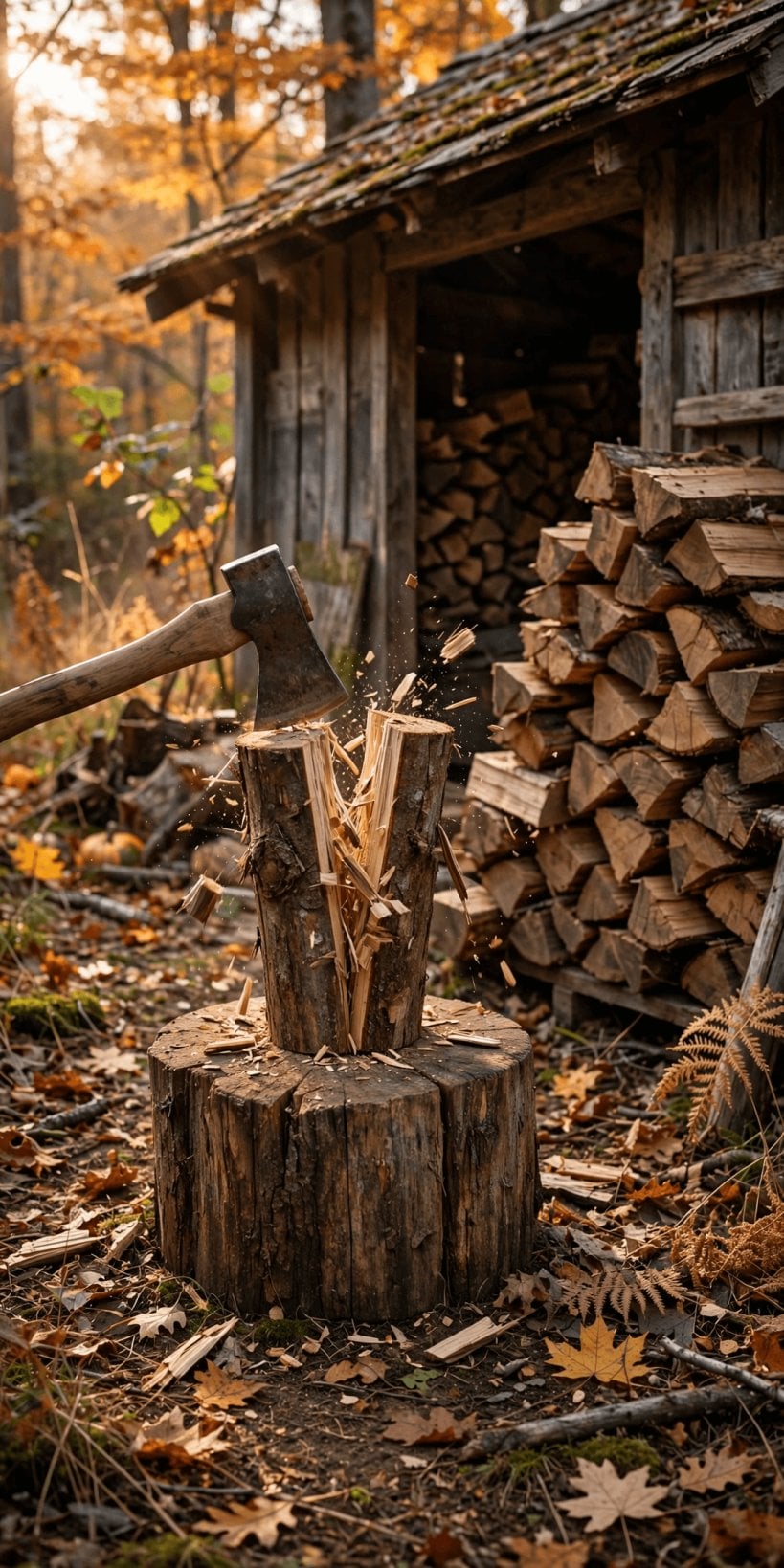
Nobody lifts a cord; everybody lifts a cord, one piece at a time, hundreds of times between the delivery pile and the finished stack. That repetition is its own hazard. Gloves are non-negotiable against splinters and bark, a wheelbarrow or cart turns the long middle distance into rolling instead of carrying, and a steady, unhurried rhythm beats a heroic first hour followed by an injured week. Split pieces have a balance and a bite of their own, and wet, freshly delivered wood is the heaviest and slipperiest version of the job, which is one more argument for tackling it fresh, in daylight and properly shod.
The stack itself is a structure and deserves a builder’s respect. Keep it off the ground on bearers or pallets so the bottom layer stays dry, build the ends tight or cribbed so the pile cannot shed logs, and keep the whole mass stable enough that pulling pieces from the middle in January cannot bring it down. Cover the top against rain and snow while leaving the sides open to the wind, because a sealed pile seasons no better than a log in a pond. Sited with sun, air and a short, level path to the door, a well-built cord stack quietly loses its water weight all year while staying safe to work from.
8. Buying Green vs Seasoned: What the Weight Difference Buys You
The chart’s two columns describe two different products wearing the same name. A green cord is cheaper per stack, available everywhere and heavier in every sense: heavier to haul, heavier to stack and unready to burn well, because a stove must boil off its water before it can properly heat a room, wasting energy and dirtying a chimney as it does. A seasoned cord costs more and arrives ready, its water weight already surrendered to last year’s sun and wind, lighter in the truck and immediately useful in the firebox. The price difference between the columns is, in large part, payment for time and dryness.
The strategic buyer uses the columns as a calendar. Buy green well ahead of need, at green prices, stack it properly and let your own yard do the seasoning that the seasoned price pays a seller to do. Buy seasoned when the season is upon you, the store is empty or the wood must burn the week it arrives. Either way, the weight figures expose bad deals kindly meant or otherwise: a suspiciously light stack sold as a full cord of green oak deserves measuring, and a cord sold as seasoned that arrives at green weight is telling you, on the scale, exactly how seasoned it really is.
9. Trucks, Trailers and Firewood Delivery
Firewood humbles vehicles like nothing else in this series, because even the lightest column in the chart describes a load that must be compared carefully with a payload rating, and the heaviest describes one that belongs on a proper delivery truck making a planned drop. The correct method never changes: choose the figure for the species and state you are actually buying, multiply by the cords on the order and compare that total with what your truck or trailer is rated to carry, not with what once fitted or what a neighbour claims to have hauled. Volume is deceptive here; a bed that looks only modestly full of green oak is carrying a serious mass.
Delivery earns its fee on full cords. A seller’s truck tips the load in one visit, in one pile, beside your stacking ground, and the weight question becomes a measuring question instead of a mechanical risk. If you haul part of an order yourself, make several trips at a sensible load, keep the wood low and contained, and remember that loose pieces shift, spill and damage tailgates with enthusiasm. However it arrives, plan the drop point before the vehicle does: every metre between the pile and the rack will be walked, loaded, hundreds of times before winter ends.
10. Common Questions About Cord Weight
Why do two sellers quote such different weights for a cord? Usually because they are selling different things under one word. One may be quoting green oak, the other seasoned pine, and the chart shows those two products can differ by more than the entire weight of a lighter cord. Others may be describing a face cord or a loose-thrown load rather than the full stacked volume. Ask for the species, the seasoning state and the stacked volume, and most disagreements dissolve, because the chart can then tell both of you what the load should approximately weigh.
Can I haul a full cord in my pickup? Only your truck’s payload rating and the chart together can answer that, and they must be asked about the exact species and state you intend to carry. For the heavy green hardwoods in the table, the honest answer for many ordinary pickups is that a full cord belongs in two trips or on a delivery truck, while the lightest seasoned figure may fall within a capable truck’s rating with room to spare. Check the rating plate, do the multiplication and believe the result, especially in winter conditions on the drive home.
Does lighter firewood mean worse firewood? Not necessarily, because the chart’s lightest figures belong to seasoned wood, and seasoning is a virtue. A seasoned cord weighs less because its water has left, not because its wood has, and it will light easier, burn cleaner and heat better than the same cord green. Within a single seasoning column, weight does track density and therefore heat per stack, which is why oak commands its price. Between columns, lighter is usually better: it means the drying was done by the sun, at the seller’s yard or yours, rather than by your stove.
Final Considerations
A cord is 128 cubic feet of stacked promise, and its weight is whatever the species and the water say it is. Learn the three species on the ladder, read the green and seasoned columns as a before and after, stack and measure honestly, and plan every haul at the heavy figure for what you are actually buying. Do that, and the heaviest delivery of the year becomes a single calm day of stacking, with a dry, ready store waiting when winter arrives.


0 Comments