

Utah asks a tiny house to do two opposite jobs: survive desert heat in summer and mountain snow in winter, often on remote land far from utilities. This guide to tiny house builders utah is a verification system — compare builder types, check licensing and certification, and ask the altitude, water and heat questions before any contract appears.
1. Choosing a Utah Builder at a Glance
Utah buyers are comparing three kinds of builder, and the state’s extremes should shape the shortlist. The summary below follows this guide’s infographic, which compares the builder types and names the four factors that matter most in Utah: altitude, water, heat and certification.
| Builder type | Best for | What to verify first |
|---|---|---|
| Custom design-build firms | A fully personalised home | A design process that specs for your exact site — its altitude, exposure and access — not a generic plan. |
| Off-grid and desert specialists | Remote land and solar living | Solar and battery design, water storage or hauling plans, and cooling that works without a grid connection. |
| Shell and DIY-finish builders | Hands-on buyers on a budget | Exactly where the shell stops, the weathertight standard, and how the warranty is split with your work. |
Whichever type leads your list, the verification work is identical. Confirm licensing and registration, ask how the home is certified, test the builder’s answers on altitude, water and heat, confirm they deliver to your part of the state, read the warranty in full, and speak to previous buyers. The sections that follow work through those checks in a sensible order, starting with where the home will actually live.
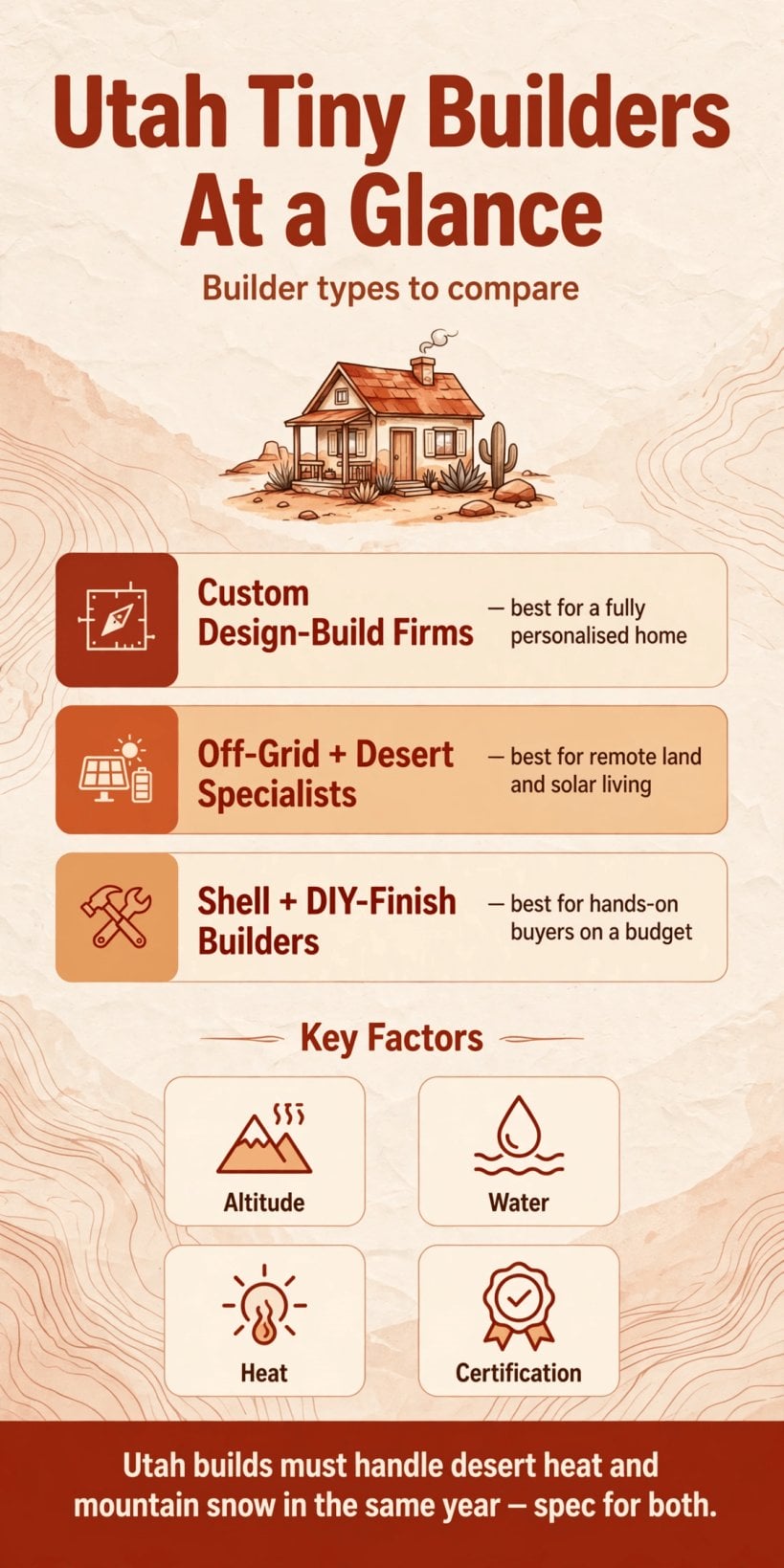
Utah builders at a glance: three builder types to compare, and four key factors — altitude, water, heat and certification — that decide whether a home suits the state’s two-season extremes.
2. Start With Placement: Where the Home Will Live
Placement comes first because Utah land is wonderfully varied and so are its rules. Cities, towns and counties treat small and movable homes differently — minimum sizes, foundation expectations, utility requirements and accessory dwelling routes all vary by place, and a home welcomed in one valley can be refused in the next. A builder’s design skills cannot rescue a plan your site will not accept, so settle the placement question early and keep every answer in writing.
Ask each builder what placements they have completed in your area and what documentation local offices asked for. Builders who work across the state will know how expectations shift between a serviced town lot, a mountain parcel and open desert land, and will warn you early when a plan needs a different route — a foundation build, an accessory dwelling application, or a park setting. The full sequence, from first sketch to a home that can be placed, is covered in our guide to how to get a tiny house built, from first sketch to finished shell. Sign only when the land and the build agree.
3. Verify Licensing, Registration and Certification
Before the portfolio comes out, verify the business. Ask for licensing and registration details, confirm they are current, and check that the legal name on the paperwork matches the name on the contract you will sign. Ask what insurance the builder carries and expect documents rather than verbal comfort. Well-run builders answer instantly, because every careful buyer asks and the evidence folder is always ready.
Certification is the companion check, and the infographic lists it as a key factor because the paperwork follows the home for life. Ask how the finished home will be inspected or certified, which standard it is built to, and exactly which documents you receive at handover. Ask, too, how a home on wheels will be titled or registered, and who handles that process. Certification underpins placement, insurance, financing and resale; a builder who is vague about it is giving you the clearest early warning in this entire guide, so write the answers down and keep them with the quote.

4. Spec for Both Seasons: Heat and Snow
The infographic’s closing line is the state’s design brief: Utah builds must handle desert heat and mountain snow in the same year, so spec for both. A home headed for the southern deserts needs serious shading, insulation that keeps heat out as well as in, ventilation and cooling sized for long, hot afternoons. A home headed for the mountains needs the opposite instinct — heat retention, protected plumbing and a roof designed with snow in mind. Many Utah homes need both instincts in a single shell, because owners move between elevations and seasons.
Judge builders by the specifics they volunteer. Ask how wall and roof assemblies are insulated, what glazing they specify for strong high-altitude sun, how condensation is controlled when a warm interior meets a cold night, and what heating and cooling plant they recommend for your site’s elevation and exposure. Ask to see a completed home specified for conditions like yours. A builder fluent in both seasons talks about assemblies and details; a builder fluent in neither talks about floor plans and finishes. The difference shows up in your first January and your first July alike.
5. Altitude: Building and Living Higher
Altitude earns its own key factor because so much of Utah living happens high. Elevation changes a build in quiet ways: snow accumulates and lingers, so roof design and structure must reckon with the load it leaves behind; heating systems work harder in thin, cold air; sun arrives stronger, which affects glazing, shading and exterior finishes; and freeze risk stretches across more of the calendar, which changes how plumbing should be routed and protected.
Weight belongs in this conversation, because snow is live load sitting on the structure and the trailer or foundation beneath it. Our reference on what a tiny house weighs and why the trailer sets the ceiling explains how totals and ratings interact. Ask each builder what altitude they assume when they specify a roof, what they change for a high site compared with a valley one, and what they would refuse to build for a mountain parcel. Concrete answers — different structure, different detailing, different plant — mark a builder who has genuinely built in the high country.
6. Water: Wells, Hauling and Storage
Water is the factor city buyers underestimate and Utah builders cannot afford to. Many rural parcels have no mains connection, so the honest options are a well, hauled water with storage, or a hybrid — and each choice changes the home’s design. Storage needs space, structure and freeze protection; pumps and filtration need power; and an off-grid specialist will size the whole system around how your household actually lives, not around a brochure lifestyle.
Ask every builder how their homes handle water where there is no street connection: tank sizes they commonly fit, where tanks sit, how they are insulated and accessed, and what happens in a hard freeze. Ask about greywater and waste with the same directness, and what local rules expect. If a well is part of the plan, ask what the builder needs from you — tests, depths, paperwork — and what remains your responsibility. In Utah, water planning is not a detail added after the design. For remote homes it is one of the design’s foundations, and the builder’s fluency here is a genuine quality signal.
7. Questions to Ask Before You Sign
A disciplined interview reveals more than a showroom tour. Ask how many homes the builder completes each year and how many were built for conditions like yours — altitude, desert, off-grid or town lot. Ask who physically builds the home, what is subcontracted, and who checks quality. Ask what the timeline assumes, what typically delays a Utah build — weather windows, materials, inspections — and how delays reach you. Then go through the quoted scope line by line: trailer or foundation, solar and batteries, water systems, appliances, delivery, setup and taxes are the classic places where similar quotes describe different homes.
Close the interview with change and money. How are mid-build changes requested, priced and approved in writing? What payment schedule is expected, and does each stage match visible progress? What documentation arrives at handover — certification, manuals, warranty papers, system diagrams, a weigh ticket where relevant? Record the answers and compare builders on evidence, not enthusiasm. The builder who answers completely before the contract tends to answer the phone during the build, and across a long project that pattern is worth real money.
8. Delivery Across the State, and What Drives Cost
Delivery in Utah can mean crossing a city or crossing half the state to a parcel at the end of a dirt road, and the builder’s realistic delivery radius within the state matters accordingly. Ask which areas they serve, what delivery cost depends on, and whether they assess route and site first: switchbacks, grades, soft sand, gates and turning space all decide whether delivery day is routine. Ask who drives, who insures the home in transit, and who levels, anchors and commissions it on arrival — for off-grid homes, arrival day includes systems, not just siting.
Delivery is also where cost drivers gather, so discuss them honestly rather than chasing invented prices. Builder type, specification for both seasons, altitude engineering, solar and water systems, site distance and access work each move a Utah total in predictable directions. Financing interacts with specification and documentation, as how to get a loan for a tiny house and tiny house mortgages and how lenders classify these homes explain. Ask each builder to name the levers on your quote — what raises it, what lowers it, and where they refuse to cut. That last answer is the most informative sentence in any sales conversation.

9. Warranty, Aftercare and References
Read the warranty while you are still choosing, not after the first problem. Establish what is covered and for how long — structure, roof, systems and finishes rarely share one term — what is excluded, and who performs the work, especially if your land sits far from the workshop. Ask how claims are raised, how response times work in practice, and what routine aftercare the builder provides as the home settles through its first full cycle of Utah seasons. Desert sun and mountain cold both find weak points quickly, so first-year support matters here more than in gentler climates.
References convert warranty language into evidence. Ask for recent buyers you may contact, including at least one whose home has lived through both a summer and a winter, and ideally one off-grid owner if that is your route. Ask them what the builder solved well and what they handled badly. Keep the complete document set — certification, warranty, manuals, system diagrams — in one file for the home; it supports insurance and strengthens resale, as our guide to how to sell a tiny house when it is time to move on sets out. Builders confident in their aftercare produce references without a pause.
10. Red Flags and Comparing Quotes
The warning signs are consistent. Slow down for a builder who will not document licensing, registration or certification, who dismisses altitude, water or dual-season specification as details to sort out later, or who wants a signature before your placement questions are answered. Discounts that expire today and build slots that vanish overnight are sales devices. So is the un-itemised quote: a single round number cannot be compared with anything, and its exclusions tend to surface later as extras you never agreed to.
For the final comparison, force every quote onto identical scope — builder type, seasonal specification, altitude assumptions, water and power systems, delivery, setup and documentation — and score each builder on evidence gathered: documents seen, references called, questions answered in writing. The same verification method runs through our companion guide to choosing tiny house builders in Connecticut; only the climate and the map change. Choose the builder whose evidence survives the checklist, and your Utah home begins life specified for the state it will actually live in — both of its seasons included.
Final Considerations
The right tiny house builders utah decision is a builder who survives verification: documented and certified, specific on altitude, water and dual-season specification, honest about delivery reach and cost drivers, and generous with references. Work the checks in order and keep everything in writing. If your search crosses state lines, the same system applies in our guides to choosing tiny house builders in Oklahoma and choosing tiny house builders in Illinois, and the financing question behind many builds — whether you can get a home loan for a tiny house — is worth reading before the first deposit moves.


0 Comments