

Choosing a builder is the biggest decision in a tiny house project, and Connecticut makes it a local one: towns set their own rules, winters test every wall, and delivery routes are rarely straight. This guide to tiny house builders in connecticut is not a directory of names. It is a verification system — the checks, questions and red flags that separate a sound build from an expensive lesson.
1. Choosing a Connecticut Builder at a Glance
Connecticut buyers are really choosing between three kinds of builder, and the right kind depends on the home you want and the land it will sit on. The summary below follows this guide’s infographic, which compares the builder types and names the four factors that matter most in this state: zoning, winters, delivery and certification.
| Builder type | Best for | What to verify first |
|---|---|---|
| Custom design-build firms | A one-off home designed around your lot | A portfolio of one-off builds, a clear design process, and experience with your town’s rules. |
| Park-model and ADU specialists | Backyard cottages and park settings | Accessory dwelling and park requirements for your town, plus utility hookups and siting. |
| Shell and DIY-finish builders | Buyers who want to finish the interior themselves | Exactly where the shell stops, the weathertight standard, and how the warranty is split. |
Whichever type you shortlist, the verification work is the same. Confirm the business is properly licensed and registered, ask how its homes are certified, check that your address sits inside its realistic delivery radius, read the warranty in full, and talk to previous buyers. The sections that follow take each check in turn, in the order an experienced buyer would run them.
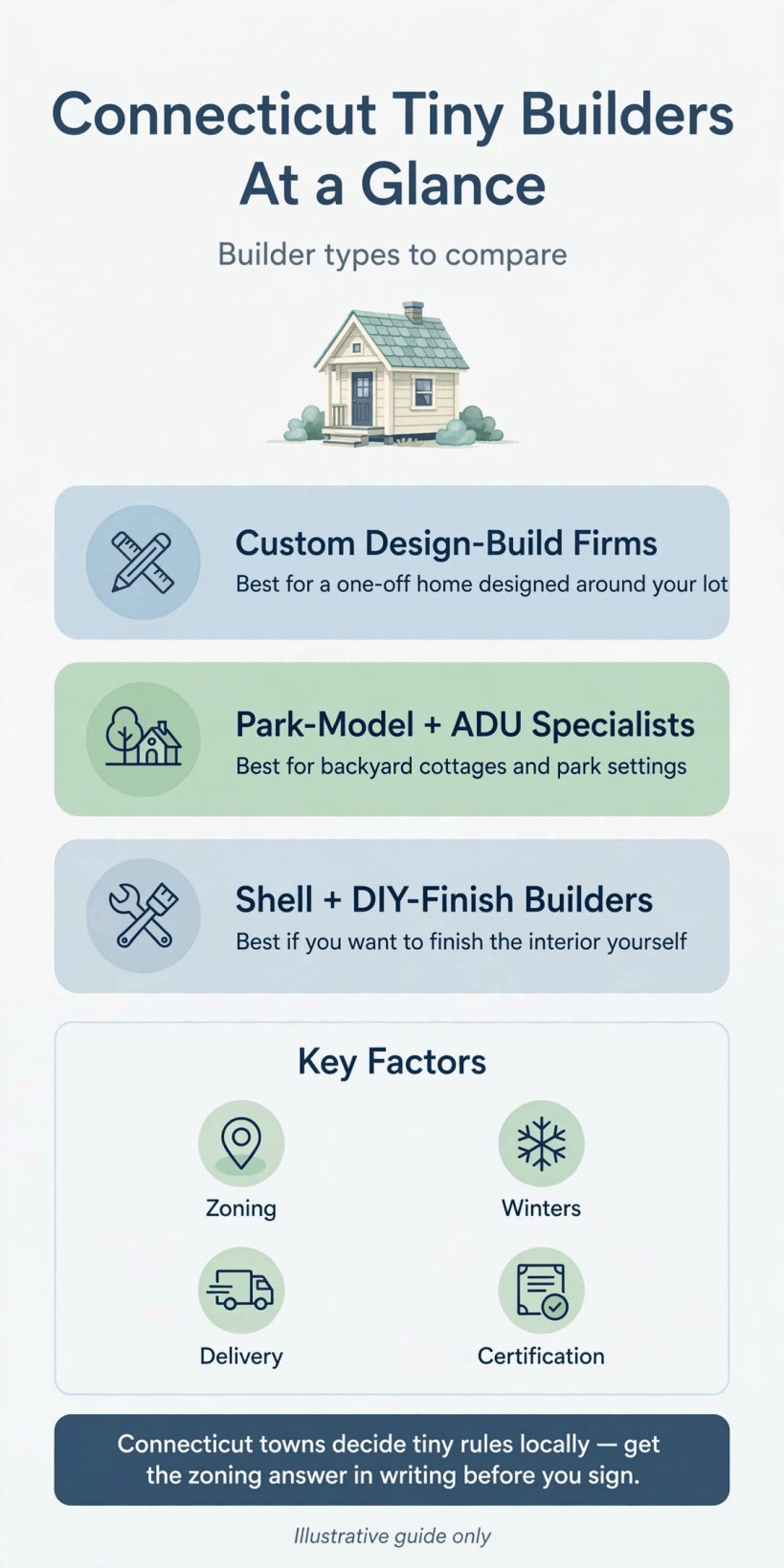
Connecticut builders at a glance: three builder types to compare, and four key factors — zoning, winters, delivery and certification — that decide which one fits your project.
2. Start With Zoning: Towns Decide Locally
The infographic’s closing advice is the right place to begin: Connecticut towns decide tiny house rules locally, so get the zoning answer in writing before you sign anything. A builder can construct a beautiful, code-conscious home and still leave you stuck if your town will not accept it on your lot — as a dwelling, as an accessory unit, or at all. Zoning decides what may be placed, where it may sit, and whether it can be lived in full time.
Ask your town’s planning or zoning office what applies to your exact parcel, and ask the builder what experience they have in that town. A builder who works in the state regularly will know which questions towns ask, what documentation they expect, and how long answers take. If the home will be built on a trailer, our guide to how to get a tiny house built, from first sketch to finished shell explains how the build route and the placement route interact. Never let a deposit run ahead of the zoning answer; the sequence protects you, and a good builder will insist on it too.
3. Verify Licensing, Registration and Certification
Before design talk begins, verify the business itself. Ask for the builder’s licensing and business registration details, confirm they are current, and check that the name on the paperwork is the name on the contract you will sign. Ask what insurance the business carries, and expect straight answers with documents to match. A legitimate operation treats these questions as routine, because its other customers asked the same ones.
Certification is the second half of the check, and the infographic lists it as a key factor for a reason. Ask how the finished home will be certified or inspected, which standard the build follows, and what paperwork you will receive at handover. That documentation travels with the home: it supports insurance, financing, placement and resale for years after the build. If a home will be registered and titled as a vehicle-style unit, ask how that is handled and by whom. Vague answers here are not a small thing — they are the clearest early warning this guide can give you.
4. Questions to Ask Before You Sign
A structured conversation reveals more than any brochure. Ask how many homes the builder completes in a typical year, and how many like yours — the type matters, because a shell builder and a custom firm run very different projects. Ask who actually builds your home, whether work is subcontracted, and who supervises it. Ask what the timeline assumes, what can delay it, and how delays are communicated. Ask what is included in the quoted scope, in writing, line by line: trailer, appliances, hookups, delivery, setup and taxes are all places where assumptions quietly diverge.
Keep going into the details buyers forget. What happens if you want a change mid-build, and how are change orders priced and approved? What payment schedule is expected, and is each stage tied to visible progress? What documentation arrives at handover — manuals, certifications, warranty papers, weigh ticket? Write the answers down, and compare builders on the quality of their answers as much as the numbers attached. A builder who welcomes hard questions before the contract usually handles hard moments during the build the same way.
5. Delivery Radius and Site Access
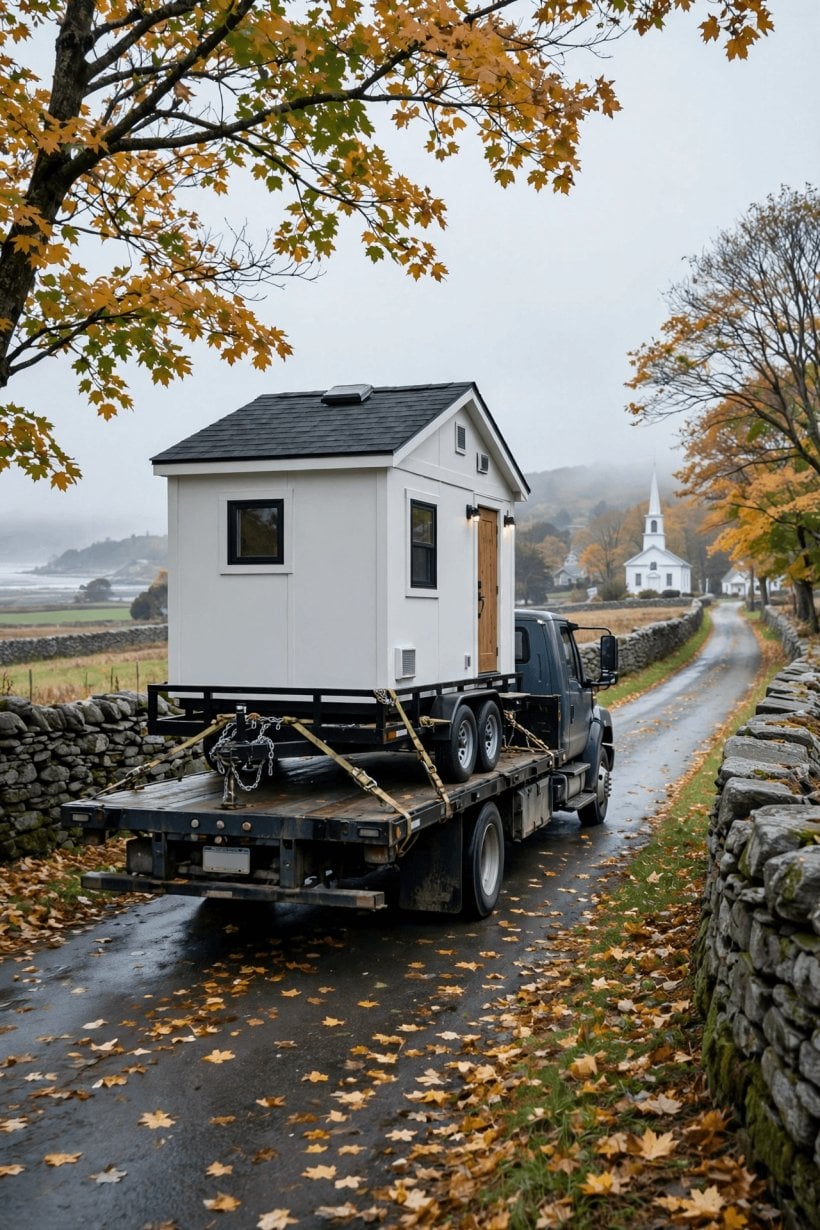
Delivery is a key factor in the infographic because Connecticut is a state of narrow lanes, low branches, stone walls and tight village corners. Ask every builder what delivery radius they actually serve within the state, what delivery costs depend on, and whether they visit or survey the site before the day. A home that leaves the workshop perfectly still has to survive the last mile: turning space, overhead clearance, ground firmness and a prepared, level spot to land on.
Weight and size sit underneath every delivery conversation, because the outfit that tows the home must be matched to it. Our weight reference on what a tiny house weighs and why the trailer sets the ceiling explains the ratings involved. Ask who drives, who is responsible during transit, what insurance covers the journey, and what happens if access fails on the day. In a state where many plots sit at the end of long private lanes, the honest delivery conversation happens before the build starts — not when a finished home is waiting at the end of your road.
6. Built for Connecticut Winters
Winters earn their place among the infographic’s key factors. A Connecticut tiny house has to handle freezing stretches, snow on the roof, and pipes that would love to burst in an empty week. Ask how the builder insulates floors, walls and roof, how plumbing is routed and protected, and what heating setup they recommend for full-time living through a cold snap. Ask about roof design and snow load thinking, window specification, and how condensation is managed in a small, warm, tightly sealed space.
Details separate a four-season home from a three-season one wearing a coat. Look for protected or interior plumbing runs, sensible tank placement, skirting or foundation thinking for stationary homes, and materials that tolerate freeze and thaw without complaint. If you can, talk to an owner who has already wintered in one of the builder’s homes — a single January is a better test than a showroom afternoon. A builder who designs for the state will answer winter questions with specifics, because they have solved these problems before.
7. Warranty, Aftercare and References
The contract ends; the relationship should not. Read the warranty before you sign, not after something leaks: what is covered, for how long, what is excluded, and who performs the work. Ask how warranty claims are raised, how quickly they are answered, and whether the builder services homes across the state or expects the home to come back to the workshop. Ask about aftercare more broadly — the small adjustments every new home needs as it settles, dries and seasons.
References are where promises get audited. Ask for recent buyers you can contact, and ideally one whose home is a year or more old. Ask those owners what went well, what went wrong, and how the builder behaved when it went wrong. Keep every document you collect — certification, warranty, weigh ticket, manuals — in one file. That file quietly raises the home’s value later, a point our guide to how to sell a tiny house when it is time to move on makes in detail. Builders who are proud of their aftercare hand over references without hesitation.
8. Cost Drivers, Discussed Honestly
Serious guides talk about cost drivers rather than invented prices, because the total for a Connecticut build is assembled from choices, not plucked from a list. The builder type is the first driver: a one-off custom design carries design time a repeat model does not, while a shell shifts cost from the builder’s invoice to your own time and finishing trades. Size, specification and finish level come next — insulation standard, window quality, cladding, appliances and interior materials each move the total in predictable directions.
Site and season drive costs too: delivery distance, access work, foundations or pads, utility connections and winter timing all belong in the honest conversation. Financing interacts with specification as well, since lenders look at the home, its certification and its documentation — see how to get a loan for a tiny house and the wider picture in tiny house mortgages and how lenders classify these homes. Ask every builder to show you the levers: what would make this build cost less, what would make it cost more, and where do they refuse to cut? The answers reveal their judgement, not just their arithmetic.
9. Red Flags That Should Slow You Down
Some warnings appear in every state, and Connecticut buyers should know the set. Be careful with any builder who will not put licensing, registration or certification details in writing, who cannot explain how the finished home will be documented, or who shrugs at your town’s zoning and urges you to sign first and ask later. Pressure tactics — expiring discounts, slots that vanish if you think overnight — belong to sales scripts, not to careful construction.
Other flags are quieter. A quote that will not break down what is included makes comparison impossible, and usually hides exclusions you will meet later as extras. A payment schedule that runs far ahead of visible progress transfers all the risk to you. No references, no completed homes you can see, and no written warranty are three versions of the same problem: nothing to verify. None of these flags requires an accusation; each simply means slow down, ask the question in writing, and watch the response. How a builder handles scrutiny before they have your money is exactly how they will handle problems after they do.
10. Comparing Quotes Like for Like
Final comparisons only work when the quotes describe the same home. Lay the shortlisted proposals side by side and align the scope: builder type, size, specification, appliances, trailer, delivery, setup, taxes and documentation. Where one quote looks dramatically keener, find the missing line before admiring the number — in tiny house quotes, the gap is almost always a scope difference, not generosity. Use the same checklist for each builder: zoning support, licensing and certification verified, delivery surveyed, winter specification explained, warranty read, references called.
This verification-first method travels well, because the fundamentals do not change at a state line — only the local rules, climate and delivery map do. If your search widens, the companion guide to choosing tiny house builders in Oklahoma applies the same system there. Score each Connecticut candidate on evidence gathered, not impressions formed, and let the builder who documented everything win over the builder who promised everything. In a purchase this size, the paperwork is not bureaucracy around the decision. The paperwork is the decision, made visible.
Final Considerations
The best tiny house builders in connecticut for you are the ones who survive your verification: licensed and documented, honest about zoning and delivery, specific about winters and warranties, and calm under questions. Run the checks in this guide in order, keep every answer in writing, and the right choice usually identifies itself. Buyers comparing states will find the same approach in our guides to choosing tiny house builders in Utah and choosing tiny house builders in Illinois. Choose the builder whose evidence you trust, and your home starts life on solid ground.


0 Comments