

Designing a tiny house room by room is how a small home ends up feeling like several houses sharing one roof. This guide takes the opposite road: one vision for the whole home, formed first and carried through every room — the journey from the first mood board to the finished, lived-in home.
Interior Design for Home Ideas: At a Glance
The strongest interior design for home ideas treat the tiny house as one home: one committed style, a palette flowing from door to far wall, the same woods, metals and textiles repeating as echoes, every room implemented in turn. This guide follows the journey in order — vision, palette, repetition, light, textiles, commandments, entry, board, build, art and payoff — and the lived-in life of the finished design.
| Topic | What It Covers | Key Fact or Figure |
|---|---|---|
| 1. The Whole-Home Vision and Choosing Your Style | One vision; the modern, the farmhouse, the boho | The best style is the loved one |
| 2. The Flowing Palette and Room-by-Room Harmony | One palette flowing; four rooms in harmony | The palette is the most important decision |
| 3. The Repeating Elements and Scale & Proportion | Woods, metals and textiles echoed; furniture right-sized | Repetition is what unifies |
| 4. The Lighting Plan and the Textiles Plan | Layered warm light; coordinated, varied textiles | The light unifies the home |
| 5. Focal Points and the 10 Commandments | One focal point per room; the ten rules | 10 commandments |
| 6. The Entry Moment and the Transitions | The first impression; thresholds and long sightlines | The entry introduces the home |
| 7. Mistakes, the Mood Board and Shopping the Vision | The errors; the board that reveals; the list that guides | The list guides the wallet |
| 8. Implementing Room by Room and the DIY Decor | One room finished at a time; decor made and customized | One room at a time always works |
| 9. The Whole-Home Art Plan and the Design Payoff | Curated art; the beautiful, functional, proud home | The vision takes a weekend; the living is ongoing |
| 10. Seasons, the Evolving Home and Living the Design | Seasonal refreshes, hosting, the signature touch | The design is done when the living begins |
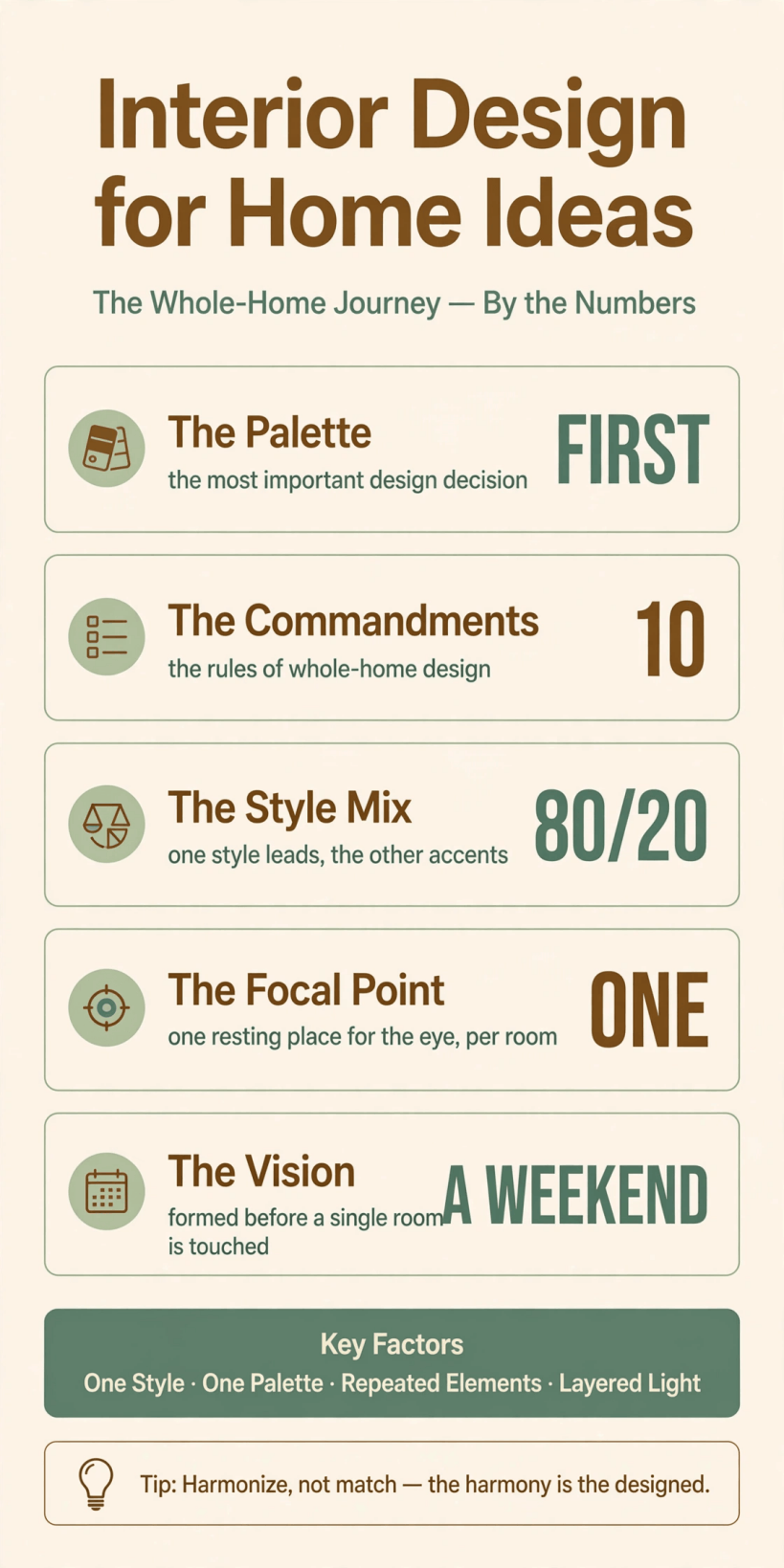
The journey by the numbers: the palette first, 10 commandments, an 80/20 mix, one focal point per room, a vision formed in a weekend.
1. The Whole-Home Vision and Choosing Your Style
The whole-home vision is a commitment before it is a decoration. The style is the chosen — the committed: one look picked and held, not sampled room by room. The flow is the room-to-room — the seamless. The palette is the unified — the harmonious: one family of colours for every light the house offers. The rule: the whole is the designed — the one. A tiny house is read almost at once — make its single statement deliberate. That framework lives in our tiny house and small-space interior design hub.
Choosing the style is the vision’s first concrete act. The modern is the clean — the minimal. The farmhouse is the warm — the rustic. The boho is the layered — the free. The rule: the style is the personal — the committed. What style works best in a tiny house? The committed one — the modern, the farmhouse, the boho, the Scandi. The best style is the loved: the tiny rewards the vision fully embraced.
And how do you design the whole interior at all? The style first, the palette second, the room-by-room third — the vision guides every choice, so no single purchase carries the home alone. A second style may join on precise terms: yes — the 80/20, the shared palette, the intentional. One style leads at roughly eighty percent; the shared palette is the treaty between them. The mix is the personal: the tiny shows every choice, so mix with care. The cohesion side of the same vision is worked through in our guide to interior design home ideas.
2. The Flowing Palette and Room-by-Room Harmony
With the style chosen, the palette is drawn. Asked what the most important design decision is, the answer is the palette: the single choice that unifies everything. The style comes second. The palette is the foundation: every other choice builds on it. The base is the throughout — the unifying: one ground colour family carried through every room. The accents are the room — the varied: each room strikes its own note inside the family. The rule: the palette flows — the tiny.

Room-by-room harmony is the palette at work in four small rooms. The living is the welcoming — the styled: the room that receives. The kitchen is the functional — the beautiful: the working room, kept as considered as any other. The bedroom is the calm — the restful: the palette at its quietest. The bath is the spa — the small: the tiniest room, the most serene treatment. The rule: the rooms harmonize — the whole. Should every room match in a tiny house? Harmonize, not match — the shared palette, the repeated elements, the room personalities. The match is the boring; the harmony is the designed.
3. The Repeating Elements and Scale & Proportion
If the palette is the foundation, the repeating elements are the stitching. The wood is the same — the throughout: one wood family appearing in room after room. The metal is the finish — the repeated: the same handle, hinge and fixture finish wherever metal shows. The textile is the pattern — the echoed: a motif or weave picked up again across the rooms, never copied exactly, always recognised. The rule: the repetition unifies — the designed. This is also the cohesion answer: how do you make a tiny house feel cohesive? The repeating (woods, metals, textiles), the flowing palette, the consistent style. The cohesion is the repeated: the eye reads the echoes and calls the home one place. The method is set out room by room in our tiny house interior design ideas: the complete whole-home design guide.
Scale and proportion keep the repetition honest. The right-sized is the furniture — the fitted: pieces chosen against the room’s real measurements, not a showroom’s. The varied is the heights — the interest: tall, medium and low pieces arranged so the eye travels — a room at one height reads flat however unified its palette. The rule: the scale fits — the tiny. One too-large sofa taxes every room that sees it.
4. The Whole-Home Lighting Plan and the Textiles Plan
The whole-home lighting plan treats light as one system, not a series of separate purchases. The layered is the every room — the rule: ambient, task and accent light in each space, so no room is lit by a single bulb’s opinion. The consistent is the temperature — the warm: one colour temperature held across the home, so moving from room to room never feels like changing climates. The rule: the light unifies — the home. The wider journey is traced in our guide to home designing ideas for a tiny house.
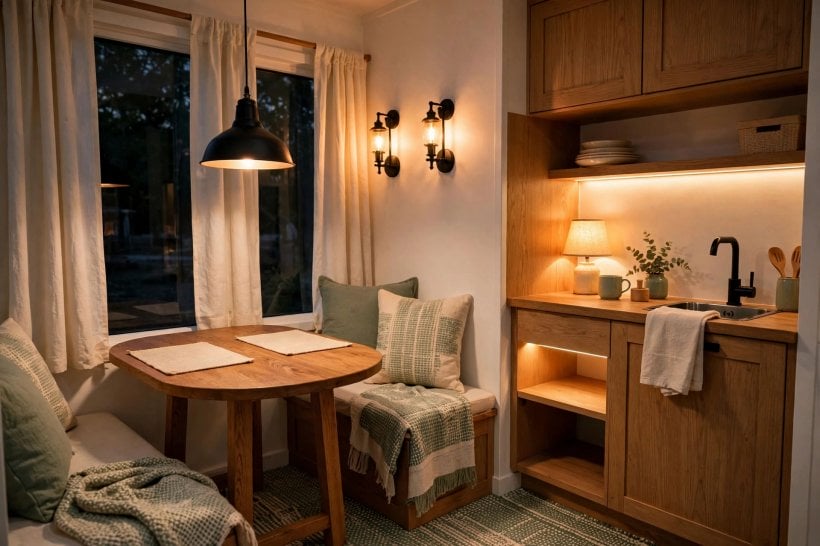
The textiles plan is the lighting plan’s soft twin. The coordinated is the palette — the shared: curtains, cushions, throws and bedding all drawn from the one palette the home agreed. The varied is the texture — the interest: linen against boucle, weave against knit, so the coordination never turns monotonous. The rule: the textiles soften — the whole. Textiles are the cheapest layer to change: decide the family once, and every later swap lands inside the design.
5. Focal Points and the 10 Commandments of Home Design
Every room gets exactly one resting place for the eye. The one per room is the eye — the rested: a single focal point that organises everything around it. The art is the large — the statement: where art is the focal point, the instinct is one generous piece rather than a scatter of small ones. The rule: the focal guides — the eye. One, chosen well, is enough. What one committed style does with its focal pieces is visible in our guide to mid-century modern interior design ideas for tiny houses.
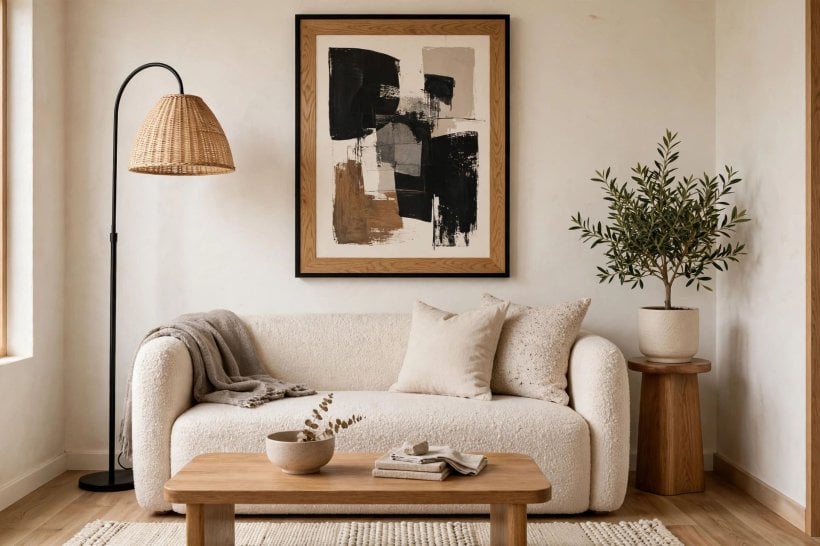
The whole method compresses into the 10 commandments of home design, listed as imperatives: choose the one style; unify the palette; repeat the elements; scale the furniture; layer the light; soften the textiles; focus the each room; edit the ruthless; personalize the deeply; live the beautiful. Read in order, they are the guide in miniature — vision first, a focus for every room, a ruthless edit, deep personalization, and at the end: live the beautiful.
6. The Entry Moment and the Transitions
The entry moment is the home’s first sentence. The first is the impression — the set: whatever the doorway shows sets the verdict. The welcoming is the styled — the warm: the entry is styled like a room, not treated as a corridor. The rule: the entry introduces — the home. In a tiny house the entry is a step and a turn — there is no hallway in which to recover from a bad first impression.
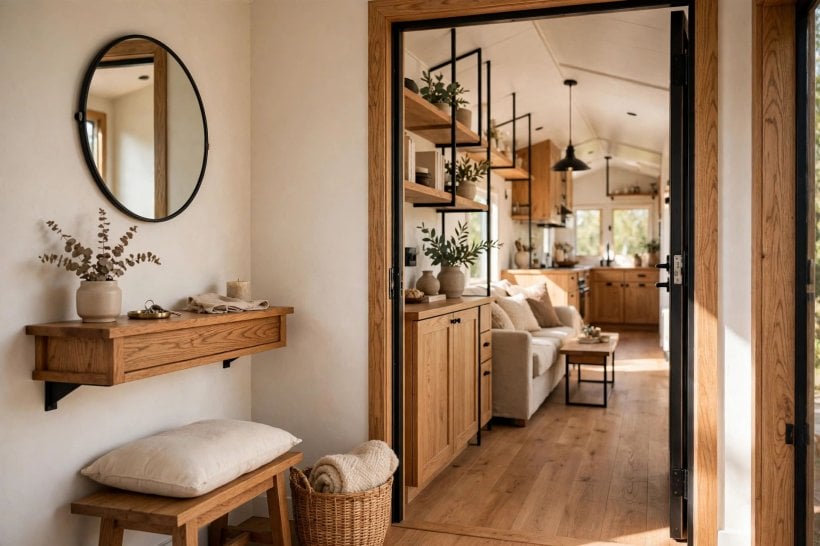
The transitions are the sentences between the chapters. The thresholds are the considered — the flowing: the line where one room’s floor, colour or light hands over to the next is designed, not left to default. The sightlines are the long — the designed: what a doorway frames is composed like a picture. The rule: the transitions connect — the rooms. The same wood underfoot and metal on the doors make the crossing feel like one home continuing.
7. Whole-Home Mistakes, the Mood Board and Shopping the Vision
The whole-home mistakes are the commandments broken: The disjointed is the styles — the unified: styles competing where one was needed. The choppy is the palettes — the flowed: palettes that start and stop at the doorways. The oversized is the pieces — the scaled: furniture bought for a bigger home’s rooms. The rule: the whole is the one — the designed.
The mood board is where the vision becomes visible before it becomes expensive. The collected is the images — the pinned: every saved image gathered in one place. The pattern is the emerged — the style: laid side by side, the images confess what they share — the wood, the colour, the light you keep saving. The truth: the board reveals — the vision. The board is the vision with evidence.
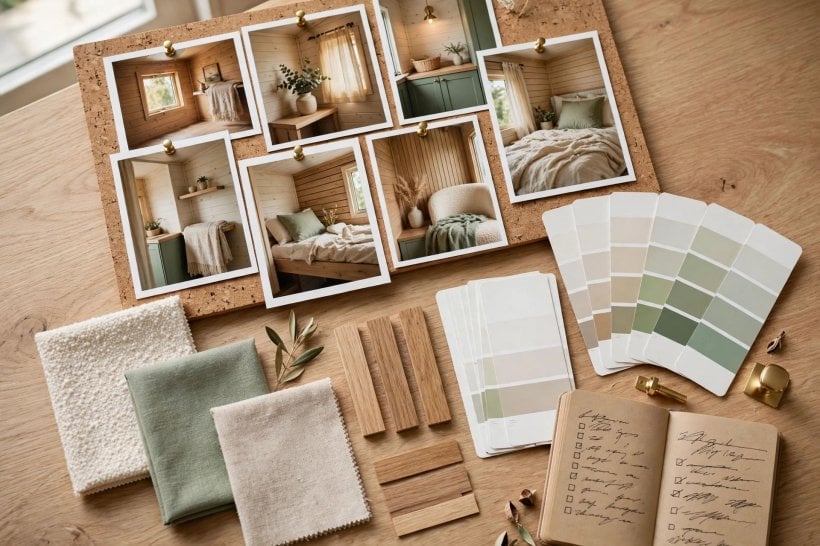
Shopping the vision is the board turned into discipline. The list is the needed — the prioritized: what the home lacks, in order. The hunt is the thrifted — the found: the second-hand and the salvaged searched first — the found piece carries a personalization no catalogue sells. The rule: the list guides — the wallet. How do I decorate a tiny house on a budget? The paint, the textiles, the thrifted, the DIY. The budget decorates beautifully: the small space needs less to transform — one tin of paint is a whole room. The decorating layer itself is worked through in our guide to tiny house decorating ideas.
8. Implementing Room by Room and the DIY Decor
Implementing room by room is how the vision survives contact with a calendar. The one is the finished — the celebrated: a single room carried to done, and the done acknowledged. The next is the begun — the momentum: the next room started on its momentum. The truth: the one-room-at-a-time works — the always. The alternative — every room at eighty percent — is how whole-home projects stall: nothing finished to live in, everything costing money at once. One finished room also becomes the palette’s proof for the next.
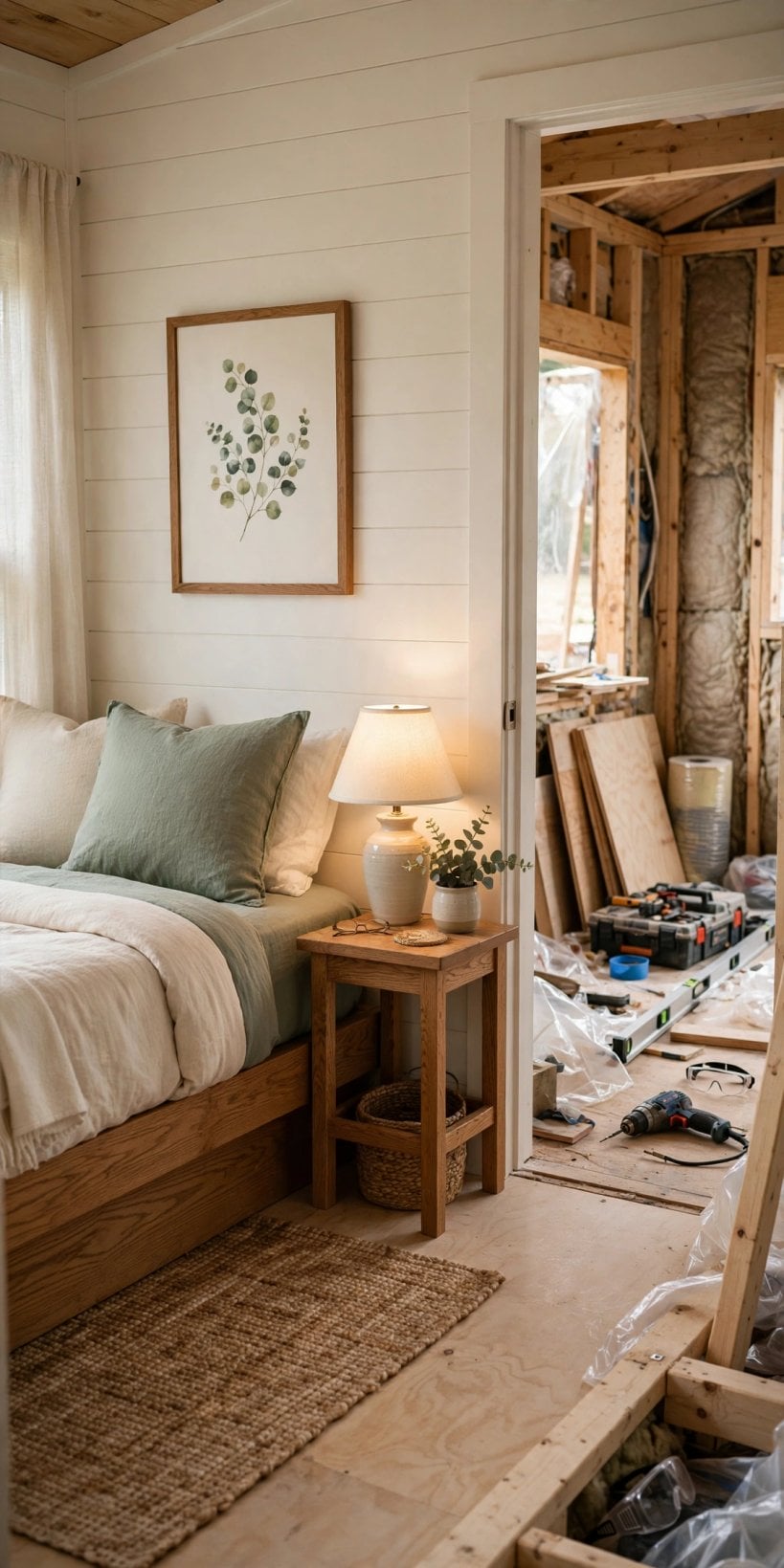
The DIY decor is the implementation’s personal layer. The made is the personal — the proud: the piece built, sewn or painted by the home’s own hands. The customized is the thrifted — the transformed: the found piece repainted, rehandled, reupholstered into the palette. The truth: the DIY personalizes — the deeply. Do I need a designer for a tiny house? Not necessarily — the vision, the board, the patience. The designer helps the stuck; the self-designed is the personal. The tiny is the DIY-designable: this method is the designer’s toolkit, written down.
9. The Whole-Home Art Plan and the Design Payoff
The whole-home art plan gathers what the focal points began. The curated is the collected — the hung: art gathered over time and hung as a collection, not scattered as filler. The cohesive is the framed — the unified: one frame family across the home, so pieces of different moods still read as relatives. The rule: the art tells — the story. A tiny house has little wall, which makes its art carry more meaning per piece — everything framed up there earned the wall.
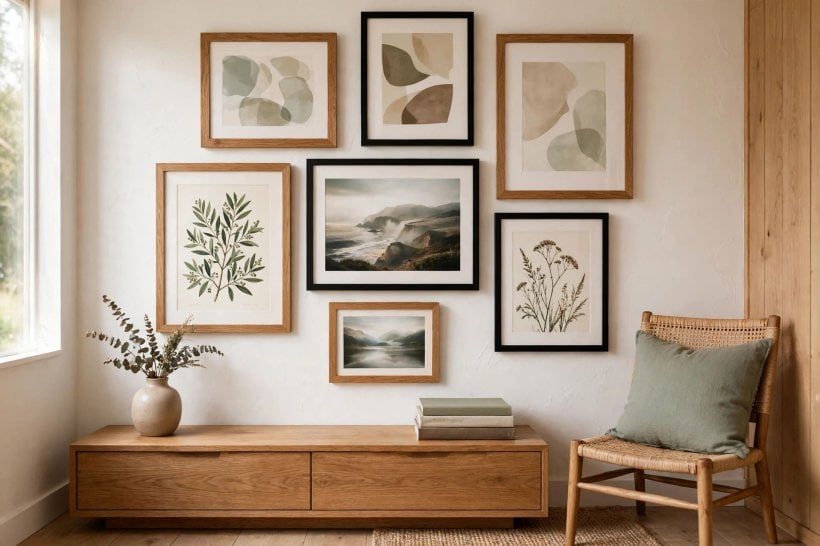
Then the design payoff. The beautiful is the daily — the lived: the design enjoyed on ordinary days, not saved for guests. The functional is the effortless — the designed: rooms that work without negotiation. The proud is the shown — the home: the pleasure of the door opened to a friend. The truth: the payoff is the home — the loved, and the invitation extended is the journey in three words: vision, plan, live — the beautiful awaits. How long does the whole thing take? The vision: the weekend. The implementing: the months. The living-in: the ongoing. The designed home is the evolved: the best interiors grow. The finishing layer across every room is detailed in our guide to interior design home decorating ideas for tiny houses.
10. Seasonal Shifts, the Evolving Home and Living the Designed Life
The seasonal shifts keep the finished home awake. The textiles are the swapped — the refreshed: the lightest layer changed with the year, heavier weaves in, airier ones out. The accents are the rotated — the new: small pieces moved and rested, so rooms feel attended, not redecorated. The truth: the seasonal keeps — the fresh. Because the textiles plan fixed the family in advance, every swap stays inside the design.
The lived-in is the improved — the learned: living teaches what the board could not. The adjusted is the tweaked — the perfected. The truth: the home evolves — the lived. How do I know when the design is done? The lived-in comfort, the nothing-itching, the home feeling. The done is the felt: the design finishes when the living begins. Hosting is its public test: the proud — the toured, the shown; the comfortable — the guests, the welcomed. The truth: the designed hosts — the best.
The closing celebrations belong in their order. The before & after: the documented — the photos, the kept; the marveled — the transformed, the proud; the truth: the before/after inspires — the next. The signature touch: the unique — the only-yours, the placed; the remembered — the guests; the truth: the signature is the soul — the home. The welcome home: the door — the opened, the designed; the sigh — the happy; the truth: the designed welcomes — the biggest. The lived beautiful: the daily — the beautiful, the used; the worn — the loved, the patina; the truth: the lived beautiful is the goal — the always. The design journey gathers them: the begun — the vision, the brave; the continued — the tweaked, the loved; the truth: the journey is the joy — the designed. Calm versions of that feeling fill our guide to zen interior design ideas for tiny houses.
The last beats are pure cadence. Home sweet home: the said — the meant, the felt; the home is the sweetest — the designed. The dream realized: the envisioned — the years, the now; the realized dream is the home — the designed. The final reveal: the friends gasped, the owner beamed; the reveal is the reward — the designed. The happily ever after: the lived — daily, beautiful; the loved — deeply; the ever-after is the designed — the lived. The curtain call: the designer bowed, the home applauded; the curtain falls — the living begins. The designed legacy: the kept — loved for years; the passed — the stories; the legacy is the lived — the beautiful. The compliments: received graciously, tips shared generously; they confirm — the designed. Photographing the designed tiny: natural light waited for, rooms tidied and shot; the photographed celebrates — the designed. And the open invitation: extended always; the invitation is the open — the forever.
Final Considerations
The best interior design for home ideas all end the same way: not with a finished room, but with a home that feels like one place and one person — vision first, palette flowing, elements repeating, every room implemented in its turn. Design it whole, live it fully.

1 Comment