

A roof without gutters still sheds every drop of rain that lands on it. The only question is where that water falls, how it travels once it lands, and whether the ground below can move it safely away from the walls.
This guide works through the ground-level systems that handle that job, what each one does well, and the honest limits that decide whether skipping gutters suits your roof and climate at all.
1. Landscape Alternatives to Gutters at a Glance
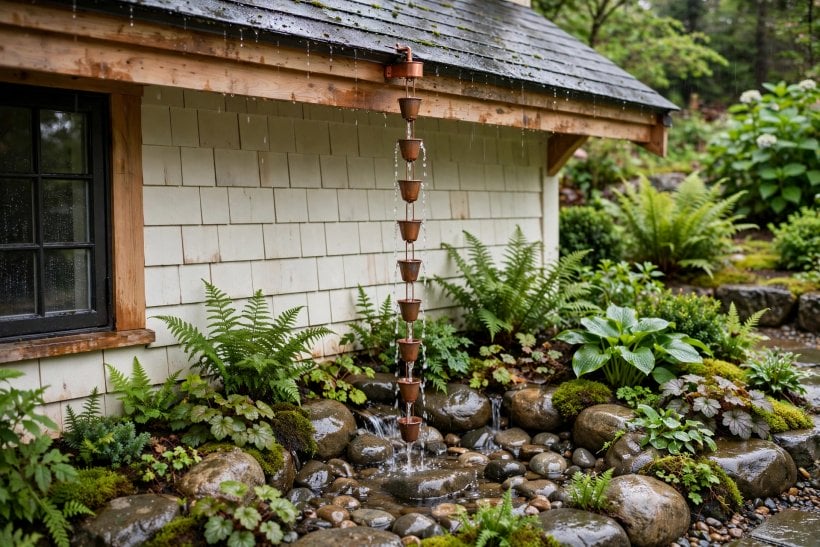
Landscape alternatives to gutters are the ground-level features that take over the work a conventional gutter and downspout would normally do: catching roof water where it leaves the edge, slowing it down, and carrying or soaking it away from the building before it can pool against a foundation, splash soil onto siding or flood a path. No single feature does the whole job. A working gutter-free design is usually a chain — a defined drip line at the eaves, a feature that receives the falling water, a route that moves it across or into the ground, and a safe place for it to end up. Miss a link, and the system is just a roof dripping onto unprepared ground.
| What replaces the gutter? | Nothing at roof level in most designs. The work moves to the ground: drip trenches, chains, buried drains, shaped channels and planted areas each handle one stage of receiving, moving and dispersing roof water. |
| Do these systems suit every house? | No. They suit simpler roof shapes, modest roof areas and gentler rainfall best. Complex roofs, tall walls and very wet or freezing climates make the job harder and may rule the approach out. |
| Where does the water end up? | Ideally well away from the foundation: spread across a planted area designed to absorb it, carried to a lower part of the plot, or collected for use — never left pooling beside the wall. |
| Are rain chains enough on their own? | Rarely. A chain guides water down from the eaves in a controlled line, but something at the base — a basin, trench, drain or planted area — still has to receive it and take it away. |
| What is the biggest risk? | Water concentrated in the wrong place. Without a gutter collecting along the edge, poorly planned drainage can concentrate erosion, damp and foundation risk exactly where the roof sheds most. |
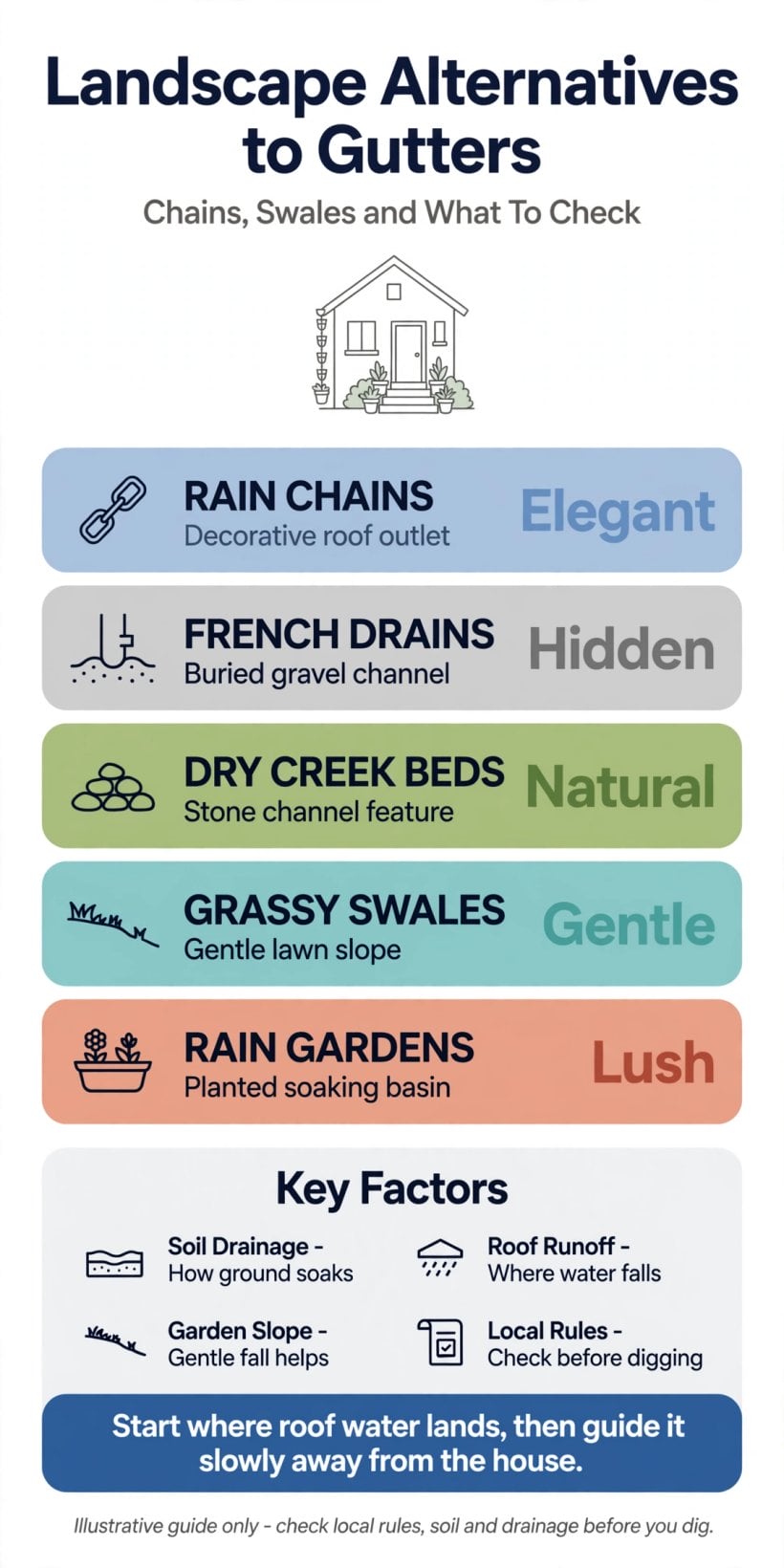
At a glance: a gutter-free roof still needs a complete chain — receive the water at the drip line, move it away from the wall, and give it a safe place to soak in or drain to.
2. Why Homeowners Skip Gutters — and When They Should Not
Homeowners leave gutters off for practical as well as visual reasons. Conventional gutters clog with leaves and need regular clearing, they can sag and leak at joints, and on a small, simply shaped home they can feel like a lot of hardware for a modest roof. For tiny and movable homes there is an added argument: anything fixed along the eaves is another projecting part to protect in transit, which is why some builders prefer removable gutter systems designed for the highway or a ground-based approach instead.
None of that makes gutters the wrong choice in general, and honesty matters here. A conventional gutter remains the most controlled way to collect water from a large, steep or complicated roof, especially where roof planes meet in valleys and concentrate flow, where walls are tall and falling water gains force and drift, or where heavy rain arrives in intense bursts that overwhelm open ground features. Homes with basements or shallow foundations close to the drip line also have more to lose if ground drainage underperforms. If your roof, soil or climate sits in that harder category, the right answer may be gutters plus good ground drainage, rather than either one alone.
3. Drip-Edge and Drip-Path Gravel Trenches

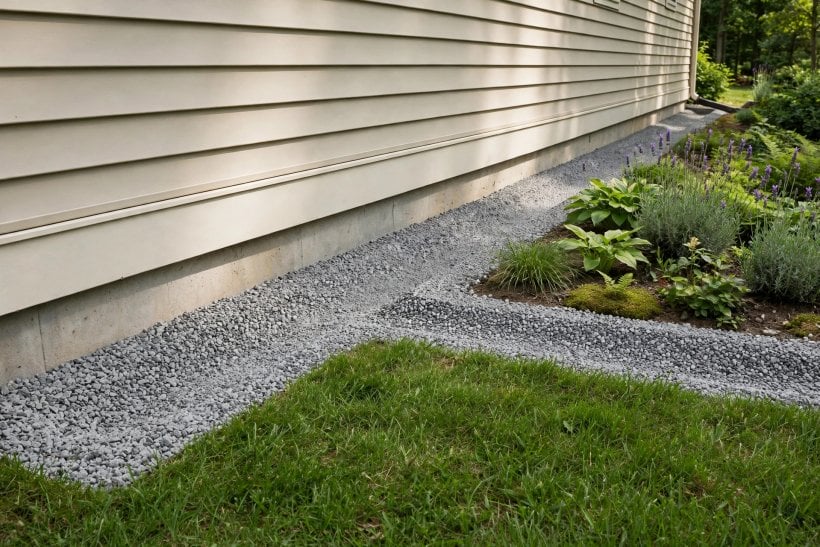
The drip path is where every gutter-free system starts. Watch where water actually leaves your roof in steady rain: on a simple roof it falls in a fairly consistent line below the eaves, though wind pushes it around and roof details concentrate it in places. That line needs a surface that can receive falling water without eroding, splashing mud onto the wall or turning into a muddy trough. A shallow trench filled with coarse gravel or stone, laid along the drip line, is the simplest receiver. The stone breaks the fall, lets water drain down through the voids instead of running across the surface, and keeps soil from splashing up the siding.
A gravel trench only works if the water entering it has somewhere to go. On freely draining soil, much of it may soak away through the base of the trench itself. On heavier soil, the trench needs to fall gently towards a drain, channel or planted area covered later in this guide, otherwise it becomes a long, stone-filled puddle holding water against the building — the opposite of its purpose. Keep it clear of fallen leaves and wind-blown soil, which gradually fill the voids and turn free drainage into a silted strip. Expect to rake it level and top up settled stone over time.
4. Rain Chains

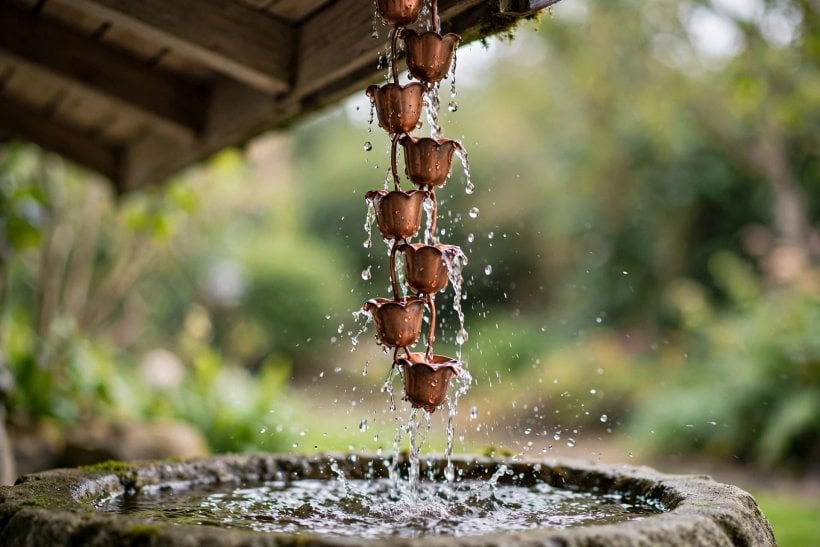
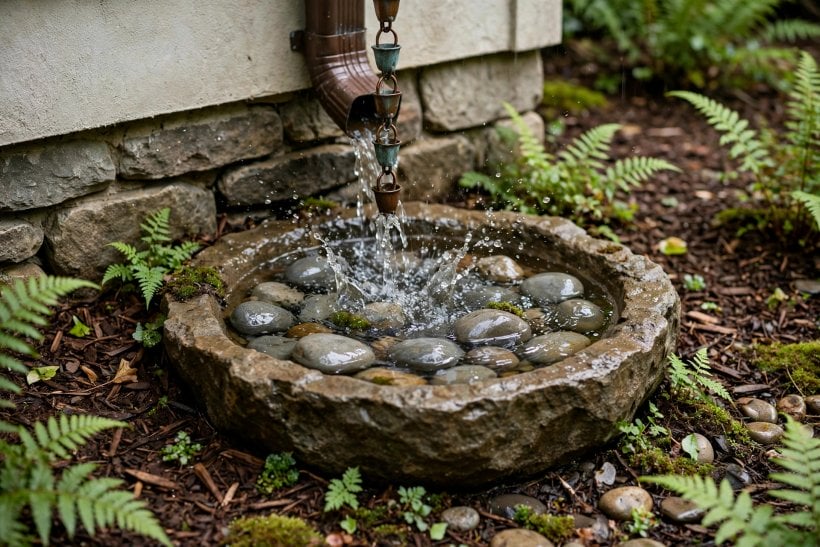
A rain chain replaces the downspout, not the gutter’s whole job. Hung from a point where roof water is gathered and directed — often a scupper or a short collector at the eaves — the chain gives falling water a line to follow, so it descends in a controlled stream instead of a free-falling sheet. Chains come as linked loops or as a series of small cups passing water from one to the next. The chain needs secure fixing at the top, anchoring at the base to stop it swinging, and a receiver beneath it: a stone-filled basin, a trench or the head of a drain.
Know the limits before you rely on one. In heavy rain, water can outrun the chain and spray partway down, and wind can blow the descending stream away from its basin, so chains perform best on sheltered walls and modest roof areas. In freezing weather they can ice up and gain weight, which the fixing has to tolerate. Where a chain discharges into a container or storage vessel, it connects naturally with rainwater harvesting and roof catchment tank sizing, and anyone collecting roof water should also check the legality of collecting rainwater under local regulations, because collection rules vary by place.
5. Ground Gutters and French Drains
Where surface features cannot move water far enough, the work goes underground. A ground gutter here is a shallow channel at the base of the wall — sometimes covered or grated, sometimes stone-filled — that intercepts water along the drip line and leads it to a discharge point. A French drain does a similar job below the surface: a trench containing a perforated pipe surrounded by coarse stone, collecting water along its length and carrying it to a lower outlet. Both suit wet plots and drip zones crossed by paths or patios.
Buried drainage is the least forgiving part of the system to get wrong, precisely because you cannot see it working. The run needs a consistent fall towards its outlet, the outlet must discharge somewhere that can accept the water without creating a new problem downhill or at a neighbour’s boundary, and the pipe and stone need protection from silt, which slowly chokes buried drains. Access points for clearing blockages are worth planning at the build stage. If a buried drain stops performing, the symptoms — damp at the wall base, standing water after rain — look exactly like having no drainage at all.
6. Dry Creek Beds
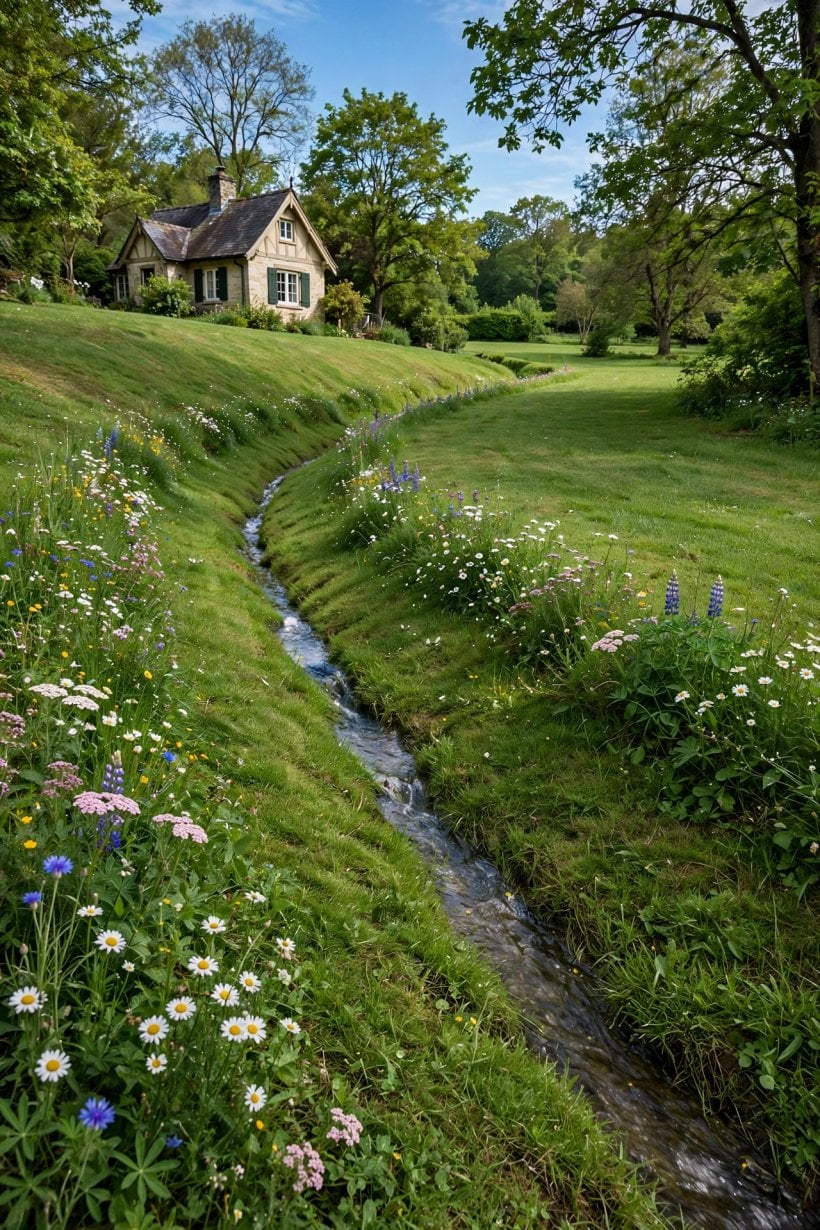
A dry creek bed is an open, stone-lined channel that carries water across the garden only when it rains and reads as a landscape feature the rest of the time. Fed from the drip line, a rain chain basin or a drain outlet, it gives roof water a defined, armoured route to a lower area, a planted soak zone or a safe discharge point, instead of letting it carve its own muddy path. The construction logic matters more than the decoration: a shaped, lined bed so water and stone stay in place, larger rock at edges and bends where flow pushes hardest, and a continuous gentle fall along the whole length, so the bed drains fully after rain.
Done well, this is the most visually rewarding way to move water across a plot, and it pairs naturally with the planting and stonework in these rock landscaping ideas. For layouts, stone grading and bed shaping, work through this dedicated guide to a river rock dry creek bed for drainage before you build. Be realistic about capacity, though: an open channel can overtop its banks in a cloudburst if asked to carry more than its size allows. Give it room suited to the roof area feeding it, keep the route away from doors and sitting areas, and check after the first heavy storms that the stone has stayed in place.
7. Swales and Grading Away From the House

Before any feature is added, the shape of the ground itself should do the first share of the work. Grading means the soil beside the house slopes gently away from the walls in every direction, so surface water moves off rather than sitting or flowing back towards the building. Over years, soil settles, beds are raised and paths are laid, and that original fall is easily lost — re-establishing it is often the single most valuable step in a gutter-free design, because every other feature performs better when the ground already persuades water to leave. Keep mulch and soil from building up against the wall above the level of the floor inside.
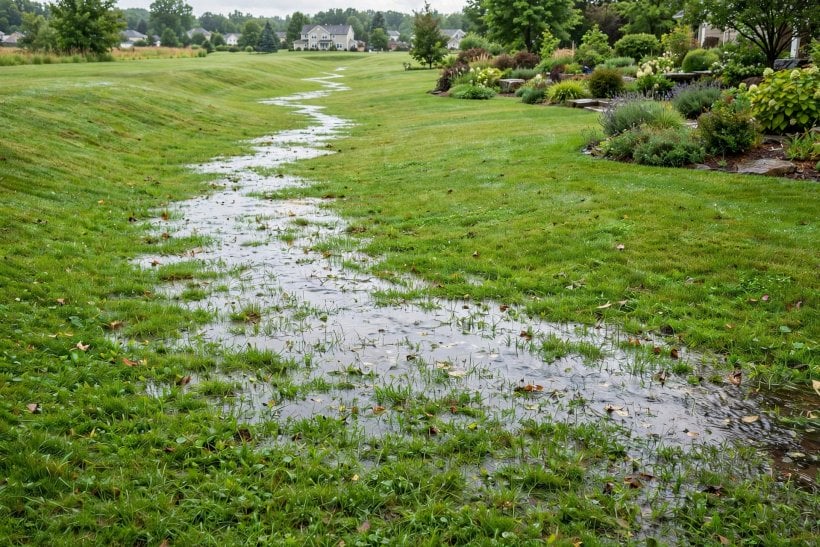
A swale takes the same idea further across the wider plot: a broad, shallow, usually grassed channel that intercepts moving water and carries it slowly sideways to a safe outlet, soaking some in along the way. Swales suit larger or sloping plots where roof water and general runoff need redirecting around, rather than through, the area beside the house. They need room, a consistent fall and an outlet that can accept what they collect. On a compact plot there may only be space for the grading half of this pairing — the layout thinking in these tiny house landscaping ideas shows how drainage, paths and planting can share a small site.
8. Splash Blocks and Extenders
Splash blocks are the smallest tools in this guide: shaped blocks, usually of concrete or durable recycled material, placed where water lands to spread the impact, reduce erosion and nudge flow a short distance away from the wall. They are most often seen under downspouts, but in a gutter-free design they earn a place under the known drip points — below a rain chain basin overflow, at the end of a short collector, or anywhere the roof consistently throws a concentrated stream. Extenders do the related job of carrying discharge a little further: a short channel or extension that moves an outlet beyond a bed, path or patio edge so water lands where the ground can deal with it.
Treat both as finishing touches, not as a system. A splash block under an unplanned drip line does little, because along most of the roof edge water does not land in one neat spot for a block to receive. Their real value is at the handful of points where your design deliberately concentrates water, and there they are cheap insurance against a scoured hole and splashed siding. Check them after storms: blocks shift, tilt and get buried by mulch, and a slipped extender silently returns discharge to the base of the wall. If you find yourself adding block after block along a whole wall, that wall needs a proper trench or channel instead.
9. Rain Gardens and Soakaways Where Water Lands
Every system in this guide ends with the same question: where does the water finally go? A rain garden answers it with planting. It is a shallow, dished bed positioned to receive runoff from a trench, creek bed, swale or drain outlet, filled with soil that drains reasonably freely and planted with species that tolerate both wet spells and dry ones. Water ponds briefly after heavy rain, then soaks down rather than running off the plot or sitting against the house. A soakaway does a similar job without the planting — a buried, stone-filled pit that holds water temporarily and releases it into the surrounding ground, set far enough from the foundation that soaking water cannot track back.
That condition decides whether this ending works. Heavy clay, a high water table or a plot where the only space sits hard against the walls can each rule a soak-based ending out, and planting will not fix soil that will not drain. Test the ground before you commit, and judge it across wet weather, not a dry week. Overflow also needs planning: in an exceptional storm a rain garden should spill along a safe surface route, not back towards the house. Keep roof runoff separate in your mind from household wastewater, too — it is a different system from greywater systems, and the two should not be improvised into one another.
10. Roof and Climate Checks, Maintenance and Foundation Protection
Match the System to the Roof and the Weather
Two roofs on the same street can need opposite answers. A small, simple roof with generous overhangs throws water clear of the walls onto a narrow, predictable drip line, which ground features handle well. A tall roof line lets falling water gain speed and drift in wind, landing further out with more erosive force, and valleys concentrate much of a roof’s water into a few fierce streams that can overwhelm a trench or chain. Roof surface and pitch matter too, as this overview of roof pitch for water collection explains — the steeper and smoother the surface, the faster water arrives at the edge. Climate is the other half: frequent gentle rain is the kindest load, intense downpours test capacity, and freezing climates add sliding snow, ice at the eaves and frozen ground that cannot absorb meltwater.
Maintain It Like a System, Not a Feature
Ground drainage fails quietly and gradually. Trenches silt up, creek bed stone migrates, buried drains clog, swale falls get flattened, and rain garden soil compacts. Walk the whole route a few times a year and after major storms, ideally while it is raining or just after, when you can see where water actually goes rather than where the plan said it would. Clear the drip trench, re-level settled stone, check chain fixings and basins, confirm drain outlets run free, and watch for early warnings: erosion gullies, damp patches at the wall base, or ground beside the house that stays soft long after the rest has dried.
Protect the Foundation First
Every other goal here is secondary to one rule: no landscape treatment is worth water sitting against the building. Ground beside the walls should always fall away, finished soil and mulch levels should stay below the interior floor level and clear of timber or cladding that can rot, and no soakaway or rain garden should sit so close that its stored water can reach the structure. After heavy rain, look at the base of each wall: pooling, splash-back staining and soil washed from the foot of the wall all signal a weak link in the chain. Fix the link, not the symptom — and if the pattern keeps repeating on one elevation, fit a gutter to that side. A hybrid is not a failure of the idea; it is the idea applied honestly.
Final Considerations
Ground-level alternatives succeed as a chain, not as a single feature. A defined drip line, a receiver that can take the fall of the water, a route that moves it away from the walls and ground that can genuinely absorb or discharge it — leave out any one of those and the rest are decoration. Start with grading, add the features your roof size, soil and climate can honestly support, and keep conventional gutters in the conversation for tall, complex or hard-worked roofs.
If the checks line up, a gutter-free home gains a cleaner roof line, no clogged channels to clear, and a garden where rain becomes a visible, managed part of the landscape. Build it in stages, watch it through real storms, and adjust before small faults become damp walls. The water is coming off the roof either way; this approach simply asks you to design, on purpose, exactly where it goes.




0 Comments